

A mold remediation certification is a credential issued by a private industry organization that verifies a technician or company has completed specific training, passed a proctored examination, and agreed to a code of professional conduct. The two most widely recognized certifying bodies are the IICRC (Institute of Inspection, Cleaning and Restoration Certification) and NORMI (National Organization of Remediators and Microbial Inspectors).
Because no federal standard governs who can legally remove mold in most of the country, these certifications serve as the industry's main quality signal. Knowing what each credential means is essential before deciding when mold remediation is required and who should do the work. This covers what each credential requires, what it actually proves, and how to verify that any certification a contractor claims to hold is current and real.
Key insights
- No federal licensing requirement exists. In most U.S. states, any contractor can legally advertise mold removal with zero formal training. Private certifications from IICRC, NORMI, and ACAC are the industry's primary quality signal in that gap.
- The IICRC AMRT is the credential to require for field work. The Applied Microbial Remediation Technician credential requires a WRT prerequisite, in-person coursework, and a proctored exam. It is what to look for in the technicians who will physically work inside your home.
- Company certification matters separately from individual certification. The IICRC Certified Firm designation covers the company level. An owner who holds an AMRT provides no protection if the crew performing your job does not hold current credentials.
- Certifications and state licenses are different things. A certification is issued by a private organization. A license is a legal requirement issued by a state. In Texas, Florida, New York, Louisiana, and several other states, a state license is required in addition to any private certification.
- Verify every credential yourself. IICRC credentials are searchable at iicrc.org. NORMI credentials are searchable at normi.org. ACAC credentials are verifiable at acac.org. A credential that cannot be found in the issuing body's database should be treated as no credential.
- A lapsed certification is the same as no certification. IICRC credentials require 14 continuing education credits every four years. Always check renewal dates in the database, not the contractor's word.
Why certifications matter in an unregulated industry
There is no federal licensing requirement for mold remediation. In most U.S. states, any contractor can legally advertise mold removal services with zero formal training, no examination, and no accountability to any standard. That gap is why private certifications matter as much as they do.
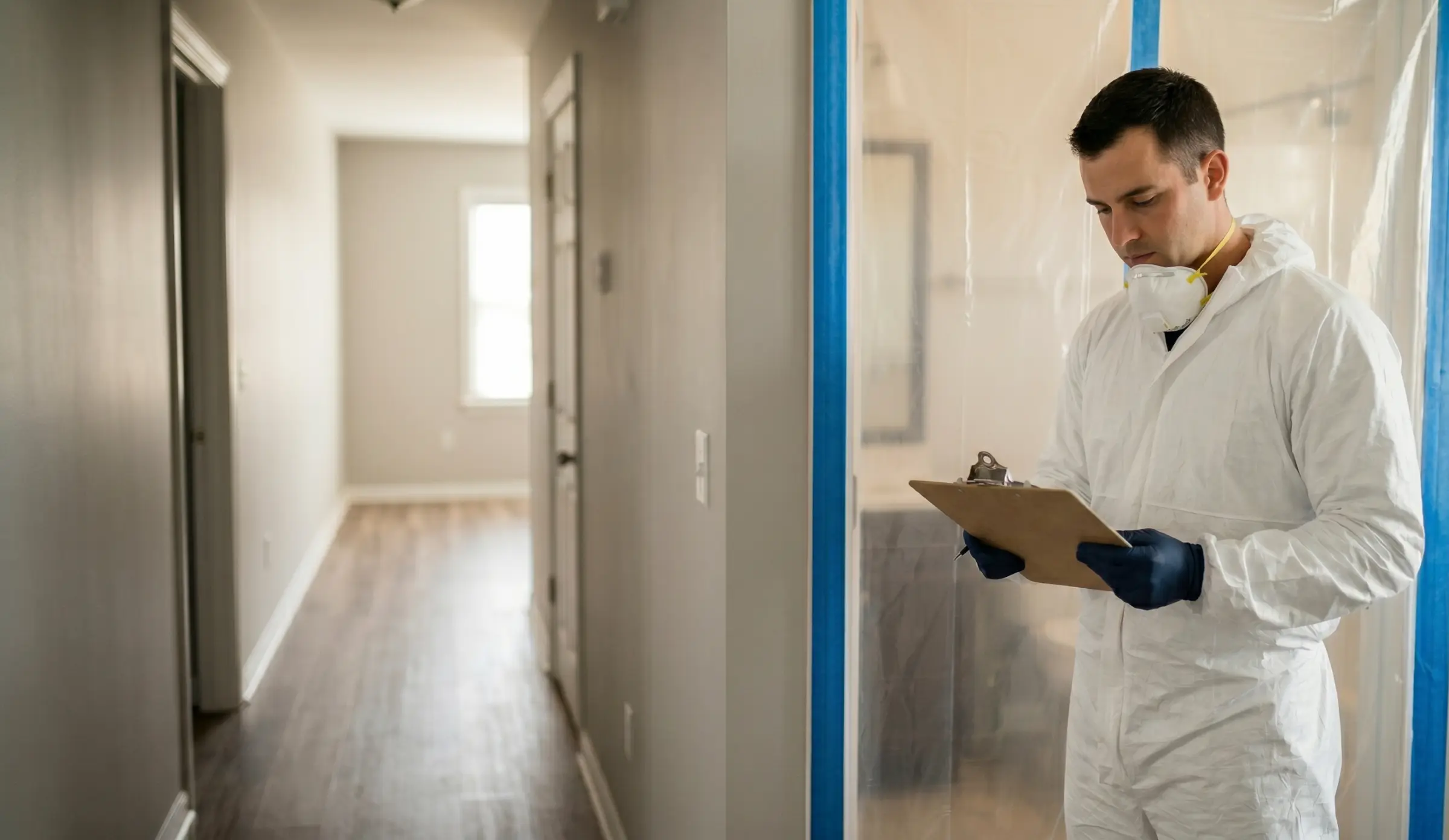
 Nothing about this scene confirms training; in most states a crew can show up with this exact equipment with zero certification behind them.
The IICRC S520 standard is the industry's closest equivalent to a federal benchmark. It defines containment protocols, PPE requirements, cleaning methods, and post-remediation verification procedures. Certifications from credible bodies are built around this standard, which means a certified contractor has at minimum demonstrated knowledge of how remediation is supposed to be done correctly and safely.
Without a credential to check, the only alternatives for a homeowner are a contractor's word, online reviews, and pricing. None of those reliably indicate whether the person arriving at your home knows how to contain mold properly, protect your family during the work, or verify that contamination is actually gone when they leave. Recognizing the signs of mold is a useful starting point, but choosing who removes it is where credentials become critical.
The IICRC: the industry's primary credentialing body
The Institute of Inspection, Cleaning and Restoration Certification is the most widely recognized credentialing organization in the remediation industry. It is an ANSI-accredited Standards Developing Organization, which means its standards go through a formal consensus process involving scientists, industrial hygienists, public health professionals, and contractors before publication.
IICRC certifications are not self-reported credentials or participation awards. Each one requires coursework, a proctored examination, and in some cases documented field experience. The IICRC also operates a Certified Firm program that extends accountability to the company level, not just the individual technician. The full scope of what certified contractors are expected to do on a job is covered under mold remediation.
Recertification is required every four years, with 14 continuing education credits needed to maintain active status. A lapsed IICRC credential should be treated the same as no credential at all.
IICRC certifications for mold work
The IICRC's two mold-specific credentials are the Applied Microbial Remediation Technician (AMRT) for field technicians and the Mold Remediation Specialist (MRS) for experienced project leads. Both are built on the ANSI/IICRC S520 standard, and the MRS carries ANAB accreditation, the highest level of independent validation available. A third credential, the Water Damage Restoration Technician (WRT), is not mold-specific but is a required prerequisite for the AMRT and held by most mold-focused technicians.
Applied Microbial Remediation Technician (AMRT)
The IICRC AMRT is the industry's primary hands-on field credential for mold remediation, requiring an in-person course, a WRT prerequisite, and a passing score on a proctored exam. It is the certification to look for in the technicians who will physically work inside your home. It is an in-person course only; no online-only path to certification exists. During training, students build physical containment structures, practice donning and doffing PPE, and work through the remediation procedures defined in the ANSI/IICRC S520 standard.
 The WRT prerequisite behind this technician's AMRT means they were trained in moisture science before mold work, not just containment and removal.
A prerequisite applies: the Water Damage Restoration Technician (WRT) certification must be earned before a technician can sit for the AMRT exam. The exam fee is $150, paid directly to the IICRC. This prerequisite structure ensures AMRT holders understand moisture science and drying principles before they work on mold jobs, since unresolved moisture is the root cause of virtually every recurrence. For more on how water damage leads to mold growth, see mold after water damage.
The AMRT is what to look for in the technicians who will actually enter your home and perform the physical work.
Mold Remediation Specialist (MRS)
The IICRC MRS is an advanced, ANAB-accredited credential for experienced remediators, requiring at least 12 months of verified field experience and a passing score on a proctored exam, with no associated course. It carries the highest level of independent validation available for a mold remediation credential. There is no course associated with the MRS; it assumes working knowledge and tests against real-world application of remediation principles.
The MRS was updated in 2021 and is ANAB Accredited, which is a higher level of independent validation than standard IICRC certifications. ANAB accreditation means a third-party body has verified that the certification program meets international standards for competency assessment. The exam is available online through a proctored system.
Look for MRS credentials in a company's ownership or senior project management, not necessarily in every field technician.
Water Damage Restoration Technician (WRT)
The WRT is not a mold certification, but it is a required prerequisite for the AMRT and a meaningful indicator of broader restoration competency. It covers moisture science, drying systems, category water classification, and contamination protocols. Because mold almost always follows unaddressed water damage, a technician with both WRT and AMRT credentials has training that spans the full problem. Post-remediation clearance is also part of that picture, and mold testing covers how clearance testing works and who should conduct it.
 A written protocol handed over like this is what IICRC S520 actually requires before work begins, not a verbal walkthrough of the plan.
The table below summarizes all three IICRC credentials alongside the primary NORMI and ACAC credentials covered in the sections that follow, so you can compare requirements side by side before evaluating a contractor's documentation.
| Certification | Issued by | What it requires | Best for |
|---|---|---|---|
| AMRT | IICRC | WRT prerequisite + in-person course + exam | Field technicians doing remediation work |
| MRS | IICRC | 12 months field experience + exam (ANAB Accredited) | Senior technicians, project leads |
| WRT | IICRC | Course + exam | Foundational water/moisture restoration |
| CMR | NORMI | 24 hours training + proctored exam | Mold remediators in licensed states |
| MRSR | NORMI/state | State-specific training + exam | Florida, Louisiana, DC licensure |
| CIH | ABIH | BS degree + 6 years experience + exam | Industrial hygienists, assessors |
NORMI certifications
NORMI, the National Organization of Remediators and Microbial Inspectors, is the second major credentialing body in the mold industry and the primary alternative to IICRC in licensed states. Where IICRC certifications emphasize the S520 standard and require a separate WRT prerequisite, NORMI certifications integrate assessment and remediation training together and are specifically designed to satisfy state licensing requirements in Florida, Louisiana, Texas, New York, and Washington D.C. NORMI has been certifying mold and indoor environmental professionals since 2004, is an approved training provider for EPA programs, and holds recognition with multiple state licensing boards. It offers more than 32 certifications across the mold, IAQ, and building science fields.
Certified Mold Remediator (CMR)
The NORMI CMR is the organization's primary remediation credential. It requires at least 24 hours of education covering mold assessment and remediation techniques, moisture science, respiratory protection, and applicable regulations including the IICRC S520, EPA standards, and OSHA guidelines. A proctored examination is required, and NORMI requires proof of insurance and payment of certification fees.
The CMR meets licensing requirements for Florida, Louisiana, Washington D.C., and Portland, Oregon, and is recognized in Texas and New York. In states where no mold-specific license exists, the CMR functions as a primary quality signal alongside or in place of IICRC credentials.
NORMI requires a minimum of 20 hours of continuing education each year to maintain certification, a higher annual requirement than IICRC's four-year cycle.
Mold Related Services Assessor (MRSA) and Remediator (MRSR)
These are Florida state licensing credentials delivered through NORMI-administered training. They require 24 hours of hands-on training that includes sampling processes, PPE, containment construction, negative pressure setup, and fresh air makeup procedures. Florida's Department of Business and Professional Regulation administers the licensing program and requires these credentials for legal operation in that state.
If you are hiring a contractor in Florida, confirming an active MRSR designation is a minimum requirement, not an optional indicator.
ACAC certifications for assessors
The American Council for Accredited Certification focuses primarily on the assessment and inspection side of the industry. Its certifications are relevant when you are evaluating a mold inspector or industrial hygienist who will assess your home and write a remediation protocol, rather than a remediation contractor who will perform the physical removal work.
Florida uses ACAC examinations for its state mold licensing program. Washington D.C. requires ACAC credentials for licensed mold work. The Certified Indoor Environmental Consultant (CIEC) and Certified Mold Inspector (CMI) are the two ACAC credentials most commonly encountered when vetting an independent assessor.
For more on what a mold assessment involves and what credentials to look for in an inspector specifically, see mold inspection.
Certifications vs. state licenses
A certification is a credential issued by a private organization. A license is a legal requirement issued by a government. The distinction matters because they carry different weight and serve different purposes. Understanding which applies in your state directly affects what you should require from any contractor you hire. For current pricing by project size, mold remediation cost covers national ranges by scope, location, and material type.
| State | License required? | Notes |
|---|---|---|
| Texas | Yes | DSHS mold remediator license; $1M liability insurance required; 25 sq ft threshold |
| Florida | Yes | MRSR (remediator) and MRSA (assessor) licenses through DBPR; NORMI or ACAC exams accepted |
| New York | Yes | Separate licenses for assessors and remediators; strict separation of roles required |
| Louisiana | Yes | NORMI training meets requirements |
| Illinois | Yes | Registration and third-party certification required |
| Washington D.C. | Yes | ACAC credentials required; DC Dept. of Environment issues license |
| Virginia | Yes (since July 2024) | IICRC certification required for residential mold remediation work |
| Most other states | No | No state mold license required; certifications are the primary quality signal |
In states without a mold-specific license, certifications are the only external check on whether a contractor has any meaningful training. In states with licensing requirements, a license is the floor, not the ceiling. A licensed contractor without current IICRC or NORMI credentials may meet the legal minimum but lack ongoing training in updated techniques.
 A license that satisfied requirements last year may not this year; Virginia's 2024 law shows how fast these rules can tighten with little notice.
Always confirm that any credential a contractor claims satisfies your specific state's current rules. Licensing requirements change, and Virginia's 2024 law is an example of states tightening standards with little advance notice to consumers.
How to verify any mold credential
To verify any mold credential, use the certifying body's own online lookup tool: IICRC credentials are searchable at iicrc.org using the Global Locator, NORMI credentials are searchable at normi.org, and ACAC credentials are verifiable at acac.org. State licenses are verified directly with the issuing state agency. Verification takes less than five minutes and eliminates the risk of hiring a contractor with lapsed, misrepresented, or fabricated credentials.
IICRC credentials: Use the IICRC Global Locator at iicrc.org. Search by the technician's name or company name. Active certifications, credential type, and issue dates appear in the results. A company listed as a Certified Firm will appear with that designation.
NORMI credentials: Search the NORMI member directory at normi.org. Active members with current certifications are listed; lapsed members do not appear.
ACAC credentials: Verify through the ACAC credential verification system at acac.org. Florida and D.C. licensing requirements mean ACAC verification is especially important in those states.
State licenses: Verify directly with the issuing state agency. Texas credentials are searchable through the TDLR (Texas Department of Licensing and Regulation). Florida credentials are searchable through the DBPR. New York credentials are managed through the state Department of Labor.
When you verify, look for three things: the correct credential type (not just any IICRC cert), an active status, and a recent renewal date. A WRT certification is not a substitute for an AMRT in a mold remediation context, and a certification renewed four years ago but not since should prompt a direct question.
For a broader checklist of what to confirm before signing a contract, how to choose a mold remediation company covers shortlist building, bid comparison, and insurance claim navigation.
The specific questions to raise with each contractor, along with what good and red flag answers look like, are covered under questions to ask a mold remediation company.
Red flags that signal weak or fake credentials
The most common credential problems in mold remediation are lapsed certifications, misapplied credential names, and company-level claims that no individual technician on the job actually holds. Outright fraud is less common than these softer misrepresentations, but all of them expose homeowners to the same risk: an uncredentialed crew performing work that requires specific training to do safely.
 A five minute lookup here is what separates a verified AMRT from a credential that lapsed four years ago and was never renewed.
"Certified" without a named body. A contractor who describes their team as "certified professionals" without specifying IICRC, NORMI, or another named organization may be referring to internal company training, a one-day online course, or nothing at all. Ask which organization issued the certification and then verify it.
Only the owner is certified, not the technicians. The IICRC Certified Firm designation covers a company whose employees hold current certifications. If the owner has an AMRT but the crew performing your job does not, the owner's credential provides no practical protection. Ask specifically about the certifications held by the people who will be on site.
Pressure to decide before you can verify. Mold remediation is time-sensitive in some situations, but not so urgent that a reputable company cannot give you 24 hours to check credentials. A contractor who discourages verification has a reason for doing so.
Credentials that cannot be found in any database. If a company lists credentials that do not appear in the IICRC, NORMI, or ACAC lookup tools, either the certification has lapsed or it was never issued. Neither outcome is acceptable.
No written scope of work or protocol. Certified contractors working to IICRC S520 standards are required to document the remediation protocol before work begins. A contractor who wants to start immediately without written documentation is not following the standard their certification is supposed to represent.
Understanding why credentials matter starts with understanding the health stakes. Is mold dangerous covers the health case for every occupant type.
What a certified contractor is actually supposed to do on your job, step by step, is covered under mold remediation process.
Frequently asked questions
What is the most recognized mold remediation certification?
The IICRC Applied Microbial Remediation Technician (AMRT) and the IICRC Mold Remediation Specialist (MRS) are the most widely recognized credentials in the industry. Both are based on the ANSI/IICRC S520 standard, and the MRS carries ANAB accreditation, which is the highest independent validation available for a mold remediation credential.
Is a mold remediation certification the same as a license?
No. A certification is a credential issued by a private organization like IICRC or NORMI, proving training and knowledge. A license is a legal requirement issued by a state government. In most states, no mold-specific license exists, making certifications the primary quality signal. In states like Texas, Florida, New York, and Louisiana, a state license is required in addition to or instead of relying on private certifications alone.
How do I verify a contractor's IICRC certification?
Go to the IICRC Global Locator at iicrc.org and search by the technician's name or company name. Verified credentials, certification dates, and any specializations appear in the search results. NORMI and ACAC have similar lookup tools on their respective websites.
Does a company need to be certified, or just the individual technician?
Both matter. The IICRC offers a Certified Firm designation for companies that employ certified technicians and agree to a code of ethics. When hiring, look for a company that holds Certified Firm status and has individual technicians with current AMRT or MRS credentials. A company with uncertified field crews provides little protection even if the owner holds a credential.
What is the IICRC S520 standard?
The ANSI/IICRC S520 is the industry's primary procedural standard for mold remediation. It covers assessment protocols, containment methods, PPE requirements, removal techniques, and post-remediation verification. All major IICRC mold certifications are based on it. When a contractor says they follow industry standards, S520 is the document that phrase refers to.
Are NORMI certifications accepted in licensed states?
NORMI certifications meet licensing requirements in Florida, Louisiana, Washington D.C., and Portland, Oregon, and are recognized in Texas and New York. NORMI is also an approved training provider for EPA programs and several state licensing boards. Always confirm that any certification a contractor holds satisfies your specific state's current requirements.
What happens if a contractor's certification has lapsed?
A lapsed certification means the contractor has not met continuing education requirements or paid renewal fees. It should be treated the same as no certification. IICRC certifications remain active when renewal fees are paid and 14 continuing education credits are earned every four years. Always verify credentials through the certifying body's database, not the contractor's word.
Sam Hickerson is the founder of RestoreAdvisor and writes consumer guides on mold remediation, water damage restoration, inspection, testing, and home recovery. His work focuses on helping homeowners understand costs, risks, and when to call a professional. He draws on guidance from the EPA, CDC, IICRC, and other authoritative sources to make complex home issues easier to navigate.