
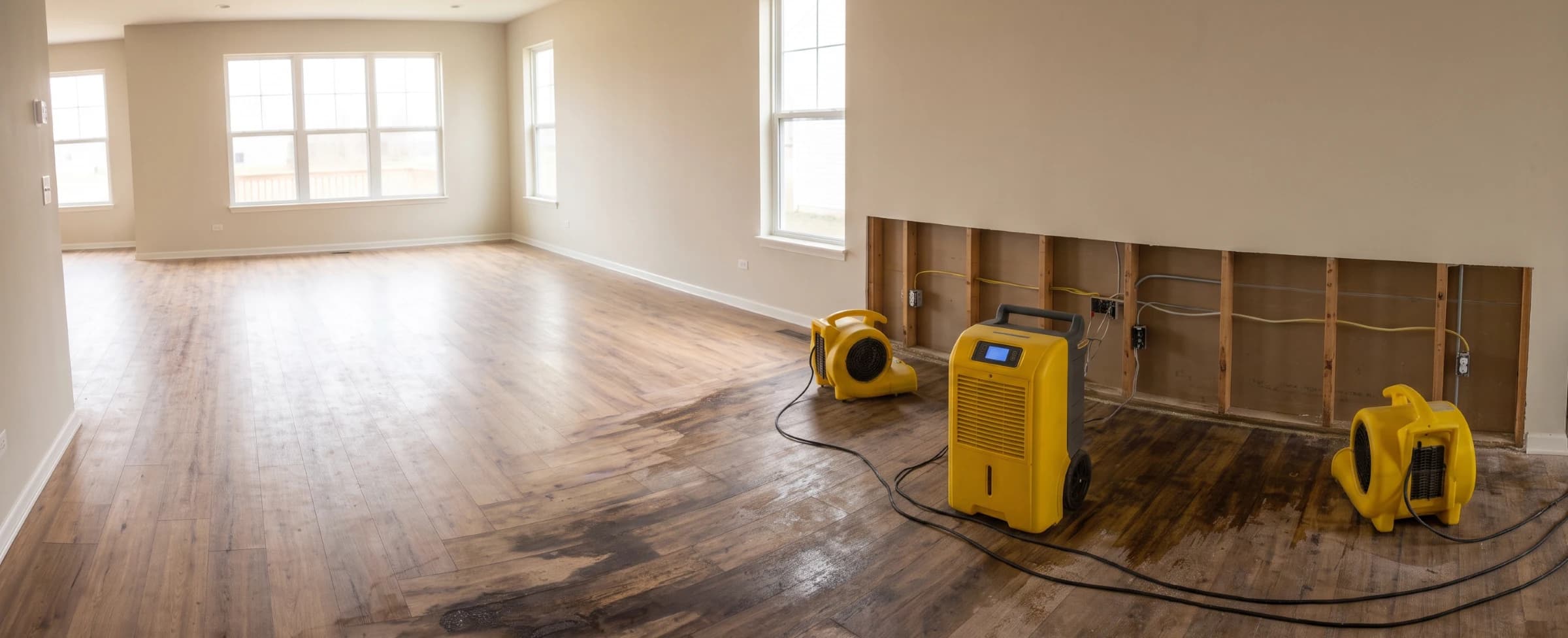

If you've just discovered water in your home, whether from a burst pipe, a roof leak, an appliance failure, or a flood, you're dealing with something that can turn into thousands of dollars of structural repair within days if it isn't handled fast. Knowing what to do first, how the restoration process actually works, and what it's likely to cost puts you in a much stronger position than calling the first company that answers the phone.
Water damage restoration is the licensed process of extracting water, drying structural materials, and repairing what was affected, governed in the United States by the IICRC S500 standard for professional water damage restoration. Getting the classification right at the outset determines nearly everything that follows: how the water is handled, what can be dried versus what must be replaced, and whether your insurance is likely to cover the cost. Left wet for more than a day or two, the same materials that need drying also become the starting point for mold growth, which is why speed matters as much as technique in the first hours after a water event.
Key insights
- Water damage is classified into three categories and four classes. Category describes contamination level (clean, gray, or black water); class describes how much of the structure absorbed water and how hard it will be to dry.
- Mold can begin growing within 24 to 48 hours of a water event. That window matters more than almost any other factor in how much a water event ends up costing.
- Most homeowners pay $1,500 to $7,000 for water damage restoration, with severe Class 4 losses reaching $20,000 or more.
- Standard homeowners insurance generally covers sudden, accidental water damage but excludes flooding, which requires separate NFIP or private flood coverage.
- Structural drying typically takes 3 to 5 days once professional equipment is in place, though full repairs can take weeks longer.
- Only a licensed restoration company can properly classify the water type, a distinction insurers rely on when deciding what a claim will cover.
I just found water damage: what to do right now
If you've just found water damage, the priorities are stopping the water source, cutting power to any affected outlets or fixtures, and documenting the damage with photos before anything is moved or cleaned. Every hour that passes after those first steps increases both the drying difficulty and the odds that mold establishes before a crew arrives.
 A quarter turn of the handle to a perpendicular position fully closes a ball valve, the fastest way to stop water flow before a plumber or restoration crew arrives.
Stop the water source
Shut off the main water valve if the source is unclear, or close the isolation valve nearest the leak if you know where it's coming from. For a roof or window leak during active rain, place a container to catch water and move on to the next step rather than waiting for the rain to stop.
Cut power to affected areas
If water has reached outlets, switches, or light fixtures, shut off the breaker for that area before doing anything else. Standing water and live electrical circuits are a serious shock and fire hazard, and OSHA guidance for flood response treats this as a first-priority safety step.
Document before you clean
Photograph and video the affected area, including the water source, the extent of standing water, and any damaged belongings, before you move furniture or begin drying. This documentation is what your insurance adjuster will ask for first.
Remove standing water fast
Use a wet vacuum, mop, or towels to remove as much standing water as possible while you wait for a professional. This buys time but does not replace extraction and drying equipment for anything beyond a small spill.
Call your insurer and a restoration company
Report the damage to your insurer the same day if you plan to file a claim, and call a water damage restoration company to begin extraction. If it's been more than 24 hours since the water event and you're already noticing a musty smell, treat this as an emergency call rather than a standard appointment, since every additional hour narrows what can still be dried and saved.
Signs of water damage in your home
The most reliable signs of water damage are a musty odor with no obvious source, visible staining on ceilings or walls, warped or soft flooring, peeling paint or bubbling drywall, and an unexplained spike in your water bill. Water damage isn't always visible; a surprising amount of it develops behind walls, under flooring, or in a crawl space before it ever produces a stain you can see.
 Concentric rings like this mark separate wetting events; a ceiling stain that grows a new ring after each rain points to an active leak, not one that already dried out.
Any of these signs on their own is worth investigating. Several appearing together, especially alongside a recent storm, plumbing repair, or appliance issue, is a strong indicator that professional assessment is overdue rather than optional.
Musty or earthy odor
A persistent damp smell, particularly in basements, crawl spaces, or rooms near plumbing, often shows up before any visible staining does.
Stains and discoloration
Water stains, tide marks, or yellow-brown discoloration on ceilings and walls indicate past or ongoing moisture intrusion, even if the surface feels dry to the touch.
Warped or soft flooring
Cupped hardwood, soft spots in subflooring, or carpet that stays damp longer than expected all point to moisture underneath rather than on the surface.
Peeling paint or bubbling drywall
These surface changes usually mean moisture is trapped behind the material, a sign the damage runs deeper than what's visible on the surface.
Structural changes
A sagging ceiling, a floor that feels bouncy or slopes noticeably, or a door or window that suddenly sticks or won't latch can indicate water has weakened structural framing rather than just a surface material. These signs warrant a professional structural assessment alongside water damage restoration, not a wait-and-see approach.
A rising water bill
A water bill that climbs with no change in usage is one of the most reliable signs of a hidden leak, often behind a wall, under a slab, or inside a crawl space foundation.
Recent history of flooding or a slow leak
Any water event that wasn't fully dried within 24 to 48 hours, including a past leak that seemed minor at the time, is worth a second look if you're also noticing a musty odor, staining, or warped flooring. This is especially true in basements, where ground moisture is constant rather than intermittent and slow leaks are easy to miss until they've been active for weeks.
What is water damage restoration?
Water damage restoration is the professional process of extracting water, drying a structure's materials, and repairing or rebuilding what was affected by a water event, following the classification and drying standards set by the IICRC S500. The industry splits the work into two scopes that homeowners often lump together: mitigation, which is the emergency extraction and drying phase, and repair or reconstruction, which is rebuilding what was removed, such as drywall, flooring, and trim.
That distinction matters when you're comparing quotes or reading a scope of work, because some companies handle both phases under one contract while others hand off reconstruction to a separate contractor. It also matters for timing: mitigation typically needs to start within hours, while reconstruction can't begin until the space has finished drying and passed a moisture check. Left too long, the same water intrusion that started as a straightforward drying job turns into a much larger one, since materials that could have been saved with fast extraction now need to be removed and replaced instead.
Water damage categories: clean, gray, and black water
Water damage falls into three categories under IICRC S500, based on how contaminated the water is: Category 1 (clean water), Category 2 (gray water), and Category 3 (black water). The category assigned to a job determines the personal protective equipment used, how materials are handled, and in many cases whether an item can be cleaned or must be discarded.
 What determines a water's category is contamination, not appearance alone: Category 2 water can look this cloudy from detergent or debris, while Category 3 water carries pathogens even when it looks only slightly darker than this.
Category assignment isn't a formality. A Category 1 leak that sits for more than 48 hours, or that passes through contaminated building materials on its way to the floor, can be reclassified as Category 2 or 3, which changes both the cost and the health precautions required for the job.
| Category | Source | Contamination level | Typical examples |
|---|---|---|---|
| Category 1 (clean water) | A clean, sanitary water source | None initially, but degrades over time | Supply line break, appliance overflow, rainwater |
| Category 2 (gray water) | Water with some contamination | Moderate; may cause illness if ingested | Washing machine discharge, dishwasher overflow, aquarium leaks |
| Category 3 (black water) | Grossly contaminated water | High; contains pathogens and toxins | Sewage backup, flooding from outside the home, standing Category 1 or 2 water left more than 48 hours |
Classes of water damage: how severity is measured
Classes of water damage measure how much of a structure has absorbed water and how much material needs to be dried, ranging from Class 1, the least amount of absorption, to Class 4, situations that require specialty drying methods. Class is assessed separately from category, and a restoration company needs both figures to scope a job correctly.
Class also drives the equipment count and drying timeline a company will quote. A Class 1 job might dry in a day or two with a couple of air movers, while a Class 4 job involving saturated hardwood, plaster, or concrete can take a week or more of continuous dehumidification before materials reach a safe moisture reading.
| Class | Water absorption | What it typically means |
|---|---|---|
| Class 1 | Least absorption | Part of a room affected, materials with low permeance such as concrete or plywood |
| Class 2 | Significant absorption | An entire room, water has wicked up walls, carpet and cushion are wet |
| Class 3 | Greatest absorption | Water from overhead, ceilings, walls, insulation, and carpet are all saturated |
| Class 4 | Specialty drying situations | Water trapped in hardwood, plaster, concrete, or stone, requiring extended drying time and specialized methods |
Why the timeline matters: what happens the longer water sits
The longer water sits, the more of a room's materials shift from salvageable to unsalvageable, and mold is only one of several consequences riding on that same clock. The EPA notes that a flooded home can take several days to weeks to dry fully, and recommends confirming dryness with a moisture meter rather than by sight before sealing, painting, or rebuilding over any surface that got wet.
 Cupping like this, where board edges lift higher than their centers, is a physical response to sustained moisture that takes days to develop, not a mark that shows up after a quick spill.
The timeline moves faster than most homeowners expect, and it compounds with water category. Category 2 or 3 water carries contamination and organic material that accelerates both material breakdown and mold risk, so a gray or black water event turns into a larger job measurably faster than a clean Category 1 leak of the same size and duration.
| Time after event | What's at stake |
|---|---|
| 0–24 hours | Most materials can still be dried and saved. Extraction started in this window keeps the job to drying only, with little to no replacement. |
| 24–48 hours | Materials that haven't been dried start absorbing more deeply, and mold spores begin colonizing damp surfaces. Cost and scope both start climbing. |
| 48–72 hours | Porous materials like carpet padding and drywall are less likely to be salvageable, and mold is often already present in them. |
| 1–2 weeks | Removal and replacement of affected materials becomes the norm rather than the exception, in wall cavities and flooring alike. |
| 1 month or more | Materials have typically failed both structurally and biologically. Mold remediation on top of the water damage restoration typically adds $1,500 to $6,000. |
If your home has already crossed that window, drying and any mold assessment need to happen together rather than one after the other, since treating either in isolation usually means redoing part of the job later. Water that reached Category 3, particularly from sewage backups or flooding, carries a higher risk of needing that combined approach, since contaminated water sustains the kind of ongoing moisture mold needs to take hold.
Common causes of water damage
The most common causes of water damage are burst or frozen pipes, roof leaks, appliance and fixture failures, flooding, foundation and groundwater seepage, and sewage backups, each of which carries a different category, urgency level, and typical cost range. Knowing which one you're dealing with helps set expectations for both the restoration process and the insurance conversation that follows.
 A pinhole split like this releases water continuously until the source is shut off, which is why the visible spray is rarely the full extent of what's already soaked into the cabinet floor and the wall behind it.
Burst and frozen pipes
A pipe that bursts, whether from age, pressure, or a hard freeze, releases Category 1 water quickly and often at volume, since the water keeps flowing until the source is shut off. That volume is what makes burst pipes deceptive: the fast, high-pressure flow frequently reaches wall cavities and subflooring before anyone notices, so the visible puddle is rarely the full extent of what needs to be dried.
Roof leaks
A roof leak tends to be slower and less obvious than a burst pipe, often showing up first as a ceiling stain that grows gradually over weeks or months rather than an obvious flood. That slow pace is exactly what makes roof leaks costly: by the time a stain is noticeable, the insulation and framing above it have usually been wet for far longer than the visible mark suggests.
Appliance and plumbing fixture failures
Washing machines, dishwashers, water heaters, and refrigerator ice makers are common sources of Category 1 or 2 water damage, usually from a failed supply line, a cracked hose, or a worn gasket. These events are often caught quickly because they happen in occupied rooms, but water frequently travels further than it appears, running under cabinets or flooring before pooling somewhere visible.
Flooding
Storm surge, an overflowing creek, or heavy rain can send flooding into a home from outside, and that water is treated as Category 3 by default because of what it has already picked up on its way in. That contamination changes the response even when the water volume looks similar to a clean supply line break, since it requires additional protective equipment, more extensive material disposal, and a faster extraction timeline.
Foundation and groundwater seepage
Water can also enter through cracks in the foundation or rise through a basement floor when groundwater levels increase after heavy rain or snowmelt, a slower and more chronic source than a single storm event. This type of intrusion is often mistaken for condensation until it recurs in the same spot after every heavy rain, which is the clearest sign the source is coming from outside the home rather than from indoor humidity.
Sewage backups
A sewage backup is always Category 3 water, and it requires specialized handling, disposal, and personal protective equipment beyond what a standard water event needs. Any materials that came into contact with sewage, including carpet, carpet padding, and drywall within the affected zone, are typically discarded rather than cleaned, regardless of how minor the exposure looks.
HVAC and appliance condensation
A clogged condensate line, an oversized air conditioning unit, or a failed drain pan can release water slowly over weeks, often inside a wall, attic, or closet where it isn't discovered until damage is already extensive. Because this type of leak is gradual rather than sudden, it also tends to raise more questions during an insurance claim than an obvious burst pipe does.
The water damage restoration and repair process
Professional water damage restoration follows a structured sequence: inspection and classification, water extraction, removal of unsalvageable materials, drying and cleaning, and final restoration. Understanding the broad shape of that sequence helps homeowners evaluate whether a company is doing the job correctly rather than skipping steps to finish faster.
 A pin meter reading in the 20s or higher signals wet framing behind the surface; most drying standards target getting that number back down near normal building material levels before a room passes inspection.
A technician starts by identifying the water source, assigning a category and class using the IICRC S500 framework, and mapping the full extent of moisture with meters and thermal imaging. Standing water is extracted next, followed by removal of anything too saturated to dry in place, typically drywall, insulation, and carpet padding. Air movers and commercial dehumidifiers then run for 3 to 5 days while surfaces are cleaned and treated, with a technician returning periodically to confirm moisture readings against a drying target rather than relying on a visual check. Once drying is confirmed, removed materials are replaced and a final walkthrough verifies the space is ready to be reoccupied.
How much does water damage restoration cost?
Most homeowners pay $1,500 to $7,000 for water damage restoration, with a national average in the $3,000 to $4,000 range. Costs scale with both category and class, since a Category 3 job requires more disposal and protective equipment, and a higher class number means more equipment running for more days.
Room type and the extent of material removal are the two biggest cost drivers beyond category and class. A single-room Category 1 job with minimal material loss sits at the low end of the range, while a multi-room Class 3 or 4 loss involving hardwood, cabinetry, or extensive drywall removal pushes toward the higher end and beyond.
Does homeowners insurance cover water damage?
Usually, but only when the cause is sudden and accidental, such as a burst pipe or a failed appliance. Most standard homeowners policies exclude water damage from flooding, chronic leaks, and general neglect, since coverage comes down almost entirely to how the water got into your home.
 Photos taken before any cleanup or repair begins are what an adjuster actually references when evaluating a claim, which is why documentation has to happen first, not after the drying crew has already been through.
Flooding is the biggest coverage gap homeowners run into, since it requires a separate policy through FEMA's National Flood Insurance Program or a private flood insurer rather than being part of a standard homeowners policy. Reporting the damage promptly and getting a written scope of work that states the cause plainly both give an adjuster less room to dispute a claim later.
Renters and water damage: who is responsible?
Landlords are generally responsible for water damage caused by a structural issue, aging plumbing, or a maintenance failure, while tenants are typically responsible for damage caused by their own actions, such as leaving a window open during a storm or failing to report a known leak. Most states require rental properties to be maintained in a habitable condition, and unaddressed water damage that leads to mold or structural deterioration is widely treated as a habitability issue.
If you're renting and dealing with water damage, document it with photos and put every repair request to your landlord in writing. Renters insurance typically covers personal belongings damaged by a covered water event but does not cover repairs to the building itself, which remains the landlord's responsibility in most cases. Habitability laws and tenant remedies for unaddressed water damage, including reporting requirements, escalation options, and rent withholding rules, vary meaningfully by state, so it's worth checking the specific rules where you live.
DIY vs. professional water damage restoration
Small Category 1 events on non-porous materials caught within a few hours, such as a quick appliance overflow, are reasonable candidates for DIY water damage cleanup. Anything involving Category 2 or 3 water, standing water present for more than a day, or moisture that has reached drywall, insulation, or subflooring calls for professional extraction and drying equipment, since consumer wet vacuums and box fans can't match the extraction rate or dehumidification capacity of commercial units.
Materials sit in a gray area worth calling out on their own. A soaked area rug or a small patch of carpet from a quick spill can often be dried or cleaned at home, but once carpet has been wet for more than a day, the padding underneath has usually absorbed more than the surface shows, and that's what actually decides whether it can be saved. The same is true of drywall: a small, dry-to-the-touch water stain can often be cleaned and repainted, but once the paper facing has stayed wet, how far the moisture traveled behind it, not how the surface looks, is the real test for whether it needs to come out.
When to call a professional
Professional water damage restoration is warranted whenever the scope of the problem exceeds what a homeowner can safely assess or fix alone, typically signaled by how long the water has been present, how contaminated it is, or how far it has spread into building materials. Waiting past that point increases both the cost of the eventual repair and the odds that mold becomes part of the job.
 More than one room affected, water sitting for hours rather than minutes, or damage you can't fully see are the specific triggers that separate a DIY weekend project from a call worth making today.
Household vulnerability adds a fourth consideration beyond the water itself: young children, older adults, and anyone with asthma or a compromised immune system have less margin for a slow or incomplete drying job. Any one of the following on its own is enough reason to call a professional rather than waiting to see how the situation develops.
- Standing water has been present for more than a few hours
- The water source is a sewage backup, flooding, or otherwise contaminated
- Water has reached drywall, insulation, carpet padding, or subflooring
- You can smell moisture but can't locate the source
- The affected area involves more than one room
- Anyone in the household has respiratory sensitivities that make mold risk a bigger concern
If any of these apply, the scope and speed required make professional restoration the right call over a DIY attempt. CDC guidance on reentering a flooded home calls for drying the structure as soon as possible, rather than waiting to see whether it dries on its own, a distinction worth taking seriously in homes with young children, older adults, or anyone with existing respiratory conditions. That single decision, dry now versus wait and see, is the most common reason a manageable water event turns into a far larger job a week or two later.
How to choose a water damage restoration company
Look for IICRC certification, get at least two written estimates, and confirm in writing whether the quote covers mitigation only or mitigation plus full reconstruction. Those three checks catch most of the issues homeowners run into when choosing a water damage restoration company.
IICRC's Water Damage Restoration Technician (WRT) and Applied Structural Drying (ASD) credentials are the two to ask about specifically, since general contractor licensing doesn't cover the drying science this work actually requires. Before signing anything, get the scope of work, the method used to confirm the space is fully dry, and how the company handles insurance documentation, all in writing rather than as a verbal assurance.
Water damage prevention
Fixing small leaks before they become large ones, watching your water bill for unexplained increases, and building a few inspection habits into your yearly routine are the most effective water damage prevention steps, rather than waiting for a problem to force the issue. Most major water losses trace back to a small, preventable failure that went unnoticed for weeks or months before it became visible.
 A detector placed at the shutoff valve rather than the floor catches a slow drip at the source, before enough water accumulates to trigger a sensor that only detects standing water.
These actions split into two types: routine checks you repeat on a schedule, and one-time upgrades, like hose replacement or a leak detector, that keep protecting your home once they're done. Both cost far less than the professional restoration job you'd otherwise be paying for.
- Replace washing machine and dishwasher supply hoses every 5 to 10 years, and use braided stainless steel hoses rather than rubber.
- Check under sinks and around water heaters for slow leaks or corrosion at least twice a year.
- Know where your main water shutoff valve is and confirm it still works before you need it in an emergency.
- Clean gutters and downspouts, and confirm they direct water away from the foundation.
- Insulate exposed pipes in unheated spaces before the first hard freeze of the season.
- Install a water leak detector near appliances and water heaters if your budget allows; many models send a phone alert before a slow leak becomes a flood.
- Have your roof inspected annually and after any major storm.
Preventing water damage in the first place also means avoiding the mold, structural repair, and secondary damage that come from water sitting too long, since almost every serious problem in a home starts with a leak that wasn't caught fast enough.
Frequently asked questions
Is water damage restoration the same as water mitigation?
No. Water mitigation is the emergency phase, extracting standing water and drying the structure to stop damage from spreading. Water damage restoration is the broader term that includes mitigation plus the repair and reconstruction that follows, such as replacing drywall, flooring, and cabinetry.
How long does water damage take to dry?
Structural drying typically takes 3 to 5 days once professional air movers and dehumidifiers are running, though this depends on the water class, the materials involved, and ambient humidity. Full repairs and reconstruction after drying can add another one to several weeks.
Does homeowners insurance cover water damage?
Usually, but only when the cause is sudden and accidental, such as a burst pipe or an appliance failure. Insurance typically excludes flooding, which requires separate NFIP or private flood coverage, and it excludes damage from long-term neglect, like a slow leak the homeowner should have caught.
Can I dry out water damage myself?
Yes, for small Category 1 clean water events on non-porous or easily dried materials, such as a quick spill or a minor supply line leak caught within hours. Category 2 or 3 water, standing water that sat more than 24 to 48 hours, or any water that reached drywall, insulation, or subflooring needs professional extraction and drying equipment.
How much does water damage restoration cost?
Most homeowners pay $1,500 to $7,000 for water damage restoration, with a national average in the $3,000 to $4,000 range. Small Category 1 jobs can run under $1,000, while Class 4 losses involving structural materials and full-room reconstruction can reach $20,000 to $30,000 or more.
What is the difference between water damage categories and classes?
Category describes how contaminated the water is, clean, gray, or black. Class describes how much of the structure absorbed water and how much drying it will take, ranging from Class 1 to Class 4. A restoration company needs both numbers to scope the job correctly.
Will mold grow after water damage even if I dry it quickly?
Not necessarily. Materials dried within 24 to 48 hours of the water event, before mold spores have a chance to establish and colonize, generally avoid mold growth entirely. That window is why fast extraction matters more than almost any other factor in a water damage response.
Who do I call first after a pipe bursts or a roof starts leaking?
Shut off the water or stop the leak first, whether that means closing the main shutoff valve or having a plumber or roofer stop the source. Then call a water damage restoration company for extraction and drying. Trying to dry a space while the source is still active wastes time and money.
Sam Hickerson is the founder of RestoreAdvisor and writes consumer guides on mold remediation, water damage restoration, inspection, testing, and home recovery. His work focuses on helping homeowners understand costs, risks, and when to call a professional. He draws on guidance from the EPA, CDC, IICRC, and other authoritative sources to make complex home issues easier to navigate.