
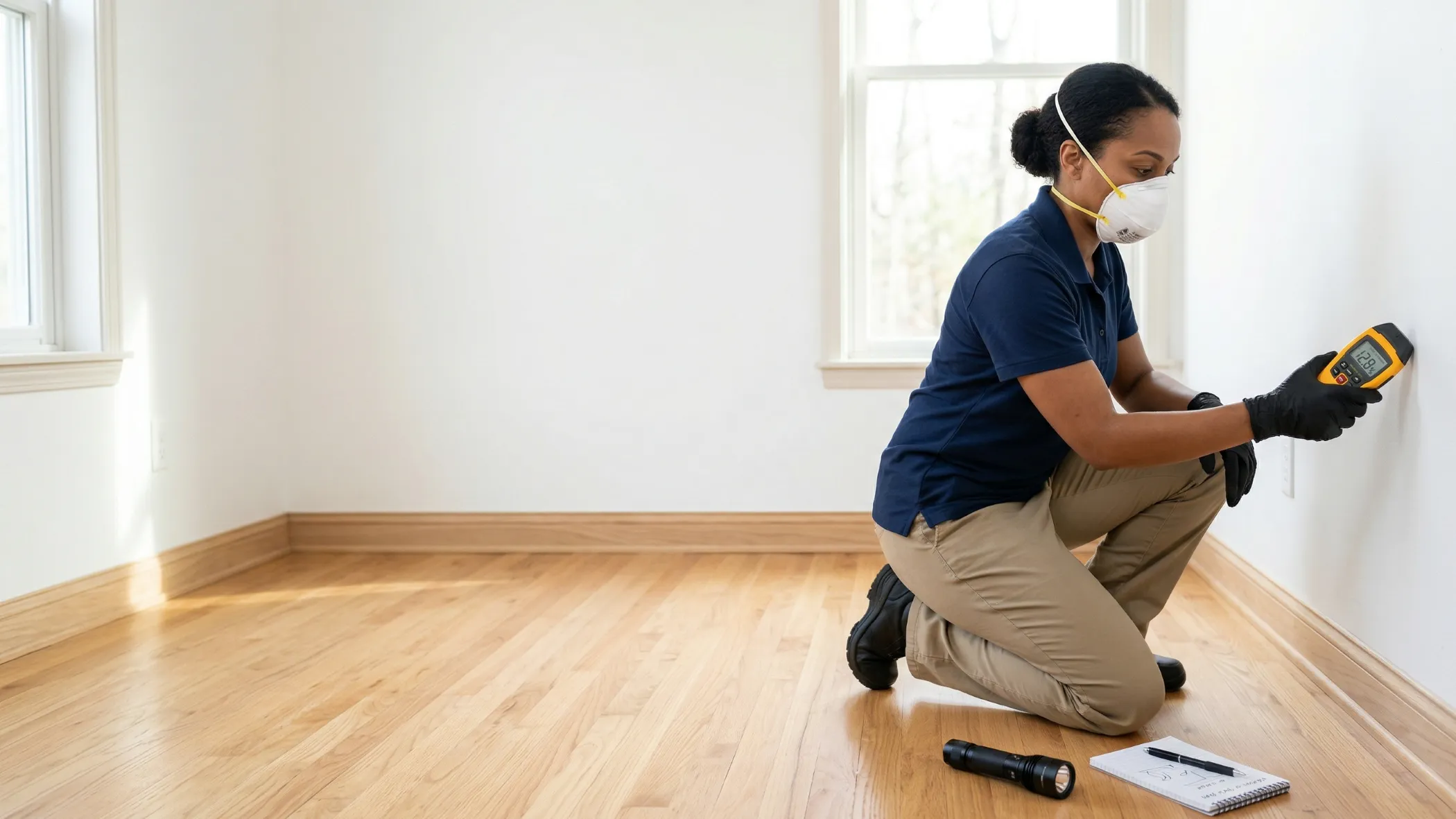

A professional mold inspection typically costs $300–$700 for a standard single-family home. Add laboratory sampling and the total rises to $400–$800 depending on how many samples are collected. Large properties, complex situations, or inspections that include thermal imaging can reach $700–$1,200 or more.
This guide covers what drives those costs, what each inspection type includes, how costs break down by mold species and property type, how to evaluate inspectors, and when an inspection is genuinely worth scheduling.
Cost insights
- Typical range: $300–$700 for a standard single-family home with visual inspection and 2–3 samples
- With lab sampling: $400–$800 total depending on sample count; lab fees of $25–$75 per sample are often billed separately
- Black mold and Fusarium: Total inspection cost typically runs $600–$800 due to additional safety precautions and sampling requirements
- Thermal imaging: Adds $100–$300 to the base cost but detects hidden moisture behind walls non-invasively
- Homeowners insurance: Rarely covers inspection as a standalone cost; may apply only if mold resulted from a covered peril such as a burst pipe
- Clearance inspection: $200–$400 after remediation is complete; a separate cost that should not be skipped
Mold inspection cost at a glance
Mold inspection costs range from $150 for a basic visual walkthrough to $1,200 or more for a comprehensive assessment with thermal imaging and multiple sample types.
| Inspection type | Average cost | What is included |
|---|---|---|
| Visual inspection only | $150–$300 | Walk-through, moisture readings, written report |
| Visual + air sampling (2–3 samples) | $400–$600 | Visual inspection plus air cassettes sent to lab |
| Visual + surface sampling | $350–$550 | Visual inspection plus tape lift or swab samples |
| Comprehensive inspection | $600–$1,200+ | Full visual, multiple sample types, thermal imaging |
| Re-inspection after remediation | $200–$400 | Clearance testing confirming successful remediation |
Prices vary by region. Inspections in major metro areas run 20%–40% above the national average. For full context on what remediation itself costs once mold is confirmed, mold remediation cost covers national averages by project size and mold type. High-humidity markets such as Houston, Miami, New Orleans, and Atlanta often have more inspectors competing for work, which moderates prices despite elevated demand.
Cost by home size
Home size is the single biggest driver of inspection cost, with inspections ranging from $150–$300 for a small condo to $700–$1,200 or more for a property over 4,000 square feet. Larger homes require more time, more travel between inspection zones, and often more samples to adequately assess all at-risk areas.
| Home size | Average cost | Notes |
|---|---|---|
| Under 1,000 sq ft (condo, small apartment) | $150–$300 | Visual-only; 1–2 samples if needed |
| 1,000–2,000 sq ft | $300–$450 | Standard residential range; 2–3 samples typical |
| 2,000–3,000 sq ft | $400–$600 | Includes basement or crawl space assessment |
| 3,000–4,000 sq ft | $500–$750 | Often requires additional samples and extended time |
| 4,000+ sq ft | $700–$1,200+ | Comprehensive recommended; thermal imaging often warranted |
These ranges assume visual inspection plus 2–3 samples. Add $25–$75 per additional sample for lab fees.
Cost by mold type
Most mold inspections cost $450 to $550 regardless of species, but Fusarium and Stachybotrys chartarum inspections run $600 to $800 due to additional safety precautions and extended sampling protocols. When a specific mold type is suspected, the inspection method, required safety precautions, and sample analysis may differ, which affects cost. The table below reflects total inspection and testing cost for a typical 2,500 sq ft home.
| Mold type | Average cost | Key characteristics |
|---|---|---|
| Cladosporium | $450–$550 | Common in HVAC systems, damp basements, and bathrooms; olive-green or brown; causes respiratory symptoms |
| Aspergillus | $450–$550 | 250+ species; grows even in low humidity; can invade walls, windows, carpet, and bedding |
| Alternaria | $450–$550 | Dark green or brown; common around showers, under sinks, and in water-damaged areas |
| Aureobasidium | $450–$550 | Pink, brown, or black; grows on painted surfaces and behind wallpaper |
| Chaetomium | $450–$550 | White then blue-green; found in water-damaged drywall; some species are carcinogens |
| Penicillium | $500–$600 | Velvety blue-green; spreads easily in water-damaged homes; grows under carpet and on ductwork |
| Trichoderma | $500–$600 | White or cream; rapidly colonizes wood and HVAC systems |
| Fusarium | $600–$800 | Extremely hazardous; grows near water leaks; can cause corneal and systemic infections |
| Stachybotrys chartarum (black mold) | $600–$800 | Requires constant moisture; grows on drywall and gypsum board; toxic to infants and immunocompromised individuals |
The higher cost for Fusarium and black mold reflects additional safety equipment, extended sampling protocols, and heightened inspector precautions. In practice, you usually do not know what species is present until testing is complete, which is why the inspection fee is relatively consistent until results suggest a more hazardous variety.
Mold inspection cost by property type
Property type affects inspection cost primarily through square footage and access complexity. A condo inspection typically runs $150–$350, while a commercial property can reach $2,500 or more, with single-family homes falling in the $300–$800 range that covers most residential situations.
| Property type | Average cost | Notes |
|---|---|---|
| Condominium or apartment | $150–$350 | Smaller square footage; access may be limited by building management |
| Single-family home | $300–$800 | Most common scenario; cost driven by size, age, and crawl space or basement presence |
| Townhouse | $250–$500 | Similar to single-family; shared walls can complicate moisture source identification |
| Multi-family (2–4 units) | $400–$1,000 | Requires inspecting each unit plus shared spaces; often priced per unit |
| Commercial property | $500–$2,500+ | Highly variable; HVAC complexity and square footage are primary drivers |
HVAC mold inspection cost
HVAC mold inspection adds $50 to $150 to the base inspection cost and is one of the most important add-ons to consider, since mold in ductwork distributes spores throughout every room in the home and is missed by standard visual inspections.
If an inspector finds elevated spore counts in air samples but cannot locate visible surface mold, the HVAC system should be among the first areas tested independently. Mold colonizing the air handler coil or supply ducts can produce chronically elevated indoor air counts even when every other surface in the home appears clean.
If you are unsure whether what you are experiencing warrants an inspection, reviewing the common signs of mold in a home can help you decide.
What affects the cost of a mold inspection
Inspection cost is driven primarily by the number of samples collected, the inspection method used, the inspector's credentials, accessibility of the property, and geographic location.
 Thermal imaging adds $100 to $300 to a base inspection but is the only non-invasive way to catch moisture hidden behind a wall like this.
Number of samples
Laboratory fees run $25–$75 per sample depending on type. A comprehensive inspection requiring 6–10 samples adds $150–$750 to the base fee. Always confirm whether the quoted price includes lab fees or whether those are billed separately after results arrive.
Inspection method
A basic visual walk-through costs far less than a comprehensive assessment using thermal imaging cameras, air sampling pumps, and multiple sample types. The method should match the situation. Visible surface mold rarely requires thermal imaging. Suspected hidden mold, post-flood assessment, or a real estate transaction usually justifies the added cost.
Inspector credentials
A Certified Industrial Hygienist (CIH) charges more than a basic mold inspector but brings substantially more expertise. The CIH credential is the gold standard for environmental microbial assessment and is worth the premium for complex situations, legal disputes, or significant health concerns. A full breakdown of which credentials are independently verified and how to confirm them is covered under mold remediation certifications.
Accessibility
Crawl spaces, unconditioned attics, inside wall cavities, and HVAC systems require additional time and specialized equipment. Inspectors may charge extra for confined space access or for using a borescope to inspect behind walls without cutting drywall. Drywall removal for access, when necessary, can add $16–$20 per square foot removed.
Geographic location
Inspections in major metro areas typically run 20%–40% above the national average. Regional humidity patterns also influence pricing indirectly. Markets where mold problems are widespread tend to have more competition among inspectors, which moderates rates despite higher volume.
Types of mold inspections
Mold inspections range from a basic visual walkthrough to a comprehensive assessment combining thermal imaging and multiple sample types, with cost and appropriate method depending on your specific situation.
Visual inspection ($150–$300)
A visual inspection covers accessible surfaces using a flashlight, moisture meter, and the inspector's trained eye. It is the appropriate starting point when mold is already visible and the goal is to document the extent and identify the moisture source. It cannot detect mold inside walls, under flooring, or circulating through an HVAC system.
Inspection with sampling ($400–$800)
Adding laboratory sampling elevates the inspection from observational to scientific. Collected samples go to an accredited laboratory that identifies mold species and measures spore concentration.
Air sampling draws a measured air volume through collection cassettes to capture airborne spores. Indoor samples are compared against an outdoor baseline collected the same day. Elevated indoor counts relative to outdoor levels indicate active hidden mold growth even when nothing is visible.
Surface sampling collects material from a suspicious area using tape lifts or swabs. This confirms whether a stain is actually mold and, if so, which species is present.
| Sample type | Lab cost per sample | Turnaround time |
|---|---|---|
| Air sample (spore trap) | $25–$50 | 3–5 business days |
| Surface tape lift | $25–$50 | 3–5 business days |
| Surface swab | $25–$50 | 3–5 business days |
| Bulk material | $30–$60 | 3–5 business days |
| ERMI dust sample | $200–$300 | 5–10 business days |
ERMI testing explained
ERMI (Environmental Relative Moldiness Index) testing analyzes settled dust for a panel of 36 mold species. It reflects long-term mold exposure history rather than pinpointing active growth locations, making it more useful for post-remediation confirmation than initial investigation.
Comprehensive inspection ($600–$1,200+)
A comprehensive inspection combines visual assessment, multiple sampling methods, and thermal imaging. Thermal cameras detect temperature differentials in walls and floors that indicate trapped moisture, which is where mold grows hidden from plain view. This is the appropriate level for large properties, significant health concerns, or legal disputes where documentation quality matters. After flooding or major water events, mold after water damage covers the timeline for when mold develops and what assessment should follow.
What is and is not included in the price
A standard mold inspection quote typically includes the visual assessment, moisture readings, written report, and remediation recommendations, but lab fees, thermal imaging, and HVAC inspection are almost always billed separately. Confirming what is included prevents surprises when the invoice arrives.
Typically included in the quoted price:
- On-site visual assessment with moisture meter readings
- Consultation about concerns, water damage history, and symptoms
- Written report of findings with photographs
- Remediation recommendations if mold is identified
Typically billed separately or added on:
- Air or surface sample collection and lab fees
- Thermal imaging camera
- HVAC system inspection
- Rush lab processing (results in 24–48 hours instead of 3–5 days)
- Re-inspection after remediation is complete
- Formal remediation protocol document (scope-of-work for contractor bidding or insurance claims)
Always request an itemized quote. Some inspectors bundle everything while others quote inspection and sampling separately, making direct price comparisons difficult without clarification.
DIY mold test kits vs. professional inspection
DIY mold test kits cost $20 to $100 but provide no actionable information about species, concentration, or moisture source, making a professional inspection the only reliable option for any situation that actually requires a response. They typically involve setting out a petri dish for 48 to 96 hours to capture settling spores, with an option to mail the dish to a lab for species identification.
The fundamental limitation of DIY kits is that mold spores are present in virtually every indoor environment because they enter constantly from outdoors. A positive result tells you spores exist somewhere in your home, which is almost certainly true without testing. It does not tell you species, concentration, location of active growth, or the moisture source causing it.
For a deeper look at what laboratory analysis involves and when it is worth ordering, mold testing covers methods, costs, and how to read results.
Mold inspection vs. mold testing vs. mold remediation
A mold inspection assesses whether mold is present and where; mold testing uses laboratory analysis to identify species and spore concentrations; mold remediation is the physical removal and treatment of affected materials. Each serves a distinct purpose and should generally be performed by separate contractors.
 A company offering all three services at once has a financial incentive to inflate findings, which is why inspection and remediation should stay separate contractors.
Mold inspection is the assessment phase. A qualified professional evaluates whether mold is present, where it is located, how extensive the growth is, and what conditions are allowing it to develop.
Mold testing refers specifically to laboratory analysis of collected samples. It can be part of an inspection or ordered independently when confirmation of a specific species is the only goal.
Mold remediation is the physical removal and treatment of affected materials. A company that both inspects and remediates has a financial incentive to find problems. Use an independent inspector for an objective assessment before hiring a mold remediation crew.
When to schedule a mold inspection
A mold inspection is worth scheduling after water damage, when buying or selling a home, when occupants have unexplained health symptoms, or when a musty odor is present without visible mold.
After water damage or flooding
Any significant water intrusion, including burst pipes, roof leaks, or appliance failures, creates conditions for mold growth within 24–48 hours. An inspection 2–4 weeks after the water source is addressed confirms whether mold developed despite drying efforts. Do not skip this step because drywall and insulation can retain moisture long after surface materials appear dry.
When buying or selling a home
A mold inspection before purchasing a home with a history of water damage, a crawl space, a basement in a humid climate, or a musty smell provides critical information before closing. A mold inspection contingency lets you negotiate remediation credits or provides grounds to walk away if significant mold is found. General home inspectors lack the specialized equipment and credentials to assess mold comprehensively.
When occupants have unexplained health symptoms
Persistent respiratory symptoms, chronic sinus congestion, allergic reactions, or fatigue that improve when leaving the home can indicate elevated indoor mold exposure. An inspection with air sampling identifies whether mold is a contributing factor. The research on whether mold is dangerous covers what exposure evidence says by population and symptom type.
When there is a musty smell without visible mold
A persistent musty odor despite no visible mold frequently indicates hidden growth inside walls, under flooring, or in the HVAC system. Air sampling is particularly valuable in this situation because it detects elevated spore concentrations that point to active hidden growth even when no surface mold can be found.
After moving into an older home
Homes built before 1980 have had more time to develop chronic moisture problems. A baseline inspection when moving into an older home identifies existing conditions before they are covered by renovations.
Periodically in high-humidity climates
In regions with sustained high humidity such as coastal areas, Houston, Miami, and New Orleans, mold can develop gradually without a single triggering event. A professional inspection every 3–5 years provides early detection before problems become costly.
What happens during a mold inspection
A professional mold inspection follows a six-step process: initial consultation, visual examination, moisture assessment, air or surface sampling, laboratory testing, and a written report of findings.
 Lab-dependent steps four and five are why a 2 to 3 hour visit still takes 3 to 5 business days to become a finished report.
Most inspections on a standard single-family home take 1–3 hours. A comprehensive inspection with multiple sampling locations can take 3–5 hours. The process typically follows this sequence:
- Initial consultation covering your concerns, any known water damage history, and health symptoms occupants have experienced
- Systematic visual examination of bathrooms, kitchens, basement walls, crawl spaces, attic areas, around windows and doors, and HVAC equipment
- Moisture meter readings of walls, floors, and ceilings identifying elevated moisture where mold is not yet visible; a hygrometer measures relative humidity since levels sustained above 60% consistently support mold growth
- Air or surface sample collection if included, with samples labeled, photographed, and shipped to the lab
- Written report within 24–72 hours documenting findings, photographs, moisture readings, and recommendations; add 3–5 business days if lab results are required
Preparing for the inspection improves the accuracy of results. Keep windows and doors closed for at least 12 hours before air sampling. Turn off HVAC systems and air purifiers 2–24 hours before sampling begins. Do not clean, vacuum, or bleach any suspected mold growth before the inspector arrives.
How to find the right mold inspector
Look for inspectors with verified ACAC or ABIH credentials, not just training certificates, and confirm they do not also offer remediation services, which creates a direct conflict of interest. Once the inspection is complete and remediation is needed, how to choose a mold remediation company covers the vetting process for contractors. Get at least two itemized quotes and confirm independent lab use before booking. Key credentials to look for are ACAC CIEC, CMI, or CRMI designations and the ABIH CIH, all of which require proctored exams and verified field experience rather than a course completion certificate.
What happens after the inspection
After a mold inspection, next steps depend on what the report finds: no action required if results are clean, DIY cleanup for minor surface mold under 10 square feet, or professional remediation for anything larger or in concealed locations.
 This report becomes the bid specification every remediation contractor should be quoting against, not their own on-site assessment.
If mold is identified, next steps depend on the extent and location:
- Minor surface mold under 10 sq ft in non-HVAC areas can often be addressed by a competent homeowner using EPA-recommended cleaning methods and appropriate protective equipment
- Moderate to extensive mold, meaning anything over 10 square feet, or any mold in HVAC systems, inside wall cavities, or affecting structural materials; the EPA thresholds and conditions that determine professional scope are covered under when mold remediation is required
When hiring a remediation contractor, use the inspector's written report as the specification for bids. This lets you compare contractors on equal terms rather than relying on each contractor's own assessment, which can vary considerably.
Schedule a clearance inspection after remediation is complete. A clearance inspection with air sampling confirms that mold levels have returned to normal before affected areas are rebuilt. This is your documentation that the work succeeded. Do not skip it.
Frequently asked questions
How long does a mold inspection take?
A standard visual inspection of a 2,000 sq ft home takes 2–3 hours. A comprehensive inspection with multiple sampling locations takes 3–5 hours. Written reports are typically delivered within 24–72 hours; add 3–5 business days if lab results are required.
What is the difference between a mold inspection and a home inspection?
A general home inspection covers overall property condition including roof, foundation, electrical, and plumbing, with a visual check for obvious mold. A dedicated mold inspection uses specialized equipment including moisture meters, thermal imaging cameras, and air and surface sampling to comprehensively assess microbial contamination. General home inspectors typically lack the credentials and equipment to conduct a thorough mold-specific assessment.
Does homeowners insurance cover mold inspection?
Most standard homeowners policies do not cover mold inspection as a standalone expense. If mold resulted from a covered peril such as a burst pipe or storm damage, the policy may cover related costs including inspection. Mold that developed from gradual moisture problems or deferred maintenance is typically excluded. Contact your insurer directly to understand your specific policy before scheduling.
Are free mold inspections legitimate?
Some remediation companies offer free inspections as a lead generation tool. These have an inherent conflict of interest since the company profits from finding problems that require paid remediation. Useful as a starting point, but verify findings with an independent inspector before committing to significant work.
Can I do my own mold inspection?
A homeowner can do a basic visual check of accessible surfaces. However, a DIY assessment cannot measure airborne spore concentrations, detect moisture behind walls, or produce the documented report required for insurance claims or real estate transactions. For health concerns, significant water damage, or a real estate transaction, a professional inspection is the appropriate choice.
How does mold affect a home's value?
Documented mold issues can reduce a home's market value by 3%–10% or more depending on severity and location. Professionally remediated mold with documented clearance testing has significantly less impact than active undisclosed mold discovered during a buyer's inspection.
How do I know if I need air sampling or just a visual inspection?
A visual inspection is sufficient when mold is already visible and the goal is to document extent and identify the moisture source before hiring a remediation contractor. Air sampling adds value when mold is suspected based on symptoms or odor but cannot be located visually, when the species matters for health decision-making, or when a real estate transaction requires documented evidence of mold-free conditions.
What should I do to prepare for a mold inspection?
- Keep windows and doors closed for at least 12 hours before the inspection
- Turn off your HVAC system and any air purifiers or dehumidifiers 2–24 hours before air sampling
- Do not clean, vacuum, or bleach any suspected mold growth before the inspector arrives
- Make a list of areas with musty odors, discoloration, or past water damage
- Gather documentation of any past water damage repairs or insurance claims
- Ensure the inspector has access to all areas including attic, crawl space, basement, and utility rooms
- Note any health symptoms occupants have experienced and when they began
What should I do if the inspection finds mold?
For minor surface mold under 10 sq ft in non-HVAC areas, EPA guidelines allow homeowner cleanup using appropriate protective equipment. For anything larger, mold inside HVAC systems, mold inside wall cavities, or mold affecting structural materials, hire an IICRC-certified remediation contractor. Use the inspector's report as the bid specification, get at least three quotes, and schedule a clearance inspection after the work is complete.
For mold that is actively spreading or covers a large area, emergency mold removal covers what to do in the first 24 hours.
Is a mold inspection worth the cost?
For unexplained health symptoms, known water damage history, musty odors, or a real estate transaction, the answer is yes in nearly every case. At $300–$700, a professional inspection is modest relative to the cost of uninformed remediation that misses the actual moisture source, or the ongoing health cost of ignoring a problem that continues to spread.
- U.S. Environmental Protection Agency (EPA): A Brief Guide to Mold, Moisture, and Your Home
- CDC Mold Health Information
- EPA Mold Remediation in Schools and Commercial Buildings (2008)
- IICRC S520 Standard for Professional Mold Remediation
- National Institute for Occupational Safety and Health (NIOSH): Dampness and Mold in Buildings
- American Council for Accredited Certification
- American Industrial Hygiene Association
Sam Hickerson is the founder of RestoreAdvisor and writes consumer guides on mold remediation, water damage restoration, inspection, testing, and home recovery. His work focuses on helping homeowners understand costs, risks, and when to call a professional. He draws on guidance from the EPA, CDC, IICRC, and other authoritative sources to make complex home issues easier to navigate.