
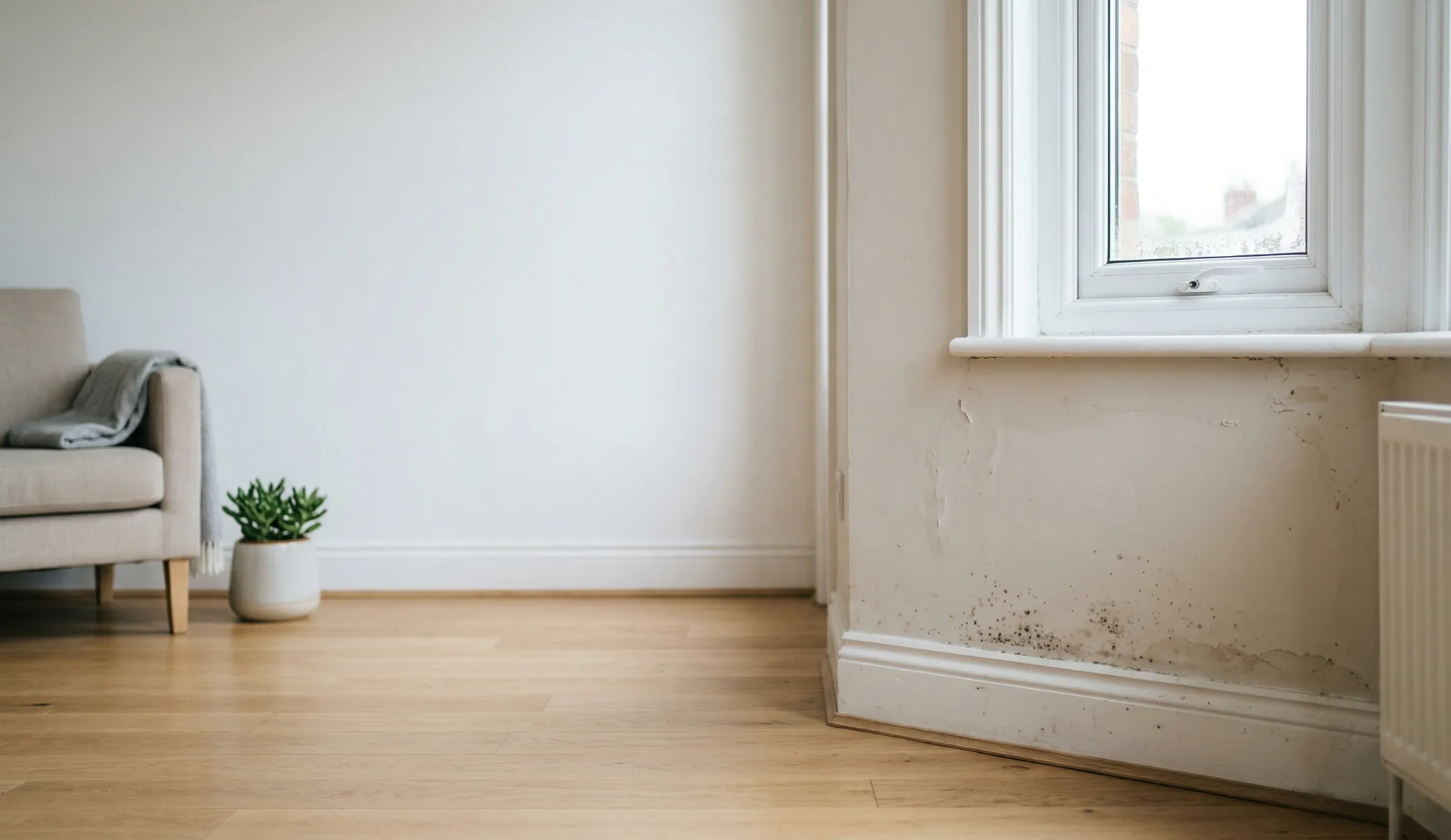

Mold does not always show itself as black spots on a wall. It grows inside wall cavities, under flooring, and in HVAC ductwork for weeks or months before any surface evidence appears. Knowing the full range of signs, including visual, odor-based, structural, and health-related indicators, lets you catch a problem early and limit both remediation costs and health exposure.
Key insights
- Musty odor without visible growth is one of the most common presentations of hidden mold.
- Mold can begin growing within 24–48 hours of unaddressed water damage (EPA).
- Health symptoms that improve when you leave home are a reliable indicator of indoor mold exposure.
- Mold appears in white, green, gray, brown, and orange, not just black.
- Unchecked mold can reduce a home's market value by 20%–37%.
- Professional inspection using moisture meters and air sampling is the only reliable way to confirm hidden mold.
Visual signs of mold
Visible mold is the clearest sign, but it does not always look the way people expect. Color, texture, and location all vary by species and surface material. Understanding what you are looking at matters because different species carry different health risks and require different responses, from DIY cleaning to professional mold remediation.
 The bleach test described below applies to the first two of these four; peeling paint and framing growth are structural signs to act on directly, not test.
Dark spots or patches
Black, dark green, or dark gray patches on walls, ceilings, grout lines, window frames, or around plumbing fixtures are the most direct indicator. Depending on species, mold can also appear white, orange, or brown. Not every dark mark is mold, since dirt and mildew can look similar, but any persistent discoloration in a moisture-prone area should be investigated.
Simple test: Apply a small amount of household bleach to the spot. If it lightens within a minute or two, the discoloration is likely fungal growth rather than dirt. No color change generally means dirt.
Water stains and ceiling discoloration
Yellow or brown staining on walls and ceilings signals past or ongoing moisture intrusion. The stain itself may not be mold, but it marks the environment where mold is likely already growing. Stains that reappear after painting are a strong signal of an active, unresolved moisture source behind the surface.
Peeling, bubbling, or warped surfaces
Paint or wallpaper that peels, bubbles, or separates from the wall indicates trapped moisture beneath the surface, conditions ideal for mold. Warped hardwood floors, swollen drywall, soft spots in ceilings, and buckling baseboards all point to the same underlying problem.
Grout and caulk discoloration
Black or dark brown discoloration in bathroom and kitchen grout, or around tub and shower caulk, is almost always mold. This is one of the most common household mold problems and among the easiest to address if caught early, before it penetrates deeper into the substrate.
Fuzzy or powdery surface growth
Some mold species produce fuzzy or powdery growth rather than flat patches. This is most common on organic materials such as wood, drywall, cardboard, and fabric, particularly in basements, crawl spaces, and attics where ventilation is poor.
Signs of mold you can smell
A persistent musty, earthy odor, sometimes described as wet cardboard, damp soil, or old books, is one of the most reliable indicators of active mold growth, even when nothing is visible. Mold produces microbial volatile organic compounds (mVOCs) as a byproduct of metabolism. These compounds are detectable at low concentrations and are what produce that distinctive smell.
NIOSH notes that thorough visual inspections combined with odor detection are often more reliable than short-term air sampling for identifying problem areas. If you smell mold but cannot locate it visually, the next step is identifying where the odor is strongest, since the table below maps common odor locations to their likely source.
| Location of odor | What it likely indicates |
|---|---|
| Near HVAC vents or registers | Mold in ductwork; spores circulating throughout home |
| Basement or crawl space | Ground moisture intrusion; inadequate vapor barrier |
| Behind walls or under sinks | Hidden mold from slow plumbing leak |
| Stronger after rain or humidity | Hidden mold responding to moisture changes in building materials |
| Inside closets or low-traffic rooms | Poor ventilation allowing mold to establish on clothing or walls |
| In finished attic spaces | Roof leak or condensation from inadequate insulation |
Signs of mold in specific areas of your home
Mold concentrates most commonly in bathrooms, basements, kitchens, attics, and HVAC systems wherever moisture accumulates consistently. Each location has a distinct set of warning signs that point to where growth is likely and how serious it may be.
 Wall framing growth like this is usually already established by the time under-sink or grout mold becomes visible in the same home.
Bathrooms
The most common mold location in homes is the bathroom, where repeated humidity cycling creates ideal conditions. Signs of bathroom mold include dark spots on wall tiles and grout, black discoloration in caulk around tubs and showers, peeling paint or wallpaper near the floor, staining on the ceiling above the shower, and visible growth around window frames and exhaust fan housing.
Basements and crawl spaces
These are high-risk areas because of ground moisture, limited airflow, and temperature differentials that drive condensation. Signs include white powdery deposits (efflorescence) on concrete walls, musty odor, visible growth on wood joists or support beams, rust on metal appliances or fixtures, standing water or persistently damp soil, and soft or deteriorating wood framing. Signs in basements tend to be more severe because moisture is constant rather than intermittent.
Basements that have experienced flooding carry the highest risk. Mold after water damage can establish within 24 hours of saturation, making fast drying the single most important response after any flooding event.
Kitchens
Mold in the kitchen concentrates under sinks, behind refrigerators, inside cabinet bases near plumbing connections, and around dishwasher edges. Look for discoloration on the cabinet floor under the sink, musty smell when opening lower cabinet doors, spots on the ceiling near the exhaust hood, and dark staining around the window above the sink.
Attics
Mold in attics usually results from inadequate ventilation or a slow roof leak, and it is often not found until a home inspection or roof repair project. Signs of attic mold include dark staining on wood sheathing or rafters, fuzzy growth on roof decking, visible daylight through the roof deck where there should be none, and evidence of moisture or staining on the attic floor insulation.
HVAC systems and ductwork
Mold in an HVAC system is particularly serious because the system spreads spores to every room in the house. Signs include a musty odor that appears or intensifies when the system runs, visible growth around supply vents or on the air handler itself, dust accumulation around registers that appears darker than normal, and occupants experiencing allergy-like symptoms throughout the home with no other explanation.
HVAC mold testing typically adds $50–$80 to the cost of an inspection. Remediation of a mold-contaminated HVAC system generally runs $3,000–$10,000 due to the specialized cleaning required.
Inside walls
Hidden wall mold is the hardest to detect without professional tools. Indicators include a musty odor concentrated near a specific wall, soft or spongy texture when pressing on drywall, staining or discoloration that bleeds through fresh paint, wallpaper peeling near the baseboard, and a documented history of plumbing leaks or water intrusion in that area.
Health symptoms that indicate mold exposure
Mold exposure commonly causes respiratory symptoms, allergy-like reactions, skin irritation, and fatigue, with severity varying by individual sensitivity and exposure level. Those with allergies, asthma, or compromised immune systems are most affected, but even healthy individuals can experience symptoms at high exposure levels. Health risks by mold type and exposure level are covered in depth at is mold dangerous.
| Symptom category | Specific signs | Pattern to watch |
|---|---|---|
| Respiratory | Coughing, wheezing, shortness of breath | Persistent without prior diagnosis or known trigger |
| Allergy-like | Sneezing, runny nose, itchy or burning eyes | Recurring indoors with no seasonal explanation |
| Skin | Rash or irritation in specific rooms | Appears at home, clears when away |
| Fatigue and headaches | Chronic, low-grade, unexplained | Improves during vacations or time spent outside the home |
| Asthma flares | Increased frequency or severity | Triggered indoors, particularly in specific rooms |
The single strongest health indicator is location pattern: symptoms that are consistently worse at home and improve when away point toward an indoor air quality problem. This pattern, combined with any of the other signs in this article, warrants a professional mold inspection.
Signs of hidden mold
Hidden mold is most likely when a musty odor is present without visible growth, or when a property has a history of water damage or flooding. Some of the most serious mold problems produce few or no visible signs at the surface. Mold growing inside wall cavities, under flooring, in ceiling spaces, and in HVAC systems can reach significant coverage before any indication appears on finished surfaces.
Situations where hidden mold is likely, even without visible signs
- Any property with a history of flooding or significant water damage
- Homes where a plumbing leak went undetected for an extended period
- Properties in chronically humid climates, including the Gulf Coast, Southeast, Pacific Northwest
- Homes with a persistent musty odor despite no visible growth
- Buildings with recurring condensation on windows, walls, or pipes
- Properties where occupants experience consistent health symptoms without another explanation
If hidden mold is suspected, professional inspection using moisture meters, infrared thermal imaging, and air sampling is the most reliable method to confirm or rule it out. Moisture meter readings above baseline in areas with no visible damage, or air sampling showing elevated indoor spore counts relative to outdoor baseline, indicate hidden growth.
 A reading above baseline here, with no visible damage on the surface, is what confirms hidden growth that a visual walkthrough alone would miss.
A standard mold inspection costs $300–$800 for most homes, covering moisture mapping, thermal imaging where offered, and a written report. Whole-home inspections using multiple sampling methods range from $1,150–$3,400.
For a full breakdown of what each method involves and typical pricing by region, see mold inspection costs.
Mold vs. mildew: what's the difference?
Mildew is a surface fungus that wipes away easily and causes minor issues; mold penetrates materials, causes structural damage, and requires a more serious response. The two are frequently confused, and the distinction matters because they require different responses.
| Feature | Mildew | Mold |
|---|---|---|
| Appearance | Flat, powdery, white or gray | Fuzzy or slimy; colors vary |
| Penetrates surfaces | No, surface only | Yes, penetrates into drywall, wood, and insulation |
| Materials affected | Surface of tiles, grout, fabric | Structural materials, drywall, framing |
| Removal method | Household cleaner and scrubbing | Often requires material removal and replacement |
| Severity | Minor nuisance | Can cause structural damage and health effects |
| Action required | DIY cleaning is sufficient | Professional assessment recommended for large areas |
For full identification by texture, color, odor, and growth pattern, see mold vs. mildew.
What to do if you find mold
What you do after finding mold depends on how much there is and where it is growing. Small surface patches on non-porous materials are often a DIY job; anything larger or inside building materials needs a professional.
Small surface mold (under 10 square feet)
The EPA defines mold covering less than 10 square feet (roughly a 3 by 3 foot area) as manageable by a careful homeowner with proper protective equipment: N95 respirator or better, nitrile gloves, and safety glasses. Non-porous surfaces such as tile and glass can be cleaned with an appropriate antimicrobial solution. Porous materials like drywall, insulation, and wood that show mold penetration should be removed and replaced, not cleaned.
Larger infestations or hidden mold
Any mold coverage exceeding 10 square feet, mold inside HVAC systems, mold within wall cavities or structural materials, or any situation accompanied by health symptoms warrants professional remediation. DIY attempts to clean large infestations without proper containment can spread spores and substantially worsen the problem. If you are unsure whether your situation warrants professional help, when mold remediation is required walks through the decision criteria in detail.
 Once drywall shows penetration like this, removal replaces cleaning as the only option regardless of how small the visible patch first appeared.
Professional mold remediation costs $10–$25 per square foot for most residential jobs, with most projects landing between $1,500–$6,000. Mold remediation costs has a full breakdown by room, mold type, and infestation size.
Fix the moisture source first
Removing mold without resolving the underlying moisture source guarantees recurrence. Before any cleanup, identify and fix the water source, whether a plumbing leak, condensation issue, inadequate ventilation, or exterior water intrusion. Remediation without moisture control is a temporary fix at best. Mold prevention covers every room, moisture source, and inspection schedule as a complete system.
Frequently asked questions
What does mold look like?
Mold appears in a wide range of colors and textures depending on species and surface. Common appearances include black or dark green fuzzy patches, white powdery growth on wood or drywall, orange or brown staining on wood, and gray or green spots on grout. Not all mold is black, and not all black spots are mold. Laboratory analysis is the only reliable way to confirm mold species and toxicity.
What does mold smell like?
Mold produces a musty, earthy odor often described as wet soil, decaying leaves, or old books. The smell intensifies in humid conditions and is typically strongest near the source: behind walls, under sinks, in crawl spaces, or in HVAC returns. If a room smells musty but shows no visible mold, assume the growth is hidden and schedule an inspection.
Can mold grow without visible signs?
Yes. Mold commonly grows inside wall cavities, under flooring, in ceiling spaces, and inside HVAC ductwork with no visible surface signs. A musty odor in the absence of visible mold is one of the most common presentations of hidden mold growth and should not be dismissed.
Is all mold dangerous?
Most common household molds cause allergy-like symptoms primarily in sensitive individuals. Certain species, particularly Stachybotrys chartarum, commonly called black mold, produce mycotoxins associated with more severe health effects. Color alone does not indicate toxicity. You cannot determine mold species or danger level from appearance; laboratory testing of collected samples is required.
How quickly does mold grow after water damage?
According to the EPA, mold can begin growing on wet building materials within 24–48 hours if moisture is not addressed. Visible surface growth typically appears within 7–10 days. In warm, humid conditions, growth accelerates significantly. This timeline underscores the importance of drying water-damaged materials immediately and completely.
When should I call a professional?
Call a certified mold inspector if mold covers more than 10 square feet, you smell mold but cannot locate it, the home has a history of significant water damage or flooding, occupants are experiencing unexplained health symptoms, or you are buying or selling a property with suspected mold issues.
How is a mold inspection different from a home inspection?
A general home inspection covers overall property condition (roof, foundation, electrical, plumbing) with a cursory visual check for obvious mold. A dedicated mold inspection uses moisture meters, thermal imaging cameras, and air or surface sampling to comprehensively assess microbial contamination throughout the building. General home inspectors typically lack both the specialized equipment and the certifications held by a dedicated mold assessor.
What does professional mold remediation involve?
Professional mold remediation involves containment of the affected area, removal of mold-contaminated materials, treatment of surfaces with antimicrobial agents, HEPA air scrubbing, and clearance testing to confirm the space is clean. The process differs from basic cleaning because it addresses both surface growth and airborne spores to prevent spread and recurrence.
Sam Hickerson is the founder of RestoreAdvisor and writes consumer guides on mold remediation, water damage restoration, inspection, testing, and home recovery. His work focuses on helping homeowners understand costs, risks, and when to call a professional. He draws on guidance from the EPA, CDC, IICRC, and other authoritative sources to make complex home issues easier to navigate.