

A pipe just let go, or the carpet in the basement has been damp since last night's storm, and the number you need before you can do anything else is what this is actually going to cost. Water damage restoration cost is priced using the water category and damage class system defined in the IICRC S500 standard, and typically runs from $1,500 to $7,000 for mitigation and basic repairs, though the final bill depends on how far the water traveled, what it touched, and how contaminated it was.
Category, class, square footage, and room each shift that number in a different direction, and a homeowners policy only covers some of it. Knowing where your situation falls, and what a fair quote should include, is what turns this range into a number you can actually check an estimate against instead of guessing.
Key insights
- National average cost is about $3,800. Most water damage restoration projects fall between $1,500 and $7,000 for mitigation and basic repairs, with small contained jobs as low as $350 and severe black water losses exceeding $20,000.
- Water category drives price per square foot more than any other factor. Clean water costs $3 to $4 per square foot to mitigate, gray water costs $4 to $6.50, and black water costs $7 to $7.50 or more because of the added decontamination steps.
- Basements are the most expensive room to restore. A basement dry-out ranges from $1,500 for a minor, unfinished space to $10,000 or more once carpet, drywall, and personal belongings in a finished basement are involved.
- Mitigation and repair are priced and billed separately. Extraction and drying typically runs $3 to $7.50 per square foot, while repair and rebuild work like new drywall and flooring adds $20 to $37 per square foot on top.
- A standard homeowners policy covers sudden events but not flooding. A burst supply line is usually covered; water that enters from outside the home during a storm falls under a separate flood policy instead.
- Delayed drying adds cost beyond the original job. Materials that stay wet longer than 24 to 48 hours are prone to mold growth, which can add $1,200 to $3,800 or more in remediation on top of the water damage repair itself.
Average water damage restoration cost
The national average for water damage restoration is around $3,800, with most homeowners paying between $1,500 and $7,000 for extraction, drying, and basic repairs. That range covers the majority of residential jobs, from a single flooded room to moderate whole-floor damage, but it does not represent every scenario.
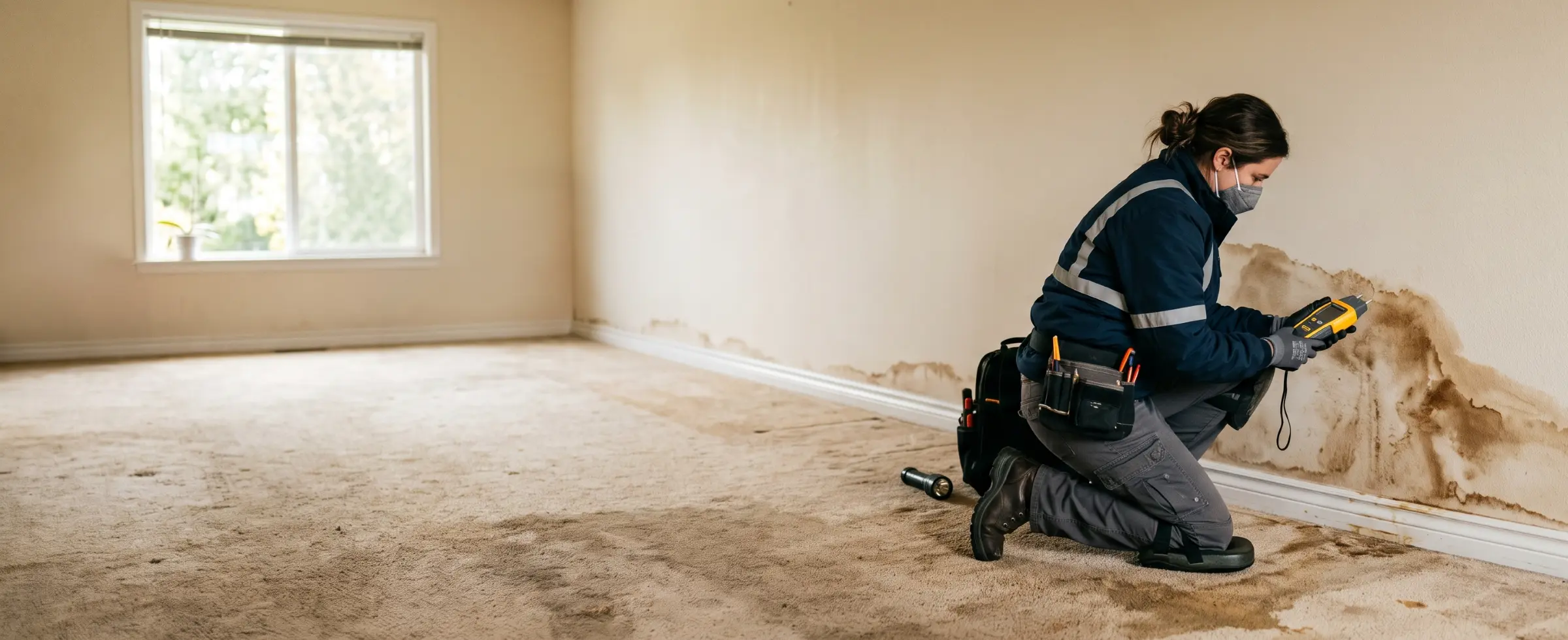
 Peeling paint and staining like this often mean moisture has already reached the drywall behind it, which is why an estimate typically separates a mitigation charge from a repair charge under IICRC S500.
Small, contained incidents cost far less. A single wet closet or a toilet overflow caught within an hour can run as low as $350, since the job is limited to extraction and a few days of drying equipment with no material replacement. On the other end, a finished basement flooded with contaminated water, or a loss that spreads across multiple floors and damages framing, can push total cost past $20,000 once structural repair and content restoration are included.
| Project scope | Typical cost | What's included |
|---|---|---|
| Minor spot mitigation | $350–$1,500 | Extraction, spot drying, no material removal |
| Standard mitigation | $1,500–$4,000 | Extraction, structural drying, antimicrobial treatment |
| Mitigation plus basic repairs | $4,000–$7,000 | Drying plus drywall and flooring replacement in one or two rooms |
| Extensive loss with structural repair | $10,000–$25,000+ | Multi-room mitigation, framing repair, full material replacement |
Water damage mitigation cost vs. repair and reconstruction cost
Mitigation and repair are two separate phases of a water damage restoration project, each with its own price tag, even though homeowners often think of the whole project as one number. Mitigation covers stopping the water, extracting it, and drying the structure, a process that typically takes 3 to 5 days with professional dehumidifiers and air movers running continuously. Repair and reconstruction cover rebuilding what mitigation couldn't save, such as drywall, flooring, and trim.
 Mitigation stops here, at drying; the framing and subfloor exposed by this cut still need repair and rebuild, priced separately under a restoration estimate.
A licensed technician classifies the water before the water damage restoration process begins, since category and class jointly determine both the drying method and which materials can be saved versus removed. That classification is also what separates a $1,500 mitigation-only job from a $7,000 job that includes repairs, because the same square footage can cost very differently depending on how much had to come out.
Some companies quote mitigation only and hand off repairs to a separate contractor. Others handle both phases under one contract. Neither approach is wrong, but a homeowner comparing two quotes should confirm which phase each number actually covers before assuming one bid is cheaper than the other.
Cost by water damage category
Cost varies significantly across water damage categories, ranging from $3 to $4 per square foot for clean water up to $7.50 or more per square foot for black water, since contamination level determines how much decontamination the job requires before drying can even start. Category 1 water is clean and the least expensive to mitigate, while Category 3 water is contaminated and requires the most labor and material removal.
 Category is assigned by contamination level, not appearance alone; water that looks similar to this can test as Category 2 or 3 depending on its source, which is what actually sets the per-square-foot rate.
Clean water comes from sources like a broken supply line or an appliance overflow with no contaminants, and it costs the least to extract and dry. Gray water has come into contact with detergent, food residue, or similar contaminants and needs antimicrobial treatment on top of drying. Black water, which includes sewage backups and floodwater, poses a health hazard and requires full personal protective equipment and removal of anything porous that it touched.
| Category | Water type | Cost per sq ft | Common sources |
|---|---|---|---|
| 1 | Clean water | $3–$4 | Supply line breaks, appliance overflow, rainwater intrusion |
| 2 | Gray water | $4–$6.50 | Washing machine or dishwasher discharge, toilet overflow without waste |
| 3 | Black water | $7–$7.50+ | Sewage backup, floodwater, standing water left more than 48 hours |
Category can also shift while water sits. Clean water left untreated for more than a day or two can pick up bacterial growth and get reclassified as Category 2, which is one reason same-day extraction keeps cost down even when the source itself was clean.
Cost by damage class
Damage class measures how much water was absorbed and how hard the space will be to dry, and it works alongside category rather than replacing it, adding equipment and labor cost as the class number rises. Under IICRC S500, water damage classes range from 1, the least amount of water and the fastest evaporation, to 4, specialty drying situations involving low-porosity materials like hardwood, plaster, or concrete.
 Thermal imaging maps how far moisture has spread, not just where the water entered, which is what actually determines whether a job is Class 2 or the more labor-intensive Class 4.
A higher class typically means more drying equipment running for more days, which adds to the mitigation bill even when the water itself was clean. Class 4 jobs in particular can take a week or more of specialty drying, since materials like solid wood or brick hold moisture deep inside and release it slowly.
| Class | Water absorbed | Typical scenario | Cost impact |
|---|---|---|---|
| 1 | Least, one area, low-porosity materials | Small leak on tile or concrete | Fastest, lowest equipment cost |
| 2 | Whole room, carpet and cushion affected | Burst pipe soaking a bedroom floor | Moderate, several days of drying |
| 3 | Greatest volume, multiple surfaces wet at once (ceiling, walls, carpet, subfloor) | Roof leak saturating ceiling and walls | Higher, more equipment needed to dry all surfaces at once |
| 4 | Deep saturation trapped in dense, low-porosity materials | Hardwood, plaster, or concrete slab soaked through | Highest, slowest to dry regardless of volume, specialty equipment |
Cost per square foot
Mitigation runs $3 to $7.50 per square foot, the core of your water damage restoration cost per square foot figure, with the exact rate set by water category. Repair and rebuild work such as new drywall and flooring is priced separately, typically $20 to $37 per square foot once drying is complete, which is why a mitigation-only quote often looks smaller than the total project cost.
A quick way to translate that rate into a real number: multiply the affected square footage by the mitigation rate for a rough mitigation-only estimate, then add the repair rate if drywall or flooring needs replacement.
| Affected area | Mitigation only | Mitigation plus repair |
|---|---|---|
| 100 sq ft | $300–$750 | $2,300–$4,450 |
| 300 sq ft | $900–$2,250 | $6,900–$13,350 |
| 500 sq ft | $1,500–$3,750 | $11,500–$22,250 |
Cost by room
Cost by room ranges from about $500 for a bathroom to $10,000 or more for a finished basement, since room size and the materials typically found in each space vary widely. A bathroom has less floor area than a basement but often involves fixtures and Category 2 or 3 water, while a kitchen adds expensive appliances and cabinetry to the repair bill.
 A finished basement like this carries furniture, flooring, and drywall replacement costs a bare unfinished space never has, which is why a severe basement loss can run past $10,000, more than double a bathroom's typical high end of $4,500.
Basements carry the widest range of any room because finished basements have carpet, drywall, and personal belongings that unfinished basements don't. A living room or family room can also run high when hardwood flooring, built-in cabinetry, or electronics are involved.
| Room | Typical cost range | Why |
|---|---|---|
| Basement | $1,500–$10,000+ | Widest range; finished basements cost far more than unfinished concrete |
| Bathroom | $500–$4,500 | Smaller footprint but often Category 2 or 3 water from fixtures |
| Kitchen | $1,500–$8,000 | Cabinetry, flooring, and appliances add to material cost |
| Living or family room | $3,265–$18,650 | Hardwood, built-ins, and electronics raise replacement cost |
| Laundry room | $1,000–$5,000 | Usually contained to one area unless water travels to floors below |
Cost by common water damage scenario
Cost by scenario ranges from about $1,000 for a minor burst pipe repair to $25,000 or more for multi-room storm flooding, since the event that caused the damage often predicts total cost more reliably than square footage alone. Matching your situation to a common scenario gives a faster starting estimate than working through category, class, and room separately.
These ranges combine water category, typical square footage, and how much repair usually follows each type of event.
| Scenario | Typical scope | Cost range |
|---|---|---|
| Supply line burst under a sink or toilet | One room, clean water, minimal demo | $1,000–$3,000 |
| Washing machine or dishwasher overflow | Kitchen or laundry room plus adjacent areas, gray water | $2,000–$5,000 |
| Roof leak during a storm | Ceiling and wall damage, possible attic involvement | $2,500–$7,000 |
| Sewage backup | Contaminated black water, full PPE, heavy demo | $7,000–$14,000+ |
| Storm flooding across multiple rooms | Extensive demo, long drying cycle, possible structural repair | $10,000–$25,000+ |
What drives water damage restoration cost up
Several factors push a project above the typical $1,500 to $7,000 range, and most of them come down to how much material has to be removed rather than how much water was involved. These factors often compound rather than apply in isolation. A contaminated black water loss in a finished basement can trigger nearly every driver on this list at once, which is why the most severe losses climb well past $20,000.
 Water traveling from an upper floor damages more than the room it lands in; the ceiling below absorbs cost from both the source room and this one, which is why multi-floor losses expand the affected square footage fast.
Water category and contamination level
Category 3 black water, most often from a sewage backup, requires full decontamination and removal of anything porous it touched, which can double or triple the per-square-foot cost compared to clean water on the same square footage.
How long the water sat before drying began
Materials that stay wet beyond the 24 to 48 hour window identified by the EPA typically need to be treated for mold before restoration can finish, adding a second phase of cost on top of the original job.
How much of the affected material is porous
Carpet, carpet pad, and drywall usually have to be removed and replaced rather than dried, while tile, concrete, and some hardwood can often be dried in place, which keeps material cost lower.
How many floors or rooms the water traveled through
A ceiling leak, often water damage from a roof leak traveling down from an upper floor, can damage the room below as well as the source room, multiplying the affected square footage well beyond where the leak actually started.
Structural damage to framing or subfloor
When water compromises floor joists or wall framing, replacement of that structural material can add several thousand dollars beyond standard mitigation and surface repair.
Contents and personal property restoration
Furniture, electronics, and belongings that were in the affected area are priced separately from the structure itself, and a fully furnished finished basement adds meaningfully more than an empty one.
After-hours or emergency response
Nights, weekends, and holiday calls typically carry a 25% to 50% premium over standard daytime rates because of overtime labor, though a faster response often limits how much material ends up needing replacement.
Does insurance cover water damage restoration cost
Usually, if the water damage was sudden and accidental rather than the result of neglect or a gradual leak. A burst supply line, water heater leak damage, or an appliance hose that lets go are the kinds of events standard homeowners policies are built to cover, subject to the policy's deductible.
 Photos taken before any cleanup starts are what insurers use to confirm a loss was sudden rather than a long-term maintenance issue, the distinction that decides whether a claim gets approved at all.
Coverage narrows in a few common situations. Damage from a leak that went unaddressed for weeks or months is often denied as a maintenance issue rather than a sudden event. Water that enters from outside the home, such as rising floodwater during a storm, falls under the FEMA NFIP program or a private flood policy instead of a standard homeowners policy, so restoration cost for flood-caused damage is only covered if that separate policy is already in place.
Deductibles also shape what a homeowner actually pays out of pocket, since exactly how homeowners insurance covers water damage determines whether that deductible eats the whole claim. A typical deductible runs $500 to $5,000, so on a $3,800 average job, insurance may cover most of the cost once the deductible is met, or very little of it if the deductible is close to the total bill.
When insurance is paying for the job, most restoration companies price using Xactimate, the estimating software insurers require for claims, which keeps quotes for the same scope of work close to each other regardless of company. Homeowners paying out of pocket tend to see more variation between quotes, since companies have more flexibility to adjust pricing, offer tiered packages, or scale back scope to fit a budget instead of following a standardized rate sheet.
DIY vs. professional water damage cleanup cost
DIY cleanup costs less up front but carries a real risk of higher total cost later. A wet vac and a set of box fans can be rented for well under $200 to handle a small, clean water spill caught within a few hours, compared to $1,500 or more for a professional mitigation job on the same footprint.
That gap narrows quickly once contaminated water, hidden moisture, or porous materials are involved. Category 3 crews follow OSHA's bloodborne pathogens standard when sewage-contaminated materials are present, which calls for respirators, disposable suits, and decontamination procedures that a homeowner typically isn't equipped to follow safely. Drywall and carpet pad that look dry on the surface but stay damp inside a wall cavity also tend to surface as a mold problem weeks later, turning a saved $1,000 into a new $1,200 to $3,800 remediation bill.
As a general rule, DIY makes sense for a small Category 1 spill caught and dried within a few hours. Anything involving standing water for more than a day, Category 2 or 3 water, or water that reached wall cavities or subflooring is worth a professional assessment even if the homeowner ends up handling minor cleanup themselves.
How to lower your water damage restoration cost
A few decisions made in the first hours after water damage occur can cut hundreds to thousands of dollars off the final bill without cutting corners on the actual drying and repair work. None of these require special expertise or delay the response that actually matters, keeping materials from sitting wet. Most homeowners only use one or two of these tips, but combining several compounds the savings on a moderate or large loss.
 Moving belongings out before a crew arrives shifts that labor cost off the invoice entirely, since restoration companies typically bill contents handling by the hour just like extraction and drying.
Get quotes from at least two companies before drying begins
Pricing can vary between companies for the same scope of work, and a second quote gives a basis for comparison before you finish choosing a water damage restoration company and equipment is already running.
Handle your own contents pack-out where it's safe to do so
Moving furniture, electronics, and belongings out of the affected area yourself, rather than paying a crew to do it, typically saves a few hundred dollars in labor cost on a small or moderate loss.
Start extraction within the 24 to 48 hour window
Drying materials within that window avoids the second remediation job entirely, which is consistently the largest avoidable cost in a water damage claim.
Ask whether your insurer requires a preferred vendor
Some insurers maintain a network of restoration companies with pre-negotiated rates; using one can simplify claim approval and avoid a dispute over pricing later.
Confirm what mitigation excludes before approving repairs
A low mitigation-only bid can look cheaper than a competitor's combined quote, but only if repair and rebuild are priced and compared separately rather than assumed to be included.
Keep receipts for temporary protective measures
Tarps, plastic sheeting, or a rented dehumidifier used to prevent damage from spreading are typically reimbursable under a covered claim, but only with documentation.
How to get an accurate water damage restoration estimate
An accurate estimate starts with an in-person inspection rather than a number given over the phone, since moisture behind walls and under flooring can't be assessed from a description alone.
1. Get an on-site inspection, not a phone estimate
A technician needs to use a moisture meter on walls, subfloor, and framing to find water that has traveled behind surfaces, since a phone quote based on square footage alone misses that hidden spread.
2. Ask for the category and class in writing
The classification determines both the drying method and the price per square foot, so a written category and class on the estimate gives you something concrete to compare against a second quote.
3. Request an itemized scope of work
A fair estimate separates extraction, drying equipment days, antimicrobial treatment, and any material removal into line items rather than a single lump sum.
4. Clarify what the number does and does not include
Confirm whether the quote covers mitigation only or also includes repair and rebuild, since a low bid that excludes drywall and flooring replacement isn't actually cheaper once that second phase gets added.
5. Confirm licensing and insurance before work begins
Ask for proof of general liability coverage and IICRC certification, since a company working without either has less incentive to document the job correctly for an insurance claim.
Frequently asked questions
How much does water damage restoration cost on average?
About $3,800 on average, with most projects falling between $1,500 and $7,000 for mitigation and basic repairs. Small, contained jobs such as a single wet closet can run as low as $350, while extensive black water loss with structural repair can exceed $20,000.
How much does water damage restoration cost per square foot?
Between $3 and $7.50 per square foot for mitigation, depending on the water category. Clean water runs $3 to $4 per square foot, gray water runs $4 to $6.50, and black water runs $7 to $7.50 or more. Repair and rebuild work, such as new drywall and flooring, is priced separately and typically adds $20 to $37 per square foot.
How long does water damage restoration take?
Drying typically takes 3 to 5 days with professional equipment. Total project time depends on scope: a small clean water event can wrap up in under a week, while a large loss involving contaminated water and reconstruction can take several weeks once repair and rebuild are included.
Does insurance cover water damage restoration cost?
Usually, if the cause was sudden and accidental, such as a burst supply line. Standard homeowners policies typically exclude gradual leaks, poor maintenance, and flooding from an outside water source, the last of which requires a separate NFIP or private flood policy.
Is water damage restoration cheaper than replacing everything?
Yes, in most cases. Extracting and drying materials that can be saved, such as hardwood, subfloor, and structural framing, costs far less per square foot than full demolition and replacement, which is why restoration companies try to dry in place before recommending removal.
How much does emergency or after-hours water damage service cost?
Typically 25% to 50% more than a standard daytime rate. Most restoration companies charge a premium for nights, weekends, and holidays because of overtime labor, though the added cost of true emergency water damage restoration is often smaller than the damage caused by delaying extraction overnight.
Can I save money by doing water damage cleanup myself?
Sometimes, for small, clean water spills caught within a few hours. A wet vac and box fans can cost under $200 to rent for a minor spill, but carpet pad and wall cavities that aren't fully dried often lead to a second, more expensive mold remediation job weeks later.
Why do water damage restoration quotes vary so much for the same job?
Because scope, not just square footage, drives price. Two companies can walk the same flooded basement and produce different quotes depending on whether they plan to dry materials in place, how much they classify as unsalvageable, and whether their number includes repair and rebuild or mitigation only, which is why the questions to ask a water damage restoration company matter as much as the total itself.
Sam Hickerson is the founder of RestoreAdvisor and writes consumer guides on mold remediation, water damage restoration, inspection, testing, and home recovery. His work focuses on helping homeowners understand costs, risks, and when to call a professional. He draws on guidance from the EPA, CDC, IICRC, and other authoritative sources to make complex home issues easier to navigate.