
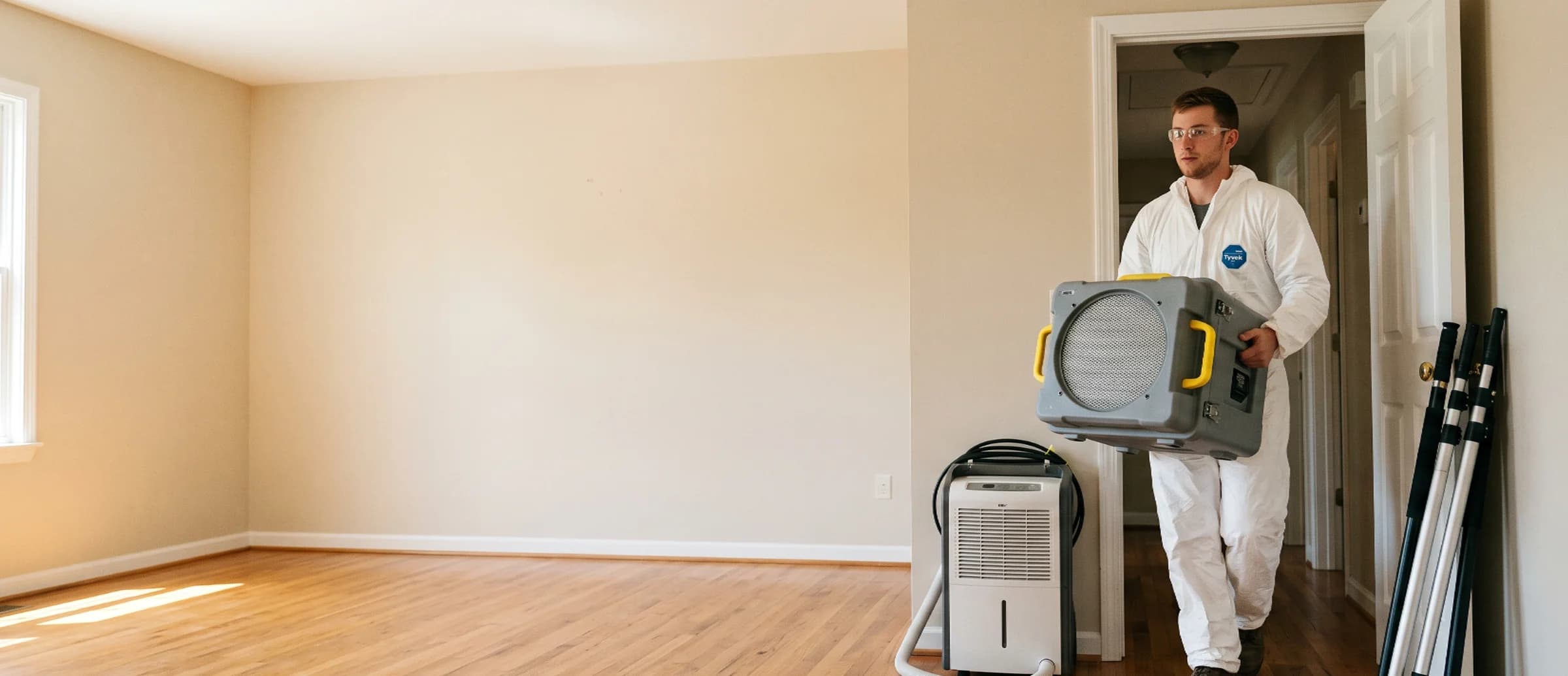

Most homeowners pay $1,500 to $6,000 for professional mold remediation, with a national average of about $2,400 and a typical rate of $10 to $25 per square foot. Small jobs under 10 square feet run $500 to $1,500, while mold in HVAC systems, crawlspaces, or behind walls can push costs much higher. Mold remediation is the professional process of containing, removing, and treating fungal growth in a building, performed according to ANSI/IICRC S520, the industry standard. This guide breaks down pricing by infestation size, location, and mold type, and explains what is and isn't included in a quote, so you know what to expect before you call a contractor. If you are still deciding whether professional help is needed, see when mold remediation is required first.
Cost insights
- Mold type affects price significantly. Black mold (Stachybotrys) requires full containment and specialized disposal, adding substantially to the cost of an otherwise similar job.
- Location drives complexity. Mold in crawlspaces, behind walls, and inside HVAC systems costs more because of access difficulty and the equipment required, not just the size of the infestation.
- Remediation and reconstruction are separate costs. Removing contaminated drywall and insulation is part of remediation; replacing it is typically a separate contract that many homeowners don't budget for.
- Moisture control is part of the real cost. A job that doesn't fix the underlying leak or humidity problem will need to be redone. Factor in any moisture repairs when comparing total project cost.
- Post-remediation testing adds $200–$600. Clearance testing after the job confirms the work was done correctly and is worth including in your budget, especially for large or black mold infestations.
Factors that affect mold remediation cost
Five variables drive the final cost of mold remediation: the size of the infestation, the type of mold present, where it is growing in the home, whether active water damage is involved, and how much structural material must be removed and replaced.
 Early to moderate wall corner growth like this often costs less than an identical infestation hidden behind drywall, since containment scales with access difficulty as much as square footage.
Understanding how these factors interact helps explain why two jobs of similar visible size can produce dramatically different quotes. A 50 square foot surface mold patch in an accessible bathroom costs far less than a 50 square foot infestation behind a finished basement wall, even though the affected area is identical.
Size of the mold infestation
Jobs under 100 square feet typically stay in the $500–$1,500 range. Once mold crosses 300 square feet or spreads into multiple rooms, costs escalate quickly because full containment systems and more labor hours are required. Understanding the full mold remediation process helps clarify why larger jobs cost significantly more.
Type of mold
Black mold (Stachybotrys) and certain Aspergillus species require more intensive containment and specialized disposal, which adds to labor time and equipment costs compared to common surface molds like Cladosporium.
Location of the mold
Crawlspaces, wall cavities, and HVAC systems cost more to remediate than open, accessible surfaces, both because of the difficulty of access and because hidden mold often goes undetected longer, allowing it to spread further before treatment.
Water damage
If the moisture source is not identified and fixed as part of the project, mold will return. This includes leaks, flooding, and chronic humidity. Some contractors include moisture remediation in their scope; others do not. Confirm this before signing any contract. For more on the relationship between water events and mold growth, see mold after water damage.
Structural damage
When mold has penetrated drywall, insulation, or subflooring, those materials must be removed and disposed of, and then replaced. Reconstruction after remediation is typically a separate cost that is not included in most remediation quotes.
Before scheduling remediation, read our mold inspection cost guide to understand what a professional assessment involves and what it costs.
Mold remediation cost by size of infestation
The size of the affected area is the single biggest driver of remediation cost. Larger infestations require more containment equipment, longer labor hours, and more material removal. The EPA defines a small mold problem as under 10 square feet, the threshold below which trained homeowners may attempt cleanup themselves, which gives useful context for understanding how contractors scale their pricing above that point.
 Baseboard level growth like this typically falls in the 10 to 100 sq ft small job range, running $500 to $1,500 before any drywall removal is needed.
Small surface mold problems that can be accessed directly and cleaned without demolition sit at the low end of these ranges. Costs increase sharply when mold is hidden behind drywall, has penetrated insulation, or has spread across multiple rooms, all of which require full containment systems, HEPA air filtration, and material removal.
| Area | Size | Cost | Examples |
|---|---|---|---|
| Small | Under 10 sq ft | $500–$1,500 | Corner of a room, small drywall patch |
| Medium | 10–100 sq ft | $800–$4,000 | Large wall section, multiple small areas |
| Large | 100–300 sq ft | $2,500–$9,000 | Entire room, attic section, basement |
| Very large | 300–1,000 sq ft | $6,000–$20,000 | Multiple rooms, whole floor |
| Whole house | 1,000+ sq ft | $15,000–$30,000+ | Widespread contamination across rooms |
Mold remediation cost per square foot
Most professional remediation companies price jobs at $10–$25 per square foot for standard work. When the job involves demolition, structural material removal, or rebuild work after mold is cleared, effective per-square-foot costs can reach $30 or more. A 50 sq ft bathroom job typically runs $1,200–$2,800; a 200 sq ft attic job runs $4,000–$9,000. See our dedicated guide on mold remediation cost per square foot for a full breakdown of how contractors arrive at their estimates.
Mold remediation cost by location in the home
Where mold is located affects cost as much as how large the infestation is. Areas that are difficult to access, such as crawlspaces and HVAC systems, require more labor and specialized equipment regardless of infestation size.
 Grout line and caulk seam mold sits at the low end of the $500 to $2,000 bathroom range; cost rises once growth is traced behind tile.
The table below covers typical ranges by location. Jobs at the lower end involve surface-level mold on accessible materials; jobs at the upper end involve hidden mold behind finished surfaces, saturated insulation, or structural framing that must be replaced. ANSI/IICRC S520 classifies mold contamination into three levels based on affected area and material type, and location is a primary factor in determining which level applies.
| Location | Cost | Key cost factors |
|---|---|---|
| Bathroom | $500–$2,000 | Tile removal, hidden plumbing leaks, subfloor damage |
| Basement | $1,500–$7,000 | Finished walls, flooring, wood framing, moisture control |
| Attic | $1,000–$5,000 | Roof sheathing, insulation removal, ventilation repairs |
| Crawlspace | $2,000–$10,000 | Difficult access, vapor barriers, encapsulation |
| HVAC system | $3,000–$10,000 | Ductwork cleaning, air handler treatment, HEPA filtration |
| Behind walls | $2,000–$8,000 | Drywall demolition, framing treatment, reconstruction |
Bathroom
Bathrooms are among the most common locations for mold growth because of persistent humidity and frequent moisture exposure. Surface mold around grout lines or ceiling corners sits at the low end of the cost range, typically $500 to $2,000. Costs rise significantly when mold has spread behind tile walls, under bathtubs, into drywall, or around leaking plumbing that was not caught early.
Basement
Basements are one of the highest-risk areas for mold due to ground moisture, limited ventilation, and susceptibility to flooding or slow foundation leaks. Finished basements with drywall, carpet, and insulation cost more to remediate than unfinished concrete spaces because more material must be removed, with costs typically ranging from $1,500 to $7,000.
Attic
Attic mold typically originates from poor ventilation or roof leaks that allow warm, moist air to accumulate against cold roof sheathing. Because mold often grows on wood framing and sheathing over a long period before being discovered, infestations can be larger than expected, with remediation costs ranging from $1,000 to $5,000.
Crawlspace
Crawlspaces present some of the most complicated and expensive remediation scenarios, typically costing $2,000 to $10,000. Limited access, ground moisture, and poor airflow create ideal conditions for mold to spread across floor joists, insulation, and subflooring. Most crawlspace remediations include encapsulation and vapor barrier installation as part of the final moisture control plan.
HVAC system
Mold in HVAC systems is particularly serious because the system actively spreads spores throughout every room of the home whenever it runs, with remediation typically costing $3,000 to $10,000. Remediation involves cleaning ductwork, treating air handlers and coils, and in some cases replacing insulated duct sections that cannot be fully decontaminated.
Behind walls
Mold behind walls is often discovered late because the surface appears dry while growth continues undetected, making it one of the more costly scenarios at $2,000 to $8,000. Remediation requires drywall demolition to access and treat the framing behind it, followed by reconstruction once the area has been cleared.
Mold remediation cost by mold type
Mold type affects remediation cost because different species require different levels of containment, PPE, and disposal protocols under ANSI/IICRC S520. Stachybotrys chartarum (black mold) consistently produces the highest costs due to mandatory full containment requirements, while common surface species like Cladosporium typically allow standard containment protocols.
 Stachybotrys confirmation triggers ANSI IICRC S520 full containment protocols, which is why black mold jobs price higher than surface species like Cladosporium.
Species identification through professional mold testing before work begins allows contractors to scope the job accurately and prevents mid-project cost surprises when a more intensive protocol turns out to be required.
| Mold type | Relative cost | Why it affects price |
|---|---|---|
| Cladosporium | Lower | Common surface mold, standard containment usually sufficient |
| Aspergillus | Moderate | Multiple species with varying toxicity, may require enhanced PPE |
| Penicillium | Moderate | Often found in water-damaged materials, spreads readily |
| Stachybotrys (black mold) | Higher | Requires full containment, HEPA filtration, and specialized disposal |
| Chaetomium | Moderate-High | Often co-occurs with Stachybotrys after serious water damage |
For full details on Stachybotrys removal see our black mold removal guide. If you are unsure of the species, professional mold testing can identify what you are dealing with before work begins.
What is included in mold remediation cost
A standard mold remediation job includes labor, containment setup, HEPA air filtration, antimicrobial treatment, and material removal and disposal, but does not typically include post-remediation reconstruction or clearance testing unless specified in the contract. Labor accounts for 50%–65% of total cost on most jobs, making it the single largest variable between competing quotes.
 HEPA filtration equipment accounts for 5 to 10 percent of a typical remediation quote and runs throughout the job, not just during removal.
Always ask contractors for an itemized written estimate. This makes it easier to compare bids and understand exactly what each quote includes versus what will be billed separately after the work is complete.
| Component | Share of cost | Notes |
|---|---|---|
| Labor | 50%–65% | Largest single component; varies with job complexity and access difficulty |
| Containment setup | 5%–10% | Plastic sheeting, negative air pressure systems, sealing HVAC vents |
| HEPA air filtration equipment | 5%–10% | Air scrubbers running during and after remediation |
| Antimicrobial treatment | 5%–10% | Applied to surfaces after mold removal to inhibit regrowth |
| Material removal and disposal | 10%–20% | Drywall, insulation, flooring; cost rises with volume |
| Personal protective equipment | 2%–5% | Respirators, suits, gloves; included in most professional quotes |
Post-remediation repairs and reconstruction costs
Reconstruction after remediation is typically a separate cost not included in most remediation quotes, and can add $500 to $10,000 or more depending on the extent of material removal. NIOSH guidance on dampness and mold in buildings identifies porous material replacement, not surface cleaning, as the required approach for mold that has penetrated drywall and insulation, which is why material removal costs are so frequently larger than homeowners expect.
| Repair type | Cost |
|---|---|
| Drywall replacement (per room) | $500–$2,000 |
| Insulation replacement | $500–$2,500 |
| Subfloor repair or replacement | $500–$3,000 |
| Flooring replacement | $1,000–$5,000 |
| Painting after drywall repair | $300–$1,200 |
| Full room restoration (severe damage) | $3,000–$10,000+ |
When comparing remediation quotes, ask each contractor whether reconstruction work is included in their scope or whether you will need to hire a separate contractor for that phase.
Who performs mold remediation and reconstruction
Mold remediation and reconstruction are typically handled by two different types of contractors. Remediation-only specialists focus exclusively on containment, mold removal, and treatment. Full-service restoration companies handle both phases under one contract.
Neither approach is inherently better, but a remediation-only quote can look significantly cheaper upfront while leaving you with substantial reconstruction costs. Always confirm the scope of work in writing before signing any contract.
Post-remediation clearance testing
Post-remediation clearance testing is independent air sampling conducted after mold remediation to confirm that airborne spore counts have returned to normal background levels, per ANSI/IICRC S520. It must be performed by a company separate from the one that completed the remediation, and results are typically available within 24–72 hours of sampling.
| Service | Typical cost |
|---|---|
| Pre-remediation mold inspection | $300–$800 |
| Pre-remediation mold testing (air or surface sampling) | $300–$1,000 |
| Post-remediation clearance testing | $200–$600 |
| Combined inspection and testing (pre-remediation) | $400–$1,500 |
Clearance testing is strongly recommended for large infestations, situations involving black mold, and any job affecting HVAC systems.
Professional remediation vs. DIY mold removal costs
DIY mold removal is appropriate only for patches under 10 square feet on hard, non-porous surfaces, per EPA guidance. Anything larger, hidden behind building materials, or involving HVAC systems requires professional remediation. For a full walkthrough of what DIY cleanup involves and where it falls short, see the DIY mold removal guide.
| Option | Cost | Best for | Key limitation |
|---|---|---|---|
| DIY cleanup | $50–$300 | Small, visible surface mold on hard materials | Cannot address hidden mold; spores can spread without proper containment |
| Professional remediation | $1,500–$6,000 | Moderate infestations, unknown source, mold in walls or HVAC | Higher upfront cost |
| Structural remediation | $5,000+ | Severe damage to walls, flooring, or framing | May also require reconstruction contractor |
DIY mold removal typically involves commercial mold removers, household bleach solutions, and N95 or P100 respirators. Protective equipment costs $30–$80 for a basic kit. The hidden cost of DIY is the risk of inadequate containment, which can spread spores to other areas of the home.
How to reduce mold remediation costs
Getting multiple quotes, confirming the moisture source is included in the scope, and acting quickly before the problem grows are the most effective ways to reduce total remediation cost. ANSI/IICRC S520 requires that the underlying moisture source be corrected before or during remediation; contractors who skip this step are not following the standard and are likely to produce a job that fails within months.
- Get at least three quotes. Remediation pricing varies significantly between contractors, and a second or third quote often reveals whether the first estimate was reasonable.
- Address the moisture source first. A contractor who remediates mold without fixing the underlying leak or humidity problem will produce a result that fails within months.
- Ask what is and is not included. Some quotes include post-remediation clearance testing; others do not. Some include reconstruction of removed drywall; others leave that as a separate contract.
- Confirm the contractor's certifications. Look for IICRC credentials, specifically the Applied Microbial Remediation Technician (AMRT) certification. See the full mold remediation certifications guide to understand what each credential requires.
- Do not delay. Small mold problems become large ones quickly. A $500 surface remediation can become a $5,000 wall remediation if the moisture source is not addressed.
Red flags when hiring a mold remediation contractor
The EPA and IICRC both emphasize that mold remediation is a regulated process requiring specific containment, filtration, and verification steps, which means there are clear standards against which any contractor's practices can be measured. The following patterns are reliable indicators that a contractor is cutting corners or misrepresenting their qualifications.
- Pressure to sign immediately or warnings that prices will increase. Legitimate contractors do not manufacture urgency.
- No written scope of work. Never pay for remediation without a written contract specifying containment procedures, materials to be removed, and what post-job verification is included.
- Inability to explain their containment approach. Any professional should be able to clearly describe how they will prevent spores from spreading to unaffected areas.
- Guaranteed complete mold elimination. No reputable contractor promises this. The goal of remediation is to reduce concentrations to normal background levels, not eliminate all spores.
- Inspection and remediation performed by the same company without disclosure. While not inherently problematic, the conflict of interest should be acknowledged. Some states require independent testing.
If you are uncertain about the health implications of the mold in your home, see is mold dangerous before making decisions about scope or urgency.
Does homeowners insurance cover mold remediation?
Homeowners insurance covers mold remediation when the mold resulted from a sudden, covered peril such as a burst pipe or storm damage. Mold from gradual moisture problems, long-term humidity, deferred maintenance, or flooding is generally excluded. Most policies that do cover mold cap the payout between $1,000 and $10,000, which may fall short of the actual remediation cost for a moderate-to-large job.
Documenting the signs of mold before contacting your insurer helps establish the scope and timing of the problem. Contact your insurer before remediation begins rather than after.
| Cause of mold | Typically covered? | Notes |
|---|---|---|
| Burst pipe | Often covered | Sudden and accidental; most standard policies include this |
| Appliance leak (sudden) | Often covered | Coverage depends on whether the appliance failure was sudden vs. gradual |
| Storm or wind-driven rain damage | Often covered | Requires homeowners policy; coverage varies by policy terms |
| Flooding (ground water) | Usually not covered | Requires separate flood insurance (NFIP or private) |
| Long-term humidity or condensation | Usually not covered | Classified as maintenance issue; typically excluded |
| Roof leak (neglected) | Usually not covered | Deferred maintenance exclusions apply in most policies |
| Roof leak (storm-caused) | Often covered | Sudden storm damage typically covered; neglect exclusions may apply |
How to hire a mold remediation professional
Hiring a reputable mold remediation contractor requires verifying IICRC AMRT certification, obtaining a written scope of work before any payment, and confirming that post-remediation clearance testing is either included or separately arranged. For a full list of questions to ask before signing, see questions to ask a mold remediation company. When comparing companies, collect at least three quotes and ask each contractor the same set of questions.
 A moisture meter reading like this should accompany any scope of work; without it, a contractor cannot confirm whether the source has actually been resolved.
- Do you specialize in mold remediation or general contracting?
- What certifications do your technicians hold?
- How will you contain the mold during the job to prevent spores from spreading?
- What equipment will you use to filter the air during remediation?
- Will you identify and address the moisture source, or is that separate from your scope?
- Which materials will need to be removed, and is reconstruction included in your estimate?
- Is post-remediation clearance testing included, or is that a separate cost?
- Can you provide references from similar projects or documentation of past clearance test results?
Frequently asked questions
How much does mold remediation cost?
Most homeowners pay $1,500–$6,000 for mold remediation, with a national average around $2,400. Small isolated surface infestations may cost $500–$1,500, while large infestations affecting structural materials, crawlspaces, or HVAC systems can reach $10,000–$30,000 or more.
What is the difference between mold removal and mold remediation?
Mold removal refers to the physical process of eliminating visible mold. Mold remediation is a broader term that encompasses removal, containment, air filtration, treatment of affected surfaces, and addressing the moisture source that caused the mold.
How long does mold remediation take?
Most residential remediation projects take one to five days. Small isolated areas may be completed in a single day. Whole-house remediation or jobs requiring significant structural demolition can take a week or longer. Post-remediation clearance testing typically occurs 24–48 hours after the work is complete.
What is included in a mold remediation job?
A standard professional remediation job includes containment of the affected area, HEPA air filtration during the work, physical removal of mold-contaminated materials, antimicrobial treatment of affected surfaces, and proper disposal of removed materials. It does not typically include reconstruction of removed drywall or flooring, or post-remediation clearance testing unless specifically included in the contract.
Can I stay in my home during mold remediation?
For small, isolated infestations, remediation crews typically contain the work area well enough that residents can remain in other parts of the home. For larger infestations, work involving HVAC systems, or multiple-room contamination, temporary relocation is advisable until remediation and clearance testing are complete.
Does homeowners insurance cover mold remediation?
Insurance typically covers mold remediation when mold resulted from a sudden covered peril, such as a burst pipe or storm damage. Mold from gradual moisture problems, long-term humidity, or deferred maintenance is generally excluded. Most policies cap mold coverage between $1,000 and $10,000.
Can I remediate mold myself?
The EPA allows homeowners to clean mold covering areas under 10 square feet using appropriate protective equipment and cleaning solutions on hard, non-porous surfaces. For anything larger, hidden behind walls, or involving HVAC systems, professional remediation is recommended.
How do I prevent mold from coming back after remediation?
Preventing recurrence requires fixing the moisture source that caused the mold. This typically means repairing leaks, improving ventilation, and maintaining indoor humidity below 50%. Any future water damage should be dried within 24–48 hours, as mold can begin growing within that window.
Is mold remediation tax deductible?
Mold remediation is not typically deductible as a standard home maintenance expense. However, if mold damage qualifies as a casualty loss under IRS rules, it may be deductible on your federal taxes. Consult a tax professional to assess whether your specific situation qualifies.
How can you tell if mold is growing behind walls?
Warning signs of hidden mold include persistent musty odors, water stains or discoloration on walls and ceilings, peeling or bubbling drywall, and any history of water intrusion in the area. A professional mold inspection using moisture meters and infrared cameras can identify elevated moisture levels inside wall cavities without opening them up.
Will mold come back after remediation?
Mold can return after remediation if the underlying moisture problem is not resolved. Professional remediation removes active growth and reduces spore concentrations to acceptable levels. Controlling moisture is the only reliable way to prevent recurrence long-term.
- U.S. Environmental Protection Agency (EPA): A Brief Guide to Mold, Moisture, and Your Home
- EPA Mold Remediation in Schools and Commercial Buildings (2008)
- IICRC S520 Standard for Professional Mold Remediation
- National Institute for Occupational Safety and Health (NIOSH): Dampness and Mold in Buildings
- American Council for Accredited Certification
- American Industrial Hygiene Association
Sam Hickerson is the founder of RestoreAdvisor and writes consumer guides on mold remediation, water damage restoration, inspection, testing, and home recovery. His work focuses on helping homeowners understand costs, risks, and when to call a professional. He draws on guidance from the EPA, CDC, IICRC, and other authoritative sources to make complex home issues easier to navigate.