
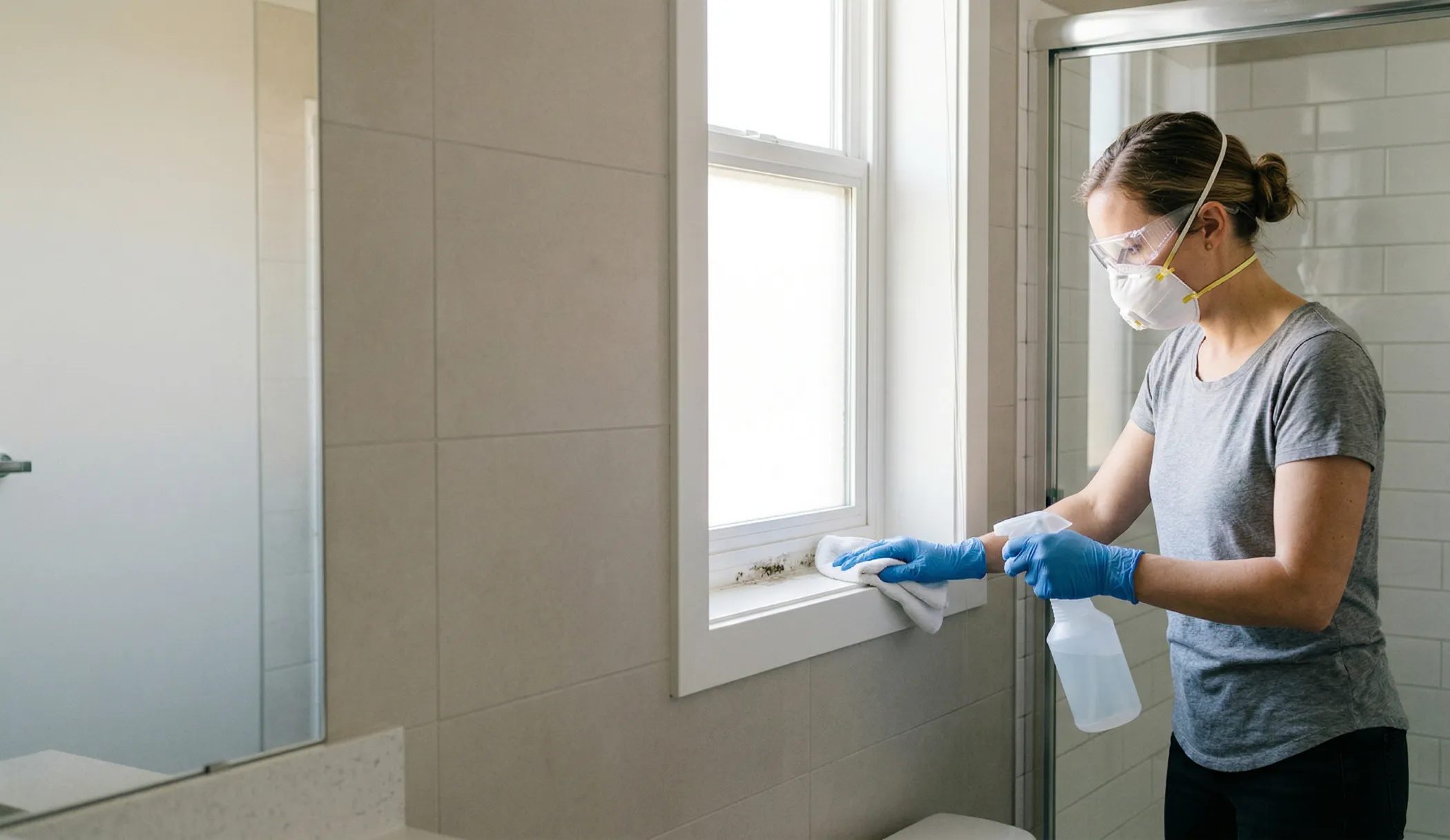

Most household mold problems start small. A dark patch on bathroom grout. Discoloration along a window sill. Black spots creeping up a basement wall. In many cases, a homeowner with the right supplies and a clear process can handle it.
But mold cleanup done wrong is worse than mold left alone. Scrubbing without containment spreads spores to clean rooms. Using bleach on porous surfaces fades the stain while the colony keeps growing underneath. Skipping the HEPA vacuum after cleanup redeposits everything you just loosened back into the air.
This guide covers the complete DIY process for mold jobs under 10 square feet on non-porous or semi-porous surfaces, following EPA cleanup guidance and ANSI/IICRC S520 protocol for the cleanable-versus-remove threshold. Signs of mold covers identification across surfaces and locations if you have not yet confirmed what you are dealing with.
Key insights
- The EPA threshold for DIY mold removal is 10 square feet, roughly a 3-foot by 3-foot patch. Anything larger requires professional containment, HEPA filtration, and clearance testing.
- Non-porous surfaces can be cleaned; porous materials must be removed. Mold threads root structures called hyphae into drywall, insulation, and carpet below the visible surface. Cleaning these materials leaves the colony intact.
- Fixing the moisture source is not the last step. It is the first. Any surface cleaned without correcting the underlying leak or humidity problem will develop mold again within days.
- A HEPA vacuum is non-negotiable. A standard shop vac does not filter mold spores. It blows them back into the air and spreads contamination to every surface in the room.
- Bleach does not work on porous surfaces. The EPA does not recommend bleach as a primary treatment. On drywall or wood, bleach fades the stain while the colony continues growing beneath the surface.
- A full DIY supply kit costs $196–$407. Skipping containment materials or PPE to reduce cost increases the risk of spreading contamination and personal exposure significantly.
Before you start: make sure this is a DIY job
The EPA draws the line at 10 square feet, roughly a 3-foot by 3-foot patch. Below that threshold, on non-porous materials, with no hidden growth and no vulnerable household members, DIY cleanup is generally appropriate. If any of the conditions below apply, stop and call a professional before disturbing anything.
Stop and call a professional if any of these apply:
- The affected area is larger than 10 square feet
- Mold is on drywall, insulation, carpet, ceiling tiles, or structural wood framing
- You can smell mold but cannot find the source
- The mold returned after a previous cleaning
- Any household member has asthma, COPD, a respiratory condition, or immune compromise
- The growth is dark greenish-black and slimy (possible Stachybotrys; do not disturb it before calling a professional)
- The mold followed a flood, sewage backup, or roof leak
If you are not certain your situation qualifies, the safest move is to review when mold remediation is required before disturbing anything.
What you are actually cleaning
The key distinction in DIY mold removal is whether the affected material is porous or non-porous. Non-porous surfaces can be cleaned; porous materials like drywall, insulation, and carpet must be removed and discarded because mold threads itself into the material below the surface.
Mold is a fungus. It does not just sit on surfaces the way dirt does. It threads root-like structures called hyphae into the material beneath it, which is why wiping visible mold off drywall or wood does not eliminate it. The colony survives below the surface and regrows, often within days. The health risk from disturbed spores is higher for certain populations; is mold dangerous covers exposure effects by population and species.
This is the foundational fact that determines everything else in this guide. Non-porous surfaces (tile, glass, sealed concrete, metal) can be cleaned because hyphae cannot penetrate them. Porous materials (drywall, insulation, carpet, ceiling tiles, untreated wood) cannot be effectively cleaned once mold has established itself below the surface. They must be cut out and discarded. The ANSI/IICRC S520-2024 standard, the professional benchmark for mold remediation work, draws this same hard line between cleanable and non-cleanable materials.
Every cleaning decision in this guide follows from that distinction.
What supplies you need before you start
A proper DIY mold removal kit costs $196 to $407 and must include a HEPA vacuum, N95 respirator, sealed safety goggles, 6-mil plastic sheeting, and nitrile gloves at minimum. Skipping any of these items risks spreading contamination or exposing yourself to spores. The two most commonly skipped items, the HEPA vacuum and the 6-mil plastic sheeting, are the ones that determine whether spores stay contained or spread to the rest of your home. If the scope of the problem is uncertain before you start, a professional assessment using moisture meters and thermal imaging establishes the full extent before any materials are disturbed. Hiring a qualified assessor means verifying mold remediation certifications before booking.
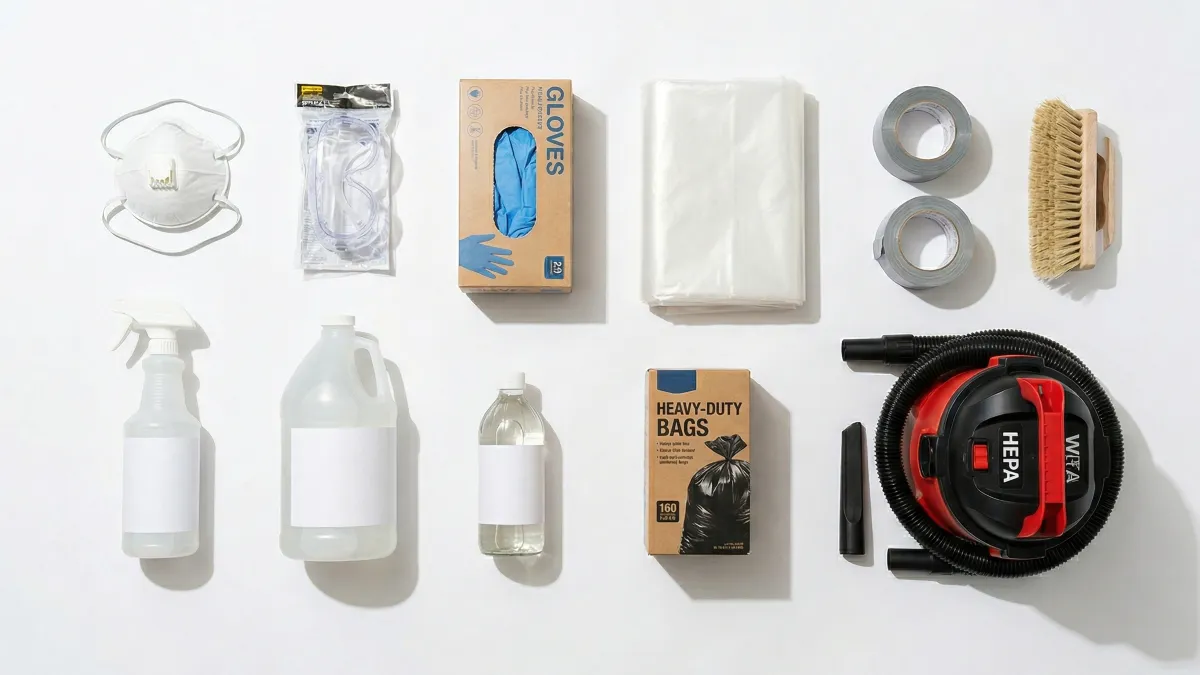
Every item in the table below serves a specific purpose in the containment and cleanup sequence. The PPE protects you during active cleaning, the containment materials prevent spores from migrating to clean areas of the home, and the HEPA vacuum captures what the cleaning process dislodges. Buying cheaper substitutes for any of these, especially thinner plastic sheeting or a non-HEPA vacuum, undermines the entire process.
| Supply / equipment | Estimated cost | Why it matters |
|---|---|---|
| N95 respirator (5-pack) | $15–$25 | Minimum respiratory protection for any mold job. Upgrade to a P100 half-face respirator if cutting or removing drywall. |
| Safety goggles (sealed, no vents) | $8–$20 | Standard open-vent safety glasses do not block spores. Goggles must seal against your face. |
| Nitrile gloves (box of 100) | $12–$20 | Non-latex. Pull them up over your sleeves so there is no gap at the wrist. |
| 6-mil plastic sheeting (10 x 25 ft roll) | $20–$35 | For sealing doorways, HVAC vents, and covering the floor. Thinner plastic tears and fails. |
| Duct tape (2 rolls) | $10–$16 | Seals every seam in your containment. Do not use masking tape. |
| Spray bottle | $3–$6 | For misting the surface before scrubbing. This single step prevents most spore spread during cleanup. |
| Stiff-bristle scrub brush | $5–$12 | Non-wire. Wire bristles damage tile grout and soft wood surfaces. |
| Dish detergent or white vinegar | $3–$6 | Primary cleaning agents. Detergent and water for most surfaces. Undiluted vinegar for grout and wood trim. |
| Heavy-duty 6-mil garbage bags (20-pack) | $15–$22 | Double-bag all removed materials before carrying them through the house. |
| Box fan (window-mount) | $25–$45 | Creates negative air pressure so spores move out, not through the rest of the home. Discard after the job. |
| HEPA wet/dry vacuum | $80–$200 | Non-negotiable. A standard shop vac does not filter spores. It blows them back into the air. |
| Total | $196–$407 | Full kit for a job under 10 sq ft |
The step-by-step process
Follow these steps in order. The sequence matters. Skipping containment setup (Step 2) before disturbing the mold (Step 4) is the most common DIY error and the one most likely to spread contamination to clean parts of the house.
Step 1: Fix the moisture source first
Find and repair the leak, condensation problem, or ventilation issue before touching anything. Mold is a symptom. If the moisture source is still active when you start cleaning, the mold will return within days. This step is not optional and it is not the last step. It is the first.
Common moisture sources to check:
- Plumbing leak (supply line, drain, or P-trap) behind or beneath the affected area
- Roof or flashing leak above the affected area
- Window condensation or a failed window seal
- Inadequate bathroom or kitchen exhaust ventilation
- Sustained indoor humidity above 60% relative humidity
Addressing the moisture source permanently is what mold prevention is built around, whether that means fixing a single leak or overhauling ventilation.
Step 2: Set up containment before disturbing anything
Close every door between the work area and the rest of the house. Tape 6-mil plastic sheeting across every doorway, HVAC supply and return vent, and any other opening. Cover the floor with plastic sheeting sealed to the baseboards. Mount the box fan in an outward-facing window and tape cardboard around the frame so air cannot re-enter around the edges. This creates negative pressure in the room: air moves from clean areas toward the work zone and out, not the other direction.
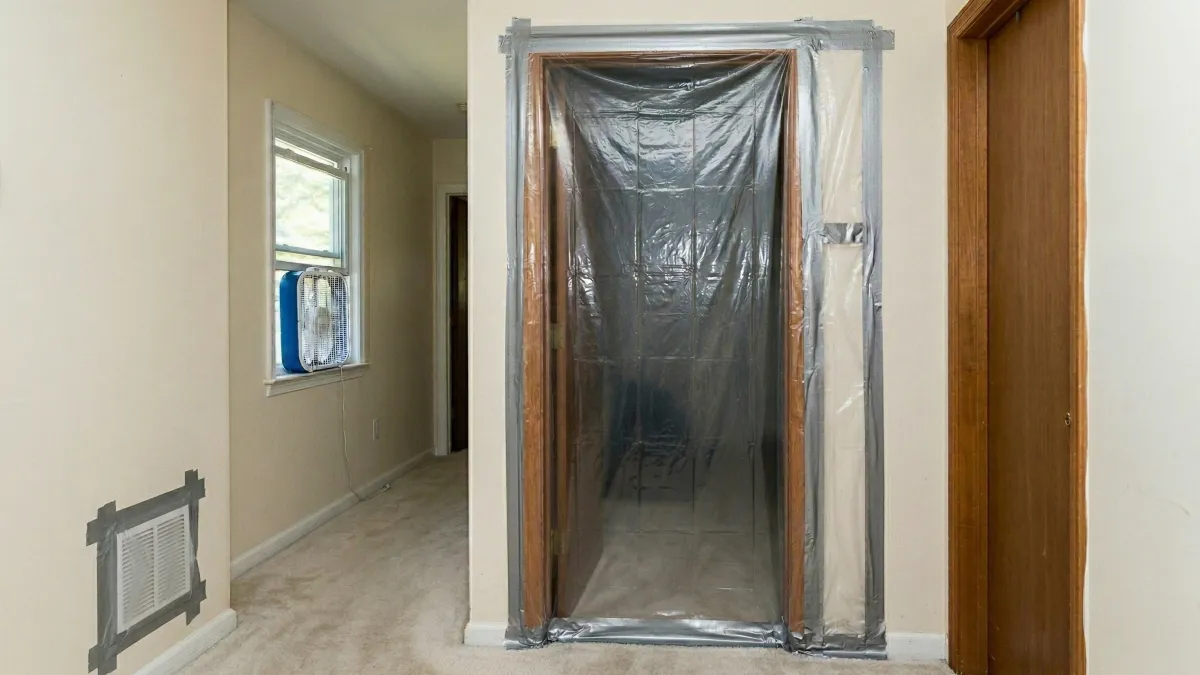
Turn off the HVAC system before starting. Running heating or cooling while disturbing a mold colony distributes spores through every room the system serves.
Step 3: Put on all PPE before entering the work area
The CDC recommends a minimum of an N95 respirator, sealed safety goggles, and non-latex gloves for any mold cleanup. For jobs that involve cutting or removing drywall, upgrade to a P100 half-face respirator and add disposable coveralls. Gear up outside the containment zone before stepping in. Spores become airborne the moment the surface is disturbed.
Step 4: Mist the surface before scrubbing
Lightly spray the moldy area with water or your cleaning solution before any scrubbing. This suppresses the spore cloud that becomes airborne the instant a colony is physically disturbed. It is one of the most commonly skipped steps in DIY cleanup and one of the main reasons mold spreads to new surfaces during the process.
Step 5: Clean by surface type
See the surface guide below for the correct cleaning solution and method for your specific material. The general rule: dish detergent and water for non-porous surfaces, scrubbed thoroughly and dried completely within 24 hours. Do not saturate drywall or wood. Do not leave cleaning solution pooled on any surface.
Step 6: Cut out porous materials that cannot be cleaned
Any drywall where mold has penetrated below the paint surface must be cut out and discarded, not cleaned. Per NYC Department of Health guidelines, cut at least 12 inches beyond the visible growth in every direction. Mold extends further than it appears. Place removed sections immediately into a 6-mil bag, fold the bag over the contaminated face, seal with tape, and double-bag before carrying through the house.
Step 7: HEPA-vacuum the entire work area
After cleaning and any material removal, vacuum every surface in the containment zone with the HEPA vacuum: walls, floor, and any exposed framing. Work top to bottom so dislodged particles fall to the floor and get vacuumed last. After the job, dispose of the HEPA filter and wash the vacuum tank, hose, and all attachments with detergent.
Step 8: Dry completely and verify
Run a dehumidifier and fans in the work area until moisture readings return to normal. Wood framing should read at or below 15% moisture content on a pin-type moisture meter before new drywall is installed. Check for regrowth at 48 hours and again at 5 days. If mold returns, the moisture source was not fully corrected or there is additional hidden growth that the cleanup did not reach.
Step 9: Restore and prevent recurrence
Apply mold-resistant primer to any exposed wood framing before hanging new drywall. In bathrooms and laundry rooms, use mold-resistant drywall (paperless or fiberglass-faced) rather than standard gypsum board. Apply grout sealer to all cleaned tile joints. Do not paint or caulk over any surface that still shows moisture, discoloration, or soft spots.
Surface-by-surface cleaning guide
The right cleaning approach depends entirely on whether the surface is porous or non-porous. For non-porous materials like tile, sealed concrete, and metal, the right product applied correctly removes the colony. For porous materials like drywall, carpet, and insulation, no product works once mold has penetrated below the surface; removal is the only option and the question of cleaning product is irrelevant.
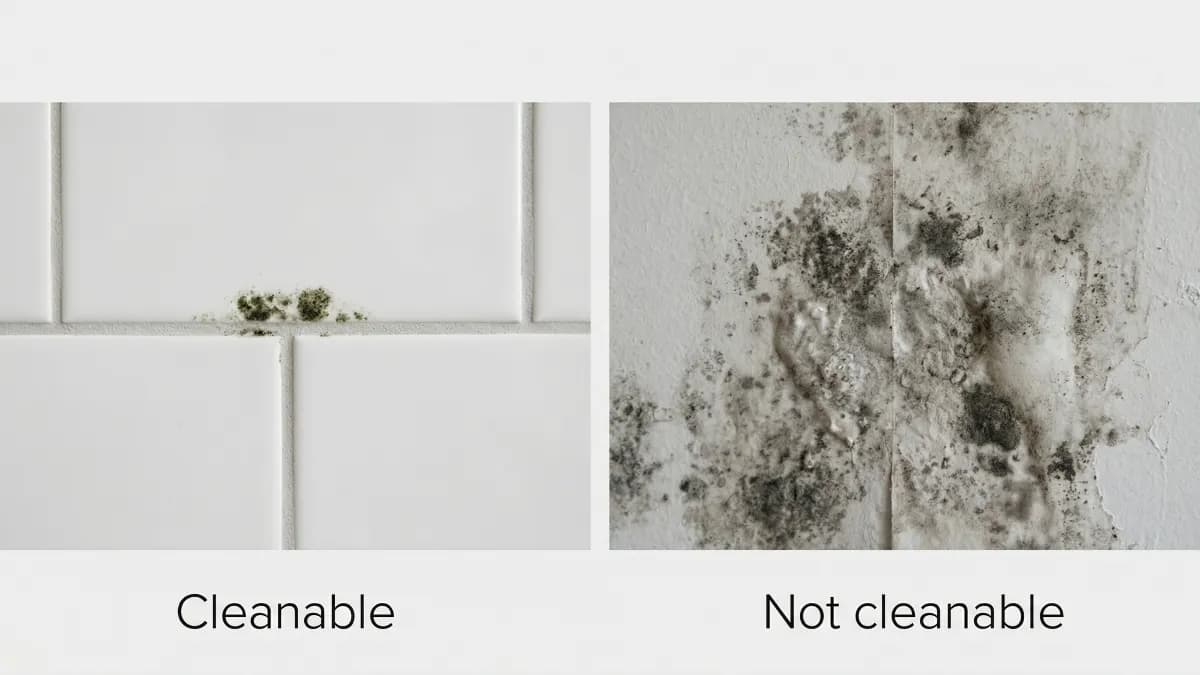
Non-porous surfaces like tile, sealed concrete, and wood trim can be cleaned with the right product and method. Porous materials like drywall, carpet, insulation, and ceiling tiles cannot be effectively treated once mold has penetrated below the surface, because no cleaning product reaches where the colony is rooted. Removal is the only option regardless of how small the visible growth appears.
| Surface | Correct cleaning agent | Method | Can it be saved? | DIY-appropriate? |
|---|---|---|---|---|
| Ceramic tile / tub surround | White vinegar or dish detergent + water | Spray, wait 15 min, scrub, rinse, dry completely | Yes | Yes |
| Shower grout | Hydrogen peroxide (3%) or baking soda paste | Apply, wait 10 min, scrub with stiff brush, rinse, dry | Yes if structurally intact | Yes |
| Painted drywall (surface growth only) | Dish detergent + water | Wipe gently, do not saturate, dry within 24 hours | Yes if mold has not penetrated paint | Yes, under 10 sq ft only |
| Drywall with mold below paint surface | N/A | Cut out 12 in. past visible growth in every direction; replace. See mold on drywall for the full removal process. | No | No. Call a professional. |
| Concrete (basement or crawl space) | Detergent + water or hydrogen peroxide (3%) | Scrub firmly, rinse, dry with fans. Do not use vinegar. | Yes (surface growth only) | Yes |
| Wood trim and baseboards | White vinegar undiluted | Spray, scrub, wipe with clean cloth, dry completely | Yes | Yes |
| Wood framing / structural studs | Detergent + water; biocide spray to follow | Sand or wire-brush shallow growth. Deep growth requires professional soda blasting. | Yes if structurally sound | Small surface areas only |
| Carpet and rugs | N/A | Cannot be cleaned. Mold embeds in the backing and pad. | No | Discard |
| Ceiling tiles | N/A | Highly porous. Mold fills the structure. | No | Discard |
| Insulation (any type) | N/A | Cannot be effectively cleaned regardless of product used. | No | Discard |
| Upholstered furniture | N/A for DIY | Surface cleaning may be possible. Consult a restoration specialist. | Possibly | Consult a specialist |
| HVAC ductwork | N/A | Requires professional duct cleaning and antimicrobial treatment. | Yes, with professional cleaning | No |
Cleaning products: what works and what does not
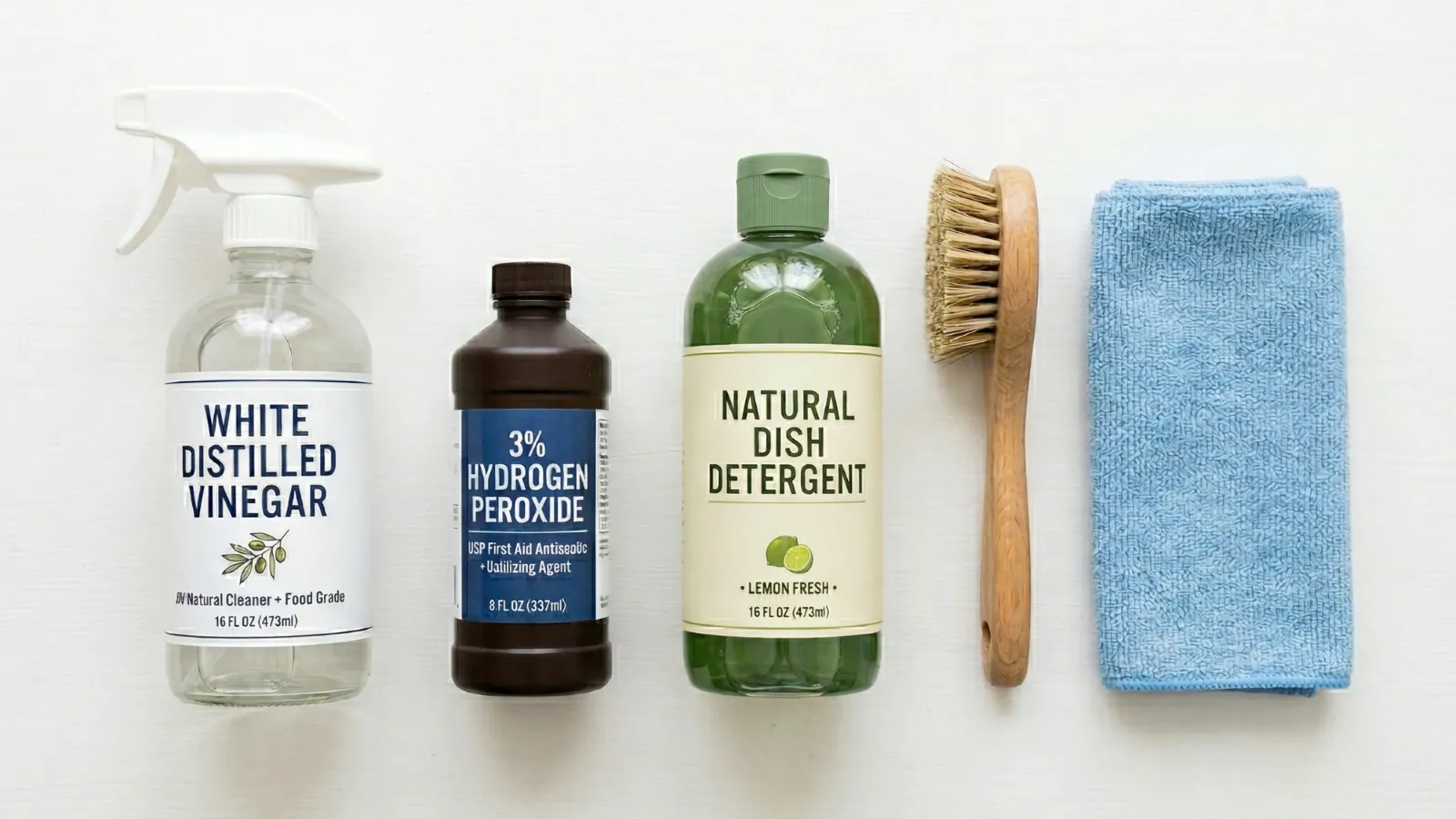
The right cleaning product depends on the surface. Detergent and water is the baseline the EPA recommends for most non-porous surfaces. Undiluted white vinegar and 3% hydrogen peroxide work on tile grout and wood trim. Bleach is not recommended by the EPA as a primary treatment because it cannot penetrate porous materials and leaves the colony intact below the surface.
Dish detergent and water
The baseline recommended by EPA guidance on mold cleanup for most non-porous surfaces. Detergent breaks the mold's bond with the surface and lifts it physically. Effective, inexpensive, and safe on virtually every cleanable surface. The right choice for tile, sealed concrete, and non-porous painted surfaces.
White vinegar (undiluted)
Undiluted white distilled vinegar kills most common household mold species on contact. Apply, wait 15 minutes, scrub, and dry completely. Effective on tile grout, wood trim, and caulk surfaces. It does not work on porous materials because it cannot reach below the surface where the colony is rooted. Do not use vinegar on concrete: its acidity degrades the surface over time.
Hydrogen peroxide (3%)
Effective on tile, grout, and concrete. Apply, wait 10 minutes, scrub, rinse, and dry. A reasonable alternative to vinegar on the same surfaces, particularly on concrete where vinegar is not appropriate.
Bleach
Bleach kills surface mold on non-porous materials only. On porous surfaces like drywall, wood, and grout, the sodium hypochlorite cannot penetrate below the surface. The water in the bleach solution soaks in, the chlorine evaporates, and the colony continues growing. EPA guidance does not recommend bleach as a primary treatment. Detergent and water is more reliable and safer on almost every surface. For Stachybotrys chartarum specifically, black mold removal requires professional containment regardless of what cleaning product is used.
Mold removal by location
Where mold is growing determines both the appropriate cleaning approach and whether DIY is realistic. Bathroom tile and grout is the most manageable scenario for a homeowner. Attic mold routinely exceeds 30 square feet by the time it is visible, which puts it beyond the EPA's 10 square foot DIY threshold in almost every case. Wall cavities and flooring require a professional regardless of visible size.
Bathroom
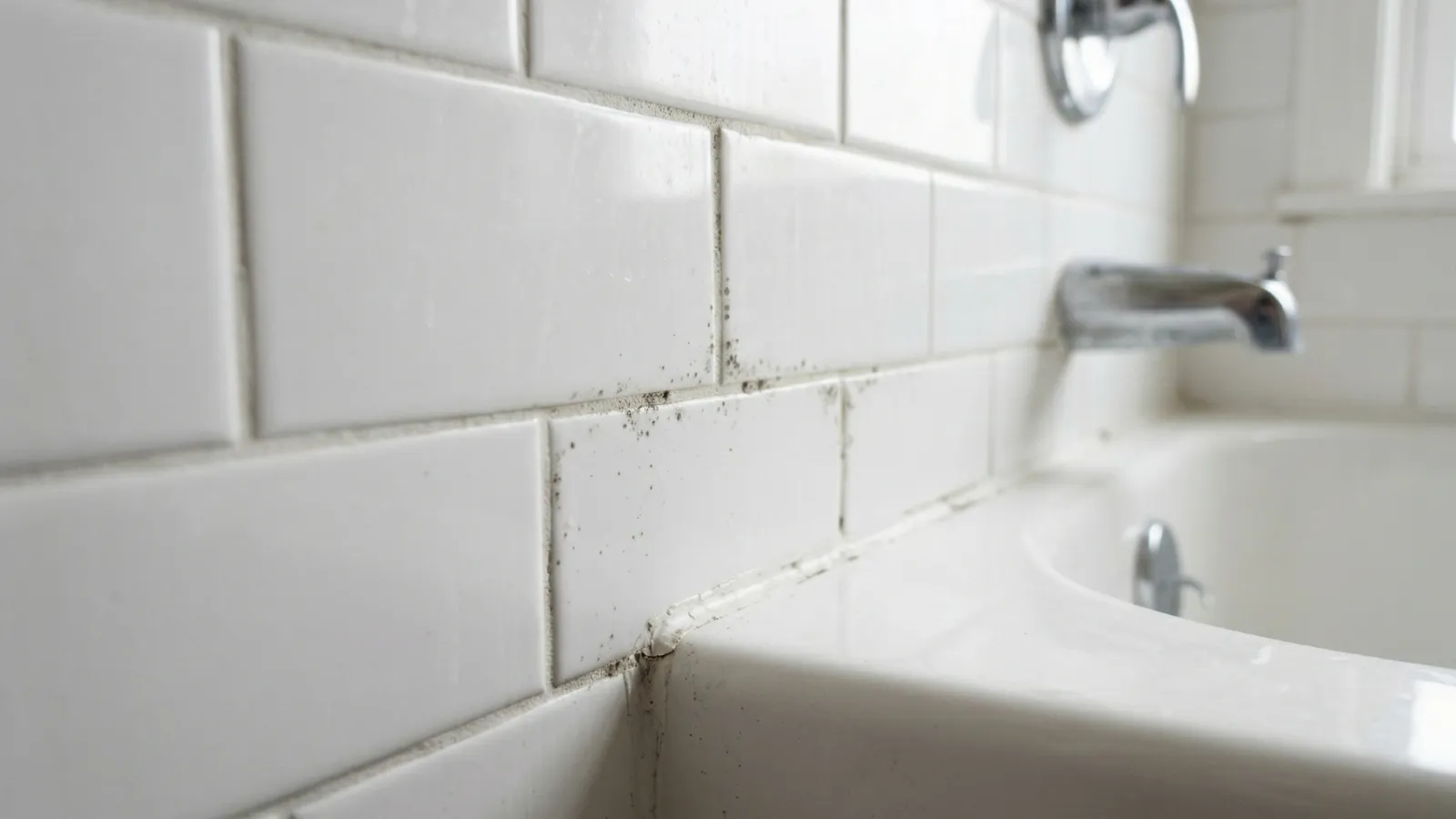
The most DIY-friendly location. Mold on tile, grout, and caulk is almost always surface growth on non-porous materials. Apply undiluted white vinegar, wait 15 minutes, scrub, rinse, and dry. Caulk that has visible mold through its full thickness should be cut out and replaced rather than cleaned. Prevention is straightforward: run the exhaust fan for at least 15 minutes after every shower. Most bathroom mold is a ventilation problem, not a structural one.
Basement
Two distinct situations. Surface mold on unpainted concrete block is generally a DIY job: scrub with hydrogen peroxide (3%) or detergent and water, rinse thoroughly, and run a dehumidifier continuously afterward. Mold on wood framing, finished drywall, or subfloor is different territory. Determine the moisture source and assess the full extent of growth before starting any cleanup.
Bathroom ceiling
Often caused by inadequate exhaust ventilation rather than a leak. If the ceiling is intact painted drywall with clearly surface-level growth, clean with dish detergent and water, dry completely, and improve ventilation going forward. If the drywall is soft, the paint is peeling, or the surface feels unstable, the drywall has been compromised by sustained moisture and needs to be cut out and replaced.
Attic
Almost never a DIY job. Attic mold typically originates from a roof leak or inadequate soffit-to-ridge ventilation and usually spreads across roof decking and rafters over months before it is discovered. By the time it is visible, the affected area routinely exceeds 30 square feet. The standard professional technique for attic mold on wood is soda blasting: food-grade sodium bicarbonate propelled at high pressure strips the contaminated surface layer without introducing moisture.
Behind walls or under flooring
Stop immediately and call a professional. Mold found inside wall cavities or beneath flooring has been growing in a sustained moisture environment, has penetrated porous building materials, and is almost certainly larger than what is visible at the point of discovery. The right next step is a mold inspection: a certified inspector uses moisture meters, infrared cameras, and a borescope to map the full extent of contamination before any materials are disturbed.
If water damage was the trigger, mold after water damage covers what typically happens inside walls and floors after a leak.
How to know when the job is done
Mold removal is complete when visible growth is gone, moisture readings in adjacent materials are at or below 15% on a pin-type moisture meter, and no regrowth appears at the 48-hour and 5-day checks. A surface that looks clean is not confirmation the job is done if moisture readings remain elevated or if the colony has penetrated below the surface layer.
If regrowth appears at either check, stop. The moisture source was not fully corrected or there is additional hidden growth the cleanup did not reach. At that point the situation has moved outside the scope of DIY. For professional remediation, the equivalent of this self-check is a post-remediation clearance air test conducted by an independent third party. Mold testing covers clearance testing methods and what results mean.
For jobs that exceed the DIY threshold, mold remediation covers the professional process from containment through clearance.
Frequently asked questions
Can I remove mold myself?
Yes, for jobs under 10 square feet on non-porous surfaces with the moisture source already fixed and no vulnerable household members. Above that threshold, or on porous materials like drywall, insulation, or carpet, DIY cleanup is not appropriate. If you cannot see the full extent of the growth, you do not actually know the size of the problem.
How much does it cost to remove mold yourself?
A properly equipped DIY job runs $196–$407 for the full supply kit listed above. If you already own a HEPA vacuum and basic PPE, the consumables run closer to $50–$80. Professional remediation typically costs $1,500–$6,000 depending on scope. Mold remediation cost covers what drives professional pricing if you are weighing the two options.
Does vinegar kill mold?
Yes, on non-porous surfaces. Undiluted white distilled vinegar kills most common household mold species on contact. Apply, wait 15 minutes, scrub, and dry completely. It does not work on porous materials because it cannot penetrate to where the colony is rooted.
Does bleach kill mold?
No, not reliably, and not on porous surfaces at all. Bleach kills surface mold on tile and tub surrounds but cannot penetrate porous materials. On drywall or grout, bleach fades the visible stain while the colony continues growing beneath the surface. Detergent and water is more reliable on almost every surface.
What kills mold permanently?
Nothing kills mold permanently on its own. Mold returns wherever moisture is present. The only permanent solution is eliminating the moisture source. Any surface that is cleaned and dried but exposed to ongoing moisture will develop mold again regardless of what product was used.
Do I need to test for mold before removing it?
Not for a straightforward small job on visible surface mold. Testing is most useful when you can smell mold but cannot locate it, when you want to confirm species before deciding on a removal approach, or when clearance testing is needed after professional work. Professional mold testing covers air sampling, surface swabs, and clearance testing; clearance testing confirms that remediation succeeded and that spore levels have returned to normal.
How long does DIY mold removal take?
Most jobs take 2–4 hours for surface cleaning on tile or grout, or most of a day for anything involving drywall removal. Drywall replacement adds 24–48 hours of drying time before the patch can be installed. Budget time for the moisture verification check at 48 hours before considering the job complete.
When should I stop and call a professional?
Call a professional if the area is over 10 square feet, if mold is on drywall or insulation, if you can smell it but cannot find it, if it came back after a previous cleaning, if a household member has a respiratory condition, or if the growth looks dark, slimy, and greenish-black. Any single one of these conditions is sufficient reason to stop. Professional remediation covers what a contractor does from containment through clearance testing.
- EPA: Mold Cleanup in Your Home
- EPA: What Are the Basic Mold Cleanup Steps?
- CDC: Mold Cleanup Guidelines and Recommendations
- NIEHS: Mold and Your Health
- OSHA: A Brief Guide to Mold in the Workplace (SHIB 03-10-10)
- ANSI/IICRC S520-2024: Standard for Professional Mold Remediation
- New York City Department of Health: Guidelines on Assessment and Remediation of Fungi in Indoor Environments
- Industry cost data: residential mold remediation pricing ranges, 2024–2025
Sam Hickerson is the founder of RestoreAdvisor and writes consumer guides on mold remediation, inspection, testing, and home recovery. His work focuses on helping homeowners understand costs, risks, and when to call a professional. He draws on guidance from the EPA, CDC, IICRC, and other authoritative sources to make complex home issues easier to navigate.