
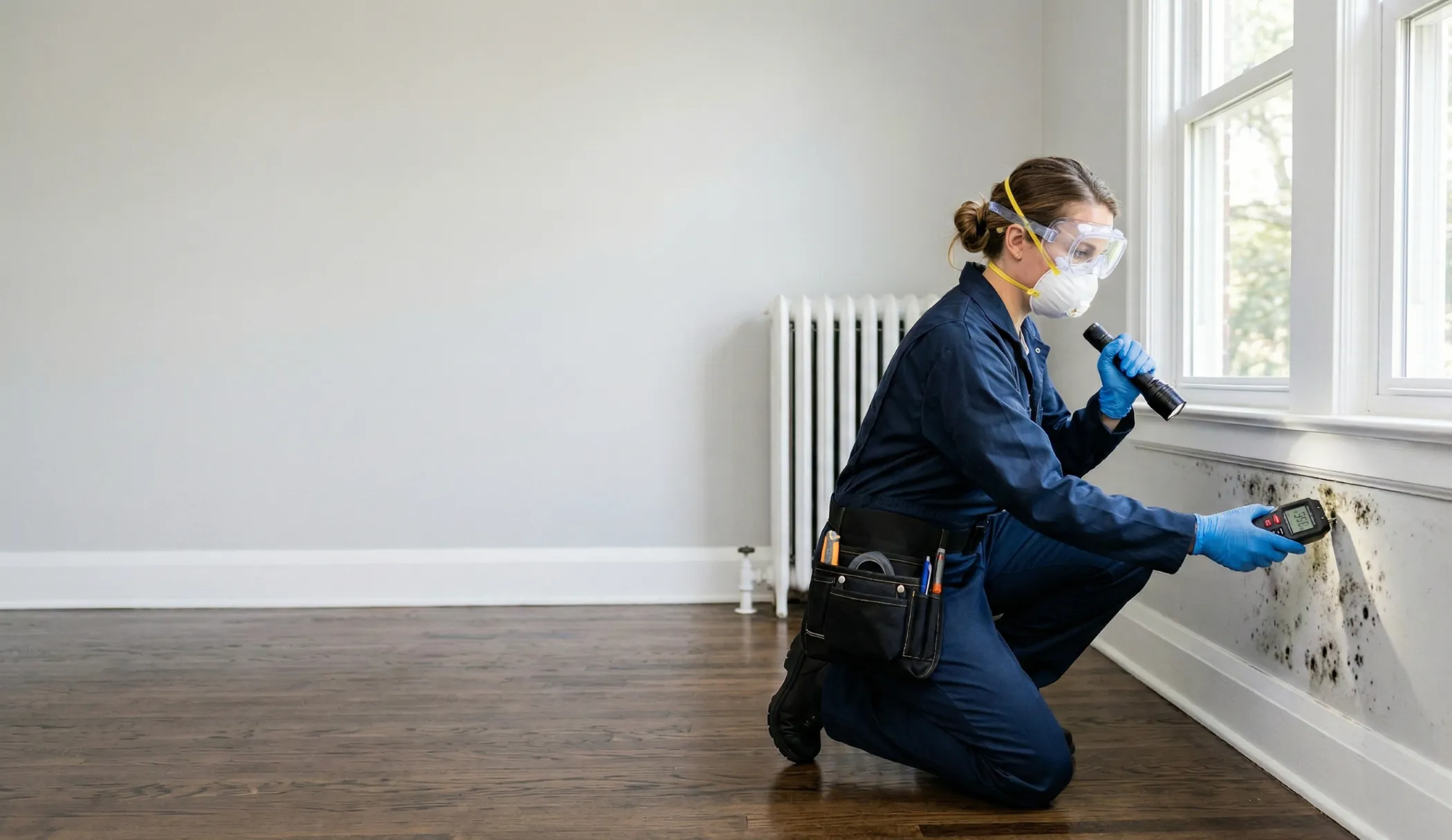

A mold inspection is a systematic on-site assessment of your home for mold presence, moisture sources, and the conditions sustaining growth. This page covers the full process step by step, which certifications are legitimate, how to vet an inspector before hiring, and which situations genuinely call for one.
Looking for pricing? Mold inspections typically run $300–$700 depending on home size and scope. See full cost breakdown.
Key insights
- A mold inspection assesses presence, location, and moisture source. It does not treat or remove mold.
- Inspection and remediation should always be done by separate companies.
- The inspection ends with a written report and remediation protocol. No written report means no accountability.
- Only ACAC and ABIH credentials are independently verified. Most other "certifications" are just course completion certificates.
- Mold can begin growing within 24–48 hours of water intrusion. After flooding, dry first, then inspect.
What a mold inspection is
A mold inspection is a professional, on-site evaluation defined under the ANSI/IICRC S520 Standard for Professional Mold Remediation as the assessment phase that determines mold presence, moisture sources, and remediation scope before any removal work begins. A trained inspector visits the property, examines moisture-prone areas with calibrated instruments, and delivers a written report documenting findings and a recommended course of action.
The inspection does not treat or remove mold. Its job is accurate diagnosis. A thorough inspection identifies not just where mold exists today, but what underlying conditions created it, because without fixing the moisture source, any remediation will eventually fail. Once mold is confirmed, mold remediation determines what needs to be removed and how.
According to a joint study by EPA researchers and Lawrence Berkeley National Laboratory, approximately 47% of U.S. homes have dampness or mold conditions. That prevalence makes accurate inspection, not assumption or guesswork, the critical first step for any homeowner dealing with suspected mold.
Why inspection comes before everything else
Remediation without inspection is guesswork. You cannot write a valid scope of work without knowing the affected materials, the spore concentrations, and the moisture source. Contractors who skip inspection and go straight to "removing all the mold" are either cutting corners or inflating scope. Without a prior inspection report, you have no independent benchmark to evaluate whether their work is complete when it's done.
Mold inspection vs. mold testing vs. mold remediation
A mold inspection locates mold and identifies moisture sources; mold testing uses lab analysis to identify species and spore concentrations; mold remediation is the physical removal of mold. Each serves a distinct purpose and should be performed by separate contractors.
| Service | What it does | Who performs it | When you need it | Typical cost |
|---|---|---|---|---|
| Mold inspection | Visual inspection + moisture mapping | Certified mold inspector | First step when mold suspected | $300–$700 |
| Mold testing | Air or surface samples analyzed by lab | Inspector + independent lab | When species or spore counts needed | $200–$500 |
| Mold remediation | Removal and containment of mold | Licensed remediation contractor | After inspection confirms scope | $1,500–$10,000+ |
Inspection and testing often happen during the same visit but are priced and scoped separately. Inspection tells you whether and where mold exists. Testing tells you what kind and how much. Both feed into a written remediation protocol, the document that specifies exactly what a contractor must do and how success is measured.
Keep inspection and remediation with different companies
The EPA's mold remediation guidance strongly recommends using separate companies for inspection and remediation work. A contractor who profits from removal has a financial incentive to find more mold than exists. The same principle applies after remediation is complete: post-clearance verification testing should be commissioned from the original inspector, not the contractor who did the work, before final payment is made.
The mold inspection process, step by step
A professional mold inspection follows a structured sequence: pre-inspection interview, visual assessment, moisture mapping, thermal imaging, air sampling, HVAC evaluation, and a written report with remediation protocol. A standard home takes two to three hours; properties with suspected hidden mold, large basements or crawlspaces, or comprehensive sampling requirements can run four to six hours.
 These are the same high-risk zones IICRC S520 directs inspectors to prioritize during the two to three hour visual assessment phase.
The steps below reflect what a qualified, thorough inspector does. Use this as a benchmark when evaluating whether a company you are considering is doing the full job.
1. Pre-inspection interview
A thorough inspector starts by asking questions before touching a single wall. What you've noticed, when symptoms started, which rooms or occupants are most affected, whether there's been any prior water damage or repairs, and whether symptoms improve when household members leave for extended periods. Room-specific symptoms suggest localized mold; whole-home symptoms increase the likelihood of HVAC involvement. This interview shapes where the inspector spends their time.
2. Visual assessment of all accessible areas
Every accessible area is examined for visible mold growth, water staining, discoloration, efflorescence on masonry, bubbling or peeling paint, and warped or buckled surfaces. High-priority zones are bathrooms, kitchens, basements, attics, crawlspaces, areas around windows and exterior walls, and anywhere near plumbing penetrations. If you've already noticed signs of mold in specific locations, point them out at the start of the walkthrough.
3. Moisture mapping
Using a calibrated moisture meter, the inspector measures moisture content in walls, floors, and ceilings throughout the home. Readings above 17%–20% in wood or drywall indicate active conditions for mold colonization. Moisture mapping is not optional; it finds the hidden wet zones that explain why mold is present even when it isn't yet visible. An inspector who skips moisture readings is conducting a visual scan, not an inspection.
4. Infrared thermal imaging (where offered)
A thermal camera detects temperature differentials in wall and ceiling surfaces that indicate hidden moisture, without cutting into walls. Evaporating moisture cools surfaces, creating a detectable thermal signature even when the surface appears normal. Not every inspector carries this equipment, but it meaningfully improves detection of mold behind tile, under flooring, and inside wall cavities. Ask whether thermal imaging is included before booking.
5. Air and surface sampling (when included)
When sampling is part of the scope, air cassettes collect spore counts from suspect rooms alongside a control sample taken outdoors for comparison. Surface swabs or tape lifts are collected from any visible growth. All samples are sealed, chain-of-custody documented, and shipped to an independent certified laboratory, never in-house. Results typically return in two to five business days. Mold testing covers sampling methods, lab standards, and how to read results in full detail.
6. HVAC and ductwork evaluation
The air handler, visible ductwork, and return registers are checked for mold growth and moisture. HVAC systems can distribute spores from a single contaminated zone to every room in the home with every cycle, making whole-home symptoms feel diffuse even when the source is localized. If distributed symptoms are part of your situation, specifically request that HVAC evaluation be included, as some companies offer it as an add-on rather than a default.
7. Written report and remediation protocol
A qualified inspection ends with a written report: findings with photographs, moisture readings by location, lab results once available, identification of the moisture source, and a prioritized remediation protocol specifying which materials need treatment or removal, what containment method is appropriate, and what clearance standards must be met before the project is considered complete. The IICRC S520 Standard for Professional Mold Remediation defines the clearance benchmarks a qualified protocol should reference. This document is the scope of work for any remediation contractor you hire. If an inspector won't commit to a written protocol, do not proceed with remediation on the basis of their verbal summary alone.
Tools a qualified inspector uses
A qualified mold inspector uses moisture meters, infrared thermal cameras, hygrometers, air sampling cassettes, surface swabs, and borescopes to detect mold and moisture beyond what is visible to the naked eye.
 An inspector without a moisture meter and thermal camera among these tools is running a visual scan, not a full inspection.
Equipment matters because mold is frequently invisible at the point it becomes a health concern. The tools below distinguish a thorough inspection from a visual walkthrough. If a company cannot describe these instruments or explain when and why they deploy them, that is a meaningful signal about their level of practice.
| Tool | What it detects | Why it matters |
|---|---|---|
| Moisture meter (pin or pinless) | Relative moisture content in building materials | Finds active wet zones before mold is visible; provides baseline readings for post-remediation comparison |
| Infrared thermal camera | Temperature differentials indicating hidden moisture pockets | Detects moisture behind walls and under floors without cutting; significantly expands detection range beyond visual methods |
| Hygrometer | Relative humidity by room | Identifies chronic humidity conditions above 60% that sustain mold even without a visible active water source |
| Air sampling cassettes | Airborne spore type and concentration | Quantifies invisible mold presence; comparison to outdoor baseline reveals elevated indoor counts not visible during walkthrough |
| Surface swabs and tape lifts | Mold species on visible growth | Lab analysis confirms species and informs remediation protocol; essential when black mold is suspected |
| Borescope (where needed) | Visual inside wall cavities and tight access points | Allows inspection of wall interiors through a small drilled hole rather than opening drywall, reducing repair costs and disruption |
Which certifications are legitimate
The only independently verified mold inspector credentials are those issued by ACAC and ABIH. All other certificates typically represent course completion only, with no proctored exam, no verified field experience, and no renewal requirement.
The mold inspection industry is unregulated in most U.S. states. Anyone can call themselves a mold inspector, print official-looking credentials, and charge for services regardless of knowledge or competence. The designations below are meaningful because they require verified field experience, a proctored examination administered by an independent accreditation body, and ongoing continuing education, not an online course and a processing fee.
The most respected certifications for residential mold work come from the American Council for Accredited Certification (ACAC), independently accredited by the Council of Engineering and Scientific Specialty Boards (CESB). Thirteen states (including California, Florida, New York, Texas, and Virginia) have formally adopted ACAC credentials as the basis for their state licensing programs. All ACAC credentials are verifiable by certificate number directly at acac.org. For the full breakdown of what each credential requires and how to verify them, see mold remediation certifications.
- Certified Indoor Environmental Consultant (CIEC) (ACAC). The highest residential IAQ designation. Requires 8 years of verified experience or a science degree plus field experience combination.
- Certified Microbial Consultant (CMC) (ACAC). Senior-level designation. Requires 8 years of field experience in microbial assessment.
- Certified Microbial Investigator (CMI) (ACAC). Mid-level credential. Requires 2 years of verified field experience before exam eligibility.
- Council-certified Residential Mold Inspector (CRMI) (ACAC). Entry-level residential credential requiring a proctored examination and verified field experience.
- Certified Industrial Hygienist (CIH) (ABIH). The highest overall industry standard. Requires a science degree and 5+ years of experience. Less common in residential work.
- Certified Environmental Thermography Consultant (CETC) (ACAC). Specialized credential for inspectors using infrared thermal imaging in environmental assessments. Requires verified field experience and a proctored examination.
A training certificate proves someone attended a course, nothing more. It requires no exam, no verified experience, and no renewal. Some companies pay for brief online courses and display the resulting seals on their websites as if they were equivalent to earned credentials. When evaluating an inspector, ask for their specific ACAC or ABIH designation and verify it by certificate number at acac.org or abih.org directly. If the credential cannot be confirmed through the issuing body's public directory, do not give it weight in your hiring decision.
How to hire a mold inspector
To hire a qualified mold inspector, verify ACAC or ABIH credentials independently, confirm they do not also offer remediation services, require a written scope before booking, and confirm they use an AIHA-accredited independent lab.
 Skipping step one, independent credential verification, is why unverifiable certifications remain the most common inspection scam.
Finding a qualified inspector in a lightly regulated industry takes a few deliberate steps. The approach below filters out the most common problems: conflicts of interest, inflated credentials, and no accountability for findings.
1. Verify credentials independently
Look up the inspector's ACAC designation at acac.org or CIH status at abih.org by certificate number before any phone call, not after.
2. Confirm they do not do remediation
Ask directly: does your company also perform mold remediation? If yes, use a different inspector. This single question eliminates the industry's most common conflict of interest.
3. Require a written scope before booking
Ask what is included in writing: moisture mapping, thermal imaging, air sampling, HVAC evaluation, independent lab, written report with remediation protocol. Vague answers predict vague reports.
4. Confirm independent lab use
Ask which laboratory processes their samples and whether it holds AIHA accreditation. In-house analysis is a red flag; there is no external check on results you receive.
5. Get at least two quotes
Compare quotes on equal terms: same sample count, same services, same lab turnaround. The lowest price often excludes lab fees and can look very different once they are added back in.
6. Read negative reviews for patterns
Recurring themes in negative reviews (unexpected up-sells, scare tactics before results, vague reports, delayed lab turnaround) matter more than the overall star average.
For the broader process of hiring and vetting a remediation contractor after an inspection confirms mold, see how to choose a mold remediation company.
Red flags and scams to avoid
The most common red flags in mold inspection are inspectors who also offer remediation, unverifiable credentials, scare tactics before lab results are available, and in-house sample analysis rather than independent lab use.
 A verbal summary without this written protocol leaves no benchmark for judging whether a remediation contractor's later work meets the ANSI IICRC S520 clearance standard.
Mold inspection is among the more fraud-prone categories in home services. Homeowner anxiety, technical complexity, and light regulation create openings for operators who use deliberate scare tactics to steer homeowners toward remediation scopes far larger than the actual problem warrants. These are the warning signs that should make you pause before proceeding.
- Inspector also offers remediation: The industry's most documented conflict of interest. A company profiting from removal has a direct financial incentive to find more mold than actually exists. Without an independent inspection, you cannot challenge their findings.
- No written report or protocol: Legitimate inspections produce a written report with photographs, moisture readings, and lab results. Verbal-only summaries provide no accountability, no valid basis for contractor bids, and no documentation for insurance purposes.
- Unverifiable certifications: Many certificates look official but carry no real credential. Verify any designation directly at acac.org or abih.org by certificate number, never from the inspector's own marketing materials.
- Scare tactics before lab results: Claims of immediate danger or evacuation urgency before any samples have been analyzed are manipulation, not science. Species identification requires lab work that takes two to five days; there are no exceptions.
- In-house lab analysis: Samples must go to an independent, AIHA-accredited third-party laboratory. An inspector who analyzes their own samples has no external check on the results they deliver to you.
- No moisture source identified: Every mold problem has a moisture source. An inspector who documents mold without identifying what is driving it has not finished the job, and any remediation done without fixing that source will fail.
Questions to ask before hiring a mold inspector
The most important questions to ask a mold inspector cover credentials and conflict of interest, testing and laboratory practices, scope and deliverables, and post-remediation clearance. An inspector who deflects or pressures you to book before answering them is a warning sign.
Credentials and conflicts of interest
- What certifications do you hold, and can I verify them by certificate number?
- Do you or your company also offer mold remediation services? (The answer you want is no.)
Testing and laboratory
- Which laboratory do you use for sample analysis, and is it AIHA-accredited?
- Do your sample fees include independent lab analysis, or is that billed separately?
- How many samples do you recommend for a home my size, and why that number?
Scope and deliverables
- What does your written report include, and will it contain a remediation protocol?
- Does your inspection include moisture mapping and thermal imaging, or are those add-ons?
- Will you inspect the HVAC system, or is that a separate service?
After the inspection
- If mold is found beyond the original scope, how do you handle that discovery?
- Do you offer post-remediation clearance testing, and will it be independent of whoever does the remediation?
- What are your clearance standards, and how will I know the remediation succeeded?
When you need a mold inspection
A mold inspection is warranted when there is a persistent odor without a visible source, unexplained symptoms that improve away from home, any significant water intrusion, or visible mold covering more than 10 square feet. Several other situations call for one even before mold becomes visible, and understanding where that line is prevents both unnecessary spending and underresponding to situations that genuinely require professional assessment.
 Ceiling staining like this crosses the EPA's 10 square foot threshold for recommended professional inspection rather than DIY assessment.
Situations that call for a professional inspection
- A persistent musty or earthy odor with no clearly visible source, one of the most common early indicators of mold growing behind walls, under flooring, or inside building cavities
- Unexplained respiratory symptoms, chronic sinus issues, or allergy-like reactions that improve noticeably when household members leave for extended periods; whether mold is dangerous covers health effects by exposure type in full detail
- Any flooding, major roof leak, or burst pipe; mold after water damage can begin within 24–48 hours of saturation
- Buying a home with a basement, crawlspace, older construction, or any documented history of water intrusion; standard home inspectors are not equipped to perform the moisture mapping or air sampling a dedicated mold inspector provides
- Visible mold covering more than 10 square feet, the EPA threshold for recommended professional remediation
- Any mold visible at HVAC registers, air handler components, or inside ductwork
- An immunocompromised household member, infant under two years old, or someone with chronic asthma; NIOSH research has documented heightened susceptibility in these groups to mold-related respiratory effects
When a professional inspection may not be necessary
- Surface mold limited to bathroom caulk or tile grout edges; clean with a 1:10 bleach-to-water solution, improve exhaust ventilation, and monitor; if it recurs within a few weeks, investigation is warranted
- Condensation mold on a single window frame in winter, primarily a ventilation and humidity issue; maintain indoor humidity below 50% and improve airflow in the room
- A clearly isolated spot from a known, already-repaired minor leak with no structural materials involved and no symptom history in the home
After water damage: dry first, then inspect
After a flood, pipe burst, or major roof leak, professional water mitigation (not mold inspection) is the immediate priority. The goal is getting materials dried within the 24–48 hour window before active mold colonization begins. Once drying is confirmed, inspection and testing determine whether remediation is needed and at what scale. For same-day situations, see emergency mold removal.
After the inspection: what comes next
What happens after a mold inspection depends entirely on what the report finds. The written report determines everything that follows, and there are three possible outcomes depending on whether mold was found, how extensive it is, and whether the moisture source has been identified.
 The moisture reading table in a report like this becomes the baseline an independent clearance test is measured against after remediation.
No mold found
The inspector documents baseline moisture readings and confirms that indoor conditions are within acceptable parameters. They may recommend preventive measures: improved exhaust ventilation, crawlspace vapor barriers, or a dehumidifier in high-humidity zones. Retain the report, as it is meaningful disclosure documentation if you sell the home and a useful baseline if you commission a future inspection.
Mold found, limited scope, moisture source identified
The remediation protocol specifies which materials need treatment or removal, the appropriate containment method, and the post-remediation clearance standards that must be met. Get bids from at least two certified remediation contractors working from the written protocol, not a verbal description of what they found. For areas under 10 square feet, many homeowners handle remediation themselves following EPA guidelines. For anything larger or involving structural materials, mold remediation covers how to evaluate scope and which situations require a professional.
Mold found, extensive contamination
For major infestations involving structural materials, HVAC systems, or growth across multiple areas of the home, the inspector's written protocol is the binding scope for all contractor bids. After remediation is complete, commission post-clearance verification testing from the original inspector before making final payment to the remediation contractor. The IICRC S520 Standard for Professional Mold Remediation defines the clearance benchmarks that must be met before a project is considered complete. Write this requirement into the contract before work begins. If clearance standards from the protocol are not met, the contractor is responsible for additional work at no added cost. For a full walkthrough of what the remediation experience looks like from the homeowner's perspective, see what to expect during mold remediation.
Mold and homeowners insurance
Standard homeowners insurance covers mold damage only when it results directly from a sudden covered peril (a burst pipe or documented storm damage), not from gradual moisture buildup, deferred maintenance, or flooding. Mold from flooding falls under a separate flood insurance policy. The documented timeline of your inspection and discovery matters for any claim. Do not delay remediation while waiting for adjuster approval, as damage that spreads during the delay can be used to argue losses were worsened after the event.
Frequently asked questions
How long does a mold inspection take?
A standard inspection of an average single-family home takes two to three hours. Homes over 3,000 square feet, properties with basements or crawlspaces, or situations where hidden mold is strongly suspected can run four to six hours. If sampling is included, the written report incorporating lab data arrives two to five business days after the on-site visit, so the full process from visit to final report typically spans about a week.
What does a mold inspector look for?
A qualified inspector looks for visible mold growth, water staining, discoloration, elevated moisture readings in building materials, ventilation conditions that sustain high humidity, and evidence of past or active water intrusion. They document not just where mold exists today, but what conditions are allowing it to persist. Without identifying and fixing the moisture source, any remediation will eventually fail.
What is the difference between a mold inspection and mold testing?
A mold inspection is a physical assessment of the property: the inspector examines your home for visible mold, measures moisture levels, and documents the conditions sustaining growth. Mold testing goes further, collecting air or surface samples sent to an independent laboratory to identify the specific species and measure spore concentrations. Inspection and testing frequently happen during the same visit but are distinct services. For real estate transactions or insurance claims, you will typically need both a written inspection report and certified lab results.
Should I get a mold inspection before buying a house?
Yes, particularly for homes with basements, crawlspaces, older construction, or any documented history of water damage or flooding. Standard home inspectors check for visible mold but are not equipped to perform calibrated moisture mapping or air sampling at the standard a dedicated mold inspector provides. An inspection during your contingency period gives you accurate information before committing and grounds to negotiate repairs, a price reduction, or an exit from the contract if significant issues are found. See mold remediation costs to understand what remediation might add to your budget if problems are confirmed.
Can a DIY mold test kit replace a professional inspection?
No. Consumer mold test kits ($20–$100) detect the presence of mold spores but cannot tell you whether concentrations are elevated, where the source is, or which species is present. Because mold spores exist naturally in virtually every indoor environment, most consumer air tests return a positive result regardless of whether there is an actual problem. The CDC's position is that identifying and fixing the moisture source matters more than species identification alone. For any genuine concern beyond obvious surface mold, a professional inspection provides the actionable information a consumer kit cannot.
Is black mold the only type that requires professional inspection?
No. According to the CDC and NIOSH, any mold growth in a home warrants attention regardless of species, because individual sensitivity varies considerably and health effects from mold exposure are not limited to Stachybotrys chartarum. The color of mold is not a reliable indicator of danger; only laboratory analysis identifies species definitively. Health effects and risk by population vary considerably and are not limited to Stachybotrys chartarum. For species-specific protocols, see black mold removal.
How do I confirm remediation was successful after an inspection?
Post-remediation verification testing, commissioned from your original inspector and not the remediation contractor, is the standard method. The inspector collects new air and surface samples and compares results against the clearance standards specified in the original remediation protocol. If spore counts have returned to normal baseline levels and visual inspection confirms no remaining growth, the project meets standard. Write this clearance test requirement into your contract with the remediation contractor before work begins, and withhold final payment until clearance is confirmed.
What indoor humidity level prevents mold growth?
The EPA recommends keeping indoor relative humidity between 30%–50% at all times, with 50% as the upper limit. Levels above 60% create reliable conditions for mold colonization, particularly in areas with limited air movement. A basic digital hygrometer ($15–$30 at most hardware stores) monitors humidity room by room. In basements and crawlspaces, passive ventilation alone is rarely sufficient. A dehumidifier combined with proper drainage and a vapor barrier is typically necessary to maintain safe moisture levels consistently in below-grade spaces.
- Fisk W. and Mudarri D., Health and Economic Impacts of Dampness and Mold
- U.S. Environmental Protection Agency (EPA): A Brief Guide to Mold, Moisture, and Your Home
- CDC Mold Health Information
- EPA Mold Remediation in Schools and Commercial Buildings (2008)
- IICRC S520 Standard for Professional Mold Remediation
- National Institute for Occupational Safety and Health (NIOSH): Dampness and Mold in Buildings
- American Council for Accredited Certification
- American Industrial Hygiene Association
- Indoor Air Quality Association
Sam Hickerson is the founder of RestoreAdvisor and writes consumer guides on mold remediation, water damage restoration, inspection, testing, and home recovery. His work focuses on helping homeowners understand costs, risks, and when to call a professional. He draws on guidance from the EPA, CDC, IICRC, and other authoritative sources to make complex home issues easier to navigate.