
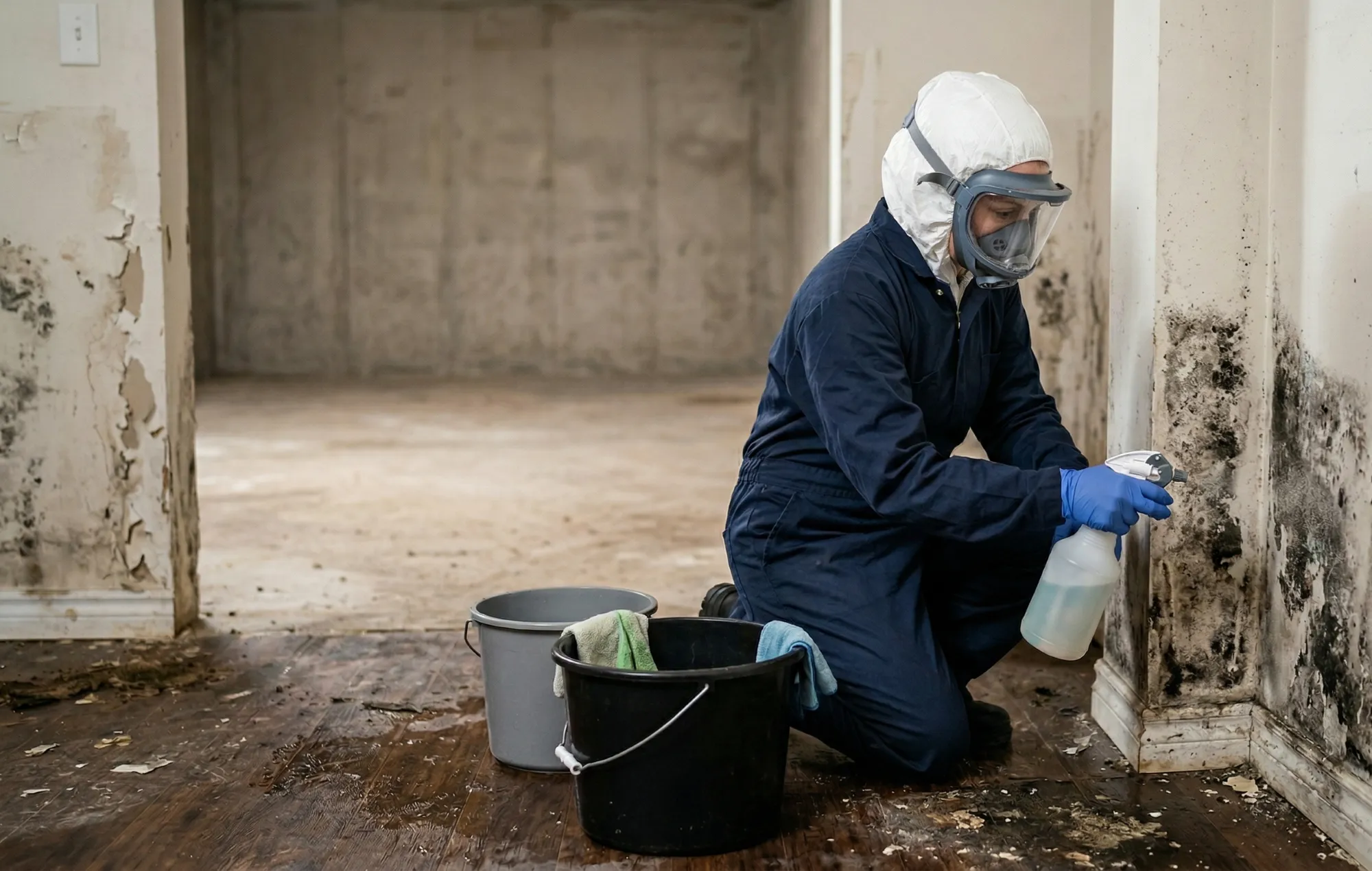

Emergency mold removal is not the same as a routine remediation job scheduled for next week. Per the ANSI/IICRC S520 Standard for Professional Mold Remediation, it is a time-critical response to a mold condition severe enough to pose an immediate health risk, cause rapid structural damage, or follow an acute water event. Knowing when your situation qualifies as a genuine emergency, and what to do in the hours before a crew arrives, can limit both the spread of contamination and the final cost of the job.
 The 24 hour action threshold marked here is what separates a same-day emergency response from a job that can wait for standard scheduling.
Key insights
- Mold can begin colonizing wet materials within 24–48 hours of a water event, per EPA and CDC guidance, making same-day response the difference between mitigation and full remediation.
- The EPA's 10 square foot threshold is the line between DIY-appropriate surface mold and a situation requiring professional containment, HEPA filtration, and clearance testing.
- Running the HVAC during a mold emergency distributes spores to every room the system serves. Shut it off immediately and leave it off until a professional has assessed it.
- Sewage or Category 3 water with mold is a biohazard event, not just a mold event. Porous materials that contacted floodwater or sewage are typically non-salvageable under IICRC S520 protocol.
- Emergency remediation costs 15–30% more than standard jobs due to after-hours response premiums and the frequent need to address concurrent water mitigation.
- An independent clearance test after remediation is required by most insurers and provides documented proof that spore levels have returned to normal before the space is rebuilt.
What makes a mold situation an emergency
A mold situation qualifies as an emergency when sewage or Category 3 water is involved, mold is present in or near the HVAC system, visible growth exceeds 10 square feet, occupants have acute health symptoms, or active water intrusion has gone unaddressed for more than 12 hours.
Not every mold discovery requires same-day service. The situations below qualify as genuine emergencies because time directly determines the extent of damage or the risk to occupants.
| Situation | Why it's an emergency | Act within |
|---|---|---|
| Sewage or Category 3 water + mold | Biohazard risk compounds health danger; 24-hour mold onset | Immediately |
| Mold in or near HVAC system | Spores circulate to every room while system runs | Immediately |
| Visible growth over 10 sq ft | Exceeds EPA threshold for DIY; active colony spreading | Same day |
| Acute health symptoms in occupants | High-risk individuals face infection and respiratory injury | Same day |
| Active water intrusion, no drying started | Mold colonization begins within 24 to 48 hours of wetting | Within 12 hours |
| Pre-closing mold discovery | Sale timeline may be fixed; disclosure and remediation required | 24 to 48 hours |
Sewage or Category 3 water intrusion. Floodwater containing sewage, or any water classified as Category 3 (grossly contaminated), can produce mold growth within 24 hours and introduces biohazard contamination that amplifies the health risk. The EPA recommends calling a professional experienced with contaminated water damage immediately for these events.
Visible mold growth covering more than 10 square feet. The EPA uses 10 square feet as the threshold above which professional remediation is recommended. Large-scale growth, especially in a central HVAC zone or a living area, means spores may already be circulating through the home. When mold remediation is required covers the EPA threshold, contamination level classifications, and the conditions that distinguish a DIY cleanup from a professional scope.
Mold discovered in or near the HVAC system. A contaminated air handler or duct system can distribute spores to every room in the house within hours of the system running. The EPA advises shutting the HVAC system off immediately if contamination is suspected and not restarting it until a professional has assessed it.
Acute health symptoms in occupants. If anyone in the home is experiencing respiratory distress, worsening asthma, or other symptoms that correlate with time spent at home, mold exposure may be the cause. High-risk individuals, including infants, elderly adults, people with asthma or COPD, and immunocompromised individuals, face greater risk from continued exposure. Health effects by population, including the specific risks facing infants, elderly adults, and immunocompromised individuals, are covered under is mold dangerous.
Active water intrusion with no drying within 24 to 48 hours. Mold can begin colonizing wet materials within 24 to 48 hours of a water event, according to both the EPA and CDC guidance. A burst pipe, roof leak during a storm, or appliance failure that has soaked flooring or drywall is a precursor emergency if drying has not started immediately. The hour-by-hour colonization timeline and category-specific risks are covered under mold after water damage.
What to do before the crew arrives: your first-hour protocol
Before the crew arrives, shut off the HVAC system, close off the affected area, stop any active water source, document everything with photos, and do not disturb the mold. These seven steps can be completed within the first hour and directly affect both the spread of contamination and the validity of an insurance claim.
 Documenting from outside the closed room, rather than entering to get closer shots, keeps this step from undoing step two's containment.
The actions you take in the first hour matter. They can stop the spread of spores to unaffected areas and preserve documentation that supports an insurance claim.
1. Shut off the HVAC system
Turn off all heating, ventilation, and air conditioning equipment. Running forced-air systems while mold is present is one of the fastest ways to distribute spores throughout the entire home.
2. Close off the affected area
If the mold is in a room or area with a door, close it. Do not use fans to push air from a moldy room into adjacent spaces.
3. Stop the water source if one is active
A leaking pipe, roof, or appliance must be shut off or contained. No remediation will be lasting if the moisture source continues.
4. Photograph and document everything
Take photos and video of all visible mold and any water damage before touching anything. Photograph water stains, warped materials, and discoloration on walls, ceilings, and floors. This documentation is essential for insurance claims.
5. Do not disturb the mold
Avoid scrubbing, vacuuming without a HEPA-filtered machine, or directing fans toward the affected area. Disturbing mold without containment releases large quantities of spores into the air.
6. Protect high-risk occupants
Anyone with asthma, allergies, COPD, or a compromised immune system should leave the affected area or leave the property entirely if the mold is extensive. The decision of whether to stay or leave during active remediation is covered in detail under staying home during remediation.
7. Call a 24/7 emergency mold remediation company
Look for IICRC-certified firms with verifiable same-day response. Document the time you called and the name of the representative you spoke with, as insurers may ask for this.
How emergency mold remediation differs from standard remediation
Emergency mold remediation compresses the standard timeline, prioritizes containment before full assessment, and typically costs 15 to 30 percent more due to after-hours response premiums.
A standard mold remediation job is typically scheduled, scoped in advance, and completed over several days with the homeowner informed at each stage. Emergency remediation may involve temporary protective measures that are later replaced with permanent solutions. The standard mold remediation process differs from emergency response primarily in sequencing and timeline; the table below captures what changes under emergency conditions.
| Factor | Emergency remediation | Standard remediation |
|---|---|---|
| Response time | 2 to 4 hours from first contact | 24 to 72 hours, business days |
| Initial priority | Containment first, full scope developed in parallel | Full assessment and protocol before work begins |
| Drying equipment | Deployed on arrival, day one | Deployed after assessment phase |
| After-hours availability | Yes, 24 hours / 7 days | Generally no |
| After-hours rate premium | 15% to 30% above standard rate; plus dispatch fee | Standard rate applies |
| Independent clearance test | Strongly recommended; required by many insurers | Recommended; sometimes optional |
The emergency mold removal process: what to expect
Emergency mold remediation follows six phases: assessment, containment, material removal, structural drying, post-remediation verification, and rebuild, typically spanning one to two weeks from first contact to clearance.
 The middle panel's negative air setup is what makes the after photo possible without spores having spread to the rest of the home during removal.
Phase 1: Emergency assessment (hour 1 to 2). A certified technician arrives, conducts a visual inspection, uses moisture meters and thermal imaging to locate hidden moisture sources, and identifies the contamination boundary. They will note any HVAC involvement, sewage contamination, or structural materials requiring immediate action.
Phase 2: Containment setup (hours 1 to 3). The affected area is sealed with polyethylene sheeting at all entry points. Negative air pressure is established using an air scrubber with HEPA filtration, which pulls air from the contained zone and exhausts it outside. This prevents spores from migrating to clean areas of the home.
Phase 3: Removal of unsalvageable materials (day 1 through day 2 in most cases). Visible mold on non-porous surfaces is HEPA-vacuumed and wiped with an EPA-registered antimicrobial solution. Porous materials such as drywall, insulation, and carpet with active mold growth that cannot be adequately cleaned are removed, double-bagged, and disposed of according to local regulations. The full scope may expand as walls are opened and hidden damage is revealed.
Phase 4: Structural drying (days 1 to 5). Industrial dehumidifiers and air movers run continuously to bring moisture levels in structural materials to an acceptable range. Technicians monitor moisture readings daily and adjust equipment placement. This phase cannot be rushed; materials must reach target moisture content before any rebuilding begins.
Phase 5: Post-remediation verification (day 3 to 7 in most cases). An independent clearance test, performed by a party separate from the company that completed the remediation, confirms that airborne spore counts have returned to normal levels and that no visible mold or elevated moisture remains. This clearance report is important for insurance documentation and future real estate disclosure. Clearance testing methods, lab turnaround times, and how to read results are covered under mold testing.
Phase 6: Rebuild and restoration (timeline varies). Drywall replacement, painting, and structural repairs follow clearance. Emergency remediation companies that are also licensed general contractors can handle rebuild in-house; others will coordinate with a separate contractor.
Emergency mold removal costs
Emergency mold removal costs more than standard remediation for two reasons: after-hours response premiums and the frequent need to address an underlying water damage event simultaneously. The base cost of mold remediation ranges from roughly $1,500 to $6,000 for most residential projects, but emergency situations often fall at the higher end of that range or exceed it. Mold remediation cost breaks down national averages by project size, location, and mold type.
 Confirming upfront whether this assessment includes water mitigation as a separate line item avoids a surprise second invoice later in the job.
Water mitigation and mold remediation are billed as separate scopes of work even when they happen simultaneously. If a water event is the cause of the emergency, expect two line items: one for extraction and structural drying under IICRC S500 standards, and a second for the mold remediation itself under IICRC S520. Confirm before work begins whether a single company is handling both or whether a second contractor will be involved, as this affects both scheduling and who coordinates with your insurer.
| Cost item | Typical range | Notes |
|---|---|---|
| Base remediation (most residential jobs) | $1,500–$6,000+ | Higher end more common in emergencies |
| After-hours dispatch or mobilization fee | $150–$500 | Charged separately from project cost; disclose before signing |
| Water mitigation (if concurrent) | $1,000–$3,500 | Billed as a separate scope before remediation pricing applies |
| Industrial drying equipment | $50–$150/ machine/day | Standard rate applies |
| Independent clearance test | $300–$600 | Performed by industrial hygienist or certified mold assessor |
How to vet an emergency mold company under time pressure
To vet an emergency mold company quickly, confirm current IICRC certification, ask for proof of licensing and insurance, and get the after-hours rate in writing before any major work begins.
When a situation is urgent, the pressure to hire quickly is real. Predatory and unqualified contractors know this. Here are the minimum verification steps you can complete quickly by phone and online before signing anything.
- Confirm IICRC certification. Ask whether their technicians hold current IICRC certification in mold remediation (CMR or AMRT). You can verify certifications at iicrc.org. What each credential requires and how to verify them independently is covered under mold remediation certifications.
- Ask for proof of licensing and insurance. Request a certificate of insurance showing general liability coverage and workers' compensation. In states that require mold remediation licensing, ask for the license number and verify it with your state contractor licensing board.
- Ask for the after-hours rate and estimate in writing. A legitimate company will provide a written scope of work and pricing before beginning non-emergency portions of the job. Containment and emergency stabilization may begin before a full estimate, but you should have written disclosure of rates before any major material removal.
- Do not hire based on the first door-knock after a storm. In disaster-affected areas, unlicensed contractors canvass neighborhoods immediately after events. Verify credentials before signing.
- Avoid companies that pressure you to waive an independent clearance test. Any company that recommends skipping post-remediation verification is not acting in your interest.
Emergency mold removal and your insurance claim
Whether your insurance policy covers emergency mold removal depends on the cause of the mold and the specific language of your policy. Most standard homeowners policies cover mold that results directly from a sudden and accidental covered water event, such as a burst pipe or washing machine failure. Gradual leaks, flooding from outside the home, and long-term humidity problems are typically excluded. The full framework for homeowners insurance coverage, including mold sublimits and how to file a claim, is covered in depth elsewhere.
For emergency situations where a covered peril is the cause, the documentation you collect in the first hours, including photos, videos, and the time-stamped record of when you discovered the damage and called for help, is critical to your claim. Insurers may also require that you take reasonable steps to prevent further damage, which is exactly what the first-hour protocol above accomplishes.
Key insurance steps during an emergency:
- Call your insurer or agent as soon as you have completed your immediate protective steps and documented the damage. Most policies require prompt notice.
- Request a claim number and adjuster assignment before or alongside calling a remediation company. Some insurers have preferred vendor lists; others prefer you select your own contractor.
- If relocation is necessary, document this clearly and notify your insurance company. Many policies include additional living expense coverage for situations where remediation makes the home temporarily uninhabitable.
Frequently asked questions
How fast does mold grow after water damage?
Mold can begin colonizing wet porous materials within 24 to 48 hours of water exposure, according to EPA and CDC guidance. Surface mold may be visible within 24 to 72 hours; larger colonies can develop in 3 to 7 days under warm, humid conditions. This is why acting within the first day of any water event is critical.
How long does emergency mold remediation take?
The containment and active remediation phase typically takes 1 to 5 days depending on the size and location of the contamination. Structural drying adds 3 to 7 additional days. Full rebuild after materials are removed adds further time based on the scope of reconstruction required.
Is it safe to stay home during emergency mold remediation?
For small, contained areas, staying in the home is generally acceptable if the contaminated area is sealed off and the HVAC system is off. For larger contamination events, HVAC involvement, or if any occupant is in a high-risk health category, temporary relocation is recommended for the duration of active remediation.
Do I need a mold inspection before emergency remediation can start?
Emergency remediation companies conduct an assessment on arrival as part of the initial response. A formal independent inspection and written protocol may be required by your insurer before full remediation proceeds. Some states also require a licensed mold assessor to produce a remediation protocol before a contractor begins work.
Can I do anything myself before the crew arrives?
Yes, but the actions are limited to stopping the moisture source, turning off the HVAC, closing off the area, and documenting the damage. Do not attempt to scrub, vacuum without a HEPA machine, or dry the area with regular fans. Disturbing mold without proper containment spreads spores. For mold under 10 square feet not connected to a larger water event, DIY mold removal covers the step-by-step contained approach.
What if the mold emergency happens after hours or on a weekend?
Legitimate emergency mold remediation companies operate 24 hours a day, 7 days a week. Expect to pay an after-hours premium, which should be disclosed before work begins. Response times from reputable IICRC-certified firms in most metro areas are 2 to 4 hours from your initial call.
How do I know when emergency remediation is finished?
According to EPA guidance, remediation is complete when the moisture problem has been fixed, all visible mold has been removed, there is no mold odor, and the area can be reoccupied without health complaints. An independent clearance test confirming that airborne spore counts are at normal levels provides the most objective confirmation per IICRC S520 protocol.
Will homeowners insurance cover emergency mold removal?
Coverage depends on the cause. Mold resulting from a sudden, accidental covered event such as a burst pipe is typically covered. Mold resulting from long-term leaks, flooding from outside, or neglected maintenance is typically not. Document the cause carefully, notify your insurer promptly, and keep records of all emergency expenses.
What credentials should an emergency mold company have?
At minimum, look for current IICRC certification in mold remediation (CMR) or applied microbial remediation (AMRT), proof of general liability insurance and workers' compensation, and state mold remediation licensing where required. Ask for the license number and verify it with your state contractor board before signing. If you also need to hire an independent assessor, credential requirements and red flags are covered under mold inspection.
Sam Hickerson is the founder of RestoreAdvisor and writes consumer guides on mold remediation, water damage restoration, inspection, testing, and home recovery. His work focuses on helping homeowners understand costs, risks, and when to call a professional. He draws on guidance from the EPA, CDC, IICRC, and other authoritative sources to make complex home issues easier to navigate.