
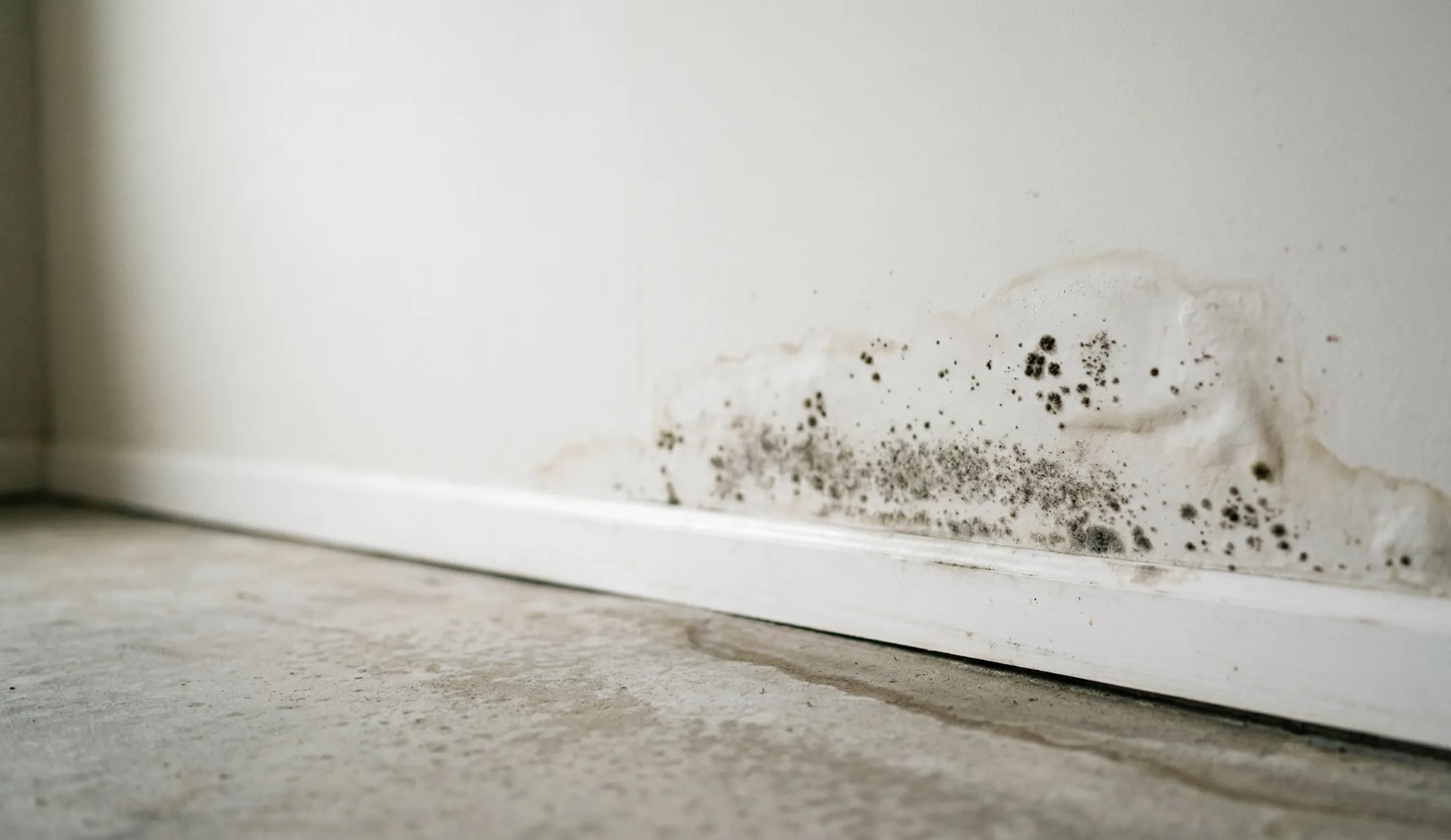

Water and mold are inseparable. Wherever moisture sits long enough inside a home, mold follows. The two are so tightly linked that the restoration industry treats them as a single event sequence: water intrusion triggers a countdown, and once that clock runs out, mold remediation replaces mitigation as the primary task.
Water damage and mold are the same problem at different stages. The gap between them is measured in hours, not days, and most homeowners don't act fast enough because they don't know how short that window actually is.
Key insights
- Mold can begin germinating within 24 hours of water intrusion. The EPA identifies the 24–48 hour drying window as the threshold for preventing mold growth in most cases.
- Water mitigation and mold remediation are separate scopes of work. Mitigation (IICRC S500) prevents mold by drying materials. Remediation (IICRC S520) removes mold that has already grown.
- Category 3 floodwater (sewage, storm surge) makes porous materials like drywall and carpet typically non-salvageable under IICRC S520 protocol regardless of drying time.
- A musty odor after drying is complete is a reliable indicator that mold grew despite mitigation efforts. Post-drying inspection is appropriate when odor persists.
- Standard homeowners insurance does not cover external flooding. Flood damage requires a separate NFIP policy. Mold sublimits of $5,000–$10,000 are common and often insufficient.
- Do not run the HVAC after a water event until it has been inspected. Running a contaminated system distributes spores and contaminants to every room in the structure.
What counts as water damage
For mold purposes, water damage is classified into three IICRC categories based on contamination level: Category 1 (clean water), Category 2 (gray water), and Category 3 (black water), with each carrying different mold risk timelines and material salvageability outcomes.
Water damage ranges from a slow drip behind a washing machine to a major flood that overtops the first floor. For mold purposes, the water source matters as much as the volume, because different sources carry different contamination levels. The IICRC S500 standard classifies water intrusions into three categories that directly affect cleanup requirements.
 Category 3 water requires professional handling regardless of square footage, since IICRC S520 treats sewage contamination as an immediate risk rather than one tied to drying time.
Category 1 water originates from a sanitary source: a supply line break, an overflowing sink with no solids, or rainwater that has not contacted contaminated surfaces. This is the least hazardous starting point, but even clean water becomes a mold risk if materials stay wet past 24–48 hours.
Category 2 water (sometimes called gray water) contains significant contamination: dishwasher or washing machine overflow, toilet overflow with urine but no feces, and water that has contacted porous building materials long enough to degrade in quality. Category 2 conditions accelerate the contamination timeline.
Category 3 water (black water) is grossly contaminated from the start: sewage backups, floodwater from rivers or storm surge, or any Category 1 or 2 source that has been sitting long enough to become a biological hazard. Category 3 events require protective equipment and professional handling regardless of the square footage involved. Understanding when mold remediation is required helps clarify the threshold between mitigation and full remediation scope.
| IICRC category | Common sources | Mold risk timeline | Material salvageability |
|---|---|---|---|
| Category 1 (clean water) | Supply line break, sink overflow, clean rainwater | Mold risk begins at 24–48 hours if undried | Most materials salvageable with prompt drying |
| Category 2 (gray water) | Washing machine overflow, dishwasher, toilet overflow (urine only) | Accelerated degradation; increased risk after 24 hours | Porous materials may require removal depending on saturation time |
| Category 3 (black water) | Sewage backup, river/storm surge flooding, standing water 48+ hours | Immediate contamination risk; mold risk acute | Porous materials (drywall, insulation, carpet) typically non-salvageable |
The 24–48 hour window: what the research says
The EPA states that water-damaged areas dried within 24–48 hours of a leak or spill will, in most cases, not grow mold. That window is the most important fact a homeowner can know, and it is also the one most frequently missed in the chaos following a water event.
 Materials pooling like this still fall within the EPA's 24 to 48 hour drying window; the clock starts at first contact, not when damage becomes visible.
The biology behind this threshold: mold spores are present in every indoor environment. They become active colonizers when they land on a wet surface with organic material to feed on. Common building materials, including wood framing, drywall paper facing, carpet backing, and insulation, all qualify. At typical indoor temperatures (65–85 degrees F) and relative humidity above 60 percent in affected cavities, spore germination can begin within 24 hours. Visible surface growth typically appears between 24–72 hours. Established colonies and structural penetration follow within 1–2 weeks if conditions remain wet.
Hour-by-hour mold growth timeline after water damage
Mold can begin germinating within 24 hours, become visible within 24 to 72 hours, and penetrate structural materials within one to two weeks if conditions remain wet.
 Spore germination begins in the 2 to 24 hour stage on this timeline, well before any surface growth would be visible to a homeowner.
Understanding the progression gives you a framework for decisions. The timeline below represents conditions at average indoor temperatures with typical building materials. Higher heat, higher humidity, or porous materials saturated with Category 2 or Category 3 water accelerate every stage.
| Time after water intrusion | What is happening | Visible signs | Action required | Mold risk level |
|---|---|---|---|---|
| 0–2 hours | Water saturates porous materials; spores contact wet surfaces | Wet floors, pooling water, active dripping | Stop source; extract standing water immediately | Minimal if dried now |
| 2–24 hours | Spore germination begins in saturated materials; moisture migrates into wall cavities | Spreading dampness, water wicking into drywall | Begin drying; call water mitigation professional | Low to moderate |
| 24–48 hours | Early hyphal growth in most saturated areas; musty odor may begin | Tacky surfaces, faint musty smell | Professional assessment required; drying equipment deployed | Moderate |
| 48–72 hours | Visible surface growth possible; mold penetrates porous materials | Fuzzy or discolored patches, intensifying odor | Remediation protocol likely needed in addition to drying | High |
| 72 hours – 1 week | Colonies establish and spread; structural degradation begins | Visible mold on multiple surfaces, strong odor | Professional mold remediation required; containment before further work | Very high |
| 1–2 weeks | Mold penetrates deep into framing and structure; spore release increases | Widespread visible mold, staining on framing | Full remediation including possible demolition of affected materials | Severe |
| 2+ weeks | Structural damage compounds; HVAC contamination possible | Visible mold throughout affected zone; health symptoms may emerge | Emergency remediation; possible occupant displacement during work | Critical |
Which water damage events carry the highest mold risk
The highest mold risk events are external flooding, slow undetected roof or plumbing leaks, basement flooding, HVAC system water damage, and firefighting suppression water, all of which either introduce Category 3 contamination or create sustained hidden moisture conditions.
Not all water incidents follow the same risk profile. The following factors accelerate mold growth and increase the scope of professional remediation required.
Flooding from external sources
Storm surge, river overflow, and surface flooding are Category 3 events by definition. Floodwater carries sediment, agricultural runoff, bacteria, and often raw sewage from overwhelmed municipal systems. Materials that contacted floodwater, including drywall, insulation, and carpet padding, are typically non-salvageable under IICRC S520 protocol. The IICRC standard for mold remediation activates when visible mold is present or when moisture has persisted long enough to support amplification, generally defined as exceeding 48 hours at relative humidity above 60 percent in affected cavities.
Roof leaks and prolonged slow leaks
These are particularly insidious because they often go undetected. A slow drip inside a wall cavity or attic can establish mold colonies over weeks before any visible sign appears in the living space. By the time homeowners notice a stain or musty odor, mold may already be well-established in framing and insulation. By that point, signs of mold including musty odor and soft drywall are often already present.
Basement flooding
Basements combine three mold accelerants: limited airflow, naturally higher humidity, and direct ground contact. Concrete block and poured concrete walls wick moisture continuously, and finished basement materials such as drywall, carpet, and wood paneling are among the most vulnerable.
 Concrete walls like these wick moisture continuously, which is why basements combine three of the highest mold accelerants at once.
HVAC system water damage
If an air handler, condensate line, or ductwork is involved in a water event, the mold risk extends to the entire duct system. The CDC specifically advises having the HVAC checked and cleaned by a professional experienced in mold cleanup before turning it on after flooding. Running a contaminated HVAC spreads spores to every room in the structure.
Water damage from firefighting
Suppression water from structure fires is typically Category 3 due to contact with fire-damaged materials, ash, and contaminated surfaces. The combination of heat stress to the structure and sustained wet conditions creates acute mold risk within the first 24–48 hours.
Water damage vs. mold remediation: two separate scopes of work
Water mitigation and mold remediation are distinct services governed by different IICRC standards. Water mitigation prevents mold by drying materials; mold remediation removes mold that has already grown. When a water event leads to mold, mold remediation becomes a second scope of work that runs after water mitigation is complete.
 Water mitigation under IICRC S500 stops at drying; it never includes mold removal, which is why a second contractor and a second scope of work often follow.
Water mitigation (governed by IICRC S500) covers the extraction of standing water, structural drying using air movers and dehumidifiers, moisture mapping, and monitoring until affected materials return to acceptable moisture content. The goal is to prevent secondary damage, with mold being the primary secondary concern. Water mitigation does not include mold removal.
The second scope of work, mold remediation (governed by IICRC S520), covers containment, removal of mold-colonized materials, HEPA air filtration, surface treatment, and post-remediation clearance testing. It addresses mold that has already grown, and what to expect during mold remediation differs significantly from water mitigation in scope, duration, and disruption.
When both events occur (a water intrusion that was not dried within the window), homeowners typically face two separate contractor scopes and two separate insurance claim pathways. Coordinating these properly is one of the most important practical tasks after a water event with mold.
Coordination between drying and mold inspection
Mold inspection after a water event should follow drying, not accompany it. A proper water mitigation job produces moisture logs confirming that affected materials returned to pre-loss moisture content before the job closes. If a contractor closes out a water job without documentation, or if drying was incomplete, mold can develop in cavities that appeared dry at the surface.
NIOSH notes that musty odor combined with visual inspection is often more reliable than short-term air sampling for identifying mold problem areas. If odor persists after drying equipment is removed, a post-drying mold inspection is the appropriate next step, especially when any of the following apply:
- Drying took longer than 3–5 days for materials that should dry faster
- Moisture readings in wall cavities or subfloor never reached target levels
- A musty odor persists after drying equipment is removed
- The water source was Category 2 or 3
- Visible discoloration appeared during or after the drying period
For Category 1 events that were dried promptly, a precautionary inspection is an option but is not always required. For Category 2 or 3 events, and for any event involving hidden cavities (wall assemblies, under flooring, attic spaces), professional inspection after drying is a reasonable step. A professional mold inspection after drying confirms whether remediation is needed and at what scale.
When to test after water damage
Testing after water damage is most useful in two situations: before remediation begins to document pre-remediation conditions for insurance purposes, and after remediation is complete to confirm clearance.
Mold testing after a water event serves a different purpose than general mold testing. Rather than identifying a suspected problem, post-water-damage mold testing is used to confirm that remediation was successful or to document conditions before remediation begins.
Before remediation
If a professional mold inspector is retained before remediation work begins, baseline air sampling and surface sampling can document the pre-remediation condition. This documentation supports insurance claims and protects homeowners if disputes arise about the scope of work.
After remediation
Clearance testing, typically air sampling and surface sampling compared against an outdoor control sample, confirms that indoor mold levels are within acceptable ranges and that no elevated spore concentrations remain from the remediation work. IICRC S520 protocol requires clearance before the remediation job is considered complete.
Flood-specific risks: sewage contamination and Category 3 mold
Category 3 flooding introduces sewage contamination that compounds mold risk and renders porous materials like drywall, insulation, and carpet typically non-salvageable under IICRC S520 protocol.
Flooding from external sources introduces a compounding risk that does not apply to clean-water events: sewage contamination. Municipal storm systems and sanitary sewer systems frequently combine during major rain events, and floodwater entering a structure may carry bacteria, viruses, and parasites in addition to mold spores. The CDC advises that homeowners assume mold is present if a flooded home has been closed up for several days, and that flooded homes may be contaminated with sewage.
From a remediation standpoint, Category 3 events require that porous and semi-porous materials that contacted floodwater be removed and discarded rather than dried and retained, because these materials cannot be adequately decontaminated once saturated with Category 3 water.
For HVAC systems specifically: do not turn on a system that was flooded until a professional has inspected and cleared it. Running a contaminated system distributes spores and contaminants throughout the structure.
Immediate action steps after water damage
Acting within the first two hours gives the best chance of preventing mold entirely. The steps below are mold prevention, not mold remediation.
 Steps four and five, drying and keeping the HVAC off, are what homeowners skip most often, even though the HVAC step is what prevents contamination from spreading house-wide.
1. Stop the water source
If the intrusion is from a plumbing failure, locate and shut off the supply. For weather-related events, prevent additional entry where possible.
2. Extract standing water
Use a wet/dry shop vacuum for smaller events. Pumps or sump pumps are appropriate for flooding. Remove standing water before it migrates further into porous materials.
3. Remove wet porous materials that cannot be dried quickly
Saturated carpet and padding, wet rugs, and soaked upholstered items hold moisture and slow structural drying.
4. Begin drying immediately
Open windows and interior doors, run fans directed to move air out of the affected area, and deploy dehumidifiers if available. Air conditioning can help with humidity control when outdoor conditions allow.
5. Do not run the HVAC if it was involved in the water event
Confirm the system is unaffected before using it for drying assistance.
6. Document everything
Photograph and video the affected area, wet materials, and visible damage before anything is moved or discarded. This documentation is essential for insurance claims.
For events larger than a small localized spill, professional extraction and drying equipment is significantly more effective than consumer tools. The IICRC S500 standard defines drying as complete when affected materials return to acceptable moisture content, a standard that requires moisture meters to verify. A phase-by-phase mold remediation checklist covers water damage preparation through post-clearance steps.
Same-day events that produce immediate mold risk fall under emergency mold removal, which runs a faster containment and extraction protocol.
The water-to-mold insurance transition
Water damage and mold are covered differently under standard homeowners insurance policies, and the distinction matters significantly when a water event leads to mold. The full framework for homeowners insurance coverage including mold sublimits, NFIP flood policies, and how to file a claim is covered in depth elsewhere.
Most standard homeowners policies cover sudden and accidental water damage: a burst pipe, a washing machine overflow, an appliance failure. They do not typically cover flooding from external sources (that requires separate NFIP flood insurance) or damage from long-term neglect or maintenance failures.
Mold coverage is frequently sublimited or excluded. Many policies include a mold sublimit of $5,000–$10,000, which is often insufficient for a full remediation project. Others exclude mold entirely or exclude it as a consequence of certain water events.
The sequence of events matters for claims. A water damage claim must typically be filed first, and the insurer's response to that claim shapes what mold coverage follows. If a water claim is denied because the source was flooding rather than a covered peril, or because the damage is attributed to deferred maintenance, mold remediation costs are unlikely to be covered either.
Key documentation practices for the insurance pathway:
- File the water damage claim promptly; do not wait until mold is visible
- Request a written scope of work from the water mitigation contractor
- Retain moisture logs and drying documentation from the mitigation company
- If mold develops, file a separate mold claim referencing the original water damage claim
- Request written denial language if any portion of the claim is disputed
For homeowners in flood-prone areas, a separate NFIP flood policy covers building structure up to $250,000 and contents up to $100,000 for direct physical loss.
How much does mold remediation cost after water damage
Mold remediation after water damage typically costs $1,500 to $3,500 for a single contained room and $7,500 to $15,000 or more for extensive flood damage with structural material removal.
Mold remediation costs after water damage follow the same general pricing structure as any mold project, but the scope is frequently larger because water events affect structural cavities such as inside walls, under floors, and in attic assemblies, rather than just visible surfaces.
| Scenario | Typical cost range | Notes |
|---|---|---|
| Small event, prompt drying, no mold growth | $0 additional beyond mitigation | Mold remediation not required; water mitigation only |
| Mold in single room after delayed drying | $1,500–$3,500 | Contained scope; standard IICRC S520 protocol |
| Mold in multiple areas or behind walls | $3,500–$7,500 | Includes wall cavity work; may require drywall removal |
| Extensive flood damage with structural material removal | $7,500–$15,000+ | Category 3 events; significant demolition often required |
Mold remediation cost varies significantly by project size, location in the home, and the type of mold involved. Clearance testing after remediation is a separate line item typically ranging $200–$600.
Choosing a contractor after water damage
Water damage events often require two separate contractors: one for water mitigation and one for mold remediation. Some firms offer both services, which can simplify coordination, but the same company should not conduct clearance testing. Testing and remediation should always be independent to avoid a conflict of interest.
Water damage jobs that produce mold often require two contractors: one for mitigation, one for remediation. The criteria for choosing a mold remediation company differ from standard home service vetting.
For water mitigation
Look for IICRC certification in Water Damage Restoration (WRT) and Applied Structural Drying (ASD). Ask for moisture logs during the job, not just a verbal assurance that the structure is dry.
For mold remediation
Look for IICRC certification in Applied Microbial Remediation (AMRT). Ask whether the company performs its own clearance testing. If yes, request that clearance testing be performed by an independent industrial hygienist or mold inspector instead.
For inspection and testing
The inspector should have no financial interest in the remediation outcome. See our mold inspection guide for credential specifics and what a professional inspection should include.
Frequently asked questions
How fast does mold grow after water damage?
Mold spores can begin germinating on wet surfaces within 24 hours of water exposure. Visible mold growth can appear as early as 24–72 hours after water intrusion in ideal conditions: temperatures between 65–85 degrees F, organic building materials, and relative humidity above 60 percent in affected cavities. The EPA identifies the 24–48 hour drying window as the threshold for preventing mold growth in most cases.
Can mold grow inside walls after water damage?
Yes, and this is one of the most common scenarios after water events. Water migrates through drywall, insulation, and framing. Even when surface drying appears complete, interior cavities can remain wet for days or weeks. Mold growing inside wall assemblies is not visible until colonies are well-established and sometimes not until materials are opened during remediation. Musty odor with no visible mold is one of the most reliable indicators of hidden wall mold after a water event.
Should I test for mold after water damage?
Testing is most useful in two situations: before remediation begins, to document pre-remediation conditions for insurance purposes; and after remediation is complete, to confirm clearance. For active water events where drying is underway, testing before drying is complete typically provides limited useful information. If drying is finished and a musty odor remains, post-drying testing can confirm whether mold growth occurred despite mitigation efforts.
Does homeowners insurance cover mold after water damage?
It depends on the source of the water damage and the specific policy language. Sudden, accidental covered water events (pipe burst, appliance overflow) are generally covered, and resulting mold may be covered up to any policy sublimit. Flooding from external sources is typically excluded from standard homeowners policies and requires separate NFIP flood insurance. Mold resulting from long-term neglect or a maintenance failure is typically excluded regardless of source.
What is the difference between water mitigation and mold remediation?
Water mitigation (governed by IICRC S500) covers water extraction, structural drying, and moisture monitoring. Its goal is preventing secondary damage including mold. Mold remediation (governed by IICRC S520) covers containment, removal of mold-colonized materials, and post-remediation clearance testing. Mold remediation addresses mold that has already grown. When water damage is caught and dried within 24–48 hours, only water mitigation may be needed. When mold has developed, both scopes of work apply.
Is it safe to stay in a home with mold after a flood?
This depends on the extent of mold growth, the health status of occupants, and the type of water involved. For Category 3 water events (sewage, floodwater), temporary displacement is generally recommended regardless of visible mold. For mold growth covering more than 10 square feet, EPA guidelines recommend professional remediation. Occupants with asthma, allergies, compromised immune systems, or other respiratory conditions face higher risk and should be most cautious about remaining during active mold conditions. Occupants with asthma, allergies, or compromised immune systems face elevated risk and should review is mold dangerous for health effects by population before deciding whether to remain.
How do I know if I have mold after a water leak?
Musty or earthy odor is the most reliable early indicator, often detectable before mold becomes visible. Visible discoloration (dark spots, fuzzy patches, or staining on walls, ceilings, floors, or framing) confirms growth. Health symptoms that improve when you leave the building and worsen when you return are another indicator. After any water event where drying was delayed, uncertain, or where hidden cavities were involved, a professional mold inspection is the most reliable confirmation method. Both visible and hidden indicators are worth knowing before any water event occurs.
What mold species are most common after water damage?
Several mold species are common in water-damaged structures. Cladosporium, Penicillium, and Aspergillus are among the most frequently found after typical water events. Stachybotrys chartarum (black mold) requires sustained and substantial moisture and is more commonly associated with chronic flooding or long-term moisture problems than with a single water event. Chaetomium is frequently found in water-damaged drywall. Species identification typically requires laboratory analysis of samples taken during a professional inspection. Confirmed Stachybotrys triggers stricter containment and clearance requirements than standard mold. Full protocol detail is covered under black mold removal.
How do I decide whether I need water mitigation, mold remediation, or both?
If water damage is fresh (under 24–48 hours) and has not yet produced visible mold or persistent musty odor, water mitigation is the appropriate first step. If mold is already visible, or if a musty odor persists after drying, mold remediation is required in addition to or instead of drying. If mold is already visible or musty odor persists after drying, professional remediation is required in addition to or instead of drying alone..
- Centers for Disease Control and Prevention: Safety Guidelines: Reentering Your Flooded Home
- Centers for Disease Control and Prevention: Mold After a Disaster
- National Institute for Occupational Safety and Health: Mold Prevention Strategies and Possible Health Effects in the Aftermath of Hurricanes and Major Floods
- IICRC S500 Standard for Professional Water Damage Restoration
- IICRC S520 Standard for Professional Mold Remediation
- Federal Emergency Management Agency: Dealing with Mold and Mildew in Your Flood-Damaged Home
Sam Hickerson is the founder of RestoreAdvisor and writes consumer guides on mold remediation, water damage restoration, inspection, testing, and home recovery. His work focuses on helping homeowners understand costs, risks, and when to call a professional. He draws on guidance from the EPA, CDC, IICRC, and other authoritative sources to make complex home issues easier to navigate.