
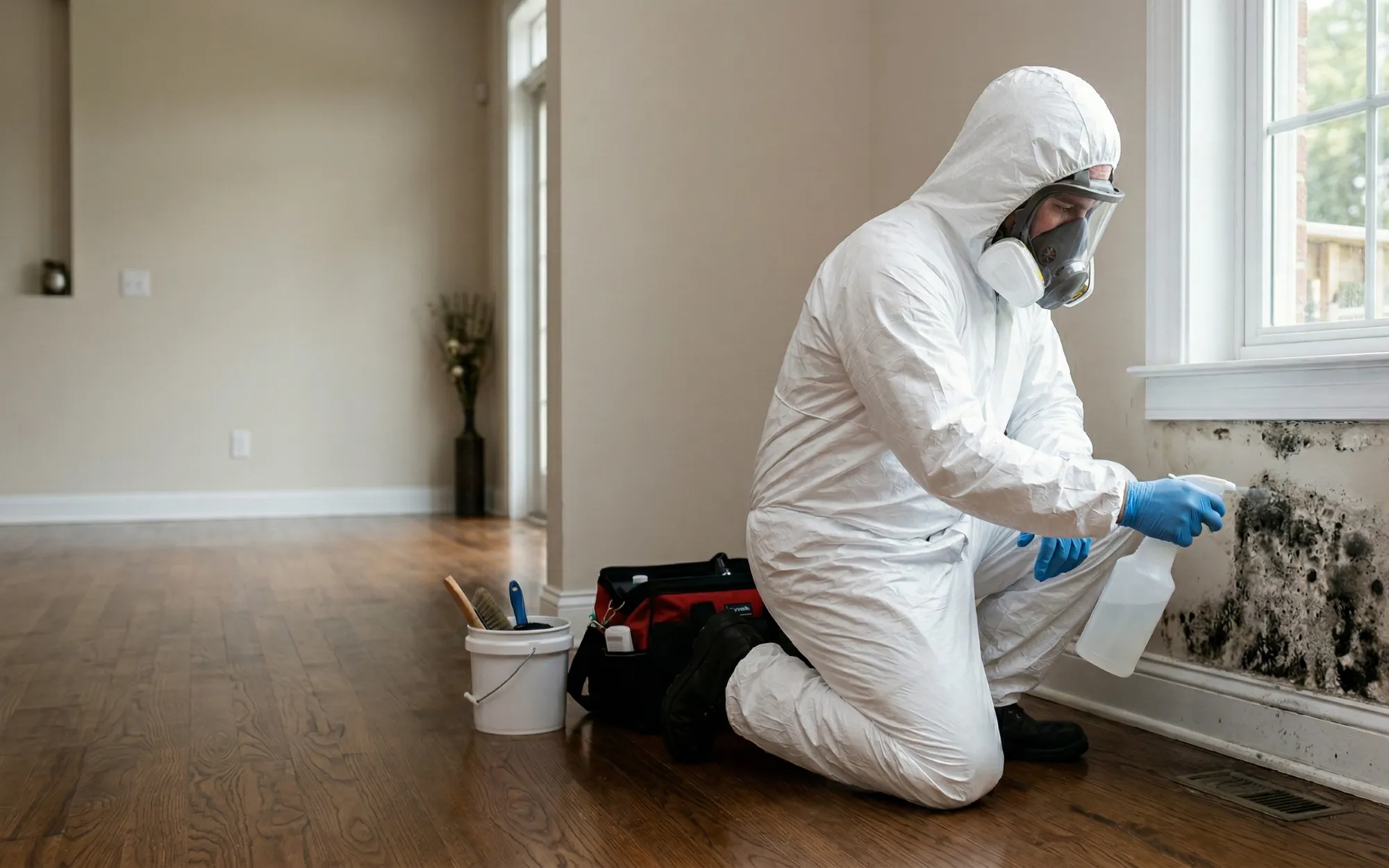

When homeowners discover a dark, slimy patch in a water-damaged corner of their home, the words "black mold" tend to surface fast. The alarm is understandable. But what most people call black mold refers to a specific species, Stachybotrys chartarum, and it behaves differently from the dozens of other molds that simply happen to appear dark-colored on your walls.
This guide focuses exclusively on black mold (Stachybotrys chartarum): how to identify it accurately, why it demands stricter removal protocols than standard mold, what a professional black mold job looks like step by step, and what it costs. The IICRC S520 Standard for Professional Mold Remediation classifies heavy Stachybotrys contamination as a Condition 3 environment requiring the highest level of containment and PPE, and the protocols described here follow that standard. General mold removal guidance for smaller, non-black-mold jobs lives on our DIY mold removal guide.
The most important thing a homeowner can do after spotting potential black mold growth is simple: do not disturb it. Understanding why starts with knowing what makes this species different.
Key insights
- Not all black mold is Stachybotrys chartarum. Cladosporium, Alternaria, and Aspergillus niger all appear black. Lab confirmation is the only reliable way to identify the species.
- Stachybotrys chartarum requires sustained moisture of at least 72 hours to grow. Brief or one-time condensation will not produce it. A confirmed case almost always indicates a slow, hidden water source.
- Do not disturb suspected black mold before professional containment is in place. Drying or scrubbing the colony aerosolizes spores that can spread throughout the home.
- Black mold remediation runs 15%–25% more than standard mold jobs due to two-stage containment, P100 respirators, lab confirmation, and independent post-clearance testing.
- Porous materials like drywall, insulation, and ceiling tile must be removed, not cleaned. Surface biocides do not reach mycotoxin residue embedded in the material.
- Post-remediation clearance testing must be performed by an independent firm, never the contractor who did the remediation work.
What black mold actually is
Black mold refers to Stachybotrys chartarum, a cellulose-digesting fungus that produces a family of trichothecene mycotoxins. Unlike many common household molds, it cannot grow on a briefly wet surface. It requires materials that have stayed consistently wet for at least 72 hours, and typically much longer. That sustained-moisture requirement is the single most useful diagnostic clue homeowners have.
 Texture is often the more reliable visual tell between the two: Stachybotrys reads slimy when active, while Cladosporium stays powdery even when established.
Characteristic traits that distinguish black mold from other dark-colored molds:
- Color: dark greenish-black, sometimes approaching true black when fully established
- Texture: slimy or wet-looking when actively growing; may appear powdery or gray-green once dried out
- Substrate: almost always on cellulose-rich materials including drywall paper, ceiling tile, fiberboard, wallpaper backing, and wood
- Location: areas with chronic or prolonged moisture, not areas with brief or one-time condensation
- Growth pattern: slow-growing relative to Cladosporium or Aspergillus; typically appears two or more weeks after initial water intrusion
Not all dark mold is Stachybotrys chartarum. Cladosporium, Alternaria, and certain Aspergillus strains can all present as black or dark green and are far more common in residential settings. For a full comparison of mold and mildew appearance by species, see our mold vs. mildew breakdown. Visual identification alone is never definitive. Confirmation requires lab analysis of a collected sample.
Why confirmation matters before removal
Confirming whether dark mold is Stachybotrys chartarum before remediation begins prevents two costly mistakes: overtreating common dark molds with expensive black mold protocols, and undertreating confirmed black mold with standard cleanup that leaves mycotoxin residue in porous materials.
The EPA acknowledges that small patches of mold under 10 square feet can be addressed by informed homeowners. For a full breakdown of the size thresholds and conditions that determine whether a job is DIY-appropriate or requires a professional, see when mold remediation is required. For most visible black mold situations, the growth has already exceeded that threshold or is located in a confined area where amateur disturbance would spread spores throughout the living environment.
The do-not-disturb rule for black mold
Do not touch, scrub, vacuum, or disturb any suspected black mold growth before professional containment is in place. Disturbing the colony aerosolizes spores that can spread throughout the home.
Black mold spores are embedded in a slimy matrix when the colony is actively growing, which actually limits their immediate airborne dispersal compared to dry-spored molds like Cladosporium. This sounds reassuring, but it creates a false sense of safety. Once the colony dries out or is physically disturbed, spores become easily aerosolized. Vacuuming, scrubbing, or cutting into drywall near a black mold colony without proper containment in place can release spores throughout the home.
Until a professional has established containment, homeowners should:
- Avoid touching or scraping the growth
- Switch HVAC systems off or to recirculate mode to prevent spore distribution through ductwork
- Keep the affected room as undisturbed as possible
- Seal visible gaps under doors with towels if the affected room connects to main living areas
- Keep children and pets out of the space
How professionals confirm black mold before remediation
Black mold is confirmed through lab analysis of air samples, surface swabs, or bulk material samples collected by a certified inspector and submitted to an AIHA-accredited laboratory. Visual inspection alone is never sufficient for species-level confirmation. Results typically return within 24–72 hours. A positive identification of Stachybotrys chartarum in the lab is what triggers the more intensive remediation protocol described in the next section.
The professional removal process for black mold
Professional black mold removal follows seven steps: containment setup, full PPE, removal of porous materials, HEPA vacuuming, biocide application, encapsulant application, and independent post-remediation clearance testing.
Because black mold requires stricter containment, more protective equipment, and specific waste disposal procedures, the professional process differs from standard mold remediation in meaningful ways. The IICRC S520 standard classifies heavy Stachybotrys contamination as a Condition 3 environment, requiring the highest level of containment and personal protective equipment.
 Step three, porous material removal, is the point where a standard mold job and a confirmed Stachybotrys job diverge most in cost and scope.
Step 1: Containment setup
Before any material is disturbed, the work area is sealed with 6-mil polyethylene sheeting. For black mold jobs, contractors establish a two-stage containment: an inner containment over the immediate work zone and an outer decontamination chamber (airlock) where workers change and remove PPE before exiting. HEPA-filtered negative air machines run continuously to keep the work area at slightly lower air pressure than adjacent spaces, physically preventing spore migration into clean areas.
Step 2: Personal protective equipment
Workers handling confirmed black mold use full-face respirators with P100 or combination organic vapor/P100 cartridges, Tyvek or equivalent disposable coveralls, boot covers, and two layers of gloves. N95 masks, which are adequate for many standard mold jobs, are not considered sufficient for confirmed Stachybotrys contamination under IICRC S520 guidelines.
Step 3: Removal of porous materials
Black mold colonizes the interior of cellulose-based materials, not just the surface. Drywall, insulation, ceiling tiles, carpet backing, and similar porous substrates cannot be cleaned in place. They are removed, double-bagged in 6-mil poly bags, and disposed of according to local regulations. Contractors typically cut 12 inches beyond any visibly affected area to ensure complete removal of colonized substrate.
Step 4: HEPA vacuuming and biocide application
After porous materials are removed, remaining structural surfaces including studs, subfloor, concrete block, and metal framing are HEPA-vacuumed to remove residual spores and debris. An EPA-registered biocide is then applied to all affected surfaces. Sodium hypochlorite is sometimes used on structural wood, though the EPA and IICRC both note that the primary goal is physical removal rather than chemical killing, since dead spore fragments can still trigger health responses in sensitive individuals.
Step 5: Encapsulant application
After cleaning and drying, an antimicrobial encapsulant is applied to remaining structural surfaces. This creates a barrier that seals any residual spores and helps inhibit future fungal growth. Encapsulants are a supplement to thorough physical removal, not a substitute for it.
Step 6: Drying and moisture source correction
The moisture problem that allowed black mold to grow must be corrected before reconstruction begins. This means repairing the water source (failed plumbing, roof leak, foundation intrusion, or chronic condensation) and running commercial dehumidifiers and air movers until structural materials reach acceptable moisture content readings, verified with a calibrated moisture meter.
Step 7: Post-remediation clearance testing
Before containment is removed and reconstruction begins, an independent hygienist or inspector who was not part of the remediation crew performs post-remediation verification (PRV) testing. Air samples and surface samples are collected and sent to an AIHA-accredited lab. Clearance is issued only when spore counts have returned to normal background levels. This step is non-negotiable on confirmed black mold jobs. For detail on what clearance testing involves and how to read results, mold testing covers the full process.
For the full technical seven-step remediation process beyond black mold specifics, see our mold remediation process.
What black mold removal costs
Black mold remediation runs higher than standard mold removal due to additional equipment, labor time, personal protective equipment, and waste disposal requirements. Industry data from 2025 points to a cost premium of 15%–25% over equivalent-sized standard mold jobs.
| Job size | Standard mold cost | Black mold cost (15%–25% premium) | What drives the difference |
|---|---|---|---|
| Small (up to 25 sq ft) | $500–$1,200 | $600–$1,500 | Lab confirmation, upgraded PPE |
| Medium (25–100 sq ft) | $1,200–$3,500 | $1,500–$4,400 | Two-stage containment, clearance testing fee |
| Large (100–300 sq ft) | $3,500–$7,000 | $4,400–$8,800 | Full demolition, waste disposal surcharges |
| Extensive (300+ sq ft or multi-room) | $7,000–$15,000+ | $8,800–$20,000+ | Independent hygienist, whole-home containment |
Several cost line items are specific to black mold jobs and will not appear on a standard mold remediation quote:
- Laboratory confirmation testing: $75–$150 per sample, required before work begins
- Post-remediation clearance testing: $300–$600 per visit, conducted by an independent firm
- Two-stage containment materials and labor: the airlock decontamination chamber adds both materials and setup time
- Higher-grade PPE per worker: full-face respirators and P100 cartridges cost more than N95s and take longer to don, doff, and decontaminate
- Waste disposal surcharges: double-bagged black mold material is subject to additional disposal fees in some jurisdictions
Costs vary by project type, location in the home, and whether insurance covers the moisture source. See mold remediation costs for the full breakdown.
For inspection and clearance testing costs specifically, see mold inspection costs.
How black mold compares to other dark-colored molds
Black mold (Stachybotrys chartarum) is distinguished from other dark-colored molds by its slimy texture, cellulose-based substrate requirement, and need for sustained moisture of 72 hours or more. Visual identification alone cannot confirm the species.
Several common residential mold species share the same dark appearance and substrate preferences as black mold. The table below shows how Stachybotrys chartarum differs from the four most common dark-colored molds found in U.S. homes.
| Mold species | Typical color | Texture | Common substrates | Moisture requirement |
|---|---|---|---|---|
| Stachybotrys chartarum (black mold) | Dark greenish-black | Slimy (wet); powdery (dry) | Drywall paper, fiberboard, ceiling tile | Sustained (72+ hrs continuous) |
| Cladosporium | Olive green to black | Powdery or velvety | Window frames, grout, fabric | Moderate; tolerates lower humidity |
| Aspergillus niger | Black | Powdery | Food, soil, HVAC insulation | Low to moderate |
| Alternaria | Dark brown to black | Wooly or velvety | Shower tiles, under sinks | Moderate |
| Chaetomium | White to gray-black over time | Cottony | Water-damaged drywall, paper | High; similar to black mold |
Because these species share overlapping appearance and growth locations, a professional sample and lab analysis are the only reliable way to confirm black mold before committing to an intensive removal protocol.
Where black mold is most often found
Black mold is most commonly found behind drywall following slow plumbing leaks, under flooring over slabs with chronic moisture, in basement walls with groundwater seepage, in crawl spaces, in attic sheathing beneath roof leaks, and in HVAC air handlers.
 Every location on this diagram shares the same requirement: moisture sustained for 72 or more hours, not the brief condensation that feeds faster-growing molds.
Because of its strict moisture requirement, black mold has a narrower footprint inside a home compared to more opportunistic molds. The most common locations in residential settings:
- Behind drywall following a slow, undetected plumbing leak
- Under flooring or carpet over a slab with chronic moisture intrusion
- In basement walls with persistent groundwater seepage
- In crawl spaces with vapor barrier failure or standing water
- In attic sheathing beneath a slow roof leak
- In HVAC air handler units with water accumulation and organic debris buildup
The common thread is sustained, often hidden moisture. Surface condensation on a bathroom mirror will not produce black mold. A slow leak behind a wall that has kept drywall paper wet for two or three weeks can. For visual and odor indicators that suggest hidden mold before it becomes visible, see signs of mold in your home.
Water damage timelines affect mold growth risk in ways that matter for black mold specifically. Mold after water damage explains how quickly Stachybotrys can establish once sustained moisture is present.
Can black mold be removed without replacing drywall?
No. In almost every confirmed case, black mold cannot be removed without replacing drywall. Black mold grows into the paper facing of drywall, not just on the surface, and surface-applied biocides cannot reach viable mycelium and mycotoxin residue embedded in the material. The IICRC S520 standard classifies contaminated porous materials as requiring removal for this reason.
The narrow exception
If black mold is confirmed only on a hard, non-porous surface such as a sealed concrete block wall, a ceramic tile, or a metal structural member, HEPA vacuuming followed by biocide application and encapsulation may be sufficient without demolition. This determination should be made by a certified industrial hygienist, not by the remediation contractor alone.
What to look for in a contractor
The key things to look for in a black mold contractor are state licensing, IICRC AMRT or ACAC certification, pollution liability insurance, and a commitment to independent post-clearance testing by a separate firm. Licensing requirements vary by state; Florida, Texas, New York, and Louisiana among others require a state mold remediation license for work above certain thresholds. On the certification side, the IICRC's Applied Microbial Remediation Technician (AMRT) credential and the American Council for Accredited Certification (ACAC) credentials both indicate specialized training in mold remediation protocols. For a full explanation of what each credential requires and how to verify them, see mold remediation certifications.
 A contractor who hesitates on question one, separating remediation from clearance testing, is the single biggest red flag on this list.
Ask any contractor these questions before signing:
- Will remediation and post-clearance testing be handled by separate firms? They should be.
- Do they follow IICRC S520 protocols? Ask them to describe their containment setup specifically.
- Will they provide a written scope of work and a post-remediation verification report?
- Are they carrying pollution liability insurance? Standard general liability often excludes mold.
- Will they identify and document the moisture source before starting any remediation work?
A contractor who discourages independent post-clearance testing is a significant red flag. On any confirmed black mold job, mold remediation and post-clearance testing must be handled by separate firms, without exception.
Do you need to leave your home during black mold remediation?
Whether you need to leave depends on job size and household vulnerability. Small contained jobs in a single room with proper containment generally do not require displacement; larger infestations or households with young children, elderly residents, or immunocompromised individuals should vacate for the duration of active remediation work. Residential jobs typically take 1–5 days.
The containment setup maintains negative air pressure throughout the job, which significantly limits spore migration into living areas. However, the tear-down phase, when containment is removed and debris is bagged for disposal, represents a brief window of elevated risk. Sensitive household members should not be present during that phase.
Health effects: what the research actually says
Black mold produces trichothecene mycotoxins linked to respiratory irritation, eye and skin irritation, and aggravated asthma and allergy symptoms. Healthy adults with limited exposure face lower risk; children, elderly individuals, and immunocompromised people face meaningfully higher risk.
The health effects of black mold exposure have been subject to significant media amplification over the years. What the research does and does not support matters when a homeowner is making decisions about evacuation, reconstruction scope, and urgency of response.
The CDC, NIEHS, and EPA all acknowledge that black mold (Stachybotrys chartarum) produces mycotoxins linked to adverse health outcomes, though they consistently note that the strength of evidence varies by outcome.
Well-documented effects include respiratory irritation (coughing, wheezing, nasal congestion), eye and skin irritation, and aggravation of existing asthma and allergy symptoms. For a full review of health risks by species, population group, and exposure level, including the research on mycotoxin mechanisms, see whether mold is dangerous.
Frequently asked questions
Is all black-colored mold actually black mold?
No. Many common mold species, including Cladosporium, certain Aspergillus strains, and Alternaria, can appear black or very dark. True black mold refers specifically to Stachybotrys chartarum and requires lab confirmation to identify. Color alone is never sufficient to confirm or rule it out.
How long does black mold remediation take?
Most residential black mold jobs take 1–5 days for active remediation work, not counting drying time (which may add 2–5 additional days) and post-remediation clearance testing (which adds 24–72 hours for lab turnaround). A single affected wall section may be completed in a day. A whole-basement situation with structural involvement can run 5–7 days or more.
Can I test for black mold myself before calling a pro?
DIY test kits can detect mold spore presence in air or on surfaces but rarely provide reliable species identification. A positive DIY result tells you mold is present, not whether it is black mold (Stachybotrys chartarum). For accurate species-level confirmation, professional sampling with laboratory analysis from an accredited lab is required.
Does bleach kill black mold?
Bleach kills surface mold on non-porous materials at sufficient concentration. It does not penetrate porous materials such as drywall, wood framing, or ceiling tile, meaning that surface application leaves viable mold mycelium and mycotoxin residue intact within the material. For black mold growing in porous substrates, bleach is not a substitute for physical removal of the contaminated material.
Will my homeowners insurance cover black mold removal?
Coverage depends on the cause of the moisture damage. Most homeowners insurance policies cover mold remediation when it results directly from a covered sudden event such as a burst pipe or appliance failure. Mold resulting from long-term neglect, deferred maintenance, or gradual seepage is typically excluded. Because black mold requires sustained moisture to grow, the nature of the water intrusion event is especially relevant to the coverage question. Reviewing your specific policy before filing a claim is important.
How do I know remediation worked?
Post-remediation verification (PRV) testing conducted by an independent hygienist is the only reliable method. Air and surface samples are collected after containment is removed and before reconstruction begins. Clearance requires that spore counts and species composition have returned to normal outdoor or background levels. A written clearance report from the testing firm is the documentation that confirms the job was completed successfully.
Can black mold come back after remediation?
Yes, if the underlying moisture problem is not corrected. Black mold cannot survive without a sustained moisture source. If that source is repaired and the structure is kept dry, recurrence is very unlikely. If the leak or humidity problem persists, regrowth can occur on newly installed materials within weeks. Moisture correction is not optional; it is the only factor that permanently prevents recurrence.
Sam Hickerson is the founder of RestoreAdvisor and writes consumer guides on mold remediation, water damage restoration, inspection, testing, and home recovery. His work focuses on helping homeowners understand costs, risks, and when to call a professional. He draws on guidance from the EPA, CDC, IICRC, and other authoritative sources to make complex home issues easier to navigate.