
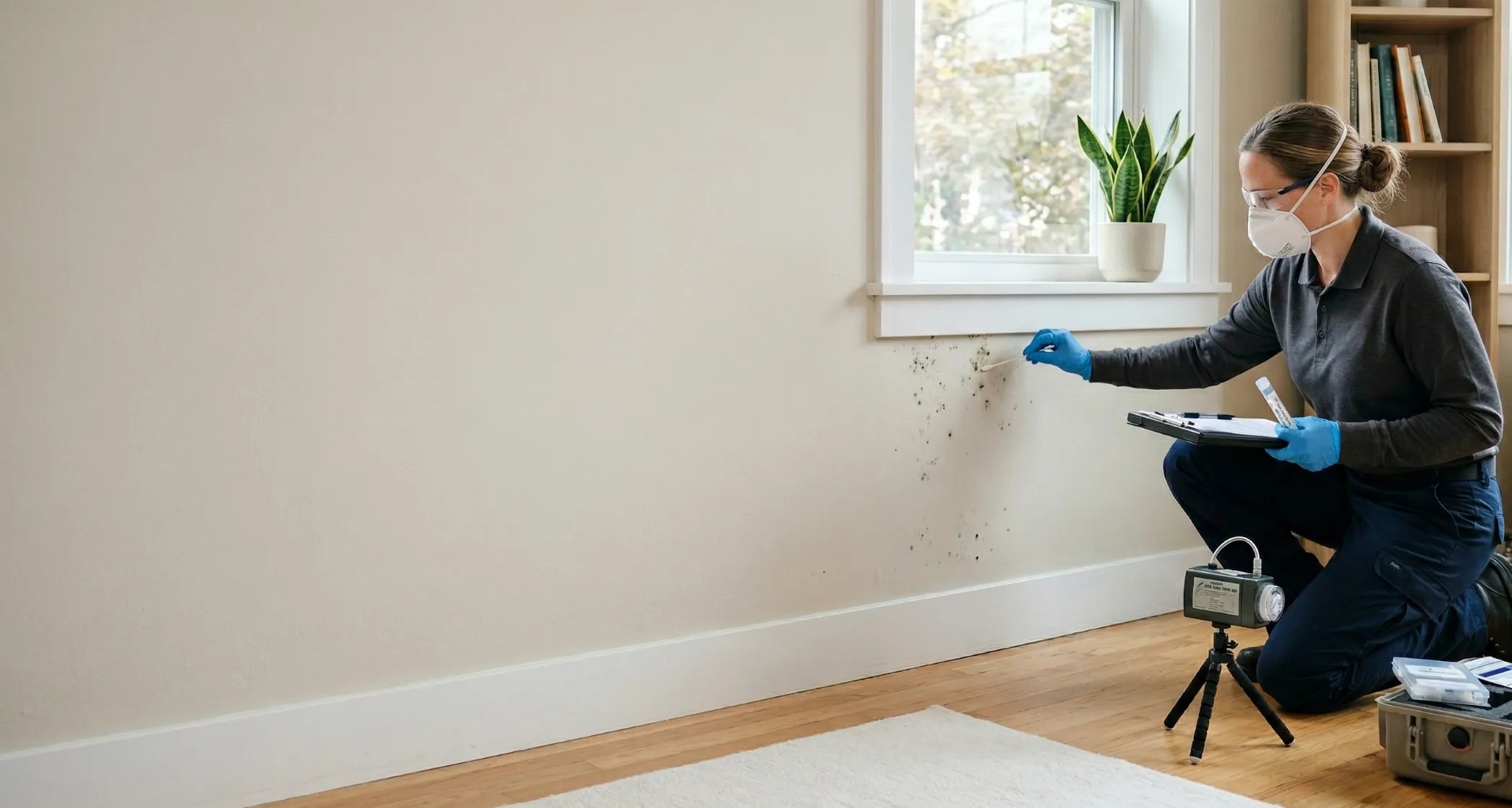

Mold testing collects physical samples from your home's air and surfaces and sends them to a certified lab to identify species and measure spore concentrations. This guide covers every testing method, what results actually mean, when testing is necessary, and when it isn't, including what professional testing typically costs: $300 to $600 for most homes.
Key insights
- Testing identifies species and measures spore counts. It is a separate step from inspection, which locates mold visually and measures moisture.
- Air sampling is the standard method for most homes. It captures what you are currently breathing, compared against an outdoor baseline.
- Indoor spore counts above 1,000 spores/m³ are considered elevated. Indoor levels more than 1.5 times the outdoor baseline warrant investigation.
- ERMI reflects historical accumulation, not current air quality. The EPA developed it as a research tool and does not recommend it for routine home use.
- Clearance testing must be done by an independent inspector. Never the remediation contractor who did the work.
- DIY kits cannot measure concentrations or identify sources. They do not produce lab-certified results for insurance or legal purposes.
What mold testing is
Mold testing is the collection and laboratory analysis of samples from your home to identify which mold species are present and at what concentrations. It answers the questions that a visual inspection alone cannot: what kind of mold is it, how much is in the air, and has it spread beyond visible surfaces?
Testing is distinct from mold inspection, which is the physical on-site assessment that uses moisture meters and visual examination to locate mold and document the conditions sustaining it. The two are often performed during the same visit, but they serve different functions. Inspection tells you whether and where mold exists. Testing tells you what kind and how much.
Testing also plays a role after remediation is complete. Post-remediation clearance testing confirms that spore levels have returned to baseline and that the work was effective before final payment is made to the contractor.
When testing adds value and when it doesn't
If mold is already visible and the moisture source is identified, testing adds limited value before remediation. The EPA's position is that if mold is present, it should be removed regardless of species. Where testing earns its cost is in situations where mold is suspected but not visible, where health symptoms need to be investigated, where a real estate transaction requires documentation, or where post-remediation verification is needed.
Mold testing methods compared
Professional mold testing uses six methods: air sampling, surface swabs, tape lifts, bulk sampling, wall cavity sampling, and ERMI, each capturing different information at different cost and accuracy levels. A qualified inspector selects methods based on what the situation calls for, not a preset menu.
 Six methods, six different price points; a swab or tape lift alone can't tell you what's currently circulating in the air the way a cassette and pump can.
Each method collects a different type of sample, works at a different cost point, and answers a different question. The table below breaks down what each one physically does and what it typically costs.
| Service | Use case | What it does | Typical cost |
|---|---|---|---|
| Air sampling (spore trap) | Standard | A pump draws air through a cassette for 5 minutes, trapping spores on a glass slide. Lab counts types and concentrations. Requires an outdoor control sample for comparison. | $90–$150 per sample |
| Surface swab | Standard | A sterile swab collects mold from a specific surface. Lab identifies the species at that location. Does not reflect air quality or spread. | $90–$270 per sample |
| Tape lift | Standard | Specialized tape lifts spores from a visible surface. Identifies genus only, not species. Low cost; commonly used in clearance testing. | $50–$100 per sample |
| Bulk sampling | Targeted | A piece of building material is removed and sent to the lab intact. Confirms deep contamination in structural materials. More invasive; requires repair. | $100–$200 per sample |
| Wall cavity sampling | Targeted | A small hole is drilled and air is drawn from inside the wall or ceiling. Detects mold behind surfaces without opening drywall. | $100–$200 per sample |
| ERMI / HERTSMI-2 | Advanced | DNA-based analysis of settled dust. Screens for 36 mold species and reflects weeks or months of accumulation, not current air quality. EPA research tool; not recommended for routine home diagnosis. | $200–$400 |
The table above shows what each method costs and what it physically does. The table below shows how to think about which one fits your situation. The key variable is time frame: air sampling captures what is happening in your home right now, while surface and bulk methods confirm what is present at a specific location. For most homeowners, a qualified inspector will combine two or three of these methods in a single visit rather than relying on one alone: air sampling to measure what is circulating, and a surface swab or tape lift to confirm the species at any visible growth. The method breakdown below maps each approach to the situations where it performs best.
| Method | What it measures | Time frame | Best use case |
|---|---|---|---|
| Air sampling | Current airborne spore types and concentrations | Snapshot (5 minutes) | Unexplained symptoms, hidden mold, clearance testing |
| Surface swab | Species on a specific surface | Point in time | Confirming visible mold type before remediation |
| Tape lift | Genus on a specific surface | Point in time | Clearance testing, low-cost surface confirmation |
| Bulk sampling | Deep contamination in building materials | Point in time | Suspected structural contamination |
| Wall cavity | Airborne spores inside wall or ceiling voids | Snapshot | Hidden mold behind walls with no surface growth |
| ERMI / HERTSMI-2 | DNA of 36 species in settled dust | Historical (weeks to months) | Research, medical referrals, long-term history |
Air sampling vs. ERMI: understanding the difference
Air sampling captures current airborne spore concentrations as a real-time snapshot; ERMI analyzes settled dust to reflect weeks or months of historical mold accumulation. They measure fundamentally different things, and choosing the wrong one produces results that are difficult or impossible to act on.
 Air sampling answers what's in the air today; ERMI dust collection answers what's settled there over the past several months.
Air sampling: a snapshot of current conditions
Spore trap air sampling draws a measured volume of air through a cassette for a set period, typically five minutes. The spores trapped are viewed under a microscope and counted by species. The result reflects what is currently circulating in your indoor air on the day of the test. This is also why an outdoor control sample is critical: outdoor mold levels fluctuate daily and seasonally, and without that baseline, an indoor count has no context.
Air sampling is the standard method accepted by insurance companies, remediation contractors, courts, and the IICRC (Institute of Inspection Cleaning and Restoration Certification). It is what most certified inspectors use and what most mold remediation process protocols reference for clearance.
ERMI: a historical look at accumulated dust
ERMI collects settled dust from floors or surfaces and uses DNA-based quantitative PCR analysis to screen for 36 mold species. Because dust accumulates over weeks or months, ERMI reflects historical mold presence rather than current air quality. This can reveal past contamination events that air sampling would miss.
The EPA developed ERMI as a research tool and explicitly states that it has not been validated for routine home use, real estate transactions, or medical diagnostic purposes. Despite this, ERMI is sometimes recommended by functional medicine practitioners for patients with mold-related health concerns. It can provide useful long-term context when interpreted by an experienced professional alongside other data.
| Method | Pros | Cons |
|---|---|---|
| Air sampling | Industry standard accepted by insurers and courts; reflects current breathing conditions; allows room-by-room comparison; directly comparable to outdoor baseline; used for post-remediation clearance | Snapshot only: a single bad day outdoors can skew results; will not detect past contamination that is no longer active; requires proper collection technique for accurate results; does not pinpoint the source location |
| ERMI | Captures historical mold burden over months; detects past contamination air sampling would miss; DNA-based and highly specific to species; can be collected by homeowner and mailed to lab | EPA does not recommend for routine home diagnosis; does not reflect current air quality; no standardized pass/fail threshold; results require expert interpretation; dust from outside sources can contaminate results |
HERTSMI-2 is not a substitute for a full assessment
HERTSMI-2 screens only five of the 36 ERMI species, those most associated with Chronic Inflammatory Response Syndrome (CIRS). It is cheaper and sometimes recommended by CIRS-treating physicians, but its narrower scope means it can miss significant contamination that a full ERMI or air sampling would detect. If you are using it for medical decision-making, do so with guidance from a physician experienced in mold-related illness.
What happens during professional mold testing
A professional mold testing visit follows six steps: pre-test walkthrough, outdoor control sample, indoor air samples by zone, surface samples where applicable, chain-of-custody lab submission, and a written report with interpretation. The visit itself runs one to three hours depending on the number of samples and whether a full inspection accompanies the testing.
 Skipping the outdoor control sample in step two invalidates every indoor count that follows, since there's no baseline to compare against.
1. Pre-test walkthrough and history review
Before collecting any samples, the tester identifies which rooms are symptomatic, whether there has been prior water damage, and whether any recent activities (cleaning, construction, opening windows) could affect air quality on the test day. HVAC systems are typically left in normal operating condition before air sampling begins.
2. Outdoor control sample collection
An outdoor sample is collected first, establishing the ambient baseline of mold spores present in the outdoor air on that specific day. This sample is what all indoor results are measured against. Without it, indoor counts have no meaningful reference point. An inspector who skips the outdoor control is not performing a scientifically valid test.
3. Indoor air samples by zone
Air sampling cassettes are placed in each suspect area and an air pump runs for a set period, typically five minutes, drawing a specific volume of air. Bedrooms, living areas, basements, and any room with reported symptoms or moisture history are prioritized. Most homes require two to six indoor samples for a complete picture.
4. Surface samples where applicable
If visible mold growth is present, swab or tape lift samples are collected from suspect surfaces. For situations where wall cavity mold is suspected, a small hole may be drilled to draw air from inside the wall. Surface samples complement air samples but do not replace them.
5. Chain-of-custody documentation and lab submission
Each sample is sealed, labeled, and logged with chain-of-custody documentation before being shipped to an independent, AIHA-accredited laboratory. The lab performs microscopic analysis, identifies spore types by genus and species, and counts concentrations. Standard turnaround is two to five business days; rush processing is available at additional cost. For guidance on vetting the company performing this work, see how to choose a mold remediation company.
6. Written report with interpretation
A qualified tester delivers the lab results alongside a written interpretation, not just the raw data. The report should explain what the findings mean in context, whether any results are elevated relative to outdoor baseline, and what action, if any, is warranted. Raw lab data sent without interpretation is not a complete deliverable.
How to read your mold test results
Mold test results report spore concentrations in spores per cubic meter, compared against an outdoor baseline collected the same day. Indoor counts above 1,000 spores/m³ or more than 1.5 times the outdoor baseline are considered elevated and warrant further investigation. Most homeowners find the raw lab data confusing without context. Here is what the numbers mean and how to interpret them.
 A debris rating above 3 on a report like this means the count itself may be less reliable, not just the mold levels it's reporting.
The outdoor baseline is the most important number
No single indoor spore count can be evaluated in isolation. The first thing a qualified interpreter does is compare indoor counts to the outdoor control sample taken on the same day. Indoor levels that are roughly equal to or lower than outdoor levels suggest normal conditions, even if the raw numbers look large. Indoor counts significantly higher than the outdoor baseline, particularly for species associated with water damage, indicate an indoor source.
As a general benchmark, indoor levels above 1.5 times the outdoor baseline for a given species warrant further investigation. A total indoor spore count above 1,000 spores/m³ is considered elevated by most practitioners, though there is no universal regulatory standard.
| Indoor total count | Interpretation | Typical next step |
|---|---|---|
| 0–500 spores/m³ | Normal range | No action required if proportional to outdoor baseline |
| 500–1,000 spores/m³ | Borderline elevated | Compare to outdoor baseline; investigate if disproportionate or if water-damage species are present |
| 1,000–3,000 spores/m³ | Elevated | Full inspection recommended; likely indicates an indoor source |
| Above 3,000 spores/m³ | Significantly elevated | Professional remediation likely warranted; do not delay |
Species matter as much as count
Not all elevated counts are equally concerning. Cladosporium and Alternaria are ubiquitous outdoor molds that commonly appear in indoor samples, especially seasonally. High counts of these genera often reflect outdoor air infiltration rather than an indoor problem. The species to watch are those most commonly associated with water damage: Stachybotrys (black mold), Chaetomium, Aspergillus, and Penicillium. Any meaningful presence of Stachybotrys or Chaetomium in an air sample is a significant finding, as these species require sustained moisture to grow and are rarely introduced from outdoor sources.
Background debris and raw count
Lab reports also show a "raw count" (the actual number of spores the analyst counted on the slide) and a background debris rating (1–5, with 1 being cleanest). A high debris rating means more non-mold particles were on the slide, which can make spores harder to see and reduce the precision of the count. A background debris rating of 3 or below is considered reliable. Reports with debris ratings of 4 or 5 should be interpreted with that limitation in mind, and a retest may be warranted.
Always get a written interpretation, not just lab data
Raw lab data is not the same as a mold test report. A certified inspector or industrial hygienist should interpret the numbers in the context of your home, the outdoor conditions on the test day, any visible findings from the inspection, and the history of water damage. A printout of spore counts without contextual interpretation does not constitute a professional mold test report.
What mold testing costs
Professional mold testing typically costs $300 to $600 for a standard home, including sampling, lab analysis, and a written report. Costs rise to $700 to $1,000 for larger homes or those requiring more sample points. Each component has its own pricing, and mold inspection costs include testing components, so understanding what you are paying for helps you evaluate quotes accurately.
| Service | Typical cost | Notes |
|---|---|---|
| Air sample (per sample) | $90–$150 | Most homes need 2–6 samples; outdoor control always required |
| Surface swab (per sample) | $90–$270 | Higher price reflects genus-and-species identification |
| Tape lift (per sample) | $50–$100 | Genus-level only; often used for clearance testing |
| Wall cavity sample | $100–$150 | Requires drilling a small access hole |
| Bulk sample | $100–$200 | Involves removing and sending material to lab; repair cost extra |
| ERMI testing | $200–$400 | DNA-based dust analysis; can be done by homeowner with mail-in kit |
| Rush lab processing | $50–$100 extra | 24–48 hour turnaround vs. standard 2–5 business days |
| Post-remediation clearance test | $200–$500 | Multiple air and surface samples; written clearance report required |
Most professional mold testing visits for a standard home total $300–$600 when sampling, lab fees, and the written report are combined. A thorough four-to-six sample test of a larger home with suspected hidden mold can reach $700–$1,000. These costs are separate from the inspection fee if booked independently, though many inspectors bundle both into a single appointment at a combined rate.
Lab fees are often quoted separately
Some inspectors quote a base rate for the visit and then add per-sample lab fees on top. Always ask whether quoted prices include independent lab analysis and the written report. A visit that does not include lab analysis is a collection service, not a mold test.
Clearance testing after remediation
Post-remediation clearance testing is the step that confirms whether mold remediation actually worked. It is not optional if you want accountability for the work done. Without it, you are taking the remediation contractor's word that the job is complete.
 An inspector independent of the remediation contractor is required here; the same company testing its own work is the conflict IICRC S520 exists to prevent.
The process mirrors initial testing: air and surface samples are collected from the remediated area and compared against the clearance standards specified in the original remediation protocol. The IICRC S520 Standard for Professional Mold Remediation defines the clearance benchmarks that must be met before a project is considered complete. For clearance to be confirmed, indoor spore levels must have returned to baseline (comparable to outdoor levels) and no indicator species should be elevated.
Who should perform clearance testing
Clearance testing must be performed by the original inspector or a different independent testing professional, never the remediation contractor who did the work. A contractor testing their own work has an obvious conflict of interest. Write this requirement into your contract before work begins. Questions to ask a mold remediation company covers exactly what to include in your contract.
For help verifying that an inspector holds legitimate credentials, see mold remediation certifications. Withhold final payment until clearance is confirmed in writing.
What clearance testing includes
- Air samples from the remediated area and adjacent rooms
- An outdoor control sample collected the same day
- Surface tape lifts from remediated materials to confirm no visible growth remains
- Visual inspection confirming no remaining mold growth and that the moisture source has been addressed
- A written clearance report stating whether the project meets the protocol's standards
Clearance is not the same as "we can't see any mold"
A visual check by the remediation contractor at the end of the job is not clearance testing. Mold spores are invisible at concentrations that still affect health. Only lab-confirmed air sampling with results meeting the protocol's clearance criteria constitutes a proper post-remediation clearance. Mold remediation covers the full process from start to clearance.
DIY mold testing: when it works and when it doesn't
DIY mold test kits are sufficient for initial screening only. For insurance claims, real estate transactions, post-remediation clearance, or any situation requiring certified results, professional testing is required.
Consumer mold test kits are available for $20–$100 at hardware stores and online. More sophisticated DIY options include mail-in air sampling kits using professional-grade cassettes analyzed by a certified lab, which run $150–$200. Understanding what each provides helps you decide whether professional testing is worth the additional cost for your situation.
Basic consumer kits (petri dish / settle plate)
These kits expose a petri dish to room air for a set period, then send or grow the sample to see if mold colonies develop. They confirm the presence of some mold spores in the air. They do not measure concentrations, identify species beyond broad categories, provide a comparison to outdoor levels, or produce results accepted by insurers, landlords, or courts. Because mold spores are present in virtually every home, a positive result from one of these kits tells you very little.
Mail-in air sampling kits with lab analysis
A step up from basic kits, these provide calibrated air pumps and cassettes that can be used by a homeowner and mailed to an accredited lab. The lab analysis is equivalent to what a professional would send. What is missing is the professional collection technique, outdoor control sampling, and interpretation from someone who has seen your home. Results are valid as raw data, but without comparison to an outdoor baseline and contextual interpretation, they are difficult to act on.
DIY may be sufficient when
- Initial screening before deciding to hire a professional
- Budget is a hard constraint and results are for personal information only
- A doctor has recommended ERMI testing and you are comfortable collecting dust samples following lab instructions
- Confirming that a very small, clearly isolated mold area has been successfully cleaned
Professional testing is required when
- Results will be used for insurance claims or legal disputes
- Real estate transaction requires certified documentation
- Post-remediation clearance is needed for contractor payment
- A household member has a health condition requiring medical-grade data
- Mold is suspected but not visible and you need a reliable answer
When you need mold testing vs. when you don't
Mold testing adds value when mold is suspected but not visible, when health symptoms need investigation, when a real estate transaction requires documentation, or when post-remediation verification is needed. When mold is already visible and the moisture source is identified, testing adds limited value before remediation.
Testing is worth scheduling when
- You have symptoms such as respiratory issues, unexplained fatigue, or chronic sinus problems but no visible mold
- A musty odor persists despite cleaning and ventilation improvements
- You are buying a home and want independent documentation of indoor air quality
- You need post-remediation clearance before making final payment to a contractor
- An insurer or landlord requires certified documentation before authorizing remediation work
- A water damage event occurred and drying was delayed
Testing is not necessary when
- Mold is visibly growing and the moisture source is identified; species identification does not change the removal process for most residential cases
- The affected area is small, clearly isolated, and has already been cleaned
- The extent of visible growth makes the remediation approach obvious regardless of species
Testing for the wrong reasons is a common mistake
Some remediation companies use testing as a sales tool, recommending extensive sampling as a first step when a visual inspection and moisture assessment would be more informative and less expensive. If a company recommends testing before performing any visual inspection or moisture mapping, ask why. Testing should follow inspection, not precede it. For how to evaluate whether remediation is warranted, see when mold remediation is required.
Frequently asked questions
How much does mold testing cost?
Professional mold testing for a typical home runs $300–$600, which includes sampling, independent lab analysis, and a written report. Larger homes or those requiring more sample points can reach $700–$1,000. Individual sample components range from $50 per tape lift to $270 per swab with full species identification. Post-remediation clearance testing adds $200–$500. See the cost table above for a full breakdown by service type.
How long does mold testing take to get results?
The on-site collection visit takes one to three hours. Standard lab turnaround is two to five business days after samples arrive at the laboratory, so most homeowners receive their written report within a week of the visit. Rush processing is available for an additional $50–$100 per order and typically returns results in 24–48 hours.
What is the difference between mold testing and mold inspection?
A mold inspection is a physical on-site assessment that uses moisture meters, visual examination, and thermal imaging to locate mold and document the conditions sustaining it. Mold testing is the collection and laboratory analysis of air or surface samples to identify species and measure spore concentrations. Inspection tells you whether and where mold exists. Testing tells you what kind and how much. The two are frequently performed during the same visit but serve different purposes and are priced separately.
Is ERMI testing reliable?
ERMI provides useful historical data about mold accumulation in a home, but the EPA explicitly states that it was developed as a research tool and has not been validated for routine home diagnosis, real estate transactions, or medical assessments. Its main limitation is that it measures settled dust, which can be contaminated by mold brought in from outside on clothing or belongings and which reflects weeks or months of history rather than current conditions. For most residential situations, spore trap air sampling is the more actionable choice. ERMI has a role in specific medical contexts when ordered by a physician experienced in mold-related illness.
What mold spore count is considered dangerous?
There is no universal regulatory standard, but most practitioners consider indoor total spore counts above 1,000 spores/m³ elevated and above 3,000 spores/m³ significantly elevated. More important than the absolute number is the indoor-to-outdoor ratio: indoor counts exceeding 1.5 times the outdoor baseline for a given species suggest an indoor source. The species present matters too; Stachybotrys and Chaetomium are associated with sustained moisture damage and are more clinically significant than elevated counts of Cladosporium, which is common outdoors. Health effects by mold type are covered in depth at whether mold is dangerous.
Can I test for mold myself?
Basic petri dish kits ($20–$100) confirm the presence of some mold spores, but since spores are present in virtually every home, a positive result tells you little. Mail-in air sampling kits ($150–$200) use professional-grade cassettes and accredited lab analysis, but lack an outdoor control sample and professional interpretation. DIY testing is reasonable for initial screening or personal information. For insurance claims, real estate documentation, post-remediation clearance, or any situation requiring certified results, professional testing is required.
Does insurance cover mold testing?
Standard homeowners insurance does not cover routine mold testing. Coverage may apply when mold results directly from a sudden covered peril, such as a burst pipe or documented storm damage, and the insurer requires testing as part of the claims process. Mold from gradual moisture accumulation, deferred maintenance, or flooding is typically excluded from standard policies. Review your policy language before assuming testing costs will be reimbursed, and contact your insurer before ordering any testing you intend to submit for reimbursement. Mold remediation costs covers what insurance typically covers and the full price breakdown.
When should I test for mold after water damage?
After a flood, pipe burst, or major roof leak, mold can begin growing within 24–48 hours. The priority during that window is water mitigation and drying, not testing. Once materials are confirmed dry and any visible mold has been addressed or remediated, testing confirms whether spore levels have returned to normal. Testing before drying is complete produces results that will be elevated regardless of remediation quality. The full timeline of what to do after a leak or flood is covered at mold after water damage.
- Fisk W. and Mudarri D., "Health and Economic Impacts of Dampness and Mold"
- EPA ERMI Fact Sheet
- U.S. Environmental Protection Agency (EPA): A Brief Guide to Mold, Moisture, and Your Home
- CDC Mold Health Information
- IICRC S520 Standard for Professional Mold Remediation
- National Institute for Occupational Safety and Health (NIOSH): Dampness and Mold in Buildings
- American Council for Accredited Certification
- American Industrial Hygiene Association
Sam Hickerson is the founder of RestoreAdvisor and writes consumer guides on mold remediation, water damage restoration, inspection, testing, and home recovery. His work focuses on helping homeowners understand costs, risks, and when to call a professional. He draws on guidance from the EPA, CDC, IICRC, and other authoritative sources to make complex home issues easier to navigate.