
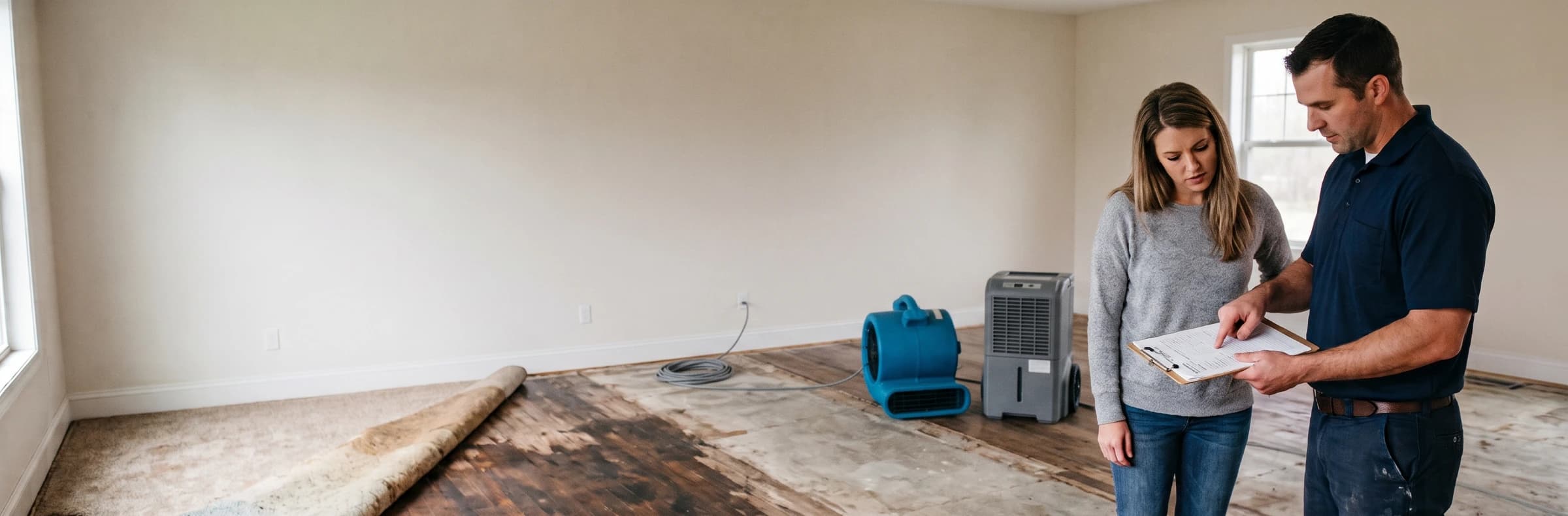

Water is still drying out of the carpet, or the adjuster already approved the claim, and now someone has to be hired to finish the job right. That decision can feel high stakes with a stranger about to work inside your home, but a handful of concrete checks make it manageable, and both of the worst outcomes, hidden moisture and liability, are avoidable with the right questions asked upfront.
A qualified water damage restoration company holds active IICRC certification, follows the drying and moisture verification procedures set out in the IICRC S500 standard, and carries both general liability and workers' compensation coverage before a single fan gets plugged in. Finding one starts with sourcing candidates and checking reviews, then moves into certification, insurance, response time, equipment, claims handling, written estimates, contract terms, and the red flags that should end a conversation before signing, all of which shapes what to expect during water damage restoration once you've made a choice.
Key insights
- IICRC certification comes first. Master Water Restorer status requires active WRT, ASD, and AMRT certifications plus three years of documented field experience.
- Insurance protects more than the homeowner. General liability and workers' compensation both need verification, since a company without coverage can leave the homeowner responsible for an on-site injury.
- Payment demands reveal legitimacy. The FTC warns that contractors who demand full payment upfront or accept only cash, wire transfer, or cryptocurrency are among the clearest signs of a scam.
- Two estimates catch inflated scopes. A written, itemized estimate from at least two companies exposes vague line items like "miscellaneous labor" before a contract gets signed.
- Local crews respond faster. Companies with in-house technicians and a local office typically arrive sooner and carry more accountability than out-of-state subcontractors.
- One company can often do both phases. Full-service companies handle water extraction and drying, then hand off directly to reconstruction, which avoids gaps in coverage between two separate contractors.
Where to find companies to compare
Several sources typically surface more reliable candidates than a general web search after a storm, especially since paid search ads are one of the same channels storm chasers use to find customers. Insurance-recommended vendors, the IICRC's Global Locator, and personal referrals each carry a different kind of built-in vetting before certification and insurance are ever verified.
 The IICRC Global Locator lists only companies with at least one actively certified technician, unlike a general web search that surfaces paid ads regardless of credentials.
Ask the insurance company for a preferred vendor list
Most carriers maintain a list of vendors already vetted for licensing, insurance, and claims-handling experience, since the insurer has a direct interest in the repair being done correctly the first time.
Search the IICRC Global Locator
The IICRC Global Locator lists certified firms and technicians by location and lets a homeowner confirm a company's certification status directly, rather than relying on a badge displayed on the company's own website.
Ask a property manager, contractor, or neighbor for a direct referral
A company that has handled a comparable job for someone in the same building or neighborhood carries more useful information than a star rating, since the referral source can speak to how the crew actually performed on-site.
Be skeptical of the first paid result after a storm
Companies that spend heavily on search ads immediately following a local weather event are using the same acquisition channel as door-to-door storm chasers, even if the ad itself looks legitimate.
Check reviews and ask for references
Online reviews and direct references reveal how a company performs on the job, which is the part a first phone call rarely shows. Look for a consistent pattern across Google, the Better Business Bureau, and Yelp rather than a handful of five-star reviews posted in the same week on a single site, since that pattern can indicate incentivized or fabricated reviews.
Ask the company directly for two or three references from jobs similar in scope to the current one, and actually call them. A reputable company should provide this without hesitation, and a company that cannot produce a single past client willing to speak has not been in business long enough to have earned that requirement.
Check the company's stated years in business against its actual registration date if that information is public, since storm chasers frequently form a new entity right before or after a major weather event and then claim decades of unrelated industry experience to sound established.
Verify IICRC certification and state licensing
Active IICRC certification is the credential that confirms a technician has been trained in the drying, moisture verification, and contamination handling procedures used industry-wide. The Institute of Inspection, Cleaning and Restoration Certification issues three water damage restoration certifications specific to this work: WRT, ASD, and AMRT.
 IICRC certifications require an annual renewal fee and continuing education credits, so a card issued years ago does not confirm the credential is still active today.
A technician who has only completed WRT can technically point to certification, but that alone doesn't guarantee hands-on drying competence, since WRT is a classroom-based introductory course with no prerequisites and no required field practice. Ask which specific certification each on-site technician holds rather than accepting a blanket claim that the company is "IICRC certified," since a company can have one certified estimator and an otherwise uncertified field crew.
| Certification | What it covers | Why it matters |
|---|---|---|
| WRT (Water Damage Restoration Technician) | Water categories and classes, drying equipment, psychrometry, and moisture mapping | Entry-level credential nearly every legitimate technician holds; no prerequisites required |
| ASD (Applied Structural Drying) | Hands-on structural drying performed in a real flood house, plus employee health and safety | Requires WRT first and in-person training, so it signals deeper hands-on competence |
| AMRT (Applied Microbial Remediation Technician) | Mold and microbial contamination handling when water sits long enough to trigger growth | Several states now require it for mold remediation work that follows a water event |
| Master Water Restorer | WRT, ASD, and AMRT certifications plus three years of documented experience | A strong signal of depth when the lead technician holds it, but not something to require, since most competent crews carry WRT and ASD without it |
Master Water Restorer status is worth treating as a bonus signal, not a requirement. Most competent field technicians carry WRT, and often ASD, while Master Water Restorer status tends to belong to a senior technician, an estimator, or the company owner rather than every crew member on a job. Listen for a named credential, WRT, ASD, or AMRT, rather than a vague "we're certified" claim; that specificity is the real signal of legitimacy. If the person managing the job also happens to hold Master Water Restorer status, that reflects real depth of experience, but its absence isn't a red flag the way an unnamed, unverifiable "certified" claim is.
State licensing requirements vary by state, so confirm what applies locally before hiring. IICRC certification isn't federally mandated, and a technician can legally perform water damage restoration work without it, but that also means no independent body has verified their training.
Ask for the company's state license number, if applicable, and verify it directly through the state contractor licensing board. Confirm the company's active certification status through official IICRC records rather than a claim printed on a business card.
In states that don't require a specific license for mitigation-only work, search the company name in the state's business registry or secretary of state database instead. A legitimate business will have a matching, findable registration, and a company with no record under its own name is far easier to lose track of after collecting a deposit.
Confirm general liability insurance and workers' compensation
General liability insurance and workers' compensation are the two coverages every water damage restoration company should carry before starting work, and both protect the homeowner as much as the company. General liability covers accidental property damage caused by the crew, such as a punctured pipe or a dropped piece of equipment, while workers' compensation covers a technician injured on the job.
Restoration crews handling the higher-risk water damage categories, gray or black water carrying contamination, face bloodborne pathogen exposure risks.
OSHA's Bloodborne Pathogens Standard addresses this directly, which is one reason insurance and proper protective equipment matter as much as the drying equipment itself. Ask for a certificate of insurance naming the property owner, not just a verbal assurance, and confirm the policy is active rather than expired. A company that hesitates to produce this document, or that only offers to send it after the job starts, has already answered the question.
Check response time and local presence
Response time matters most in the first 24 to 48 hours after a water event, the window the EPA cites as the point at which materials that stay wet typically start to grow mold. A company able to dispatch a crew within a few hours has a real advantage over one that schedules an inspection days out.
Local companies with in-house crews and a physical office tend to respond faster on emergency water damage calls and carry more accountability than operations that rely on out-of-state subcontractors brought in after a major storm. Ask where the crew is based, whether the technicians who show up are direct employees or subcontractors, and how the company handles warranty callbacks once the job is finished. A company with no local address and no answer to that last question is one to keep looking past.
Ask what drying equipment and technology they use
The equipment a company brings to a job site says as much about its competence as any certification, since underpowered equipment leads directly to incomplete drying. A qualified crew arrives with moisture meters, air movers, and commercial dehumidifiers sized to the square footage and material type involved, the same variables behind water damage restoration cost per square foot, not whatever happened to be in the truck.
 A reading of 28.4% is well above the 5 to 12% considered normal for dry drywall. Readings above 17% typically mean the material is compromised and needs replacement rather than continued drying.
The amount of equipment matters as much as the type. IICRC S500 psychrometric calculations determine dehumidifier and air mover count based on the specific square footage, ceiling height, and materials affected, not a flat number applied to every job regardless of size. A company that brings the same handful of units to a small bathroom leak and a flooded basement is skipping that calculation.
| Equipment | What it does | When it's used |
|---|---|---|
| Moisture meter | Measures moisture content inside building materials to confirm they're actually dry, not just dry to the touch | Throughout drying and at final verification |
| Thermal imaging camera | Detects temperature differences that reveal hidden moisture behind walls, ceilings, or flooring | Initial inspection and mid-job monitoring |
| LGR or desiccant dehumidifier | Pulls moisture out of the air so surrounding materials release trapped water faster | Continuously during the multi-day drying phase |
| HEPA air scrubber | Filters airborne particles and contaminants, particularly relevant once category 2 or 3 water is involved | Category 2 and 3 jobs, and any job with visible mold |
Ask how many drying units the company plans to bring and why. A single dehumidifier in a basement with several hundred square feet of standing water is a sign the company is either understaffed or trying to save on equipment rental at the homeowner's expense.
Review their experience with insurance claims
Insurance claims experience determines how smoothly documentation, billing, and adjuster communication go once the job starts, separate from whether homeowners insurance covers water damage for your specific cause of loss. A company experienced with claims typically uses estimating software such as Xactimate, the same platform most insurance adjusters reference, which keeps the scope of work consistent with what the carrier expects to see.
Ask whether the company bills the insurer directly or expects payment upfront with reimbursement handled later, since direct billing removes a meaningful cash flow burden during an already stressful event. Be cautious of any contractor who offers to negotiate the insurance claim directly, since only a licensed public adjuster or attorney can legally represent a homeowner in that role. A restoration company documenting damage for a claim is normal; a company positioning itself between the homeowner and the insurer is not.
Get written estimates from at least two companies
A written, itemized estimate is the most reliable way to compare two water damage restoration companies on equal terms, since verbal quotes leave too much room for scope creep once work begins. Ask each company to itemize labor, equipment run time, and material replacement separately, since these are the same cost drivers behind published water damage restoration cost ranges by category and class.
A complete estimate should include:
- The water category and class documented in writing, not just described verbally
- A projected drying timeline, typically 3 to 5 days for a straightforward Class 1 or 2 loss under the water damage classes system
- Whether mitigation, meaning extraction and drying, and reconstruction, meaning rebuilding, are priced separately or bundled together
- A payment schedule tied to project milestones rather than a large deposit due before work starts
What should be in the contract before you sign
A signed contract should spell out cancellation rights, how additional damage gets priced, and what happens if the completion date slips, not just the total cost. These protections matter as much as the price itself once work is already underway.
 The FTC's three-day cancellation right applies only to contracts signed away from a company's regular place of business, not to repairs a homeowner called in and requested.
Know your cancellation rights
The FTC's Cooling-Off Rule gives a right to cancel a contract within three business days when it's signed somewhere other than the company's regular place of business, such as at home during an unsolicited visit.
That right doesn't apply to repairs a homeowner specifically requested, which covers most emergency water damage calls, so it mainly protects against pressure-sale scenarios rather than a company called in after a burst pipe.
Get change orders in writing
If a technician finds additional damage once walls or flooring are opened up, which happens often once hidden moisture is exposed, the added cost and scope should be documented and approved before work continues rather than added to the final invoice as a surprise.
Confirm what happens if the completion date slips
A contract with a stated timeline gives a homeowner grounds to ask questions if a job originally quoted at five days stretches to three weeks with no update, rather than simply waiting and hoping for a call.
Watch for storm chaser and scam red flags
Storm chasers are contractors who arrive in a neighborhood immediately after a major weather event, often going door to door before an insurance adjuster has even inspected the damage. The FTC warns that recognizing a handful of consistent tactics can prevent a homeowner from losing a deposit to a company that never finishes the work.
Unsolicited door-to-door offers
A company that shows up uninvited within hours of a storm, offering an immediate inspection or discount, is using a pressure tactic rather than a referral or reputation to get work.
Demands for full payment upfront
Legitimate companies typically use staged payments tied to project milestones. A large deposit or a demand for full payment in cash, wire transfer, gift card, or cryptocurrency before any work begins is one of the clearest scam indicators.
Pressure to sign the same day
Offers that are only valid today, or that discourage getting a second estimate, are designed to prevent comparison shopping rather than to save the homeowner money.
No written contract or proof of insurance
A company that will not put the scope of work, price, and timeline in writing, or that cannot produce a certificate of insurance on request, has given a direct answer about how it operates.
Offers to waive the insurance deductible
Waiving a deductible is illegal in many states and typically signals a company padding the invoice elsewhere to cover the difference.
Report suspected fraud to the FEMA Disaster Fraud Hotline or through the FTC's online complaint form, both of which track patterns across multiple homeowner reports in the same affected area.
Questions to ask before you hire
Asking these questions during the first phone call or on-site inspection surfaces certification, insurance, and scheduling details that matter as much as the water damage restoration process itself once work begins.
 Writing down each company's answers makes it possible to compare responses side by side once two or three calls are done, rather than relying on memory alone.
1. What IICRC certifications does your team hold?
A named credential, WRT, ASD, or AMRT, is a good sign; a blanket "fully certified" claim is not.
2. Can you provide a certificate of insurance naming me as the property owner?
A same-day document beats a promise to send one later.
3. Are your technicians employees or subcontractors?
Direct employees signal more consistency than a subcontracted crew.
4. What is your average response time for a job like mine?
A specific number of hours beats "as soon as possible."
5. Will you bill my insurance company directly?
Direct billing means paying nothing out of pocket while the claim processes.
6. What does your written estimate include?
Itemized labor, equipment, and materials, not a single lump sum.
7. Do you handle both mitigation and reconstruction, or will I need a second company?
One company handling both phases means a single point of accountability.
8. Can you provide two or three references from similar jobs?
Hesitation or excuses here is a bigger red flag than the answer itself.
These eight cover the fastest way to rule out a bad fit; the full questions to ask a water damage restoration company list adds coverage for insurance billing, the written contract, and the in-home estimate itself.
Frequently asked questions
Should I hire the company my insurance company recommends?
Yes, but verification still applies. Insurer-recommended companies, sometimes called preferred vendors, are typically pre-vetted for licensing and insurance, though it's still worth confirming certifications directly and getting a second estimate for comparison.
Can a general contractor handle water damage restoration instead of a specialized company?
Only for the reconstruction phase, not the initial mitigation. General contractors typically lack IICRC training in structural drying and moisture verification, which means hidden moisture can remain behind walls even after visible repairs are complete.
Is it illegal for a contractor to offer to waive my insurance deductible?
Yes, in many states. Waiving a deductible is considered insurance fraud in numerous jurisdictions, and a company offering it is usually planning to recover that cost by inflating other parts of the invoice.
Should I sign my insurance check over to the restoration company?
No. Insurance checks should be deposited by the homeowner, with payments to the contractor made directly and tied to completed work, not signed over as a lump sum to a third party.
Do water damage restoration companies offer free estimates?
Most do for the initial inspection, though a detailed written estimate with itemized pricing sometimes follows a formal on-site assessment. Ask upfront whether the first visit is free before scheduling it.
What's the difference between a public adjuster and a restoration company?
A public adjuster is licensed specifically to negotiate an insurance claim on the homeowner's behalf, while a restoration company documents and repairs the physical damage. A restoration company that positions itself as also negotiating the claim is stepping outside its role.
Sam Hickerson is the founder of RestoreAdvisor and writes consumer guides on mold remediation, water damage restoration, inspection, testing, and home recovery. His work focuses on helping homeowners understand costs, risks, and when to call a professional. He draws on guidance from the EPA, CDC, IICRC, and other authoritative sources to make complex home issues easier to navigate.