
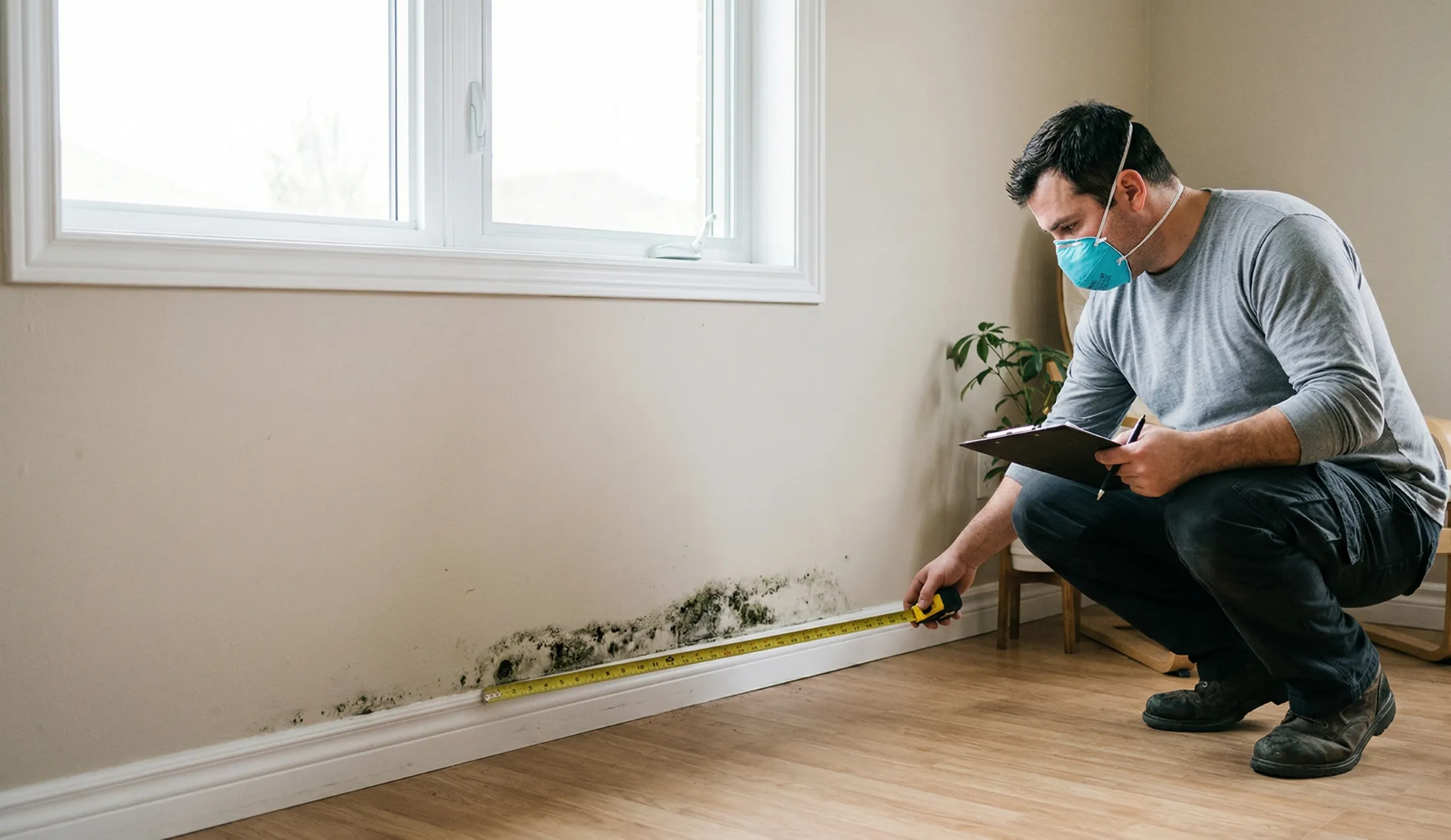

Most mold remediation quotes are written in square feet. Per-square-foot pricing is the method by which certified contractors calculate residential remediation quotes, measuring the contaminated surface area and applying a rate per square foot as defined under ANSI/IICRC S520, the industry standard for professional mold remediation. A contractor walks through your home, measures the contaminated surface area, and multiplies by a per-square-foot rate to build your estimate. Understanding exactly how that math works puts you in a far stronger position when comparing bids or questioning a line item.
This guide explains how per-square-foot pricing is built, what shifts the rate up or down, how to measure your affected area before getting quotes, and how to use sq ft figures to evaluate competing bids fairly. For overall project cost ranges by room and mold type, the mold remediation cost breakdown covers every major variable.
Key insights
- $10–$25 per sq ft is the standard range. Most residential mold remediation jobs fall in this range. Wall cavity access, confined spaces, or confirmed Stachybotrys push the rate to $15–$30 per sq ft. Light surface mold on non-porous materials can come in at $8–$12.
- Small jobs cost more per foot. Most certified contractors apply a minimum job charge of $500–$1,500 regardless of size. A 10 sq ft patch billed against a $1,000 minimum produces an effective rate of $100 per sq ft, not $10–$25.
- Labor is 50–70% of your invoice. A two-person certified crew bills at $80–$140 per hour combined. The number of required steps under ANSI/IICRC S520 determines how many hours a given scope actually takes, which is why two similarly sized jobs can produce very different labor charges.
- Confined spaces carry a 20–35% labor premium. Crawl spaces and attics where technicians must crouch or work from a ladder take significantly more time per square foot than open, accessible rooms, and that time premium is reflected directly in the per-foot rate.
- Stachybotrys adds 15–25% to the base rate. Black mold requires full-face respirators, higher-grade HEPA filtration, and sealed waste handling under IICRC protocols, all of which add cost on top of the standard sq ft rate.
- The sq ft rate almost never includes reconstruction or clearance testing. Drywall replacement, insulation, paint, and post-remediation air sampling are typically separate line items. Always confirm what is and is not in the quoted rate before signing.
Quick reference: 2026 per square foot rates
The national standard rate for professional mold remediation in 2026 is $10 to $25 per square foot of contaminated surface area for most residential jobs. Complex projects involving wall cavity access, HVAC contamination, or hazardous species run $15 to $30 per square foot. Light surface mold on non-porous materials in accessible locations can fall as low as $8 to $12 per square foot.
 Jobs under 10 sq ft rarely hit the low end of this chart since most contractors apply a $500 to $1,500 minimum regardless of size.
These figures reflect the contaminated surface area treated, not your home's total square footage. Total project cost rises quickly as the affected area grows, and minimum job charges mean small patches rarely come in at the low end of the per-foot range even when the rate itself is modest.
| Area size (sq ft) | Typical total cost range | Notes |
|---|---|---|
| Under 10 sq ft | $500 to $1,500 | Minimum job charges apply; effective per-ft rate is high |
| 10 to 25 sq ft | $800 to $2,000 | Small bathroom patch, window surround |
| 25 to 50 sq ft | $1,200 to $2,800 | Corner of basement wall, laundry room ceiling |
| 50 to 100 sq ft | $1,800 to $4,000 | Half a bathroom or partial crawl space |
| 100 to 200 sq ft | $2,500 to $6,500 | Single room, full bathroom, partial attic |
| 200 to 300 sq ft | $4,000 to $9,000 | Multiple rooms or significant attic growth |
| 300 sq ft and above | $6,000 to $20,000+ | Whole-floor or whole-house involvement |
How contractors build a per-square-foot quote
A per-square-foot remediation quote bundles labor, containment, equipment, materials, disposal, and clearance testing into a single rate, with labor typically representing 50 to 70 percent of the total. The specific steps a certified crew must follow are governed by ANSI/IICRC S520, which determines the minimum number of phases required for a given contamination level and therefore the floor on labor hours. Some components scale with the contaminated area; others are fixed regardless of how small the job is.
 Containment barriers like these are priced by perimeter, not treated area, which is why they add proportionally more cost to a small job than a large one.
Labor
Labor is the largest single driver, typically representing 50 to 70 percent of a remediation quote. A two-person certified crew bills at a combined $80 to $140 per hour depending on region. A 100 sq ft drywall job takes roughly 6 to 10 labor hours including setup, remediation, teardown, and cleanup. At a mid-range $100 per hour combined, that is $700 to $1,000 in labor alone before materials or equipment. IICRC S520 sets the procedural requirements that determine how many steps (and therefore how many hours) a certified crew must invest for a given scope.
Containment
Containment costs scale with the perimeter of the work area, not the contaminated surface itself. Erecting 6-mil poly barriers, zip walls, and negative-pressure airlocks costs roughly $0.50 to $0.90 per square foot of barrier erected. On a small job, containment may cost as much as the remediation work itself. This is why the effective per-square-foot rate rises sharply on jobs under 25 sq ft.
Equipment
HEPA air scrubbers rent at $75 to $120 per day. Negative-air machines add another $50 to $90 per day. Most residential jobs require 1 to 2 scrubbers running for 1 to 3 days. That fixed cost of $150 to $720 spreads across the total square footage, making small jobs expensive on a per-foot basis.
Materials
Antimicrobial agents, encapsulants, HEPA vacuum filters, and disposal bags add $1 to $4 per square foot treated. Containment sheeting, tape, and PPE for the crew add another $0.50 to $1.50 per job regardless of size.
Disposal
Contaminated drywall, insulation, and debris must be bagged in sealed containers and disposed of per local regulations. Disposal typically costs $0.30 to $0.60 per pound of removed material. Drywall weighs roughly 2.5 pounds per square foot; a 50 sq ft drywall removal job generates about 125 pounds of debris, adding $37 to $75 in disposal costs alone.
Clearance testing
Post-remediation air testing to verify the job is complete runs $150 to $400 per clearance visit and is typically billed separately from the sq ft rate. Some contractors bundle one clearance test in their base quote; others charge for it as a line item. Confirm which applies to your bid. How mold testing works and what clearance sampling involves is covered in detail separately.
Why small jobs cost more per square foot
The minimum job charge is the most common reason homeowners are surprised by a quote. Most certified remediation companies set a minimum invoice of $500 to $1,500 regardless of how small the job is. If you have 8 square feet of mold on a bathroom wall and the contractor's minimum is $1,000, your effective per-square-foot rate is $125. That does not mean the contractor is overcharging. It reflects the fixed cost of deploying a certified crew with proper equipment.
This dynamic matters most when comparing quotes. A contractor quoting $22 per square foot on a 30 sq ft job may have no minimum charge built in. Another quoting $14 per square foot may be applying a $700 minimum that renders the per-foot rate misleading. Always request a line-item breakdown so you can compare the actual structure of competing bids.
Quick check: if your affected area is under 25 sq ft, ask each contractor to state their minimum job charge explicitly before comparing per-foot rates. The minimum, not the rate, will drive your final invoice.
How location in the home affects the per-square-foot rate
Where the mold is growing changes the per-foot rate significantly. Difficulty of access, ventilation constraints, required teardown, and material type all influence how many labor hours a square foot of contaminated surface actually requires.
 Wall cavities price highest on this map because reaching them requires access holes and demolition before treatment can even begin.
Crawl spaces and attics where a technician must crouch, crawl, or work from a ladder account for 20 to 35 percent more labor time than equivalent square footage in an open, accessible room. That time premium is what drives the higher end of those location-specific rate ranges and is the primary reason two jobs of the same square footage can produce very different invoices.
| Location | Per sq ft range | Why the rate differs |
|---|---|---|
| Bathroom surfaces (tile, grout, caulk) | $8 to $15 | Accessible; mostly non-porous materials |
| Drywall (surface mold only) | $10 to $20 | Depends on whether drywall must be removed |
| Drywall (deep penetration, removal required) | $14 to $28 | Adds demolition, disposal, and rebuild costs |
| Basement walls (poured concrete) | $8 to $16 | Usually accessible; material cleanup is straightforward |
| Crawl space (wood framing, insulation) | $12 to $28 | Confined access adds labor time; insulation removal adds disposal cost |
| Attic (wood sheathing) | $10 to $25 | Accessibility varies; insulation removal may be required |
| Wall cavities (hidden mold) | $18 to $35 | Access holes, demolition, and rebuild all required |
| HVAC and ductwork | Flat rate ($2,000 to $10,000) | Priced by system or zone, not by sq ft |
How the mold species affects the rate
Most common household molds, including Cladosporium, Penicillium, and Aspergillus, remediate at the standard $10 to $25 per sq ft range using standard PPE and EPA-registered antimicrobials. Stachybotrys chartarum, commonly called black mold, and mold associated with sewage or category 3 water events require full-face respirators, higher-grade HEPA filtration, and sealed waste handling. Contractors typically add a 15 to 25 percent premium on the base sq ft rate for confirmed Stachybotrys jobs.
For details on how Stachybotrys is handled differently from standard mold, the black mold removal process covers the specific containment protocols and cost premiums involved.
How depth and substrate affect the rate
Surface mold on non-porous materials such as tile or concrete runs $8–$15 per sq ft because no material removal is required. Deep mold in porous materials such as drywall, wood framing, or insulation runs $18–$35 per sq ft because physical removal, bagging, disposal, and rebuilding are all required on top of the treatment itself. The difference between those two scenarios on a 50 sq ft job can be $500 versus $1,750 or more.
Surface mold on non-porous materials (tile, concrete, fiberglass) is the least expensive scenario. A technician can clean and treat the surface without removing or replacing any material. This is the lower end of the rate range.
Surface mold on semi-porous materials (drywall paper face, painted wood) requires careful treatment and may involve sanding or light abrasion. The material may survive if caught early, but if the mold has moved into the gypsum core or wood fibers, removal is necessary.
Deep mold in porous materials (unpainted drywall, wood framing, insulation) almost always requires physical removal and disposal of the contaminated material, then rebuilding. This is the upper end of the rate range, and it adds separate rebuild costs on top of the sq ft remediation rate.
A contractor should be able to tell you at inspection whether the mold is surface-level or has penetrated the substrate. If they cannot answer that question clearly, request it in writing before signing a contract.
How to measure your affected area before getting quotes
To measure your affected area, identify all visibly contaminated surfaces, calculate the height times width of each patch in feet, add them together, and double the total as a buffer for hidden growth.
 A measured patch this size should still be doubled in your estimate, since visible mold often has a matching hidden component behind the surface.
Contractors will measure during their inspection, but knowing your approximate square footage beforehand gives you a useful reality check on incoming quotes. Here is a practical four-step method.
- Identify all visibly affected surfaces. Check walls, ceilings, floors, exposed framing, and insulation. Look inside closets, behind furniture, and around window frames.
- For each affected area, measure the height and width of the contaminated patch in feet and multiply. A section 4 feet wide by 3 feet tall is 12 sq ft. Round up.
- Add all areas together. If you find growth on three wall sections, total their individual measurements.
- Double your total as a conservative buffer. Visible mold frequently has a hidden component behind the surface or in adjacent cavities. A 30 sq ft visible patch may require treating 50 to 60 sq ft once the contractor investigates.
This self-measurement is not a substitute for a professional inspection. It is a tool for identifying quotes that seem implausibly low (suggesting underscoping) or implausibly high (suggesting the affected area is being inflated). An independent mold inspection measures the contaminated surface with moisture meters and thermal imaging cameras, identifies hidden growth, and produces a written scope that any contractor can bid against.
How to use square footage to compare bids
To compare mold remediation bids accurately, confirm each contractor measured the same square footage, check whether containment and clearance testing are included in the rate, and compare total project cost rather than the per-foot rate alone.
When you receive multiple quotes, the per-square-foot rate alone does not tell the full story. Two bids can show identical rates while describing very different scopes of work.
- Confirm whether the sq ft measurement is the same across bids. If one contractor measured 80 sq ft and another measured 130 sq ft for the same area, find out why before comparing rates. One may have identified hidden growth the other missed.
- Check whether containment is a line item or bundled in the sq ft rate. A $22 per sq ft quote with containment included may be cheaper than a $15 per sq ft quote with a separate $600 containment charge.
- Confirm whether clearance testing is included. A quote that includes post-remediation air sampling is a more complete scope than one that leaves it out, even if the per-foot rate is higher.
- Ask whether rebuild costs are in the quote. If drywall must come out, replacement drywall, tape, mud, and paint are typically billed as a separate line item from the remediation sq ft rate. Compare total project cost, not just the remediation rate.
- Ask about the minimum job charge. If your job is small, the minimum may matter more than the per-foot rate.
- Ask whether your state requires a licensed mold contractor and confirm the contractor holds that license. States including Florida, Texas, and New York mandate licensing for remediation work above specific thresholds.
The mold remediation hiring process covers the full list of questions to ask before signing. If you are deciding whether a professional is needed at all, when mold remediation is required sets out the EPA thresholds and contamination levels that determine scope.
What the sq ft rate does not include
The per-square-foot remediation rate generally covers labor, containment, antimicrobial treatment, and debris removal. Confirm with your contractor that the following items are either included or explicitly out of scope before signing:
- Post-remediation rebuild (drywall, paint, flooring, insulation replacement)
- Structural repairs to framing or sheathing
- Plumbing or roof repairs that caused the moisture problem
- Mold inspection or pre-remediation testing; mold inspection cost typically adds $300–$800 before remediation begins
- Clearance testing (sometimes bundled, often billed separately)
- HVAC cleaning (priced by system, not by sq ft)
- Air quality testing beyond the final clearance sample
The full mold remediation cost breakdown covers rebuild line items, clearance testing costs, and how those figures affect the total invoice.
Regional variation in per-square-foot pricing
Labor costs, contractor licensing requirements, and regional demand all affect the rate you will see in your area. States with mandatory mold contractor licensing (including Florida, Texas, and New York) tend to have higher baseline rates because licensed firms carry greater overhead. Coastal metros generally run 15 to 30 percent above the national midpoint. The Midwest and Mountain West tend to be 10 to 20 percent below it.
States requiring a licensed remediator also tend to have more competitive certified contractor markets, which can partially offset the higher overhead. In states without licensing requirements, there is wider variation in contractor quality, making vetting credentials more important, not less.
If you suspect mold following water damage, get quotes promptly. Mold spread between inspection and start date can increase the treated square footage and total cost. Most contractors will not guarantee their initial sq ft estimate if moisture conditions change before they mobilize.
Frequently asked questions
What does mold remediation cost per square foot in 2026?
The standard range is $10 to $25 per square foot for most residential jobs. Jobs involving wall cavity access, confined spaces, or hazardous species typically fall in the $15 to $30 range. Light, accessible, surface-only mold on non-porous materials can come in at $8 to $12 per square foot.
Why is my quote so high for a small job?
Small jobs carry high effective per-foot rates because fixed costs such as crew mobilization, containment setup, equipment rental, and disposal spread across fewer square feet. Jobs under 25 sq ft will almost always exceed the standard per-foot rate because most contractors apply a minimum job charge of $500 to $1,500.
Is the sq ft rate based on my home's size or the affected area?
It is based on the contaminated surface area only, not your home's total square footage. A 2,500 sq ft home with a 40 sq ft mold patch is a 40 sq ft remediation job.
What square footage triggers the need for professional remediation?
The EPA guidance threshold is 10 square feet. Areas under 10 sq ft may be appropriate for careful DIY cleanup if the homeowner is not in a high-risk health category and the moisture source is already corrected. Areas above 10 sq ft should be handled by a certified professional.
Does the per-square-foot rate include clearance testing?
Not always. Ask each contractor whether their quoted rate includes post-remediation air sampling. If it does not, budget an additional $150 to $400 for a clearance visit.
How do I know if a contractor is measuring the affected area accurately?
Getting an independent mold inspection before soliciting remediation quotes is the most reliable approach. The inspector produces a written scope with measured affected areas. You can then give every contractor the same scope to bid against, making comparisons accurate.
Can I negotiate the per-square-foot rate?
The rate itself has limited negotiating room, but you can reduce total cost by handling safe non-mold prep work yourself such as moving furniture and clearing access paths, combining the job with other moisture or repair work to reduce mobilization costs, or getting three or more written bids to create competitive pressure.
Is mold in an attic or crawl space billed by square foot?
Yes, but those locations carry higher rates than open rooms because of confined-space labor premiums. Insulation removal in these areas is typically billed separately by weight or as a flat line item on top of the sq ft remediation rate.
Sam Hickerson is the founder of RestoreAdvisor and writes consumer guides on mold remediation, water damage restoration, inspection, testing, and home recovery. His work focuses on helping homeowners understand costs, risks, and when to call a professional. He draws on guidance from the EPA, CDC, IICRC, and other authoritative sources to make complex home issues easier to navigate.