
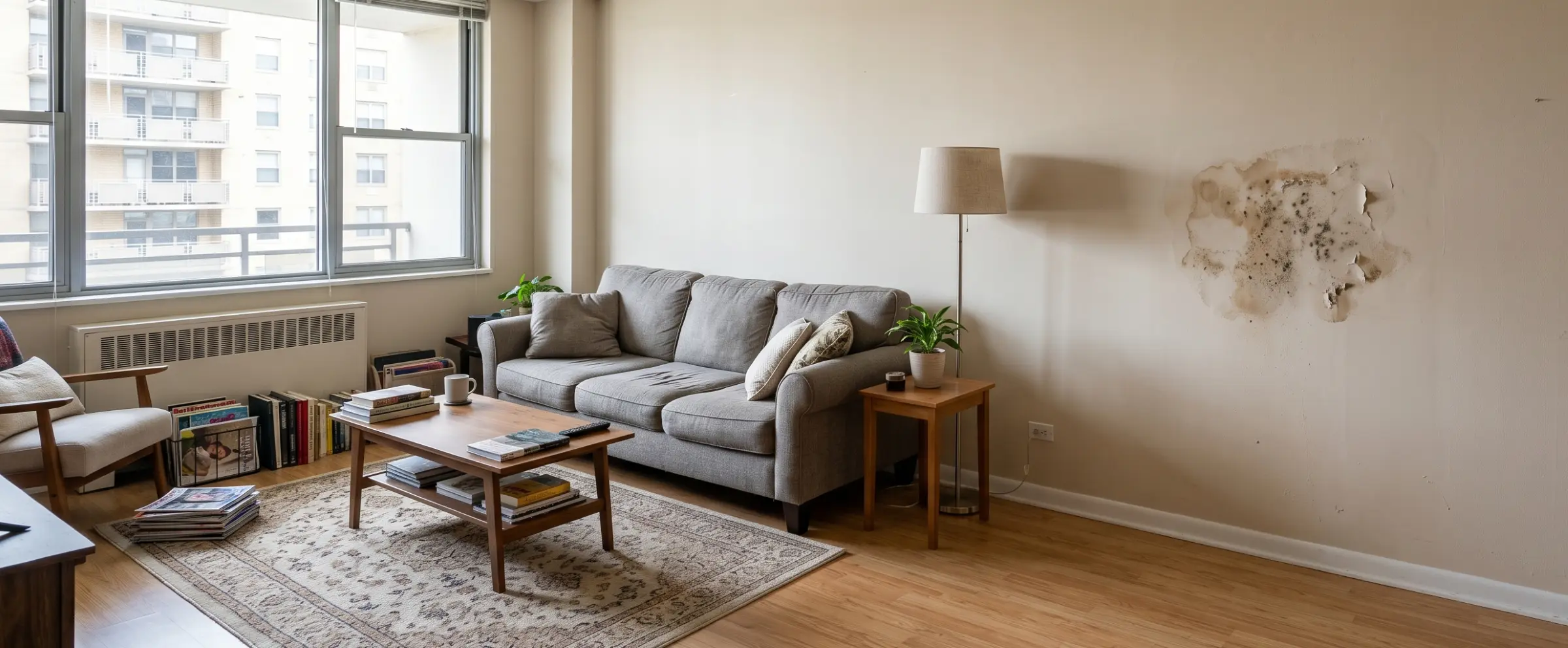

Finding mold in a condo means asking who pays, you or your insurance, and then a second question a single-family homeowner doesn't have to deal with: does the HOA owe part of the bill. The unit is yours, but the wall it's growing on, the pipe behind it, and the air handler feeding it might belong to the association. That ownership split decides who pays, who hires the contractor, and how fast the work can start.
Mold remediation in a condo or HOA unit is the process of identifying which party is responsible for the moisture source under the building's governing documents, then removing contaminated material per the IICRC S520 standard for professional mold remediation. The responsible party is determined by whether the source sits inside the unit boundary, in a limited common element assigned to one owner, or in a general common element the association maintains for everyone.
Key insights
- Responsibility follows the source, not the location of the damage. Mold appearing inside your unit can still be the association's responsibility if the moisture came from a common element like the roof or a shared plumbing stack.
- The EPA's 10-square-foot threshold applies the same way in condos as houses. Above that size, professional assessment and remediation become the standard recommendation rather than a DIY cleanup.
- Shared HVAC systems move spores between units. A leak two doors down can surface as a musty smell or visible growth in your unit through interconnected ductwork.
- Two insurance policies typically apply. The association's master policy and your individual HO-6 policy split coverage based on where the damage sits, and both usually carry mold sublimits far below full remediation cost.
- Most governing documents define three property categories. Your unit interior, limited common elements assigned to your unit alone, and general common elements shared by the whole building each carry different maintenance rules.
- A board's refusal to act isn't the end of the road. Written notice, an independent assessment, and a direct claim for failure to maintain common elements are all standard escalation paths.
Who is responsible for mold remediation in a condo
Responsibility comes down to where the moisture started, not where the mold is visible. If the source is a general common element, such as the roof, exterior wall, or a shared plumbing stack, the association is typically responsible for repairing the source and remediating the mold that resulted. If the source originates inside the unit boundary, such as a dishwasher supply line or a bathroom fan that was never run, the owner is typically responsible.
 Moisture migrating from a shared structure like a roof or upper-floor plumbing typically surfaces at the ceiling line first, which is why IICRC S520 treats the wall-ceiling junction as a key inspection point for common-element sources.
Most condominium declarations and the default rules in states that haven't been overridden by those declarations split maintenance into three categories, and mold responsibility tracks the same lines. A leak from a shared pipe inside a wall that falls under the building's common elements points to the association. A leak from your own washing machine connection points to you. The harder cases involve limited common elements, which technically belong to the association but serve only one unit, such as a balcony, an HVAC condenser pad, or the wall cavity directly behind your unit's drywall.
Negligence can shift the default. An association that knew about a roof leak for months and didn't fix it can be held responsible for the resulting mold even if the declaration would otherwise put interior damage on the owner. The same applies in reverse: an owner who ignored a visible leak or ran a humidifier for weeks without addressing condensation can end up responsible for damage that started in a common element, because the delay itself caused the spread.
The first step in any condo mold situation is determining the source, not arguing about who pays. Request a written assessment from an independent inspector with current certifications before anyone hires a remediation contractor.
Common elements, limited common elements, and your unit
A condo's structure splits into three legal categories that determine who maintains what, and mold responsibility follows that same split. General common elements are the parts every owner shares and the association maintains, including the roof, exterior walls, building foundation, hallways, elevators, and the main risers for shared plumbing and electrical systems.
 A unit's front door marks the start of the owner's responsibility; risers, service closets, and similar infrastructure just outside it typically remain general common elements the association maintains.
Limited common elements sit in a gray zone. They belong to the association but serve only one unit or a small group of units. Common examples include a balcony, a patio, an HVAC condenser pad, the wall cavity directly behind a single unit's interior surface, and in many declarations, the wood framing and insulation inside exterior walls even though the drywall finish belongs to the owner. A wall cavity that stays wet long enough to support black mold growth is exactly the kind of limited common element dispute that ends up in front of a board, since whether the association or the owner pays depends entirely on the specific language in your declaration.
Your unit interior is everything inside the unit boundary as defined in the declaration, typically the airspace and the unfinished surfaces of walls, floors, and ceilings inward. Paint, flooring, cabinets, fixtures, and personal belongings are almost always owner responsibility regardless of what caused the damage underneath them.
| Element type | Examples | Who maintains it | Mold remediation responsibility |
|---|---|---|---|
| General common element | Roof, exterior walls, main plumbing risers, hallways | Association | Association, in most cases |
| Limited common element | Balcony, HVAC pad, wall cavity behind one unit | Varies by declaration | Check governing documents first |
| Unit interior | Drywall surface inward, paint, flooring, fixtures | Owner | Owner, unless the moisture source was a common element |
Pull your declaration before you call anyone. The document's definitions section will state explicitly where your unit boundary sits and whether wall cavities, in-wall plumbing, and HVAC components are classified as limited common elements or part of the unit.
How mold spreads between condo units
Mold spreads between condo units through three physical pathways: shared wall cavities, shared or interconnected HVAC ductwork, and plumbing chases that run vertically through multiple floors. Because these structures connect units that otherwise feel separate, a moisture problem in one unit frequently surfaces as a symptom in another.
 Staining concentrated around a shared supply register suggests contamination is moving through the duct system itself, which is why HVAC components are typically treated as a common element rather than a unit-specific repair.
Shared walls between adjoining units or between a unit and a hallway create a continuous cavity. Moisture entering on one side can support mold growth that migrates toward the drier side over weeks, especially in older buildings with minimal cavity insulation or vapor barriers.
Shared HVAC ductwork is the fastest-moving mold in HVAC pathway in multifamily buildings. Many condo buildings use either a shared central air handler serving multiple units or individual unit systems tied into a common duct trunk. Spores entering the supply air at one register can circulate to every unit on that branch. A musty smell that gets stronger when the system runs, without any visible source in your own unit, is a strong signal the contamination originated elsewhere on the shared system.
Plumbing chases, the vertical shafts that carry supply and drain lines through stacked units, create a third pathway. A slow leak two floors up can travel down the chase and surface as a stain or odor in a unit far from the original failure. This is why a thorough condo mold inspection often needs access to the units above, below, and beside the affected one, not just the unit where symptoms appear.
Why this matters for who gets blamed
A board or a neighbor may assume mold in your unit started in your unit simply because that's where it's visible. Shared-pathway spread means visible location and point of origin are frequently two different places, and proving which one applies usually requires mold testing or a moisture assessment rather than a visual inspection alone.
Signs your condo's mold involves a shared structure
Five patterns point toward a shared structure as the source rather than something contained to your unit.
- Mold appears on a wall shared with a neighboring unit or with a hallway
- Ceiling staining follows a pattern consistent with the unit above or the roof
- Multiple units on the same stack or floor report similar symptoms around the same time
- The smell or growth tracks a shared HVAC supply or return register
- A recent roof, envelope, or plumbing repair elsewhere in the building precedes the mold's appearance
 Mold appearing mid-wall rather than at a ceiling or floor line often points to moisture traveling through a shared wall cavity, which is why a thorough assessment checks the neighboring unit, not just the affected one.
None of these signs alone confirms responsibility, but they shift the burden of investigation toward the association and away from a simple assumption that the problem is yours. Signs of mold elsewhere in the unit, such as bathroom ceiling staining unrelated to any shared wall, point the other direction, toward a unit-interior cause like inadequate ventilation.
If you notice any of these patterns, request that the assessment cover the adjacent units and the relevant common element, not just your own unit. An assessor who only inspects your walls cannot rule out a shared source, and an incomplete assessment becomes a point of dispute later if the board pushes back on responsibility.
The EPA's mold cleanup guidance treats the moisture source, not the visible damage, as the starting point for any remediation plan. That starting point matters more in a condo than in a single unit home, since the source and the damage often sit on opposite sides of a property line that only your declaration can define.
What the remediation process looks like in a condo
Condo mold remediation follows the same technical process as remediation in a single-family home, with one added layer: coordination across units and, often, board approval before work in common elements can begin. The technical sequence, per OSHA, covers inspection, containment, removal, cleaning, drying, and clearance testing.
 Negative air machines pull air directly from the containment zone and exhaust it outside, keeping the space under negative pressure so spores do not spread into the rest of the unit during the work IICRC S520 requires.
The added logistics typically include written notice to the board describing the problem and location, a professional assessment to confirm whether common elements are involved, board or property manager authorization before a contractor can access common elements or adjacent units, and coordination with neighbors if the source or remediation requires entry into a unit other than the one reporting the problem. Buildings governed by stricter rules may also require the association's approved vendor list or a specific insurance certificate from any contractor before work starts, which can add days to a timeline that would otherwise move faster in a detached home.
A thorough mold inspection in a multi-unit building should specifically document which side of the unit boundary the contamination falls on, since that documentation becomes the basis for the responsibility determination and any insurance claim that follows.
Adjacent units can carry contamination that hasn't yet become visible on your side of a shared wall, which is why air or surface sampling matters more here than in a single unit home, even though testing isn't required to confirm a mold problem exists in the first place.
Once the source is confirmed and access is arranged, the actual mold remediation work, containment, removal of contaminated porous material, HEPA cleaning, and drying, proceeds the same way it would in any other property. The unit-specific complication is sequencing: if the source is a common element like a shared plumbing stack, that repair has to happen before remediation can hold, the same logic that applies to any water-damage-driven mold case.
What it costs and who typically pays each part
Condo mold remediation costs $500 to $15,000 in most cases, depending on whether the job is confined to a single unit interior or involves common elements, shared HVAC components, or multiple affected units. A small bathroom or kitchen patch under 10 square feet, fully inside the unit boundary, sits at the low end. A job involving a shared wall cavity, contaminated ductwork, or remediation across more than one unit sits at the high end.
What pushes a job from one end of that range to the other is access and demolition scope, not square footage alone. Opening a shared wall cavity often means cutting drywall on both sides for two units rather than one, coordinating two owners' schedules, and in many buildings, obtaining board sign-off before any common-element surface comes down. Most owners find out how that cost actually gets divided only after filing a claim under their HO-6 policy, since the master policy and the individual policy rarely cover the same line items. A unit-interior job under 10 square feet can usually start within days; a shared-element job frequently adds a week or more of approval and access logistics before remediation even begins.
| Scenario | Typical cost | Usually billed to | Common element |
|---|---|---|---|
| Small unit-interior patch, under 10 sq ft | $500–$1,500 | Owner | No |
| Larger unit-interior job, 10–100 sq ft | $1,500–$6,000 | Owner | No |
| Shared wall or limited common element | $2,000–$8,000 | Varies by declaration | Yes |
| Common element source (roof, riser) | $3,000–$15,000+ | Association | Yes |
| Multi-unit remediation from shared HVAC | $5,000–$15,000+ | Often split | Yes |
These figures cover remediation only, not the underlying repair to a leaking roof, failed pipe, or HVAC component that caused the moisture in the first place. Mold remediation cost at the national level breaks down further by square footage and project type if your situation doesn't fit neatly into a condo-specific scenario.
The dollar figure rarely lands on one party in full. Who actually pays often comes down to two parallel insurance policies rather than out-of-pocket payment from either party. The association's master policy typically covers damage to common elements and, in many declarations, the structural components inside units such as drywall and subfloor. The owner's individual HO-6 policy covers personal property, upgraded finishes, and whatever the master policy excludes. Both policies commonly carry mold-specific sublimits in the $5,000 to $10,000 range, well below the cost of a major job, which is where disputes over the remaining balance tend to start.
How to get the board to act when they won't
Getting an unresponsive board to act requires a documented escalation path: written notice, an independent assessment, and, if the board still refuses, a formal claim against the association for failing to maintain the common elements.
 Photographing the date, location, and extent of mold creates a record an independent assessor or the association's insurer can later use to confirm whether a common element caused the damage.
Start with a written notice to the board, not a phone call or a verbal mention to the property manager. Describe the mold's location, the date you noticed it, and which common element you believe is involved, and ask the questions that get a written response with a timeline for assessment rather than a verbal promise.
If the board doesn't respond or denies responsibility without an inspection, the next step is an independent professional assessment, paid for separately if necessary, that documents the moisture source and whether it ties to a common element. This document is what turns a dispute over opinion into a dispute over evidence. From there, escalation options include filing a claim against the association's master policy directly, sending a formal demand letter through an attorney citing the specific maintenance obligation the board failed to meet, using mediation or arbitration if your state requires it before litigation, and filing suit for breach of the association's maintenance duty if the lower steps fail. Boards that have documented a pattern of delayed maintenance face a stronger negligence case than ones responding promptly to a first report.
Choosing the right contractor matters more in a contested condo situation than in a straightforward single-family job, because the contractor's documentation becomes part of the evidence if the dispute escalates. How to choose a remediator covers vetting steps that apply everywhere, but in a condo dispute, the paper trail matters as much as the work itself.
Verified certifications and a clear written scope of work protect you if the board later challenges whether the job was necessary or properly performed. Ask the contractor for both before work starts, not after.
Mold in a rented condo unit
If you rent your condo rather than own it, your landlord, not the HOA directly, is typically your first point of contact, even though the landlord may ultimately need to pursue the association for a common-element cause. Habitability law obligates your landlord to address mold regardless of whether the underlying cause is a common element the association controls. State tenant rights law varies on how quickly a landlord must respond once notified in writing, but your landlord's dispute with the association over who ultimately pays does not change your right to a livable unit in the meantime.
Preventing recurrence in a shared building
Preventing mold from coming back in a condo means controlling moisture inside your unit and reporting any sign of a shared-structure problem in writing. The CDC recommends the same humidity and ventilation basics for any home, with one addition unique to shared buildings: recurring mold in a unit that has otherwise eliminated interior moisture sources is a signal to ask the association about the condition of the shared structure behind that wall, not just to clean it again.
 Keeping indoor humidity below 60 percent, the threshold CDC guidance points to for moisture control, makes recurring mold in an otherwise dry unit a stronger signal that a shared structure is still wet.
Run exhaust fans during and after showers, keep indoor humidity below 60%, and report any leak, no matter how small, to the board in writing within days rather than weeks. A delay in reporting can shift later liability toward the owner even when the original source was a common element, since most declarations and courts weigh how promptly a problem was disclosed.
If mold returns within a few months of remediation in the same spot, the moisture source likely wasn't fully addressed, which in a condo often means the underlying common-element repair needs revisiting, not just another round of cleaning. If you're still working out whether your situation needs a professional at all, the EPA's 10-square-foot threshold applies the same way in a condo as it does anywhere else, regardless of who ends up paying for it.
Frequently asked questions
What if the condo board refuses to address mold in a common element?
Document the mold with photos, request a written professional assessment, and submit a formal written notice to the board citing the specific common element involved. If the board still refuses to act, escalation options include the association's insurance carrier, a demand letter from an attorney, mediation or arbitration if your state requires it before a lawsuit, and a direct claim against the association for failing to maintain the common elements.
Do I need a separate inspector and remediator for condo mold?
Often, yes. Several states require it by law, and IICRC S520 recommends it as best practice even where it is not mandated. A remediator who also performs the assessment has a financial interest in finding more mold than exists. An independent assessor confirms the scope and later verifies the work passed clearance testing.
Who pays if mold in my unit came from my upstairs neighbor's leak?
Responsibility generally follows the leak's origin, not the unit where damage appears. If the neighbor's unit caused the leak through their own plumbing or negligence, their HO-6 policy or personal liability typically covers your damage. If the leak came from a common element such as a shared supply line in the wall between floors, the association's policy is usually the first source of coverage.
Can I withhold HOA dues until the board fixes a mold problem?
No. Withholding assessments is not a recognized remedy for unresolved maintenance issues in most states and can trigger late fees, liens, or even foreclosure proceedings against your unit regardless of whether the board is in the wrong. Use the formal escalation channels instead: written demand, insurance claim, mediation, or legal action.
Sam Hickerson is the founder of RestoreAdvisor and writes consumer guides on mold remediation, water damage restoration, inspection, testing, and home recovery. His work focuses on helping homeowners understand costs, risks, and when to call a professional. He draws on guidance from the EPA, CDC, IICRC, and other authoritative sources to make complex home issues easier to navigate.