

A basement backup in Detroit does not wait for a hurricane. The city runs on a combined sewer system that carries stormwater and wastewater through the same aging pipes, and when a summer storm drops several inches of rain in a few hours, that water has nowhere to go but back up through the lowest drain in the house. Detroit homeowners have lived through this twice in the last five years: the June 2021 storm that flooded tens of thousands of basements across four counties, and the storm that followed in August 2023. In a University of Michigan survey of Detroit homes tracked between 2012 and 2020, four out of five households that flooded turned up mold in the basement afterward.
Mold remediation is the physical removal of mold growth and the material it has colonized, carried out to the ANSI/IICRC S520 standard and, when flooding is the cause, coordinated with the plumbing and drying work a basement backup requires first. Michigan has no state mold license, so knowing what to verify before hiring someone matters more here than in states that screen contractors for you.
Key insights
- Typical cost. Mold remediation in Detroit runs $1,200 to $5,500 for most jobs, with small isolated patches closer to $300 to $800 and flooded, sewage-contaminated basements running $8,000 to $15,000 or more.
- No state license. Michigan does not license mold remediators or assessors. Verify IICRC AMRT certification and a Michigan Residential Builder's License for the repair work instead.
- Old housing stock. More than half of Detroit's homes were built before 1950, with an average construction year of 1937, concentrating risk in original clay tile drains and uninsulated basements.
- Combined sewer risk. The June 2021 storm alone generated more than 25,000 flooding calls to the city in two days, and standard homeowners insurance typically excludes sewer backup unless a specific endorsement was purchased.
- Renter protections are limited but real. Michigan's implied warranty of habitability under MCL 554.139 requires landlords to keep units fit for use, though the state has no mold-specific repair deadline yet.
- Basements dominate. Basements are the leading location for mold growth in Detroit homes, ahead of bathrooms and attics, a pattern driven by the combined sewer system rather than by humidity alone.
Why Detroit homes are exposed to mold
Detroit's mold risk comes from two conditions layered on top of each other that show up together in few other U.S. cities: a combined sewer system prone to basement backups during heavy rain, and a housing stock where more than half the homes predate 1950. Neither factor alone would put Detroit near the top of the risk list. Together, they mean moisture problems in Detroit routinely start below grade rather than from a roof leak or storm surge.
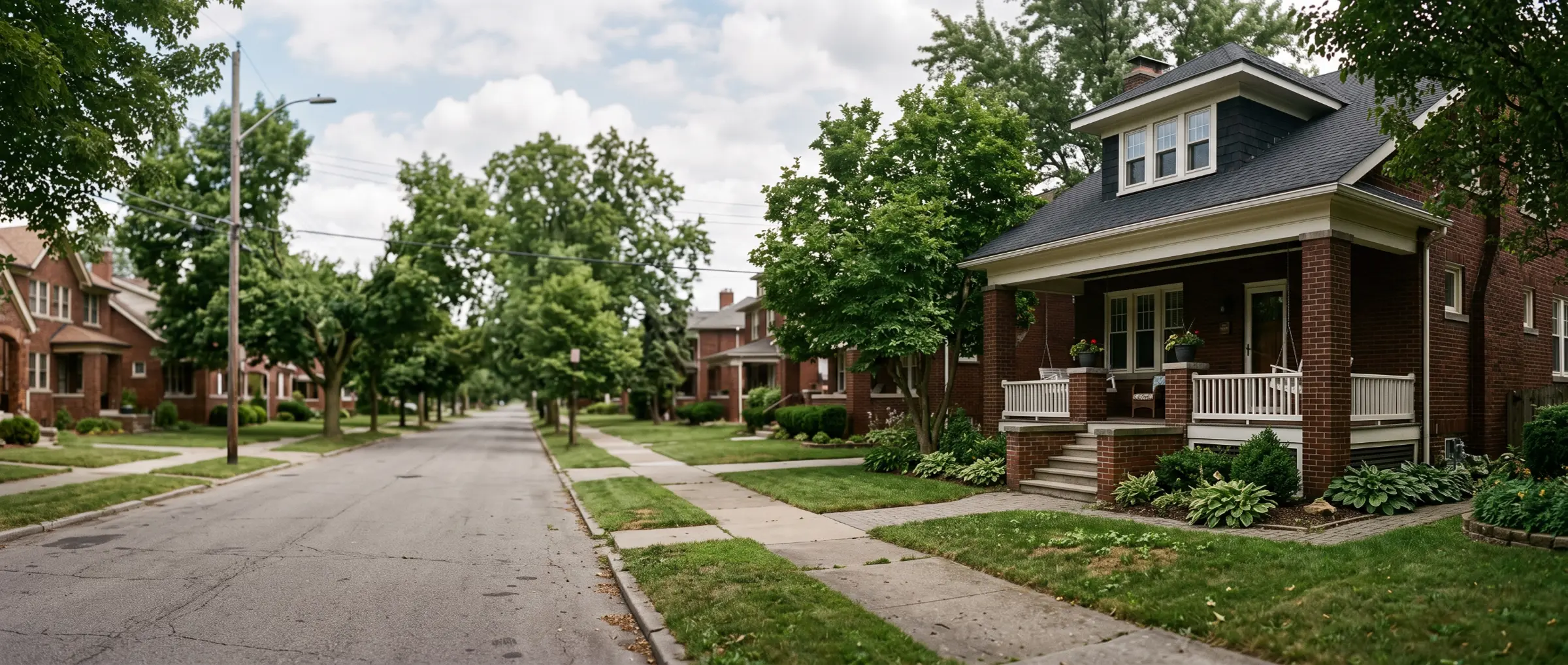
 Detroit's 1920s building boom produced dense rows of brick bungalows on clay tile perimeter drains now nearing a century old, the same infrastructure driving much of today's basement backup risk.
The combined sewer system carries stormwater and sewage through the same network of pipes, many of them originally laid more than 80 years ago. During a heavy rain event, the system can exceed capacity faster than it can move water out of the city, and the excess backs up through household drains, most often into basements. This is a structural feature of how Detroit was built, not a maintenance failure at any single home, which is why flooding has hit neighborhoods with no nearby river or low-lying terrain. The city's housing stock compounds the problem: the average Detroit home was built in 1937, roughly 58% of the city's homes predate 1950, and about 80% predate 1960. Original clay tile perimeter drains from that era are now well past their intended service life and are a common point of failure even in years without a major storm.
Detroit's climate adds a steady baseline of moisture on top of the flood risk. The region averages around 34 inches of precipitation a year with relative humidity averaging in the mid-70s, spread fairly evenly across the seasons rather than concentrated in a single wet month. That baseline humidity is enough to sustain slow-growing basement mold between flood events, which is part of why survey researchers found mold in more than half of Detroit basements that had never flooded at all.
| Location | Primary cause in Detroit | What to look for | DIY or pro |
|---|---|---|---|
| Basement | Combined sewer backup and seepage through unwaterproofed original masonry | Standing water line, musty odor at the floor drain, warped baseboards | Pro if a backup was involved; DIY only for small, dry, isolated spots |
| Bathroom | Original cast iron plumbing and a lack of exhaust ventilation in pre-1950s construction | Grout discoloration, peeling paint near the tub or shower | DIY for patches under 10 square feet |
| Attic | Ice damming against older, minimally insulated roof decks | Sheathing staining near the ridge or eaves | Pro for structural wood, especially with visible rot |
| Kitchen | Aging supply lines under original cabinetry | Under-sink staining, swollen cabinet base | DIY for small, contained patches |
| HVAC | Older forced-air systems with ductwork run through unconditioned basements or attics | Musty smell at startup, visible growth on registers | Pro required |
Construction era also shapes where the risk concentrates. Detroit's fastest building boom ran through the 1920s, when brick bungalows and two-family flats went up across the city on the clay tile drain systems now reaching the end of their service life. Construction slowed sharply during the Depression and picked back up after World War II with capes and brick ranches built on full basements, which is the floor plan that dominates the city today.
Brick construction dominates across every era, covering more than half of the city's homes, and it holds up better against moisture than the wood siding and asphalt shingle exteriors found on newer infill lots. That durability applies to the exterior walls rather than the basement, though, which is why a well maintained brick bungalow can still carry the same below grade flooding risk as a home in worse condition nearby.
| Era | Common construction | Where it concentrates | Mold vulnerability |
|---|---|---|---|
| Pre-1920s | Balloon-frame wood construction, stone or unparged brick foundations | Corktown, Woodbridge, and other pre-boom neighborhoods | Foundation seepage through unwaterproofed masonry |
| 1920s boom era | Brick bungalows and two-family flats, clay tile perimeter drains | East side and near-west neighborhoods built during Detroit's fastest growth decade | Century-old drain tile prone to collapse and backup |
| 1930s to 1950s | Capes and post-war brick ranches, full poured or block basements | West side and outer east side neighborhoods built through the postwar boom | Basement-dominant floor plans concentrate exposure below grade |
| 1960s and later | Limited infill, slab or shallow crawl space in newer pockets | Riverfront, Midtown, and scattered infill lots | Lower basement exposure, though plumbing still ties into the same combined sewer system |
What mold remediation costs in Detroit
Most Detroit mold jobs fall between $1,200 and $5,500 for professional mold remediation, generally at or below national averages given the region's lower labor costs, though the range widens considerably once a basement backup and sewage contamination enter the picture. A small, isolated patch on a nonporous surface can run as little as $300, while a whole-basement job after a combined sewer event, complete with demolition, drying, and clearance testing, can reach $15,000 or more.
 Drywall removal to the flood cut line, not surface cleaning, is what drives most of the cost on a Category 3 basement job since porous material below the water line generally cannot be salvaged.
Cost depends less on square footage alone than on whether the water involved was clean or contaminated. A dry, surface-level patch on drywall costs a fraction of what a Category 3 sewage backup does, because the backup requires removing porous materials the water actually touched rather than just treating visible mold on top of them.
| Project scope | Typical cost | What drives the price |
|---|---|---|
| Small, isolated area (under 10 sq ft) | $300–$800 | Single wall or ceiling patch, no demolition |
| Moderate (one room or partial basement) | $1,200–$3,500 | Containment, some material removal, air scrubbing |
| Large or whole-basement | $3,500–$8,000 | Full material removal, sewer backup contamination, extended drying |
| Whole-home or post-flood | $8,000–$15,000+ | Multiple rooms, structural drying, reconstruction |
Location within the home matters just as much as scope. Basement jobs tied to a sewer backup run considerably higher than a bathroom or kitchen patch, both because of the contamination classification and because Detroit's older cast iron and clay plumbing tends to need parallel repair work before remediation can finish.
Bathroom and kitchen jobs stay on the lower end of the range because the plumbing behind those walls, while original in many homes, rarely ties into the same combined sewer backup pathway that basements do. A leaking supply line under a kitchen sink is a contained, single-source problem, which keeps both the cost and the contamination risk well below what a flooded basement carries.
| Location | Typical cost | Local cost driver |
|---|---|---|
| Basement, surface-level | $1,000–$3,000 | Waterproofing coordination, drain condition |
| Basement, post-flood contamination | $3,000–$10,000+ | Category 3 water classification requires more demolition |
| Bathroom | $500–$2,000 | Cast iron plumbing age in pre-1950s homes |
| Attic | $800–$3,500 | Roof deck access and insulation removal |
| Kitchen | $600–$2,500 | Original supply line condition |
Per square foot, expect roughly $8 to $22 depending on accessibility and whether material has to come out. A standalone inspection, separate from remediation, typically runs $200 to $600.
Budget for clearance testing as its own line item rather than an afterthought, especially on a Category 3 basement job where confirming the work actually held matters more than it would on a small surface patch.
Pricing runs higher in the weeks after a citywide flood event like June 2021 or August 2023, when contractor demand spikes across the same neighborhoods at once. Getting a quote during a normal period, before the next major storm, avoids that surge and gives a more accurate baseline for comparison.
National mold remediation costs vary by home size and mold type, and Detroit's numbers sit slightly below those national averages.
Hiring a mold remediation company in Detroit
Michigan has no state license specifically for mold remediation, which means the burden of verification falls on the homeowner rather than on a licensing board. That is not unique to Detroit, but it does mean the questions you ask before choosing a mold remediation company carry more weight here than in a state that screens contractors for you.
 A written scope of work that separates moisture correction, containment, removal, and clearance testing into distinct line items is what a homeowner should expect before signing, not a single bundled price.
Start by confirming IICRC AMRT certification through the organization's public locator, since that is the closest thing to an industry standard Michigan contractors can hold. Separately, ask whether the company carries a Michigan Residential Builder's License or Maintenance and Alterations Contractor License through the state's licensing agency, because demolition and reconstruction work fall under that license even when the mold removal portion does not. A mold inspection from a company unaffiliated with the remediation crew adds a layer of protection against a conflict of interest, particularly on larger basement jobs where the same company doing the assessment has an incentive to inflate the scope.
| Question | What a credible answer sounds like |
|---|---|
| Are you IICRC AMRT certified? | Names a specific certification number and offers to show it, not just a logo on a truck |
| Who performs clearance testing? | A third party, not an employee of the remediation company |
| What is your Michigan contractor license number? | A specific number checkable through LARA, not "we're insured, that's enough" |
| How do you classify basement backup water? | References Category 1, 2, or 3 water classification by name, not just "we'll clean it up" |
| What does the written scope include? | Separate line items for moisture correction, containment, removal, and testing |
A written scope of work should separate moisture correction, containment, material removal, and clearance testing into distinct line items rather than a single bundled price. That level of detail matters most on jobs tied to emergency mold removal after a flood, where the temptation to move fast can lead to skipped documentation that later becomes a problem for an insurance claim or a home sale.
Detroit's flood history and what it means for your basement
Detroit's mold risk is inseparable from its flood history, and two storms in particular explain most of what homeowners are dealing with today. The June 2021 storm dropped six to eight inches of rain across the city over two days, generated more than 25,000 flooding-related calls, and triggered disaster declarations in four Detroit-area counties. Roughly two years later, the August 2023 storm hit many of the same low-lying neighborhoods again, reinforcing that this is a recurring pattern rather than a single historic event.
 Detroit's combined sewer system exceeds capacity faster than it can move stormwater out of the city, sending the excess back up through household drains rather than the street alone.
What makes Detroit's flooding distinct from storm surge or river flooding elsewhere is where the water enters the home. Basement backup flooding comes up from below, through floor drains and fixtures, carrying wastewater rather than clean stormwater in many cases. That distinction matters for both remediation scope and health risk: mold after water damage from a Category 3 sewage backup requires more aggressive material removal than the same square footage affected by a clean-water leak, because porous materials that contacted sewage generally cannot be salvaged regardless of how they look afterward.
The city runs two programs aimed at the underlying plumbing rather than mold itself. The Basement Backup Protection Program installs sump pumps, backwater valves, and downspout disconnections in neighborhoods with a documented history of DWSD service requests for backups, and the related Private Sewer Repair Program addresses failing sewer laterals for eligible low-income homeowners across a wider set of districts. Neither program funds mold remediation directly in most cases, though the city has indicated it will consider mold-related costs case by case for households already enrolled in the sewer repair track.
For basement work specifically, the moisture correction has to happen before remediation can hold. A basement that floods repeatedly because of an unaddressed backwater valve or sump pump gap will regrow mold within weeks of a clean remediation job, which is why contractors who skip the plumbing conversation and jump straight to cleanup are a red flag rather than a shortcut.
Vetting that kind of contractor thoroughly matters more on a flood-tied basement job than on a routine bathroom patch, since the plumbing and the mold have to be addressed by people who are actually coordinating with each other rather than working the two problems separately.
What to do in the first hours after a Detroit basement floods
Stop using water in the house first, then document the damage before starting any cleanup. Those two actions, done in that order, keep a Category 3 sewage backup from turning into a larger mold problem than the water itself caused.
 Standing water needs to come out within hours, not days, since the 24 to 48 hour window before mold establishes starts as soon as water enters the home.
1. Stop using water in the house
Running a washing machine, dishwasher, or extra toilet flushes adds volume to a sewer system that is already backing up, which can push more water into the basement rather than less.
2. Document the damage before touching anything
Photograph the water line, standing water depth, and any items in contact with it. This record supports both an insurance claim and a DWSD service request, and it is far easier to gather before cleanup starts than after.
3. Avoid direct contact with the water
Basement backup water often carries raw sewage under Category 3 classification. Wading in without boots and gloves, or letting pets or children near it, adds a contamination risk on top of the property damage.
4. File a DWSD service request
Call the Detroit Water and Sewerage Department to get a service request number. Michigan law requires this step before the city will accept a claim for basement backup damage, and the claim itself must be filed within 45 days of discovering the loss.
5. Begin extraction and drying
Standing water needs to come out within hours, not days, since the 24 to 48 hour window before mold establishes starts as soon as water enters the home. A wet vac and fans handle a small event, while anything beyond a few inches generally calls for a water mitigation company with pump equipment.
6. Call a mold remediation contractor once the water is out
Remediation cannot start productively while water is still standing, so this step follows extraction rather than happening at the same time. Bring the photos and DWSD service request number to the first estimate, since a contractor working from documentation quotes more accurately than one working from a verbal description.
Mold risk by Detroit neighborhood
Risk in Detroit tracks basement backup history more closely than it tracks proximity to the Detroit River, which is part of what makes the city's flood pattern distinct from a coastal or tidal market. The Detroit Water and Sewerage Department identified 11 neighborhoods for its Basement Backup Protection Program based specifically on service requests and claims data rather than elevation maps alone, and that list is the closest thing available to an official risk ranking.
 The Detroit Water and Sewerage Department identified these repeat backup neighborhoods using service request and claims data, not elevation maps alone, making the list closer to an official risk ranking than a general guess.
Jefferson Chalmers sits at the top of that list. It is the lowest geographic point in the city, lies within a federally recognized flood plain, and was prioritized first in the city's repair program because of how consistently it has flooded. Neighboring Islandview shares much of that exposure along the same eastside corridor. On the west side, Warrendale and Chadsey-Condon have generated repeat basement backup complaints tied to aging sewer laterals rather than proximity to open water, while Barton-McFarland on the northwest side carries similar risk from its older plumbing infrastructure. Morningside and East English Village round out the eastside cluster, and Victoria Park, one of the first two neighborhoods enrolled in the city's repair program alongside Aviation Sub, holds the distinction of being the lowest elevation point identified within city limits.
| Neighborhood | Primary risk factor | Homeowner note |
|---|---|---|
| Jefferson Chalmers | Lowest elevation in the city, federal flood plain | First neighborhood enrolled in city repair funding |
| Islandview | Shares the eastside flood corridor with Jefferson Chalmers | Canal and river-adjacent lots see the most repeat flooding |
| Warrendale | Aging sewer laterals, repeat DWSD backup complaints | West side, no direct river or lake exposure |
| Chadsey-Condon | Aging sewer laterals in southwest Detroit | Prioritized in the city's Phase 2 repair rollout |
| Barton-McFarland | Older plumbing infrastructure, northwest Detroit | Repair funding available through the Private Sewer Repair Program |
| Morningside | Repeat basement backup history, east side | Enrolled in Phase 2 of the city's protection program |
| East English Village | Older housing stock paired with sewer capacity limits | Repair funding available through city programs |
| Victoria Park | Lowest geographic point identified by the city | One of the first two neighborhoods to receive funded repairs |
Mold species common in Detroit homes
Detroit homeowners encounter Cladosporium most often, since it thrives at the moderate, sustained humidity typical of an ordinary damp basement rather than requiring a major flood event. Aspergillus and Penicillium tend to show up on water-damaged drywall and framing after any leak, whether from a roof, a supply line, or a basement backup, and the two are frequently reported together on lab results because they cannot be reliably told apart by sight alone.
Sustained saturation from basement flooding creates conditions that favor species requiring days of continuous moisture rather than the weeks or months an ordinary humid basement might take. Stachybotrys chartarum, the species behind most black mold concerns, and the related genus Chaetomium both need that kind of extended wet period to establish, which is one reason they turn up more often after a documented backup event than after routine seasonal dampness. Neither species is unique to Detroit, but the combined sewer system's flooding pattern creates the sustained saturation both need more reliably than a typical basement would on its own.
| Species | Common Detroit location | Appearance | Health category |
|---|---|---|---|
| Cladosporium | Basement walls, ordinary humidity | Dark green to black, powdery texture | Allergenic |
| Aspergillus / Penicillium | Water-damaged drywall and framing after any leak | Blue-green to white, fuzzy | Allergenic, some toxigenic species |
| Stachybotrys chartarum | Cellulose materials after sustained flooding | Dark, slimy when wet | Toxigenic |
| Chaetomium | Water-damaged drywall after prolonged saturation | Gray-white maturing to olive or black | Toxigenic |
Population-specific health risks from these species, including which groups face the most serious complications, generally matter more to a Detroit homeowner than telling one allergenic species apart from another by sight. The practical point for Detroit homeowners is that a mold problem tied to a documented flood event warrants more caution about species identification than a small, isolated bathroom patch, simply because the flooding conditions that produce it also favor the species with the most significant health profile.
Renting in Detroit: mold and your landlord
Michigan law does not currently include a mold-specific statute, but tenants are protected under the implied warranty of habitability in MCL 554.139, which requires landlords to keep rental premises fit for use and in reasonable repair and to comply with applicable health and safety laws. When mold results from a landlord's failure to fix an underlying leak or moisture source, that general habitability standard is the legal basis a tenant has to work with today.
 Michigan's implied warranty of habitability under MCL 554.139 requires landlords to keep rental units fit for use, the standard tenants currently rely on absent a mold-specific repair deadline.
That is likely to change. A package of bills, Senate Bills 19 through 21, introduced in the Michigan Legislature and placed on third reading with a substitute as of June 2025, would set specific repair deadlines for the first time, including a 72-hour window for landlords to begin repairs after written notice of mold, performed to the ANSI/IICRC S520 standard. The bills would also let tenants withhold rent into escrow or pursue repair-and-deduct remedies if landlords miss the deadline.
As of this writing, the bills have not been signed into law. Broader tenant mold rights in Detroit still run through the general habitability standard rather than a mold-specific deadline, at least until the pending legislation, if any of it, is enacted.
In practice, Detroit tenants dealing with mold should document the issue in writing to the landlord, keep dated photos, and request repairs formally even though Michigan law does not require a specific notice format. The city's separate Certificate of Compliance system, which requires landlords to certify that a rental unit is safe and habitable, gives tenants an additional avenue: if a landlord lacks a valid certificate, a tenant's rent obligation can be redirected into an escrow account rather than paid directly, though that process runs through the city's rental enforcement system rather than the courts.
Buying or selling a Detroit home with a mold history
Michigan's Seller Disclosure Act, codified at MCL 565.957, requires sellers of one-to-four unit residential properties to disclose known material defects, including environmental hazards they are actually aware of, on a standard disclosure statement. The duty applies to actual knowledge rather than a requirement to inspect for problems the seller does not know about, which means a seller who never experienced a basement backup has no disclosure obligation even in a flood-prone neighborhood, while a seller who dealt with repeated flooding and never remediated it does.
 A basement that looks dry at a showing does not rule out a past flood that was pumped out without proper remediation, which is why a professional inspection before closing matters more here than in most markets.
Given how much of Detroit's housing stock has flooded at least once in the last five years, buyers should treat a clean-looking basement with some skepticism rather than as proof nothing happened. A previous flood that was pumped out and dried without proper remediation can leave hidden mold behind drywall or under flooring that a visual walkthrough will not catch. Requesting a professional inspection before closing, and asking directly whether the seller enrolled in the city's Basement Backup Protection Program or filed any DWSD claims, gives a buyer more useful information than the disclosure form alone in a market where informal sales and cash transactions are common enough that formal disclosure paperwork does not always tell the whole story.
Vacant and Detroit Land Bank Authority properties carry a different version of the same problem. A home that sat unheated and unoccupied for months or years, with no one running a dehumidifier or fixing a slow leak, often develops mold that a quick walkthrough will not reveal, and Land Bank sales generally come with no seller disclosure at all since the prior occupant is long gone. Buyers going through an auction or a Land Bank purchase should budget for a full inspection rather than relying on the sale listing, since the standard disclosure protections that apply to a traditional sale do not apply here.
Sellers who did remediate a past flood correctly are generally better served by disclosing mold when selling a house along with documentation of the completed work than by staying silent, since a clearance report and contractor invoice from a properly finished job read as due diligence rather than as a red flag.
Insurance coverage for mold damage in Detroit
Standard HO-3 homeowners insurance policies generally exclude damage from sewer and drain backup as a baseline matter, which means mold that follows a combined sewer overflow is often not covered unless the homeowner purchased a specific water backup or sump pump failure endorsement before the storm. That gap is the single most important insurance fact for a Detroit homeowner to understand, because it is the opposite of what many people assume a standard policy covers.
Flood insurance through the National Flood Insurance Program does not close that gap either in most basement backup cases, since NFIP policies are triggered by external flooding from a river or other body of water rather than by water backing up through household plumbing during a storm the sewer system could not handle. Homeowners who filed claims after the June 2021 event frequently found that neither their standard policy nor an NFIP policy, where they had one, covered the basement loss without the specific backup endorsement in place beforehand.
Beyond Detroit's backup-specific gap, homeowners insurance questions, including how mold sublimits and the standard claims process work, apply the same way they would in any market. Locally, a covered municipal infrastructure failure, as opposed to damage from a homeowner's own plumbing, may also open a separate claims path against the Detroit Water and Sewerage Department, which requires filing within 45 days of discovering the damage and obtaining a service request number before the claim can proceed.
Financial assistance for Detroit flood and mold damage
FEMA Individual Assistance, the Detroit Home Repair Fund, and the city's HUD disaster recovery allocation are the three funding sources available to Detroit homeowners beyond the plumbing repair programs already covered, though none of them cover mold remediation automatically.
 Stacking multiple funding sources on the same job usually requires separate paperwork for each one rather than a single combined application, which is why organized records matter as much as the funding itself.
Eligibility and coverage vary widely by program, and most require documentation gathered in the first hours after a flood, which is part of why photographing damage early matters regardless of which funding source ends up applying. Applying for FEMA Individual Assistance after a federally declared disaster, as both the June 2021 and August 2023 storms triggered, is often the first stop for uninsured losses.
| Program | What it covers | Note |
|---|---|---|
| FEMA Individual Assistance | Uninsured losses after a federally declared disaster, including some cleanup costs | Both 2021 and 2023 storms triggered declarations |
| Detroit Home Repair Fund | Plumbing, roofing, and related repairs for low-income homeowners | Mold remediation not guaranteed, coordinated with plumbing scope |
| City CDBG-DR allocation | $441 million in HUD disaster recovery funds awarded after the 2021 and 2023 storms | Mold costs considered case by case for households in the Private Sewer Repair Program |
| Fix Our Flooded Basements bill | Would expand FEMA eligibility for full basement damage and mold mitigation | Introduced in Congress, not yet enacted |
None of these programs replace an insurance claim or a direct conversation with a contractor, and stacking multiple sources on the same job usually requires separate documentation for each one. That is another reason the photos and service request number from the first hours after a flood are worth keeping organized rather than reconstructing later.
Preventing mold in a Detroit home
Prevention in Detroit centers on managing the combined sewer relationship rather than the general humidity advice that applies almost everywhere else. A backwater valve and a working sump pump address the specific failure mode that produces most Detroit basement mold, and both are eligible for city funding in the neighborhoods enrolled in the Basement Backup Protection Program.
 A backwater valve prevents sewage from flowing back into the home when the municipal system exceeds capacity during a storm, making it the single most effective fix for Detroit's specific flooding pattern.
Install a backwater valve
A backwater valve prevents sewage from flowing back into the home when the municipal system exceeds capacity during a storm, and it is the single most effective fix for the specific flooding pattern Detroit experiences.
Disconnect downspouts from the sewer line
Older Detroit homes often route roof downspouts directly into the sewer system, which adds stormwater volume to a system already prone to overflow. Redirecting downspouts away from the foundation reduces that load.
Maintain a working sump pump with battery backup
Basement backups often coincide with power outages during severe storms, and a sump pump without battery backup fails at exactly the moment it is needed most.
Inspect original clay tile drains before they fail
Homes built during Detroit's 1920s boom are old enough that original perimeter drain tile is a common point of failure. A camera inspection before a problem develops costs far less than emergency repair after a backup.
Keep indoor humidity below 60% year-round
Detroit's steady Great Lakes humidity sustains slow mold growth even without a flood event. A dehumidifier sized for the basement's square footage addresses that baseline risk between storms.
Room-by-room mold prevention covers additional actions beyond these Detroit-specific priorities, useful for anything not tied to the combined sewer system specifically.
Frequently asked questions
How much does mold remediation cost in Detroit?
Most Detroit jobs run $1,200 to $5,500. A small, isolated patch can run $300 to $800, while a flooded basement with sewer contamination can reach $8,000 to $15,000 or more once demolition and drying are included.
Does Michigan require a mold remediation license?
No. Michigan has no state mold remediation or assessor license. Contractors doing repair and demolition work still need a Michigan Residential Builder's License or Maintenance and Alterations Contractor License, and reputable remediators carry IICRC AMRT certification even though it is not legally required.
Does homeowners insurance cover mold from a Detroit basement backup?
Usually not without an added endorsement. Standard HO-3 policies exclude sewer and drain backup by default, so mold that follows a combined sewer overflow typically is not covered unless a water backup rider was purchased before the storm.
Is my Detroit landlord required to remove mold from my rental?
Yes, under the general habitability duty in MCL 554.139, which requires landlords to keep rental units fit for use and in reasonable repair. Michigan does not yet have a mold-specific repair deadline, though pending state legislation would add one.
How long does mold remediation take in Detroit?
A contained, single-room job usually takes two to four days. A basement flooded during a combined sewer event often takes one to two weeks once drying time, material removal, and clearance testing are factored in.
Do I have to disclose mold when selling a Detroit home?
Yes, if you have actual knowledge of it. Michigan's seller disclosure law under MCL 565.957 requires sellers of one-to-four unit homes to disclose known material defects, which includes known mold or water intrusion history.
What Detroit neighborhoods have the highest mold risk?
Areas with the longest history of basement backup complaints, including Jefferson Chalmers, Islandview, Warrendale, and Morningside, carry the highest documented risk based on the city's own service request data.
Can I clean basement mold myself after a Detroit flood?
Sometimes, if the area is under 10 square feet, the surface is nonporous, and the water was not sewage-contaminated. Basement backups classified as Category 3 water almost always call for a professional because of the contamination risk, not just the mold.
Does the city of Detroit help pay for mold remediation?
Partially, in specific programs. The Basement Backup Protection Program and Private Sewer Repair Program fund plumbing fixes tied to flooding in designated neighborhoods, and mold remediation is sometimes covered case by case for households already enrolled in the sewer repair track.
What causes mold in older Detroit homes?
Aging clay tile drain lines, uninsulated original basements, and a combined sewer system that backs up during heavy rain are the three drivers specific to Detroit's housing stock, which is more than half built before 1950.
How do I find mold clearance testing in Detroit?
Ask your remediation contractor for an independent third-party tester rather than someone from the same company, then confirm the tester samples air and surfaces separately from the crew that performed the removal.
Is black mold common in Detroit basements?
It shows up more often after sustained flooding than after routine humidity. Stachybotrys chartarum and Chaetomium both need days of continuous saturation to establish, which basement backups provide more readily than an ordinary damp basement does.
Sam Hickerson is the founder of RestoreAdvisor and writes consumer guides on mold remediation, water damage restoration, inspection, testing, and home recovery. His work focuses on helping homeowners understand costs, risks, and when to call a professional. He draws on guidance from the EPA, CDC, IICRC, and other authoritative sources to make complex home issues easier to navigate.