

You've confirmed mold in your home and you're calling a professional. Now the practical question takes over: how long is this going to take, and can you stay in your house while it happens? Those questions have real answers, but the honest version is more specific than most sites give you.
The process known as mold remediation is defined by the ANSI/IICRC S520 Standard as returning indoor mold levels to a normal, pre-event condition through containment, source correction, and removal. The timeline for that process depends on six variables, and understanding them will tell you far more than a single average number ever could.
Key insights
- Most residential jobs take 1–5 days of active remediation work, not counting pre-drying time or clearance testing.
- Total project duration including drying, clearance testing, and reconstruction routinely runs 1–3 weeks for moderate to large jobs.
- Clearance testing adds 24–72 hours after active work ends before the containment can come down and the space is declared safe.
- The moisture source must be fixed before or during active remediation. If a plumber or roofer is needed, that work can delay the project by days before mold removal even begins.
- Porous materials like drywall and insulation are removed and replaced rather than cleaned, which adds time compared to non-porous surface jobs.
- Stachybotrys chartarum (black mold) requires additional containment layers and more careful material handling, typically adding 1–2 days to comparable jobs of the same size.
Mold remediation takes 1–5 days for most homes
Mold remediation duration is directly tied to the square footage affected, the materials involved, and where in the house the mold is growing. The EPA's guidance recommends professional involvement for any growth covering more than 10 square feet, the point at which containment, HEPA filtration, and certified removal are required rather than optional. Below that threshold, DIY may be appropriate; above it, the timelines in this table apply.
 A reading like this determines whether the timeline stays on the low end of the range or extends, since drying can't be skipped just because a crew is scheduled to move to the next phase.
The table below gives active remediation days only. It does not include pre-project moisture correction, drying time, or post-remediation clearance testing, all of which add to the total calendar duration. For guidance on whether your situation crosses the threshold for professional involvement, see when mold remediation is required.
| Job size | Affected area | Active remediation | Total project estimate |
|---|---|---|---|
| Small | Under 10 sq ft | 1–2 days | 3–5 days |
| Medium | 10–100 sq ft | 2–5 days | 5–10 days |
| Large | 100–300 sq ft | 5–7 days | 1–2 weeks |
| Whole-home or multi-room | 300+ sq ft | 7–14 days | 2–4 weeks |
| HVAC system involvement | Varies | Add 1–3 days | Add to above |
These are realistic working estimates based on IICRC S520 protocol requirements, which mandate continuous air filtration, phased material removal, moisture verification, and clearance testing before a job can be closed out.
Phase-by-phase timeline: what happens each day
Mold remediation follows a defined sequence of phases, each with its own duration: inspection and containment on day one, moisture correction and removal in days one through three, drying in days two through four, and clearance testing before reconstruction can begin. Understanding the sequence helps you anticipate the schedule your contractor should be keeping. For the full technical breakdown of what crews do at each step, see the mold remediation process.
 Framing contamination this extensive behind an otherwise unremarkable wall is exactly the kind of discovery that pushes a three day estimate into a five or six day job.
Day 1: Inspection, assessment, and containment setup
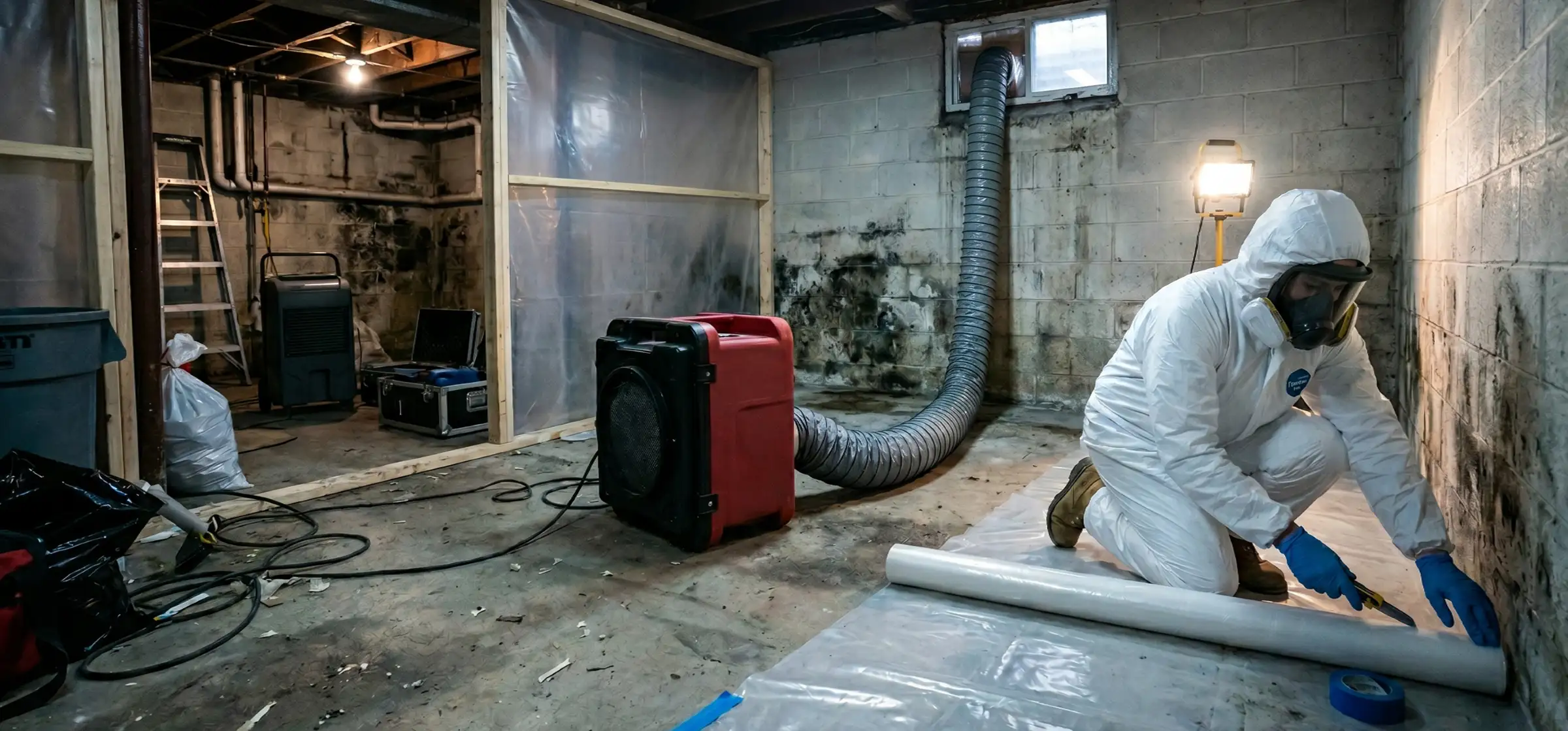
The project starts with a walk-through inspection to map the full extent of visible mold and identify hidden moisture using infrared cameras and moisture meters. The contractor produces a written scope of work before any removal begins. Containment barriers of 6-mil polyethylene sheeting are installed, HVAC vents in the affected area are sealed, and negative air pressure is established using HEPA air scrubbers. On a typical residential job, this setup takes two to four hours and is usually completed on day one.
Days 1–2: Moisture source correction
The IICRC S520 requires that the moisture source be corrected as part of remediation, not after it. If the source is a slow drain, condensation issue, or minor plumbing fix, the remediation crew may handle it directly. If a plumber or roofer is needed, scheduling that work is the homeowner's responsibility, and it must happen before or alongside active mold removal. A plumbing repair can be completed in a few hours. A roof leak repair may take one to three days, depending on damage scope and contractor availability.
Days 1–3: Mold removal
Porous materials that cannot be decontaminated, including drywall, fiberglass insulation, carpet, and ceiling tiles, are physically removed, double-bagged in 6-mil plastic, and disposed of as contaminated waste. Non-porous and semi-porous surfaces are HEPA vacuumed, wiped with antimicrobial solutions, and allowed to dry. Structural wood in attics and crawl spaces may be treated with soda blasting or dry ice blasting, methods that abrade the mold from the surface without adding moisture. The duration of this phase scales directly with square footage and material type.
Days 2–4: Drying and air filtration
After removal, industrial dehumidifiers and air movers run continuously to bring moisture readings below safe thresholds. Per IICRC S520 guidance, wood must reach 16% moisture content or below before clearance testing can proceed. In a moderately humid environment, structural drying takes one to three days. In a crawl space or basement with elevated ambient humidity, drying can take longer. Air scrubbers with HEPA filtration run throughout this phase to capture any airborne spores disturbed during removal.
Days 3–7: Clearance testing
An independent mold testing inspector collects air and surface samples from the treated area and submits them to a certified lab. Results return in 24–72 hours. A passed clearance report is the official documentation that the job is complete and reconstruction can begin.
Days 5–14+ : Reconstruction
Reconstruction of removed materials is a separate phase from remediation and is handled by a general contractor, not the mold crew. Replacing drywall, insulation, flooring, and trim in a single room takes two to four days of rebuild time. Jobs requiring structural wood repair, new vapor barriers in a crawl space, or full bathroom or basement rebuilds can take one to three weeks. Your mold remediation contractor and general contractor will need to coordinate scheduling so the rebuild does not begin before clearance is confirmed. Clearance requires an independent mold inspection by a third party unaffiliated with the remediation company.
Reconstruction costs are billed separately from remediation, and mold remediation cost figures typically do not include the rebuild phase.
If you want a phase-by-phase action list from pre-remediation prep through final documentation, the mold remediation checklist covers every step in printable format.
What delays mold remediation
Most timeline overruns are predictable and avoidable with early planning. Hidden mold, moisture sources requiring a separate contractor, and clearance test failures are the three most common reasons a project runs longer than estimated.
 A pocket flagged here before demolition starts is what separates a contingency-padded estimate from the timeline blowouts that come from surprises found only after walls are already open.
Hidden mold behind walls and under floors. The initial inspection identifies visible mold and uses moisture meters to flag likely areas of concealed growth. Once walls are opened during removal, additional mold is often found that was not detectable from the surface. Each newly discovered area must be scoped, contained, and removed before the project can move forward. Contractors experienced with mold after water damage know to build contingency time into estimates for this reason.
Moisture source that requires a separate contractor. If a plumber, roofer, or HVAC technician must complete repairs before remediation can proceed, the project timeline is at the mercy of their schedule. This is one of the most common sources of unexpected delays, particularly for jobs stemming from slow leaks or storm damage.
HVAC system involvement. Mold in ductwork, air handlers, or evaporator coils requires specialized cleaning protocols and, in some cases, duct replacement. Adding HVAC mold remediation to a job typically extends the timeline by one to three days and requires dual certification in both mold remediation (IICRC AMRT) and duct cleaning (NADCA ASCS).
Stachybotrys chartarum. Black mold requires a more cautious removal approach due to the health risks associated with disturbing Stachybotrys colonies. Full-face respirators and Tyvek suits are mandatory. Material removal is slower to avoid fragmenting colonies. Additional cleaning passes are standard. A black mold removal job of the same square footage will typically run one to two days longer than a job involving common household molds like Cladosporium or Penicillium.
Insurance adjuster approval. For insurance-covered jobs, the remediation company typically cannot begin work until the adjuster has assessed the damage and approved the scope. In active claims, adjuster visits can be scheduled within one to three days. In high-volume periods, such as after regional storms or flooding, that wait can extend to one to two weeks. If the situation is urgent, your policy may have provisions for emergency mold removal protective measures that allow work to begin before formal adjuster approval.
Clearance failure. If post-remediation air sampling returns spore counts above background levels, the containment remains in place, additional cleaning is performed, and the property is retested. Each additional round of testing adds two to four days to the timeline.
Mold remediation timeline by location in your home
The location of the mold growth is one of the strongest predictors of project duration. A bathroom job can wrap in one to three days while the same square footage in a crawl space or finished basement can take twice as long due to access constraints and material removal requirements.
 Access this limited is the reason identical square footage takes roughly twice as long here as it would in an open, unfinished basement with the same contamination.
Finished spaces like a completed basement require drywall removal, insulation removal, and framing treatment before cleaning can begin, which adds two to three days compared to an unfinished space with exposed concrete and open framing. Confined spaces like crawl spaces and attics add time due to limited access and the physical difficulty of moving equipment in and out. HVAC systems require a separate specialist and add their own phase on top of any structural remediation.
| Location | Typical active days | Why it takes this long | Common additions |
|---|---|---|---|
| Bathroom | 1–3 days | Small areas, non-porous tile; drywall behind tile adds time | Caulk and grout removal, fixture removal |
| Basement (unfinished) | 2–4 days | Concrete block and exposed framing clean faster than finished surfaces | Efflorescence treatment, sump pit |
| Basement (finished) | 3–6 days | Drywall removal, insulation removal, framing treatment required | Full drywall rebuild |
| Attic | 2–5 days | Large surface area of structural wood; soda blasting adds time | Insulation removal and replacement |
| Crawl space | 2–5 days | Limited access, full insulation removal typically required | Vapor barrier installation |
| HVAC system | 2–4 days | Ductwork cleaning and component disinfection; replacement if needed | Air handler work, duct replacement |
| Wall cavity | 2–4 days | Requires opening walls, framing treatment, and drywall replacement | Plumbing access, insulation |
Jobs that span multiple locations or that involve both structural framing and finished surfaces should be estimated at the higher end of these ranges.
Staying home or relocating during remediation
Whether you can stay in your home during remediation depends on the size of the job, the location of the affected area, and the health status of the people in the household.
 Relocation isn't universally required under S520, but it's the right call for any household member with asthma or immune compromise for the full duration of active work, not just when the crew is in their room.
For small, contained jobs, such as a single bathroom or a localized wall cavity, most homeowners remain in unaffected parts of the house without issue. The containment barriers and negative air pressure system are specifically designed to prevent mold spores from migrating beyond the work zone.
For larger jobs covering multiple rooms, a full basement, or an attic, temporary relocation during active work is recommended. The ANSI/IICRC S520 does not mandate relocation as a universal requirement, but the CDC: Basic Facts About Mold recommends that individuals with asthma, allergies, or compromised immune systems avoid exposure to areas where mold is being disturbed. Anyone in the household who falls into a high-risk category should leave for the duration of active remediation, not just when work is happening in their specific area.
Noise from air scrubbers and demolition, chemical odors, and limited room access are all part of active remediation. For a detailed look at what each phase feels like from inside the house, see what to expect during mold remediation.
For most jobs, returning home after active work is complete but before clearance results arrive is reasonable if the containment is still in place and the HVAC system serving the affected area is shut down. Most contractors recommend waiting 24–48 hours after containment comes down for air scrubbers to clear airborne particulates before fully re-occupying the treated space.
Frequently asked questions
How long does mold remediation take on average?
Most residential mold remediation jobs require 1–5 days of active work. The total project duration, including pre-drying, clearance testing, and any reconstruction, typically runs 1–3 weeks for moderate to large jobs.
Can I stay in my home during mold remediation?
For small, contained jobs, yes. Most homeowners remain in unaffected areas of the house without issue. For larger multi-room jobs, or if anyone in the household has asthma, allergies, or a compromised immune system, temporary relocation is recommended for the duration of active work.
How long does mold remediation take in a crawl space?
Crawl space remediation typically takes 2–5 days for active work, plus additional time for drying. Jobs requiring full insulation removal and a new vapor barrier can run 5–7 days before any reconstruction phase.
How long does black mold remediation take?
Typically 1–2 days longer than a comparable job involving common household mold species. Black mold (Stachybotrys chartarum) follows the same general phase sequence but requires stricter containment protocols and more cautious material handling, which adds time regardless of square footage.
How long after mold remediation can I return home?
Most contractors recommend waiting 24–48 hours after active work is complete and air scrubbers have run to clear airborne particulates. If clearance testing is being performed, wait for the results, which typically return 24–72 hours after samples are submitted to the lab.
Does mold remediation include reconstruction?
No. Mold remediation covers inspection, containment, removal, cleaning, and disinfection. Reconstruction of drywall, insulation, flooring, and other removed materials is a separate phase handled by a general contractor and billed separately.
What happens if the clearance test fails?
Additional cleaning is performed and the property is retested. The containment stays in place until a passing clearance report is issued. Each additional round of testing adds two to four days to the overall timeline.
Sam Hickerson is the founder of RestoreAdvisor and writes consumer guides on mold remediation, water damage restoration, inspection, testing, and home recovery. His work focuses on helping homeowners understand costs, risks, and when to call a professional. He draws on guidance from the EPA, CDC, IICRC, and other authoritative sources to make complex home issues easier to navigate.