
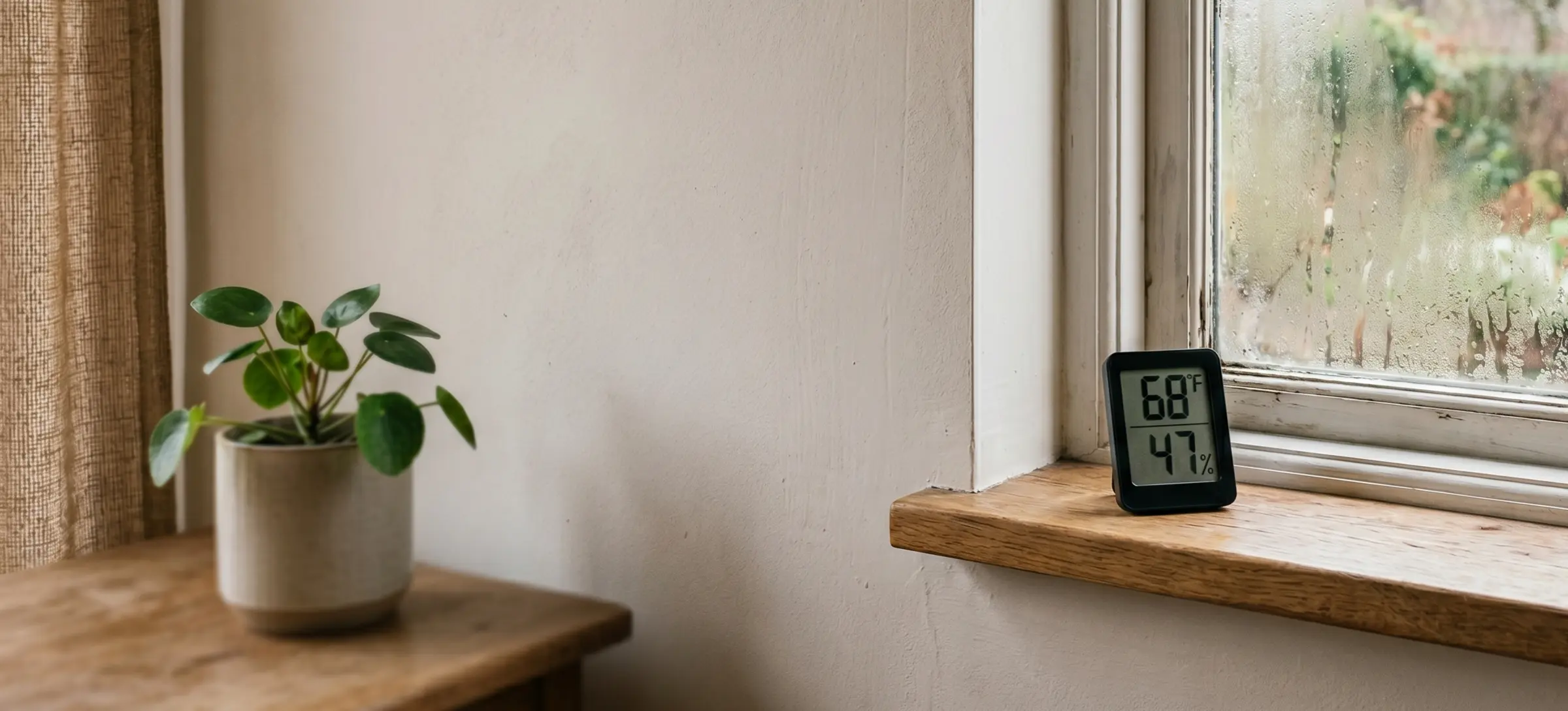

If your home feels stuffy in summer, your windows fog in winter, or mold keeps coming back no matter how many times you clean it, humidity is almost certainly the cause. Relative humidity (RH) is the measure of moisture in the air as a percentage of the maximum that air can hold at a given temperature; when indoor RH exceeds 60%, the EPA identifies this as the threshold at which mold can grow on organic surfaces. Mold cannot grow without water, which means controlling humidity is not a supplemental step in mold prevention; it is the entire strategy. This guide explains exactly what relative humidity level triggers mold growth, why the mechanism matters more than any single number, and how to keep your home in the safe range year-round.
Key insights
- The EPA threshold is 60% RH. Indoor relative humidity above 60% creates conditions where mold can grow on any organic surface that also has dust or debris. Keeping RH below 60% prevents germination; the ideal target is 30%–50%.
- 60% RH is when mold can grow, not when it will definitely grow. Mold also needs a food source and the right temperature. In real homes with wood, drywall, and dust, elevated humidity above 60% almost always produces mold within days to weeks.
- Surface moisture is often more dangerous than ambient RH. A room at 50% RH can still grow mold on a cold wall where condensation raises local moisture to 80% or higher. Ambient readings alone do not tell the full story.
- 24–48 hours is the critical window. When humidity spikes from a water event, mold can germinate on wet organic surfaces within 24–48 hours at typical indoor temperatures.
- A hygrometer costs under $20 and removes the guesswork. Humidity problems are invisible until they produce mold. Monitoring RH directly in problem-prone rooms is the only reliable way to know your baseline.
- Humidity control alone cannot fix existing mold. Dehumidifiers prevent future growth but do not kill established colonies. Visible mold requires physical removal and source correction before prevention measures can hold.
How humidity causes mold
Humidity causes mold by supplying the moisture that dormant spores need to germinate and colonize organic surfaces. Mold spores are present in virtually every home and cannot be eliminated; what you can control is whether those spores find the moisture they need to activate. Per IICRC S520, moisture is the single controlling variable in mold growth indoors because all other required factors (organic material, temperature, oxygen) are already present in most buildings. The relationship is direct: higher sustained humidity means faster material saturation and faster mold development.
 Moisture matters more here than temperature does; a 2022 study cited alongside IICRC S520 found humidity level plays the more critical role in whether growth can establish at all.
Temperature affects the rate of growth but not the fundamental requirement. The IICRC S520 standard and research published in a 2022 NIH/PubMed study on indoor mold prevention both conclude that moisture level plays a more critical role than temperature in determining whether mold can establish and persist. Reducing humidity is therefore more effective and more energy-efficient than trying to keep a home cold enough to slow mold metabolism.
The humidity thresholds that matter
The EPA recommends keeping indoor relative humidity (RH) below 60%, with an ideal range of 30%–50% for most living spaces, per the EPA's guidance on mold and moisture. These are the reference numbers most frequently cited by building scientists, HVAC engineers, and remediation professionals.
These thresholds are not binary switches. Mold does not appear the instant humidity crosses 60% and disappear when it drops to 59%. What matters is duration and surface contact: sustained exposure above the threshold on an organic material is what produces visible growth. The table below shows how risk scales across the full range, and what conditions each level creates in practice.
| RH level | Mold risk | What it means in practice |
|---|---|---|
| Below 30% | None from humidity | Too dry for mold, but causes wood cracking, static, dry skin, and respiratory irritation |
| 30%–50% | Safe zone | EPA and ASHRAE-recommended range; mold growth stalls, dust mite activity suppressed |
| 50%–60% | Caution zone | Elevated risk if sustained; dust mites thrive; mold can grow on cold surfaces even at this level |
| 60%–70% | Active risk | EPA threshold for mold germination on organic surfaces; dehumidification or ventilation required |
| Above 70% | High risk | Mold can germinate within 24–48 hours on any damp organic surface at typical indoor temperatures |
The 50% threshold is where dust mite activity becomes significant alongside mold risk, which matters for anyone managing mold and asthma or related allergy conditions. In cold climates during winter, the EPA recommends targeting the lower end of the range (30%–40%) to prevent condensation on cold exterior surfaces, even when ambient readings appear safe.
Surface moisture vs. air humidity: why the distinction matters
Surface moisture and ambient air humidity are two different readings, and it is surface moisture that directly feeds mold growth. When warm indoor air contacts a cold surface, it releases moisture as condensation, pushing local surface moisture far above what a room's ambient RH suggests. A space that reads a "safe" 45%–50% RH in the center can have cold walls, uninsulated pipes, or concrete floors with enough condensed moisture to sustain active mold colonies. This is why ambient RH readings alone are not sufficient to assess mold risk.
 A room can read a safe 45 to 50% at its center and still produce growth right here, since local surface moisture at a cold window frame runs far higher than the ambient reading suggests.
Common condensation locations in homes include exterior walls in winter, uninsulated pipes in basements and crawl spaces, single-pane window frames and sills, the back of furniture placed against cold exterior walls, and HVAC supply ducts running through unconditioned spaces. Addressing these cold surfaces through insulation, vapor barriers, and improved air circulation is as important as controlling ambient humidity.
The IICRC S520 sets wood moisture content thresholds for remediation decisions: 19% is the warning threshold where mold risk elevates, and 28% is the structural damage threshold. A professional inspector uses a pin or pinless moisture meter to measure these values directly at the surface, rather than relying on room RH alone. Understanding how mold inspection uses moisture meters to detect hidden problems illustrates why surface readings matter.
How to measure indoor humidity
The most reliable way to measure indoor humidity is with a digital hygrometer, a small device that displays relative humidity and temperature simultaneously. Digital models cost $15–$40 and are widely available at hardware stores. Most record minimum and maximum readings over time, which is useful for catching overnight humidity spikes that would otherwise go undetected.
Placement matters. A single hygrometer in the living room tells you very little about your bathroom, basement, or crawl space, where conditions are often dramatically different. Place hygrometers in:
- Bathrooms (on a wall away from the shower, not directly in steam)
- Basements and crawl spaces (the most chronically humid areas in most homes)
- Bedrooms (particularly exterior-facing rooms in winter)
- HVAC closets or return air plenums (to catch whole-home humidity issues)
If a room consistently reads above 55% without a specific moisture event (like a shower), that baseline is high enough to warrant investigation before mold appears. Rooms that appear fine at midday may spike overnight when outdoor temperatures drop, which is why a recording hygrometer showing minimum and maximum values gives a more accurate picture than a single reading.
What raises indoor humidity
High indoor humidity comes from three categories of sources: occupant activities, building moisture migration, and HVAC system problems. Identifying which source is driving your readings determines which fix is appropriate.
 A single shower like this adds roughly 2 pints of moisture to the air when the fan isn't running, enough to spike a small bathroom to 80 or 90% RH.
Occupant activities are the most controllable. Showering adds approximately 2 pints of moisture to the air per shower if the bathroom fan is not running. Cooking produces 1–3 pints per meal depending on method. A single load of laundry air-dried indoors can release 4–5 pints. Running a clothes dryer with a disconnected or leaking duct vents all of that moisture directly into the home.
Building moisture migration includes water entering through the foundation or slab (common in basements and crawl spaces), ground vapor rising through unencapsulated crawl spaces, and rain or groundwater seeping through cracks in foundation walls. These sources are often continuous and produce the highest sustained humidity levels, particularly in belowgrade spaces.
HVAC system problems are frequently overlooked. An oversized air conditioner that short-cycles does not run long enough to dehumidify the air, even while it cools. A clogged condensate drain line lets pooled water evaporate back into the system. Ductwork running through unconditioned attics or crawl spaces can sweat and introduce moisture into supply air. The connection between mold in HVAC systems and whole-home humidity problems is direct: a single contaminated evaporator coil can distribute both spores and moisture through every room.
Room-by-room humidity risks
Bathrooms, crawl spaces, and basements carry the highest sustained humidity in most homes, while living areas and bedrooms typically stay within the safe range under normal conditions. The rooms with the highest sustained RH are the most likely to develop mold problems when conditions are not actively managed.
 A space this size can sustain 65 to 75% RH year-round from ground moisture migration alone, with no single occupant activity driving the reading.
The risk is not always proportional to room size. A small bathroom with no exhaust fan routinely spikes to 80%–90% RH during a shower and may never fully dry out between uses. A large unfinished basement with ground moisture migration can sustain 65%–75% RH continuously, year-round, without a single occupant activity driving it. Monitoring each space separately is the only way to know where your actual problem is.
| Room | Typical RH range | Primary moisture source | Most common mold locations |
|---|---|---|---|
| Bathroom | 70%–90% during use; 50%–60% sustained without exhaust fan | Shower and bath steam | Ceiling, grout, caulk, behind tile |
| Kitchen | 55%–75% during cooking | Cooking and dishwasher steam | Under sink, ceiling above range, cabinet interiors |
| Basement | 55%–75% sustained in humid climates | Ground moisture migration, air conditioning condensation | Walls, floor joists, rim joists, stored cardboard |
| Crawl space | 70%–90% in humid climates without encapsulation | Ground vapor, air infiltration | Wood framing, subfloor, insulation batts |
| Attic | Varies widely; spikes if exhaust fans vent indoors | Kitchen/bath fans, air leaks from living space | Plywood sheathing, rafters |
| Bedroom | 40%–55% typical; higher in exterior-facing rooms in winter | Breathing and sleeping, condensation on cold walls | Window frames, exterior wall corners |
| HVAC/utility | Depends on system; high if condensate drain is blocked | Condensate from cooling coil | Evaporator coil, drain pan, supply ductwork |
Rooms below grade and spaces with limited air exchange have the highest chronic humidity. For bathrooms, a properly sized exhaust fan running for at least 20 minutes after a shower is the most effective single intervention. For basement mold, the solutions involve both dehumidification and moisture barrier installation. Crawl spaces present the same challenge at greater severity, since ground vapor rises continuously through unencapsulated soil.
Seasonal humidity and mold risk
Seasonal changes shift both the source and location of indoor humidity problems: summer raises ambient RH through warm, moisture-laden outdoor air, while winter creates localized condensation on cold surfaces even when ambient RH is low. The strategies that effectively control humidity in one season can make the other season's problems worse if applied without adjustment.
 Ambient humidity typically drops indoors in winter, which is why condensation like this at the glass, not the room's overall reading, is the actual risk to watch for in cold months.
Summer: Warm outdoor air holds significantly more moisture than cool air. When humid summer air enters through windows, infiltrates through the building envelope, or is brought in through an HVAC system running in humid conditions, indoor humidity climbs. Air conditioning is the primary defense in summer, but it only dehumidifies effectively when it runs long enough. Short-cycling caused by an oversized unit is a common reason for persistently high summer humidity even in homes with functioning air conditioning. Targeting 45%–50% RH is appropriate for summer operation.
Winter: Cold climates produce the opposite problem. Outdoor air is cold and dry, but heating that air indoors raises its temperature without adding moisture, which means indoor RH typically drops in winter. The humidity concern in winter is not ambient RH (which is usually low) but condensation. Warm, humid indoor air contacts cold exterior walls, window glass, and uninsulated pipes, depositing moisture at exactly the locations where mold grows most easily. Keeping RH at 30%–40% in winter prevents condensation on cold surfaces while maintaining comfort.
Shoulder seasons (spring and fall) are the most unpredictable. Outdoor temperatures swing, buildings cycle through heating and cooling, and humidity control systems may not be running consistently. These transitions are when moisture problems most often go undetected long enough to develop into active mold growth. If anyone in the household is experiencing unexplained respiratory symptoms during these periods, the connection between mold and health is worth investigating alongside a humidity audit.
Year-round, the best defense is a calibrated hygrometer in each high-risk space. Read it seasonally, not just when you suspect a problem. A consistent monitoring routine is more reliable than reacting to visible mold after the fact.
How to lower indoor humidity
Lowering indoor humidity requires matching the fix to the source: ventilation and exhaust fans address occupant-generated moisture, dehumidifiers address chronic ambient RH in damp spaces, and structural corrections address moisture entering through foundations, crawl spaces, or the building envelope. Most homes with persistent humidity problems need all three categories working together.
 A barrier installed to ANSI IICRC S520 standards addresses the ground vapor migration that's often the dominant moisture source in a space like this, something a dehumidifier alone can't fully offset.
Behavioral and ventilation steps should come first because they cost nothing. A full room-by-room breakdown of these actions, including frequency targets, is at mold prevention.
Run exhaust fans in bathrooms and kitchens during and for at least 20 minutes after the activity. Vent the clothes dryer to the outside and inspect the duct connection annually. Open windows on dry days for cross-ventilation. Avoid air-drying laundry indoors. Move houseplants away from exterior walls, since plant soil and evaporation add measurable moisture. Cover pots while cooking.
Dehumidifiers are the standard equipment solution for basements, crawl spaces, and other chronic moisture areas. When selecting a unit, capacity matters more than brand. The Association of Home Appliance Manufacturers (AHAM) standard sizes units by the pints of water they remove per day.
Undersized units run continuously without reaching the target RH. Oversized units short-cycle, which reduces their effective dehumidification and wears out the compressor faster. Matching capacity to the actual space is the most common mistake homeowners make when purchasing.
| Space size | Condition | Recommended capacity | Notes |
|---|---|---|---|
| Up to 500 sq ft | Moderately damp (55%–65% RH) | 30 pint/day | Small basement area or large bathroom |
| 500–1,000 sq ft | Moderately damp | 40–50 pint/day | Standard basement; run continuously |
| 1,000–2,500 sq ft | Very damp (65%–80% RH) | 50–70 pint/day | Full basement or crawl space with moisture issues |
| 2,500+ sq ft or wet (80%+ RH) | Wet or very wet | 70–90+ pint/day or whole-home unit | Active seepage; consider whole-home system |
Set the dehumidifier to maintain 45%–50% RH as the target, not to run continuously at maximum. A unit that overshoots and drops the room to 25% RH creates a different set of problems. For basements, targeting 30%–45% RH is tighter because cooler temperatures push effective RH higher on surfaces even when the meter reads a seemingly safe number. The CDC's Basic Facts About Mold recommends keeping indoor humidity below 60% as the minimum standard, making 45%–50% a comfortable margin of safety.
Structural corrections address moisture sources that equipment cannot solve alone. Basement wall sealing and floor coatings reduce direct water infiltration. Crawl space encapsulation with a vapor barrier installed to ANSI/IICRC S520 standards addresses ground vapor migration, which is often the dominant moisture source in belowgrade spaces. Improving attic ventilation to meet the IRC 1:150 net free area ratio (or 1:300 with a vapor retarder on the warm-in-winter side) prevents moisture from exhaust fans and air leaks from accumulating in the framing. Adding insulation to cold pipes, exterior walls, and rim joists reduces condensation surfaces.
For HVAC-related humidity, the fixes include upgrading to a correctly sized unit (Manual J calculation), replacing a clogged condensate drain, and insulating duct runs in unconditioned spaces. A professional HVAC technician can assess whether your system has adequate dehumidification capacity for your climate zone.
When humidity control is not enough
Humidity management prevents mold. It does not reverse it. If you have already crossed from prevention territory into active mold growth, equipment and behavioral changes will reduce future moisture but will not eliminate established colonies.
 A dehumidifier running in a room with growth this established won't reverse it; equipment prevents future colonization but doesn't eliminate colonies that have already formed.
Signs that humidity control has already failed and remediation is needed include visible mold covering more than a few square feet, a musty odor that persists even after surfaces are cleaned and dried, wood moisture meter readings above 19%, mold that returns within days of cleaning, or any mold in the HVAC system or ductwork.
The signs of mold section covers visual and odor indicators by room and surface, including the musty odor patterns and recurring spot growth that signal a chronic moisture problem.
Mold that developed from a sudden moisture event (a burst pipe, roof leak, or flood) is a separate problem from chronic humidity mold. The priority after any such event is structural drying within the 24–48 hour window; the timeline and sequence for that process is covered at mold after water damage. Professional remediation is frequently warranted after any water intrusion that wets structural materials, regardless of current humidity readings.
In both chronic and acute cases, the underlying moisture source must be corrected before any remediation can hold. A dehumidifier placed in a room with an active roof leak will not prevent mold from growing on the wet framing above it.
The decision about scope (DIY versus professional, and what size job crosses the line) is covered in when is mold remediation required, including the EPA's 10-square-foot threshold.
If a professional inspection confirms active growth, professional mold remediation addresses the source before prevention measures can hold.
Frequently asked questions
What humidity level causes mold to grow?
The EPA sets the threshold at 60% relative humidity, above which mold can germinate on organic surfaces. Most species grow most aggressively above 70% RH. Keeping indoor RH in the 30%–50% range prevents mold from establishing.
Can mold grow at 50% humidity?
Mold is unlikely to grow in open air at 50% RH, but it can still develop on cold surfaces where condensation raises local surface moisture significantly above ambient levels. A room at 50% RH with a cold exterior wall or uninsulated pipes can still produce mold at those contact points.
How do I know if my home humidity is too high?
Condensation on windows or cold pipes, a persistent musty odor, peeling paint, wood that swells or feels soft, and mold spots that return after cleaning are all signs of chronically elevated humidity. A hygrometer gives a precise reading in any room for under $20.
Does a dehumidifier prevent mold?
A dehumidifier is one of the most effective tools for mold prevention in damp spaces, removing moisture from the air and keeping RH in the safe range. It does not kill existing mold or address the structural moisture sources that may be causing the problem.
What is the ideal indoor humidity level?
The EPA and ASHRAE both recommend 30%–50% relative humidity for general living spaces. This range prevents mold growth and dust mite activity while avoiding the dry-air problems that occur below 30% RH.
How quickly does mold grow at high humidity?
When humidity exceeds 70% and temperatures are in the 70°–90°F range, mold can germinate within 24–48 hours on damp organic surfaces. This is why prompt drying within 24–48 hours after any water event is the standard recommended by the EPA, IICRC, and FEMA.
What rooms have the highest humidity in a home?
Bathrooms and kitchens generate the most acute moisture spikes from showering and cooking. Basements and crawl spaces tend to have the highest sustained background RH levels due to ground moisture migration.
When should I call a professional instead of using a dehumidifier?
When visible mold is already present, when a musty odor returns after cleaning, when wood moisture readings exceed 19%, or when mold has reached HVAC components, humidity control alone is not sufficient. A mold inspector can identify the moisture source and determine whether professional remediation is needed before prevention measures can be effective.
- EPA: Mold Course Chapter 2, Moisture and Mold
- EPA: A Brief Guide to Mold, Moisture, and Your Home
- EPA: Mold Course Chapter 9, Mold Prevention
- CDC: Basic Facts About Mold
- NIOSH: Dampness and Mold in Buildings (2019-115)
- IICRC S520: Standard for Professional Mold Remediation
- NIH/PubMed: Temperature vs. Relative Humidity for Indoor Mold Prevention
- ASHRAE Standard 55: Thermal Environmental Conditions
Sam Hickerson is the founder of RestoreAdvisor and writes consumer guides on mold remediation, water damage restoration, inspection, testing, and home recovery. His work focuses on helping homeowners understand costs, risks, and when to call a professional. He draws on guidance from the EPA, CDC, IICRC, and other authoritative sources to make complex home issues easier to navigate.