
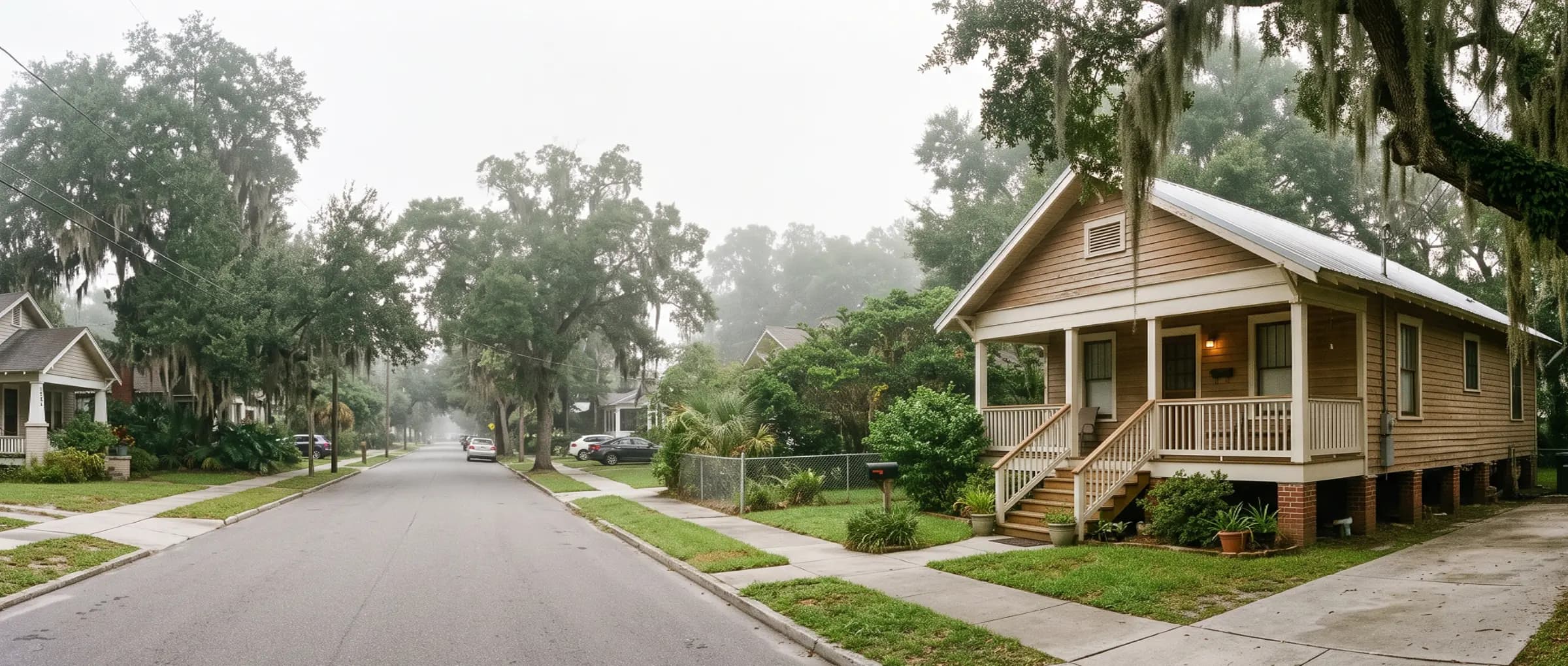

Jacksonville's mold risk doesn't come from one dominant source the way it does in some Florida cities. It comes from a river system with dozens of tidal tributary creeks that can flood a neighborhood without a hurricane ever making landfall nearby, combined with a subtropical humidity load that never really lets up. Mold remediation is the licensed process of correcting that moisture source, removing contaminated material, and verifying the space is clean again, governed in Florida by the IICRC S520 standard and the state's Department of Business and Professional Regulation.
That combination means water sits somewhere longer than it should more often than in most Florida markets. This page covers what remediation actually costs here, how Duval County's flood-prone geography changes the job, and what to check before you sign with anyone.
Whether you're dealing with a single water-stained ceiling tile or a whole flooded first floor, professional mold remediation runs the same way: confirm the moisture source, scope how far contamination spread, and bring in a licensed team to correct both rather than just repainting over the stain. Skipping straight to cosmetic repairs without addressing the source is the most common reason a job has to be repeated within a year.
Key insights
- Typical cost. Jacksonville mold remediation runs $1,500–$7,500 for most residential jobs, with flood-related whole-room work reaching $10,000–$15,000 or more.
- Licensing is separated. Florida requires a Mold Assessor to identify and write the protocol and a different, separately licensed Mold Remediator to perform the removal on any job over 10 square feet.
- Flooding doesn't require a direct hit. San Marco, Riverside, and downtown flooded during 2024's Hurricane Helene and 2017's Hurricane Irma, neither of which made landfall near Jacksonville, because tidal creeks backed up under sustained onshore wind.
- Growth starts fast. Materials wet for more than 24–48 hours in Jacksonville's humidity are treated as contaminated under EPA guidance, even before visible growth appears.
- Older housing stock carries different risk. Pre-1960s homes in Springfield, Riverside, and Ortega commonly sit on vented crawl spaces, which trap humidity against wood framing in a way newer slab construction in Mandarin or Oakleaf does not.
- Insurance rarely covers the whole job. Florida HO-3 mold sublimits typically cap out at $10,000, well under the cost of a flood-related remediation.
Why Jacksonville's flooding doesn't wait for a hurricane
Jacksonville's mold risk is driven by tidal creek flooding that happens independent of storm intensity, not just by direct hurricane strikes on the coast. The city sits on the St. Johns River, but the river itself is only part of the story. Dozens of tributary creeks including McCoys Creek, Hogans Creek, the Trout River, and the Ribault River spider out from the main channel through some of the city's oldest neighborhoods, and those creeks back up under sustained onshore wind and heavy rain long before the St. Johns itself reaches flood stage.
 Floodwater from a tidal creek carries the same contamination category as sewage backup under the IICRC S520 standard, unlike water from a clean supply line leak.
That pattern showed up clearly during Hurricane Irma in September 2017. Irma passed roughly 100 miles west of Jacksonville and had weakened to a Category 1 storm by the time it did, yet a nor'easter ahead of the storm combined with Irma's onshore winds to push the St. Johns River to a record 5.57 feet, exceeding a flood mark set in 1864. Homes in San Marco, Riverside, and along both riverbanks downtown flooded for days. Seven years later, Hurricane Helene followed the same pattern without ever making landfall in Northeast Florida: Jacksonville's mayor described the September 2024 flooding in San Marco, Riverside, and downtown as happening "in areas we were already expecting."
Neither storm required a direct hit on the city to cause days of standing water in the same handful of neighborhoods.
Duval County spans more than 750 square miles, among the largest land areas of any city in the continental United States, which means flood risk here isn't concentrated on a single coastline the way it is in more compact Florida cities. A home miles from the ocean along the Trout River can flood from the same storm that leaves an oceanfront property at the Beaches untouched. Jacksonville's 1991-2020 climate normal for annual rainfall is 53.40 inches at Jacksonville International Airport, according to NWS Jacksonville records, with morning relative humidity regularly climbing into the 90s during the summer wet season before dropping to the 50s and 60s by afternoon. June is typically the wettest month at 7.60 inches, with September close behind at 7.56 inches as peak hurricane season overlaps the tail end of the summer rains.
For a homeowner, the practical takeaway is that storm track and storm category are poor predictors of your personal flood risk here. Whether your creek or drainage basin overflows matters more than whether the storm made a direct hit, and that risk repeats on the same streets year after year regardless of which named storm is responsible.
A flood event and an ordinary plumbing leak both start the same countdown once material gets wet, though creek and river water carries additional contamination concerns a clean pipe leak doesn't. The 24 to 48 hour mold growth timeline that follows any water event applies here just as it does after a burst pipe, which is why waiting to see if a flooded room "dries out on its own" before calling anyone usually costs more in the end.
Hurricane events and what they mean for mold risk
The pattern holds across every major flood event on record in Jacksonville, regardless of a storm's official category or how close it tracked to the coast.
| Event | River crest / impact | Neighborhoods affected | Mold implication |
|---|---|---|---|
| Hurricane Irma (2017) | 5.57 ft, record crest | San Marco, Riverside, downtown, Southbank | Multi-day saturation drove widespread drywall and framing loss in flooded structures |
| Hurricane Matthew (2016) | Near-record surge | Riverside, Historic Springfield, coastal Duval | First of two back-to-back record events in under a year |
| Hurricane Helene (2024) | Isolated tributary flooding | San Marco, Riverside, downtown | Confirmed the pattern repeats even without a direct or nearby landfall |
Jacksonville neighborhoods with the highest mold risk
Jacksonville's mold risk splits along two mostly separate lines: older, low-lying neighborhoods near the river and its tributaries, and newer suburban development on slab foundations further from the water. Each carries a different primary risk factor.
 Homes built on brick piers before the mid-1960s create a vented crawl space that traps humidity against untreated wood framing, the primary risk factor along Jacksonville's tidal creek corridors.
Foundation type explains much of that split. Homes built before the 1960s in the city's historic core commonly sit on vented crawl spaces rather than a poured slab, and that under-floor cavity behaves like a below-grade space even though it's technically open to outside air. Full detection, encapsulation, and cost detail for a crawl space foundation is directly relevant to a large share of Jacksonville's pre-1960s housing stock.
| Neighborhood | Primary risk factor | Homeowner notes |
|---|---|---|
| San Marco | Tidal creek and river flooding | Flooded during both Irma and Helene; many 1920s homes with river-adjacent lots |
| Riverside and Avondale | Tidal creek flooding, aging plumbing | Historic housing stock with mixed crawl space and slab foundations |
| Springfield | Aging drainage along Hogans Creek | Roughly 1,800 structures over 75 years old; vented crawl spaces common |
| Ortega | River-adjacent flooding, mature tree canopy | Waterfront lots with older wood-frame construction |
| Northside (Trout and Ribault River corridor) | Chronic creek flooding independent of named storms | Lower-lying terrain that floods from heavy rain alone, not just hurricanes |
| Mandarin | HVAC condensation, near-continuous AC season | Predominantly newer slab construction, less flood exposure |
| Southside and Baymeadows | HVAC condensate, roof and gutter maintenance | Mixed-age suburban stock, moisture typically mechanical rather than flood-driven |
What to do in the first 24 to 48 hours after your home floods
The first 24 to 48 hours after a flood call for cutting power to affected circuits, stopping the water source, documenting the damage, and starting extraction before a professional arrives. Acting within that window in a Jacksonville home is what determines whether the damage stays a cleaning job or becomes a full remediation.
 Raising furniture above standing water limits contact time with contaminated floodwater, but wood and upholstered pieces still need to dry fully before they're safe to bring back into use.
1. Cut power to any affected circuits
Standing water and electrical systems don't mix. If it's safe to reach your breaker panel without wading through water, shut off power to any circuit serving a flooded room before doing anything else. If the panel itself sits in a flooded area, wait for a professional rather than risking it.
2. Stop the water source if it's still active
A creek or river flood usually resolves on its own timeline, but a burst pipe, water heater failure, or roof leak needs the source shut off immediately, since every additional hour of active water adds to the area that eventually needs remediation.
3. Photograph and document everything before you touch anything
Insurance adjusters and mold assessors both rely on documentation from before cleanup began. Photograph water lines on walls, standing water depth, and any items that were submerged, and keep a written log of the date and time you first noticed the water.
4. Classify the water before deciding who to call first
Clean water from a supply line is different from creek, river, or sewage water, which the IICRC S520 standard treats as a higher contamination category requiring different PPE and disposal protocols. If your flooding traces back to the St. Johns River or a tributary creek, treat it as contaminated water from the start rather than waiting for a lab result to confirm it.
5. Start extraction and mechanical drying immediately
Wet-vacuum standing water, move furniture and rugs off wet flooring, and run fans and a dehumidifier if you have them, even before a contractor arrives. This buys time against the 24 to 48 hour window but doesn't replace professional structural drying for anything beyond a small, contained area.
6. Call your insurance carrier the same day
Report the claim while the damage is fresh and before any cleanup obscures the original extent. Ask directly whether your policy covers the specific cause, since Florida homeowners insurance treats a burst pipe very differently from creek or river floodwater.
Every hour past the 24 to 48 hour mark increases the odds that a same-day cleaning job becomes a full remediation scope, which is the biggest driver of the cost ranges below. A licensed crew brings equipment most homeowners don't have on hand, including negative air machines and HEPA air scrubbers for anything beyond a single small room.
How to spot mold after a Jacksonville leak or flood
The clearest early signals are a musty odor, discoloration on drywall or baseboards, and any surface that stayed damp for more than a day after water intrusion, whether from a storm, a roof leak, or an appliance failure. Jacksonville's humidity makes the odor test less reliable than it is in drier climates, since a faint musty smell can also come from a closed-up room with no active mold, so pair it with a visual check rather than relying on smell alone.
 A reading above 28 percent moisture content signals the wood framing behind the wall has likely sustained structural damage, well past the 19 percent threshold where mold growth becomes active.
Check the areas that stay damp longest first, since that's where a small problem tends to show up before it spreads. Crawl space access panels, the wall behind a washing machine, and the ceiling below an upstairs bathroom are the three spots homeowners most often miss during a routine walk-through, and they're also where a slow leak has the most time to do damage before anyone notices.
| Signal | Where to check first | What it usually means |
|---|---|---|
| Musty odor with no visible source | HVAC vents, crawl space access panel | Hidden moisture in ductwork or under-floor space |
| Discolored baseboards or drywall | Exterior walls, areas near past leaks | Water intrusion that's already reached porous material |
| Peeling paint or bubbling drywall texture | Ceilings below bathrooms, walls facing prevailing rain | Moisture trapped behind the surface, often further along than it looks |
| Persistent condensation on windows or ducts | Single-pane windows, uninsulated duct runs | Chronic humidity rather than a one-time event |
Any of these signs after a documented flood or extended leak warrants a professional look rather than a wait-and-see approach, since Jacksonville's humidity accelerates growth once material is wet. A licensed assessor typically confirms hidden growth with a moisture meter and, on larger jobs, a thermal imaging camera, both of which locate contamination behind a wall or under flooring without cutting it open. Bathrooms, closets, and other low-airflow rooms tend to show signs of mold earliest, before more ventilated parts of the home do.
Lab confirmation isn't always necessary for visible growth, but it matters when the extent is unclear or when a lab result changes what a remediation crew scopes into the job.
What mold remediation costs in Jacksonville
Most Jacksonville mold remediation jobs cost $1,500–$7,500, with the total driven by how much material has to come out rather than the square footage of visible mold alone. A single bathroom ceiling patch from a slow roof leak sits at the low end of that range. A flood-affected room with saturated drywall, baseboards, and flooring runs considerably higher because the crew is replacing structural materials, not just cleaning a surface.
 Contaminated drywall gets bagged and sealed on site rather than carried loose through the home, since disturbing dry mold releases spores that can spread the job beyond its original scope.
Access also moves the number more than most homeowners expect. A crew that has to tear out cabinetry, work inside a low crawl space, or coordinate around occupied rooms bills more hours than a job with a clear, open work area, even when the affected square footage is identical.
| Project scope | Typical cost | What drives the price |
|---|---|---|
| Small patch, under 10 sq ft | $500–$1,500 | Nonporous or limited surface, no material removal required |
| Single room, 10–100 sq ft | $1,500–$4,500 | Drywall and baseboard removal, containment setup |
| Multiple rooms or flood-affected zone | $5,000–$10,000 | Structural drying, subfloor and wall cavity work, clearance testing |
| Whole-home or crawl space flood recovery | $10,000–$15,000+ | Extensive material replacement, HVAC involvement, extended drying time |
Location within the home changes the number too. A Jacksonville per-square-foot rate typically falls in the $10–$25 range, and jobs in crawl spaces or attics run toward the higher end of that band because of restricted access.
| Location | Typical cost range | Why |
|---|---|---|
| Bathroom or kitchen | $500–$2,500 | Contained area, often addressable without full-room demolition |
| Crawl space (common in older Duval homes) | $2,500–$8,000 | Restricted access, vapor barrier and encapsulation add-ons |
| Attic | $1,500–$6,000 | Roof leak diagnosis often required before remediation begins |
| HVAC system | $600–$5,000+ | Duct cleaning versus full component replacement varies widely |
A standalone mold inspection in Jacksonville generally runs $300–$500, and clearance testing after remediation, which confirms the job passed before you pay the final invoice, typically adds $200–$600 depending on how many samples the assessor pulls. After a named storm, expect remediation quotes to run 10%–20% higher than baseline as contractor demand spikes across the region; this surge pricing eases once the immediate post-storm rush clears, usually within a few weeks.
The figures above reflect Jacksonville-specific market conditions; national mold remediation cost tables break costs down further by mold type and infestation size across the country.
Do you need a licensed contractor in Duval County
Yes. Florida requires anyone performing mold assessment or remediation on a job affecting more than 10 square feet to hold a state license through the Department of Business and Professional Regulation, and the law splits that work into two separate roles that generally cannot be performed by the same company on the same project.
 Florida law requires the technician who assesses a property and the one who removes the mold to hold separate licenses, so ask directly which role this visit covers before any work begins.
A Mold Assessor identifies the contamination, writes the remediation protocol, and later performs clearance testing to confirm the work succeeded. A Mold Remediator carries out the physical removal according to that protocol. Under Florida Statute §468.8419, a Mold Assessor cannot perform remediation on a property they assessed within the preceding 12 months, and the same restriction applies in reverse. Florida built this separation specifically to prevent a conflict of interest: a company that both diagnoses the problem and gets paid to fix it has an incentive to overstate the scope, so the law keeps those functions independent. Jacksonville jobs fall under the identical Chapter 468 requirement; the Florida DBPR licensing explainer has the complete statute citations and a step-by-step license verification walkthrough.
A printed certificate the company hands you at the walkthrough isn't proof of anything current, since license status can change and a certificate doesn't reflect a suspension or expiration.
To verify a contractor's license before signing anything, search the Florida DBPR license search tool directly using the license number they provide.
Beyond the state license, ask whether the individual technicians hold IICRC AMRT certification, which covers the technical training behind the S520 standard rather than legal authorization to work in Florida. State licensing and technical certification answer two different questions, and a contractor should be able to speak to both.
What to ask before hiring a Jacksonville mold contractor
The most important questions to ask a Jacksonville mold contractor cover licensing status, the written remediation protocol, how they classify flood water, who performs clearance testing, and how they account for local humidity in their timeline. Confirming all five before signing protects you more than the state's licensing law does on its own.
Are you a licensed Mold Assessor, a licensed Mold Remediator, or both?
A credible answer names one role clearly and explains that a separate company will handle assessment or remediation, whichever the contractor doesn't perform. A vague answer, or a claim that one company can legally do both on your job, is a licensing violation.
Will you write a remediation protocol before work begins?
Florida law requires a written protocol from the assessor before remediation starts. If a company wants to begin demolition on the same visit as the initial walkthrough with no written scope, that skips a legally required step.
How do you handle a job that started as water damage from creek or river flooding?
A contractor familiar with Jacksonville's tributary flooding pattern should mention Category 2 or 3 water classification for floodwater, since creek and river water carries contamination risk that a clean pipe leak doesn't, and that classification changes the required PPE and disposal protocol.
What's included in your clearance testing, and who performs it?
The assessor, not the remediation crew, should perform final clearance testing. If the same company quoting your remediation also plans to "test" its own work, that's the conflict of interest Florida's two-license system exists to prevent.
What's your estimated timeline, and does that account for Jacksonville's humidity during the drying phase?
Structural drying takes longer in a climate with baseline humidity in the 70s than it does in a drier region. A contractor who quotes the same drying timeline regardless of season or ambient humidity may be underestimating the job.
These five questions cover what's specific to Duval County's licensing structure and climate. For building a shortlist, comparing written bids, and reading a contract before you sign, the full contractor vetting process applies here the same as anywhere else in Florida.
Does homeowners insurance cover mold in Jacksonville
Sometimes, and usually only partially. A standard Florida HO-3 policy covers mold remediation when it results from a sudden, accidental covered event, such as a burst supply line or a storm-damaged roof that let water in over a short window. It typically excludes mold caused by gradual leaks, chronic humidity, or flooding from rising water, which is the specific mechanism behind most of Jacksonville's tributary creek flooding.
That distinction matters here more than in cities where flood risk comes primarily from storm surge, because standard homeowners insurance in Florida never covers flood damage regardless of cause; that requires separate flood insurance through the National Flood Insurance Program or a private carrier. If your mold problem traces back to St. Johns River or creek overflow rather than a plumbing failure, your homeowners policy's sudden-event coverage likely doesn't apply, and you'd need to have carried flood insurance to have any claim at all. Most Florida HO-3 policies also cap mold-specific payouts at $10,000 regardless of cause, well under the cost of a flood-related whole-room remediation. The HO 04 26 endorsement raises that $10,000 sublimit, and pairing it with flood coverage through the NFIP is the closest thing to full protection against a tributary creek claim under standard mold insurance coverage in Florida. Jacksonville homeowners in a mapped flood zone should treat that combination as a higher priority than the state average would suggest.
The hidden mold risk in Jacksonville's past flood zones
Homes in San Marco, Riverside, Springfield, and other tributary-adjacent neighborhoods that flooded during Hurricane Irma in 2017 or Hurricane Helene in 2024 are still turning up hidden mold to licensed assessors years after each event, which makes this an active due diligence problem for anyone buying, renovating, or chasing down a persistent odor with no obvious source in an affected corridor. The standard 24 to 48 hour window for mold to establish passed long ago in any home that wasn't fully extracted and dried at the time.
 A room can pass a normal walkthrough with no visible sign of damage while growth like this sits just behind the trim, which is why a licensed assessment matters more than a visual check on any home with a known flood history.
Confirm which flood pathway affected the property, not just whether it's in a flood zone
FEMA flood maps model river and coastal flooding well but don't fully capture Jacksonville's tributary creek pattern, so a property outside a mapped high-risk zone can still have flooded during Irma or Helene if it sits near McCoys Creek, Hogans Creek, or another tributary. Cross-reference the Duval County property appraiser's records against both FEMA maps and any publicly available flood extent data from either storm, since the map alone won't tell the full story here.
A clean disclosure form only means the current seller didn't personally see it flood
Florida Statute §689.25 requires sellers to disclose flooding history, but that duty covers only their own ownership period. A property that changed hands after 2017 or 2024 can show no flood history on paper even though a prior owner lived through it, which is why the disclosure form is a starting point rather than proof.
Bring in a licensed assessor, since a home inspector isn't trained or authorized to look for this
A standard home inspection isn't a licensed mold assessment under Florida law and won't reliably detect hidden growth inside wall cavities or under flooring. For any home near San Marco, Riverside, Springfield, or the Trout and Ribault River corridor, a separate DBPR-licensed inspection is worth the cost before closing, or before chasing a persistent odor that has no obvious source. If a prior owner did remediate after Irma or Helene, ask for the written protocol, post-clearance air sampling results, and contractor invoices showing individual DBPR license numbers; a seller who can't produce that paperwork isn't necessarily hiding something, but there's no proof the work met the IICRC S520 standard either.
Watch for signs that surface long after the water is gone
A home that was dried quickly or only cosmetically repaired after either storm can go months or years without visible mold. What tends to show up later is a musty smell that won't place itself, baseboards that feel soft or discolored at the old flood line, paint lifting slightly where a wall meets the floor, or allergy symptoms that ease up whenever you're away from the house.
Buying or selling a home in a flood-prone Jacksonville neighborhood
Florida law requires sellers to disclose known material defects, including past mold and flooding, under the state Supreme Court's ruling in Johnson v. Davis, and this duty applies whether or not the property sits inside a FEMA-mapped flood zone. Listing agents carry the same obligation under Florida Statute §475.278. A home that flooded during Irma or Helene and was fully remediated doesn't need to stay off the market, but the seller's knowledge of that history is a disclosable fact regardless of current condition.
For the specific documentation to request and the warning signs of a flood that wasn't fully remediated, the checklist above covers what applies to any Jacksonville property with Irma or Helene exposure. Exactly what counts as a seller's "known" defect varies by state; Florida's Johnson v. Davis standard sets the baseline here, while the full state-by-state comparison matters most for anyone also weighing a property outside Florida.
Renters fall under a separate legal framework entirely, Florida's Residential Landlord and Tenant Act, rather than the seller disclosure statutes above.
If you're renting, Florida's implied warranty of habitability puts the burden of addressing mold on the landlord in most cases, particularly when the source is a building-side issue like a roof or plumbing failure rather than tenant behavior. A landlord who ignores a documented, written complaint can face rent withholding or repair-and-deduct remedies under Florida's renters' rights statute, but only after the tenant follows the required notice steps first.
Mold in Jacksonville's military and rental housing
Mold in privatized on-base military housing follows a different complaint process than mold in a standard Duval County rental, routed through the installation's housing office and Inspector General channel rather than civilian landlord-tenant law. Jacksonville is home to NAS Jacksonville and NS Mayport, two of the largest military installations in the Southeast, and PCS-driven turnover makes the area's rental market larger and faster-moving than most Florida metros of similar size.
 A PCS move can happen with only a few weeks' notice, which is why photographing any existing mold or water damage before move-in matters more here than it does in a typical year-long civilian lease.
Privatized military housing has faced well-documented mold problems nationally, including congressional hearings and litigation against several of the companies that manage housing at bases across the country, and Jacksonville-area installations are not exempt from that pattern. A service member or military family in privatized on-base housing who suspects mold should route the issue through the housing office and the installation's Inspector General complaint process first, since privatized military housing operates under a different set of maintenance and dispute-resolution rules than a typical civilian lease. The service member's chain of command is also a resource if the housing office response is inadequate.
For off-base rentals, which cover the much larger share of Jacksonville's PCS and short-term military housing market, Florida's standard tenant protections apply the same way they do to any renter in the state, and the implied warranty of habitability covered above puts the repair burden on the landlord regardless of whether the tenant is a service member.
Documentation matters more for military families than for most renters, since a PCS move can happen with little notice and a dispute over mold-related damage or health issues is harder to resolve once a family has relocated. Photograph any mold or water damage as soon as you notice it, keep copies of maintenance requests and any response you receive, and put a request for a mold inspection in writing rather than relying on a verbal ask.
The mold species that show up most in Jacksonville homes
The mold species most commonly found in Jacksonville homes are Cladosporium, Aspergillus, Penicillium, and, in flood-affected properties, Stachybotrys chartarum and Chaetomium. Cladosporium and the Aspergillus and Penicillium group show up most often in routine air sampling here, consistent with most humid Southeastern cities, and typically point to ordinary condensation or HVAC moisture rather than a flood event.
Stachybotrys chartarum and Chaetomium, both of which require sustained saturation rather than brief dampness to establish, show up more often in homes with a documented flood or extended leak history, including properties affected by the 2017 and 2024 flood events described above. Assessors working post-flood jobs in San Marco, Riverside, and Springfield report higher rates of both species than the citywide baseline, consistent with the pattern documented after other major Florida flood events. If your home has a history of creek or river water intrusion, testing that specifically screens for these species, rather than a general air sample, gives your assessor a clearer picture. Containment and cost premiums for Stachybotrys specifically are covered by the black mold removal process.
Neither Stachybotrys nor Chaetomium is more inherently dangerous than the other common indoor genera at low exposure levels, but both indicate a water event serious enough to warrant a closer look at the affected structure rather than surface cleaning alone.
What these species mean for occupant health varies by population: children, older adults, and anyone with an existing respiratory condition face a clinically elevated health risk from the same exposure level that a healthy adult might not even notice.
How to prevent mold in a Jacksonville home
Most preventable mold in Jacksonville traces back to one of two sources: a mechanical system that wasn't serviced on schedule, or a structural gap that let outside moisture in during a storm. Both are cheaper to catch on a routine schedule than to remediate after the fact.
 Live oak litter and Spanish moss clog gutters faster in Jacksonville than in most cities, and a blocked gutter sends water straight down the siding toward the foundation instead of away from it.
The actions below are ordered roughly by how often they actually prevent a call to a remediation company, based on what shows up most in local jobs, starting with the maintenance item Jacksonville homeowners skip most often.
| Action | Frequency | Why it works |
|---|---|---|
| Inspect crawl space vapor barriers | Annually, before summer | Older Duval homes on vented crawl spaces lose humidity control fastest here |
| Service HVAC condensate drain lines | Every 3 months during cooling season | Jacksonville's near-continuous AC use makes clogged drain lines a leading non-flood cause |
| Clear gutters and check roof flashing | Before and after hurricane season | Prevents the slow roof leaks that drive the majority of non-flood mold calls |
| Document flood zone status and elevation | Once, when you buy or renovate | Determines whether NFIP flood insurance is worth carrying given tributary flood history |
| Monitor indoor humidity with a hygrometer | Ongoing | Keeping indoor relative humidity under 60% limits growth regardless of source |
Jacksonville's HVAC systems run nearly year-round given the region's mild winters, which makes routine condensate drain service a higher-priority maintenance item here than in cities with a shorter cooling season.
A clogged drain line is one of the most common calls that starts as "just a musty smell" and turns into a full remediation once the pan overflows into a closet or ceiling cavity.
Homes with vented crawl space foundations, common throughout the city's older neighborhoods, benefit from the same humidity control principles that apply to any below-grade or under-floor space, since the crawl space environment behaves more like a basement than like open-air ventilation in practice.
Frequently asked questions
How much does mold remediation cost in Jacksonville?
Most Jacksonville jobs run $1,500–$7,500, with small bathroom or closet patches near $500–$1,500 and whole-room or flood-related jobs reaching $10,000–$15,000 or more.
Does Jacksonville require a licensed mold contractor?
Yes. Florida requires separate Mold Assessor and Mold Remediator licenses through the DBPR for any job over 10 square feet, and the same company generally cannot perform both roles on one job.
Why does my Jacksonville neighborhood flood even when a storm doesn't hit us directly?
Because much of the city's older housing sits along tidal creeks that feed the St. Johns River, not just the riverbank itself. Onshore wind and heavy rain can push those creeks out of their banks during storms that pass well offshore or inland, which is why San Marco, Riverside, and Springfield flood repeatedly regardless of a storm's exact track.
How long does mold take to grow after a Jacksonville flood?
24–48 hours in Jacksonville's warm, humid climate, which is faster than in drier regions. Materials that stay wet longer than two days should be treated as contaminated even if no visible growth has appeared yet.
Is mold covered by homeowners insurance in Jacksonville?
Sometimes. Florida HO-3 policies typically cover mold that results from a sudden covered event, such as a burst pipe, but exclude mold from gradual leaks, chronic humidity, or unrepaired flood damage, and most policies cap the payout at $10,000 or less.
Do I need a separate inspector before hiring a remediation company?
Yes, in most cases. Florida law requires the mold assessor who identifies the problem and writes the remediation protocol to be a different company than the one that performs the removal work, which protects you from a conflict of interest.
What areas of Jacksonville flood most often?
Neighborhoods along the St. Johns River and its tributary creeks flood most consistently, including San Marco, Riverside and Avondale, Springfield, and areas along the Trout and Ribault Rivers on the Northside, even during storms that never make direct landfall nearby.
Are older Jacksonville homes more prone to mold?
Often, yes. Homes built before the 1960s in neighborhoods like Springfield, Riverside, and Ortega commonly sit on vented crawl spaces rather than concrete slabs, and that under-floor airspace traps humidity against untreated wood framing in a way slab foundations don't.
Do I have to disclose past mold or flooding when selling a Jacksonville home?
Yes. Florida's disclosure duty under Johnson v. Davis requires sellers to disclose known material defects, including past flooding and mold, and this obligation applies regardless of whether the home sits in a mapped flood zone.
Can I clean up flood-related mold myself?
Sometimes. Small, contained patches under 10 square feet on nonporous surfaces are DIY-eligible under EPA guidance. Anything larger, anything from a flood or sewage backup, or any growth on porous material like drywall or wood framing should go to a licensed assessor first.
What should I do first if my Jacksonville home just floods?
Cut power to any affected circuits if it's safe to reach the breaker panel, then stop the water source if it's still active. Photograph the damage before you touch anything, and start extraction within the first few hours if conditions allow it.
What's the difference between mold remediation and mold removal in Jacksonville?
Mold removal is the physical step of taking out contaminated material. Mold remediation is the full process, including moisture source correction, containment, removal, and clearance testing, which is what Florida's DBPR licensing framework actually regulates.
Sam Hickerson is the founder of RestoreAdvisor and writes consumer guides on mold remediation, water damage restoration, inspection, testing, and home recovery. His work focuses on helping homeowners understand costs, risks, and when to call a professional. He draws on guidance from the EPA, CDC, IICRC, and other authoritative sources to make complex home issues easier to navigate.