
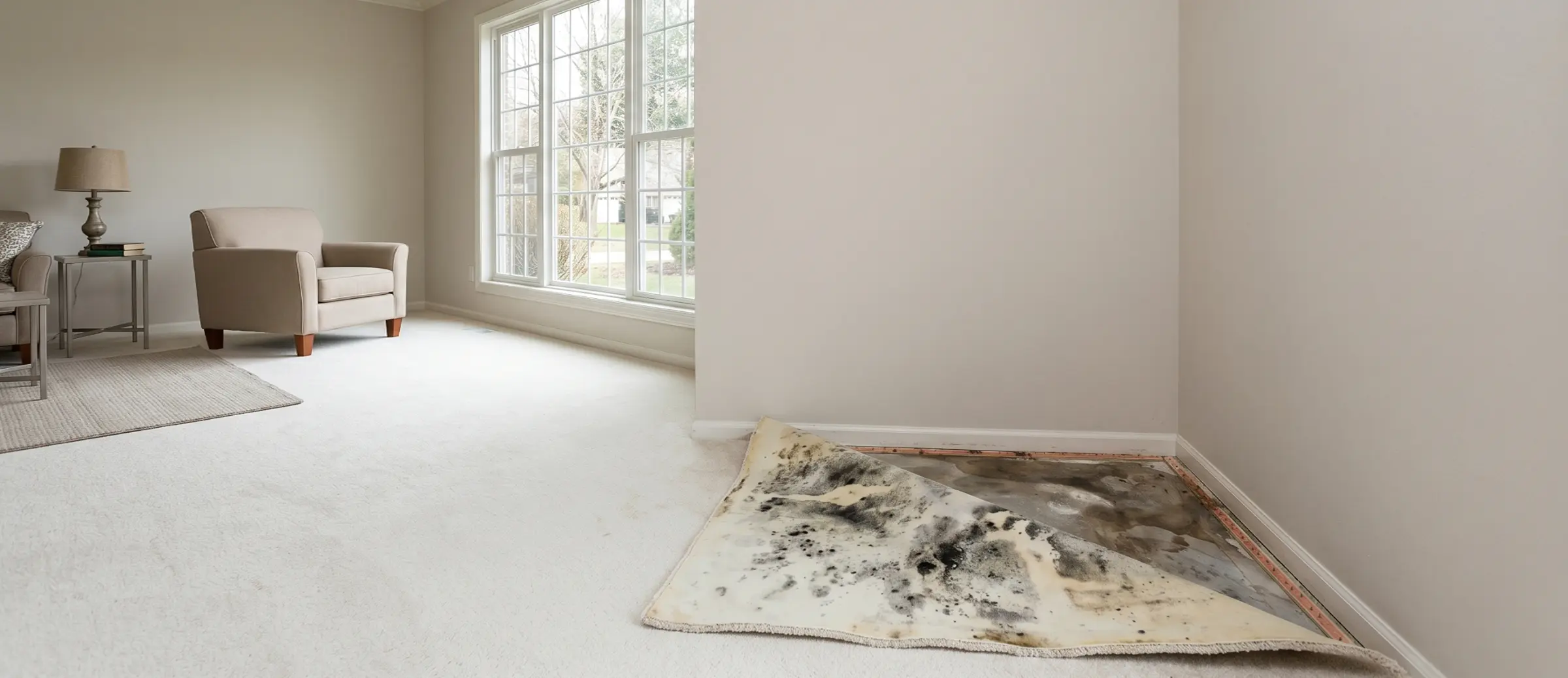

Finding mold on your carpet triggers an immediate and reasonable question: can you clean it, or does it have to go? You are not being oversensitive. Carpet mold is fungal growth that establishes within carpet fibers, backing, padding, and subfloor systems when moisture persists for 24–48 hours or longer, classified under the ANSI/IICRC S520 Standard for Professional Mold Remediation as a porous material remediation scenario requiring assessment before any cleaning or removal begins.
The short answer, supported by both the EPA and the ANSI/IICRC S520 Standard for Professional Mold Remediation, is that moldy carpet is more often a replacement job than a cleaning one. The reason is structural: carpet is a layered, porous system, and by the time mold is visible on the surface, it has almost always penetrated deeper than surface cleaning can reach. This guide covers how to make the save-or-replace call correctly, what removal looks like when cleaning is appropriate, and what professional remediation will cost when it is not.
Key insights
- Mold grows fast. Wet carpet can develop mold colonies within 24–48 hours, per EPA guidance, particularly when humidity exceeds 60% and airflow is limited.
- Surface appearance is misleading. Mold visible on carpet fibers typically indicates more extensive growth in the backing and padding below.
- Padding almost always goes. Even when carpet is borderline salvageable, the underlying pad is nearly always too saturated to clean effectively and must be replaced.
- The EPA is direct about porous materials. The EPA states that absorbent materials such as carpet may have to be thrown away if they become moldy, because mold can fill the empty spaces and crevices of porous materials in ways that make complete removal difficult or impossible.
- The 10-square-foot rule applies. The EPA threshold for professional intervention is 10 square feet of visible mold growth, roughly a 3-foot by 3-foot area.
- Water source determines protocol. Carpet wetted by sewage or floodwater (Category 3 water per IICRC S520) must be replaced regardless of visible mold extent.
Can a moldy carpet be saved?
Most moldy carpet cannot be saved and should be replaced. The EPA explicitly states that absorbent porous materials such as carpet may need to be discarded when they become moldy, because mold can fill the spaces and crevices of porous materials in ways that make complete removal difficult or impossible. The ANSI/IICRC S520 standard reinforces this position for contaminated porous materials.
 Growth this visible on the face fibers almost always means the backing and pad beneath have already been colonized for longer than the surface staining suggests.
The narrow exception is a small, surface-level patch on synthetic carpet caused by a clean water source, where the backing is dry and the padding is unaffected. Outside those specific conditions, the risk of incomplete removal, continued spore release, and recurrence makes replacement the correct call.
Replace the carpet if any of these conditions are true:
- The affected area is larger than 10 square feet
- The moisture source was sewage, floodwater, or gray water (IICRC Category 2 or Category 3 water)
- The padding is wet or visibly moldy when you lift the carpet corner
- The subfloor shows staining, soft spots, or visible mold
- The carpet has been wet for more than 48 hours
- A musty odor persists after the carpet has dried
- Anyone in the household is experiencing worsening respiratory symptoms
Cleaning may be appropriate if all of the following are true:
- The affected spot is under 10 square feet
- The moisture source was clean water (Category 1: burst supply pipe, appliance overflow from a clean source)
- The carpet is synthetic (nylon, polyester, olefin), not natural fiber (wool, cotton, jute-backed)
- The backing is dry to the touch and shows no visible mold when you lift the corner
- The padding beneath is also dry and unaffected
- The carpet was wetted less than 48 hours ago and dried quickly
Even when all six cleaning criteria are met, re-testing is prudent. A moisture meter reading below 15% in the backing and pad before any cleaning confirms true dryness.
How to identify mold on carpet
Mold on carpet appears as dark patches, most commonly green, black, gray, or white, that may look fuzzy, matted, or powdery depending on the species present. The four most reliable indicators are a persistent musty odor, a damp or spongy feel underfoot, unexplained discoloration on the face fibers, and worsening respiratory symptoms in household members that improve when they leave the home. Visible surface growth is the last indicator to appear, not the first: by the time you see discoloration on the face fibers, the backing and padding have typically been colonized for some time.
 A spot that stays consistently soft underfoot even in dry weather points to trapped moisture in the pad, ideal mold conditions well before any growth becomes visible.
The early warning signs of signs of mold in carpet are more often sensory than visual:
Musty or earthy odor. A persistent odor that worsens in humid conditions or when the HVAC runs is caused by microbial volatile organic compounds (MVOCs) produced as mold metabolizes organic material in the carpet fibers, backing, and adhesive. If a room smells musty and you cannot locate the source on walls or ceilings, lift the carpet in a low-traffic corner.
Damp or spongy feel underfoot. If an area of carpet feels consistently soft or damp even in dry weather, moisture is trapped in the pad or beneath the subfloor. This creates ideal mold conditions even before growth is visible.
Unexplained discoloration. Dark or off-color patches that do not correspond to any spill, traffic pattern, or stain should prompt a physical inspection of the backing.
Worsening allergy or respiratory symptoms. If symptoms improve when household members leave the home and worsen when they return, airborne mold spores from carpet are a possible cause. The health effects of mold exposure include nasal irritation, coughing, and worsening asthma.
How to inspect beneath the carpet: Lift a corner or edge in the suspect area and look at the backing directly. Gray, green, or black staining on the backing or pad is mold. Use a flashlight and look for fuzzy or weblike growth. A moisture meter pressed against the subfloor through the lifted area will confirm whether moisture is still present.
Carpet anatomy: why depth matters
Depth matters because carpet is not a single material. It is a four-layer system, and mold can colonize each layer independently, which is why surface cleaning alone fails to eliminate it. A standard wall-to-wall installation consists of face fibers, primary backing, padding, and subfloor, and by the time mold is visible on top, the layers below are almost always already affected.
 Jute backing shown in this second layer is far more mold-prone than the polypropylene used on most synthetic installations, which is part of why fiber type matters for the save-or-replace call.
Face fibers are what you walk on and see. Synthetic fibers (nylon, polyester, olefin) resist mold somewhat because they offer little organic material. Natural fibers (wool, cotton) are significantly more susceptible because they provide both organic material and moisture retention.
Primary backing is the woven or nonwoven base that anchors the face fibers. It is typically polypropylene on synthetic carpets, but many carpets use jute or other organic secondary backings that are highly mold-prone. Mold penetrates the backing quickly and is impossible to clean from the fiber matrix once established.
Carpet padding (cushion) sits between the backing and the subfloor. Foam, rebond, and fiber pads are all porous and absorb moisture aggressively. Padding is almost never salvageable once it has been wetted long enough for mold to establish. Even if the face fibers and backing are cleaned successfully, leaving moldy or saturated pad in place guarantees recurrence. In nearly every carpet mold scenario, padding replacement is required even when the carpet itself is saved.
Subfloor (plywood, OSB, or concrete slab) is the surface the pad sits on. When moisture migrates through the pad, mold can establish on the subfloor surface. On wood subfloors, this means structural wood exposure; on concrete slabs, it means mold on the concrete surface and potential migration into adjacent wall framing. Subfloor involvement changes the job from carpet removal to a broader remediation scope that requires mold testing to confirm clearance.
How to remove mold from carpet (DIY)
Removing mold from carpet yourself is a nine-step process: fix the moisture source, put on PPE, seal off the work area, dry the carpet fully, inspect the backing and pad, apply an EPA-registered antimicrobial product, scrub and extract, HEPA vacuum when dry, then verify with a moisture meter. This process is only appropriate when the affected area is under 10 square feet, the carpet is synthetic, the moisture source was clean water, and the padding is confirmed dry and unaffected.
 This treatment only applies once the backing and pad beneath have been checked and confirmed dry; treating the surface while the layers below stay wet just delays the same problem.
1. Fix the moisture source first
No mold removal is durable without eliminating the moisture cause. Identify whether the source was a plumbing leak, condensation, a spill, or a slow water intrusion. If you cannot confirm the source is fixed, professional moisture investigation is warranted before any remediation begins.
2. Put on appropriate PPE
Wear an N95 or higher respirator (not a dust mask), nitrile gloves, and safety goggles. Mold disturbance releases spores into the breathing zone. Anyone with asthma, allergies, or a compromised immune system should not be present during removal.
3. Isolate the work area
Seal doorways and air returns with 6-mil polyethylene sheeting. Open a window in the work room and position a box fan to exhaust air outward. Turn off the central HVAC system to prevent spore distribution through ductwork.
4. Dry the carpet before treating it
If any moisture remains in the carpet, use a wet vacuum (not a standard vacuum, which will spread spores) to extract as much water as possible. Pull the carpet back from the affected area to expose the pad and subfloor. Run a dehumidifier and fans to dry both sides before applying any treatment.
5. Inspect the backing and pad
With the carpet lifted, inspect the backing, the pad, and the subfloor. If you find mold on any of these surfaces, the job has moved beyond DIY scope. Discard the padding regardless. Even if you proceed with carpet cleaning, the pad should not be reused.
6. Apply an EPA-registered antimicrobial product
Spray the affected area of the carpet face fibers with 3% hydrogen peroxide (standard pharmacy bottle, used undiluted) or an EPA-registered antimicrobial product labeled for carpet use. Allow the solution to dwell for 10–15 minutes. Avoid bleach: it does not penetrate backing, discolors synthetic fibers, and leaves a residue that attracts soil.
7. Scrub and extract
Scrub the treated area with a stiff-bristled brush, working from the outside of the patch inward to avoid spreading spores. Extract the solution immediately with a wet vacuum. Do not over-saturate the carpet during this step.
8. HEPA vacuum when dry
Once the carpet is fully dry, HEPA vacuum the treated area thoroughly. A standard vacuum will recirculate spores; only a HEPA-filtered unit is appropriate. Bag and seal all vacuum contents before disposal.
9. Verify dryness and monitor
Confirm that carpet backing reads below 15% moisture content with a moisture meter before reinstalling and before considering the job complete. Monitor the area over the following two to four weeks for odor or recurrence.
A note on area rugs: small area rugs with confirmed surface-only mold can sometimes be taken outside, cleaned, and dried in direct sunlight (UV exposure suppresses mold). This is a more viable option than attempting the same process with wall-to-wall carpet, where lifting and drying logistics are much more difficult. The California Department of Public Health states that throw rugs wetted by water can be kept only if they can be thoroughly washed and show no musty odor once dry.
When to call a mold remediation professional
Call a professional when mold covers more than 10 square feet, when the padding or subfloor is affected, when the water source was sewage or floodwater, when the carpet has been wet for more than 48 hours, or when household members are experiencing respiratory symptoms. Any one of those conditions makes DIY removal inappropriate and puts the job within the scope of ANSI/IICRC S520-certified remediation.
 Containment like this goes up before any carpet comes out, since pulling contaminated material without it spreads spores well past the original affected room.
Professional mold remediation follows the ANSI/IICRC S520 protocol. For carpet jobs, that typically means containment with polyethylene barriers and negative air pressure, HEPA air scrubbers running continuously during work, controlled removal and bagging of carpet, padding, and any contaminated subfloor material, antimicrobial treatment of the subfloor and framing, and clearance testing before reconstruction. The remediation process is not complete until independent post-remediation testing confirms spore counts have returned to normal background levels.
Professionals have access to moisture meters, thermal imaging cameras, and air sampling equipment that accurately maps the true extent of contamination before removal begins. For confirmed mold after water damage, the professional scope also addresses Category 1, 2, or 3 water classification and adjusts containment and PPE requirements accordingly.
For contractor selection, look for IICRC-certified firms with the Applied Microbial Remediation Technician (AMRT) credential. A full walkthrough of how to evaluate credentials and scope of work is covered under mold remediation. Avoid any contractor who offers to remediate without first performing a moisture assessment, or who discourages independent clearance testing after the work is done.
Carpet mold removal cost
The cost of carpet mold removal depends primarily on the size of the affected area, whether padding and subfloor are involved, and whether a structural restoration contractor is needed in addition to the mold remediator.
 A quote for a job like this should separate padding replacement from any subfloor work, since subfloor involvement is what typically pushes a job from a low estimate into a much larger one.
Padding replacement is almost always required even when the carpet itself is salvageable, which means most professional jobs involve at minimum two material line items: labor and a new pad. When the subfloor is also affected, a second contractor for structural repairs is often necessary, and that coordination adds both time and cost to the total project.
| Scenario | Typical cost | What drives the cost |
|---|---|---|
| DIY surface removal, small area | $50–$150 | PPE supplies, antimicrobial product, wet vacuum rental |
| Professional cleaning, surface mold under 10 sq ft | $300–$600 | Containment, labor, HEPA filtration, disposal |
| Professional removal with padding replacement, 1 room | $800–$2,500 | Removal labor, new padding, carpet reinstallation or replacement |
| Carpet and padding replacement with subfloor treatment | $2,000–$6,000 | Subfloor drying and antimicrobial, replacement flooring material and labor |
| Multi-room or whole-floor mold removal | $4,000–$10,000+ | Scale of containment, labor hours, material volume |
| Subfloor replacement (per sq ft, add-on) | $2.20–$4.75/sq ft | Plywood or OSB removal and reinstallation |
| New carpet and padding installation (per sq ft) | $2–$8/sq ft | Material grade and installation labor |
Labor represents approximately 60% of total professional remediation costs. Subfloor involvement is the largest single cost escalator because it adds structural repair work to the mold removal scope. Geographic location affects labor rates significantly, with coastal and major-metro markets running 20%–40% higher than national averages.
For full context on mold remediation cost, including how size, location, and mold type affect pricing across all materials, the cost section covers the complete national breakdown.
Insurance coverage for carpet mold follows the standard covered-peril doctrine. Mold caused by a sudden, accidental event (burst pipe, appliance failure) is typically covered under HO-3 homeowners policies. Mold from chronic moisture, gradual leaks, flooding, or maintenance neglect is generally excluded. Document the water event with photographs and contact your insurer before beginning any removal work. For a complete breakdown of cause-by-cause mold insurance coverage, including how to file a claim and dispute a denial, the insurance coverage section covers the full framework.
How to prevent mold on carpet
Carpet mold is almost always preventable. Mold cannot establish on dry carpet: the critical variable is moisture control, not the carpet itself. According to NIOSH Publication 2019-115, maintaining indoor relative humidity below 60% is the single most effective measure for preventing mold growth on porous building materials.
 A vapor-barrier pad like this one resists water penetration far better than standard rebond fiber padding, which matters most in basements and any room built on a slab.
The actions below apply year-round, but homes in humid climates and any room below grade require the most consistent attention. A basic hygrometer, available for under $20, is the easiest way to monitor humidity in problem rooms without guesswork.
| Prevention action | Frequency | Why it works |
|---|---|---|
| Maintain indoor humidity at 30%–50% RH | Continuous (monitor with hygrometer) | Mold cannot sustain growth below 60% RH; 30%–50% provides a safety margin |
| Dry wet carpet within 24 hours | Immediately after any wetting event | EPA guidance establishes 24–48 hours as the window before mold colonization begins |
| Use a dehumidifier in basement and below-grade rooms | During humid months (spring through fall) | Below-grade spaces have consistently higher humidity from ground moisture |
| Use moisture-resistant carpet padding in high-risk areas | At installation | Foam or rubber moisture-barrier pads resist water penetration better than rebond fiber pads |
| Fix plumbing and roof leaks immediately | As discovered | Slow leaks below carpet are the most common cause because they go undetected for weeks |
| Vacuum regularly with HEPA filtration | Weekly | Removes organic debris (dust, skin cells) that feeds mold; HEPA captures spores before they settle |
| Avoid wall-to-wall carpet in basements and bathrooms | At installation or renovation | These rooms have structurally higher moisture loads; hard flooring with area rugs is safer |
| Inspect carpet edges quarterly in high-humidity rooms | Every 3 months | Mold typically starts at edges and seams where moisture collects against baseboards |
In basements and rooms built on a concrete slab, consider hard flooring alternatives for any future renovation. Concrete slabs wick ground moisture constantly, and that moisture migrates upward through carpet systems regardless of room ventilation. If carpet is required in these locations, a vapor-barrier pad rated for below-grade use is the most effective preventive measure available at installation.
For a complete room-by-room prevention system, mold prevention covers high-risk areas including basements, bathrooms, crawl spaces, and HVAC systems in full.
Frequently asked questions
Can mold on carpet be cleaned or does it need to be replaced?
Most moldy carpet needs to be replaced, not cleaned. The EPA states that absorbent porous materials such as carpet may have to be discarded when they become moldy. Cleaning may be appropriate only for small spots under 10 square feet on synthetic carpet where the moisture source was clean water and the padding is confirmed dry and unaffected.
What does mold on carpet look like?
Carpet mold usually appears as dark green, black, gray, or white patches that may look fuzzy or powdery. It is often accompanied by a persistent musty odor. Because carpet fibers obscure growth, mold is frequently more extensive than the surface appearance suggests. Lifting a corner to inspect the backing and padding is the most reliable way to assess true spread.
How long does it take for mold to grow on wet carpet?
Mold can establish visible colonies on wet carpet within 24–48 hours under the right conditions, according to EPA guidance. Warm temperatures, limited airflow, and relative humidity above 60% accelerate growth. Carpet padding is especially vulnerable because it retains moisture against the subfloor even after surface fibers appear dry.
What kills mold on carpet?
For small DIY-eligible jobs, 3% hydrogen peroxide (undiluted from a standard pharmacy bottle) or an EPA-registered antimicrobial product labeled for carpet use are the most effective options. Bleach is not recommended: it discolors fibers, does not penetrate backing, and leaves a residue. Vinegar has limited efficacy and no verified kill rate for most mold species at residential concentrations.
Does homeowners insurance cover mold on carpet?
Coverage depends on the moisture source. Mold caused by a sudden accidental event such as a burst pipe or appliance failure is typically covered under standard HO-3 policies. Mold from chronic moisture, flooding, or gradual leaks is usually excluded. Document the water event immediately, stop the source, and contact your insurer before any removal work begins.
Can I stay in my home while moldy carpet is being removed?
For small DIY jobs in a single contained room, it is generally possible to remain in other parts of the home with the work area sealed. For professional remediation involving full carpet removal, demolition, or multi-room scope, temporarily relocating reduces spore exposure risk, especially for children, the elderly, and anyone with asthma or respiratory conditions. The full decision framework for staying home during remediation covers the range of scenarios by job size and household health profile.
Sam Hickerson is the founder of RestoreAdvisor and writes consumer guides on mold remediation, water damage restoration, inspection, testing, and home recovery. His work focuses on helping homeowners understand costs, risks, and when to call a professional. He draws on guidance from the EPA, CDC, IICRC, and other authoritative sources to make complex home issues easier to navigate.