
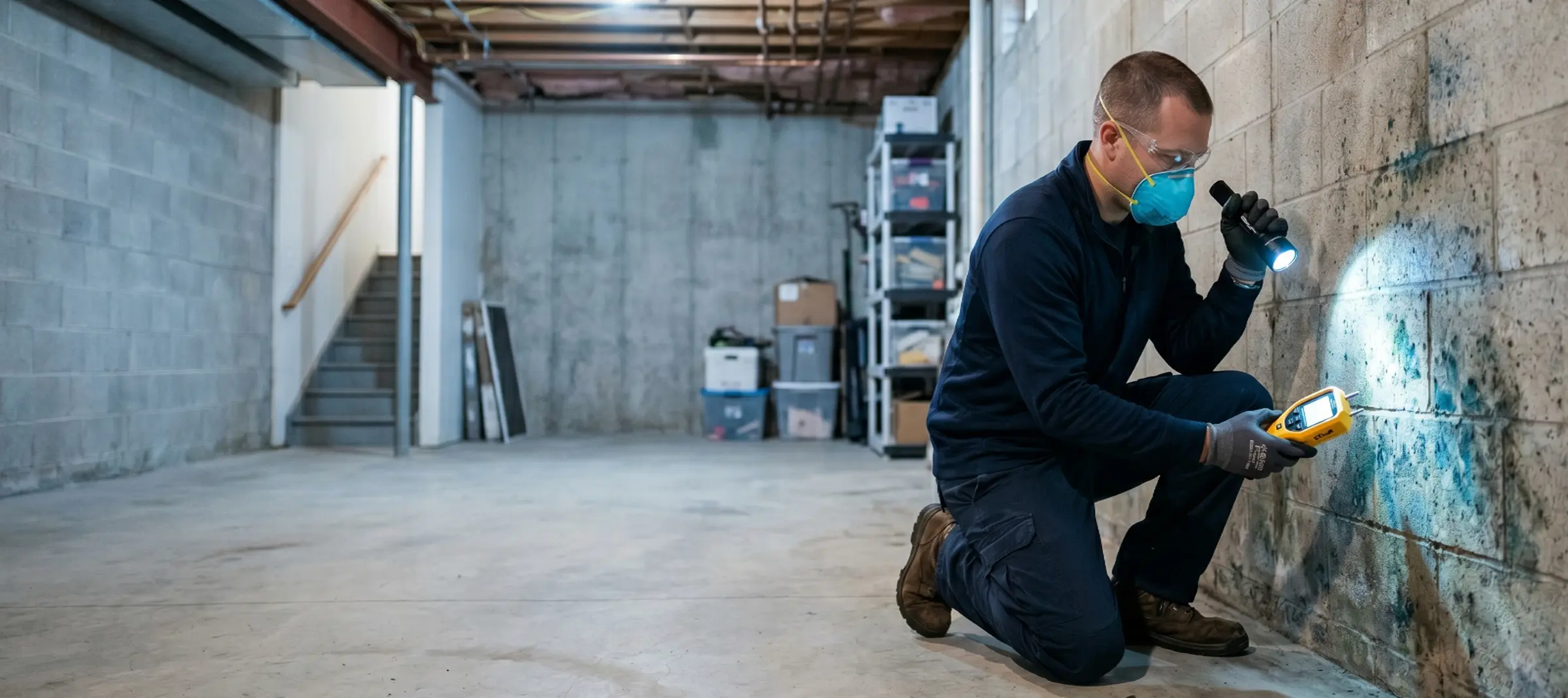

You found something blue-green and fuzzy growing somewhere it should not be. Maybe it's on a wall behind furniture, in the corner of a basement, or on water-damaged insulation in the attic. Penicillium is a genus of over 300 mold species classified by the CDC as one of the three most common indoor molds in the United States, recognized under ANSI/IICRC S520 as a water-damage-associated fungus that colonizes porous building materials and can produce mycotoxins harmful to human health. It needs less moisture than most other species to get started, and once established it spreads quickly through airborne spores.
If you are not yet certain whether what you see is mold at all, common signs of mold in your home include discoloration patterns, musty odor, and surface texture differences that help distinguish mold from water staining or efflorescence before you arrange testing.
Key insights
- One of the most common indoor molds. The CDC lists Penicillium among the three most frequently found mold genera in U.S. homes, alongside Cladosporium and Aspergillus.
- Lower moisture requirements than most molds. Penicillium can colonize surfaces at around 80% relative humidity, a level that other hazardous molds like Stachybotrys cannot. Keeping indoor RH consistently below 50% prevents growth.
- More than 300 species exist. Most share blue-green coloration and a powdery texture, but visual identification cannot confirm species. Lab testing is required to distinguish Penicillium from Aspergillus.
- Spreads rapidly. Penicillium produces large quantities of airborne spores, which is why a colony on water-damaged insulation can migrate to adjacent rooms quickly.
- Some species produce dangerous mycotoxins. Ochratoxin A (nephrotoxic), patulin (gastrointestinal and immune effects), and citrinin (additional kidney toxicity) are produced by specific Penicillium species under certain conditions.
- High-risk populations face the most serious consequences. Infants, people with asthma, immunocompromised individuals, and the elderly should be relocated during any remediation involving Penicillium.
What Penicillium mold looks like
Penicillium is most recognizable by its blue-green to teal coloration and a powdery or velvety surface texture that distinguishes it from slimier molds like Stachybotrys. Colonies typically form circular patches that expand outward from the initial growth point, with a white or pale yellow fringe at the leading edge of active growth. The underside of a colony is usually pale yellow, tan, or white. Some species appear more yellow-green or olive, and a small number present as entirely white when very young, before pigmentation develops fully.
 The white fringe marking active growth here is nearly identical to Aspergillus under visual inspection, which is why lab analysts group both genera together as "Asp/Pen" on air sampling reports.
The name Penicillium comes from the Latin word for paintbrush, a reference to the brush-like arrangement of spore-bearing structures visible under a microscope. Visually, however, Penicillium is nearly indistinguishable from Aspergillus. Both genera produce similar colors, textures, and spore sizes, and are routinely grouped as "Asp/Pen" in air sampling reports because analysts cannot differentiate their spores under a light microscope. Air sampling or surface swab testing processed by an accredited laboratory is the only reliable way to confirm genus and species.
If you see a musty-smelling blue-green patch expanding across a water-stained surface, Penicillium should be near the top of your list.
Penicillium species found indoors
Penicillium encompasses over 300 described species, but six account for the majority of residential contamination cases in the United States: P. chrysogenum, P. verrucosum, P. expansum, P. citrinum, P. brevicompactum, and P. crustosum. These species differ meaningfully in their preferred surfaces, moisture thresholds, and mycotoxin production.
Species identification matters because mycotoxin risk is not uniform across the genus. P. verrucosum produces ochratoxin A, one of the most studied nephrotoxic mycotoxins, while P. chrysogenum, far more common in U.S. homes, is primarily an allergen. Knowing which species you are dealing with helps calibrate the urgency of removal and the level of protection needed during the process.
| Species | Appearance | Common indoor locations | Mycotoxins | Risk level |
|---|---|---|---|---|
| P. chrysogenum | Blue-green, powdery | Water-damaged drywall, wallpaper, fabric | Moderate toxins, highly allergenic | Moderate |
| P. verrucosum | Olive-green, granular | Stored materials, damp basements | Ochratoxin A | High |
| P. expansum | Blue-green, velvety | Food, wood, stored organic materials | Patulin | Moderate-high |
| P. citrinum | Yellow-green, powdery | Building materials, insulation | Citrinin | Moderate |
| P. brevicompactum | Olive-gray, velvety | Damp wallpaper, chipboard, insulation | Mycophenolic acid | Moderate |
| P. crustosum | Blue-green, dense | Food, cool damp environments | Penitrem A (neurotoxic) | High if ingested |
P. chrysogenum is the species most commonly found in water-damaged U.S. homes. It produces the penicillin antibiotic that transformed medicine, but its allergenic properties and moderate toxin production make it a genuine health concern when growing indoors at scale. P. verrucosum is the species of greatest concern for kidney health, producing ochratoxin A, a mycotoxin classified by the WHO as a nephrotoxin and probable human carcinogen; unlike P. chrysogenum, it has been isolated in heavily contaminated buildings, not just food stores. Deeper clinical context on how these species affect different household populations is covered in is mold dangerous.
Where Penicillium grows in your home
Penicillium grows in any indoor location where moisture meets an organic surface, including insulation, drywall, wallpaper, carpet, wood framing, HVAC ductwork, and stored organic materials such as cardboard or fabric. Unlike molds that require saturated conditions, Penicillium can colonize surfaces at 80% relative humidity, which is a threshold many other hazardous indoor molds cannot reach. A home with routine humidity fluctuations, not just one with visible water damage, can support active growth.
 Growth this established can establish at just 80% relative humidity, a threshold many other hazardous indoor molds can't reach, which is why a home that only feels slightly damp can still support it.
Homes that have experienced a water event are at elevated risk because mold after water damage can begin establishing within 24–48 hours, and Penicillium is consistently among the first genera to colonize. This is partly because of its low moisture threshold and partly because it produces spores in large quantities that are already present in most indoor environments, waiting for the right conditions. A slow pipe drip behind a wall or a single flooding event that is not fully dried within 48 hours is enough to trigger an established colony.
| Location | Primary cause | What to look for | DIY or pro |
|---|---|---|---|
| Insulation (attic, basement, crawl space) | Moisture intrusion, condensation | Blue-green staining, musty odor in adjacent spaces | Pro: porous material |
| Wallpaper and drywall | Plumbing leaks, flooding, high humidity | Discoloration, bubbling, visible surface growth | Pro if drywall is affected; DIY for surface paint only |
| HVAC ductwork and air handler | Condensate moisture, low airflow | Musty odor from vents, visible growth at registers | Pro: NADCA/IICRC protocols required |
| Carpet and padding | Flooding, plumbing leaks | Discoloration, persistent musty smell, respiratory symptoms | Pro: carpet and padding must be replaced |
| Fabrics and upholstered furniture | High indoor humidity, direct moisture | Surface discoloration, musty smell | Pro if structural; small items may be discardable |
| Wood framing and subflooring | Leaks, flooding, crawl space moisture | Blue-green staining on wood grain surface | Pro if structural framing is involved |
| Stored organic materials (cardboard, paper) | Any moisture exposure | Visible growth, softening of material | DIY: remove and discard contaminated items |
| Food and pantry goods | Normal moisture + organic substrate | Visible blue-green growth on food | DIY: discard food, clean shelves, investigate moisture |
Penicillium's ability to colonize insulation is particularly significant. Fiberglass and cellulose insulation both provide enough organic debris to support growth, and once established in insulation, Penicillium spores are continuously distributed through HVAC airflow into living spaces, producing whole-home symptoms from a single localized source. Homes in climates with high summer humidity are disproportionately affected because ambient humidity and mold conditions interact: every percentage point of RH above 60% meaningfully expands the number of surfaces Penicillium can colonize.
Health risks of Penicillium exposure
Penicillium exposure causes health problems through three mechanisms: IgE-mediated allergic reactions, direct irritant effects from inhaled spores and fragments, and mycotoxin exposure in species that produce them. The CDC: Basic Facts About Mold identifies Penicillium as one of the most common indoor mold genera and notes that exposure can cause stuffy nose, coughing or wheezing, and skin rash, with more severe reactions in people with mold allergies or asthma.
For most healthy adults, low-level exposure produces irritant symptoms: nasal congestion, sneezing, runny nose, itchy or watery eyes, and mild coughing. These symptoms resemble seasonal allergies and often improve when the person leaves the home and worsen on return, which is a clinically useful pattern for identifying mold as the cause.
 Symptoms this persistent in an elderly household member carry higher risk than the same presentation in a healthy adult, given age related vulnerability to hypersensitivity pneumonitis and pneumonia.
For people with mold allergies, asthma, or compromised immune systems, the consequences are more serious. Research published in the American Journal of Respiratory and Critical Care Medicine and funded by the National Institute of Environmental Health Sciences found that household Penicillium was associated with increased peak expiratory flow variability in asthmatic children, indicating worsened airway control. Separately, NIOSH has documented hypersensitivity pneumonitis in workers exposed to Penicillium from contaminated ventilation systems. This condition, sometimes called "farmer's lung" in occupational contexts, involves immune-mediated lung inflammation that can become chronic if exposure continues.
| Population | Common symptoms | Serious conditions | Risk level |
|---|---|---|---|
| Healthy adults | Congestion, sneezing, mild cough | Chronic sinusitis with prolonged exposure | Low-moderate |
| Mold-sensitized individuals | Allergic rhinitis, skin rash, watery eyes | Asthma exacerbation, allergic sinusitis | Moderate-high |
| Children (especially infants) | Coughing, wheezing, respiratory infections | Asthma development, increased exacerbations | High |
| Asthma patients | Wheezing, chest tightness, shortness of breath | Severe asthma attacks, ABPA | High |
| Weakened immune systems individuals | Any of the above, more severe | Pulmonary infection, systemic infection | Very high |
| Elderly | Respiratory irritation, fatigue | Pneumonia, hypersensitivity pneumonitis | High |
Mycotoxin exposure is the most serious health concern specific to Penicillium. Ochratoxin A, produced primarily by P. verrucosum, is classified by the WHO as a nephrotoxin with probable human carcinogenicity. Animal studies demonstrate consistent kidney damage from ochratoxin A exposure; the clinical picture in humans is less fully characterized but includes associations with chronic kidney disease and urinary tract cancers. Patulin, produced by P. expansum and related species, is acutely toxic at high doses and a suspected carcinogen. Citrinin, from P. citrinum, also targets the kidneys. These mycotoxins are more commonly associated with food contamination than airborne inhalation, but building-related exposure is documented, particularly in heavily contaminated environments.
Penicillium sensitization is measurable: a study funded by the National Institute of Environmental Health Sciences found that sensitized children exposed to even low indoor Penicillium levels had significantly increased peak expiratory flow variability, a marker of worsened asthma control. Clinical depth on symptom progression, diagnostic testing, and treatment is covered in mold exposure symptoms.
DIY removal vs. professional remediation
Penicillium removal is a DIY job only when the affected area is under 10 square feet, on a non-porous surface, and in a home with no high-risk occupants. Any growth larger than that, any growth on porous materials such as drywall or insulation, and any HVAC involvement requires professional remediation following ANSI/IICRC S520 standards. Contamination level classifications and the full criteria for when mold remediation is required determine whether a job falls within DIY scope or professional territory.
 A patch this size only qualifies for DIY if the baseboard surface is non-porous; painted drywall this close to a floor joint often means the paper backing is already contaminated too.
For Penicillium specifically, the porous material rule matters more than for some other genera. Because Penicillium spreads rapidly and penetrates porous substrates like insulation, drywall paper, and carpet backing quickly, what appears to be a surface patch often reflects deeper contamination. Cleaning the visible surface without removing the affected material leaves viable spores and mycelium in place, and regrowth is the predictable result.
| Factor | DIY appropriate | Call a professional |
|---|---|---|
| Size | Under 10 sq ft | 10 sq ft or larger |
| Surface type | Non-porous (tile, glass, sealed concrete) | Porous (drywall, insulation, carpet, wood) |
| Location | Accessible surface in a ventilated room | Inside walls, HVAC, attic, crawl space |
| Household health | All adults, no respiratory conditions | Anyone with asthma, immune issues, or infants present |
| Recurrence | First occurrence | Has returned after previous removal |
| Moisture source | Identified and corrected | Unknown or cannot be corrected |
| Odor | Limited to visible area | Musty smell from other rooms or vents |
When in doubt, an independent mold inspection is the most cost-effective next step. An inspector can use moisture meters, thermal imaging, and air sampling to map the full extent of contamination before any work begins, which prevents under-scoping a job and paying twice.
How Penicillium mold is removed
The professional remediation process for Penicillium follows ANSI/IICRC S520 protocols and does not differ fundamentally from remediation of other mold genera, with one important note: because Penicillium spreads readily through airborne spores, containment and negative air pressure are particularly important.
 Negative air pressure matters more on a job like this than for many other genera, since Penicillium's high spore production spreads faster once framing this contaminated gets disturbed.
1. Inspection and moisture mapping
A certified AMRT contractor uses moisture meters and, where warranted, thermal imaging cameras to identify all affected materials and the moisture source driving growth. The scope of work is written before any removal begins.
2. Source moisture correction
The plumbing leak, roof leak, HVAC condensation issue, or other moisture source is repaired before mold removal begins. Skipping this step makes remediation temporary.
3. Containment and negative air pressure
The work zone is isolated with 6-mil polyethylene sheeting. Negative air machines with HEPA filtration run throughout the job, exhausting contaminated air outside the building and preventing spores from migrating to unaffected areas.
4. Removal of porous materials
Contaminated insulation, drywall, carpet, carpet padding, and other porous materials are removed, double-bagged in 6-mil poly bags, and disposed of per local regulations. No attempt is made to clean these materials in place.
5. Cleaning of non-porous surfaces
Remaining non-porous surfaces in the affected area are HEPA-vacuumed, cleaned with a registered antifungal agent or detergent, and then wiped down. Structural wood framing that cannot be removed may be cleaned, treated with a fungicide or encapsulant, and allowed to dry to below 16% moisture content.
6. HEPA air scrubbing
Air scrubbers with HEPA filtration run during and after the removal phase to capture airborne spores disturbed by the work.
7. Post-remediation clearance testing
An independent inspector (not the remediation company) conducts post-remediation clearance testing using air samples or surface swabs. Results are compared against outdoor baseline levels. Work is not complete until clearance is achieved. Mold remediation oversight belongs to a separately credentialed assessor, a requirement in some states and best practice everywhere.
For professional mold remediation, IICRC-certified contractors with the Applied Microbial Remediation Technician (AMRT) credential should be the baseline requirement. Verify credentials through the IICRC Global Locator before signing any contract. A certified crew will follow a documented containment, removal, and clearance sequence that gives you objective verification the job is complete.
Penicillium mold removal cost
Professional Penicillium removal costs are determined by the size of the affected area, the materials involved, and the location. The numbers below reflect typical ranges for residential jobs; HVAC involvement and structural wood replacement can push costs above the standard range.
 A scope like this should specify which materials get removed versus cleaned in place, since that distinction is the single biggest driver between a $1,000 job and a $5,000 one.
The single biggest cost variable is whether porous materials need to be removed. A surface-only job on sealed concrete or tile costs a fraction of what a job involving contaminated insulation, drywall, or subflooring will run, because material removal and disposal add both labor time and tipping fees that compound quickly at larger scales.
| Scope | Typical cost | What drives the cost | Timeframe |
|---|---|---|---|
| Small surface patch (under 10 sq ft) | $500–$1,000 | Containment, labor, clearance testing | 1 day |
| Medium infestation (10–50 sq ft) | $1,000–$3,000 | Material removal, containment, clearance | 2–3 days |
| Large infestation (50–100 sq ft) | $2,500–$5,000 | Extensive drywall/insulation removal, drying | 3–5 days |
| Whole-room or multi-room | $4,000–$10,000+ | Full material removal, structural treatment | 5–10 days |
| HVAC system involvement | $600–$10,000+ | Component cleaning or replacement, duct work | Variable |
| DIY (under 10 sq ft, non-porous) | $50–$150 | Respirator, gloves, cleaning products | Half day |
These figures align with the national averages covered in the mold remediation cost section. The cost per square foot typically runs $10–$25 for standard remediation; HVAC work, attic jobs, and crawl space access drive per-square-foot costs higher due to labor and access complexity.
Clearance testing is a line item many homeowners overlook. Independent post-remediation testing typically costs $200–$500 and should always be conducted by a party separate from the remediation contractor. Without it, you have no objective verification that the job is complete.
Insurance coverage for Penicillium removal depends entirely on the cause of the moisture that enabled growth. Sudden and accidental water events, such as a burst pipe, are typically covered under standard HO-3 policies. Gradual leaks, high humidity, and flooding require either an endorsement or separate flood insurance.
How to prevent Penicillium from returning
Keeping indoor relative humidity consistently below 50% is the most effective single measure for preventing Penicillium, which can colonize surfaces at RH levels as low as 80%, well within the range of a home that feels only slightly damp. Because Penicillium needs less moisture than most other indoor molds, passive prevention is not enough; active monitoring with a hygrometer and prompt repair of any moisture source are both required.
 A check like this catches the slow condensation streaks that Penicillium needs just 24 to 48 hours to colonize, well before the same moisture would register as a problem to most other mold species.
Unlike Stachybotrys, which requires sustained saturation over weeks, Penicillium can establish within 24–48 hours of a moisture event on a surface that dries quickly afterward. This means a single slow roof drip or a condensation streak on an uninsulated pipe can be enough to start a colony that then spreads via HVAC before the source is identified.
| Prevention action | Frequency | Why it works for Penicillium |
|---|---|---|
| Maintain indoor RH between 30%–50% | Ongoing (monitor with hygrometer) | Penicillium requires ~80% surface moisture to colonize; lower ambient humidity starves growth before it starts |
| Run exhaust fans during and 30 min after cooking/bathing | Every use | Removes humidity spikes that create surface moisture conditions sufficient for Penicillium |
| Inspect and change HVAC filters | Every 1–3 months | Clogged filters reduce airflow, increasing condensate moisture around coils where Penicillium establishes |
| Inspect insulation in attic, basement, and crawl space | Annually | Insulation is the most common site for large Penicillium infestations that go undetected longest |
| Fix plumbing leaks within 24–48 hours | On discovery | IICRC S520 guidance: mold can establish within 24–48 hours of a moisture event |
| Remove or seal organic materials in storage areas | Annually | Cardboard, paper, and fabric provide substrate; stored materials should be in sealed plastic bins |
| Clean condensate drain pans and HVAC drip lines | Twice yearly (spring/fall) | Clogged drain pans are a primary Penicillium growth site in HVAC systems |
| Use mold-resistant drywall and insulation in renovations | At installation | Products rated ASTM D3273 Class 1 significantly reduce substrate availability in high-moisture areas |
Inspection matters as much as humidity control. Penicillium growing in attic insulation or behind a bathroom wall can release spores into living spaces for months before visible signs appear elsewhere. An annual walk-through with a moisture meter in areas where leaks or condensation are plausible catches growth at the colony stage, before it requires full professional remediation.
Consistent mold prevention practices address Penicillium alongside the full range of common indoor molds. Households with asthmatic members face compounded risk, since indoor Penicillium exposure is directly associated with increased airway reactivity and asthma exacerbations in children.
Frequently asked questions
Is Penicillium mold dangerous?
Yes, particularly for sensitive populations. Penicillium triggers allergic reactions and respiratory symptoms in many people. Certain species produce mycotoxins including ochratoxin A, which the WHO classifies as nephrotoxic and a probable carcinogen, and patulin, which is toxic to mammals at high doses. For healthy adults in low-exposure situations the risk is primarily irritant-level; for people with asthma, infants, immunocompromised individuals, or the elderly, the risk is meaningfully higher.
What does Penicillium mold look like?
Penicillium typically appears blue-green, teal, or occasionally yellow-green with a powdery or velvety surface texture. Colonies start circular and expand outward. The colony's underside is usually pale yellow, tan, or white. It is visually nearly identical to Aspergillus, so lab testing is needed to confirm identification.
Where does Penicillium grow in a house?
Penicillium most commonly grows on water-damaged insulation, wallpaper, drywall, carpet, and HVAC ductwork. It can also colonize organic materials such as food, fabrics, and stored paper products. It needs less moisture than most other indoor molds, which is why it can appear in areas that do not seem particularly wet.
Can I remove Penicillium myself?
Yes, in limited circumstances. Patches under 10 square feet on non-porous surfaces, in households where no one has respiratory conditions or immune issues, can be addressed with careful DIY removal following EPA protocols. Any growth on porous materials, inside walls, or in HVAC systems requires professional mold remediation by a contractor certified to the IICRC S520 standard.
How do I know if I have Penicillium vs. another mold?
You cannot confirm Penicillium by sight alone. Blue-green color and powdery texture are strong indicators, but Aspergillus looks nearly identical under visual inspection. Lab analysis of an air sample or surface swab is required to confirm genus and species. Mold testing by an accredited laboratory is the only reliable approach.
How much does Penicillium mold removal cost?
Professional removal typically runs $500–$6,000 for most residential jobs depending on the size and location of the infestation. HVAC involvement or large structural contamination can exceed that range. DIY supplies for an eligible small patch cost $50–$150. Independent clearance testing adds $200–$500 to any professional job and should always be included.
Does Penicillium mold spread fast?
Yes. Penicillium is among the fastest-spreading indoor molds because of its low moisture threshold and high spore production. A colony on water-damaged insulation can release enough spores to establish secondary colonies in adjacent spaces within days, especially in homes with forced-air HVAC systems.
Can Penicillium grow in HVAC systems?
Yes. Penicillium is one of the most common mold genera found in HVAC ductwork and air handlers. Evaporator coils, condensate drain pans, and porous duct liner materials are primary growth sites. HVAC-related Penicillium requires professional remediation following IICRC S520 and NADCA ACR standards; DIY cleaning of ductwork is not appropriate.
Sam Hickerson is the founder of RestoreAdvisor and writes consumer guides on mold remediation, water damage restoration, inspection, testing, and home recovery. His work focuses on helping homeowners understand costs, risks, and when to call a professional. He draws on guidance from the EPA, CDC, IICRC, and other authoritative sources to make complex home issues easier to navigate.