
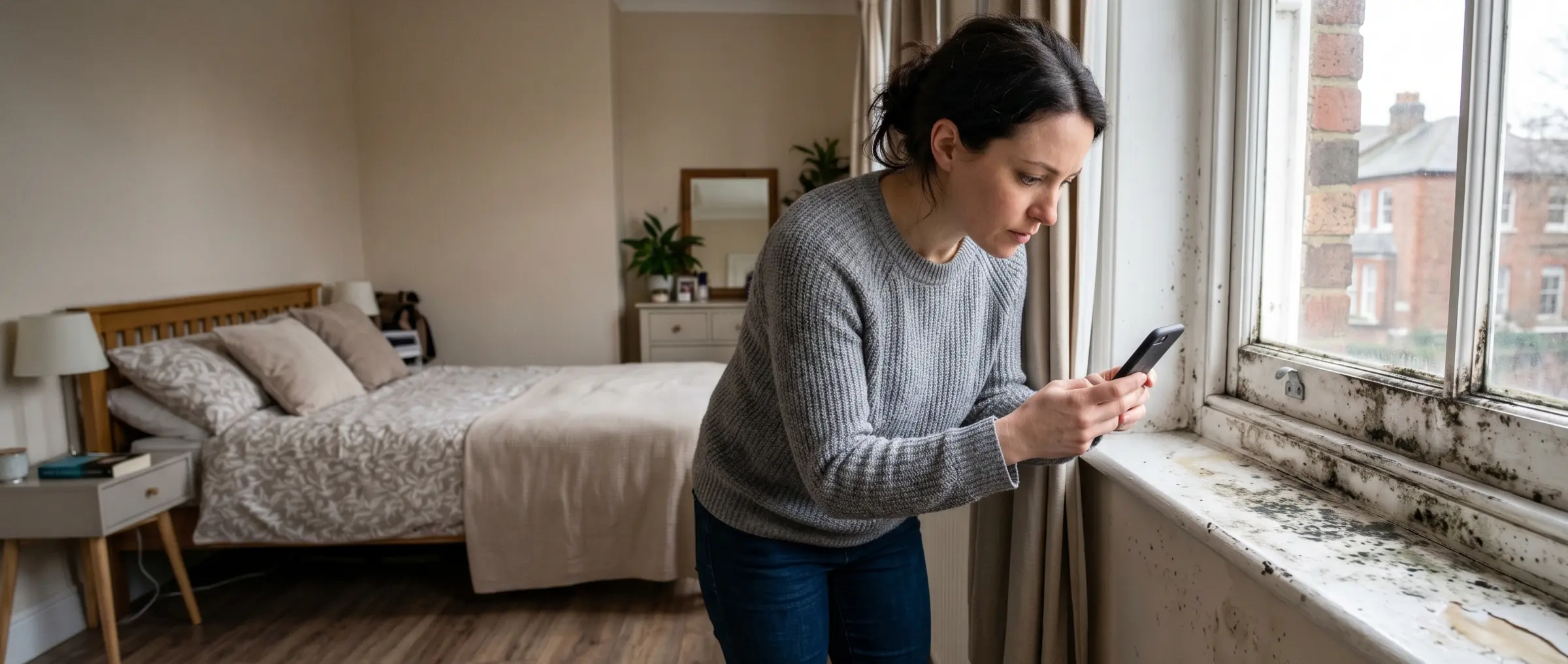

Finding mold in your rental is stressful, and the first question renters ask is almost always the same: is this my problem, or my landlord's? The answer matters because professional mold remediation can cost $1,500–$6,000 or more, and someone has to pay for it. It also matters for your health: the CDC advises that the presence of visible mold or mold odor in a building poses a health threat regardless of species.
Mold remediation for renters is governed primarily by the implied warranty of habitability, a legal doctrine recognized in every U.S. state that requires landlords to maintain rental units in a livable and safe condition throughout the tenancy. No federal mold statute exists, but this habitability framework, combined with a growing number of state-specific mold laws, gives tenants meaningful legal leverage when a landlord refuses to act. This guide explains exactly who is responsible, what the law requires, how to report it correctly, and what your options are if your landlord does nothing.
Key insights
- No federal mold standard exists. Landlord mold responsibility is governed by state habitability law and, in a handful of states, specific mold statutes.
- The implied warranty of habitability covers mold. Courts in every state have ruled that significant mold growth connected to a building defect constitutes an uninhabitable condition.
- Written notice to your landlord is the required first step. Before pursuing any legal remedy (rent withholding, lease termination, or a lawsuit) you need documented written notice on file.
- The moisture source determines who pays. If mold grew from a structural defect (leaking pipe, roof, HVAC), the landlord is responsible. If it grew from tenant behavior (never using exhaust fans, blocking vents), the tenant may share or bear the cost.
- Five-plus states have specific mold statutes including California, Texas, New York, New Jersey, Maryland, Indiana, and Montana. All other states rely on general habitability law.
- Professional remediation per ANSI/IICRC S520 requires clearance testing. As a tenant, you are entitled to a written clearance report confirming contamination has been removed before you return to the space.
Who is legally responsible for mold in a rental
In rental mold disputes, the landlord bears legal responsibility when the moisture source is a building defect the landlord is obligated to maintain: a plumbing leak, roof failure, inadequate ventilation, or HVAC malfunction. This duty flows from the implied warranty of habitability, a legal obligation in every U.S. state requiring that a rental remain fit for human occupation throughout the tenancy. The EPA guidance on mold cleanup is clear that controlling moisture is the only practical way to control mold, so the party responsible for fixing the moisture source bears responsibility for the resulting mold. If a landlord ignores a reported leak and mold follows, liability is clear.
 Whether this conversation resolves anything often comes down to the moisture source behind it; a structural defect like this window seal is the landlord's obligation regardless of how the discussion goes.
What the warranty of habitability covers
The warranty of habitability is an implied promise in every residential lease, written or oral, that the dwelling will remain livable throughout the rental period. It is not waivable by lease language; a clause in your lease stating "tenant accepts the unit as-is" does not eliminate this obligation under state law.
Courts have consistently held that significant mold growth breaches the warranty of habitability when it threatens health or safety. The standard is not perfection; a small patch of bathroom mildew on a tile grout line that can be wiped off generally does not rise to a habitability violation. Mold covering more than a few square feet, mold that returns repeatedly despite cleaning, mold hidden behind walls or under flooring, or mold producing strong odors are all signs of mold that courts treat as uninhabitable conditions. These typically meet the threshold used to define a habitability violation.
The federal Department of Housing and Urban Development (HUD) Housing Quality Standards, which govern federally assisted housing, classify mold and dampness as deficiencies that must be corrected before a unit passes inspection. Tenants in HUD-assisted housing have an additional federal enforcement channel available through their local public housing authority.
When the tenant is responsible for mold
A tenant is responsible for mold costs when their own behavior created or allowed the moisture condition that caused it, not when the source was a building defect the landlord controls.
 A leak left unreported for months like this one weakens a tenant's legal position significantly, since most leases require prompt reporting of exactly this kind of maintenance issue.
A tenant may be fully or partially responsible for mold remediation costs when:
- The tenant failed to report a known water leak, allowing it to continue until mold developed
- The tenant consistently blocked ventilation or failed to use bathroom exhaust fans, creating chronic moisture buildup
- The tenant's use of the space introduced excessive moisture without reasonable mitigation (for example, operating a humidifier without monitoring indoor RH)
- The tenant ignored a landlord's written request to improve ventilation or reduce indoor humidity
- The tenant damaged plumbing or caused a water intrusion that led to mold
Most leases require tenants to report maintenance concerns in writing. If you knew about a dripping pipe under the sink for six months and never told your landlord, the fact that mold grew there weakens your legal position significantly. This matters most when the mold in question is black mold, where remediation costs and liability stakes are highest.
State mold laws for renters
Most states handle mold through general habitability law rather than dedicated mold statutes, but eight states and jurisdictions have passed specific legislation setting disclosure requirements, remediation timelines, or licensing rules. Your state's framework determines which deadlines apply and what enforcement channels are available.
 Only a handful of states have dedicated mold statutes; for the rest, what this research actually turns up is how courts in that state have interpreted general habitability law case by case.
The table below covers the eight states and jurisdictions with the most significant mold-specific legislation. If your state is not listed, habitability law still applies and courts in every state have ruled mold a covered condition. The difference is that without a specific statute, timelines and remedies are determined case by case rather than by fixed legal deadlines.
| State | Framework | Key provisions | Tenant remedies |
|---|---|---|---|
| California | Toxic Mold Protection Act (2001); SB 655 (2016); mandatory booklet at lease signing (2022) | Written disclosure if landlord knows of mold; visible mold is a substandard housing condition; landlord must remediate and fix moisture source | Rent withholding, repair-and-deduct up to 1 month's rent, lease termination, damages |
| Texas | Property Code § 92.058–92.061 | Landlord must remediate visible mold within 7 days of written notice; disclosure of past remediation over $1,000 required | Lease termination, rent reduction, damages, attorney's fees |
| New York | Labor Law §§ 930+; NYC Local Law 55; NYC Admin. Code § 24-154 | NYC: 10+ sq ft requires licensed professionals; assessor and remediator must be separate entities; buildings 10+ units require licensed remediation | Rent withholding, HPD complaint, civil court damages |
| Maryland | Tenant Mold Protection Act (eff. July 1, 2025); Tenant Safety Act (2024) | Written assessment notification; specific remediation timelines; written results to tenant; mold booklet at lease signing | Rent abatement presumed without landlord proof; actual damages; lease termination |
| Colorado | C.R.S. § 38-12-503 | Containment required within 72 hours of notice; moisture correction, decontamination, or removal required | Rent withholding (into escrow), lease termination, damages |
| New Jersey | Administrative Code 5:10-27 | Mold classified as substandard condition; landlord must remediate | Rent withholding, habitability complaints to DCA |
| Montana | Mold Disclosure Act (2003) | Landlord must disclose known mold at lease signing | Civil claims for non-disclosure |
| Indiana | State code addresses mold under habitability; specific guidelines for multi-family housing | Landlord must respond within reasonable time after notice | Rent withholding with escrow, damages |
| All other states | Implied warranty of habitability | Courts interpret mold as habitability violation case by case | Vary by state; consult a local tenant attorney |
Even in states without specific mold statutes, the warranty of habitability gives tenants meaningful legal standing.
How to document and report mold to your landlord
To document mold in a rental, take date-stamped photos and video of all visible growth and moisture sources, note when you first observed the problem, and send written notice to your landlord by email or certified mail before taking any other action. Without this written record, landlords frequently deny knowledge of the problem or dispute the timeline, and no legal remedy is available until notice is on file.
 Wide shots showing location relative to walls and fixtures matter as much as close-ups like this one, since they establish scale and placement that a single tight photo can't capture.
1. Photograph and video everything
Take date-stamped photos and video of all visible mold, including close-up shots showing texture and color, and wide shots showing location relative to walls, floors, and fixtures. Photograph any related moisture indicators: water stains, bubbling or peeling paint, warped baseboards, wet walls, or standing water. Document the square footage as best you can. Save everything to a cloud backup immediately.
2. Note the timeline in writing
Write down when you first noticed the mold, any prior water events in the unit (leaks, flooding, condensation), and any maintenance requests you have already submitted. If you have previous communications with your landlord about water or plumbing issues, pull those records together now.
3. Send written notice to your landlord
Written notice is required before you can pursue any legal remedy in most states. Send a clear, factual message identifying the location of the mold, the approximate area affected, any known or suspected moisture source, and a request for remediation and inspection. Email creates a time-stamped record. For serious situations or if your lease requires formal notice, send a letter via certified mail with return receipt so you have proof of delivery. Keep a copy.
4. Set a reasonable response deadline
Your notice should state when you expect a response. Most states use "reasonable time" as the standard, which courts typically interpret as 7–30 days depending on severity. If occupants are experiencing mold exposure symptoms such as respiratory irritation or worsening asthma, note that the situation is urgent and request a response within a specific number of days.
5. Continue documenting after notice
If your landlord does not respond or responds but takes no action, document that too. Log dates of calls, texts, and emails. A mold inspection by a qualified professional creates a neutral third-party record that documents moisture meter readings, affected areas, and spore conditions, all of which become useful evidence if the dispute continues.
What proper mold remediation in a rental looks like
Proper mold remediation in a rental must include five elements per IICRC S520: moisture source correction, containment, physical removal of contaminated materials, HEPA vacuuming and surface treatment, and post-remediation clearance testing by an independent assessor. A contractor who skips any of these steps is not performing standard remediation:
 This testing only counts as valid clearance if it's performed by someone independent of the remediation company; a tenant is entitled to request the written report regardless of who paid for the work.
- Moisture source identification and repair. Remediation without fixing the water source will fail. The moisture problem must be corrected before or concurrent with mold removal, or the mold will return within weeks.
- Containment. The work area is sealed with plastic sheeting and maintained under negative air pressure to prevent spores from spreading to unaffected areas of the unit.
- Physical removal of contaminated materials. Porous materials such as drywall, insulation, carpet, and ceiling tiles that are contaminated beyond the surface level are bagged and removed, not just treated. Applying paint or sealant over mold without removal is not remediation.
- HEPA vacuuming and surface cleaning. Non-porous surfaces are cleaned and treated with an antimicrobial agent. HEPA air scrubbers run throughout the project.
- Post-remediation clearance testing. An independent assessor (not the same company that did the removal) tests the air and surfaces after work is complete to confirm spore counts have returned to acceptable levels. You are entitled to receive a written copy of the clearance report.
Professional mold remediation costs in a rental are the landlord's responsibility when a structural moisture source caused the problem. Typical projects run $1,500–$6,000 depending on scope, with larger jobs involving multiple rooms or structural repairs running higher.
As a tenant, you have the right to ask your landlord for the remediation contractor's license and certifications, the written scope of work, and the post-clearance testing report. A landlord who refuses to provide this documentation after work is completed is a red flag.
What to do if your landlord refuses to act
If your landlord refuses to remediate mold after written notice, you have six escalation options: report to local housing authorities, contact tenant legal aid, request rent abatement, withhold rent into escrow, use repair-and-deduct where available, or sue for damages. Which path makes sense depends on your state's law, the severity of the contamination, and how much urgency the health situation carries.
 A single consultation like this often clarifies which of six possible escalation paths actually applies in that state, since the right move varies significantly by jurisdiction and severity.
Report to local housing or health authorities
Every jurisdiction has a housing inspection or code enforcement department. File a formal complaint and request an inspection. A housing inspector's written finding that mold constitutes a habitability violation carries significant legal weight, and many landlords begin remediation immediately once an official complaint is on file. If the situation is urgent, emergency mold removal and a formal complaint can run in parallel.
Contact a tenant legal aid organization
Most metro areas have nonprofit tenant legal aid programs that provide free consultations. A single attorney call can clarify exactly which remedies apply in your state and whether your documentation is sufficient to support a claim.
Request a rent reduction or abatement
If the mold reduces your ability to use part of the unit (for example, a bedroom that cannot be occupied), you may be entitled to a proportional rent reduction for the period during which conditions were substandard. In Maryland, the 2025 Tenant Mold Protection Act creates a presumption of rent abatement that the landlord must rebut.
Withhold rent with caution
Rent withholding is a high-risk strategy. If you stop paying rent without following the correct legal procedure, your landlord can file for eviction and the mold problem becomes a defense rather than a proactive claim. In states where rent withholding is permitted, the funds are typically paid into a court-held escrow account rather than simply retained. Do not withhold rent without legal guidance.
Use repair-and-deduct where available
California and several other states allow tenants to hire a contractor to fix the problem and deduct the cost from rent, up to a statutory cap (one month's rent in California). The requirements are specific: prior written notice, a reasonable repair period, and the work must be performed by a licensed contractor.
File a lawsuit for damages
Tenants who have suffered property damage or health consequences from landlord-caused mold can sue in civil court. Recoverable damages may include medical expenses, property replacement costs, temporary housing costs, and in some cases attorney's fees. The EPA's 10-square-foot threshold and the contamination level classifications used to determine when remediation is required are often cited in these cases to establish scope.
Widespread Stachybotrys (black mold), mold in HVAC systems actively circulating spores, or mold discovered after a flooding event all require faster action than a standard administrative complaint process allows.
Renters insurance and mold
Renters insurance almost never covers mold as a standalone event, but it may cover personal property damaged by mold if the underlying water event qualifies as a covered peril. This distinction matters most when you need to replace furniture, clothing, or electronics that the mold damaged.
 Furniture damaged like this is only covered by renters insurance if the underlying water event itself was a covered peril; mold from chronic condensation against an exterior wall typically isn't.
- Mold resulting from chronic humidity or condensation
- Mold from a slow or gradual leak that you or your landlord failed to address promptly
- Mold from flooding (flood events require a separate NFIP or private flood policy)
- Cleanup costs for mold in the structure (that is the landlord's property)
- Personal property (clothing, furniture, electronics) damaged by mold if the mold resulted from a sudden, covered water event such as a burst pipe or an appliance overflow
- Additional living expenses if mold forces you to temporarily vacate, provided the underlying event was a covered peril
Review your specific policy's mold language carefully. Some insurers offer mold endorsements that expand coverage. If your unit has experienced water damage, report the event to your insurer promptly; delayed reporting can void coverage. The insurance coverage framework that governs landlord policies explains why landlords sometimes claim their insurer won't pay.
Understanding what drives mold remediation cost also helps you assess whether a landlord's claimed coverage limit matches the actual scope of work needed.
Breaking your lease over mold
Tenants can break a lease over mold without financial penalty by invoking constructive eviction, a legal doctrine that applies when a landlord allows a condition so dangerous or uninhabitable to persist that the tenant is effectively forced out. To use this remedy, the landlord must have been given written notice and failed to remediate within a reasonable time. A tenant who leaves without first establishing those conditions remains liable for unpaid rent.
 Moving out before establishing written notice and a documented repair window like this one is the single most common way a legitimate constructive eviction claim falls apart in court.
- Documented written notice to the landlord with a specific repair request
- Evidence that the landlord failed to respond or act within a reasonable time
- Evidence that the condition rendered the unit uninhabitable (a housing inspector's report or a professional mold inspection report strengthens this significantly)
- In some states, a showing that you actually vacated the premises as a result
The strength of a constructive eviction claim depends partly on whether the mold situation is dangerous enough to support a finding of uninhabitability, and a professional inspection report or housing inspector's finding is the most reliable way to establish that. A tenant attorney can often resolve the situation in a single certified demand letter that triggers landlord action without requiring you to leave.
Temporary relocation depends on job size, containment quality, and whether vulnerable household members are present. Renters weighing that decision will find the full criteria covered under staying home during remediation.
Frequently asked questions
Is my landlord required to fix mold in my apartment?
Yes, in virtually every state. Landlords are required by the implied warranty of habitability to maintain rental units in livable, safe condition. Significant mold growth tied to a structural moisture source constitutes a habitability violation. No federal mold statute exists, but state habitability law covers it in all 50 states.
What if I caused the mold myself?
You may be responsible for cleanup costs if the mold resulted from your behavior rather than a building defect. The key distinction is moisture source: if a structural issue caused it (leaking pipe, roof failure, faulty HVAC), that is the landlord's responsibility. If the source was tenant behavior (never using exhaust fans, blocking vents, failing to report a leak you knew about), responsibility may fall on you. Most leases require tenants to report maintenance concerns promptly.
Can I withhold rent because of mold?
Yes, but only in states that permit it, and only after following the correct legal procedure first. Rent withholding is a high-risk strategy: if you stop paying without following the proper steps, your landlord can begin eviction proceedings. In most states you must first give written notice and allow a reasonable repair period. Some states require rent to be paid into a court-held escrow account rather than simply withheld. Consult a local tenant attorney before withholding rent.
How do I document mold for a landlord dispute?
Take date-stamped photos and video of all visible mold and any moisture sources. Write down when you first noticed the problem. Send written notice to your landlord by email or certified mail and keep a copy. Document any health symptoms in writing as well.
Does renters insurance cover mold damage?
Renters insurance typically does not cover mold unless it results from a covered sudden peril like a burst pipe. Gradual mold from chronic humidity or a slow leak is almost always excluded. Your personal property damaged by mold may be covered if the underlying water event was covered.
Can I break my lease because of mold?
Yes, in most states, if the landlord has been notified and failed to remediate within a reasonable time. You typically need documented written notice to the landlord, evidence the problem remained unresolved, and in some states a housing inspection report. Consult a tenant attorney before breaking your lease.
What states have specific mold laws for renters?
California, Texas, New Jersey, Maryland, Colorado, Indiana, Montana, and New York have specific mold-related statutes or regulations. Maryland passed the Tenant Mold Protection Act effective July 1, 2025. New York City requires licensed professionals for remediation over 10 square feet and mandates assessor-remediator separation. Most other states handle mold under general habitability law.
How long does a landlord have to fix mold?
There is no single federal standard. Texas requires landlords to begin mold remediation within 7 days of written notice. Colorado law requires containment within 72 hours. Maryland's 2025 law sets specific timelines for assessment and remediation. In states without specific statutes, courts generally define "reasonable time" as 14–30 days for non-emergency situations, less for severe contamination.
What should professional mold remediation in a rental include?
Proper professional remediation per ANSI/IICRC S520 includes identifying and fixing the moisture source, containing the work area with plastic sheeting and negative air pressure, physically removing affected porous materials, HEPA vacuuming, antimicrobial treatment of non-porous surfaces, post-clearance testing by an independent party, and a written clearance report.
Is mold in a rental dangerous to my health?
The CDC advises that visible mold or mold odor in a building poses a health threat. Individuals with asthma, mold allergies, compromised immune systems, or young children face heightened risk. Stachybotrys and other mycotoxin-producing species carry more serious health implications than common surface molds, and risk scales with contamination area and occupant vulnerability.
Musty odors, visible growth larger than a few square feet, and recurring patches that return after cleaning all warrant professional assessment. Mold testing can confirm species and airborne spore counts before and after remediation.
- EPA: Mold Cleanup in Your Home
- CDC: Basic Facts About Mold
- IICRC S520 Standard for Professional Mold Remediation
- HUD: Healthy Homes Program
- NIOSH: Dampness and Mold in Buildings
- California Health & Safety Code §§ 26147–26148 (Toxic Mold Protection Act)
- New York Labor Law §§ 930+ (Mold Remediation)
- Colorado Revised Statutes § 38-12-503
- Texas Property Code § 92.058
- Maryland Tenant Mold Protection Act (effective July 1, 2025)
Sam Hickerson is the founder of RestoreAdvisor and writes consumer guides on mold remediation, water damage restoration, inspection, testing, and home recovery. His work focuses on helping homeowners understand costs, risks, and when to call a professional. He draws on guidance from the EPA, CDC, IICRC, and other authoritative sources to make complex home issues easier to navigate.