
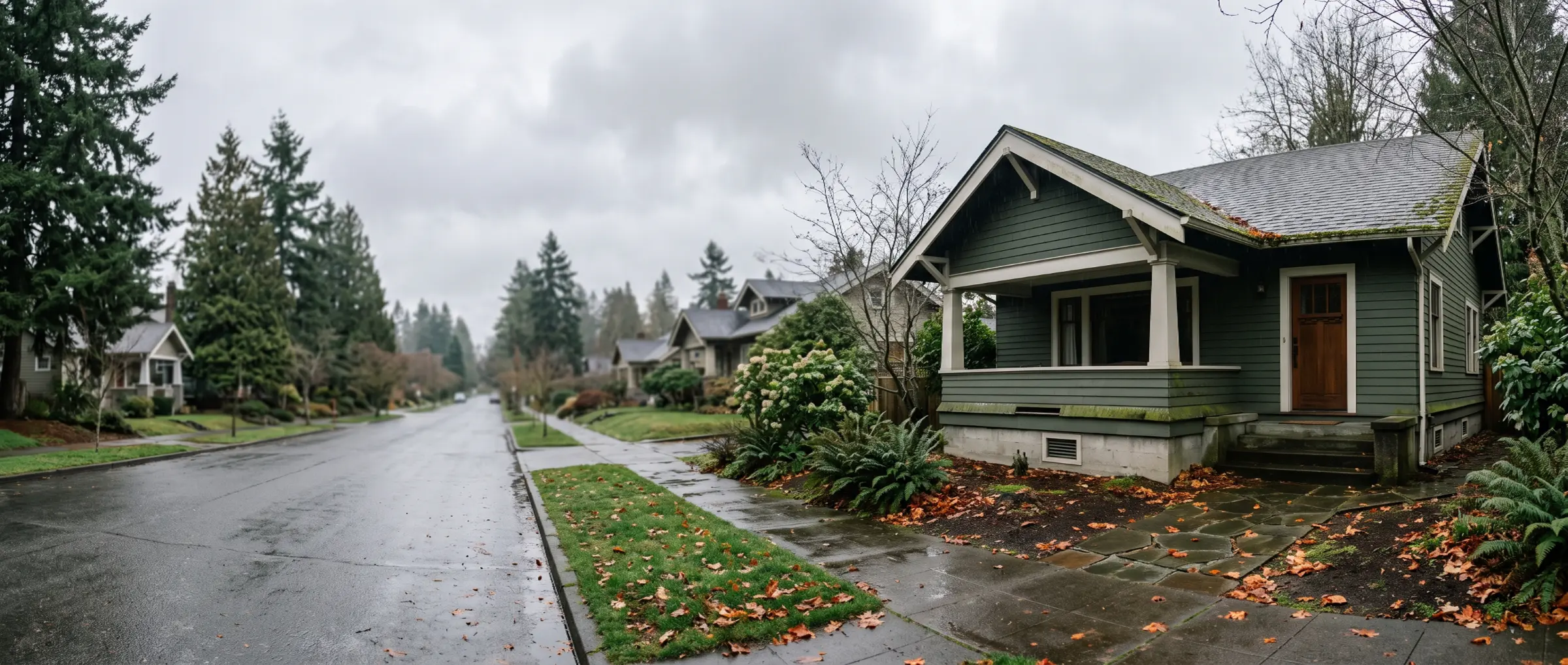

If your home has a vented crawl space and it was built before 1960, you likely already have the conditions for mold, whether or not you've ever had a leak. Seattle's risk often starts underneath the house rather than from rain hitting it directly: groundwater moves laterally through clay-heavy soil and surfaces against foundations and crawl space floors, a pathway most homeowners don't think to check until a musty smell or a contractor's flashlight finds it. Mold remediation under ANSI/IICRC S520 is the process of identifying that moisture source, containing the area, removing contaminated material, and verifying the fix, and in a groundwater-fed crawl space that fix looks different than patching a one-time leak.
Washington has no mold remediation license, so the verification work that a licensing board would otherwise handle falls to you, and knowing the right credentials to check matters more here than it would in a state with a licensing system behind it. Knowing what drives the risk in your specific home, what a fair local price looks like, and where you stand as a renter, buyer, or seller under Washington law puts you in a much stronger position before anyone sets foot in your crawl space.
Key insights
- Washington has no mold contractor license. Verification rests on IICRC AMRT certification and active L&I registration, not a state credential.
- Seattle's risk comes from sustained saturation, not storms. Puget Sound lowlands average roughly 38 inches of rain a year, spread across persistently overcast, low-evaporation conditions rather than single flood events.
- A large share of Seattle's housing predates modern moisture controls. Pre-1960s post-and-pier construction common in Wallingford, Ballard, and Beacon Hill often has no vapor barrier or a barrier that has degraded to dust.
- Groundwater, not just rain, is a distinct local driver. Shallow aquifers can surface at street level after extended wet periods, a mechanism separate from surface flooding.
- Typical remediation cost runs $1,500 to $4,250. Crawl space access, not mold severity, is what pushes a Seattle job toward the top of that range.
- Seattle's RRIO program ties habitability inspection directly to rental housing. Few cities have a comparable municipal inspection ordinance covering moisture conditions.
Why Seattle's mold risk is different
Seattle's mold problem is a chronic-moisture problem, not a flood problem. The Puget Sound lowlands sit between 35 and 60 inches of precipitation annually depending on exact location, per NOAA's regional climate data, with the Seattle area averaging close to 38 inches, spread across roughly 150 rainy days rather than concentrated in a short storm season. That distinction matters for remediation: a city with hurricane-driven risk deals with acute saturation events followed by drying windows, while Seattle's building materials rarely get a sustained dry period at all during the wet months, which is what makes mold here a baseline condition rather than a post-event complication.
 Lateral groundwater intrusion under ANSI/IICRC S520 Condition 2 classification requires moisture correction before any vapor barrier work, not after.
Two mechanisms compound that baseline moisture. The first is direct: prolonged low-intensity rain keeps relative humidity elevated at material surfaces well past the roughly 60% threshold where active mold growth becomes possible. The second is less obvious to most homeowners. In several Seattle neighborhoods, particularly hillside areas with clay-heavy soil like Beacon Hill, groundwater moves laterally through the soil during the rainy season and surfaces against foundations and crawl space floors independent of surface rainfall hitting that specific lot. A vented crawl space built in the 1920s or 1930s, designed under a building-science assumption that air circulation alone would manage moisture, has no defense against water arriving from underneath rather than from above.
Seattle's recent weather history shows what happens when that baseline saturation gets an acute event layered on top. In December 2025, a series of atmospheric rivers, including a Pineapple Express system rated AR-4 on the atmospheric river intensity scale, brought sustained heavy rainfall to western Washington, pushed several rivers to record or near-record flood stage, and triggered a state of emergency declaration. Mold doesn't require a flood of that scale to establish itself, but events like it illustrate the ceiling on Seattle's moisture exposure, and any home that took on water during that window is now past the point where waiting to see if it dries out on its own makes sense.
Where mold hides in Seattle homes
The five locations most likely to grow mold in a Seattle home are the crawl space, basement, window sills and frames, bathroom ceilings near the exhaust fan, and attic sheathing under the roof. Where it shows up first often determines whether the situation calls for professional remediation or a simple wipe-down, so it helps to know the highest-risk spots before deciding either way.
 An exhaust fan rated below the room's actual moisture load is a common cause of ceiling mold even when the fan runs after every shower.
Three of the five locations below trace back to groundwater or aging plumbing rather than rainfall hitting the house directly, which is the split that makes Seattle's risk map look different from a city where surface flooding or storm surge drives most of the damage.
| Location | Primary cause in Seattle | What to look for | DIY or pro |
|---|---|---|---|
| Crawl space | Lateral groundwater intrusion, degraded or missing vapor barrier | Musty odor at floor level, visible standing moisture, white mineral deposits on framing | Pro |
| Basement | Hydrostatic pressure through foundation walls, sump failure | Efflorescence, peeling paint near the slab, condensation on cold walls | Pro for anything beyond a small surface patch |
| Window sills and frames | Single-pane and early double-pane condensation in older homes | Black speckling on wood frames, swelling sash | DIY for a small patch on nonporous trim |
| Bathroom ceilings and exhaust paths | Underpowered or absent exhaust fans relative to shower volume | Peeling paint, soft drywall near the fan housing | DIY if under 10 sq ft on paintable drywall |
| Attic sheathing | Roof leaks combined with inadequate ventilation in older roof assemblies | Dark staining on the underside of sheathing, compressed or wet insulation | Pro |
The crawl space deserves the most attention because it's the location where Seattle's specific risk factors converge: it's the part of the house closest to the groundwater table, it's most likely to have a vapor barrier from a decades-old, now-degraded installation, and it's the hardest area for a homeowner to check without crawling in with a flashlight. A musty smell that you've noticed but can't trace is a common early indicator worth tracking down before assuming it's coming from somewhere else.
Removing the contaminated material is only half of professional mold remediation in a crawl space that's wet from groundwater rather than a one-time leak; the job isn't finished until a vapor barrier and, where needed, perimeter drainage go in to stop the cycle from repeating. Confirming whether the moisture is coming from one source or several usually requires getting under the house with a moisture meter rather than guessing from a visible patch alone.
In homes where the existing barrier has degraded past the point of repair, contractors typically quote encapsulation as a separate line item from the mold removal itself: a new 6-mil or heavier polyethylene barrier sealed to the foundation walls, plus perimeter drainage correction where lateral groundwater is the source. Skipping that second step after paying for removal is the most common reason mold returns to a Seattle crawl space within a year or two.
What the remediation work itself involves
A Seattle crawl space or basement remediation follows the same sequence regardless of which contractor performs it, since the underlying steps come from the ANSI/IICRC S520 standard rather than any individual company's process. The crew isolates the work area with plastic sheeting, then runs a HEPA air scrubber under negative pressure so spores can't migrate into the rest of the house while material is disturbed. Contaminated insulation and any drywall or framing that can't be cleaned gets removed and bagged for disposal; surfaces that can be salvaged are HEPA vacuumed and treated with an EPA-registered antimicrobial rather than replaced outright. The vapor barrier and any drainage correction go in only after this cleaning step, not before, since sealing a crawl space over active mold traps moisture and spores against the wood rather than resolving anything.
The job isn't complete until an independent party, not the same company that did the removal, confirms it with clearance testing. That separation matters more in Washington's no-license environment than it would in a state that requires assessor and remediator to be different businesses by law: nothing stops a Seattle contractor from grading their own work, so asking who performs clearance testing before signing is worth doing alongside the credential checks above.
How to spot mold in a Seattle home
The clearest signs of mold in a Seattle home are a musty smell strongest at floor level, cupped or soft hardwood, an unexplained rise in water usage, a smell that returns each fall with the heat, visible staining on crawl space joists, and respiratory symptoms that ease away from home. Most homeowners notice one of these indirectly, through smell or a symptom pattern, well before they see growth directly, since the highest-risk locations sit out of normal sightlines. The six signals below track the city's two dominant mechanisms: chronic crawl space dampness and the slower failure of aging plumbing.
 Cupping this pronounced usually means the subfloor below has been absorbing crawl space moisture for weeks, not days.
A musty smell that's strongest near the floor
Crawl space air migrates upward through subfloor gaps and HVAC penetrations, so an earthy odor that's noticeably stronger at floor level than at head height, especially in a pre-1960 home, points to the space below rather than anything visible in the room itself.
Cupped or soft hardwood floors
Wood flooring absorbs moisture from below when crawl space humidity stays elevated for weeks at a time. Cupping, where board edges rise above the center, is the early sign. A soft or springy spot underfoot means the subfloor itself has already taken on more moisture than the surface shows.
A water bill that's crept up without an obvious reason
In homes with original galvanized or cast-iron supply lines, a slow internal leak can run for months before it shows up as a wet spot, the kind of EPA-documented moisture pathway that often produces mold well before anyone notices the underlying leak. An unexplained increase in water usage is often the first measurable sign, well before any visible staining appears.
A smell that returns each fall when the heat kicks back on
Ductwork running near or through a crawl space picks up musty air over the dry months. The first heating cycles of the season can push that air through the registers before the system flushes itself out. If the smell clears within a few days, it's likely surface buildup at the vents; if it persists past a week, the crawl space itself warrants a look.
Visible staining or a white powdery film on joists
If you can safely access the crawl space, dark staining or fuzzy growth on the joists or subfloor is active mold, consistent with the visual indicators CDC guidance describes for confirming mold versus other discoloration; a white, chalky film can be either older inactive growth or mineral efflorescence from groundwater, which isn't mold itself but confirms the moisture conditions that support it nearby.
Respiratory symptoms that ease when you're away from home
This alone proves nothing, since plenty of unrelated factors can explain it. Paired with any of the signals above, though, congestion or irritation that consistently lifts on vacation and returns within a day of coming home is worth mentioning to whoever inspects the crawl space.
These six signals track Seattle's two dominant pathways, groundwater and aging plumbing, but a kitchen leak or bathroom ventilation failure can produce mold with none of these specific tells. A broader room-by-room visual and odor checklist covers signs outside these two patterns.
Mold species in Seattle
Cladosporium and Penicillium are the species most commonly found in Seattle crawl spaces and basements year-round, with Aspergillus and Stachybotrys chartarum appearing more often after a specific water event. This mix reflects Seattle's sustained, moderate moisture rather than the high-heat, high-humidity conditions that favor more aggressive species in Gulf Coast or Southeast climates.
 Surface color alone cannot confirm species; a swab test is the only way to distinguish ordinary Cladosporium from a more serious finding.
Species identification matters because it changes both the urgency and the protocol, not just the label on a lab report, given how health risks differ by species and exposure level. A lab confirming which genus is present tells a contractor whether standard cleaning is sufficient or whether the job needs full containment before anyone touches the affected material.
| Species | Where it's typically found in Seattle | Conditions that favor it | DIY appropriate |
|---|---|---|---|
| Cladosporium | Crawl spaces, basements, window sills | Cool, persistently damp conditions year-round | Small surface patches only |
| Penicillium | Crawl spaces, behind baseboards | Organic building materials with chronic moderate moisture | Small surface patches only |
| Aspergillus | HVAC systems, water-damaged drywall | Indoor air with elevated humidity over weeks | No |
| Stachybotrys chartarum | Sustained water-damaged drywall, flood-affected materials | Continuous saturation lasting beyond a few days, as after a flood event | No |
A surface swab confirming Cladosporium in a routine crawl space check generally points toward standard removal and a vapor barrier fix. A sample coming back as Stachybotrys chartarum after a flood event, the kind December 2025's atmospheric rivers produced, calls for full containment regardless of how small the visible patch looks, since visual color alone cannot distinguish it from the less serious species in low light. Identifying the genus correctly also determines whether black mold removal protocols and the cost premium that comes with them actually apply to the job.
Seattle mold remediation costs
Mold remediation in the Seattle metro typically falls between $1,500 and $4,250 for a normal-range job, above the roughly $2,400 national average because of the region's labor costs rather than any difference in how the mold itself behaves.
 Finished basements cost more to remediate than unfinished ones because the drywall and flooring removal adds labor the concrete shell alone would not require.
Crawl space access is the single biggest swing factor in a Seattle quote, more than mold type or square footage alone, since the city's pre-1960 housing stock commonly has 18-to-24-inch clearance that doubles the labor time of the same job in a basement or above-grade room.
| Project scope | Typical Seattle cost | Local cost driver |
|---|---|---|
| Small bathroom or closet patch | $500–$1,500 | Minimum labor charge applies even for small jobs |
| Crawl space remediation | $1,500–$6,000 | Access difficulty and frequent need for a new vapor barrier |
| Finished basement | $3,000–$8,000 | Drywall and flooring removal add labor beyond the surface clean |
| Whole-home or post-flood remediation | $10,000–$20,000+ | Multiple affected rooms plus structural drying equipment runtime |
| HVAC system remediation | $3,000–$10,000 | Full duct cleaning and air handler treatment per system |
Several line items show up separately from the headline square-footage rate: mold testing or air sampling, where used, runs $300 to $600; specialized equipment like air scrubbers and commercial dehumidifiers is often billed daily on top of labor; and any vapor barrier or drainage correction tied to a crawl space job is typically a separate quote from the remediation itself. A contractor who quotes a single flat number without breaking out containment, removal, disposal, and any moisture-source correction is worth a second question before you sign.
The other factor that pushes a job toward the top of the range is mold that's already reached structural framing rather than staying on the surface of insulation or vapor barrier material. A 100-square-foot crawl space job that would run $1,000 to $2,500 on a clean concrete slab can run closer to $6,000 once the crew is replacing joist sections rather than just cleaning them.
Cost by location in a Seattle home
The room or system affected changes the price as much as the square footage does, the same variable the national mold remediation cost breakdown tracks across project sizes, since crawl space and attic work involve confined-space access that bathroom or kitchen work doesn't.
| Location | Typical Seattle cost | Why it varies |
|---|---|---|
| Bathroom or kitchen | $500–$2,000 | Surface mold on tile or grout is straightforward; cabinet or subfloor removal adds cost |
| Basement | $1,500–$8,000 | Finished basements require drywall and flooring removal; unfinished concrete is cheaper to access |
| Crawl space | $1,500–$6,000 | Low clearance and groundwater seepage are the two cost drivers specific to Seattle |
| Attic | $1,500–$6,000 | Roof leak repair and insulation replacement add to the base remediation cost |
| HVAC system | $3,000–$10,000 | Full duct cleaning and air handler treatment, priced per system rather than per square foot |
| Whole home or post-flood | $10,000–$20,000+ | Multiple affected rooms plus structural drying equipment running for days |
How long a Seattle job takes from inspection to clearance
A small bathroom patch can be inspected, remediated, and cleared within a week. A crawl space job with a new vapor barrier typically runs two to three weeks once drying time and lab turnaround are included.
| Job type | Active work | Drying time | Clearance lab | Total |
|---|---|---|---|---|
| Bathroom or small surface | 1–2 days | 1–2 days | 1–3 days | 3–7 days |
| Crawl space remediation | 2–4 days | 3–5 days | 1–3 days | 1–2 weeks |
| Crawl space with new vapor barrier | 3–5 days | 5–7 days | 1–3 days | 2–3 weeks |
| Finished basement | 2–4 days | 3–5 days | 1–3 days | 1–2 weeks |
| Whole-home or post-flood | 5–10+ days | 7–14 days | 1–3 days | 3–6 weeks |
Clearance testing by an independent inspector, not the remediation company itself, is what confirms a job is actually done, and a space that fails on the first pass simply means the moisture source needs another look before the barrier goes back up.
Hiring a contractor when Washington has no mold license
Washington has no mold remediation license, full stop. The state Department of Health is direct about this: anyone can call themselves a mold remediation specialist without specialized training or credentials. That doesn't mean there's no way to verify competence; it means the verification has to come from a different set of credentials than a state-issued license would otherwise provide. Before the hiring question comes up at all, it's worth confirming the situation actually calls for professional remediation rather than a DIY fix.
 A contractor who inspects the crawl space before quoting can break out containment, removal, and disposal by square footage instead of a single flat number.
Two things actually carry weight in Washington. The first is active registration with the Department of Labor and Industries, which every contractor doing construction-related work in the state must hold regardless of trade, and which is searchable through L&I's contractor lookup tool along with bond status and any recorded infractions. The second is IICRC Applied Microbial Remediation Technician certification, an industry credential rather than a government one, but the closest thing to a verifiable standard in a state without licensing.
Ask for the L&I registration number and check it yourself
Don't take a business card at face value. L&I's public lookup shows whether registration is current, whether the bond is active, and whether there's an infraction history, in under a minute.
Ask for an IICRC AMRT certificate number
Cross-check it against the IICRC Global Locator rather than a logo on a website, since logos can be copied without the underlying certification.
Confirm pollution liability coverage specifically
General liability policies frequently exclude mold-related claims. A contractor doing this work regularly should be able to produce a certificate showing pollution liability, not just standard general liability.
Get the scope of work tied to measured square footage
A vague lump-sum quote makes it hard to tell what's included. A scope broken into containment, removal, disposal, and any vapor barrier work by square footage is the standard a licensed remediator would be required to produce in a state with a licensing board, and there's no reason a Washington contractor can't match it voluntarily.
Ask directly whether they address the moisture source or only the visible mold
In a state with no separation requirement between assessment and remediation, the same company that cleans the mold may also be the one deciding whether the underlying leak or groundwater issue gets fixed. Get that answer in writing before work starts.
The credential checks above sit alongside the broader hiring framework of bid comparison and contract terms that apply regardless of state licensing rules.
Mold remediation itself doesn't require a city permit in Seattle, but the repair work that often comes with it can. Seattle's Department of Construction and Inspections exempts minor repairs and alterations costing $6,000 or less in any six-month period, calculated at fair market value of labor and materials even if you do the work yourself. That exemption stops applying the moment a project touches load-bearing supports, changes the building envelope, or reduces egress, ventilation, or fire resistance, regardless of cost. A crawl space job that's removal-and-vapor-barrier-only usually stays under that radar; one that involves replacing a sistered joist or reframing a section of subfloor crosses into permit territory even on a modest budget. Ask your contractor directly whether the proposed scope triggers a permit before work starts, since unpermitted structural work can complicate a future home sale.
Insurance and homeowners
Washington homeowners insurance generally follows the same covered-peril structure used nationally: mold resulting from a sudden, specifically named event, such as a burst supply line, is typically covered under a standard HO-3 policy, while mold from a gradual leak, chronic condensation, or deferred maintenance is typically excluded. Most policies that do cover mold cap the payout at a sublimit well below what a significant remediation job costs, often in the $5,000 to $10,000 range, which means a homeowner can have nominal coverage and still be responsible for most of the bill on a serious job. A documented mold inspection at the time the problem is discovered gives an adjuster something concrete to evaluate, rather than a verbal description after the fact.
 Photographing damage at the moment it's discovered gives an adjuster something concrete to evaluate against the policy's named-peril language, rather than a description after the fact.
The December 2025 atmospheric river flooding adds a wrinkle specific to that event and similar ones: standard homeowners insurance generally excludes flood damage from rising surface water, which is covered instead through NFIP flood insurance or a private flood policy, a separate product most Seattle homeowners outside mapped flood zones don't carry. If your home took on water during that event or a comparable one, the insurance pathway depends heavily on whether the water came from a covered peril like a burst pipe versus surface flooding, and that distinction is worth clarifying with your carrier before you assume either outcome.
Mold in a Seattle rental
Washington tenants are protected by two layers that don't exist together in most states. At the state level, the Residential Landlord-Tenant Act, RCW 59.18, requires landlords to keep a rental unit fit for human habitation, which is the legal basis for requiring mold remediation when the condition affects habitability, separate from whatever insurance coverage a landlord's own policy provides. At the city level, Seattle's Rental Registration and Inspection Ordinance requires nearly all rental properties to register with the city and undergo periodic inspection, on a roughly five-to-ten-year cycle, against housing maintenance standards that include moisture and structural conditions.
 Seattle's Rental Registration and Inspection Ordinance covers buildings like this one on a multi-year cycle, which is a separate enforcement layer from a tenant's individual habitability claim under state law.
That second layer is what makes Seattle distinct from most other cities. RRIO doesn't exist to resolve an individual tenant's mold complaint quickly, an inspection cycle measured in years isn't built for that, but it does create a city enforcement mechanism and a documented maintenance-standard history that a tenant pursuing a habitability claim under state law can point to. A tenant dealing with active mold doesn't need to wait for a scheduled RRIO cycle: documenting the condition, providing written notice to the landlord, and escalating through Seattle's Code Compliance division or the Renting in Seattle helpline can move faster than the inspection schedule.
Knowing tenant rights under the broader state-by-state framework helps set realistic expectations for how fast that kind of escalation actually moves.
Buying or selling a Seattle home with mold
Washington's seller disclosure law, RCW 64.06, requires sellers of improved residential property to deliver a Form 17 disclosure statement covering material facts known to the seller, including an environmental section. The detail that matters for mold specifically: a buyer can waive most sections of Form 17, but cannot waive the environmental section if any answer in it would be yes. That makes known mold one of the few items a Washington seller can't route around through a standard waiver, which is a meaningfully different mechanism than the broad caveat emptor exposure in some other states.
The disclosure obligation runs on actual knowledge, not a duty to investigate, so a seller who genuinely doesn't know about a hidden crawl space problem isn't automatically liable for failing to disclose it. That's exactly why a pre-listing crawl space inspection matters more in Seattle than in newer-construction markets: in a home with century-old vented construction and no recent inspection, "actual knowledge" can be thinner than either party assumes, and a buyer's own inspection becomes the real safeguard rather than the disclosure form. Washington's rule is just one version of a seller disclosure obligation that varies meaningfully by state.
Soil and construction era: Seattle's neighborhood risk
Beacon Hill, Wallingford, and Ballard carry the highest mold risk in Seattle, driven by a combination of clay-heavy hillside soil and pre-1960 housing stock that predates modern vapor barriers and plumbing standards. Risk elsewhere in the city tracks two factors: soil type and housing age, which often overlap but aren't identical.
 Post-and-pier foundations built into a slope before modern footing depth standards rarely divert lateral groundwater the way a poured perimeter foundation does.
Two homes on the same Beacon Hill block can carry very different exposure depending on whether one has a replaced vapor barrier and the other still has its original 1930s installation, since a home's neighborhood sets the baseline conditions but its own construction and maintenance history compounds or offsets them.
| Neighborhood | Primary risk factor | Homeowner notes |
|---|---|---|
| Beacon Hill | Clay-heavy hillside soil, lateral groundwater movement | Post-and-pier foundations from the 1920s-40s commonly lack footings deep enough to divert subsurface water |
| Wallingford | High concentration of pre-1923 Craftsman bungalows | Original vented crawl spaces frequently have degraded or absent vapor barriers |
| Ballard | Aging galvanized and cast-iron plumbing, dense older housing stock | Slow internal pipe corrosion can leak behind walls for months before becoming visible |
| Central District | Mixed pre-1960s construction, aging plumbing | Similar galvanized pipe corrosion risk to Ballard, plus older crawl space construction |
| Georgetown and South Park | Low elevation near the Duwamish River corridor | Higher chronic moisture exposure; some crawl spaces require heavier-gauge vapor barrier installation |
| Rainier Valley | Mix of finished basements and older single-family stock | Finished basements raise remediation cost when drywall and flooring must come out |
| Green Lake and Phinney Ridge | High water table proximity | Basement and crawl space moisture more consistent through the year than in higher-elevation areas |
Flood-zone proximity isn't what drives risk in most of these neighborhoods; soil drainage characteristics and construction-era moisture controls are. A 1980s home in a low-lying area with a modern vapor barrier can carry less risk than a 1920s home on a hillside with an original, unreplaced barrier.
Mold prevention for Seattle's wet climate
The five most effective ways to prevent mold in a Seattle home are inspecting the crawl space vapor barrier annually, keeping gutters and downspouts clear, running bathroom exhaust fans after showering, having older galvanized or cast-iron plumbing inspected, and checking the crawl space after any major storm. Each targets one of the specific moisture mechanisms covered above rather than generic year-round advice.
 A clogged gutter redirects roof runoff straight down the foundation wall, adding to whatever groundwater is already moving through the soil below.
Inspect the crawl space vapor barrier annually
In homes built before 1960, check the crawl space for tears in the vapor barrier, gaps at the foundation wall seam, and any standing moisture at the start of the wet season, typically October.
Keep gutters and downspouts clear and directed away from the foundation
Seattle's tree canopy means gutters clog faster than in many cities; clogged gutters redirect roof runoff straight down the foundation wall, adding to whatever groundwater is already present.
Run bathroom exhaust fans for at least 20 minutes after showering
Many older Seattle bathrooms have fans sized for a smaller original footprint or no fan at all, which keeps indoor humidity elevated well past the point where a fan running on its own timer would have cleared it; a portable dehumidifier in a poorly ventilated bathroom helps in the interim.
Have galvanized or cast-iron supply lines inspected if your home predates 1960
In neighborhoods like Ballard and the Central District, internal pipe corrosion can leak slowly behind a wall for months before any visible sign appears.
Schedule a post-storm crawl space check after any atmospheric river event
After a named heavy-rain event, check the crawl space within a few days rather than waiting for a routine seasonal inspection, since the 24-to-48-hour mold colonization window starts as soon as material moisture content stays elevated. Homes within King County's mapped flood-risk areas warrant this check after every significant storm, not just named flood events.
These five actions work best as part of a complete prevention system followed year-round, particularly in a climate where the wet season runs most of the year, rather than as one-time fixes.
Frequently asked questions
Does Washington require a mold remediation license?
No. Washington has no mold-specific contractor license. Anyone can call themselves a mold remediation specialist, so the credential to check is IICRC AMRT certification and active L&I contractor registration, not a state mold license.
How much does mold remediation cost in Seattle?
Seattle mold remediation typically runs $1,500 to $4,250 for a normal-range job, above the national average because of regional labor costs. Small bathroom or closet jobs start around $500, while whole crawl space or basement remediation can reach $10,000 to $20,000.
Why does Seattle have so much mold compared to other cities?
Seattle's mold risk comes from sustained baseline moisture rather than storm events. Puget Sound lowlands average roughly 38 inches of rain a year spread across many overcast, low-evaporation days, and a large share of the housing stock predates modern vapor barrier and crawl space drainage standards.
Is mold covered by homeowners insurance in Seattle?
Sometimes. Washington HO-3 policies generally cover mold that results from a sudden, named peril like a burst pipe, but exclude mold from gradual leaks, chronic humidity, or unaddressed maintenance issues, and most policies cap mold-specific payouts at a low sublimit.
Do Seattle landlords have to fix mold in a rental?
Yes. The Washington Residential Landlord-Tenant Act requires landlords to maintain a unit fit for habitation, and Seattle's Rental Registration and Inspection Ordinance subjects registered units to periodic city inspection for conditions including moisture and mold.
Do I have to disclose mold when selling a house in Seattle?
Yes, if you have actual knowledge of it. Washington's Form 17 seller disclosure statement includes an environmental section, and a buyer cannot waive that section if any answer in it would be yes, which makes known mold one of the few disclosure items a seller cannot route around with a waiver.
Can I remove mold myself in my Seattle home?
Yes, for areas under 10 square feet on nonporous, accessible surfaces, per EPA guidance. Crawl space mold, anything behind drywall, or growth tied to a slab or groundwater source in older Seattle homes usually needs professional assessment because the visible patch rarely reflects the full extent of the problem.
What part of Seattle has the worst mold risk?
Risk concentrates in neighborhoods with pre-1960s post-and-pier construction on clay or hillside soil, such as Beacon Hill, Wallingford, and parts of the Central District, where lateral groundwater movement and unsealed century-old crawl spaces combine with the region's chronic rainfall.
What mold species are most common in Seattle homes?
Cladosporium and Penicillium dominate in crawl spaces and basements year-round, while Aspergillus and Stachybotrys chartarum show up more often after a specific water event, such as a roof leak or December 2025-type flooding, where sustained saturation lasts long enough to support them.
How long does mold remediation take in a Seattle crawl space?
A standard crawl space job runs two to four days for inspection, containment, removal, and drying, longer if a vapor barrier and perimeter drainage need to be installed afterward to address the groundwater source rather than just the visible mold.
Does fixing a leak guarantee the mold won't come back in a Seattle home?
No, not on its own. In homes with lateral groundwater intrusion rather than a single point-source leak, fixing one entry point can leave the underlying soil moisture and crawl space humidity unaddressed, which is why a vapor barrier and drainage correction matter as much as the remediation itself.
Sam Hickerson is the founder of RestoreAdvisor and writes consumer guides on mold remediation, water damage restoration, inspection, testing, and home recovery. His work focuses on helping homeowners understand costs, risks, and when to call a professional. He draws on guidance from the EPA, CDC, IICRC, and other authoritative sources to make complex home issues easier to navigate.