
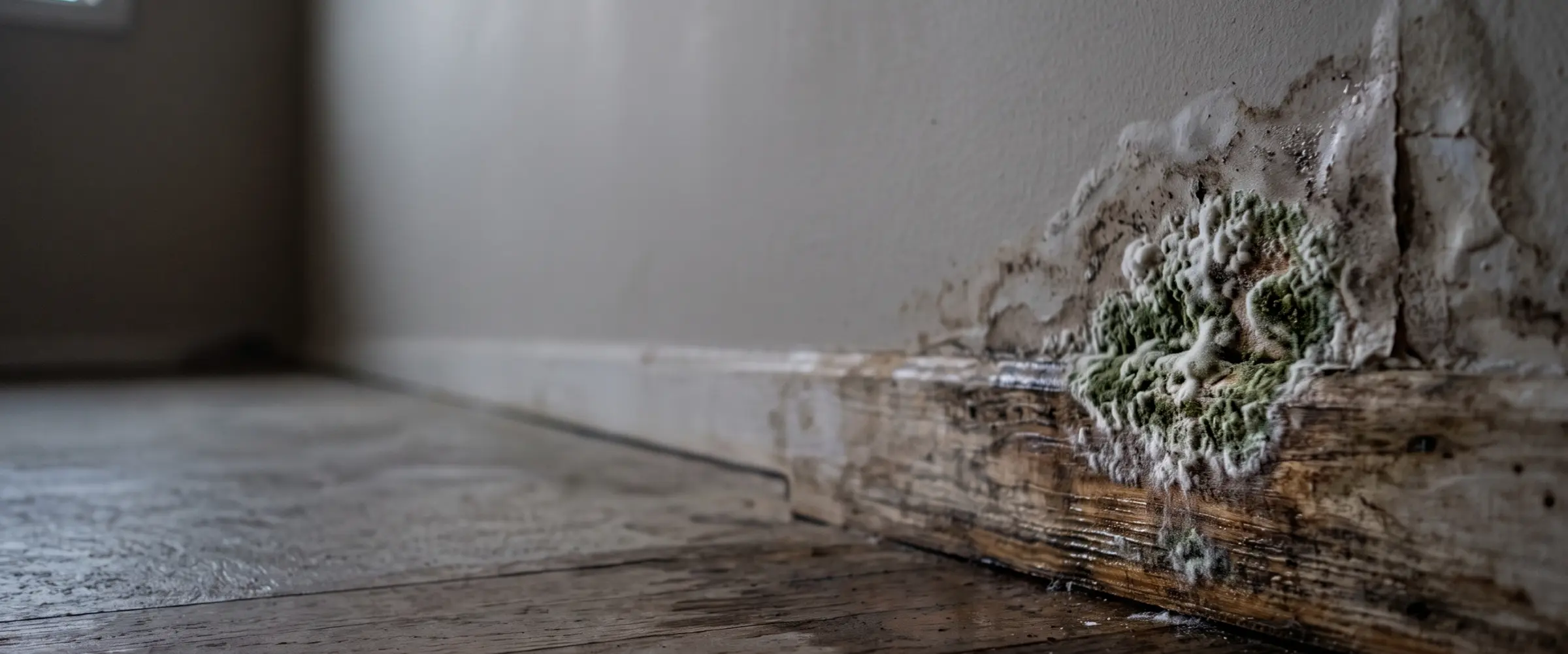

A mold patch that seemed to double in size in just a day or two, especially on wet cardboard, wallpaper, or exposed wood, is genuinely unsettling to find in your home. Trichoderma is a genus of fast-growing filamentous fungi that the CDC lists among common indoor molds, and it breaks down cellulose in materials such as wood, paper, and drywall facing wherever moisture persists, consistent with ANSI/IICRC S520 remediation guidance.
Species-level identification, the real health risks for your household, and a straightforward removal plan are what separate overreacting to a cosmetic patch from missing a job that actually needs a professional. Trichoderma behaves differently from molds like Aspergillus or Cladosporium in a few specific ways, and those differences change both how urgently you should act and how the removal itself should be done.
Key insights
- Fast color change. Trichoderma typically turns from white to green or gray-green within two to five days as it begins producing spores, one of the fastest visible transitions among common indoor molds.
- Cellulose digester. Trichoderma breaks down cellulose directly, which can weaken wood, paper, and cardboard structurally rather than just growing on the surface.
- Mostly an allergen. Healthy people usually experience only allergy-type symptoms from Trichoderma exposure, such as sneezing, coughing, or skin irritation.
- Rare infection risk. Trichoderma longibrachiatum is the species most often linked to invasive infections, and these cases occur almost exclusively in people with severely weakened immune systems.
- Needs more water. Trichoderma requires more sustained moisture than several other common indoor molds, so its presence often points to a flood or chronic water intrusion rather than simple condensation.
- Removal means removal, not cleaning. Because the fungus penetrates deep into wood and paper fibers, affected porous material usually needs to come out rather than be scrubbed.
What does Trichoderma mold look like
Trichoderma mold starts out white or nearly transparent with a fine, fuzzy texture, then darkens to green, yellow-green, or gray-green within two to five days as it begins producing spores. That speed is one of the fastest color transitions among common indoor molds.
 Trichoderma typically shifts from white to green within two to five days as it begins producing spores, one of the fastest color transitions among common indoor molds.
Some species, most notably Trichoderma viride, produce a faint sweet or coconut-like odor as they mature, though many colonies have no distinct smell at all. Texture varies by species too: some form a dense cottony mat that spreads several inches within days, while others stay flatter with a granular or powdery surface and no concentric growth rings. Because green and white color ranges overlap across several genera, visual identification alone can't confirm the species; a swab or sample analyzed through professional mold testing is the only way to know for certain which mold you're dealing with.
Trichoderma mold species and how to tell them apart
Four species account for most Trichoderma identifications in homes: Trichoderma viride, Trichoderma harzianum, Trichoderma longibrachiatum, and Trichoderma koningiopsis, distinguished mainly by growth speed, texture, and the locations where each tends to establish.
Species identification typically requires a lab culture rather than visual inspection alone, since color and texture during early growth stages overlap across all four species, and even trained inspectors rely on spore morphology under magnification to confirm which one is present.
| Species | Appearance | Common locations | Health category |
|---|---|---|---|
| Trichoderma viride | White turning green, powdery surface, mild coconut-like odor in some samples | Damp wood, soil-contaminated materials, water-damaged framing | Common allergen, low infection risk |
| Trichoderma harzianum | White to pale green, dense cottony growth that spreads fast | Potting soil, houseplant containers, damp wood trim | Common allergen, also used commercially as a biofungicide |
| Trichoderma longibrachiatum | White maturing to dark green or gray-green | Water-damaged drywall, HVAC condensate pans, clinical plumbing | Most frequently linked to invasive infection in immunocompromised patients |
| Trichoderma koningiopsis | Pale green, granular texture, no concentric rings | Soil, agricultural material, occasionally water-damaged wood | Common allergen, rarely implicated in infection |
Trichoderma longibrachiatum is the species overwhelmingly cited in case reports of invasive infection, which is why lab confirmation matters more for this genus than for a purely cosmetic mold. Early pale-stage colonies are also sometimes mistaken for other white mold species until pigment develops, so a sample taken before color fully sets in can still be misread on sight alone.
Where Trichoderma mold grows in your home
Trichoderma mold grows wherever cellulose-based material stays wet for an extended period, which is why it shows up most often on wood, paper, and paper-faced products rather than tile or metal. Because the fungus needs more sustained moisture than several other common indoor molds, its presence in a home usually signals unresolved water damage rather than everyday condensation.
 Stored paper and cardboard act as a direct food source once they take on moisture, which is why basements and other storage areas account for a disproportionate share of Trichoderma cases.
Growth often starts on the hidden side of a material facing the moisture source, such as the back of drywall or the underside of carpet padding, so visible surface growth typically means the colonization underneath is already more extensive than what's showing.
| Location | Cause | What to look for | DIY or pro |
|---|---|---|---|
| Wood framing and subfloor | Flooding, slow plumbing leaks, or roof leaks reaching structural wood | Discoloration, softened or spongy texture, musty odor near the affected area | Pro for framing or subfloor; DIY only for small, accessible surface patches |
| Drywall paper facing | Sustained humidity or a hidden leak behind the wall | Green or gray staining that spreads along the paper facing rather than staying in one spot | Pro once staining extends beyond a small patch |
| Wallpaper and wallpaper paste | Moisture trapped between the paper and the wall | Bubbling, peeling, or discoloration at seams | DIY for small areas if the wall behind is dry |
| Stored cardboard and paper | Damp basements, attics, or garages | Soft, crumbling cardboard with visible fuzzy or powdery growth | DIY discard and replace; rarely worth cleaning |
| Carpet and carpet padding | Flooding or a slow subfloor leak | Musty odor, discoloration on the underside of carpet or padding | Pro for padding; carpet often needs replacement |
| Bathroom grout, caulk, and trim | Chronic high humidity without adequate ventilation | Green-tinged discoloration along grout lines or wood trim | DIY for small surface areas |
| HVAC condensate pans and drain lines | Standing water in a poorly draining condensate system | Slimy or fuzzy growth inside the pan or along the drain line | Pro, since HVAC components need to be assessed as a system |
Several of these conditions overlap most often in basements and crawl spaces, which is why older homes see a disproportionate share of Trichoderma cases in those areas.
Is Trichoderma mold dangerous
For most healthy people, Trichoderma mold causes only allergy-type symptoms such as sneezing, coughing, or skin irritation, and it is not classified as a major mycotoxin producer the way Stachybotrys is. The exception is Trichoderma longibrachiatum, which has caused rare but serious invasive infections in people with severely compromised immune systems.
 For healthy adults, direct contact with Trichoderma typically causes only allergy type symptoms such as skin irritation, a different risk profile than the rare invasive infections seen in immunocompromised patients.
Exposure happens primarily through inhaling airborne spores or fragments, which can trigger an IgE-mediated allergic response in sensitized people, consistent with CDC: Basic Facts About Mold. Some Trichoderma species can produce trichothecene mycotoxins under certain growth conditions, most often documented in contaminated food and agricultural settings rather than indoor air, so the health concern for most households centers on allergy and asthma aggravation rather than toxin exposure.
| Population | Typical symptoms | Elevated risk | Notes |
|---|---|---|---|
| Healthy adults | Sneezing, coughing, mild skin irritation | Low | Symptoms usually resolve once exposure stops |
| Asthma or existing allergies | Wheezing, chest tightness, worsened asthma control | Moderate | Airborne spore exposure can trigger flare-ups |
| Neutropenic or transplant patients | Fever, respiratory symptoms, signs of localized infection | High | Case reports describe pulmonary and disseminated infection, mainly from Trichoderma longibrachiatum |
| Peritoneal dialysis patients | Abdominal pain, signs of peritonitis | High | An uncommon but recognized route of infection tied to dialysis catheters |
| Children and older adults | Similar allergy symptoms, potentially more pronounced | Slightly elevated | Immune response and respiratory sensitivity vary by age |
Case reports catalogued in NIH/PMC clinical literature describe Trichoderma longibrachiatum causing pulmonary, peritoneal, and disseminated infections almost exclusively in people with hematologic cancers, stem cell transplants, or long-term immune suppression, with mortality in these documented cases reported near 50 percent.
This risk profile has more in common with select Aspergillus species than with purely allergenic molds like Cladosporium, and health risk tied to mold exposure varies considerably by species and by immune status. Households without an immunocompromised member are unlikely to see anything beyond the usual allergy and asthma symptoms, even after direct contact with an active colony.
Trichoderma and wood damage
Trichoderma causes structural damage by digesting cellulose directly, the main structural component of wood and paper, rather than simply growing on top of these materials. That sets it apart from molds that only colonize the surface of wood without breaking down the fiber itself.
Enzymes the fungus produces break down cellulose fibers for food, which is also why Trichoderma species are used commercially as biocontrol agents against plant pathogens in agriculture. Indoors, that same enzymatic activity can weaken a section of subfloor or framing before visible growth alone would suggest a problem, which is one reason treatment for mold on wood often requires cutting out and replacing material rather than surface cleaning. Softwoods and untreated framing lumber tend to show damage faster than hardwood trim or engineered wood products, since the cellulose in softer species is easier for the fungus's enzymes to break down.
The same fiber-digesting mechanism explains why colonized drywall paper facing often can't simply be wiped clean either, even though drywall itself is not solid wood. The paper facing is compressed cellulose, so Trichoderma treats it the same way it treats a sheet of cardboard once moisture has been sitting long enough.
A field test can help distinguish active fungal decay from cosmetic surface mold: press a screwdriver or similar tool into the suspected area, and wood that gives way easily or feels soft and crumbly likely has decay in addition to surface growth, which changes the scope of the job from cleaning to replacement.
DIY removal vs calling a professional
Trichoderma is appropriate for DIY cleaning only when the affected area is under 10 square feet, sits on a nonporous or lightly porous surface, and the household has no immunocompromised members, the same EPA benchmark used to determine when mold remediation is required for any species.
 Proper protective equipment is required even for small DIY jobs, since disturbing colonized material can release a concentrated burst of spores.
Immune status matters more for this genus than for most other indoor molds, since a household with an immunocompromised member changes the calculation even when the affected area is small and easily reached.
| Condition | Recommendation |
|---|---|
| Affected area larger than 10 square feet | Call a professional |
| Growth on structural wood, subfloor, or wall framing | Call a professional |
| Anyone in the household is immunocompromised | Call a professional |
| Growth followed a flood or significant water event | Call a professional |
| Wood feels soft, spongy, or crumbly under light pressure | Call a professional |
| Growth is confined to a small, accessible, nonporous surface | DIY is reasonable |
| Moisture source is already identified and fixed | DIY is reasonable for a small area |
If species confirmation matters, particularly for households with anyone immunocompromised, a professional mold inspection can collect a sample and confirm whether Trichoderma or another genus is present before work begins. Because Trichoderma digests the material it grows on, cleaning the surface without addressing what's underneath often leaves the colonization intact even when the visible color disappears, which is a common reason the mold reappears within weeks of a DIY attempt.
How to remove Trichoderma mold
Removing Trichoderma mold safely follows the same core sequence as most indoor mold jobs: fix the moisture source first, contain the area, remove or clean the affected material, and dry everything completely before closing the space back up. For anything beyond a small nonporous patch, following full professional mold remediation rather than piecing together DIY steps reduces the chance of missed hidden growth.
 Colonized drywall is cut out and discarded rather than cleaned, since Trichoderma grows into the paper facing rather than sitting on the surface.
1. Identify and stop the moisture source
Trace the leak, flood residue, or humidity problem responsible for the growth and correct it before doing anything else. Cleaning without fixing the underlying moisture almost always leads to regrowth within days.
2. Isolate the work area
Close doors, tape plastic sheeting over doorways, and turn off HVAC systems serving the room so spores disturbed during cleaning don't spread to the rest of the home.
3. Wear proper protective equipment
An N95 respirator, gloves, and eye protection are the minimum for handling Trichoderma safely, since disturbing colonized cellulose materials can release a concentrated burst of spores and fragments.
4. Remove porous materials rather than scrubbing them
Cut out and discard colonized drywall, wallpaper, cardboard, and carpet padding rather than attempting to clean them, since the fungus grows into the material rather than sitting on its surface.
5. Clean nonporous surfaces with detergent and water
For tile, glass, or sealed wood, a detergent-and-water solution followed by thorough drying is sufficient for small areas, consistent with EPA guidance that prioritizes detergent over bleach for general mold cleanup.
6. Dry the area completely and monitor for recurrence
Use fans and a dehumidifier to bring the space below 50 percent relative humidity, then check the area again after a week to confirm the growth has not returned.
Professional jobs typically follow IICRC S520 protocols for containment, removal, and clearance testing, which is part of why a licensed job costs more than a DIY attempt but carries a lower chance of hidden growth being missed.
Trichoderma mold removal cost
Trichoderma mold removal typically costs $300 to $6,000, depending on how much porous material has to be removed and whether structural wood is affected. Labor accounts for most of that range, since removing porous material by hand and running containment equipment takes far more time than the disposal itself, and pricing also shifts based on regional labor rates and whether the affected area is easily accessible or hidden behind finished walls.
| Scenario | Typical cost | What's included |
|---|---|---|
| Small surface patch, nonporous material | $300–$600 | Cleaning, minor material removal, basic clearance check |
| Drywall or wallpaper section, under 25 sq ft | $600–$2,000 | Material removal, containment, disposal |
| Affected subfloor or wall framing | $2,000–$6,000 | Structural material removal, drying equipment, reconstruction |
| Whole-room remediation after flooding | $3,500–$10,000+ | Full removal, containment, drying, clearance testing |
| HVAC condensate or duct involvement | $600–$3,000 | Component cleaning or replacement, drain line correction |
Costs climb quickly once structural wood is involved, since Trichoderma's cellulose-digesting habit often means replacing rather than treating the affected framing. These figures track closely with broader mold remediation cost data across project sizes, since the cost drivers, material removal versus surface cleaning, are the same regardless of species.
Preventing Trichoderma mold from coming back
Preventing Trichoderma mold comes down to controlling moisture and avoiding damp cellulose storage, since the fungus cannot establish itself without both. Because a visible colony can form within two to five days of sustained wetness, the biggest lever for prevention is how quickly a household responds once water shows up, whether that means shutting off a supply line, calling a plumber, or simply mopping up standing water before it soaks into flooring or trim. A response that takes a week instead of a day is often the difference between a quick wipe down and a section of subfloor that needs to be replaced.
 Fixing a leak within 24 to 48 hours interrupts Trichoderma's growth cycle before it can establish on nearby wood or drywall.
Cardboard, paper, and untreated wood scraps left in a garage, basement, or attic act as a food source the moment they get damp, so clearing out old boxes and paper waste from storage areas removes a hazard that a dehumidifier alone won't address. Keeping indoor humidity below the active-growth range described in the humidity thresholds handles the moisture side of the same equation.
| Action | Frequency | Why it works |
|---|---|---|
| Fix leaks and address flooding within 24 to 48 hours | Immediately upon discovery | Trichoderma needs sustained moisture; fast drying interrupts colonization |
| Keep indoor humidity below 50 percent | Ongoing, monitor with a hygrometer | Reduces ambient moisture available to cellulose-based materials |
| Store cardboard and paper off damp floors | Ongoing | Prevents direct contact with basement or garage humidity |
| Inspect HVAC condensate pans and drain lines | Quarterly | Standing water in condensate systems is a common Trichoderma source |
| Check wood framing after any water event | Within a week of the event | Early detection prevents deep fiber colonization |
Ongoing humidity control matters more for this genus than for molds that tolerate brief condensation, since Trichoderma's moisture requirement runs higher than average.
The room by room mold prevention system extends the same logic to every part of the home, including humidity targets, material choice, and inspection schedules. Applying that system consistently matters more for Trichoderma than for molds with a lower moisture threshold, since even a brief lapse in humidity control can restart growth on cellulose materials that were never fully dried out.
Frequently asked questions
Is Trichoderma mold dangerous?
Rarely for healthy people. Trichoderma mainly causes allergy-type symptoms in most households, and serious invasive infection is limited almost entirely to people with severely compromised immune systems, primarily from the species Trichoderma longibrachiatum.
What does Trichoderma mold smell like?
Often nothing distinctive. Some strains, particularly Trichoderma viride, produce a faint sweet or coconut-like scent as they mature, but many colonies have no notable odor at all.
How fast does Trichoderma mold grow?
Very fast, typically two to five days to mature and begin producing spores, which is faster than several other common indoor mold genera.
Can I clean Trichoderma mold myself?
Yes, for small areas. DIY cleaning is reasonable when growth is under 10 square feet, on a nonporous surface, and the moisture source has already been fixed. Anything larger or on structural wood generally needs a professional.
Does Trichoderma mold need to be professionally removed from wood?
Usually, if the wood shows softening. Because Trichoderma digests cellulose directly, wood that feels spongy or crumbly under light pressure typically needs professional assessment rather than surface cleaning.
Is Trichoderma the same as green mold?
Not exactly. Trichoderma is one of several genera that can appear as green mold, including Aspergillus and Penicillium, and lab testing is the only reliable way to confirm which one is present.
Will homeowners insurance cover Trichoderma mold removal?
Sometimes, depending on the cause. Coverage typically follows the same rules as other mold claims: sudden, covered water damage has a better chance of coverage than gradual leaks or chronic humidity that went unaddressed.
Can Trichoderma mold come back after remediation?
Yes, if moisture returns. Trichoderma regrows quickly once conditions are favorable again, so confirming the moisture source is permanently resolved matters more than the cleaning method itself.
Sam Hickerson is the founder of RestoreAdvisor and writes consumer guides on mold remediation, water damage restoration, inspection, testing, and home recovery. His work focuses on helping homeowners understand costs, risks, and when to call a professional. He draws on guidance from the EPA, CDC, IICRC, and other authoritative sources to make complex home issues easier to navigate.