
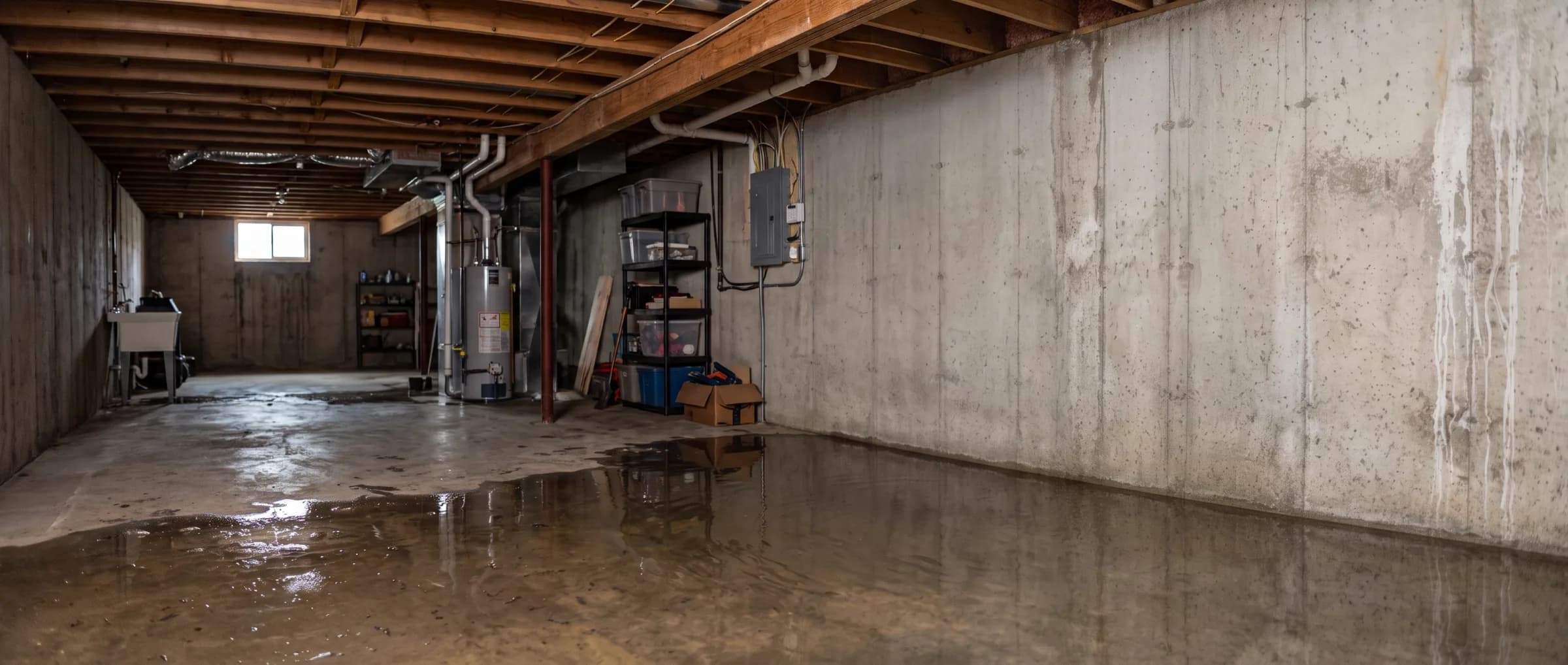

Finding water in your basement doesn't tell you much by itself, since it could be coming from four different directions and each one calls for a different response. Wall cracks let groundwater seep in slowly. Window wells overflow during a storm. A supply line or a sump pump fails without any weather involved at all. You'll find how to tell which one you're dealing with, what it costs to fix, and when the situation calls for a plumber, a foundation specialist, or a certified water damage restoration company rather than a mop and a fan, so you can respond correctly instead of guessing.
Key insights
- Basement water has four sources. Hydrostatic pressure, window wells, floor drains and sewer lines, or above-grade sources like burst pipes and appliances, each pointing to a different specialist.
- Early signs mean a slow leak. A crack, efflorescence, or a musty smell without visible water usually points to an ongoing seepage problem rather than a one-time event, and it tends to worsen without intervention.
- Finished basements cost far more. A finished basement typically costs two to four times more to repair than an unfinished one, since drywall, flooring, insulation, and framing are all at risk that an unfinished basement doesn't have.
- Insurance depends on the cause. Standard homeowners insurance covers sudden plumbing and appliance failures in a basement but excludes groundwater seepage, sewer backup, and flooding unless a specific endorsement is in place.
- Mold risk builds within days. The EPA cites 24 to 48 hours as the window in which mold can begin growing on wet or consistently damp material, and basements are especially prone to it because of below-grade humidity.
- Sump pumps fail without warning. Sump pump failure is one of the most common basement flooding causes, and quarterly testing catches most failures before they turn into a flood.
Why basements are vulnerable to water damage
A basement sits below grade on some or all sides, meaning soil and groundwater press against its walls and floor continuously rather than only during a storm. Under the ANSI/IICRC S500 standard that governs professional water damage restoration, a basement water event is classified by contamination category and by the class of drying difficulty, the same system used across every other room in the house, but a basement's below-grade construction changes which category and class are most common there.
 Groundwater under hydrostatic pressure can migrate through a hairline crack or porous concrete with no single point of failure, which is why the ANSI/IICRC S500 standard classifies the resulting water by contamination level rather than by exactly where it entered.
That constant soil contact is the reason basements deal with a source no other room faces at all: hydrostatic pressure, the force of water in saturated soil pushing against a wall or slab until it finds a crack, a porous section of concrete, or the joint where the wall meets the floor. That same pressure is what foundation water damage responds to, not to what's built inside the wall, which is why a finished basement and an unfinished one sit under identical stress. The difference is only in what's there to absorb the water once it gets through.
What's causing the water in your basement
Basement water most often comes from hydrostatic pressure through the foundation, a window well, a sump pump failure, a sewer or drain backup, a burst pipe, or surface water overwhelming the yard. The fastest way to identify which one applies is to look at where the water first appeared and how it behaved, since each entry pattern points to a different cause and a different specialist.
 Where the water first appears, along a wall, at a window well, or from a floor drain, narrows the likely cause faster than the volume of water does, since each entry point points to a different specialist.
Basements can also show more than one source at once. A storm severe enough to cause water damage from flooding elsewhere in the neighborhood often coincides with a sump pump overwhelmed by the same rising water table, since both are driven by the same saturated soil, which is why a single major storm sometimes calls for two separate repairs rather than one.
| What you're seeing | Likely source | Category |
|---|---|---|
| Damp wall, white chalky residue, water along the wall-floor joint | Hydrostatic pressure through the foundation | 1 |
| Warm spot on the floor, rising water bill, no visible entry point | Slab leak under the foundation | 1 |
| Water spreading from the corner where the sump pit sits | Sump pump failure | 1–2 |
| Water rising from a floor drain or basement toilet, sewage odor | Sewer or drain backup | 3 |
| Water pooling near or below a window during or after rain | Window well failure | 1–2 |
| Whole basement floor wet at once after a major storm | Surface water or overwhelmed drainage | 3 |
| Steady flow or spray from a visible pipe or fitting | Burst or leaking supply pipe | 1 |
A slab leak is often the hardest of these to catch early, since the water travels under the concrete before surfacing anywhere visible and can run for weeks before a warm spot or a rising water bill gives it away.
The category matters as much as the cause for deciding how urgently to act. Groundwater and a burst clean-water pipe both start as Category 1, but a sewer backup starts at Category 3 regardless of volume, and any water that sits for more than 48 hours can reclassify upward under IICRC S500 no matter where it started. Beyond contamination risk, water damage categories also determine which materials can be dried in place and which need to be removed, a distinction that carries more weight once a basement's finished materials are involved.
Window wells: a basement-specific failure point
A window well is the space carved out around a below-grade window, and it's a failure point unique to basements, since no other room in a house sits below grade with an exposed opening like it. Water gets into a basement through a window well in one of three ways: the well itself fills faster than its drain can handle, the drain is clogged or was never connected, or the window's own seal has failed and lets well water through even when the well itself is draining correctly.
 A window well deep enough to serve an emergency egress window, generally at least 36 inches under IRC guidelines, holds far more rainwater before overflowing than a shallow utility-window well does, which is exactly why its drainage connection matters more.
Current building code, per the International Residential Code, requires a window well used for emergency egress to connect to the home's foundation drainage system, but that requirement is relatively recent, and plenty of older window wells were built with no drain at all, no code violation at the time, just no outlet for the water now. A well without that connection, or with a drain that's silted in or crushed, has nowhere for water to go except toward the window it surrounds. A missing or damaged well cover makes this worse by letting rain and snowmelt collect directly in the well instead of running off before it reaches the drain.
The fix depends on which of the three failure points is responsible. A clogged drain can often be cleared and flushed without excavation. A well with no drain connection at all typically needs one added, which is foundation and drainage work rather than a water damage repair. A failed window seal is a window replacement or resealing job. Confirming which one applies before paying for a fix is worth a few extra minutes of inspection, since the cost runs anywhere from a same-day drain flush to a full excavation job depending on which one it turns out to be.
Mechanical equipment and utilities at risk
A basement often holds the water heater, furnace, and main electrical panel in the same room where the flooding happens, which changes some of the usual safety assumptions before a professional arrives. If the panel itself is wet, partially submerged, or has water actively running down the wall behind it, cutting power there isn't safe, and service needs to be shut off from outside by the utility company or an electrician instead.
 Cutting power at a panel that's wet or has water running down the wall behind it isn't safe; that call has to go to the utility company or an electrician instead of being made from inside the basement.
A furnace or air handler sitting directly on the slab is vulnerable even in a shallow flood, since a few inches of water is enough to reach the blower motor, gas valve, or control board. Running the system after any of those components have been wet risks a short or a gas safety issue, so most technicians recommend leaving it off until it's been inspected, regardless of how the rest of the basement is drying.
A water heater reacts differently depending on its fuel type. An electric unit with water at or above its heating elements needs power cut before anyone works near it, while a gas unit sitting in standing water risks a damaged gas control valve that isn't always obvious from the outside. Either type is worth having inspected before relighting or restoring power, even if the tank itself looks undamaged.
What to do right now
Move quickly, but move safely: water and basement electrical outlets are a genuine shock hazard, and the source of the water changes what's safe to touch. A basement calls for the same emergency water damage restoration triage system used everywhere else, applied to the specific hazards a below-grade room adds.
Confirm it's safe to go down there
Check for any sign of standing water near an outlet, a power strip, or an appliance cord before stepping onto a wet basement floor. Cut power to the area at the breaker if there's any doubt, following the electrical shock hazard guidance OSHA outlines for flood response.
Identify roughly where the water is coming from
Note whether it's along a wall, around a window well, near the sump pit, from a floor drain, or spreading from a specific pipe or appliance. This single observation determines who you call first.
Stop the source if it's reachable and safe
Shut off a supply valve for a plumbing or appliance leak, or clear a blocked window well drain if that's the visible cause. Leave anything involving the foundation, the sewer line, or standing Category 2 or 3 water to a professional.
Document before you move anything
Photograph the water level, the affected walls and flooring, and any items in its path before extraction begins. This record supports an insurance claim regardless of what caused the water.
Start extraction and airflow, or call for it
Remove standing water and get air moving across wet surfaces within the first few hours for a small, clean-water event you're handling yourself. Call a certified restoration company immediately for anything larger, contaminated, or beyond a few inches deep.
Protecting stored belongings
Basements are one of the most common storage spaces in a home, and protecting what's kept there starts in the same first hour as stopping the water itself, since certain materials are damaged within minutes rather than hours. Cardboard, paper, and anything sitting directly on the floor are usually the first things worth moving.
 Cardboard left directly on the floor can become unsalvageable within an hour, while the same items in a sealed tote raised even a few inches off the slab often survive the same event untouched.
Basement storage is also the hardest category to document for an insurance claim, since most homeowners can't reconstruct an exact inventory of what was in a box that's since dissolved. A periodic photo inventory of what's stored down there, even a few minutes with a phone camera once a year, makes that documentation far easier if a claim ever becomes necessary.
| What's stored | Why it's at risk | How to prevent it next time |
|---|---|---|
| Cardboard boxes and paper documents | Wicks water almost immediately and can become unsalvageable within an hour | Store in sealed plastic bins, not cardboard |
| Photographs and keepsakes | Water and mud stain and warp irreplaceable items fast | Keep in a plastic tote on a shelf, not directly on the floor |
| Electronics and small appliances | Water damage to internal circuitry often isn't reversible even after drying | Elevate on shelving at least a few inches off the slab |
| Off-season clothing and textiles | Absorbs water and can support mold within 24 to 48 hours in a damp space | Store in sealed bins rather than open boxes or garment racks |
| Furniture with wood or particleboard legs | Swells and delaminates at the base long before the rest of the piece looks affected | Use plastic risers or store upholstered pieces off the floor |
None of this replaces professional drying for anything that's already wet by the time extraction starts. It's aimed at limiting how much needs replacing in the first place, through shelving and storage decisions made before a leak happens rather than during one.
Finished vs. unfinished basements
Whether a basement is finished changes almost every decision that follows a water event, from how much material is at risk to how quickly mold becomes a concern. An unfinished basement with a concrete floor and open framing can often dry in place, while a finished basement with drywall, carpet, and insulation traps moisture behind and under materials that need to come out before drying can even start.
 Porous materials like carpet, carpet pad, and drywall start wicking moisture within hours, which is why a finished basement almost always needs materials removed before drying can start, unlike bare concrete.
The line between the two also affects how quickly the full extent of a loss becomes clear. An unfinished basement lets a technician see and measure framing directly, while a finished basement often hides the true damage until drywall or flooring comes out, which is why a finished-basement estimate sometimes grows once materials are opened up.
| Factor | Unfinished basement | Finished basement |
|---|---|---|
| Materials at risk | Concrete floor, exposed framing, stored items | Drywall, carpet or laminate flooring, insulation, framing, furniture |
| Typical drying approach | Air movers and dehumidification directly on concrete and framing | Materials removal (flood cuts, carpet pull) followed by drying |
| Urgency to act | Lower for small, contained water on bare concrete | Higher, since moisture wicks into porous materials within hours |
| Typical repair cost | $500–$5,000 for most events | $2,000–$25,000 depending on category and extent |
| Recommended insurance endorsement minimum | Often adequate at lower water backup coverage limits | Usually needs a higher water backup or sump coverage limit |
The same source of water produces a different-looking job depending on whether the basement is finished. A window well leak into an unfinished basement might mean pulling a few boxes off the floor and running a dehumidifier for two days. The identical leak into a finished basement with carpet against that same wall can mean a flood cut into drywall, carpet pad removal, and several days of monitored drying, all traceable to a source that would barely register in the room next door if it had a bare concrete floor.
Signs of basement water damage
Signs of basement water damage include efflorescence, a musty odor, peeling paint, rust on metal fixtures, warped baseboards, and a sump pump running more often than usual, and several of these develop well before any standing water appears. A homeowner often notices the smell or the stain first, since below-grade humidity and slow seepage rarely announce themselves the way a burst pipe does.
 Efflorescence forms as water migrates through concrete and evaporates at the surface, leaving mineral deposits behind, which means the moisture causing it is still moving through the wall even after the residue itself dries.
Several of these signs also follow a seasonal pattern. Efflorescence and musty odors often become more noticeable in spring, when snowmelt and heavy rain raise the water table, and can fade over a dry summer even though the underlying entry point never actually closed.
| Sign | Where to look | What it usually means |
|---|---|---|
| Efflorescence (white, chalky residue) | Concrete walls and floor | Water has been moving through the concrete and evaporating, leaving mineral deposits behind |
| Musty odor with no visible water | Anywhere in the space | Elevated humidity or a hidden leak, often before mold is visible |
| Peeling paint or bubbling on painted walls | Foundation walls | Moisture trapped behind the paint film, usually from seepage |
| Rust on metal legs, shelving, or HVAC components | Floor-level metal fixtures | Chronic dampness at floor level, even without standing water |
| Warped baseboards or cupped flooring | Wall-floor joint | Water has reached the material from below or behind, not just from a spill |
| Sump pump running unusually often | Sump pit area | Rising groundwater or a developing drainage problem, not necessarily a pump failure yet |
Catching these signs early is worth the effort because a basement's below-grade position means a slow leak rarely resolves on its own the way a surface puddle from a spill might.
What it costs to fix basement water damage
Basement water damage costs range from a few hundred dollars for a small, quickly caught leak to well over $25,000 for a finished basement hit by Category 3 water. The two biggest cost drivers are whether the basement is finished and how contaminated the water was, with square footage affecting both.
 A basement job typically bills in two separate stages, mitigation for extraction and drying, then materials removal and reconstruction once the space is confirmed dry, rather than a single combined invoice.
Most estimates also split into two separate bills rather than one. Mitigation, the extraction and drying, is typically billed first and moves quickly, while materials removal and reconstruction follows once the space is confirmed dry, which is why a single basement event can show up as two invoices instead of one.
| Scenario | Typical cost | What drives it |
|---|---|---|
| Small window well leak, caught within a day, unfinished basement | $250–$1,500 | Extraction and drying only, materials salvageable |
| General flooding, unfinished basement, several hundred square feet | $1,500–$6,000 | Extraction, drying, and dehumidification across a larger area |
| Finished basement, carpet and drywall replacement | $3,000–$12,000 | Materials removal and reconstruction on top of drying |
| Category 3 water (sewage backup) in a finished basement | $6,000–$25,000 | Contaminated material disposal, sanitizing, and full reconstruction |
| Extensive loss involving foundation repair or structural drying | $15,000–$50,000+ | Combines water damage restoration with foundation or structural work |
These figures cover water damage restoration itself, not the cost of fixing the underlying source. A cracked foundation wall, a failed sump pump, or a burst pipe each carries its own repair cost separate from the cleanup, and that repair is what prevents the same basement from flooding again. National water damage restoration cost figures blend every room and cause into one range, so checking a basement-specific quote against these narrower figures is usually more useful than comparing it to a whole-house average.
Does insurance cover basement water damage
Coverage depends entirely on how the water got into the basement, not on the fact that it happened in a basement. A standard homeowners policy generally covers a sudden, accidental source like a burst pipe or a failed water heater the same way it would anywhere else in the house, while excluding several of the causes that are especially common below grade.
Groundwater seepage through a foundation wall is excluded on a standard policy regardless of how the water got into the ground in the first place, a point NAIC's consumer guidance on homeowners coverage makes clear. Sewer and drain backup is also excluded unless a water backup endorsement has been added, and insurers commonly recommend higher coverage limits for a finished basement than an unfinished one, since the amount at risk is much greater once drywall, flooring, and furniture are involved. Surface flooding, water that enters from outside rather than from a pipe or fixture inside the home, isn't covered by a standard policy at all and requires a separate NFIP flood insurance policy through FEMA.
Flood insurance itself treats a basement differently than the rest of the house. Under NFIP building coverage, a policy pays for essential, permanently installed basement equipment (a furnace, a water heater, a sump pump) but excludes finished walls, floors, and most basement improvements, so a finished basement is rarely made whole by flood insurance alone even when the policy pays out.
A basement claim still follows the same deductible structure and filing sequence as any other room, the same mechanics homeowners insurance covers water damage walks through in full, including what to do if a claim gets denied.
Renter and landlord responsibility
In most states, a landlord is responsible for water damage caused by a failure in the building itself, a plumbing leak, a foundation crack, or a failed sump pump, while a tenant is responsible for promptly reporting the problem and for damage caused by their own negligence. That split holds whether the basement is a full separate unit or a single room being rented, though the exact obligations vary by state and by the specific lease terms.
 Photographing damage the moment it's found supports both a habitability complaint to a landlord and a renters insurance claim, since an HO-4 policy covers only the tenant's own belongings, not the structure itself.
Two separate insurance policies come into play, and they don't cover the same things. The landlord's dwelling policy covers the structure itself, walls, flooring, and built-in fixtures, while a tenant's own belongings are only protected under a renters policy, commonly labeled HO-4, which most landlords require but don't provide. A tenant without one has no coverage at all for furniture, electronics, or stored items lost to a basement flood, regardless of who caused it.
Habitability law adds another layer that's easy to miss. Most states require a landlord to keep a rental unit safe and livable, which can mean a basement apartment with ongoing water intrusion is legally uninhabitable until it's fixed, giving a tenant grounds to withhold rent or terminate a lease in some jurisdictions. Those specific rights and procedures vary by state, so a tenant dealing with a landlord who won't address a known leak is better served checking their own state's tenant protections than assuming a single national rule applies.
A condo or multi-unit basement adds a third layer on top of the landlord-tenant split. The building's master insurance policy typically covers shared structural elements and common areas, while an individual unit owner's HO-6 policy covers interior finishes and belongings, the same master-policy overlap that applies to a condo unit anywhere else in the building.
DIY vs. professional
A small amount of clean water on a bare concrete floor, caught within the first day, is usually the safest basement scenario to handle yourself. Contaminated water, a finished basement, or water that's been sitting for more than 48 hours generally isn't.
One basement-specific mistake is closing the space back up too soon. Concrete is porous enough to hold moisture well below the surface even after the floor looks and feels dry, so a DIY dry-out that stops at the first dry reading on top of the slab often leaves water trapped underneath that resurfaces as a musty smell weeks later.
| Factor | DIY-safe range | Call a professional |
|---|---|---|
| Water category | Category 1 only | Category 2 or 3 |
| Standing time | Caught within 24–48 hours | Sitting longer than 48 hours |
| Footprint | A few inches, one section of floor | Spread across most of the basement |
| Materials involved | Bare concrete, no carpet or drywall | Carpet, drywall, insulation, or finished flooring |
| Household factors | No infants, older adults, or immunocompromised residents nearby | Any vulnerable household member with regular basement access |
Even a DIY-eligible basement leak benefits from confirming the space is actually dry with a moisture meter rather than relying on how the concrete looks or feels, since concrete can appear dry at the surface while still holding elevated moisture underneath. The DIY water damage cleanup equipment list, air movers and a dehumidifier sized to the square footage rather than a single household fan, applies the same way in a basement as it does anywhere else.
For anything outside that range, vetting the right specialist by credentials, insurance, and response time matters as much as vetting a general contractor would.
Basement water damage and mold risk
A basement's combination of below-grade humidity and limited airflow makes it one of the fastest rooms in a house to develop mold after a water event. The 24-to-48-hour window the EPA cites for mold colonization applies here the same as anywhere else, but a basement's baseline humidity often means that window starts counting the moment materials get wet, not after several additional days of poor drying.
Stopping the source, drying the space, and getting the water damage restoration handled comes first, regardless of whether mold has already started. Basement mold species tend to favor low light and constant humidity rather than the brief surface exposure a quick leak produces, which is why basement mold remediation follows a different timeline and treatment approach than simply drying the space out.
Preventing basement water damage
Most basement water damage traces back to one of a small number of preventable failures: a window well, a sump pump, exterior grading, a foundation crack, or excess humidity. Addressing those five points directly prevents more basement water damage than general home maintenance does.
 A well-fitted cover keeps rain and snowmelt from collecting in the well at all, which does more to prevent a basement leak than a functioning drain trying to keep up with water that never needed to be there.
Connect window well drains and keep wells covered
A window well with a functioning drain tied into the foundation drainage system, plus a well-fitted cover, handles the majority of rain and snowmelt before it ever reaches the window itself.
Test the sump pump quarterly and add backup power
A pump that hasn't been tested since it was installed is a common contributor to sump pump failure during a power outage or a heavy storm, when it's needed most.
Extend downspouts and grade soil away from the foundation
Water discharged right at the foundation wall soaks straight back down toward it. Extending downspouts several feet and maintaining a slope away from the house reduces the hydrostatic pressure driving groundwater seepage in the first place.
Seal foundation cracks as soon as they appear
A hairline crack sealed early is a much smaller job than the same crack after a season of freeze-thaw cycles has widened it into an active leak point.
Run a dehumidifier to keep humidity under 50 percent
Basements trap humidity even without an active leak, and staying under roughly 50 percent relative humidity, consistent with CDC guidance on mold-conducive conditions, keeps the space from becoming a mold risk on its own.
These five actions target window wells, the sump system, grading, foundation cracks, and humidity, the sources responsible for most basement water events. The rest of the house carries its own set of failure points, plumbing, appliances, and the roof among them, and the same room-by-room logic behind water damage prevention applies there too.
Frequently asked questions
Is basement water damage always covered by homeowners insurance?
No. A standard policy generally covers basement water damage from a sudden, accidental source like a burst pipe or a failed appliance, but it excludes groundwater seepage, surface flooding, and sewer or sump pump backup unless you carry a separate endorsement for those causes.
How do I know if the water is from a leak or from the water table?
Check the timing and pattern. Water tied to rainfall, appearing along the wall-floor joint on multiple walls, or showing up as efflorescence points to groundwater and hydrostatic pressure, while water near a single fixture, pipe run, or appliance points to a leak regardless of the weather.
Can I finish a basement that has had water damage in the past?
Yes, once the original source is fixed and the space has been confirmed dry with a moisture meter, not just a visual check. Finishing over an unresolved leak or seepage problem traps moisture against new drywall and framing and creates a mold problem faster than an unfinished basement would.
How much does it cost to dry out a flooded basement?
Extraction and drying alone typically runs $500 to $3,000 for an unfinished basement with a few inches of clean water, before any materials removal or repair. Category 3 water, finished materials, or a larger footprint push that range considerably higher.
Is a damp basement always a mold risk?
Not from ambient humidity alone, at least not immediately, but consistent dampness raises the risk the longer it continues. A quick way to check the source is to tape a small square of plastic to the wall overnight: moisture on the outside face points to ambient humidity, while moisture trapped underneath means water is actively moving through the wall, which needs addressing sooner.
Should I remove basement carpet after a small leak?
It depends on the water category and how long it sat. Category 1 water caught and dried within 24 to 48 hours often allows carpet and padding to be salvaged, while Category 2 or 3 water, or any water left standing more than two days, usually means the padding and sometimes the carpet itself need to come out.
Can a basement flood without any rain?
Yes. A high water table, a burst pipe, a failed sump pump, a sewer backup, or a slab leak can all flood a basement on a clear day, which is why diagnosing the source matters more than checking the weather.
What's the difference between basement flooding and basement seepage?
Flooding is water entering quickly and in volume, from a burst pipe, a sewage backup, or surface water overwhelming the yard, while seepage is a slower process where groundwater migrates through porous concrete, small foundation cracks, or the wall-floor joint over hours or days.
Do I need to run a dehumidifier in my basement year-round?
Not necessarily, if the basement has a sealed slab, no history of dampness, and feels dry without one. Basements with any past water event, exposed concrete, or consistently musty air generally need one running continuously, sized around 30 to 50 pints per day for a typical 1,000-square-foot space, since an undersized unit can run constantly and still lose ground in a humid climate.
Will a sump pump alone keep my basement dry?
Not by itself. A sump pump manages water that reaches the pit, but it does nothing for water entering through wall cracks, window wells, or a sewer line, which is why most dry basements combine a working sump system with exterior grading, window well drainage, and interior crack sealing.
Sam Hickerson is the founder of RestoreAdvisor and writes consumer guides on mold remediation, water damage restoration, inspection, testing, and home recovery. His work focuses on helping homeowners understand costs, risks, and when to call a professional. He draws on guidance from the EPA, CDC, IICRC, and other authoritative sources to make complex home issues easier to navigate.