
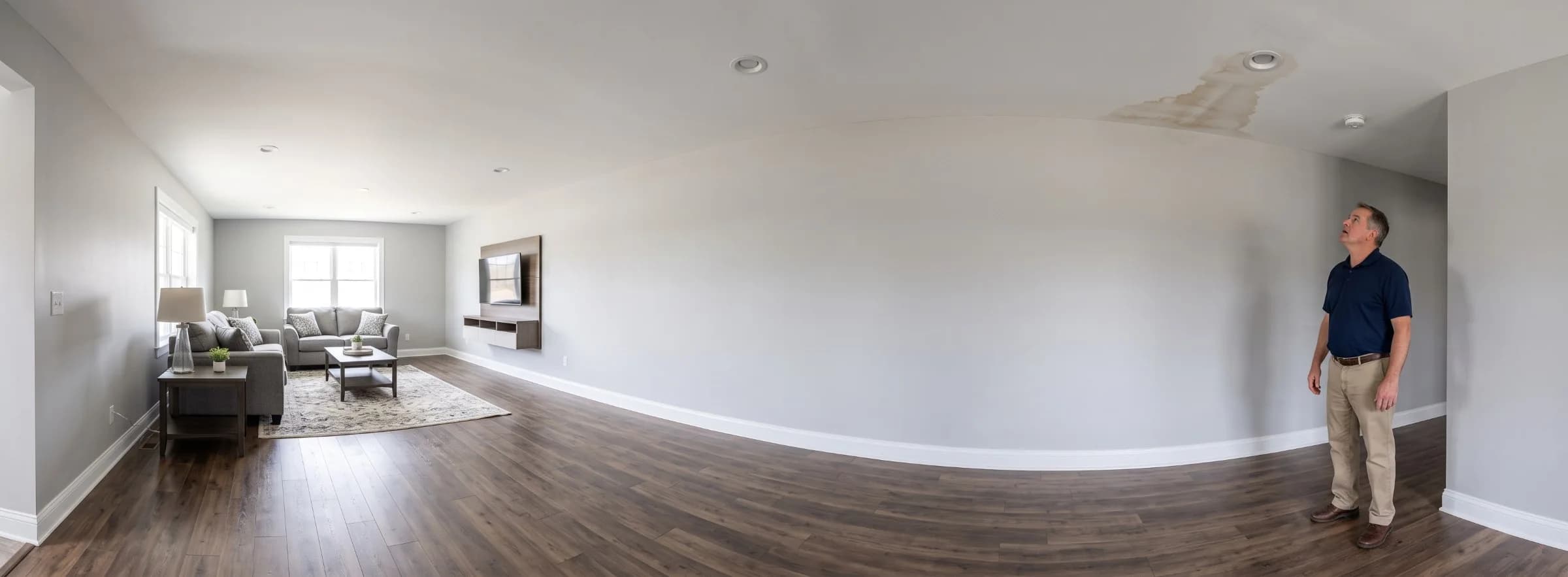

A new house is supposed to be the one home that does not leak, and finding a wet stain on a brand new ceiling can feel like proof that something was done wrong. A builder warranty does pay for some water damage restoration after a covered defect, but the coverage is narrower than most buyers assume, and knowing exactly where the line falls determines whether you call your builder, your insurance company, or both.
A builder warranty, also called a new home warranty or a 1-2-10 warranty, is a contractual promise from a homebuilder to repair specific defects in workmanship, mechanical systems, and structural components for a set period after closing, structured according to the tiered format 2-10 Home Buyers Warranty established and most third-party administrators now follow, and it runs alongside the implied warranty of workmanlike construction that most states impose by law regardless of what the builder's contract says. The 1-2-10 structure sets three separate coverage windows, the repair responsibility usually stops at the failed component rather than the water damage it causes, and most states require written notice to the builder before a defect claim can go to court.
Key insights
- Builder warranties follow a 1-2-10 structure. One year for workmanship and materials, two years for major mechanical and distribution systems like plumbing and electrical, and 10 years for major structural defects, a timeline set by the 2-10 Home Buyers Warranty program and mirrored by most third-party new-home warranty administrators.
- A builder warranty typically covers the defective part, not the water damage it causes. The 2-10 Home Buyers Warranty states plainly that a home warranty will not cover water damage itself, meaning the ruined drywall, flooring, and belongings usually fall to a homeowners insurance claim instead.
- An implied warranty of workmanlike construction exists in most states even without a written contract. This legal protection can cover defects a written builder warranty excludes or has already expired on, though a small number of states allow builders to disclaim it with clear contract language.
- Right-to-repair statutes require written notice before a lawsuit. Most states give the builder 15 to 30 days to respond and 30 to 90 or more days to inspect and offer a repair, and Georgia's Right to Repair Act specifically requires 90 days' notice before a homeowner can file suit.
- FHA, VA, and USDA loans require a 1-year builder warranty on new construction. HUD Form HUD-92544, the Warranty of Completion of Construction, guarantees at least one year of builder responsibility for defects on government-insured new-construction mortgages.
- The statute of repose can bar a claim even after the defect is found. Unlike the statute of limitations, which runs from discovery, the statute of repose runs from substantial completion of the home and cuts off construction defect claims after a fixed number of years, commonly 6 to 10, no matter when the damage appears.
What a builder warranty covers
A builder warranty covers water damage only when it traces back to a defect in workmanship, materials, or a covered system within the warranty's active coverage period, such as a plumbing joint that was never properly soldered or roof flashing installed out of specification. It does not cover water damage caused by normal wear, homeowner neglect, acts of nature, or anything outside the systems the warranty lists, and most builders require the defect to be reported in writing before the applicable coverage window closes.
 IRC Section P2503.7 requires a supply line to hold working water pressure or a 50 psi air test for at least 15 minutes before it can be covered, so a signed test record protects a workmanship claim you may need years later.
Most production builders back their warranty with a third-party administrator such as 2-10 Home Buyers Warranty, which underwrites the workmanship and structural tiers and handles the claims process independently of the builder. A custom or small-volume builder more often carries the warranty directly, backed only by the builder's own balance sheet, which matters if the company goes out of business before the 10-year structural window closes.
Before drywall goes up, the plumbing rough-in is supposed to be pressure tested under IRC Section P2503.7, which requires new water-supply piping to hold either working water pressure or a 50 psi air test for at least 15 minutes before it gets covered by walls or flooring. A joint that fails months later, after the test passed and the walls closed, is exactly the kind of workmanship defect the 1-year warranty tier is designed to catch.
The 1-2-10 structure explained
The 1-2-10 structure divides a builder warranty into three coverage tiers with different lengths, each covering a narrower and more serious category of defect the longer it runs. Workmanship and materials get one year, major mechanical and distribution systems get two years, and major structural defects get 10 years, a format popularized by 2-10 Home Buyers Warranty and now used by most third-party new-home warranty administrators nationwide.
 NAHB's Residential Construction Performance Guidelines treat a foundation crack wider than roughly 1/4 inch as excessive rather than normal curing, so a measured reading like this is what supports or defeats a structural tier denial.
All three tiers start on the same closing date and run concurrently rather than stacking end to end. A homeowner is covered under all three during year one, under only the systems and structural tiers during year two, and under only the structural tier for the remaining eight years of the 10-year window, so a plumbing leak reported in year four falls entirely outside the written warranty and depends on the implied warranty of workmanlike construction instead.
| Warranty tier | Coverage | What it protects | Example |
|---|---|---|---|
| Workmanship and materials | 1 year | Fit and finish defects in materials and installation | A poorly caulked shower pan or a loose supply-line fitting under a sink |
| Major systems | 2 years | Plumbing, electrical, HVAC, and other distribution systems | A slab leak from a copper line laid without adequate protection |
| Major structural defects | 10 years | Load-bearing elements such as the foundation, framing, and roof structure | Foundation cracks wide enough to let groundwater into a basement |
The structural tier only applies to a defect serious enough to meet the technical definition of a major structural defect, not routine settling or cosmetic cracking. NAHB's Residential Construction Performance Guidelines set the reference tolerances most administrators use to judge that line: a foundation crack wider than roughly 1/4 inch, more than about 1/2 inch of levelness variation across any 20-foot span, or foundation plumbness off by more than about 1 inch over an 8-foot vertical measurement are treated as excessive rather than normal curing and settlement.
A homeowner disputing a denied claim involving foundation cracks can ask the administrator to measure against these published tolerances rather than accept a verbal denial. Getting a second, independent measurement before accepting a denial is worth the cost when a structural claim is on the line, since the 10-year tier is the most valuable piece of the warranty in dollar terms.
Scheduling an independent inspection shortly before each tier's coverage window closes, particularly at the one-year mark and again before the 10-year structural window ends, catches slow-developing defects such as a hairline foundation crack or a hidden slab leak while they are still covered. A defect found the week after a tier expires has no warranty remedy at all, regardless of how clearly it traces back to the original construction.
What a builder warranty does not cover
A builder warranty almost never pays to replace the drywall, flooring, insulation, or belongings that a covered leak ruins, since most warranty contracts limit repair to the failed component itself rather than the damage it causes. The 2-10 Home Buyers Warranty program states this directly: a home warranty will not cover water damage itself, which is why the ruined materials around a covered defect usually become a homeowners insurance matter instead.
 The 2-10 Home Buyers Warranty states directly that its policies pay to fix the failed part, not the water damage it causes, so this cabinet interior would fall to a homeowners insurance claim even when the supply line itself is a covered repair.
A builder warranty leaves that repair gap for insurance to fill, since homeowners insurance covers water damage that is sudden and accidental, exactly the category most first-year builder-warranty leaks fall into once the failed part itself has been fixed. Filing both claims in the right order matters: get the builder to repair or replace the defective component under warranty first, then submit the resulting drywall, flooring, and contents loss to the homeowners carrier rather than waiting for the warranty claim to close before starting the insurance claim.
Several other categories fall outside builder-warranty coverage even when they involve water. Damage from a homeowner's own plumbing modification, a skipped maintenance task such as a full winter freeze after the heat was left off, storm and flood water entering from outside the building envelope, and normal condensation on a properly installed system are typically excluded regardless of how recently the home closed. Most contracts also cut off coverage the moment a homeowner or a third-party contractor other than the builder performs unauthorized repair work on the affected system.
The materials most often left stranded between these two coverage gaps are the ones a leak touches directly. Warped drywall around a slow leak, cupped or delaminated engineered flooring under a supply line, and swollen cabinet toe-kicks below a dishwasher connection are common examples that a builder warranty repairs only if the underlying defect is still within its coverage window, and that a homeowners policy otherwise treats as ordinary water-damage repair once the source is fixed.
What to do right now
Acting within the first 24 to 48 hours after finding water damage protects both the builder warranty claim and any related insurance claim, since mold growth and material damage both compound quickly on a warm, wet surface. The order matters: containing the water, documenting the source, and notifying the right party in writing come before repairs start, not after.
 Containing the water within the first 24 to 48 hours protects both claims that follow, since mold growth and material damage compound quickly once a wet surface sits.
1. Stop the water source and contain the damage
Shut off the water supply to the affected fixture or the home's main shutoff valve if the source is unclear, and move furniture and belongings away from the wet area. If the volume of water is significant or electrical outlets are affected, emergency water damage restoration response within the first few hours limits how far the water spreads into subfloors and framing.
2. Photograph and document everything before cleanup starts
Take dated photos and video of the damage, the suspected source, and any visible defect such as a loose fitting or missing flashing, before anyone touches or repairs the area. This documentation supports both the warranty claim and any later insurance claim, and it is difficult to recreate convincingly after the area has dried or been repaired.
3. Notify the builder or warranty administrator in writing
Send written notice, by email or certified letter, describing the defect, the date it was discovered, and the damage it caused, and keep a copy along with any delivery confirmation. Most warranty contracts and state right-to-repair statutes require this written notice within a specific window, so verbal notice alone is not enough to preserve the claim.
4. Bring in a qualified restoration company for anything beyond a small, contained spill
Standing water, wet subfloor or drywall, or any water that sat for more than a few hours before discovery usually needs professional drying equipment rather than fans and towels. Follow the same criteria used when choosing a water damage restoration company for any other loss, since a technician who documents moisture readings and follows the ANSI/IICRC S500 standard gives both the builder and the insurer verifiable proof of the damage's extent.
5. File the insurance claim once the defect itself is being addressed
Contact the homeowners insurance carrier once the builder has acknowledged the defect or repair work has begun, and provide the same documentation gathered in the earlier steps. Repair costs for the resulting damage vary widely by scope, and reviewing typical water damage restoration costs beforehand helps a homeowner evaluate whether a contractor's estimate is reasonable before approving the work.
Every step above still applies even when the defect looks minor at first, since a small leak in new construction is more often the first sign of a defect than an isolated event. A written trail from the moment the damage is found gives both the warranty claim and the insurance claim their best chance of being paid without a dispute over timing or cause.
Causes of new construction leaks
Water damage in a home under a year or two old traces almost entirely back to construction defects rather than aging materials, since nothing in the building has had time to wear out on its own. A supply line pressure tested and passed at rough-in can still fail months later if a fitting was cross-threaded, a nail punctured a line during drywall hanging, or a connection was never fully tightened before the wall closed.
 These building-envelope defects, unlike a supply line failure, often stay hidden until the first heavy rain or hard freeze exposes them, well after the builder's final walkthrough.
Plumbing failures make up the largest share of first-year claims. A burst pipe from a punctured supply line, a cracked PVC drain fitting that was never properly primed, and a water heater connection that loosens as the house settles are the three most common plumbing-related causes builders and warranty administrators see in year one.
Beyond plumbing, several building-envelope and system defects also account for a meaningful share of new-construction water intrusion:
- Roof flashing installed out of specification around vents, chimneys, or valleys
- Window and door units set without proper flashing tape or sill pans
- Grading that slopes toward the foundation instead of away from it
- A sump pump wired or sized incorrectly for the site's water table
- HVAC condensate lines left disconnected or improperly sloped
- A shower pan or tub surround installed without a functioning waterproof membrane
- Foundation cracks from inadequate curing time or reinforcement
Several of these show up only after the first heavy rain or the first hard freeze, which is why a defect can pass a builder's final walkthrough and still surface as window and door flashing leaks or a foundation seep weeks after move-in. Reporting the defect the moment it appears, rather than waiting to see if it recurs, keeps the claim inside the warranty's notice deadline.
Warranty vs. homeowners insurance
A builder warranty and a homeowners insurance policy cover water damage from opposite ends of the same event: the warranty pays to fix the defective component that failed, while insurance pays to repair or replace what that failure damaged. Knowing which one to call first prevents a homeowner from filing a claim that gets denied for being the wrong type of claim entirely.
 Insurers often require proof that the underlying defect has already been corrected before approving payment for damage like this, so a documented moisture reading, taken after the repair, speeds up the second claim rather than delaying it.
When a covered plumbing or system defect causes damage, the builder warranty claim comes first since it addresses the root cause the insurer will otherwise ask about, and filing a water damage insurance claim for the resulting drywall and flooring loss follows once the source is documented as fixed or in progress. Insurers frequently ask for proof that the underlying cause has been corrected before approving payment for repeat or ongoing damage, so sequencing the two claims out of order can delay both.
| Builder warranty | Homeowners insurance | |
|---|---|---|
| What it pays for | Repairing or replacing the failed component | Repairing the resulting damage to structure, contents, and finishes |
| Who administers it | The builder or a third-party administrator like 2-10 HBW | The homeowner's own insurance carrier |
| Typical trigger | A defect in workmanship, materials, or a covered system | A sudden and accidental water event, regardless of cause |
| Cost to the homeowner | Usually no deductible for a covered warranty repair | Subject to the policy's standard deductible |
Neither policy replaces the other, and a homeowner who assumes the builder warranty is a substitute for insurance often discovers the gap only after a claim is denied. The NAIC's consumer guide to home insurance recommends confirming what a standard policy excludes, such as flood water and gradual leaks, before assuming a builder warranty will cover what the policy does not.
A homeowner who is unsure which policy applies can look at the timeline instead of the cause. A defect that existed before the walls closed points to the warranty, while damage from an event after move-in, even one triggered by that original defect, points to insurance for everything except the part that failed.
A failed water heater connection is a useful example of how the split works in practice. The warranty replaces the fitting or unit if it failed from a covered defect within the systems tier, and the insurance claim covers the flooring, cabinetry, and drywall the leak soaked in the meantime.
Builder's risk vs. home insurance
Builder's risk insurance covers the home during construction, typically for 9 to 12 months, and is carried by the contractor or the property owner rather than by a standard homeowners policy, which does not take effect until closing. It usually costs 1% to 4% of the total project value, and IRMI's definition of a builders risk policy describes it as protecting an insurable interest in materials, fixtures, and equipment used in construction until the project is completed and accepted.
 A water event like this falls to a builder's risk policy rather than a homeowners claim, since the coverage IRMI describes as protecting materials and fixtures during construction is the only policy in force before closing.
A water event that happens during construction, such as an unfinished roof exposing framing to a storm, is a builder's risk claim rather than a homeowners insurance claim or a warranty claim, since the warranty period has not started and the homeowner has no insurable interest yet. Confirming who carried the builder's risk policy, and whether it stayed in force through the final walkthrough, matters if water damage is discovered on closing day itself.
The implied warranty explained
An implied warranty of workmanlike construction exists automatically under most states' common law or statutes, regardless of whether the builder offered a written warranty at all. It requires new construction to be built in a reasonably skillful manner and to be fit for its intended purpose as a home, and it can cover a water-damage-causing defect a written warranty has already expired on or never addressed.
This implied protection matters most once a written warranty's shorter tiers have run out, since a defect causing structural water damage years later can sometimes still be pursued under the implied warranty or the separate 10-year structural tier, depending on the state and the specific defect. Some states, including Arizona, have held in court that the implied warranty cannot be waived or disclaimed by contract language, while other states allow a builder to limit or replace it with clear, conspicuous disclaimer language in the purchase agreement.
A claim under the implied warranty still has to be brought within the same statute of limitations and statute of repose that govern any other construction defect claim in that state. Relying on the implied warranty does not buy extra time beyond those deadlines just because no written warranty tier applies anymore.
Right-to-repair notice requirements
Most states require a homeowner to send the builder written notice of a defect and give the builder a chance to inspect and repair it before filing a lawsuit. These right-to-repair statutes typically require notice within a set number of days of discovering the defect, give the builder 15 to 30 days to respond, and allow 30 to 90 or more days for inspection and a repair offer before the homeowner can proceed to court.
Notice periods vary sharply by state, and Georgia's Right to Repair Act is one of the stricter examples, requiring a homeowner to give the builder 90 days' written notice before filing suit over a construction defect, longer than the notice window in most other states. Skipping this notice step, even when the defect is serious and clearly the builder's fault, can get a lawsuit dismissed or delayed until proper notice is given and the waiting period runs.
Documenting the notice matters as much as sending it. A dated letter or email describing the defect, photos of the damage, and a copy of any warranty claim already filed with the builder or administrator all strengthen the homeowner's position if the dispute eventually needs a contractor, an inspector, or an attorney to resolve.
California takes a similarly structured but distinct approach under its own Right to Repair Act, commonly known as SB 800, which assigns different warranty periods by defect type: one year for paint and finish work, four years for plumbing and electrical systems, and 10 years for structural defects, alongside its own pre-litigation notice and inspection procedure. A homeowner should confirm the specific notice period and warranty periods for their own state rather than assume Georgia's or California's timelines apply nationwide, since both the notice window and the underlying coverage periods vary considerably from state to state.
When the builder denies your claim
Most builder warranty contracts route a denied or ignored claim to mediation or binding arbitration rather than allowing an immediate lawsuit, since the purchase agreement typically includes an arbitration clause the buyer signed at closing. Reviewing that clause before escalating a dispute determines whether the next step is a formal arbitration filing, a mediation session, or, in the narrower cases where arbitration was not required, a lawsuit once the right-to-repair notice period has run.
 Most purchase agreements route a denied claim to arbitration rather than an immediate lawsuit, so reviewing this clause before escalating a dispute determines whether the next step is a filing, a mediation session, or court.
Mediation uses a neutral third party to help both sides reach a voluntary agreement and does not bind either party to the outcome, while binding arbitration functions like a private trial: an arbitrator reviews the evidence and issues a decision that is enforceable in court and difficult to appeal. A third-party administered warranty such as 2-10 Home Buyers Warranty typically specifies its own arbitration process in the warranty booklet, separate from whatever process the builder's purchase agreement requires for other disputes.
When arbitration or mediation fails to resolve a legitimate water damage claim, a homeowner still has options outside the warranty itself. Filing a complaint with the state contractor licensing board, requesting a case review from the state attorney general's consumer protection division, or consulting a construction defect attorney before the statute of limitations closes are the paths homeowners typically pursue once the warranty's own dispute process is exhausted.
Statute of limitations vs. repose
The statute of limitations for a construction defect claim runs from when the defect was discovered or reasonably should have been discovered, and it typically gives a homeowner 2 to 6 years to file suit depending on the state. The statute of repose runs on a separate, harder clock measured from the date of substantial completion, typically 6 to 10 years and as long as 15 years in some states, and it bars a claim outright once that period expires regardless of when the damage was found.
These two clocks can produce a result that surprises homeowners: a defect discovered in year 11 of a home with a 10-year statute of repose has no legal remedy against the builder at all, even though the statute of limitations for discovery-based claims would otherwise still be open. Checking the specific state's periods, not just the length of the written builder warranty, is the only way to know whether a legal claim is still possible, and FindLaw's construction defect law comparison by state lists both deadlines side by side.
HUD's 1-year warranty for FHA loans
New construction financed with an FHA, VA, or USDA-insured mortgage requires the builder to sign a 1-year warranty covering workmanship and materials defects, documented on HUD Form HUD-92544, the Warranty of Completion of Construction. This requirement applies regardless of whether the builder also offers its own longer 1-2-10 warranty, and it exists specifically to protect the government's insurance exposure on the loan.
 New construction financed with an FHA, VA, or USDA-insured mortgage requires the builder to sign HUD Form HUD-92544 at this stage, guaranteeing at least one year of responsibility for workmanship defects regardless of any longer warranty the builder also offers.
That obligation is spelled out on HUD Form HUD-92544, which requires the builder to remedy defects reported within the first year after closing, covering the same kind of workmanship issues, including plumbing and roofing defects, that cause early water intrusion. A separate requirement that new FHA-insured homes carry a 10-year insured structural protection plan was made optional rather than mandatory effective March 14, 2019, so a homeowner should confirm directly with the builder or lender whether that longer structural coverage was actually purchased rather than assuming it exists.
A homeowner filing a HUD-92544 claim for a water-related defect should also confirm the repair itself is handled correctly, since a warranty claim number does not exempt the work from local code enforcement. Standard permit requirements for water damage repairs still apply to warranty work exactly as they would to any other repair, and skipping a required permit can create a separate problem at resale even after the water damage itself is long fixed.
Frequently asked questions
Does a builder warranty cover mold caused by a covered leak?
Usually not directly, since most builder warranties exclude mold as a secondary consequence of a defect rather than the defect itself, even when the leak causing the mold is fully covered. The builder is typically only responsible for fixing the plumbing or system defect, while mold remediation and any resulting property damage are handled through a homeowners insurance claim or, in states with stricter builder liability rules, a separate negligence claim.
Is a builder warranty the same as a home warranty?
No, a builder warranty and a home warranty are different products from different points in a home's life. A builder warranty comes from the company that built the home and covers construction defects under the 1-2-10 structure, while a home warranty is a service contract a buyer purchases separately to cover the repair or replacement of aging appliances and systems, regardless of who built the house or when.
What happens to the builder warranty if the builder goes out of business?
It depends on whether the warranty was administered by a third party. A warranty backed by an independent administrator such as 2-10 Home Buyers Warranty generally continues to honor claims even if the builder closes, since the administrator, not the builder, holds the financial obligation, while a builder-direct warranty with no third-party backing typically becomes unenforceable once the company dissolves.
Can a new home have water damage before the buyer even closes?
Yes, and that damage is usually a builder's risk insurance matter rather than a builder warranty or homeowners insurance claim. Builder's risk insurance covers the structure during construction, so water intrusion discovered at the final walkthrough or during the punch-list period should be reported to the builder immediately rather than assumed to be covered once the homeowners policy takes effect at closing.
Does homeowners insurance start on the day of closing for a new home?
Yes, but the coverage starts at the specific time written into the policy, not automatically at midnight, so a gap of a few hours between recording the deed and the policy's stated effective time is possible. Asking the insurance agent to confirm the exact effective time, and having the title company record closing before that time, closes this gap rather than assuming same-day coverage is automatic.
How long does a builder have to fix a warranty-covered water leak?
There is no single national deadline, since two different clocks can apply and they do not always match. A third-party administered warranty often resolves a straightforward defect claim within about 30 days on its own, separate from and usually faster than the state's right-to-repair statute, which sets a longer window for anything that escalates toward a lawsuit.
Does the 10-year structural warranty cover a leaking basement?
Only if the leak stems from a major structural defect, such as a foundation wall that was poured or reinforced incorrectly, rather than routine basement moisture or a non-structural waterproofing failure. A leak from a cracked but non-structural foundation coating, a missing exterior drain, or ordinary hydrostatic pressure typically falls to the shorter systems tier, a homeowners insurance claim, or a separate waterproofing contractor rather than the 10-year structural coverage.
Do I need to disclose a builder warranty water damage claim if I sell the home?
Yes, most states require disclosing any known water damage history, including a repaired defect covered under a builder warranty, when selling within the disclosure period the state sets. The rules for disclosing water damage when selling a home generally treat a repaired builder-warranty claim the same as any other repaired water event, so keeping the warranty repair paperwork on file supports an accurate disclosure later.
What voids a builder warranty on a water-related repair?
Skipping required maintenance, such as winterizing during a vacancy or annual HVAC servicing, and making unapproved renovations to a covered system are common causes of a voided claim beyond the defect itself. Repairing the affected system before the builder has a chance to inspect it also voids coverage for that specific defect, which is why documenting the damage before touching it matters as much as reporting it.
Should I hire my own restoration company or wait for the builder to send one?
Hire your own promptly if water is actively spreading, since waiting for the builder's preferred vendor can allow damage to spread into subfloors, framing, and adjoining rooms while the claim is still being processed. A water damage restoration checklist followed by an independent, properly documented company protects the homeowner's position either way, since the builder's warranty claim is not affected by who performs the mitigation work as long as the defect itself is reported promptly.
- 2-10 Home Buyers Warranty: Does a Home Warranty Cover Water Damage?
- HUD Form HUD-92544: Warranty of Completion of Construction
- IRC Section P2503.7: Water-Supply System Testing
- NAIC: A Consumer's Guide to Home Insurance
- Georgia Attorney General: Right to Repair Act
- NAHB: Residential Construction Performance Guidelines
- IICRC S500: Standard for Professional Water Damage Restoration
- IRMI: Builders Risk Policy Definition
- FindLaw: Construction Defect Laws by State
Sam Hickerson is the founder of RestoreAdvisor and writes consumer guides on mold remediation, water damage restoration, inspection, testing, and home recovery. His work focuses on helping homeowners understand costs, risks, and when to call a professional. He draws on guidance from the EPA, CDC, IICRC, and other authoritative sources to make complex home issues easier to navigate.