
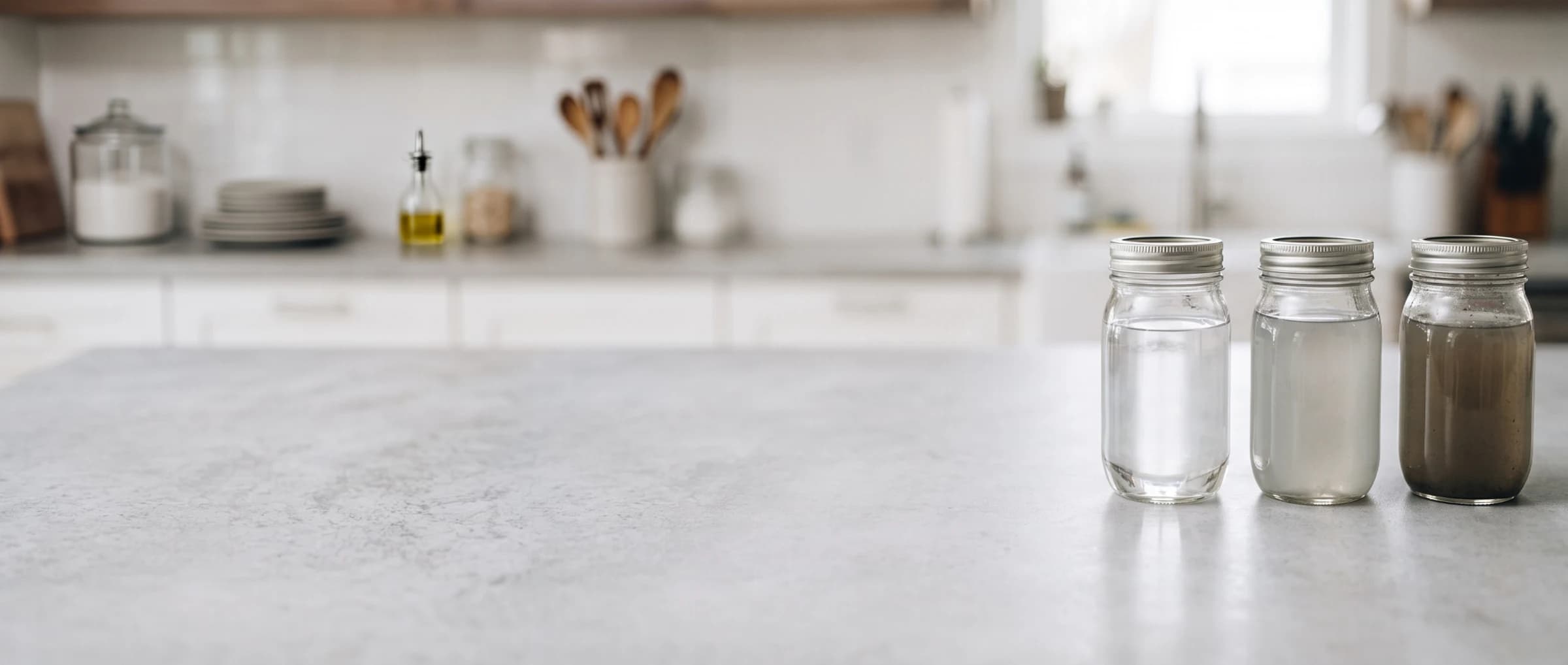

A technician tells you the loss is category two, or your insurance adjuster mentions category three in an email, and neither term means much until someone explains it. The category attached to your water damage determines the safety precautions required, which materials get pulled out versus dried in place, and how the claim gets documented, so it is worth understanding before any water damage restoration work starts.
Water damage categories are the three-tier contamination classification defined by the ANSI/IICRC S500 Standard for Professional Water Damage Restoration, ranking water from Category 1, clean and sanitary, through Category 3, grossly contaminated black water, based on its source and what it has contacted. Once the category is confirmed, everything else, from protective equipment to material removal to how the claim gets filed, follows from that one number.
Key insights
- Three categories, one standard. IICRC S500 defines water damage by contamination level: Category 1 (clean), Category 2 (gray), and Category 3 (black), independent of how much water is present.
- Categories can worsen without new water entering. Category 1 water left standing 24 to 48 hours can develop microbial growth and reclassify to Category 2, and Category 2 water can reach Category 3 in a similar window.
- Color is not a reliable indicator. Clear-looking water can carry contamination from what it traveled through, and murky water is not automatically Category 3.
- Category 3 requires full material removal. Under IICRC S500, porous materials that contact black water, including drywall, carpet, padding, and insulation, are removed rather than dried, with no exception for cost or limited exposure.
- Category and class measure different things. Category describes contamination; class, numbered 1 through 4, describes how much of the structure absorbed water and how hard it will be to dry.
- The category shapes the insurance claim. Category 3 losses typically require more detailed source documentation and are more likely to draw adjuster scrutiny than a Category 1 supply-line break.
What are water damage categories?
Water damage categories are a three-level classification system that ranks water intrusion by how contaminated the water is, not by how much of it there is or how far it spread. Every water loss gets assigned a category from 1 to 3 under IICRC S500, based on its originating source and the quality of that water after it contacts building materials, soil, or other contaminants on-site.
 The category assigned during this initial walkthrough follows the job through the scope of work, moisture logs, and the insurance claim, so getting it right on the first visit matters more than it looks.
The category is separate from the extent of the damage. A small Category 1 leak and a large one are still the same category, since category answers a contamination question, not a volume question, and that distinction drives which safety measures and materials decisions apply from the first visit.
The number shows up in more places than the initial inspection. It appears on the technician's scope of work, on the moisture logs used to confirm the job is dry, and often on the insurance claim itself, since an adjuster reviewing a water loss will typically ask what category was assigned and how it was documented. A homeowner who understands what the number means can read that paperwork instead of taking it on faith.
The three water damage categories
IICRC S500 defines three categories, each with its own sources, health risk profile, and materials-handling rule. The standard's current edition refers to them by number rather than by the clean, gray, and black water labels, though those labels remain in wide use across the restoration industry because they describe the same three tiers in plainer language.
 IICRC S500 ties each category to a risk profile and typical sources, not to how much water is present, so a small Category 3 loss carries the same handling requirements as a large one.
Confirming the category is usually a technician's first documented decision on-site, made before extraction equipment is even unloaded, since it determines which protective precautions, containment steps, and disposal rules apply to everything that follows.
| Category | Contamination level | Materials handling |
|---|---|---|
| 1: clean water | No significant contamination at the time of loss | Most porous materials can be dried in place if extraction starts within 24–48 hours |
| 2: gray water | Significant chemical, biological, or physical contamination that can cause illness on contact | Porous materials that absorbed the water are typically removed rather than dried in place |
| 3: black water | Grossly contaminated, carrying pathogenic or toxigenic agents | All porous materials in contact with the water are removed, no exceptions under IICRC S500 |
Category 1: clean water
IICRC S500 defines Category 1 water as originating from a source that carries no meaningful contamination at the moment of loss. It's the only category where drying materials in place is the default approach rather than the exception, provided extraction starts before the water has time to sit.
Category 1 sources include:
- Supply line failures
- A refrigerator leak from a cracked ice maker line
- A clean tub or sink overflow
- Melting snow or ice entering through a roof gap
- Rainwater entering before it contacts soil or roofing debris
- A broken toilet tank with no additives or contaminants
Category 2: gray water
IICRC S500 defines Category 2 water as carrying a significant degree of contamination capable of causing illness or discomfort on contact. Porous materials it touches are typically removed rather than dried, since the contamination sits inside the material itself.
Category 2 sources include:
- Discharge or hose failure causing washing machine water damage
- A discharge line failure causing dishwasher leak water damage
- Sump pump failure
- A toilet overflow with urine but no solids
- Hydrostatic seepage under pressure
- Category 1 water left standing 24–48 hours
Category 3: black water
IICRC S500 defines Category 3 water as grossly contaminated, carrying pathogens such as E. coli, Salmonella, hepatitis A, and norovirus. Every porous material this water touches is removed, with no exception under the standard.
Category 3 sources include:
- A sewage backup reaching the structure
- Toilet backflow that began beyond the trap, regardless of visible contents
- Rising water or storm surge causing flood water damage
- River or stream water entering the structure
- Category 2 water left untreated 24–48 hours or longer
Can a water damage category get worse over time?
Yes. Water damage categories are not fixed at the moment of the event; they escalate as time passes and conditions change, and a category never downgrades on its own. Category 1 water typically has a 24 to 48 hour window before microbial activity and contact with building materials push it into Category 2, and Category 2 water can degrade into Category 3 on a similar timeline.
 Water sitting for 24 to 48 hours is the window IICRC S500 uses to mark reclassification, and the higher the staining climbs, the longer it likely sat before anyone found it.
Temperature and humidity accelerate the process. Warm, humid conditions, common across much of the year in a state like California's Central Valley, shorten the window in which clean water stays clean, since bacteria and mold spores already present in building materials multiply faster in warmth. Contact matters too: water that spreads across a floor and picks up soil, pet waste, or a previously contaminated surface can jump categories even without any new water entering the structure.
Delay has a financial consequence as well as a health one. A Category 1 job that gets extraction and drying started within a day or two costs a fraction of what the same leak costs once it degrades into Category 2 or 3, since mandatory material removal adds labor and disposal expense a drying-only job never needed.
Water damage categories vs classes
Category and class measure two different things, and mixing them up is a common source of confusion when reading a restoration estimate. Category describes how contaminated the water is, while the classes of water damage, numbered 1 through 4, describe how much of the structure and its contents absorbed water and how difficult that moisture will be to remove.
The two ratings move independently of each other. A Category 1 supply line break can still be a high class if it saturates carpet, subflooring, and drywall across an entire room, while a confined Category 3 sewage backup in a small bathroom might carry a lower class rating by volume alone. An estimate that lists both a category and a class number is describing contamination and saturation separately, not restating the same fact twice.
| Category answers | Class answers |
|---|---|
| Is this water a health hazard? | How much of the structure absorbed water? |
| What protective equipment does the crew need? | How many drying days should this take? |
| Does this material get dried or thrown out? | Does drywall need to come out for airflow? |
| What does the insurance file need to document? | How much equipment needs to run at once? |
How is the water damage category determined?
A technician determines the water damage category primarily by identifying its source and history, not by how the water looks. The assessment traces where the water originated, what it contacted on its way into the structure, and how long it has been present, then matches those facts against the same IICRC S500 category definitions a technician studies while earning water damage restoration certifications.
 A moisture reading at the suspected source, paired with what the water contacted on its way in, is what settles the category on most jobs, not a lab test.
Laboratory pathogen testing exists but is rarely used for a standard residential loss; it tends to appear only in disputed insurance claims where the source is genuinely unclear. For most jobs, a documented source, a clean supply line versus a sewage line versus floodwater, settles the category without lab work. The technician typically backs up that call with photos of the source, moisture meter readings at the point of origin, and notes on how long the water is believed to have been present, all of which become part of the file if the claim is ever questioned.
This is part of why documentation matters so much for a claim, and it is one of the things worth confirming when you choose a water damage restoration company: ask how they document the source and category, not just what number they assign.
Homeowners can make a reasonable guess for an obvious Category 1 event, a burst supply line no one has walked through, but should not attempt to self-classify anything involving a floor drain, a toilet, floodwater, or an unknown source, since misjudging the category creates both a health risk and a documentation gap for the insurance claim.
A few common situations and where they typically land:
| Scenario | Likely category | What it means for restoration |
|---|---|---|
| Refrigerator ice maker line leak, found the same day | 1 | Minimal removal, most materials can be dried in place |
| Leak behind a bathroom vanity that went unnoticed for a week | 1, reclassified to 2 | Removal instead of drying, plus disinfection, purely because of how long it sat |
| Foundation seepage after heavy rain tracks across a basement floor | 2 | Cleaning and disinfection of the slab, plus a contents check for anything stored directly on the floor |
| Upstairs tub overflow that leaks through the ceiling below | 1 at the source | Ceiling and possibly flooring removal despite the clean source, since the water traveled through multiple assemblies |
| Sewer line backup reaching a finished basement | 3 | Full PPE, complete material removal, and the most insurance documentation of any scenario here |
What each category means for materials and cleanup
Category determines whether a wet material gets dried in place or removed, and that decision happens early in the water damage restoration process, often before drying equipment is even set up. A handful of material types make up most of the removal decisions on any job, regardless of category.
 Porous materials like carpet padding and insulation rarely survive any category of water contact, while non-porous materials like concrete and tile are usually salvageable regardless of category.
Carpet padding
Padding absorbs water like a sponge and rarely survives contact with anything above Category 1, and even Category 1 padding left wet more than a day or two is usually replaced rather than dried, since it is inexpensive relative to the labor of drying it thoroughly.
Insulation
Wet insulation loses its thermal value and, in fiberglass batts, tends to compress and mat once saturated. Any category of water contact typically means replacement rather than drying.
Drywall below the waterline
Drywall that absorbed Category 2 or 3 water is usually cut out in a technique called a flood cut, removed a foot or more above the visible water line to reach material the water wicked into but that is not visibly wet.
Hardwood flooring
Solid hardwood can sometimes be dried and refinished after Category 1 exposure if cupping is minor and drying starts quickly, but engineered flooring with a particleboard core rarely survives any category of standing water.
Concrete and tile
Non-porous materials like concrete, tile, and most stone can usually be cleaned and disinfected rather than removed, even after Category 3 exposure, since the water does not penetrate the material itself.
Materials removed after Category 2 or 3 exposure are typically double-bagged and labeled before leaving the property, a step that protects everyone who handles the debris afterward and gives the restoration company a record of what was removed if the insurance claim later asks for an itemized list.
Health risks and safety precautions by category
Health risk rises with category, and the protective equipment a technician wears reflects that. Category 1 work typically calls for basic protection, gloves and eye protection, since the exposure risk is low, though the EPA recommends an N-95 respirator at minimum once mold growth is a possibility on any job that has sat unaddressed.
Category 2 work adds waterproof boots and more consistent glove use, since the water can carry bacteria capable of causing gastrointestinal illness on contact.
Category 3 work calls for the fullest protection: full-body protective suits, respirators with the appropriate cartridge rating, and disposal protocols for anything the water touched, an approach that mirrors the universal-precautions principle behind OSHA's Bloodborne Pathogens Standard even though that specific regulation governs workplace blood exposure rather than residential water restoration.
 This level of protection, full suit and cartridge respirator, is specific to Category 3 work; a Category 1 supply-line leak calls for gloves and eye protection, not a hazmat suit.
Containment barriers, negative air pressure, and controlled access to the affected area become standard once a job moves past Category 1, and a homeowner should expect a technician to explain which parts of the home are off-limits until the category-appropriate cleanup is complete.
Households with young children, older adults, pregnant occupants, or anyone with a compromised immune system or respiratory condition face elevated risk from any category once mold or bacteria have had time to establish, since these groups are more susceptible to the health effects the CDC associates with mold exposure. This is one of the reasons speed matters even on a Category 1 loss in a household with a vulnerable occupant, and it is worth telling the technician up front so containment and drying can be prioritized in occupied rooms first.
How category affects cost and insurance
Category is one of the biggest cost drivers on a water damage job, since higher categories require more material removal, more disposal, and more PPE and containment than a comparable Category 1 loss of the same size. Category 1 mitigation for a single contained area often runs a few hundred to a couple thousand dollars, while Category 3 work commonly starts several thousand dollars higher for a comparable footprint, largely because mandatory removal replaces what would otherwise be a drying-only job.
Insurance treats categories differently as well. Most policies cover sudden and accidental water damage regardless of category, but Category 3 claims, particularly sewage backups, often require more detailed documentation of the source and are more likely to draw adjuster scrutiny than a straightforward supply-line break. Some policies also carry a separate sewage or water-backup endorsement that specifically applies to Category 3 losses, which is worth confirming with your insurer before assuming a Category 1 policy limit applies across the board. Category is only one input into water damage restoration cost, alongside class, room, and square footage, so two Category 1 jobs of very different sizes can land far apart on price.
Frequently Asked Questions
Is black water the same thing as Category 3 water?
Yes. Black water is the informal name for Category 3 water under IICRC S500, the grossly contaminated tier that includes sewage backups, floodwater, and any lower category left untreated long enough to develop pathogenic contamination.
Can I clean up Category 2 or Category 3 water myself?
No, this is not recommended. Category 2 and Category 3 water require protective equipment, antimicrobial treatment, and material removal decisions that go beyond typical homeowner tools, and contact with Category 3 water carries a real risk of illness.
How do restoration companies determine the water category?
By source and history, not appearance. A technician traces where the water came from, what it contacted before reaching living space, and how long it sat, then classifies it against the IICRC S500 definitions.
Is there a Category 4 water damage?
No. IICRC S500 defines only three water damage categories. People sometimes confuse this with the separate four-tier class system, which describes saturation rather than contamination, or with hurricane category ratings, which are an unrelated scale.
Does insurance treat all three water damage categories the same way?
No, and the practical difference is mostly about documentation rather than coverage itself. A Category 1 claim usually settles on photos and a stated cause, while a Category 3 claim, especially a sewage backup, typically needs a professional's written source determination before an adjuster will approve it.
What happens if the water source can't be identified?
Technicians default to the more conservative, higher-risk category when the source is unclear or when the water has contacted soil, floodwater, or an unknown surface, since underestimating contamination creates a bigger safety and liability problem than overestimating it.
Does murky or discolored water always mean Category 3?
No. Color and clarity are not reliable indicators of category. Clear-looking water can carry contamination it picked up from a wall cavity or crawl space, and rust-tinted water from an iron-heavy supply line is often still Category 1.
Can a Category 1 water loss still lead to mold?
Yes. Category 1 water that sits for more than 24 to 48 hours creates the moisture conditions mold needs to establish, regardless of how clean the water was at the source, which is why speed matters even on a supply-line break.
Is a professional assessment necessary for a small Category 1 leak?
It depends on how far the water traveled. A leak confined to a visible, easily dried surface may not need one, but water that reached wall cavities, subflooring, or baseboards is worth a professional check, and confirming how a company documents source and category is one of the questions to ask a water damage restoration company before that visit even happens.
Sam Hickerson is the founder of RestoreAdvisor and writes consumer guides on mold remediation, water damage restoration, inspection, testing, and home recovery. His work focuses on helping homeowners understand costs, risks, and when to call a professional. He draws on guidance from the EPA, CDC, IICRC, and other authoritative sources to make complex home issues easier to navigate.