
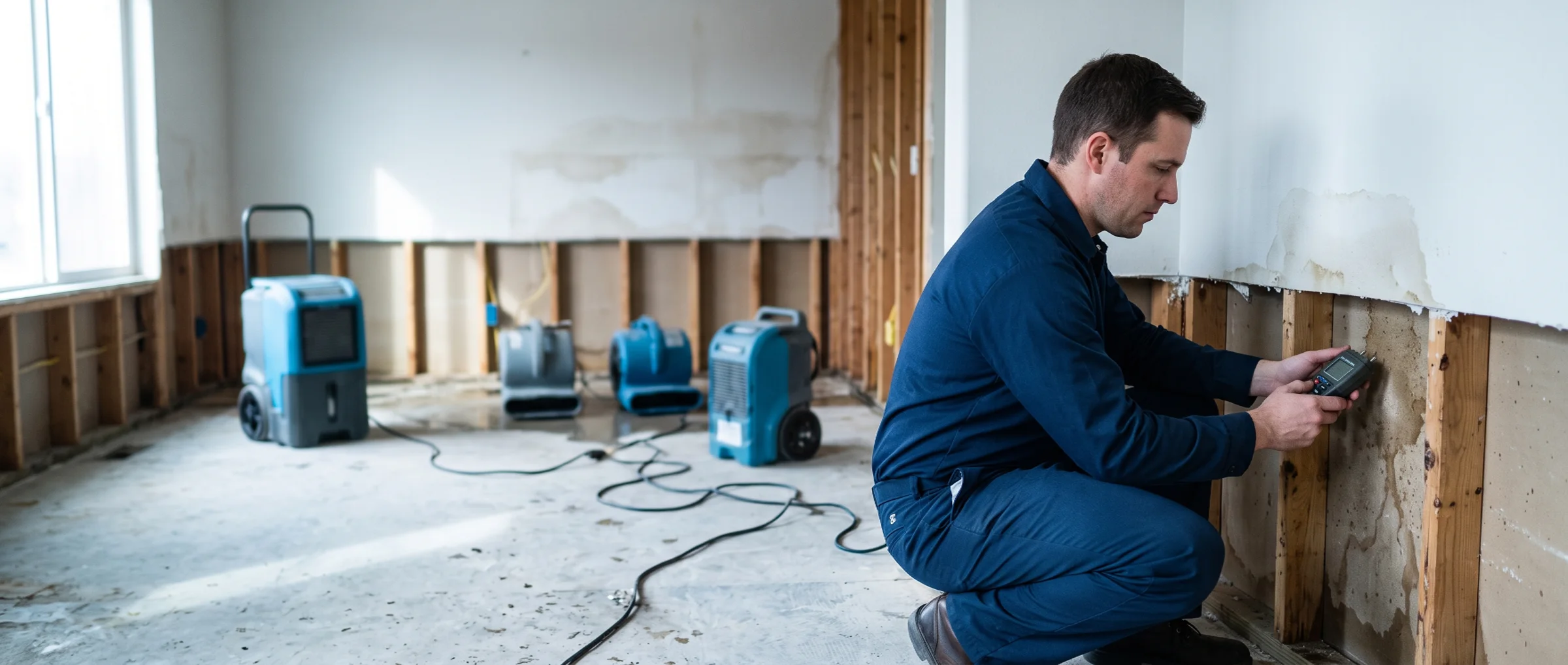

A company truck advertising "IICRC certified" doesn't say which technician on the crew actually holds the credential, or whether it's still current. That's easy to miss when you're comparing quotes from a few companies and trying to separate a genuinely qualified crew from one just repeating industry jargon. WRT, ASD, AMRT, and the rest each verify a different, specific skill set, and once you understand what separates them, "are you certified" becomes a question with a real, checkable answer.
A company can hold IICRC Certified Firm status as a business while sending an uncertified technician to your specific job, since the two credentials run under different rules entirely. Knowing the difference between WRT, ASD, and AMRT, what the Master Water Restorer (MWR) designation actually requires, and how to check a certification's status in under a minute turns hiring from a guessing game into a clearer sense of what to expect during water damage restoration once work begins.
Key insights
- WRT is the entry point. The Water Damage Restoration Technician certification has no prerequisites and covers the foundational drying science every water damage technician should know.
- A firm only needs one certified technician. IICRC Certified Firm status requires at least one active Certified Technician on staff, current liability insurance, and agreement to the IICRC Code of Ethics, not that every crew member holds a credential.
- Master Water Restorer is rare. Earning it requires WRT, CCT (or CCMT), RRT, ASD, AMRT, and HST certifications plus a minimum of three consecutive years as an IICRC-certified technician. Only 3.7% of IICRC's constituents have reached it.
- Certifications aren't licenses. IICRC credentials verify technical training, not legal authority to operate. Most states don't license water damage technicians specifically, though contractor licensing can apply to the rebuild phase.
- Renewal takes ongoing coursework. Technicians must log 14 continuing education hours every four years to keep a base certification active, information you can check against a stale-looking credential.
- The IICRC's locator tool is free to search. It confirms whether a firm's certification is currently active, but it won't tell you whether the specific technician sent to your house holds a matching credential.
What a water damage restoration certification actually confirms
A water damage restoration certification is a credential, most commonly issued by the IICRC, that verifies a technician has completed standardized coursework and passed an exam covering the procedures in ANSI/IICRC S500, the accredited standard for professional water damage restoration. It doesn't confirm a company's business practices, pricing, or customer service. It confirms that the person holding it has been tested on water categories, drying science, and structural assessment.
 A visible water stain radiating from a single point, rather than scattered mottled discoloration, is one visual cue technicians use to distinguish active water damage from mold that has already taken hold.
Confirming that distinction matters most in the early hours after water damage restoration begins, when decisions about extraction equipment, material removal, and drying targets are already being made by whoever shows up. A homeowner who knows what WRT or ASD actually means can ask a more specific question than "are you certified," and get an answer that reveals whether the technician's training matches the job in front of them.
The core IICRC certifications for water damage
Six IICRC certifications cover the skills most relevant to a residential water loss, and each one builds toward a different part of the job, from initial extraction through mold-adjacent contamination and final flooring repair. Most companies build technicians up through these certifications in a rough sequence rather than all at once, starting with WRT before adding ASD or AMRT as a technician takes on larger, more contaminated, or more complex losses, so a technician's certification list is a reasonable proxy for the range of jobs they're actually prepared to handle.
| Certification | What it covers | Needed for MWR |
|---|---|---|
| WRT (Water Damage Restoration Technician) | Water categories and classes, extraction, basic psychrometry, drying equipment selection | Yes |
| ASD (Applied Structural Drying) | Advanced drying science, moisture mapping, complex drying plan development | Yes |
| AMRT (Applied Microbial Remediation Technician) | Mold-adjacent contamination control, containment, and remediation procedures | Yes |
| HST (Health and Safety Technician) | Jobsite safety, PPE selection, hazard recognition on contaminated losses | Yes |
| CCT or CCMT (Carpet Cleaning Technician / Master Technician) | Carpet fiber identification and cleaning methods relevant to water-affected flooring | Yes |
| RRT (Repair and Reinstallation Technician) | Flooring and carpet repair, reinstallation after drying is complete | Yes |
None of these certifications are legally required to operate a restoration business. The HST certification ties into OSHA's Bloodborne Pathogens standard, which governs the PPE and exposure controls a technician needs when handling Category 3 water.
They're voluntary credentials that companies pursue to demonstrate technical competency, and holding more of them doesn't automatically raise water damage restoration cost, since pricing is driven more by category, class, and scope than by which credentials a crew holds.
IICRC Certified Firm status versus individual technician certification
IICRC Certified Firm status is a business-level credential, separate from any individual technician's certification, that requires a company to employ at least one active Certified Technician, maintain current liability insurance, and agree to the IICRC's Code of Ethics and complaint resolution policy. Firms pay a prorated application fee plus $25 to enroll, and $199 annually to keep the status active.
 A company's IICRC Certified Firm status only requires one individually certified technician on staff, so the crew sent to a job can include members without a matching credential of their own.
The distinction matters because the two credentials answer different questions. Certified Firm status tells you the business meets a baseline of insurance and ethics standards. Whether every technician it sends to a job is individually certified is a separate question entirely. Individual technician certification, WRT, ASD, AMRT, and the rest, tells you what training the specific person doing the work has completed. A homeowner checking only one of these gets half the picture, and certification is just one line on a longer water damage restoration checklist worth working through before signing anything.
| Requirement | Certified Technician | Certified Firm |
|---|---|---|
| Who it applies to | An individual employee | The business as a whole |
| Minimum standard | Passed course and exam | Employs at least one certified technician |
| Insurance requirement | Not applicable | Current liability insurance required |
| Renewal | 14 CE hours every 4 years | $199 annual fee |
An IICRC certification belongs to the individual technician who earned it, not the company that employs them. If a certified technician leaves, their certification leaves with them, and the business's Certified Firm status then depends on whichever other certified employee remains on staff. A company's website listing certifications should reflect technicians currently on payroll rather than credentials carried over from someone who left months or years earlier.
What the WRT certification covers
The Water Damage Restoration Technician certification trains technicians to classify a water loss by category and class, extract standing water, apply basic psychrometry, and select the right drying equipment for a residential or commercial job. It has no prerequisites, and it's usually the first certification a technician earns before pursuing anything more advanced.
 Carpet padding is pulled and discarded in most water losses since it retains moisture even after face-fiber extraction, one of the practical judgment calls covered in WRT training.
The WRT course covers the water damage categories, the four classes of water loss based on absorption and evaporation load, and the basic psychrometric principles that determine how many air movers and dehumidifiers a room needs. It also covers documentation practices technicians use to support insurance claims, and procedures for explaining category and class findings to an adjuster. Because there are no prerequisites, a company advertising WRT-certified staff is only confirming a baseline level of training; years of field experience is a separate claim entirely.
WRT is the specific technician-level credential that separates an individually certified technician from a company that merely employs one certified person somewhere on staff. Asking which technician assigned to your job holds it, by name if possible, is how that distinction becomes a useful question rather than an abstract one.
Insurance carriers and third-party administrators that run preferred-vendor programs commonly require at least WRT certification as a minimum standard before a company can qualify, regardless of how long that company has been in business. That requirement comes from the insurer rather than the IICRC, and it varies by carrier, but it's a large part of why WRT has become close to a baseline expectation in practice.
Certified water restoration technician: what the term actually means
"Certified water restoration technician" describes IICRC's WRT credential in plain language, but it isn't the credential's formal name, and the phrase is also used by at least one unrelated training provider for a different certificate entirely.
IICRC's actual certification is called Water Damage Restoration Technician, abbreviated WRT. No IICRC credential is formally named "certified water restoration technician." Separately, an online training company called IAQCert markets its own assessment-based program under the name Certified Water Damage Restoration Technician, or CWDRT, which has no affiliation with the IICRC, ANSI, or any IICRC-recognized standard. A card or website listing "CWDRT" refers to a credential issued by that separate organization under a similar-sounding name, unconnected to IICRC's WRT.
If a technician's certification isn't identified by a specific abbreviation you can look up, WRT, ASD, AMRT, or another recognized credential, and is instead described only as "certified water technician" with no named issuing body attached, ask directly which organization issued it before treating it as equivalent to IICRC certification.
Applied Structural Drying and Applied Microbial Remediation Technician certifications
Applied Structural Drying (ASD) and Applied Microbial Remediation Technician (AMRT) are advanced IICRC certifications that build on WRT fundamentals, with ASD focused on complex drying calculations and AMRT focused on mold-adjacent contamination control. Both matter most on losses more complicated than a straightforward, quickly caught leak.
 Thermal imaging highlights temperature differences that indicate trapped moisture behind drywall, one of the moisture-mapping skills covered under ASD certification.
Applied Structural Drying (ASD) covers the psychrometric calculations, moisture mapping, and drying plan adjustments needed for complex or large-scale losses, such as flood water damage across multiple rooms or jobs involving dense building materials that trap moisture. A technician with ASD certification is trained to recalculate a drying plan mid-job when moisture readings don't drop as expected, rather than running the same equipment on a fixed schedule regardless of results.
Applied Microbial Remediation Technician (AMRT) certification covers containment construction, cross-contamination prevention, and remediation procedures for mold-adjacent losses. Because Category 2 and 3 water damage can trigger microbial growth within the same 24 to 48 hour window that drives most water damage timelines, a technician with both WRT and AMRT training is better positioned to catch early mold signs during extraction rather than treating mold after water damage as a separate problem discovered later.
Neither certification is required for every water loss. A straightforward Category 1 leak caught within hours rarely needs ASD-level drying calculations or AMRT-level contamination controls. A multi-day sewage backup cleanup, standing floodwater, or a job where drying stalls after the first few days is a different story, and that's when it's worth asking specifically whether the assigned technician holds these certifications, not just WRT.
The Master Water Restorer designation
IICRC's Master Water Restorer (MWR) designation is the most advanced water damage credential it offers, and earning it requires combining six separate certifications rather than any single one. The path runs through two stages: WRT, CCT (or CCMT), and RRT certifications combined with at least 12 consecutive months as a certified technician earn the Journeyman Water Restorer credential; adding AMRT, HST, and ASD certifications on top of a minimum of three consecutive years as an IICRC-certified technician completes the Master Water Restorer designation.
Only 3.7% of IICRC's constituents have reached this level, which makes it a meaningful signal of sustained field experience rather than a company-wide requirement. A company without an MWR-designated technician on staff isn't necessarily under-qualified for a standard residential loss; the designation matters more on large-loss or unusually complicated jobs where a technician needs to draw on years of combined training rather than a single course.
Other credentials and state licensing requirements
Beyond the IICRC, the Restoration Industry Association (RIA) and the American Council for Accredited Certification (ACAC) both issue parallel restoration certifications, and state contractor licensing applies separately from any of these credentials. None substitutes for the others, so checking only one still leaves gaps in what you actually know about a company.
 A well-equipped, organized service vehicle is a rough visual indicator of an established operation, though it says nothing about state contractor licensing, which is verified separately from any IICRC, RIA, or ACAC credential.
The Restoration Industry Association issues its own certifications, including the Water Loss Specialist (WLS) designation and the Certified Restorer (CR), a senior-level credential that combines examination, documented field experience, and adherence to RIA's own code of ethics. RIA credentials aren't a substitute for IICRC training; they run on a parallel track and are more common among project managers and company owners than field technicians, since CR in particular emphasizes leadership and business practice over hands-on technique.
The American Council for Accredited Certification (ACAC) is a separate certifying body active in structural drying, best known for its Council-certified Residential Structural Dryer (CRSD) credential. ACAC-certified technicians are tested on many of the same drying principles as IICRC's WRT and ASD certifications, and the two aren't mutually exclusive; some technicians hold both. A company citing ACAC certification instead of IICRC is offering a comparable credential issued by a different certifying body, and it's reasonable to ask the same verification questions of either.
State contractor licensing sits alongside both credentialing systems and covers different ground entirely. Certifications are one factor in choosing the best water damage restoration company, but they don't replace confirming state-specific licensing where it applies, particularly for the reconstruction phase once drying is complete. Most states don't issue a license specific to water damage mitigation, but general contractor licensing typically applies once a job moves from drying into rebuilding damaged drywall, flooring, or framing. A handful of states also require a separate license for mold remediation work performed after a water loss, regardless of whether the technician already holds an AMRT certification.
How to verify certifications before hiring a company
Verifying certifications is one part of choosing the best water damage restoration company, and it takes five checks: confirming active status through IICRC's locator tool, identifying the specific technician assigned to your job, checking that certification hasn't lapsed, confirming any state licensing that applies separately, and watching for specific signs of a misrepresented credential.
 The IICRC's free online locator confirms whether a company's Certified Firm status and individual technician credentials are currently active before any contract is signed.
1. Search the IICRC Global Locator
The IICRC maintains a free online locator that shows a firm's Certified Firm status and lists individual technician credentials on file. Searching the company's name before signing a contract confirms the certifications on their website or truck lettering are actually current, not expired or self-reported.
2. Ask which technician is assigned to your job
Certified Firm status doesn't guarantee that the specific person arriving at your house is individually certified. Ask by name, or at minimum by certification level, which technician will handle the extraction and drying, and confirm that matches what the locator tool shows.
3. Confirm the certification hasn't lapsed
A WRT card earned five years ago with no recorded continuing education may no longer be active. IICRC requires 14 CE hours every four years for base certifications, and the locator tool reflects current status, not just whether someone once passed the exam.
4. Check state contractor licensing separately
IICRC certification and state licensing come from entirely separate authorities. Confirm whether your state requires a general contractor or specialty license for the reconstruction portion of the job, since a water damage restoration certification alone doesn't authorize that work everywhere.
5. Watch for these specific red flags
A certificate photographed or framed on a wall proves someone passed an exam once, not that the certification is still active or that it belongs to anyone currently on staff. A company that can't produce a name attached to a certification, that shows a certification expiration date already in the past, or that describes staff only as "certified" without naming WRT, ASD, AMRT, or another specific credential, is a company worth asking more questions before hiring.
What a certification does not guarantee
A certification confirms training. The outcome of your specific job depends on other factors entirely. A WRT-certified technician follows the same core water damage restoration process regardless of which company employs them, but the certification itself doesn't guarantee that process will be executed on schedule, that the company carries adequate insurance for your property, or that pricing will be fair. Those factors depend on the individual company's practices, which is why certification works best as one filter among several rather than the only one.
It also doesn't guarantee every technician on a multi-person crew holds the same credential. Larger jobs often involve a lead technician with WRT or ASD certification directing less experienced crew members through extraction and equipment setup. That's a normal staffing structure, but it's worth confirming who is actually making the drying-plan decisions on your property versus who is running equipment under supervision. A technician's certification level also doesn't by itself determine water damage restoration cost, which depends more on category, class, and square footage than on which credentials the crew holds.
Frequently asked questions
What certification should a water damage restoration company have?
At minimum, at least one technician on staff should hold the IICRC Water Damage Restoration Technician (WRT) certification. Companies handling contaminated water, mold-adjacent losses, or larger structural drying jobs should also have technicians certified in Applied Structural Drying (ASD) and Applied Microbial Remediation Technician (AMRT).
What does IICRC stand for?
IICRC stands for the Institute of Inspection, Cleaning and Restoration Certification. It's an ANSI-accredited, non-profit standards and certification body founded in 1972 that sets training requirements for water damage, fire and smoke, and mold remediation technicians.
What is the difference between WRT and ASD certification?
WRT covers the foundational principles of water damage restoration, including water categories, the classes of water damage, and basic drying science, with no prerequisites. ASD is an advanced certification focused specifically on complex structural drying, psychrometry calculations, and building science, and it assumes the technician already understands WRT-level fundamentals.
Is IICRC certification required by law?
No. IICRC certification is a private industry credential, not a government license. Most states don't license water damage restoration technicians specifically, though general contractor licensing may apply to the reconstruction phase of a job, and mold work in some states requires a separate state license regardless of IICRC certification.
How can I verify a company's IICRC certifications?
Search the company or technician's name in the IICRC's free online locator tool, which shows active Certified Firm status and individual technician credentials. A certification that can't be found there, or that shows an expired date, isn't currently valid.
What is a Master Water Restorer?
Master Water Restorer (MWR) is IICRC's advanced designation for water damage specialists. It requires WRT, CCT (or CCMT), and RRT certifications followed by at least 12 months as a Journeyman Water Restorer, then AMRT, HST, and ASD certifications on top of a minimum of three consecutive years as an IICRC-certified technician. Only 3.7% of IICRC's constituents hold it.
Does every technician on the job need to be certified?
No, not necessarily. IICRC Certified Firm status only requires that a company employ at least one certified technician, not that every crew member sent to every job holds a matching credential. Ask directly which certification the technician assigned to your specific loss holds, one of the more useful questions to ask a water damage restoration company before the crew arrives.
How often do IICRC certifications need to be renewed?
Base technician certifications, including WRT, ASD, and AMRT, require 14 continuing education hours every four years. Inspector and Master-level designations require 14 CE hours every two years. Certified Firm status renews annually for a $199 fee.
Sam Hickerson is the founder of RestoreAdvisor and writes consumer guides on mold remediation, water damage restoration, inspection, testing, and home recovery. His work focuses on helping homeowners understand costs, risks, and when to call a professional. He draws on guidance from the EPA, CDC, IICRC, and other authoritative sources to make complex home issues easier to navigate.