
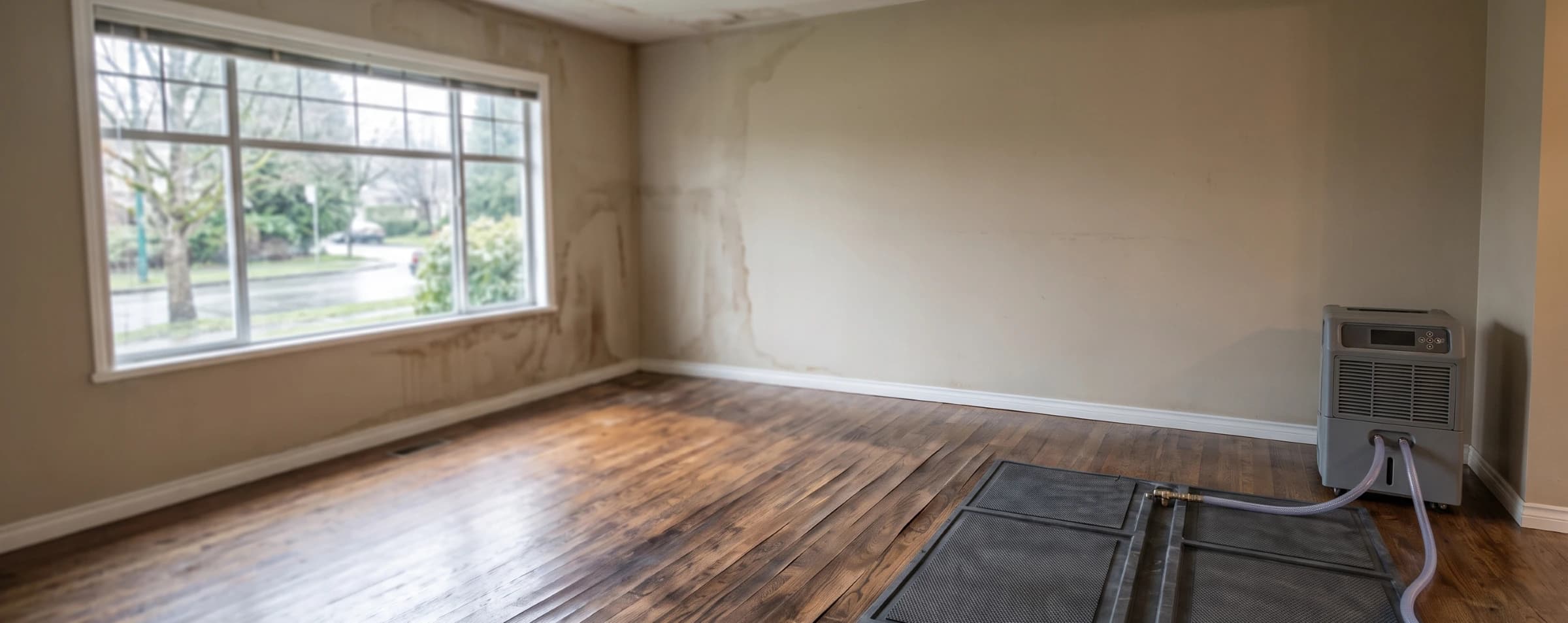

If your inspection report or insurance estimate from a water damage restoration company lists your water damage as a Class 2 or Class 3, that number carries more weight than it looks. It sets how much equipment a crew brings, how many days they monitor the drying, and how much of your home gets cut out and removed before anything actually dries.
Class describes how much of a structure absorbed water and how difficult that water will be to remove, and it's defined under the ANSI/IICRC S500 Standard for Professional Water Damage Restoration, the reference restoration companies and insurance adjusters use to scope a job. Class 1 covers the smallest, fastest drying losses. Class 4 covers water trapped deep inside dense materials like hardwood, concrete, or plaster that can take weeks to release. Knowing where a loss falls tells you what to expect from the crew in your home and gives you a way to check that the scope on your estimate actually matches what happened to your house.
Key insights
- Class measures water, not contamination. Water damage class ranges from Class 1 to Class 4 under the ANSI/IICRC S500 standard and describes how much of a structure absorbed water and how hard it will be to dry.
- Classes 1 through 3 are area based. They're set by the percentage of combined floor, wall, and ceiling surface area affected: under 5% for Class 1, 5% to 40% for Class 2, and over 40% for Class 3.
- Class 4 works differently. It's defined by material type, not surface area, and applies whenever water has soaked deep into low permeance materials like hardwood, plaster, concrete, or masonry.
- Class and category are separate systems. Class measures water volume and drying difficulty; category measures contamination. A loss can be Category 1 and Class 4 at the same time.
- Class is finalized after demolition, not at first walkthrough. Technicians officially assign class once unsalvageable materials, like soaked carpet padding, have been removed, since that changes how much wet surface area remains.
- A loss can move to a higher class mid-job if a technician opens a wall or floor and finds more saturation than the initial inspection showed.
What are water damage classes?
Water damage classes are a four tier system, Class 1 through Class 4, that IICRC trained technicians use to describe the amount of water in a structure and how difficult it will be to dry, based on the ANSI/IICRC S500 standard. The class number is separate from water damage category, which measures contamination instead of volume.
A technician determines class during the initial inspection and documents it in the moisture log that becomes part of the insurance file. Every category of water, clean, gray, or black, can carry any class from 1 to 4. A burst pipe that floods an entire finished basement with clean, Category 1 water can still be a Class 3 loss because of how much area it covered before anyone shut off the source.
The four classes of water damage
The four classes are distinguished primarily by the percentage of a room's combined floor, wall, and ceiling area that absorbed water, with Class 4 set apart by material type rather than area. These percentage thresholds come from the current edition of the ANSI/IICRC S500 standard, the version restoration contractors and adjusters use to scope a job today.
 Class 1 through Class 4 measure how much of a room absorbed water and how hard it will be to dry, with Class 4 defined by material type rather than surface area.
These thresholds apply to each affected room individually, not to the house as a whole. A 120 square foot bathroom and a 400 square foot great room both use the same 5% and 40% cutoffs, just measured against each room's own combined surface area, so a small bathroom can reach Class 3 with far less total water than a great room would need to hit the same class.
| Class | Wet area affected | Materials typically involved | Drying difficulty |
|---|---|---|---|
| Class 1 | Under 5% of combined floor, wall, and ceiling area | Localized flooring or a small drywall section, minimal wicking | Easiest |
| Class 2 | 5%–40% of combined area, water wicked up walls to roughly 24 inches | Carpet, pad, and lower wall cavities across an entire room | Moderate |
| Class 3 | Over 40% of combined area | Ceilings, walls, insulation, carpet, pad, and subfloor, often soaked from overhead | Most demanding by volume |
| Class 4 | Not area based | Hardwood, plaster, concrete, brick, or multilayer assemblies holding deeply bound moisture | Hardest, may need specialty methods |
Class 1 water damage
Class 1 is the smallest and fastest drying category of loss, affecting less than 5% of a room's combined floor, wall, and ceiling area. Materials involved have low permeance, so they absorbed minimal moisture in the first place, think a small section of vinyl flooring or drywall, not soaked carpet or padding. A slow water heater leak caught within a day or a small supply line leak under a sink are typical Class 1 scenarios. Because so little material absorbed water, Class 1 losses dry fastest among the four classes and usually need the least equipment.
Class 2 water damage
Class 2 covers losses where 5% to 40% of a room's combined floor, wall, and ceiling area absorbed water, with moisture wicking up walls to roughly 24 inches. An entire room's carpet and padding are typically saturated, and moisture has usually reached structural materials underneath, plywood subfloors, particleboard, or the lower few inches of drywall. A supply line failure causing washing machine water damage that floods a laundry room and travels into an adjoining hallway is a common Class 2 example. Padding this saturated is rarely salvageable and is usually one of the first materials removed.
Class 3 water damage
Class 3 is the most water intensive of the three area based classes, affecting more than 40% of a room's combined floor, wall, and ceiling surface. Water at this level often arrives from overhead, such as water damage from a roof leak, a burst pipe in a ceiling cavity, or an upstairs bathroom overflow, and it saturates ceilings, walls, insulation, carpet, padding, and subfloor across virtually the entire space. Class 3 losses carry the highest evaporation load of the three area based classes, meaning the most water has to leave the air for the space to dry, which is why crews bring more air movers and higher capacity dehumidifiers than a Class 1 or 2 job.
Class 4 water damage
Class 4 is defined by material type instead of surface area. It applies whenever water has deeply saturated low permeance materials, hardwood flooring, plaster, brick, concrete, natural stone, or multilayer assemblies like a gym floor or a built-up subfloor, that release moisture far more slowly than drywall or standard framing lumber. The IICRC S500 refers to Class 4 situations as specialty drying situations because standard air movers and dehumidifiers aren't enough on their own; a crew may need injection drying systems, desiccant dehumidification, or heat drying to pull bound water out of dense materials, methods taught in IICRC's Applied Structural Drying certification course. A finished basement with a concrete slab that sat under standing water for several days is a common Class 4 scenario, even if the water itself was clean, Category 1, in every other respect.
What each class typically looks like in your home
Before a technician arrives, the physical signs in a room offer a rough read on which class a loss is likely to fall into under the ANSI/IICRC S500 classification system, though only a moisture meter reading confirms it officially. Carpet that simply feels damp points toward Class 1 or 2, while water that has visibly climbed walls, sagged a ceiling, or sat on hardwood or tile for days points toward Class 3 or 4.
 A stain line at roughly this height often points to a Class 2 loss, since IICRC S500 defines that range as water wicking up to about 24 inches on the wall. Paint bubbling below the line signals the drywall itself absorbed water, not just the surface.
Visible signs can undersell the real scope, since water travels behind baseboards, under flooring, and into wall cavities well before any of that becomes visible on the surface. A room that looks like a minor Class 1 spill on top can test as Class 2 or higher once a technician checks moisture levels inside the wall itself, which is one reason a professional reading matters more than a visual impression.
| Scenario | Likely class | Why |
|---|---|---|
| Dishwasher leak caught within a few hours, small puddle on the kitchen tile | Class 1 | Minimal area affected, low permeance flooring, little time to absorb |
| Toilet overflow floods a bathroom and travels under the baseboard into an adjoining hallway | Class 2 | Carpet and pad soaked the length of the hallway, water wicked partway up the walls |
| A small ceiling stain from a slow roof leak turns out, once opened, to have soaked insulation across most of the attic | Class 3 | Overhead saturation was hidden until the ceiling was opened, covering far more than the visible stain suggested |
| Refrigerator water line leaks undetected for several days, saturating a section of hardwood kitchen flooring | Class 4 | Hardwood is a low permeance material that holds water deep regardless of the area affected |
| Sump pump fails during a storm and several inches of water sit in a finished basement for two days | Class 3 | Widespread saturation across carpet, drywall, and baseboards from prolonged standing water |
How is the class of a water loss determined?
Under the ANSI/IICRC S500 standard, a technician determines class by measuring the percentage of combined floor, wall, and ceiling surface area that absorbed water, using a moisture meter and a visual inspection, then documenting the finding in writing as part of the job file.
A technician's class assessment at the first walkthrough is preliminary. The number that ends up on the documentation and insurance estimate is finalized after unsalvageable materials, soaked carpet padding, waterlogged insulation, or drywall below a flood cut, have been removed, since taking that material out changes how much wet surface area is left for the drying equipment to address. This is one reason two technicians can walk the same room minutes apart and note different class numbers: one may be assessing before demolition, the other after.
A technician's inspection typically checks:
- Moisture meter readings on framing, subfloor, and drywall, compared to a dry standard taken from an unaffected part of the house
- How high water has wicked up the walls
- Whether carpet, padding, or upholstered furniture are saturated
- Whether the room contains low permeance materials like hardwood, plaster, or concrete that would push the loss to Class 4 regardless of area affected
Water damage classes vs. categories
Class and category are the two measurement systems the ANSI/IICRC S500 standard uses to scope a water loss, and they measure two different things. Class measures how much water is present and how hard it will be to dry; category measures how contaminated that water is. The two systems are independent, so any category can pair with any class.
 A single loss carries both ratings at once, such as Category 2, Class 3, since the two IICRC S500 systems are scored independently of each other.
The mix-up between the two is common because both use small numbers and both come from the same S500 standard. A ceiling leak from an overflowing bathroom fixture above, for example, might be Category 2 (gray water, since it passed through a supply line carrying some contaminants) and Class 3 (since it saturated the ceiling, walls, and flooring across a large area) at the same time, two separate ratings describing two separate things about the same event.
| Question | Class | Category |
|---|---|---|
| What it measures | Amount of water and drying difficulty | Contamination level of the water |
| Scale | 1 to 4 | 1 to 3 |
| Set by | Percentage of wet surface area, or material type for Class 4 | Source of the water and what it has contacted |
| Can it change during the job | Yes, if more saturation is found after demolition | Yes, water degrades toward a higher category over time |
| Example on one estimate | Class 3 | Category 2 |
A single loss carries both numbers on the estimate, something like Category 2, Class 3. The category tells you whether it's safe to be in the room without protective equipment; the class tells you how long the drying phase will likely run and how much equipment it will take. During the job, water damage categories determine what protective equipment a crew wears and which materials get bagged as biohazard waste instead of dried in place, an entirely separate decision from the class number.
How class affects drying equipment and timeline
Class number is the main input restoration companies use to calculate how many air movers and dehumidifiers a room needs, since the S500 ties equipment counts to a room's cubic footage and its class based evaporation load. Higher classes need more equipment because more water has to move from the materials into the air before a dehumidifier can pull it back out, which is a big part of why class is such a strong predictor of how long water damage restoration takes.
 A single air mover and dehumidifier like this is typically enough for a Class 1 loss. Class 3 and Class 4 losses require several air movers plus higher capacity or specialty dehumidification to handle the larger evaporation load.
A Class 1 room might dry with a single air mover and one small dehumidifier. A Class 3 room with saturated ceilings and walls typically needs several air movers positioned to create continuous airflow across every wet surface, plus a larger capacity dehumidifier or two, and Class 4 often adds specialty equipment like injection drying panels or a desiccant dehumidifier that can pull moisture at a lower relative humidity than a standard refrigerant unit. Class 3 and Class 4 losses usually add several extra monitoring visits beyond what a Class 1 job needs, since the water damage restoration process requires confirming that moisture in low permeance materials has reached the dry standard before the job can close.
Because equipment count and monitoring days both scale with class, class is one of the larger drivers behind the price difference between a small Class 1 job and a whole room Class 3 loss.
Can the class change during restoration?
Yes. A loss can move to a higher class mid-job if a technician opens a wall, pulls flooring, or finds saturation in a cavity that wasn't visible during the initial inspection.
This is different from category, which changes because contaminated water sits and grows bacteria; class changes because more wet material is discovered or removed. A room initially logged as Class 2 based on visible carpet and wall wicking can become Class 3 once a technician cuts into drywall and finds saturated insulation behind it, or Class 4 if the subfloor underneath turns out to be hardwood rather than plywood. Reclassification should show up as a written change order, not just a verbal mention, since it affects both the equipment plan and, on an insurance claim, the approved scope of work.
What class means for your estimate and restoration company
A class number should show up in writing on the estimate, tied to specific line items, room by room equipment counts, projected monitoring days, and any materials marked for removal rather than drying, not just an isolated number with nothing behind it.
 Class should show up on the estimate tied to a specific drying plan and equipment count, not just as a number, so it's worth asking what supports the class the technician assigned.
Confirming that a crew's proposed equipment count and drying plan actually match the class they recorded is one thing worth checking before choosing a water damage restoration company, since an under equipped Class 3 job dries slower and risks secondary mold growth, while an over equipped Class 1 job pads the bill without speeding anything up.
Ask to see the actual moisture readings, not just the class label. A legitimate reading includes a comparison between the wet material and a dry standard taken from an unaffected area of the house, expressed as a percentage or a relative scale depending on the meter. A number with no comparison point isn't a real reading.
Technicians who hold IICRC's Applied Structural Drying credential have specifically trained on class based equipment calculations and psychrometric readings, one of several water damage restoration certifications worth checking before a Class 3 or Class 4 job starts.
Frequently asked questions
Is Class 4 always worse than Class 3?
Not necessarily. Class 4 measures material type, not total water volume, so a small Class 4 area, such as a section of hardwood floor with deeply bound moisture, can involve less total water than a large Class 3 room, even though Class 4 often takes longer to dry because of how slowly those materials release moisture.
Is there a Class 5 water damage?
No. The ANSI/IICRC S500 standard only defines four classes. Any water loss, no matter how large or how contaminated, is documented under Class 1 through Class 4.
Can a Class 1 loss involve Category 3 water?
Yes. A small, contained backup from a floor drain can affect well under 5% of a room's surface area, Class 1, while still being grossly contaminated Category 3 black water. The two ratings are independent, and a small Category 3 loss still requires full contamination protocols regardless of how little area it covers.
How much does class affect the cost of water damage restoration?
Significantly. Class drives equipment count, monitoring days, and how much material gets removed instead of dried, which are among the biggest levers behind the total price. Detailed water damage restoration cost ranges by class and room show a small Class 1 spot running a few hundred dollars, while an extensive Class 3 or Class 4 loss can run well over ten thousand.
Does every water damage job get an official class number?
Yes. Any restoration company following IICRC S500 procedures assigns and documents a class as part of the initial inspection, since it's the basis for the drying plan and equipment order, even on small jobs that never involve an insurance claim.
Should I ask my restoration company how they determined my class?
Yes. A specific list of questions to ask a water damage restoration company, including how the class and category were determined and what moisture readings support them, helps confirm the number on an estimate reflects an actual inspection rather than a guess.
Does a higher class mean my home is more likely to grow mold?
Somewhat. Class describes how much material absorbed water, not how contaminated it is, but a higher class does mean more wet surface area sitting past the 24 to 48 hour window the EPA cites for materials to start supporting mold growth, so Class 3 and Class 4 losses carry a longer window of risk if drying is delayed.
What happens if a room has materials from more than one class?
The room is documented under its highest class present. If a bedroom has mostly Class 2 carpet and wall wicking but also includes a section of solid hardwood flooring that absorbed water, the hardwood section pushes the overall room assessment to Class 4, since Class 4 is defined by material type rather than area.
What should I do if I disagree with the class my contractor assigned?
Ask to see the moisture readings and photos that support the class on the estimate, then request a second inspection if the documentation doesn't match what you're seeing in the room. On an insurance claim, you can also ask the adjuster to review the technician's readings independently, since adjusters routinely check class determinations against the photo and moisture evidence on file.
Sam Hickerson is the founder of RestoreAdvisor and writes consumer guides on mold remediation, water damage restoration, inspection, testing, and home recovery. His work focuses on helping homeowners understand costs, risks, and when to call a professional. He draws on guidance from the EPA, CDC, IICRC, and other authoritative sources to make complex home issues easier to navigate.