
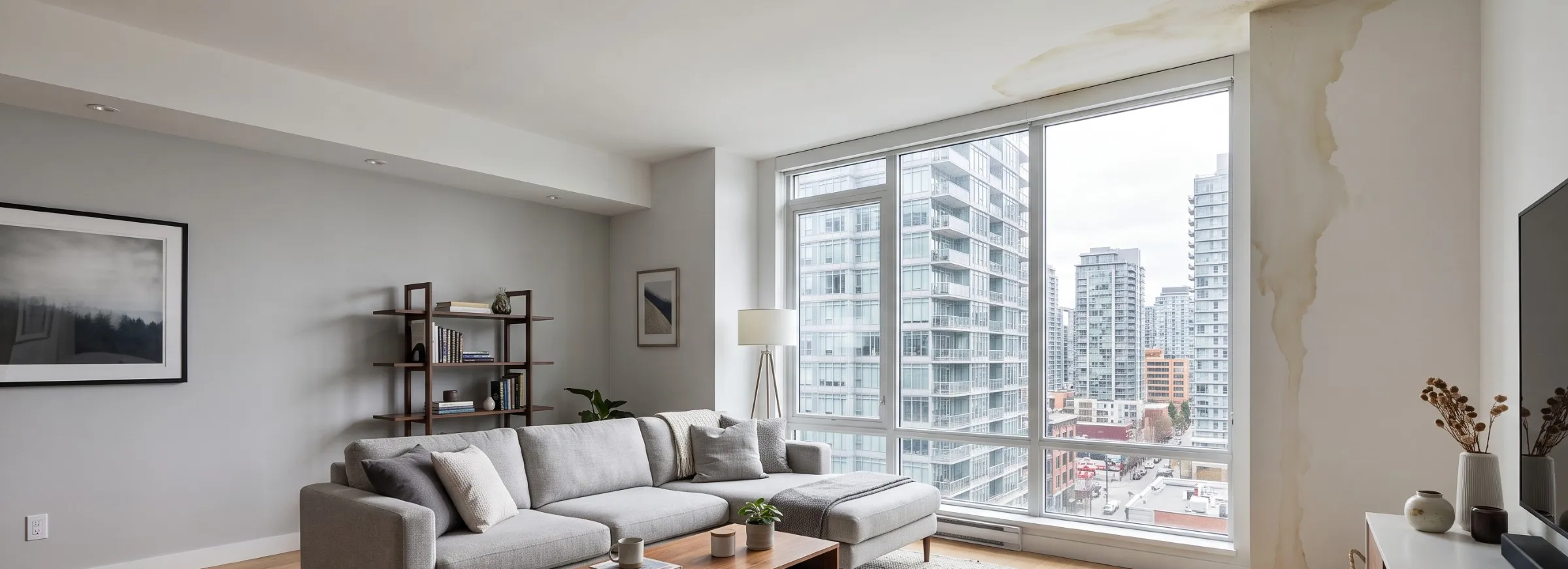

Water spreading across a condo ceiling raises two questions at once. The first is how to stop it. The second, the one that trips up condo owners far more than single-family homeowners, is who actually has to pay for it. In a condo, that second question depends on a document most owners never read closely: the association's declaration, and the line it draws between what you own and what the HOA insures.
Extraction, structural drying, and repair inside a condo follow the same water damage restoration sequence as any other property, evaluated under the IICRC S500 water damage classification standard. What's different is the ownership layer sitting on top of that process. A condo unit sits inside a building the owner doesn't fully own, so responsibility for both the repair and the bill splits according to where the water started, not simply where the damage shows up.
Key insights
- Responsibility follows the source, not the location of the damage. Water appearing inside your unit can still be the association's responsibility if it originated in a roof, riser, or other shared structure.
- Two insurance policies usually apply. The association's master policy and your own HO-6 policy split coverage based on where the damage sits, and the split depends on which of the three master policy types the HOA carries.
- Loss assessment coverage protects you from a special assessment. If the HOA charges its deductible back to owners after a claim, this HO-6 endorsement can absorb your share.
- Water from a neighboring unit usually routes through liability, not the HOA. Your neighbor's HO-6 liability coverage is generally the one that responds if their own plumbing or negligence caused the leak.
- Governing documents define the boundary, not assumption. The declaration's definitions section states exactly where your unit interior ends and a limited or general common element begins.
- Reporting delay can shift liability. An owner who sits on a known leak, or a board that ignores one for months, can end up owning damage that would otherwise have fallen to the other party.
Who's responsible for water damage
Responsibility for water damage in a condo comes down to where the water originated: inside your unit's boundary, in a limited common element assigned only to your unit, or in a general common element the association maintains for the whole building. The association is generally responsible for repairing and remediating damage that started in a general common element, while responsibility for damage that started inside a unit falls to that unit's owner, regardless of which unit the damage is now visible in.
 Moisture readings taken in a shared hallway, a general common element under most declarations, typically point toward the association's master policy rather than an individual owner's HO-6 coverage.
A sewage backup in a shared drain stack that serves six units illustrates the point well. The contamination might surface first in the lowest unit on the stack, but the source sits in a pipe none of those owners individually control, putting repair and remediation on the association's side of the line more often than not. A dishwasher supply line that fails inside a single unit works the other way: the damage stays contained to that owner's space and their own HO-6 policy, not the master policy, is the first stop.
Negligence can shift the default in either direction. An association that knew about a roof leak for months and never scheduled the repair can be held responsible for the resulting interior damage even where the declaration would otherwise assign interior repairs to the owner. The same logic applies in reverse: an owner who ignored a visible leak from their own fixture for weeks, letting it spread into a neighboring unit or a shared wall, can end up responsible for damage that started on their side but grew worse because of the delay.
The first step in any condo water event is confirming the source, not arguing about who pays first. Pull your declaration and identify which category the affected area falls into before you call anyone about responsibility.
Common vs. unit elements
A condo's structure splits into three legal categories, general common elements, limited common elements, and the unit interior, and water damage responsibility follows the same three-way split. General common elements are the parts every owner shares and the association maintains, including the roof, exterior walls, building foundation, hallways, elevators, and the main risers carrying shared plumbing between floors.
 Drainage from a shared roofline, pool building, or clubhouse counts as a general common element under most declarations, putting the repair on the association's master policy rather than any individual owner's HO-6 coverage.
Limited common elements sit in a gray zone. They technically belong to the association but serve only one unit or a small group of units, such as a balcony, an HVAC condenser pad, and, in many declarations, the wood framing inside exterior walls even though the drywall finish belongs to the owner. Your unit interior, by contrast, is everything inside the unit boundary as defined in the declaration, generally the unfinished surfaces of walls, floors, and ceilings inward, where paint, flooring, cabinets, and personal belongings are almost always the owner's responsibility. A recurring stain on a shared wall is a classic limited common element dispute, since whether the association or the owner pays depends entirely on that building's declaration.
| Element type | Examples | Maintained by | Who's responsible |
|---|---|---|---|
| General common element | Roof, exterior walls, main plumbing risers, hallways | Association | Association, in most cases |
| Limited common element | Balcony, HVAC pad, wall cavity behind one unit | Varies by declaration | Check governing documents first |
| Unit interior | Drywall surface inward, paint, flooring, fixtures | Owner | Owner, unless the source was a common element |
Confirming which category applies isn't always obvious from a plain reading, since many declarations describe limited common elements by function rather than as a named list. The Community Associations Institute recommends every owner keep a current copy on hand for exactly this reason, since the definitions section will state whether wall cavities, in-wall plumbing, and HVAC components in your building count as limited common elements or part of the unit itself.
Shared wall or unit above
Water damage that involves a shared wall or the unit above you almost always resolves through one of two paths: liability between neighbors, or the association's master policy, depending on whether the source sits inside a private unit or a shared structure. Sorting out which path applies before repairs start prevents a dispute over who reimburses whom later.
 A stain centered on a fixture like this usually means water traveled through the ceiling cavity from above, most likely the unit or roof directly overhead, rather than from a plumbing line inside the room itself.
When the source is your upstairs neighbor's unit, their own plumbing or negligence usually triggers their HO-6 liability coverage, the same portion of a condo policy that covers damage an owner causes to someone else's property. A stain on your own ceiling is a common flashpoint in this scenario, since it can plausibly originate from the unit above, a roof leak, or a shared HVAC line running through that section of the building, three sources with three different responsible parties. File your own claim first rather than waiting on that determination, since your insurer pays for your unit's damage under your own coverage, then pursues reimbursement from your neighbor's carrier through subrogation, keeping your repair moving instead of stalling on a dispute between two insurance companies.
When the source is a shared structure instead, several patterns show up repeatedly across condo buildings. Each one carries the same underlying logic: if no single unit controls the failed component, the association's policy is the default starting point.
Roof failure or flashing leak above a top-floor unit
Water traveling down from a failed roof section reaches a top-floor unit's ceiling first, the classic pattern behind water damage from a roof leak, and the association's master policy is the first stop since the roof is a general common element in nearly every declaration.
A shared plumbing riser or drain stack serving multiple units
A burst pipe in a vertical riser can affect several stacked units at once, and because the riser itself belongs to no single owner, the association's policy generally responds even though the visible damage sits inside private units.
Exterior wall envelope failure letting wind-driven rain into the wall cavity
A failed seal at a window or exterior joint lets water track down inside the wall assembly, often surfacing as a stain well below the actual entry point.
A shared HVAC condensate line or rooftop unit draining into the building
Central systems that serve multiple units can leak into ceilings or walls far from the mechanical room itself, the same HVAC water damage from condensation mechanism that shows up inside a single unit, which is why a musty smell with no obvious source in your unit is worth reporting to the board, not just cleaning up.
Elevator pit or parking garage drainage backing up into lower-level units
Ground-floor and below-grade units can take on water from drainage systems that serve the whole building rather than any single unit, and a backup here often hits several units along the same hallway at once rather than a single isolated space.
Six recurring scenarios cover most of what actually determines who pays once the dust settles, and the pattern generally holds even in a building whose declaration is silent or ambiguous on a specific cause.
| Scenario | Typically responsible |
|---|---|
| Leak from your own unit's plumbing or appliance | You, through your HO-6 |
| Leak from a neighboring unit's plumbing | Your neighbor's HO-6 liability coverage |
| Failure in a shared riser or drain stack | The association's master policy |
| Roof or exterior envelope failure | The association's master policy |
| Damage worsened by your own delay in reporting it | You, even if the original source was shared |
| Damage worsened by the board's delay in fixing it | The association, even if the source was inside a unit |
A few states go further and set the priority order by statute rather than leaving it to the declaration alone. Nevada, for example, requires that when both the association's policy and a unit owner's policy could apply to the same loss, the association's insurance is primary, which is designed to prevent exactly the kind of finger-pointing between insurers that can stall a repair for weeks. Check whether your state has a similar rule, since it can change who you call first even when the declaration itself is ambiguous, and the answer rarely comes down to which party simply notices the damage first.
That same category of state law commonly carves out an exception for willful misconduct or gross negligence. Even where the association's policy would normally be primary, a board can repair the damage under its own coverage and then charge the cost back to the specific owner, tenant, or guest whose conduct caused it, rather than spreading that cost across every owner through the master policy. Ignoring a running toilet for days or overloading a washing machine connection are common examples of the kind of conduct that triggers this exception, and the practical effect is that "the source was a common element" doesn't automatically protect an owner whose own actions made the loss worse or caused it outright.
What to do right now
Stop the source if it's safely reachable inside your own unit, cut power to the affected area, photograph everything, and notify both the property manager and your own insurer within the first hour. Acting on all four in roughly that order protects your claim as much as it protects the unit itself, since a condo water event usually needs to support two separate insurance files rather than one.
 Photographing the damage before cleanup starts is what both the association's insurer and your own HO-6 carrier will ask for first, and a timestamped image is harder to dispute later than a description written from memory.
Stop what you can safely reach
Shut off the water at the fixture or the unit's main shutoff if the source is inside your own unit. If the source is a shared riser, the roof, or another common element you can't access, call the property manager's emergency line immediately instead of attempting to reach it yourself.
Cut power to the affected area
Switch off power at the breaker for any outlet or fixture near standing water before you do anything else in the space, following OSHA on electrical shock hazard during flood response. In a condo, that breaker may sit in a shared electrical room rather than inside your own unit, so know where it is before you need it.
Photograph everything before you touch it
Take wide shots of the affected rooms and close-ups of the source, the standing water, and any staining, before you move belongings or start drying. This record matters more in a condo than in a single-family home, since it may need to support two separate insurance claims.
Notify the board and your own insurer at the same time
Call or email the property manager to report the location and likely source, and open a claim with your own HO-6 insurer the same day. Don't wait for the board to determine responsibility before starting your own claim, since that determination can take weeks.
Call a restoration company if water is still spreading
If the HOA hasn't dispatched anyone within a reasonable window and water is actively damaging your unit, call an emergency water damage restoration company directly rather than waiting. You can sort out which policy reimburses which invoice after the water is out and the space is drying.
Who to call and in what order
Report the loss to the property manager or board first, call your own HO-6 insurer the same day, then bring in a restoration company once the source is stopped or access to a shared area is authorized. Calling the wrong party first, or waiting on one before contacting the next, can add days to getting repairs authorized in a building where several parties may need to sign off.
 Reaching the property manager and your own HO-6 insurer the same day matters more than which one you call first, since the two claims can move in parallel once both are open.
The property manager matters first because they control access to any common element the source might involve and can authorize emergency mitigation work in shared spaces, something a restoration company can't do on its own in a building it doesn't manage. Your own HO-6 insurer doesn't need to wait on that determination either: your claim for the unit's interior damage can move in parallel with whatever the association's insurer decides about the common-element portion, and the two claims don't have to resolve in any particular order.
When you do bring in a restoration company, the right questions to ask before hiring matter more in a condo dispute than in a straightforward single-family job, since a certified firm's documentation becomes part of the record if responsibility gets contested. Ask specifically whether they've worked a shared-structure claim before, since documenting damage in a way that satisfies two different insurers at once is a different skill than photographing a single-family loss.
If a neighboring unit is the source, contact that neighbor directly in addition to the board. Getting their insurance information early keeps your claim from stalling later if your insurer needs to pursue subrogation.
A company that's used to coordinating with HOA boards and multiple insurers will move noticeably faster than one that isn't, one reason choosing a water damage restoration company with condo experience is worth the extra call it takes to confirm. Ask for a reference from a past condo job specifically, since a company can be excellent at single-family work and still stumble on board sign-offs and split billing between two policies.
Master policy vs. HO-6
Two insurance policies generally apply to condo water damage: the association's master policy, covering the building and common elements, and your own HO-6 policy, covering your unit's interior, personal property, and liability. Both operate under the same sudden-and-accidental standard that governs how homeowners insurance covers water damage in any home, but which policy actually pays depends on which of three master policy types your association carries.
A bare walls policy covers only the building's structural framing and the common elements, stopping at the drywall in every unit. A walls-in policy adds the original fixtures and finishes the unit came with when built, such as standard cabinets, flooring, and countertops. An all-in policy goes further still, covering interior finishes and often upgrades up to the building's original construction standard. None of the three covers your furniture, electronics, or other personal property, and none of them covers upgrades beyond what the master policy's form specifically includes.
| Master policy type | What it covers | What your HO-6 covers |
|---|---|---|
| Bare walls | Structural framing and common elements only | Drywall, flooring, cabinets, fixtures, personal property |
| Walls-in | Framing plus original fixtures and finishes | Upgrades, personal property, liability, loss of use |
| All-in | Framing plus interior finishes to pre-loss condition | Personal property, liability, loss of use, deductible exposure |
Even under an all-in policy, "pre-loss condition" usually means the unit's original, builder-grade condition, not whatever condition it was in the day before the loss. Any upgrade made since move-in, higher-end flooring, a renovated kitchen, custom cabinetry, falls into a category insurers call improvements and betterments, and it's covered only if your own HO-6 policy carries that endorsement at a limit that reflects what you actually spent on the upgrade. Owners who renovate without updating their HO-6 coverage accordingly are the ones most likely to discover this gap during a claim rather than before one.
A water heater leak inside your own unit is a useful test case. Even under an all-in master policy, an appliance failure that's clearly contained to your unit's interior usually falls to your HO-6 dwelling coverage first, since the master policy generally responds to structural damage and shared-source events rather than every appliance failure that happens to occur inside a private unit.
Master policy deductibles run higher than a typical individual homeowner's deductible, often several thousand dollars and sometimes into the tens of thousands for a major water event. When the association's insurer pays a claim, the HOA frequently passes that deductible back to owners through a special assessment, which can arrive as a surprise bill months after the repair itself is finished.
Loss assessment coverage, an inexpensive HO-6 endorsement, can reimburse you for your share of that special assessment. The NAIC recommends confirming the limit on that endorsement matches your building's typical deductible rather than assuming a default amount is enough.
Filing your claim
Filing a condo water damage claim means reporting to both your own insurer and the association at the same time, rather than waiting for one determination before starting the other. Coordinating between the two claims, not choosing the right one to file first, is what actually speeds up the repair.
 Keeping a dated folder of correspondence and photos matters most when two adjusters, one from the HO-6 policy and one from the master policy, are working the same loss and each may ask for a different piece of it.
Request a copy of the master policy's declarations page or certificate of insurance from the board if you don't already have one on file. This document tells you the master policy's type, its deductible amount, and the coverage limits your HO-6 adjuster needs to determine whether it applies. Most declarations require the association to provide this on request, and having it ready before you call your own insurer speeds up their initial assessment.
Keep a dated log of every call, email, and photograph, the same documentation habit that matters in any water damage claim, but doubly so when two adjusters are working the same loss from different sides. Note who you spoke with, what they said about responsibility, and any commitment on timing, since verbal assurances from a property manager rarely hold up if the board later disputes the scope.
Expect the two claims to move at different speeds. A straightforward unit-interior claim on your own HO-6 policy generally moves faster than a common-element claim against the master policy, which often needs board approval before the association's insurer authorizes repair work. Don't let the slower claim hold up mitigation on your side, since extraction and drying inside your unit shouldn't wait on a determination about who ultimately pays for it.
When one shared-source event, a riser failure being the most common example, damages several stacked units at once, each owner usually files a separate HO-6 claim for their own unit's interior damage rather than one joint claim covering everyone. The association files its own claim under the master policy for the common-element repair and, depending on the policy type, some or all of each unit's structural damage. Ask the property manager to designate a single point of contact tracking every affected unit in a widespread event, since multi-unit losses stall most often when no one is centralizing that information.
Beyond the two-policy coordination that's specific to a condo, the rest of the process, reporting the loss, documenting the damage, submitting a proof of loss, and appealing a denial if it comes to that, follows the same filing a water damage insurance claim sequence used for any cause of water damage. The condo-specific wrinkle mostly disappears once both insurers have agreed on which portion of the loss belongs to which policy.
When the board won't act
An unresponsive board on a common-element water issue requires a documented escalation path: written notice, an independent assessment if the board disputes responsibility, and formal escalation if the board still refuses to act. Verbal complaints and hallway conversations with the property manager rarely produce a paper trail that helps you later.
 Sending a demand letter by a method that produces proof of delivery matters here, since a board or its attorney can dispute an email but not a signed return receipt.
Start with written notice describing the water damage's location, the date you first noticed it, and which common element you believe is involved. Ask for a written response with a specific timeline for assessment rather than accepting a verbal promise, since delay carries real cost here. Materials that stay wet for the EPA's 24 to 48 hour mold-risk window while a board deliberates turn a water damage claim into a mold remediation project on top of it, which raises both the cost and the number of parties who need to agree on responsibility.
If the board doesn't respond or denies responsibility without an inspection, bring in an independent assessor to document the moisture source and confirm whether it ties to a common element. This report turns a dispute over opinion into a dispute over evidence, and it's the document most insurers and, if it comes to that, most attorneys will ask for first. From there, escalation typically follows in this order:
1. File directly with the association's insurance carrier
Going straight to the carrier holding the master policy can move things when the board itself is the bottleneck, since the insurer has its own interest in resolving a documented claim.
2. Send a formal demand letter
Cite the specific maintenance obligation the board failed to meet, referencing the governing documents by section where possible, and set a clear deadline for a response.
3. Use mediation or arbitration if your state requires it
Many states require this step before a lawsuit can proceed, so confirm your state's requirement before moving toward litigation.
4. File suit for breach of the association's maintenance duty
This is the last resort, pursued once the earlier steps have failed and the documentation trail supports the claim that the association neglected its obligation.
Boards that have a documented pattern of delayed maintenance face a stronger case against them than ones that respond promptly to a first report, which is part of why the written notice at the start of this process matters as much as any step that follows it. Save every piece of correspondence even after the repair is finally scheduled, since a pattern that resurfaces on a second leak a year later is what actually persuades an insurer or a judge.
Cost of water damage in a condo
Water damage in a condo costs $500 to $30,000 or more, depending on whether the job is confined to a single unit's interior or involves a shared structure, multiple units, or extensive drying and repair. A small appliance leak caught quickly and contained to one unit sits at the low end, and a shared riser failure affecting several stacked units sits at the high end.
 Opening a shared wall cavity like this often means cutting drywall on both sides for two separate units, one reason a common-element repair costs more than the square footage alone would suggest.
A per-square-foot benchmark is a useful way to sanity-check a contractor's quote at either end of that range, since a scenario-based estimate alone can be hard to compare against a rate the contractor actually quotes. Five scenarios cover most condo water events, from a small appliance leak confined to one owner's finishes through a multi-unit loss split across several policies.
| Scenario | Typical cost | Usually billed to |
|---|---|---|
| Small unit-interior job, contained to owner's finishes | $500–$2,500 | Owner's HO-6 |
| Larger unit-interior job, appliance or fixture failure | $2,500–$8,000 | Owner's HO-6 |
| Shared wall or limited common element source | $3,000–$12,000 | Varies by declaration |
| General common element source, riser or roof | $5,000–$25,000+ | Association's master policy |
| Multi-unit event affecting several stacked units | $10,000–$50,000+ | Split across HOA and multiple owners |
What pushes a job from one end of that range to the other is access and demolition scope more than square footage alone. Opening a shared wall cavity often means cutting drywall on both sides for two separate units, coordinating two owners' schedules, and in many buildings, getting board sign-off before any common-element surface comes down. National water damage restoration cost figures by category, class, and room apply the same way inside a condo unit as they do in a single-family home.
Renting a condo you don't own
If you rent a condo rather than own it, your landlord, the unit owner, is your first point of contact, not the HOA directly, even though your landlord may ultimately need to pursue the association for a common-element cause. Habitability law obligates your landlord to address water damage regardless of who ends up paying for the underlying repair, and the dispute between your landlord and the association over responsibility doesn't change your right to a livable unit in the meantime. Repair timelines and remedies if a landlord stalls follow the same rules that govern any water damage in a rental, condo or not, since a landlord's obligation to a tenant doesn't change based on what kind of building they own.
Preventing water damage
Preventing water damage in a condo means controlling what you can inside your unit and reporting anything you can't control immediately, in writing, rather than waiting to see if it resolves on its own. Most of the failures that end up in a board dispute trace back to a small warning sign that sat unreported for weeks, not a sudden, unpredictable event.
 Braided stainless steel supply lines fail far less often than the rubber ones many units still have, and swapping them proactively costs a fraction of what a single leak behind a cabinet would.
Know your unit's shutoff and the building's main risers
Find your unit's individual water shutoff valve now, before an emergency, and ask the property manager where the risers serving your stack run so you know what you're dealing with if a shared line fails.
Report any sign of a leak in writing the same day you notice it
A short email to the property manager documenting a small stain or a damp spot creates a timestamp that protects you later if the source turns out to be a common element and the delay becomes part of a responsibility dispute.
Check supply lines and appliance hoses annually
Braided stainless steel supply lines on your dishwasher, washing machine, and refrigerator fail less often than the rubber hoses many units ship with, and replacing them proactively is far cheaper than a flood.
Ask your board for the master policy's type and deductible
Knowing whether your building carries bare walls, walls-in, or all-in coverage, and what its deductible is, tells you exactly how much interior coverage your own HO-6 policy needs to carry.
Add loss assessment coverage to your HO-6 policy
This inexpensive endorsement protects you from an unexpected bill if the HOA passes its deductible back to owners after a shared-structure loss.
The same core prevention habits, testing shutoff valves, checking supply lines, and watching for early signs, apply in any home, condo or not, with the added layer of a shared structure and a declaration that a single-family homeowner never has to think about. A quick annual review of who insures what, prompted by nothing more than reading your own HO-6 renewal notice, catches most coverage gaps before a claim ever forces the question.
Frequently asked questions
Who pays for water damage in a condo, the HOA or the owner?
It depends on where the water started. The association is generally responsible for damage that began in a general common element, such as the roof or a shared plumbing riser, while responsibility for damage that began inside a unit falls to that unit's owner, regardless of which unit the damage later shows up in.
Does the HOA's master policy cover my personal belongings?
No. The master policy covers the building structure and, depending on its type, some or all of the original interior finishes. Furniture, electronics, clothing, and other personal property are covered only by your own HO-6 policy.
What if the water came from my upstairs neighbor's unit?
Your neighbor's liability coverage is the one that generally applies, not the association's master policy, since a private unit-to-unit leak usually doesn't involve a common element at all. File with your own HO-6 for your unit's damage first, since your insurer can pursue reimbursement from your neighbor's carrier through subrogation while your repair moves forward without waiting on that outcome.
Is a bare walls or an all-in master policy better for owners?
Neither is automatically better. A bare walls policy keeps HOA premiums lower but shifts more interior repair cost onto each owner's HO-6 policy, while an all-in policy covers more of the interior but usually comes with higher association dues to fund it.
What is loss assessment coverage and do I need it?
Loss assessment coverage is an HO-6 endorsement that pays your share of a special assessment the HOA charges owners after an insured loss. Most condo owners benefit from carrying it, since even a modest limit costs little next to the size of assessment a single major claim can trigger.
Who pays the HOA's insurance deductible after a water damage claim?
The association pays it first out of reserve funds or dues, then frequently recovers some or all of it from owners through a special assessment, particularly when the loss originated in a shared structure that benefits every unit. Loss assessment coverage on your own HO-6 policy can absorb that charge.
Can I withhold HOA dues if the board won't fix a leak?
No. Withholding assessments is not a recognized remedy for a maintenance dispute in most states and can trigger late fees, a lien, or even foreclosure proceedings against your unit regardless of whether the board is in the wrong. Use written notice, an independent assessment, and formal escalation instead.
Does condo insurance cover flood damage?
No, not under a standard HO-6 policy or a typical master policy. An outside water source, such as a storm surge or overflowing waterway causing flooding, requires a separate National Flood Insurance Program policy or private flood coverage, purchased by the owner, the association, or both depending on the building's flood zone.
How long does the HOA have to fix a common-element leak?
Most governing documents require repair within a reasonable time rather than a fixed number of days, though a handful of states set specific deadlines for habitability-affecting repairs. Get the timeline commitment in writing from the board, since a vague verbal promise is difficult to enforce if the repair stalls.
What if my neighbor doesn't have insurance?
You can still file the claim against your own HO-6 policy for your unit's damage, and your insurer may pursue your neighbor directly for reimbursement. Collecting from an uninsured neighbor is harder than collecting through their carrier, which is one reason many declarations require every owner to carry HO-6 coverage.
Do I need my own inspector, or can I rely on the HOA's?
Yes, whenever responsibility is disputed or a common element might be involved, an independent inspection is worth the cost, and confirming the inspector's certifications matters as much as getting the second opinion itself. The association's inspector works for the association, and independently documenting the moisture source protects you if the board's insurer later argues the damage started inside your unit.
What if the water damage in my condo turns into mold?
Report it the same way you'd report the water source, in writing, since the same general-common-element-versus-unit-interior split determines who handles the remediation. Mold that traces to a shared structure generally falls to the association, the same as the water that caused it, while mold confined to your own unit's finishes is yours to remediate under your HO-6 policy.
Sam Hickerson is the founder of RestoreAdvisor and writes consumer guides on mold remediation, water damage restoration, inspection, testing, and home recovery. His work focuses on helping homeowners understand costs, risks, and when to call a professional. He draws on guidance from the EPA, CDC, IICRC, and other authoritative sources to make complex home issues easier to navigate.