
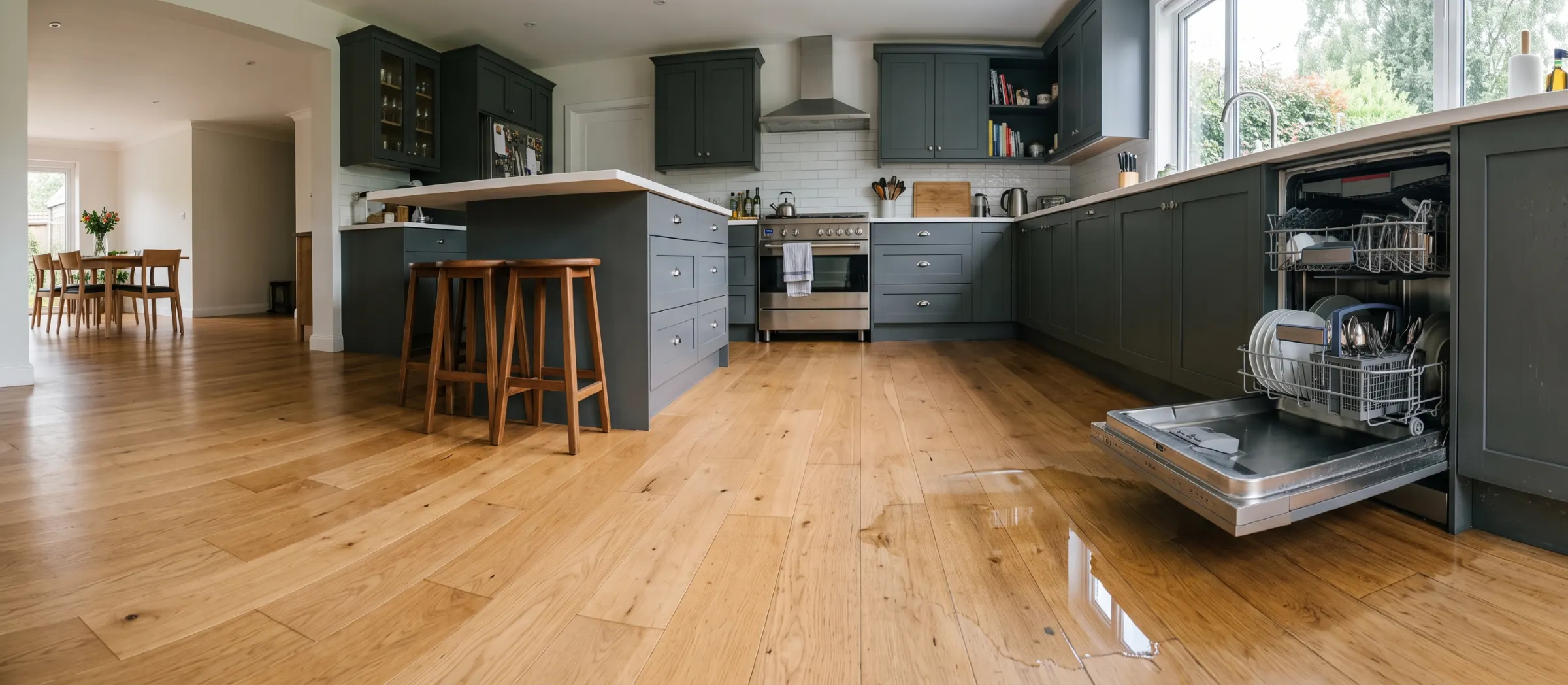

Water spreading across the kitchen floor from an open dishwasher door is unsettling, especially once it has reached the cabinet base or the flooring beyond the appliance. Most dishwasher leaks stay contained to a small area and cost far less to fix than a burst pipe or a flooded basement. Shutting off the water and power within the first few minutes limits how far it spreads and how much the repair ends up costing.
A dishwasher leak is water damage caused by a failure in the appliance's supply line, door seal, tub, pump, or drain connection, and it falls under ANSI/IICRC S500, the standard restoration companies use to classify water contamination and plan drying. Whether it turns into a $300 cleanup or a $4,000 subfloor replacement usually comes down to how fast the water is stopped and dried, not how the leak started.
Key insights
- Two contamination levels are possible. A supply line leak is Category 1 clean water under IICRC S500, but a leak from the tub, pump, or drain hose carries detergent and food residue and is classified as Category 2 gray water.
- The floor absorbs water fast. A dishwasher sits directly on the flooring with no gap to catch spillage, so water can reach the subfloor beneath it within an hour depending on volume.
- The 24 to 48 hour window still applies. The enclosed cabinet base and toe kick around a dishwasher trap moisture, which can put mold growth on the same EPA timeline as a larger leak.
- Repair and cleanup are separate costs. Fixing the dishwasher itself typically runs $150 to $600, while water damage cleanup is billed separately and depends on how far the water traveled.
- Insurance depends on speed, not size. A sudden supply line rupture is usually covered even if the resulting damage is large, while a slow leak from a worn gasket is often denied even if the damage is small.
- Particleboard rarely survives. Cabinet bases and subfloor sheathing beneath a dishwasher are often particleboard or engineered wood, which absorbs water and typically needs replacement rather than drying.
What to do right now
Stopping a dishwasher leak starts with shutting off its water supply and power, then containing and documenting the damage before it spreads further into the kitchen. Acting within the first 10 to 15 minutes meaningfully limits how far water travels into cabinets, subflooring, and any room beyond the kitchen.
 The angle stop valve, not the appliance's power switch, is what actually stops water flow to a leaking dishwasher.
1. Shut off the water supply
Find the angle stop valve under the sink that feeds the dishwasher, usually near the sink's own shutoff, and turn it clockwise until it stops. If you cannot locate it or water keeps running, shut off the home's main water valve instead.
2. Cut power at the breaker
Turn off the breaker feeding the dishwasher before touching any standing water near the unit. A wet floor next to a plugged-in appliance is an electrical shock hazard, and OSHA's flood response guidance treats cutting power as the first safety step for exactly this reason.
3. Contain and remove standing water
Use towels or a wet/dry vacuum to pull up water on the floor and inside the cabinet base before it spreads under adjacent cabinets or toward the dishwasher's shared wall.
4. Move items and open the space to air
Clear anything stored in the sink cabinet or nearby lower cabinets, and prop the doors open so air can reach the wet surfaces instead of trapping moisture behind a closed door.
5. Photograph the damage and call for help
Take photos of the standing water, the cabinet base, and the dishwasher itself before cleanup starts. Call an appliance repair technician for the unit and a water damage restoration company if water reached the flooring, cabinets, or an adjoining room.
A dishwasher leak rarely rises to a true emergency, but if the water is spreading into multiple rooms or reached an electrical outlet before you could cut power, the fuller emergency water damage restoration sequence covers broader triage criteria, including when to evacuate and how to handle a submerged outlet. The same 24 to 48 hour mold-risk window applies either way, so the urgency of stopping the water matters more than which category the event technically falls into.
What not to do
Running the dishwasher again before the cause is found, using a household vacuum on standing water, and waiting on insurance approval before drying are the most common mistakes after a dishwasher leak. Each one turns a contained spill into a larger repair.
 Running the unit again before the cause is confirmed risks soaking the same cabinet base a second time before the first leak has even dried.
Don't run the dishwasher again to test it
Running the unit again before the cause is identified risks soaking the same cabinet or subfloor a second time, often before the first round of water has had a chance to dry.
Don't use a household vacuum on standing water
A standard vacuum isn't built for liquid and creates an electrocution risk. Use towels or a dedicated wet/dry vacuum instead.
Don't ignore water that reached an adjoining room or cabinet
Water travels along subflooring and baseboards well past where it's visible on the surface, so a spill that looks contained to the kitchen may already be under an adjacent room's flooring.
Don't wait on insurance approval before drying
Most policies expect homeowners to take reasonable steps to prevent further damage. Extracting water and starting to dry the area doesn't interfere with a claim, and delaying it usually makes the claim more expensive.
Is it the dishwasher, or the sink and disposal?
A dishwasher sits in the same cabinet as the sink drain and garbage disposal, so a puddle underneath doesn't automatically mean the dishwasher is the source. Isolating which fixture is actually leaking takes only a few minutes and prevents chasing the wrong repair.
 A dishwasher, sink drain, and garbage disposal often share one cabinet, so confirming the source before repairing anything prevents fixing the wrong fixture.
Dry the cabinet floor completely, then run each fixture on its own. Run the dishwasher alone with the sink untouched and the disposal off, and watch for water only during the wash or drain cycle. Then run the sink and disposal with the dishwasher off, and check for water at the P-trap, the disposal's connection ring, or the drain line, since those are the points a sink or disposal leak shows up instead of at the dishwasher's own hose connections.
Timing is the fastest tell if you can't watch the cabinet directly. Water that appears only while the dishwasher is running, or shortly after it drains, points to the dishwasher. Water that shows up any time the sink is used, whether or not the dishwasher has run that day, points to the sink or disposal instead.
Where the leak is coming from
A dishwasher leak comes from one of three general locations: the door at the front, the tub or pump underneath the unit, or the supply and drain hose connections behind it. Identifying which one is producing water is the fastest way to narrow down the cause before a technician arrives.
 A gasket that has lost its flexibility no longer compresses fully when the door closes, letting water escape at the front of the unit during a wash cycle.
Leak from the front or door
Water pooling directly in front of the dishwasher while it's running usually points to the door. A worn or damaged rubber gasket around the door's perimeter no longer seals tightly, and a loose or cracked latch can prevent the door from closing fully. Food particles or silverware caught in the door seal can also hold it open just enough to let water escape during a wash cycle.
Leak from underneath the unit
Water appearing under the dishwasher rather than in front of it typically comes from the pump seal, a cracked tub, or a unit that isn't level. This leak type is harder to spot early because the water pools out of sight until it reaches the edge of the cabinet base or the flooring beyond it, which is why a leak from underneath the unit often does more damage before it's discovered.
Leak from the hose connections
If the dishwasher itself is dry but water is pooling behind or beside it, check the supply line and drain hose connections. A loose fitting, a clogged drain hose that backs up, or a cracked supply line can all leak steadily without the appliance showing any obvious sign of failure.
Is a dishwasher leak a DIY cleanup?
A dishwasher leak is DIY-safe to clean up when it's caught within the first hour, the water came from the supply line rather than the tub or drain, and it never soaked into porous material like the cabinet base or subfloor. Once water has sat for more than a few hours or reached wood, particleboard, or drywall, drying it correctly usually calls for equipment most homeowners don't have on hand.
 A reading under 15% confirms the wood is dry enough to close back up, while anything above 17% signals moisture a visual check alone would miss.
Surface appearance is a poor guide for whether an area is actually dry, since wood and particleboard can feel dry to the touch while still holding elevated moisture underneath. Particleboard in particular can read dry on top while staying saturated an inch below the surface, which is why a visual check alone isn't enough before closing the cabinet back up.
| Factor | DIY-safe | Call a professional |
|---|---|---|
| Response time | Caught and dried within 1 hour | Standing water for more than a few hours |
| Water source | Supply line, clean water | Tub, pump, or drain, gray water |
| Materials affected | Sealed flooring or tile only | Cabinet base, subfloor, or drywall |
| Confirmed dryness | Moisture meter reads under 15% | No way to test, or reading above 17% |
Confirming the area is actually dry matters more than how it looks on the surface. A moisture meter reading under 15% on wood confirms the space is dry enough to close back up, while a reading above 17% signals elevated moisture that risks mold even if the surface feels dry, the same threshold restoration technicians check before closing out any water event. A contained dishwasher spill rarely needs more than towels and a wet/dry vacuum, but a leak that spreads past the cabinet calls for the extraction pumps, air movers, and PPE that a full DIY water damage cleanup requires once the scope grows beyond one appliance.
Who to call: appliance repair, plumber, or a restoration company
Call an appliance repair technician for a leak inside the dishwasher itself, such as a door gasket, pump seal, or tub crack. Call a plumber instead for a leak at the supply line, the angle stop valve, or the drain connection outside the unit, since that work falls outside an appliance technician's scope. If water has already reached the cabinet base, flooring, or an adjoining room, choosing a water damage restoration company becomes the more urgent call, since drying needs to start within hours regardless of when the appliance itself gets fixed.
Confirm any restoration company's water damage restoration certifications before hiring, particularly IICRC's WRT credential, since a technician trained on structural drying will assess moisture in the cabinet base and subfloor more accurately than a general handyman would. Asking for the technician's certification number and checking it against IICRC's online registry takes a minute and confirms the credential is current rather than lapsed.
Where the water travels and how it's classified
A dishwasher leak is classified as Category 1 clean water or Category 2 gray water under IICRC S500, depending on whether it came from the supply line or from the tub, pump, or drain hose, since wash cycle water carries detergent residue and food particles. This distinction, defined under water damage categories, changes which materials can be cleaned versus which need to be removed.
 Water spreads sideways into the neighboring cabinet base and along the subfloor well past what's visible without removing the toe kick.
Once water is on the floor, it moves toward the path of least resistance rather than staying put. A dishwasher typically sits between two cabinets, so water spreads sideways into the neighboring cabinet base, downward into the subfloor directly beneath the unit, and along the subfloor toward the nearest wall. On upper floors, enough standing water can eventually reach the ceiling of the room below, which turns a kitchen leak into a two-room repair. How long the water sat before discovery determines whether the affected materials can be dried in place or need to come out entirely.
Because dishwashers sit inside cabinetry against particleboard and painted drywall, a leak that goes undetected for more than a day or two commonly leads to kitchen mold under the sink or behind the toe kick rather than staying a purely structural repair. An enclosed space, organic material, and steady moisture are exactly the combination mold needs, which is why a dishwasher leak escalates faster than an open floor spill in a ventilated room.
What causes a dishwasher to leak
Six mechanical failures account for most dishwasher leaks: a worn door gasket, a loose or cracked supply line, a clogged or disconnected drain hose, a failed pump seal or cracked tub, a malfunctioning float switch, and overloading the unit or using the wrong detergent. Where the water first appears narrows down which of these is responsible, but the underlying mechanical failure is what actually needs repairing.
 A loose or corroded fitting at the supply line or drain hose can leak steadily without the appliance itself showing any sign of failure.
Age plays a role in which of these is most likely. A unit under five years old is more likely to leak from a manufacturing defect, a loose factory fitting, or improper installation, while a unit past eight to ten years is more likely to leak from a gasket that has simply worn out or a pump seal that has degraded from normal use.
| Cause | What's happening |
|---|---|
| Worn door gasket | Rubber seal has hardened, cracked, or come loose and no longer seals the door |
| Loose or cracked supply line | Water inlet hose or fitting leaks before it reaches the tub |
| Clogged or disconnected drain hose | Water backs up or drips from a loose connection during the drain cycle |
| Failed pump seal or cracked tub | Internal seal or tub housing no longer holds water during the wash cycle |
| Malfunctioning float switch | Switch fails to shut off water fill, causing the tub to overfill |
| Overloading or wrong detergent | Oversudsing or blocked spray arms force water past the seals |
A leak that shows up only during certain cycles, such as the drain or rinse phase, usually points to the hose or pump rather than the door, since the door seal is under the same pressure throughout the entire cycle. If you're comparing this to another appliance failure, a washing machine leak follows a similar cause list but tends to release far more water per incident, since a washing machine holds and discharges a much larger volume than a dishwasher does.
Cost of dishwasher leak cleanup and repair
Fixing a leaking dishwasher costs $150 to $600 for parts and labor, while the water damage cleanup it causes is billed separately and ranges from $300 to $4,000 or more depending on how far the water spread. These two costs are frequently confused because they arrive close together, but a plumber or appliance technician's invoice and a restoration company's invoice cover entirely different work.
 Scope, not the appliance repair itself, drives most of the cost difference between a $300 cleanup and one running into the thousands.
Response time affects the final number as much as the scenario itself. A leak dried within a few hours often stays in the lower end of its scenario range, while the same leak left overnight can jump to the next tier simply because water had time to wick further into the subfloor or an adjacent cabinet.
| Scenario | Typical cost | What drives it |
|---|---|---|
| Caught immediately, no material damage | $150–$600 | Appliance repair only, no restoration needed |
| Cabinet base affected | $300–$1,200 | Cabinet base drying or replacement, minor extraction |
| Subfloor or flooring affected | $1,000–$3,500 | Flooring removal, subfloor drying or replacement |
| Adjacent cabinet, wall, or room affected | $2,000–$6,000 | Wider extraction, drywall and cabinetry work |
| Extensive spread or ceiling below affected | $4,000–$10,000+ | Multi-room drying, structural repair, reconstruction |
Nationally, water damage restoration cost runs $1,500 to $7,000 across all causes, and a dishwasher leak tends to land on the lower end of that range since it's a contained, single-appliance source rather than a whole-room event. Most invoices for a dishwasher-caused claim stay under $2,000 unless the leak reached a finished basement ceiling below or ran for multiple days unnoticed.
If a contractor quotes a project by square footage rather than a flat scenario price, water damage restoration cost per square foot runs $3 to $7.50 for mitigation, which helps confirm whether a per-square-foot quote for a small kitchen leak is reasonable. A typical dishwasher-leak footprint, the cabinet base plus a few square feet of adjoining floor, rarely exceeds 20 to 30 square feet, so a quote in the thousands for that scope alone is worth a second opinion.
Does insurance cover a dishwasher leak
Homeowners insurance typically covers a dishwasher leak under a standard HO-3 policy when it was sudden and accidental, such as a supply line that ruptures without warning, but denies claims when the leak was gradual and the result of a part that wore out over weeks or months without being addressed. Insurers determine which category applies by looking at how long the water was likely present, evidence of prior staining or corrosion, and whether routine maintenance would have caught the problem earlier.
A slow drip from a worn door gasket that finally soaked through the cabinet base over several weeks is the scenario most likely to get denied, since the damage pattern itself, staining, warped particleboard, or a musty smell that built up gradually, tells the adjuster the leak wasn't sudden. A cracked supply line or a pump seal that fails outright and floods the kitchen in minutes is the scenario most likely to get approved. Filing follows the same documentation standard as any other cause under homeowners insurance coverage for water damage: photograph the damage before cleanup starts, get a written restoration estimate, and open the claim the same day the sudden event occurred.
The dishwasher itself, as a mechanical appliance, is generally excluded from a homeowners policy regardless of what caused it to fail. A home warranty or the manufacturer's warranty is the more relevant coverage for the appliance repair, while homeowners insurance applies only to the resulting damage to the home.
Signs of a developing dishwasher leak
Five signs point to a leak developing before it becomes obvious on the floor: water pooling at the base after each cycle, a musty odor from the cabinet below, a toe kick panel that looks swollen or discolored, longer cycles or error codes from the unit's leak sensor, and flooring in front of the dishwasher that has started to cup or lift.
 Flooring that starts to cup or lift at the seams has already absorbed more water than a surface wipe would suggest.
Water pooling at the base after each cycle
A small puddle that appears every time the dishwasher runs, even if it seems to dry between uses, indicates a consistent leak point rather than a one-time event.
Musty odor from the cabinet below
An odor from the sink cabinet or the cabinet next to the dishwasher often shows up before any visible staining does, since the smell develops as soon as moisture and organic material meet, the same early-warning signal named in CDC guidance on mold.
Swollen or discolored toe kick panel
The toe kick, the panel at floor level beneath the dishwasher's door, is usually the first material to show water damage because it sits closest to the leak source.
Longer cycles or error codes
Many modern dishwashers have a leak sensor that pauses or ends a cycle early when it detects water where it shouldn't be. Repeated error codes referencing a leak or drain issue are the appliance itself flagging the problem before a human notices it.
Flooring that cups or lifts in front of the unit
Hardwood or laminate flooring that starts to cup, lift at the seams, or feel soft underfoot in the area directly in front of the dishwasher has already absorbed more water than a surface wipe would suggest.
These signs are specific to the dishwasher itself. The broader set of signs of water damage worth checking elsewhere in the kitchen, such as under the sink or along the baseboard, is worth a look at the same time.
Preventing dishwasher leaks
Five habits catch most dishwasher leaks before they cause damage: inspecting the door gasket annually, checking the supply line and drain hose connections, avoiding overloading the unit, using the correct detergent type and amount, and installing a leak detection pad or sensor under the unit.
 A leak detection sensor triggers an alert within minutes of contact with water, catching a failure long before it reaches the subfloor.
Inspect the door gasket annually
Check the rubber seal around the door for cracking, hardening, or debris caught in the seal. A gasket that's lost its flexibility no longer compresses fully when the door closes.
Check the supply line and drain hose connections
Look at the fittings behind the dishwasher for corrosion, looseness, or a hose that's kinked or cracked. A braided supply line lasts longer and fails less abruptly than the older plastic or rubber styles.
Avoid overloading the unit
Follow the manufacturer's load capacity and don't block the spray arms with oversized items. Overloading forces water and suds past seals that were only designed to handle a normal load.
Use the correct detergent type and amount
Regular dish soap or too much detergent produces excess suds that can force water past the door seal. Use dishwasher-specific detergent in the amount the manufacturer recommends for your water hardness.
Install a leak detection pad or sensor
A battery-powered water sensor placed under the dishwasher sends an alert the moment it senses moisture, catching a leak within minutes instead of days.
The same shutoff valve worth testing under the dishwasher is worth testing at every fixture in the house, part of the broader water damage prevention habit of an annual walkthrough rather than a one-appliance fix. A once-a-year check of the water heater, washing machine, and every sink connection catches the slow failures before they turn into weekend emergencies.
Frequently asked questions
Is a dishwasher leak covered by homeowners insurance?
Usually, if the leak was sudden and accidental, such as a burst supply line or a cracked pump. Insurance typically denies claims for gradual leaks caused by a worn gasket or hose that went unaddressed for weeks or months.
How much does it cost to fix a dishwasher leak?
$150 to $600 to repair the dishwasher itself, for parts like a gasket, hose, or pump. Water damage cleanup is a separate cost, ranging from $300 for a contained floor spill to $4,000 or more if the subfloor or an adjacent room was affected.
Can I run my dishwasher again after it leaked?
No, not until the source is repaired and confirmed dry. Running the unit again before the cause is identified risks turning a small floor spill into a repeat event that soaks the same cabinet or subfloor a second time.
How do I know if a dishwasher leak reached the subfloor?
Check for a musty odor from the cabinet base, a toe kick panel that feels soft or looks swollen, or flooring in front of the unit that has started to cup or lift. A moisture meter reading above 17% on wood subflooring confirms elevated moisture that visual inspection alone can miss.
Is dishwasher leak water dangerous?
Sometimes. Water from the supply line is typically clean, Category 1 water under IICRC S500. Water from the tub, pump, or drain hose carries detergent residue and food particles, which classifies it as Category 2 gray water and changes how it should be cleaned up.
Should I call a plumber or an appliance repair company?
Call an appliance repair technician if the leak is inside the dishwasher itself, such as a gasket, pump, or tub seal. Call a plumber if the leak is at the supply line, shutoff valve, or drain connection outside the unit.
How long does it take for a dishwasher leak to cause mold?
24 to 48 hours is the window in which mold can begin colonizing wet wood and drywall, according to EPA guidance on flood cleanup and indoor air quality. A dishwasher's enclosed cabinet base and toe kick trap moisture and often reach that window faster than an open floor spill would, a timeline the CDC's mold guidance also flags as the point where colonization becomes likely on wet cellulose materials.
Can a dishwasher leak damage the unit below in a condo or apartment?
Yes, if the leak reaches the subfloor and travels through the ceiling of the unit below. In a multi-unit building, this typically involves the building's HOA or property manager in addition to the homeowner's own insurer, since the ceiling damage in the unit below is often a separate claim.
Is it safe to keep using a dishwasher that has leaked before?
No, not until a technician identifies and repairs the specific cause. A dishwasher that leaked once without a confirmed repair is likely to leak again from the same worn part, and a repeat leak in the same location compounds damage that was never fully dried the first time.
Sam Hickerson is the founder of RestoreAdvisor and writes consumer guides on mold remediation, water damage restoration, inspection, testing, and home recovery. His work focuses on helping homeowners understand costs, risks, and when to call a professional. He draws on guidance from the EPA, CDC, IICRC, and other authoritative sources to make complex home issues easier to navigate.