
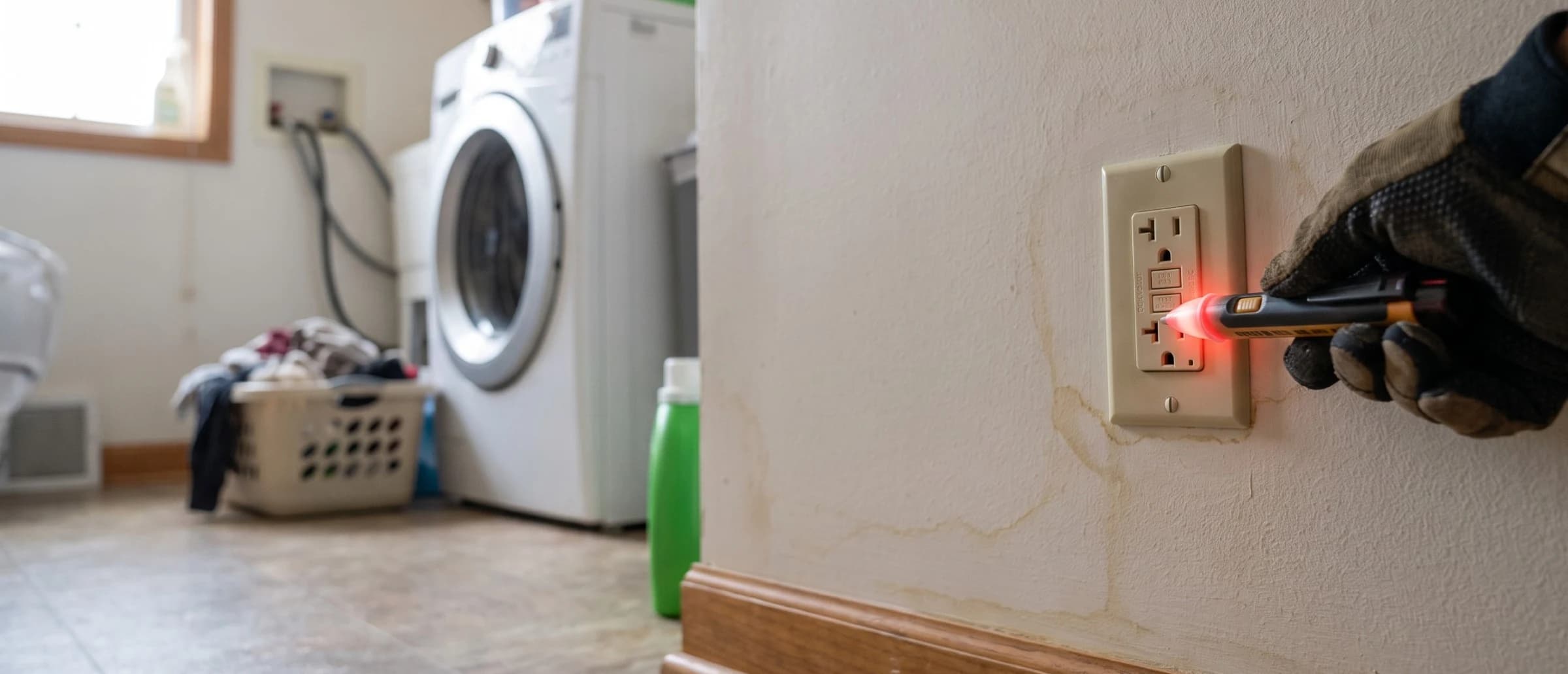

You found water near an outlet, or a GFCI stopped resetting after a leak, and now you're standing in front of it wondering whether it's safe to touch. It isn't, not until you know what actually happened inside the wall behind it. Cut power at the breaker, not the outlet itself, and treat a GFCI that won't reset as a warning sign rather than a nuisance to reset around.
The Electrical Safety Foundation International, the industry authority on electrical hazards, treats any outlet, switch, or wiring exposed to standing water, spray, or sustained dampness as equipment that needs a professional evaluation before it's reenergized, regardless of how dry the cover plate looks. That standard exists because water changes what's inside an outlet box in ways a homeowner can't see from the outside: corroded contacts, contaminated terminals, and degraded wire insulation, none of which show up as a stain, a smell, or a working night light.
Key insights
- Never touch a wet outlet. Water conducts electricity, so a wet or recently flooded outlet can carry current to your hand or anything else touching it.
- A GFCI that won't reset is often protecting you. The most common reason a GFCI stays tripped after water exposure is that it's detecting a genuine ground fault, not malfunctioning.
- Dry-looking doesn't mean safe. Corrosion and contaminated terminals can sit inside an outlet box for weeks after the surrounding wall dries.
- Cut power at the breaker, not the outlet. Never reach for a wet outlet's switch, plug, or reset button to shut it off.
- Contamination level changes the risk. Water from a sewage backup or a flood corrodes wiring and terminals faster than a clean supply-line leak.
- Inspection typically runs $100 to $500. A licensed electrician's evaluation and any outlet repair or replacement usually falls in that range for a single circuit.
What to do if an outlet got wet
Cut power at the breaker box before doing anything else, then stay away from the outlet itself until the water is gone and an electrician has cleared it. This applies whether the water came from a burst pipe, a flooded room, or a slow leak that finally reached the wall.
 Cutting power at the labeled circuit, rather than the main breaker, keeps unaffected rooms powered while the wet outlet is inspected.
Stay clear of the outlet and any standing water nearby
Water pooled near an active circuit can be energized even if nothing looks unusual, and a puddle gives current a path across the floor. Keep pets and kids out of the room until the power is confirmed off.
Cut power at the main breaker or the labeled circuit
If you can reach the breaker panel without stepping into water, switch off the specific circuit or the main breaker if you're not sure which one it is. Never touch a breaker or replace a fuse with wet hands or while standing on a damp floor, a hazard OSHA's flood response guidance specifically warns against.
Note which outlets and rooms lost power
A tripped breaker only tells you one circuit went down. Walk the affected area and write down every outlet, switch, and fixture that stopped working, since they may share a junction box or cable run you can't see.
Photograph the outlet and any visible water line before drying anything
A photo of the cover plate, any discoloration, and the water's high point gives the electrician and your insurer a record of how high the water reached relative to the outlet.
Call an electrician, and a restoration company if water is still active
An electrician is the only one who can clear the circuit for use again. If water is still spreading through the home, get an emergency water damage restoration company on the phone the same call, since extraction needs to start before drying and electrical repairs can move forward.
What not to do
Don't reset a tripped GFCI repeatedly, dry an outlet yourself and plug something into it to test it, or touch a breaker with wet hands. Each of those instincts feels like it's solving the problem, but none of them actually confirms the outlet is safe, and several create a shock risk of their own.
Don't press the reset button over and over
Repeated resetting doesn't remove the moisture causing the trip, and it wastes time you could spend calling an electrician.
Don't dry it yourself and plug something in to test it
A hair dryer reaches surface moisture, not corrosion or contamination inside the box. Plugging in a lamp to see if it works is not a safe way to confirm an outlet is undamaged.
Don't touch a breaker or replace a fuse with wet hands
Standing on a damp floor while working the panel turns a routine shutoff into a shock risk.
Don't assume a working light means the circuit is safe
A fixture can still draw power normally while a nearby outlet on the same run sits damaged, corroded, or partially submerged behind the wall.
Running equipment near a wet outlet
No, not into the outlet or circuit that got wet. Drying equipment, extension cords, and anything else you plug in during cleanup need to run from a circuit that wasn't affected by the water.
This includes fans, dehumidifiers, and shop vacuums brought in before a restoration crew arrives. Running a cord across a wet floor to a questionable outlet defeats the purpose of cutting power in the first place, and it's the same reason a restoration crew treats equipment placement as a deliberate part of the water damage restoration process rather than an afterthought: equipment gets plugged into a confirmed-dry circuit or run on a GFCI-protected cord until the affected one is cleared.
Signs an outlet was affected by water
Visible staining around a cover plate is the obvious sign, but several others point to hidden damage even when nothing looks wet. A GFCI that won't reset, a breaker that keeps tripping, or lights flickering on the same circuit can all mean water reached the wiring without ever producing a stain you'd notice.
 Staining that spreads outward from the plate rather than pooling underneath it suggests water traveled through the wall cavity before reaching the outlet, not just splashed against it from the floor.
Not every sign points to the outlet nearest the water. A stain several feet from a working GFCI can mean water traveled along a stud or cable run before it reached the box that actually failed, so it's worth checking every outlet on the affected wall rather than just the one closest to where the water pooled.
| Sign | Where to look | What it usually means |
|---|---|---|
| Discoloration or a stain around the plate | Cover plate, baseboard below it | Water reached the box directly |
| GFCI won't reset | Kitchens, bathrooms, garages, outdoors | Moisture is creating a real ground fault |
| Breaker trips repeatedly | Panel | The circuit itself may have taken on water |
| Warm or swollen cover plate | Any affected room | Possible arcing or heat damage inside |
| Burning smell or buzzing | Outlet, switch, or panel | Insulation or wiring damage in progress |
| Flickering lights on the same circuit | Fixtures sharing the run | Hidden wiring damage upstream or downstream |
Why a dry outlet can still be dangerous
An outlet can look completely normal on the outside while the contacts, terminals, and insulation inside the box are still corroded or contaminated. Water travels through wall cavities along framing and insulation well beyond the point it's visible, so an outlet several feet from any stain can still be affected.
That gap between appearance and actual condition is why a burst pipe or an appliance leak that never produced a puddle in front of an outlet can still leave that outlet unsafe. Sediment and residue left behind after the water dries can interfere with the outlet's internal contacts, and re-energizing a damaged component can cause arcing, overheating, or a tripped breaker with no visible warning beforehand.
Moisture trapped behind the cover plate for more than a day or two also sets up the same conditions the CDC associates with faster mold growth. That's a separate problem from the electrical repair itself, but worth flagging to whoever is running the drying equipment so it doesn't get missed once the outlet is cleared.
GFCI outlets and water
A GFCI, or ground fault circuit interrupter, compares the current flowing out through the hot wire against the current returning through the neutral wire, and it cuts power in a fraction of a second if the two don't match. Water inside the box gives current a path to ground that bypasses the normal circuit, and the GFCI reads that as a fault and refuses to stay reset until it's gone.
 GFCI protection is required near sinks and other wet fixtures under residential electrical code, which is why this outlet trips on contact with moisture rather than a fault elsewhere in the house.
That's the reason kitchens, bathrooms, garages, and outdoor outlets have carried GFCI protection under building codes for decades: those are exactly the places water and electricity are most likely to meet. If a dishwasher leak or sink leak near an outlet is what tripped yours, that's the outlet working as designed, not a sign it needs replacing outright, though it still shouldn't be reset until dry.
Tripped GFCI or damaged outlet?
No. A GFCI that won't reset is usually behaving correctly, protecting you from a real ground fault caused by moisture, while a damaged outlet has physical harm inside it, corrosion, melted plastic, or burned contacts, that a reset button can't fix. The distinction matters because one resolves once the area is fully dry and the other requires replacement no matter how long you wait.
An electrician tests for the difference with the power off: a continuity and insulation check on a GFCI that still won't reset once everything is dry usually points to internal damage rather than lingering moisture, at which point the fix is a new outlet rather than more drying time. That test takes only a few minutes once the circuit is confirmed de-energized, and it applies the same way whether the ground fault protection sits at the outlet itself or at a GFCI breaker in the panel.
When to call an electrician immediately
Call an electrician right away if contaminated water reached the outlet, more than one outlet or an entire room lost power, you notice a burning smell or sparking, or the outlet was ever submerged. Any one of those on its own is reason enough to leave the power off until someone qualified inspects it.
 Melted plastic and soot around a slot point to arcing that already occurred, a fire risk that calls for cutting power immediately rather than waiting to see if the outlet still works.
Water reached the outlet from a contaminated source
A sewage backup or any Category 2 or 3 water carries bacteria and debris that accelerate corrosion inside an outlet box far faster than a clean supply-line leak, and contact with that residue is a health hazard on top of the electrical one.
Multiple outlets or an entire room lost power
A shared circuit, junction box, or panel-level issue is more likely than a single bad outlet, and it needs a broader inspection than one receptacle.
You notice a burning smell, buzzing, sparking, or a warm cover plate
These are signs of active arcing or heat damage, and the circuit should stay off until an electrician confirms it's safe.
The outlet was below the water line during a flood or storm event
Anything submerged during storm and hurricane water damage needs a full evaluation before it's used again, even if it's been dry for weeks.
Your home has older or aluminum wiring
Aging wiring is more vulnerable to corrosion and less forgiving of a mistake, which is a reason to bring in a professional rather than test it yourself.
If water reached the breaker panel
Water at the breaker panel is a bigger risk than a single wet outlet, and it isn't something to handle with a reset button or a hair dryer either. On this point, ESFI's flood safety guidance is direct: leave the power off until a qualified electrician inspects the whole system, and call before anyone touches the panel again.
The panel is the point every circuit in the house routes through, so even a small amount of water inside it can affect more than the one breaker that tripped. A flooding event or a basement leak that reached a low-mounted panel means an electrician needs to inspect the panel itself, not just the individual breakers, before power gets restored to the rest of the house. A panel that took on standing water is often replaced rather than dried out and reused, since the bus bars and breaker connections inside are difficult to fully clean and verify.
What an electrician checks
An electrician checks the internal condition of the outlet box and wiring, the parts that never show up in a quick look or a test-plug check. With the power off, they start with a moisture reading inside the box itself, generally treating a reading at or below roughly 15 percent as dry and anything above 17 percent as still elevated, the same threshold a restoration crew relies on during structural drying to confirm a wall cavity is actually dry.
From there, they inspect the physical contacts and terminals for corrosion or pitting, run an insulation resistance test on the wiring to check for degraded coating, and trace the circuit back to the panel if a breaker keeps tripping. Only once all of that comes back clean does the outlet get cleared to use again.
Repair or replace the outlet
Whether an electrician repairs, reconditions, or replaces a water-affected outlet depends on how much water reached it and what it was contaminated with, not on how the outlet looks or tests once it's dry. A light splash that dried within a day and standing water that sat against the box overnight can leave an outlet looking and testing the same, even though one carries far more hidden risk than the other.
 Rust on the mounting ears and blackened contacts like this mean the metal itself has degraded, a condition an electrician cannot clean or recondition back to a safe state. The replacement outlet beside it costs only a few dollars in parts, so most of the bill is the labor to trace and confirm the damage.
Contamination type matters as much as exposure time. Bacteria and debris from a sewage backup or floodwater accelerate corrosion in ways a clean supply-line leak doesn't, which is why the same few hours of exposure can call for different outcomes depending on what was in the water.
| Scenario | Typical outcome | Why |
|---|---|---|
| Light splash, dried quickly, no discoloration | Reset and use once confirmed dry | Minimal chance of internal contamination |
| Standing water reached the box | Replace the outlet | Corrosion and contamination are difficult to fully clear |
| Category 2 or 3 water involved | Replace outlet and inspect wiring | Contaminants accelerate long-term corrosion |
| Submerged during a flood | Replace outlet, wiring, and possibly the breaker | Extended exposure degrades every component involved |
How this connects to restoration
The electrical repair and the water damage restoration are two separate jobs, but they run on the same underlying facts. A restoration company classifies the loss using the same water damage categories IICRC S500 defines, and an electrician weighs that same contamination level and how long the water sat when deciding whether an outlet can be reconditioned or needs to come out entirely. A clean, quickly-caught leak and a Category 3 loss that sat overnight call for different answers even at the same outlet.
That's also why the restoration side and the electrical side of the job stay separate. A technician holding water damage restoration certifications can extract water, run drying equipment, and monitor moisture in the walls, but only a licensed electrician can clear a circuit for use, and drying equipment itself needs to run from an unaffected circuit until that clearance happens.
Cost to inspect and repair
A single outlet inspection and repair typically runs $100 to $500, with the number depending on whether the outlet needs replacing or the electrician finds damage further into the wiring. That figure covers a straightforward single-outlet visit, not a circuit rewire or panel-level repair, both of which cost substantially more.
 A live voltage reading like this confirms the circuit is still energized, one of several checks included in a diagnostic visit before any repair work begins.
Labor accounts for most of that spread, not parts. A GFCI outlet itself costs under twenty dollars, but tracing a fault behind a wall, testing several points along a circuit, or coordinating a visit around a restoration crew already mid-job all add time an electrician bills for.
| Scope | Typical cost |
|---|---|
| Diagnostic visit only | $75–$150 |
| Single outlet or GFCI replacement | $100–$300 |
| Circuit rewire (one run) | $500–$2,000 |
| Panel-level inspection and repair | $500–$3,500+ |
These figures cover the electrical repair itself and sit separate from the extraction and drying costs a water damage restoration job carries, since the two are typically billed by different companies. Expect the restoration side, extraction, drying, and any repairs, to add another few thousand dollars for a single room on top of whatever the electrical work runs.
Does insurance cover this repair
Homeowners insurance usually covers electrical repairs caused by water damage when the underlying water event was sudden and accidental, the same standard insurers apply to the rest of a water damage claim. A burst pipe that soaks a wall and shorts an outlet is a typical example of coverage applying.
Damage from a slow, long-ignored leak or general wear tends to fall under the same maintenance exclusions that apply to the water damage itself, per NAIC's consumer guidance on homeowners insurance. Keep the electrician's invoice and inspection notes with your other documentation, since an adjuster reviewing the claim will want to see that the electrical repair was tied directly to the water event rather than a pre-existing issue.
Preventing future electrical damage
Confirming GFCI protection in wet-prone rooms, keeping outlets and panels elevated in flood-prone spaces, and responding to leaks the same day they're found are the habits that most reliably prevent a repeat. None of them require major renovation, just consistent follow-through.
 Testing the button monthly confirms the internal trip mechanism still works, since a GFCI can fail silently and stop protecting the circuit long before it visibly stops functioning.
Confirm GFCI protection in every wet-prone area
Kitchens, bathrooms, garages, basements, and outdoor outlets should all carry GFCI protection, and testing the button monthly confirms it's still functioning.
Keep outlets and panels elevated in flood-prone spaces
If you're finishing a lower level prone to basement water damage or a garage in a flood-risk area, outlets set higher on the wall and a panel above the historical flood line reduce exposure the next time water gets in.
Maintain the systems that keep water away from wiring in the first place
Testing your sump pump a few times a year to catch sump pump failure early prevents the basement flooding scenario that most often reaches outlets and panels near the floor.
Respond to any leak the same day it's found
The longer water sits against a wall, the further it travels and the more likely it reaches an outlet or junction box you didn't expect.
Have an electrician address any outlet that's tripped for no clear reason
A GFCI that trips with no water and no obvious cause can be an early sign of wiring wear worth catching before it becomes a bigger problem.
Frequently asked questions
Is it safe to touch a wet electrical outlet?
No. Water conducts electricity, so a wet outlet can carry current to your hand, the wall around it, or anything else touching it. Cut power at the breaker before you go anywhere near it, and don't touch it again until it's confirmed dry and safe by an electrician.
Why won't my GFCI outlet reset after water got into it?
It's usually detecting a real ground fault, not malfunctioning. Moisture inside the outlet box creates a leakage path between the hot wire and ground, and the GFCI is refusing to reset specifically to stop you from getting shocked.
What's the difference between a GFCI outlet and a GFCI breaker after water damage?
A GFCI outlet protects the single location it's installed in, while a GFCI breaker protects an entire circuit from the panel. If your home uses breaker-level protection, a circuit that won't reset is following the same ground-fault logic just at the panel instead of at one outlet, and it needs the same response: leave it off and let an electrician confirm the fault is gone.
How long does a water damaged outlet take to dry out?
A few days at minimum, and that timeline only applies to surface moisture. Water trapped behind the box, inside conduit, or in the wall cavity can take substantially longer, which is why drying time alone isn't a safe test.
Does a tripped breaker mean the outlet is safe now?
No. A tripped breaker only confirms that one circuit lost power. Other circuits sharing the same wall, junction box, or cable run can still be energized, and the breaker itself may have been exposed to water.
Is it dangerous if I already plugged something into a wet outlet before realizing it?
It's a reason to have the outlet checked, not necessarily a sign of damage. If whatever you plugged in worked normally with no spark, trip, or unusual smell, the outlet likely wasn't wet enough internally to cause harm in that moment, but an electrician should still confirm there's no hidden corrosion before you rely on it again.
Should I call an electrician or my water damage restoration company first?
Call both, but keep them separate. A restoration company handles extraction and drying and is not licensed to evaluate or repair wiring, while a licensed electrician is the only one qualified to clear an outlet or circuit for use again, and water damage restoration cost for that side of the job is billed separately from the electrician's invoice.
What if my insurer says the electrical damage isn't covered but the water damage is?
That split usually comes down to documentation, not a blanket exclusion. If the adjuster can't see a clear link between the covered water event and the electrical damage, submitting the electrician's inspection report tying the two together often gets the decision reversed.
Should every outlet on the circuit be replaced, or just the one that got wet?
Usually just the ones water actually reached, not the whole circuit automatically. An electrician traces which outlets and boxes were exposed and tests each individually, since outlets further down the same circuit that stayed dry don't need replacing just because they share a wire run with one that did.
Is it safe to briefly turn the breaker back on just to test if the outlet works?
No. Even a brief test can complete a circuit through corroded contacts and cause arcing or a shock, and it tells you nothing reliable about hidden damage inside the box. Leave the breaker off until an electrician has actually inspected it.
Sam Hickerson is the founder of RestoreAdvisor and writes consumer guides on mold remediation, water damage restoration, inspection, testing, and home recovery. His work focuses on helping homeowners understand costs, risks, and when to call a professional. He draws on guidance from the EPA, CDC, IICRC, and other authoritative sources to make complex home issues easier to navigate.