
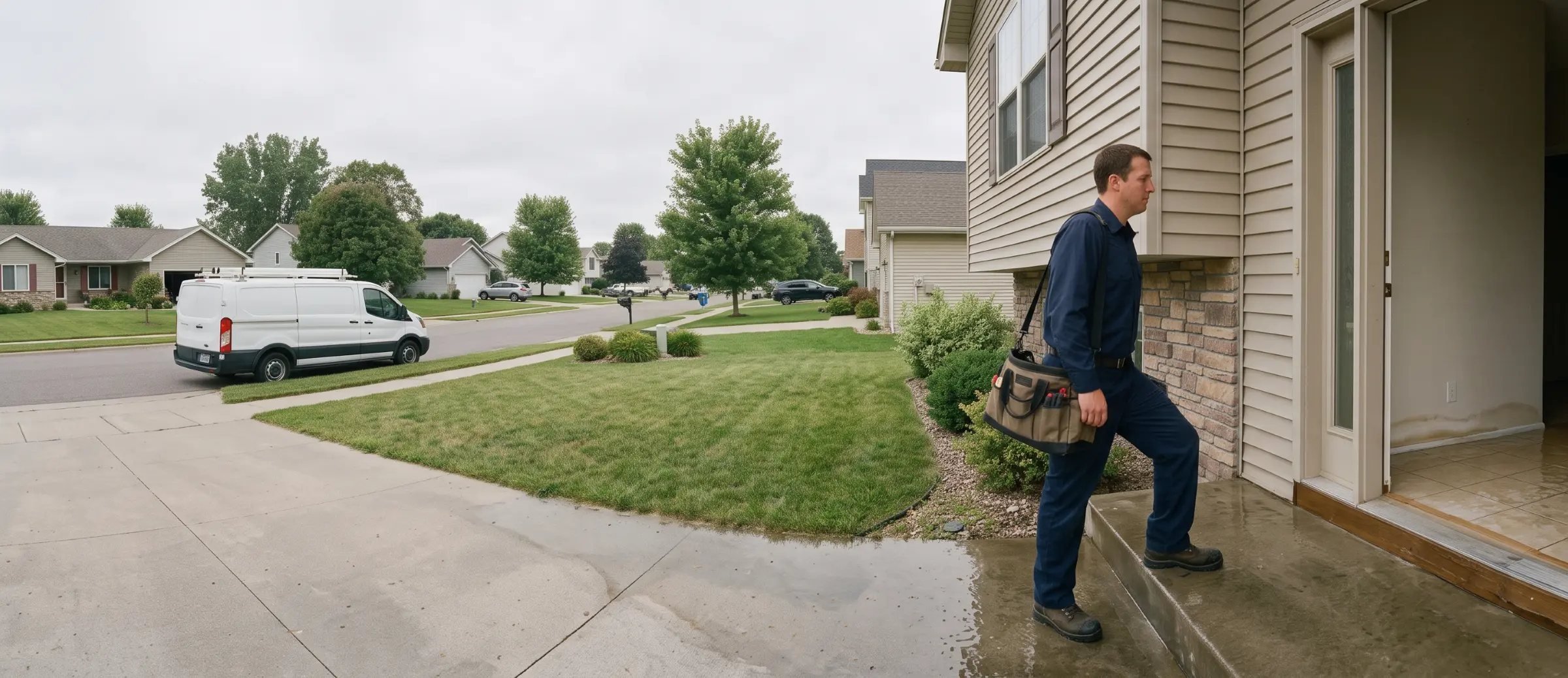

Water spreading across a floor or dripping through a ceiling puts every minute against you, and knowing what actually counts as an emergency changes what happens next, whether to grab towels and wait, or get a restoration crew moving right now. The next several minutes matter most: stopping the water, cutting power safely if it's reached electrical components, and getting a real 24-hour response on the way rather than a voicemail that returns calls at nine.
Emergency water damage restoration is the mitigation response, extraction, safety triage, and moisture control, that begins within hours of a loss to stop it from spreading further, following the timelines and safety practices set out in the IICRC S500 standard for professional water damage restoration.
The full arc of water damage restoration spans days or weeks from first call to final repair, but the emergency phase is the narrow window in the first few hours where speed determines how much of a home stays salvageable.
Key insights
- Active water is the threshold. Water damage is a true emergency when it's actively flowing, has reached electrical components, or carries sewage; a resolved leak with no ongoing movement is urgent but not a 911-level event.
- Cut power at the breaker. When water reaches outlets or a breaker panel, shutting off power at the main breaker, not unplugging devices sitting in water, is the correct first move under OSHA flood safety guidance.
- Real 24-hour service means a live rotation. A genuine 24-hour restoration company has a technician or on-call dispatcher who can confirm an arrival window immediately; a voicemail box that returns calls the next morning isn't true emergency service.
- Arrival typically takes 30 to 60 minutes. Most urban emergency response arrives on-site within an hour of the call, though rural areas and widespread storm events can push that timeline well past 60 minutes.
- After-hours service usually costs more. Emergency and after-hours response commonly carries a 25 to 50 percent labor premium or a flat dispatch fee, though the extraction and drying itself is priced the same as standard service.
- The clock starts at 24 to 48 hours. The CDC's mold-growth timeline on damp materials is the underlying reason emergency response exists instead of waiting for the next business day.
Is your water damage a true emergency?
A water damage emergency is any situation where water is actively spreading, has reached electrical components, or carries sewage or other contamination, each of which creates a health or safety risk beyond the property damage itself. A slow, contained leak with no active water movement is urgent and still needs fast attention, but it doesn't carry the same immediate danger.
 Water reaching this height on the wall means it also reached the outlet mounted just above it, which is the point IICRC S500 calls for cutting power at the breaker before anyone enters the room.
- Water is actively flowing from a pipe, appliance, or roof and hasn't been stopped
- Standing water has reached outlets, an appliance, or the breaker panel
- The water is contaminated: sewage backup, floodwater, or an unknown source
- A ceiling, wall, or floor is sagging, bulging, or shows signs of structural strain
- A household member is especially vulnerable to mold or bacterial exposure, such as an infant, an older adult, or someone who is immunocompromised
Contamination level plays directly into urgency: water classified as Category 3 under water damage categories carries bacteria and pathogens that turn a routine cleanup into a health hazard, and that's true whether the source is a sewage backup or floodwater from outside the home.
The CDC: Basic Facts About Mold puts the mold-growth window on damp materials at 24 to 48 hours, one more reason any of the five triggers above should move a homeowner toward same-day professional response rather than a scheduled appointment. If none of them apply and the water has already stopped moving, the situation is more likely urgent than a true emergency, and treating it that way saves the premium that comes with a middle-of-the-night dispatch.
What to do in the first 10 minutes
The first 10 minutes of a water damage emergency should be spent moving people away from the water, cutting power if it's reached an outlet or panel, and stopping the source if it's accessible, in that order, before any cleanup starts. Calling for help comes right after these three physical safety steps, not before them.
 Cutting power at the main breaker, not unplugging individual devices, is the step OSHA flags as the highest-risk moment in an active water emergency.
1. Get people and pets away from the water
Standing water conducts electricity, and floodwater or sewage backup can carry pathogens. Move everyone, including pets, to a dry area of the home before doing anything else.
2. Cut power at the breaker if you can reach it safely
If water has reached outlets, appliances, or the breaker panel itself, shut off power at the main breaker rather than unplugging individual devices sitting in water. This is one of the highest-risk steps in an active water emergency under OSHA: Flood Preparedness and Response guidance, and if reaching the panel means walking through standing water, wait for an electrician instead.
3. Stop the water source if it's accessible
A burst supply line usually has a shutoff valve within a few feet, and a washing machine or dishwasher leak can often be stopped at the appliance's own valve. If the source is external, a roof leak during a storm or a municipal main break, stopping it isn't possible from inside the house, so move to the next step instead.
4. Call for help before you start cleaning
Once people are safe and the water is stopped or as controlled as it can be, call a restoration company, or for anything involving sewage, structural risk, or an inaccessible electrical hazard, call 911 first. Cleanup can wait a few extra minutes; getting the right people moving toward the house cannot.
Who to call: 911, your utility, or a restoration company
Call 911 when there's an immediate danger to life, an active electrical fire risk, or a structural collapse in progress. Call your utility company when the source is outside your control, a municipal water main or a downed power line, and call a restoration company for the water damage itself once immediate safety is handled.
 Calling 911 is only necessary for an active electrical or structural hazard; water damage on its own, even a serious loss, is a call to a restoration company, not an emergency dispatcher.
A restoration company is the right call for anything from a single flooded room to whole-house flooding, once the household is safe and any electrical hazard is cut off. Emergencies rarely leave time for the kind of research worth doing when choosing a water damage restoration company, which is exactly why it helps to already know which company you'd call before an emergency happens rather than searching mid-crisis.
Renters have one more call to make first. A landlord or property manager usually controls the building's master shutoff and is financially responsible for emergency repairs to the structure itself, so notifying them immediately, even before or alongside calling a restoration company, protects a tenant from being held liable for a delayed response. Most leases require this notice regardless of who ultimately pays for the mitigation work.
Having a few basics ready before you dial speeds up the call: your address, what caused the water and whether it's still flowing, whether power to the area has been cut, and whether anyone in the home is especially vulnerable to mold or bacterial exposure. A dispatcher uses that information to decide how fast to send someone and what equipment to bring.
What to do if you weren't home when it happened
If you weren't home when it happened, get someone with a key, a neighbor, property manager, or family member, into the house immediately to shut off the water and cut power, walking them through it by phone if needed. The emergency clock starts the moment the water is discovered, not the moment you arrive, so acting through someone else beats waiting until you can get there yourself.
Most restoration companies can begin emergency mitigation with verbal authorization from the homeowner over the phone, so being physically present isn't required to get the loss stopped once someone else has let the crew in. This is different from the neighbor's or property manager's role, which is limited to access and the basic safety shutoffs, not authorizing the actual restoration work.
Smart water sensors and automatic shutoff valves that send an alert the moment they detect moisture are worth the modest cost for exactly this scenario, since they catch a leak hours or days before a neighbor would otherwise notice a stain or a smell. Photos or video from whoever grants access, taken before any cleanup starts, still create the documentation an insurance claim needs, even if the homeowner isn't the one holding the phone.
What "24-hour emergency water damage restoration" actually means
24-hour emergency water damage restoration means a company keeps technicians on call around the clock and can dispatch someone to a property regardless of the time or day, not that a cheerful person answers at 3 a.m. In practice, this ranges from a live dispatcher who sends a tech within the hour to an answering service that just takes a message until morning, and that difference matters enormously when water is actively spreading.
 A live dispatcher who can confirm an arrival window on the spot, not an answering service that takes a message, is the difference between a genuine 24-hour operation and one that only claims to be.
An IICRC Certified Firm status is one of the fastest ways to confirm a company is a real operation rather than a lead-generation service reselling the call to a subcontractor, verified during that same phone call by checking the firm's status against water damage restoration certifications and confirming the responding technician's individual credential hasn't lapsed. Asking whether the person on the phone can confirm an arrival window, not just that someone will call back, separates a company with an actual on-call rotation from one relying on a voicemail box.
Response time in most metro areas runs 30 to 60 minutes from the initial call to a technician arriving on-site, though rural areas and severe weather events that overwhelm every local company at once can push that well past an hour. Confirming licensing, insurance, and a realistic arrival window matters just as much during an emergency as it does when comparing quotes on a non-urgent job, and the full list of questions to ask a water damage restoration company applies here too.
What to do while you wait for help to arrive
While waiting for a crew, take a few photos or a short video of the damage before touching anything, then pull out standing water with a wet/dry vacuum or towels, move furniture and rugs off the wet floor, and open windows for airflow if the weather allows. These actions in the minutes before a technician arrives meaningfully reduce how much needs to be repaired later.
 Photos taken before any water is removed or items are moved create the timestamped record an insurance adjuster relies on to confirm when and how the loss occurred.
The EPA flags this kind of moisture buildup as a driver of indoor air quality problems after a flood event, which is why airflow matters even before drying equipment arrives. Anything wood or upholstered lifted onto blocks or aluminum foil stays drier than furniture left flat on a wet floor, and boxes or loose items moved off the floor entirely avoid wicking moisture into their contents.
How much of this makes sense to do alone depends partly on scale. A single wet carpet in a bathroom is a very different job than a fully saturated loss spread across multiple rooms.
The full ordered sequence of extraction, drying, and documentation steps beyond this immediate window follows the same order laid out in the water damage restoration checklist. It's organized as nine checkbox phases meant to be printed and followed step by step during the job, rather than read once and set aside.
Power outage complications during a water emergency
A power outage during a water emergency stops a sump pump from running, cuts off any dehumidifiers or air movers already in place, and can push a homeowner toward a generator, each of which adds its own hazard on top of the original water damage. Flooding and outages often arrive together during the same storm, and treating them as two separate problems instead of one compounding one is where people get hurt.
A sump pump that loses power at the exact moment it's needed most is one of the most common ways a manageable basement leak turns into a full flood. A battery backup or water-powered backup sump pump is the only real protection against this, and neither works retroactively once the outage has already started, so a homeowner without a backup system should watch the sump pit manually and be ready to bail water by hand or call for emergency pumping if levels rise faster than expected.
Running a generator indoors, in a garage, or too close to open windows to power a dehumidifier or sump pump creates a carbon monoxide risk that can be fatal within minutes, according to CPSC: Carbon Monoxide Information Center. A generator should stay at least 20 feet from the house, pointed away from windows and doors, and should never run in an attached garage even with the door open. Professional drying equipment generally can't run until power is restored or generator capacity is confirmed on-site, which is one more reason to mention an outage on the initial call to a restoration company.
Does emergency water damage restoration cost more?
Yes, emergency and after-hours response typically carries a premium above standard daytime rates, usually either a flat dispatch fee or a percentage markup on labor for nights, weekends, and holidays. The extraction and drying work itself is priced the same regardless of when it happens; it's the urgency and staffing outside normal hours that costs more.
That premium commonly runs 25 percent to 50 percent above standard labor rates, or a flat emergency dispatch fee in the range of $150 to $500 depending on the company and region, on top of the water damage restoration cost for the mitigation work itself. Homeowners are sometimes surprised by this line item on an invoice, but it usually reflects the actual cost of keeping technicians on an overnight rotation rather than padding.
Homeowners insurance generally reimburses the emergency response as part of the overall mitigation claim when the loss is a covered peril, so an after-hours premium doesn't typically come out of pocket separately from the rest of the job. The insurance coverage for water damage a specific policy provides still determines whether the underlying cause, a burst pipe versus a gradual leak, is covered at all, which matters more to the final bill than the after-hours fee itself.
Emergency scenarios by type
The cause of a water event determines both its urgency level and the correct first action, and that ranges from an actively flowing burst pipe to a slow appliance leak discovered days later. Matching the scenario to the right response keeps a homeowner from either under-reacting to a genuine emergency or paying an emergency premium for something that could safely wait.
 An actively flowing pipe is the clearest emergency trigger of the six scenarios below, since every minute it runs adds to both the water damage and the eventual cost.
Many emergencies involve more than one factor at once, a burst pipe during a winter storm, or a sewage backup triggered by heavy rainfall, and the higher urgency level always takes precedence when scenarios overlap. The size of the loss matters too: a single wet carpet falls under a very different water damage classes rating than a fully saturated multi-room flood, and that classification shapes how much equipment a crew brings on the first visit.
| Scenario | Urgency level | Immediate action |
|---|---|---|
| Burst or actively flowing pipe | Emergency, call now | Shut off the main water valve, cut power if it reached outlets, call a restoration company immediately |
| Sewage or drain backup | Emergency, do not enter | Stay out of the affected area, avoid using drains, call a restoration company for contaminated-water handling |
| Storm or exterior flooding | Emergency if rising | Move to higher ground if water is rising, cut power at the breaker if accessible, call once safe |
| Roof leak during an active storm | Emergency if spreading | Place a container to catch water, avoid roof access during the storm, call as soon as it's safe |
| Appliance or fixture leak | Urgent, same day | Shut off the appliance's water valve, extract standing water, call a restoration company same day |
| Slow leak discovered after the fact | Urgent, not 911-level | Confirm the source is stopped, document the damage, schedule an inspection within 24 to 48 hours |
Once a crew is on-site, the assessment and initial extraction phase looks similar regardless of which scenario brought them there, and the full water damage restoration process runs eight phases from that first assessment through the final moisture check.
What happens when the crew arrives
A responding technician's first task is assessment: confirming the water's category and class, checking for electrical or structural hazards, and identifying how far moisture has traveled beyond what's visible. Extraction typically begins within minutes of that assessment, before any paperwork or estimate discussion happens.
From there, the pace shifts from emergency triage to the multi-day drying and monitoring process. Noise from air movers, changes in indoor air quality, and a handful of decisions a homeowner is asked to authorize once the crisis phase ends are all part of what to expect during water damage restoration.
Total project length varies widely by scenario: a single-room mitigation can wrap up in under a week, while a multi-floor loss can run past a month, and how long water damage restoration takes breaks that range down by severity and material. Knowing that range upfront helps set expectations with an insurer or a landlord who wants a completion date.
Emergency board-up and temporary protective measures
Board-up and tarping protect a home from further water and weather intrusion when a storm has caused a structural opening, a broken window, a hole in the roof, or a damaged door, that would otherwise let more water in before repairs begin. Most restoration companies offering 24-hour service include this as part of emergency response rather than as a separate call.
 A tarp is a temporary fix meant to last days, not weeks, and should be checked again after any additional storm activity before the actual roof repair begins.
A tarp secured over a roof opening and plywood over a broken window or door are temporary measures meant to last days, not weeks, and should be inspected after any additional storm activity. Sandbags or barriers around an exterior door threshold can help during active exterior flooding, though they're a stopgap for water already approaching the house rather than a substitute for stopping the source.
Frequently asked questions
Is a slow leak considered a water damage emergency?
No, a slow leak with no active water movement is urgent but not an emergency in the same sense as an actively flowing pipe or sewage backup. It still deserves same-day attention, since even a small ongoing leak can reach the 24 to 48 hour mold-risk window, but it typically doesn't require a middle-of-the-night dispatch call. Checking signs of water damage for staining age and moisture readings can help confirm whether a scheduled inspection is enough.
What should I avoid doing during a water damage emergency?
Avoid using a household vacuum on standing water, since it isn't built for water pickup and creates a shock risk. Also avoid entering a room with a sagging ceiling, walking through water near an outlet or breaker panel, or using electrical appliances that have gotten wet until a professional confirms it's safe.
Can I remove water myself before a crew arrives?
Yes, for a small amount of Category 1 clean water, a wet/dry vacuum, towels, or a mop can safely handle extraction while you wait. Category 2 or 3 water, gray or contaminated water from an appliance backup, sewage, or an unknown source, should be left to a professional with the right PPE rather than handled by hand.
Will homeowners insurance cover emergency after-hours service?
Usually, yes, when the underlying cause is a covered peril, the after-hours premium gets folded into the overall mitigation line item on the claim rather than billed separately. It's still worth confirming with the adjuster, since a handful of policies cap emergency service fees or require prior authorization above a certain dollar amount.
What happens if no restoration company answers overnight?
Try at least two or three companies rather than waiting on hold with one, since call volume during regional storms can overwhelm even a legitimate 24-hour operation. If the water is actively spreading and no company answers, stopping the source and containing what you can with towels or buckets until morning is the reasonable fallback, not waiting by the phone.
Should I evacuate the house during the first hour of an emergency?
Only if there's an active electrical hazard, a structural collapse risk, or contaminated water you can't avoid; otherwise, staying in an unaffected part of the home is fine during the initial response. This is a narrower, safety-driven decision than the longer relocation question homeowners face once a job is underway and drying equipment is running for days.
How can I tell if a company's 24/7 claim is real?
Ask directly whether a live technician or on-call rotation answers after hours, or whether the call goes to an answering service that just takes a message. A company that can give a specific arrival window on the spot, rather than a vague promise that someone will call back, is a stronger signal than the 24/7 label on its website alone.
What's the difference between emergency mitigation and full restoration?
Emergency mitigation is the extraction, drying, and stabilization work that has to start within hours to stop a loss from getting worse, while full restoration, repairs and reconstruction, is scheduled separately once the property is dry. Mitigation typically begins the same day it's called in, but the rebuild phase, new drywall, flooring, or paint, often starts days or weeks later once materials and contractors are scheduled.
Sam Hickerson is the founder of RestoreAdvisor and writes consumer guides on mold remediation, water damage restoration, inspection, testing, and home recovery. His work focuses on helping homeowners understand costs, risks, and when to call a professional. He draws on guidance from the EPA, CDC, IICRC, and other authoritative sources to make complex home issues easier to navigate.