
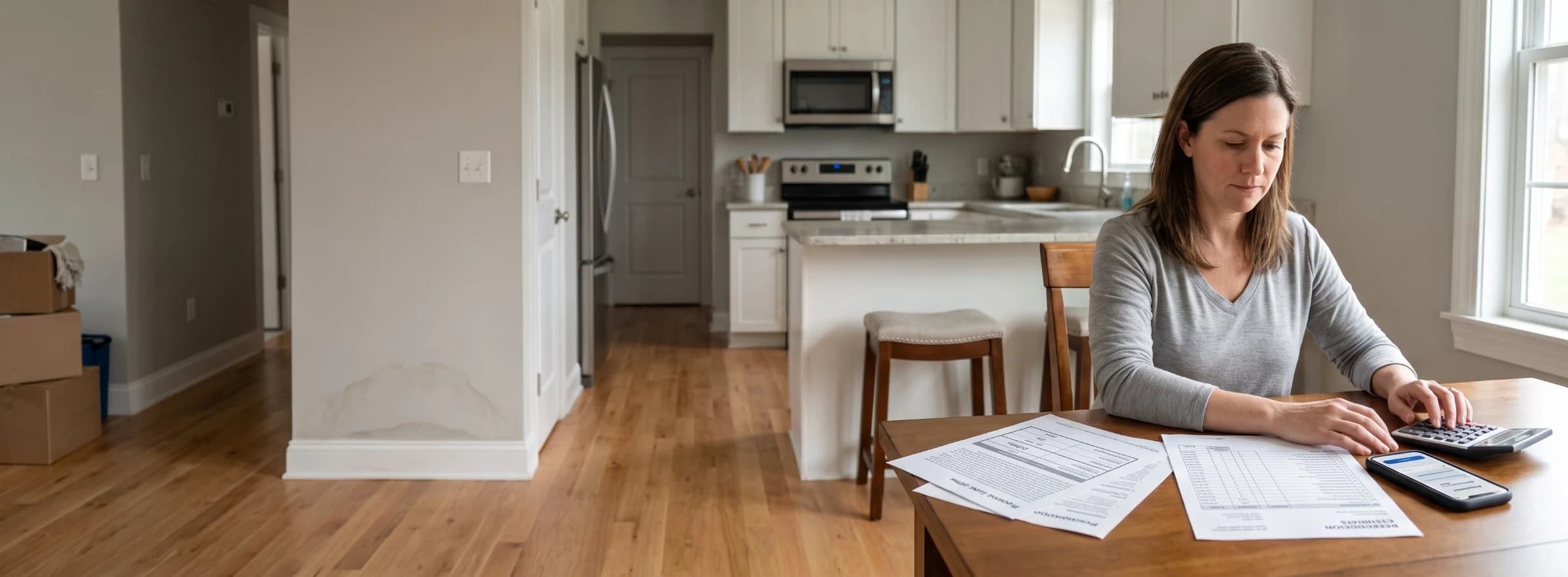

Finding out you cannot cover the cost of water damage restoration on your own, whether insurance came up short, a claim is still pending, or the cause was never covered in the first place, does not mean the drying and repair have to stop. Real financing exists for this exact situation: contractor payment plans, personal loans, home equity products, and, after a federally declared disaster, low-interest government loans and grants that many homeowners never think to check. Start with what your insurer already owes you, since that number decides how much of any of this you actually need to borrow, before you sign anything that makes the situation worse.
Water damage restoration financing means using a loan, payment plan, or grant, rather than cash on hand, to cover extraction, drying, and repair costs after a water event, and the options range from a restoration company's own installment plan to a Small Business Administration disaster loan governed by 13 CFR Part 123. Confirming what your policy already covers matters first, since it changes how much you actually need to finance rather than the full number on the estimate.
Key insights
- Ask before you borrow. Many restoration companies offer in-house or third-party payment plans directly, sometimes 0% for 6 to 18 months, before a homeowner ever applies for outside financing.
- Insurance changes the math first. If a covered peril caused the damage, financing only needs to bridge the deductible and whatever the adjuster's estimate left out, not the full job.
- Disaster loans beat most private loans on rate. An SBA disaster loan tops out at 8% APR, or 4% if you cannot get credit elsewhere, with terms up to 30 years, but only after a federal disaster declaration covers your county.
- A HELOC is cheaper but riskier. Home equity products typically carry a lower rate than an unsecured personal loan, but they use your home as collateral rather than your credit score alone.
- FEMA grants do not have to be repaid. Individual Assistance can provide up to $43,600 toward housing repairs, though it applies only after a presidential disaster declaration and only supplements, not replaces, insurance.
- Full payment upfront is a red flag. A legitimate restoration company will start work on a deposit or an insurance assignment; demanding the entire cost in cash before touching the property is a documented storm-chaser tactic.
Insurance and your deductible
Most homeowners do not need to finance the entire cost of water damage restoration, only the deductible and whatever the adjuster's estimate leaves out, so the first call worth making is to your insurer rather than a lender. A burst pipe, an appliance failure, or another sudden and accidental event is typically covered under a standard homeowners policy covering water damage, which means the insurer pays the restoration company directly or reimburses you, and financing only has to bridge your deductible, usually $500 to $2,000, plus any line item the adjuster excluded.
 A covered claim typically pays the restoration bill minus the deductible, usually $500 to $2,000, so confirming the payout before borrowing keeps you from financing money the insurer already owes you.
If the cause is gradual, like a slow supply-line drip, or excluded outright, like groundwater seepage or flooding with no separate flood policy, the claim may pay little or nothing, and the full restoration bill becomes something you finance rather than a gap you bridge. Before assuming you need a loan for the whole job, get the adjuster's written estimate and compare it against the restoration company's own scope of work, since a mismatch between the two is often where the actual financing need starts.
If your claim was denied outright rather than simply excluded, that changes which financing option makes sense. Reviewing what to do after a denied water damage insurance claim before signing a loan against your home is worth the extra day, since an appeal or a second opinion sometimes recovers money a lender assumed you would never see.
Reduce what you need to finance
The fastest way to make water damage restoration affordable is often to shrink the total bill before you ever apply for financing, since a smaller job costs less to borrow against either way. Getting a second written estimate from another certified company is the easiest way to bring the total down, since scope and pricing can vary meaningfully for the same job, and a second opinion sometimes trims real money off the total without cutting anything the home actually needs.
Phasing the work can help just as much when cash, not the damage itself, is the real constraint. Authorizing extraction and drying now, the steps that stop mold and further structural loss, while deferring cosmetic repairs like painting or flooring replacement until funds are available, keeps the home safe without financing the entire job in one lump sum. Confirm with the company in writing which line items are time-sensitive and which can wait, since pairing that with a phased payment plan often reduces how much you need to borrow at any one time.
Letting your insurer pay directly
An assignment of benefits, or AOB, is a document that lets the restoration company bill your insurer directly for the covered portion of the job, rather than you paying the company and waiting on your own water damage insurance claim to be processed and reimbursed. Signing one can remove the need to finance anything beyond your deductible, since the company gets paid out of the claim itself instead of out of your pocket.
 An assignment of benefits lets the company bill your insurer directly, but it also hands over some control of the claim, so read what you're signing separately from any repair contract before agreeing to it.
An AOB is not without risk. Once signed, you typically give up some control over the claim, including how the company negotiates the settlement amount with your insurer, and the National Association of Insurance Commissioners warns homeowners to read the fine print before signing one, since several states have added disclosure requirements or restrictions on AOB contracts after billing disputes between contractors and insurers left homeowners caught in the middle. Florida is the clearest example: after years of surging AOB-driven litigation, the state banned homeowners from assigning post-loss property insurance benefits to a third party altogether for policies issued on or after January 1, 2023, under Senate Bill 2-A, so what is allowed varies by state and is worth confirming before you sign. Read the document before signing, confirm it applies only to this specific job rather than authorizing open-ended future charges, and ask what happens if the insurer disputes part of the bill, since in most contracts you remain responsible for whatever the insurer refuses to pay.
Ask about a payment plan
Before applying anywhere else, ask the company doing the work whether it offers its own payment plan, since most established restoration companies do, and the terms are often better than a bank's. Many companies partner with a point-of-sale lender such as Wisetack, GreenSky, or a similar home-improvement financing service, and some run 0% promotional windows of 6 to 18 months on approved credit, with a soft credit check that does not affect your score until you accept the offer.
A company financing its own customers usually structures payment around project phases, a deposit at the start, a progress payment once drying is complete, and a final payment at closeout, rather than demanding the full estimate before a single air mover is turned on. When choosing a water damage restoration company, asking about financing during the same call you ask about licensing and insurance costs nothing and can save a separate loan application altogether, since knowing the company's own terms tells you how much outside financing you still need to arrange.
Personal loans
An unsecured personal loan lets you borrow a fixed amount, typically $1,000 to $50,000, and repay it in equal monthly installments over roughly 2 to 7 years, without putting your home up as collateral. Rates depend heavily on credit; a strong credit profile can land a rate in the high single digits, while fair or poor credit often pushes personal loan APRs into the 20s or higher, which is why the Federal Trade Commission recommends comparing offers from at least a few lenders before signing.
 A personal loan usually funds within a day or two since it isn't secured by the home, but that speed comes at a cost: the rate reflects your credit risk, so it's worth comparing the total repayment against a slower, cheaper option first.
Approval and funding can happen within a day or two through an online lender, which matters when a restoration company needs a deposit before extraction can begin, though a credit union or your own local bank is often worth a call first, since both frequently beat a national online lender's rate for existing members or account holders. Because the loan is unsecured, the interest rate reflects your credit risk rather than your home's equity, so it is usually the more expensive option per dollar borrowed than a home equity product, but a missed payment does not put the house itself on the line. Compare any loan offer against the national average cost of water damage restoration for a job your size, since a lender or a company will sometimes propose financing more than the actual scope requires.
Home equity loans and HELOCs
A home equity loan or home equity line of credit (HELOC) lets you borrow against the equity in your home, typically at a lower interest rate than an unsecured personal loan, because the loan is secured by the property itself. A home equity loan pays out as a lump sum with a fixed rate and fixed monthly payment, while a HELOC works more like a credit line you draw from during an initial period, usually around 10 years, before switching to a repayment period in which the monthly payment can rise.
 Federal rules require lenders to spell out a HELOC's draw period, repayment period, and rate in writing, since the loan uses the home itself as collateral and a missed payment carries real foreclosure risk.
The Consumer Financial Protection Bureau requires lenders to give HELOC applicants a standardized disclosure covering the rate, draw period, and repayment terms specifically because the risk is real: falling behind on payments can put your home at risk of foreclosure, not just your credit score. That risk is worth weighing seriously against a project whose scope can still shift once drywall comes down and hidden damage is confirmed. A home equity loan or line of credit also takes longer to close than a personal loan, often several weeks for underwriting and, in some cases, an appraisal, which can be a mismatch if water is actively spreading and extraction cannot wait.
Be cautious of a newer product marketed as a home equity "investment" rather than a loan. The CFPB has warned these home equity contracts can cost more than a standard home equity line of credit and are not always clearly disclosed as debt, so confirm in writing whether what you are signing is a loan, a lien, or something else before you agree to it.
Credit cards and 0% intro APR
A credit card with a 0% introductory APR can cover a smaller restoration bill interest-free if you pay it off before the promotional period ends, typically 12 to 21 months, but the rate reverts to a standard card APR, often well above a personal loan's, the moment that window closes. Many issuers apply deferred interest retroactively to the entire original balance if even a small amount is still owed when the promotional period expires, not just to the remaining balance, which can turn what looked like a free loan into a large, sudden interest charge.
A card makes the most sense for a modest job, a deductible, or a gap the adjuster left uncovered, paired with a firm payoff plan, rather than as the primary way to fund a full restoration. Opening a new card also triggers a hard credit inquiry and, if the balance is large relative to the card's limit, can temporarily lower your credit score through utilization, both worth weighing if you expect to apply for a personal loan or a HELOC around the same time.
Borrowing from a retirement account
A 401(k) loan or a hardship withdrawal can fund water damage restoration quickly since the money is already yours, but both carry real costs that make this a last-resort option rather than a first one. A 401(k) loan, where your plan allows it, typically lets you borrow up to 50% of your vested balance or $50,000, whichever is less under IRS rules, and you repay yourself with interest, though the outstanding balance usually comes due in full if you leave or lose your job.
 Borrowing from a 401(k) skips the credit check, but a hardship withdrawal is taxed as ordinary income and, under 59½, usually adds a 10% penalty on top, cutting into the amount that actually reaches the restoration company.
A hardship withdrawal does not have to be repaid, but it is taxed as ordinary income and, if you are under 59½, usually carries an additional 10% early withdrawal penalty on top of that tax bill, which can shrink a $10,000 withdrawal considerably before it ever reaches the restoration company. Because both options reduce money that is growing for retirement, most financial advisors treat this as something to compare against a personal loan's interest cost rather than an automatic first choice, especially when a lower-rate option like a HELOC or a disaster loan is available to you.
FEMA disaster assistance
FEMA Individual Assistance can provide a grant, money you do not repay, toward water damage repair, but only after the president formally declares a major disaster for your county and that declaration includes Individual Assistance. For disasters declared on or after October 1, 2024, the program's Housing Assistance can provide up to $43,600 for repair or replacement of a primary residence, with a separate pool of up to $43,600 in Other Needs Assistance for uninsured losses like damaged belongings, though FEMA determines the actual award based on verified, uninsured damage rather than the maximum figure.
FEMA assistance is designed to make a home safe and livable again, not to fully restore it to its pre-loss condition, and any insurance payout for the same damage is deducted from what FEMA can pay. A storm and hurricane water damage event large enough to affect a whole county is the most common trigger for the kind of declaration that unlocks this aid. If your county has not received a disaster declaration, or the declaration does not include Individual Assistance, this option simply is not available yet, no matter how severe the damage was to your specific home.
SBA disaster loans
The Small Business Administration's disaster loan program offers low-interest, long-term loans to homeowners and renters in a federally declared disaster area, and for many homeowners it is a better financing option than a private loan even though it is administered by a business-focused agency. Homeowners can apply for up to $500,000 to repair or replace a primary residence, and renters or homeowners can borrow up to $100,000 separately for personal property, both under 13 CFR Part 123.
 SBA disaster loans only open up once a federal disaster declaration covers the county, and the loan amount is based on documented, uninsured loss rather than the $500,000 cap being approved automatically.
Interest is capped by law at 8% for applicants who could get credit elsewhere, or 4% for those who could not, and the loan can stretch out to 30 years, which keeps the monthly payment far lower than a comparable personal loan. SBA will not require collateral on a home loan of $25,000 or less, and the agency will not begin billing until several months after the funds are disbursed.
A flooding event large enough to trigger a federal disaster declaration is the most common path homeowners take into this program, though tornadoes, hurricanes, and wildfires qualify the same way. As with FEMA assistance, an SBA disaster loan only becomes available once your county falls inside a federal disaster declaration, and any insurance settlement for the same damage reduces what SBA will lend.
If you also carry a separate flood insurance policy through the National Flood Insurance Program, file that claim first rather than waiting on SBA to finish underwriting. A flood insurance payout runs on its own waiting period and coverage caps, and neither FEMA nor SBA can speed that process up.
HUD and USDA home repair loans
When there is no federal disaster declaration, or the damage is limited to your home rather than a whole region, two federal loan programs are still worth checking: HUD's Title I Property Improvement Loan and USDA's Section 504 Home Repair program, both aimed at homeowners who cannot qualify for a large home equity loan. Neither program requires the disaster declaration that FEMA and SBA aid depend on, which makes them worth checking even when the damage is confined to a single home.
 USDA's Section 504 program is limited to very-low-income homeowners in eligible rural areas, and unlike a disaster loan, it needs no federal disaster declaration to apply, with a partial grant available at age 62 and older.
HUD's Title I program insures private lenders against loss on home improvement loans, so HUD itself does not lend the money; you apply through a Title I-approved bank, credit union, or mortgage company. A single-family home can borrow up to $25,000 at a fixed rate negotiated with the lender, over a term of up to 20 years, and loans under $7,500 do not require the home as collateral at all.
USDA's Section 504 Home Repair program serves a narrower group: very-low-income homeowners in eligible rural areas who cannot get affordable credit elsewhere. Loans are capped at $40,000 with a fixed 1% interest rate over 20 years, and homeowners age 62 or older may qualify for a grant of up to $10,000 that does not have to be repaid, rising to $15,000 if the damage occurred in a presidentially declared disaster area.
The casualty loss tax deduction
Homeowners in a federally declared disaster area may be able to deduct uninsured casualty losses on their federal tax return, which will not help with cash flow during the restoration itself but can lower your total cost once you file. The deduction is based on the loss in your home's value caused by the disaster, not the repair bill, and you must first subtract any insurance reimbursement you received or expect to receive.
The rules are detailed in IRS Publication 547, which covers Form 4684, the form used to claim the loss, and have been adjusted more than once by recent tax legislation, including which disasters qualify and how the loss amount is calculated, so this is worth a conversation with a tax professional rather than something to estimate on your own. It will not lower your restoration bill today, but it is worth factoring into your total recovery cost once the job is finished and your return is due.
Nonprofit and local assistance
Local and national nonprofits sometimes cover emergency home repairs or bridge the gap while a loan or insurance claim is pending, and the fastest way to find what is available in your county is to call 211, the free referral line most U.S. counties operate for exactly this kind of need. Coverage and eligibility vary widely by county, so 211 staff typically route the call to whichever local program actually has funding available that week.
Community action agencies, the Salvation Army, and local United Way chapters run emergency home repair or utility assistance funds in many counties, usually income-qualified and limited to health-and-safety repairs rather than full cosmetic restoration. A HUD-approved housing counselor, reachable through the same national network that vets mortgage and reverse-mortgage counseling, can also review your specific financing options for free and flag anything that looks predatory before you sign.
Financing scams and red flags
Storm chasers and predatory lenders both target homeowners with active water damage specifically because the situation is urgent, so learning the warning signs before you sign matters as much as finding the right financing itself. Regulators in most states report the same handful of tactics resurfacing after every major storm, which makes them worth recognizing before you're the one under pressure to sign.
 The FTC flags full upfront payment and same-day sign-now pressure as recurring tactics after storms, so verifying a company's license and getting terms in writing costs nothing and takes only a few extra minutes.
Full payment demanded before any work begins
No legitimate restoration company needs 100% of the job cost in cash before starting; a deposit tied to project phases is standard, and the FTC flags full upfront payment as a common tactic among post-disaster storm chasers.
A loan added to your estimate without a separate disclosure
Some contractors fold a financing arrangement into a written repair estimate rather than presenting it as its own document. Read any financing agreement on its own terms, separate from the repair contract, before signing either one.
Pressure to sign the same day
A legitimate lender or contractor gives you time to compare at least one other offer. Same-day, sign-now pressure paired with a discount for signing immediately is a pattern regulators warn about after every major storm.
No written terms, or terms that keep changing
Ask for the interest rate, monthly payment, total repayment amount, and any fees in writing before agreeing to anything verbally, and treat a verbal-only offer as incomplete.
A home equity offer that is not clearly a loan
Confirm in writing whether what you are signing is a loan, a lien on your home, or something else entirely before you agree, since a product marketed as an "investment" can still function like debt secured by your house.
Comparing your options
The right way to pay for water damage restoration usually combines two or three financing sources rather than relying on one: insurance for what it covers, a short payment plan or personal loan for the deductible and shortfall, and a disaster loan or grant only if your county qualifies. Any insurance settlement or FEMA grant you receive later is typically expected to reduce or repay a private loan taken out for the same damage, so read the fine print on how a lender treats a later payout before you sign. Compare the total repayment amount, not just the monthly payment, since a longer loan at a lower rate can still cost more overall.
| Option | Cost | Term | Best for |
|---|---|---|---|
| Contractor payment plan | Often 0% for 6–18 mo, then a standard rate | 6 months to a few years | A gap you can pay off quickly |
| Personal loan | High single digits to 20%+ APR by credit | 2–7 years | Fast funding, no home collateral |
| Home equity loan or HELOC | Lower rate than most unsecured loans | 10–30 years | Larger jobs, strong home equity |
| Credit card, 0% intro | 0% during the intro window, then a standard card rate | 12–21 month intro window | Small balances paid off fast |
| Retirement account loan | Interest paid back to yourself, plus tax and penalty risk on a withdrawal | Up to 5 years (loan) | Money you already have, last resort |
| FEMA Individual Assistance | Grant, not repaid | Not applicable | Declared disasters, uninsured losses |
| SBA disaster loan | 4%–8% APR, set by law | Up to 30 years | Declared disasters, larger losses |
| HUD Title I loan | Fixed rate negotiated with the lender | Up to 20 years | Smaller jobs, limited home equity |
| USDA Section 504 | 1% fixed loan; grant to age 62+ | Up to 20 years | Very low income, rural, seniors |
A concrete example shows why term matters as much as rate when you compare two offers. Financing $5,000 on a personal loan at 15% APR over 3 years costs roughly $1,240 in total interest, while financing the same $5,000 on a HELOC at 9% APR over 10 years costs roughly $2,600 in total interest, more than double, because the longer term outweighs the lower rate. Ask any lender for the total repayment amount, not just the monthly payment, before deciding between two offers on that basis alone.
Whichever combination you land on, keep every estimate, invoice, and loan document together in one place. It is the same documentation an insurer, a lender, and a nonprofit assistance program will each ask you to produce separately, and documenting water damage for insurance covers the habits that make every one of those requests faster to answer.
Renters and condo owners
Renters generally cannot use a home equity loan, a HELOC, or a mortgage-based program, since none of those borrow against equity they do not have, which shifts the realistic options toward a personal loan, a landlord-covered repair, or a renters insurance claim for personal property. Condo owners sit somewhere in between, since they own their unit but not the structure around it, which changes who is actually on the hook for a given repair before financing enters the picture.
 A renter's own policy typically covers damaged belongings, while a landlord or an HOA's master policy usually covers the structure itself, which changes how much, if anything, a tenant or condo owner needs to finance out of pocket.
If the water damage is the landlord's responsibility, water damage in a rental explains when the landlord has to pay for the structural repair regardless of your own financial situation. That responsibility split can remove the need to finance anything beyond your own damaged belongings, which renters insurance may already cover.
Condo owners face a similar split: a repair to a shared wall or a building system is usually the HOA's master policy responsibility, while anything inside the unit is the owner's. That distinction decides whether the repair falls under water damage in a condo coverage the HOA already carries, or comes out of your own pocket to finance.
Frequently asked questions
Can I get 0% financing for water damage restoration?
Yes, sometimes. Many restoration companies partner with point-of-sale lenders that offer a 0% promotional rate for 6 to 18 months on approved credit, and some credit cards offer a similar introductory window. The rate typically reverts to a standard APR, or in some card cases applies deferred interest retroactively, if you have not paid the balance off by the end of the promotional period, so confirm the exact terms in writing and add it to the questions to ask a water damage restoration company before you sign anything.
Does homeowners insurance cover the full cost of water damage restoration?
Not always. A sudden, covered event like a burst pipe is typically covered minus your deductible, but gradual damage, flooding without a separate flood policy, and neglect are usually excluded, which means the amount you need to finance depends entirely on your policy's cause-of-loss determination.
What if my insurance claim is denied and I can't afford the repair?
Appeal before you borrow against your home. A denial is not always final, and reviewing the stated reason, requesting a second inspection, or getting a written estimate from a second restoration company can sometimes recover money that changes how much you actually need to finance.
Can I use a home equity loan for water damage repairs?
Yes, if you have enough equity and can qualify, typically enough that your mortgage plus the new loan stays under about 80% to 85% of your home's value. A HELOC usually costs less in interest than an unsecured personal loan, but it uses your home as collateral, so missed payments carry a real risk of foreclosure that a personal loan does not.
Is FEMA assistance available if there's no declared disaster?
No. FEMA Individual Assistance is only available after the president declares a major disaster for your county and that declaration specifically includes Individual Assistance. A serious water event confined to one home, without a broader regional disaster, does not qualify no matter how much damage occurred. Check FEMA's disaster declarations for your county before assuming this option is or isn't available to you.
How much does the SBA disaster loan program let me borrow?
Homeowners in a declared disaster area can apply for up to $500,000 to repair or replace a primary residence, plus up to $100,000 separately for damaged personal property, though SBA bases the actual amount on your documented, uninsured loss rather than approving the maximum automatically.
Will a payment plan or loan hurt my credit?
It depends on the type. Many restoration companies use a soft credit check that does not affect your score until you accept financing, while a personal loan, credit card, or HELOC application typically triggers a hard inquiry and reports to the credit bureaus once opened, the same as any other credit account.
Can renters get financing for water damage repairs?
Renters cannot use home equity products, since they do not own the property. Check your renters insurance policy first, since it may already cover your damaged belongings, and a personal loan remains an option for costs it doesn't.
What if a contractor demands full payment upfront?
Treat it as a warning sign rather than a policy to accept. Ask the company to itemize what the upfront amount actually covers, and if it can't explain the breakdown or won't move to a phased schedule tied to the work completed, get a second quote from another certified company before paying anything.
Can I roll water damage repairs into a mortgage refinance?
Some homeowners do, through a cash-out refinance or a renovation-focused loan, but refinancing takes weeks to close and resets your entire mortgage, so it rarely fits an active water emergency and is better suited to damage that has already been dried out and stabilized.
Are there grants, not loans, for water damage repair?
Yes, in limited circumstances. FEMA Individual Assistance is a grant after a declared disaster, and USDA's Section 504 program offers a grant of up to $10,000, or $15,000 in a declared disaster area, to very-low-income homeowners age 62 or older in eligible rural areas. Outside those two programs, most water damage assistance is a loan you repay rather than a grant.
What's the fastest way to get money for an active water emergency?
Call the restoration company first and ask what it needs to start extraction today, since many begin work on a deposit or a verbal insurance authorization rather than full payment, and pair that with an online personal loan application if a gap remains, since funding can often arrive within one to two business days.
- SBA: Disaster Assistance
- FEMA: Individual Assistance
- CFPB: Home Equity Lines of Credit
- HUD: Title I Property Improvement Loans
- USDA: Single Family Housing Repair Loans and Grants
- FTC: How To Avoid Scams After Weather Emergencies
- IRS: Publication 547, Casualties, Disasters, and Thefts
- NAIC: Assignment of Benefits, Consumer Beware
Sam Hickerson is the founder of RestoreAdvisor and writes consumer guides on mold remediation, water damage restoration, inspection, testing, and home recovery. His work focuses on helping homeowners understand costs, risks, and when to call a professional. He draws on guidance from the EPA, CDC, IICRC, and other authoritative sources to make complex home issues easier to navigate.