
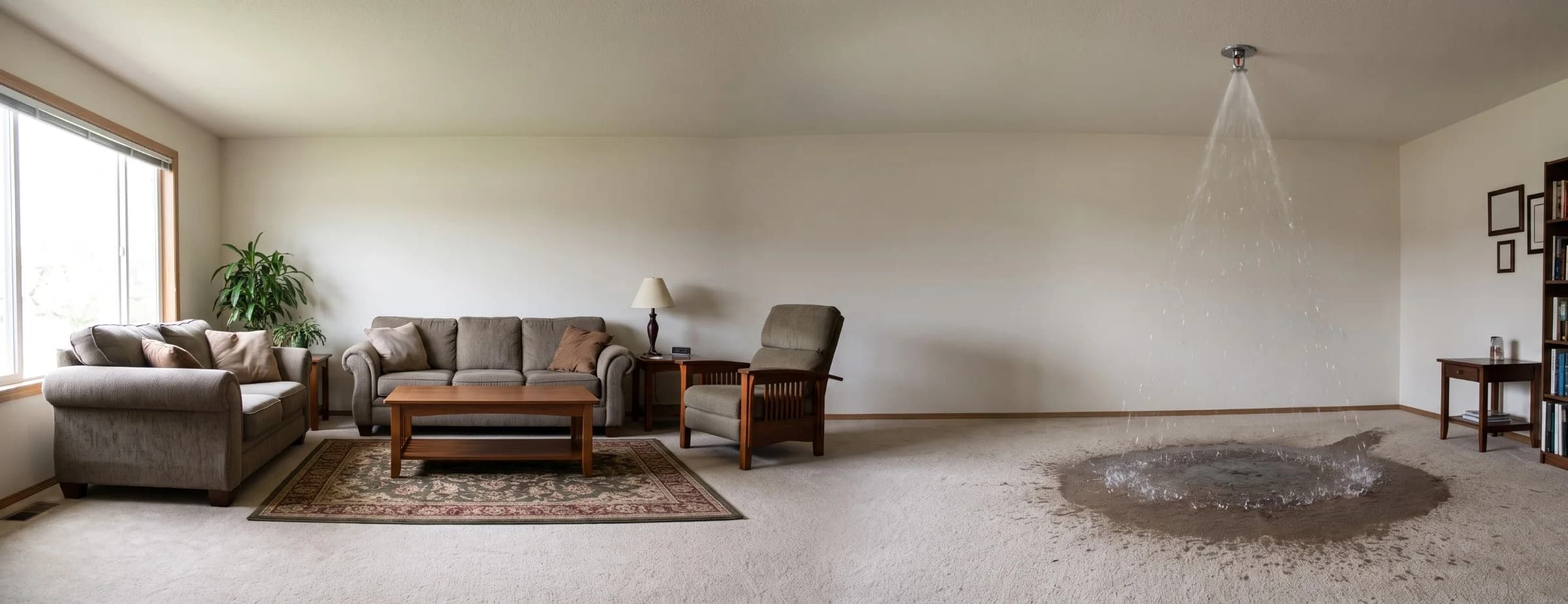

Water is spraying from a single ceiling sprinkler head somewhere in your home right now, and there was no fire you could see when it started. Fire sprinkler water damage is usually less severe than people expect, since a sprinkler head releases a fraction of the water a fire hose would (roughly 8 to 26 gallons per minute versus 50 to 125 or more from a hose line), and the flow typically stays confined to the room where the head triggered. Shutting off the water comes first, followed by how water damage restoration actually classifies and cleans up what's left, and what the repair and insurance side looks like once the immediate crisis has passed.
A fire sprinkler system is an automatic, water-based fire suppression system installed under NFPA 13, 13R, or 13D, depending on the building type, that releases water through a ceiling-mounted head when heat from a fire melts a glass bulb or fusible link at that head's rated temperature. Once the water reaches carpet, drywall, or a wall cavity, the ANSI/IICRC S500 standard treats it the same way it treats water from a burst pipe or an overflowing appliance: by source, contamination level, and how much material absorbed it. Those three factors decide everything from the equipment a technician brings to whether the room needs to be sealed off before drying starts.
Key insights
- Confirm there's no active fire before touching anything. A trip with no smoke, heat, or burning smell is almost always mechanical, but any doubt means evacuating and calling 911 first.
- The water keeps running until someone shuts it off. A residential sprinkler head is a one-time-use device that cannot reset itself, so water continues flowing until the main control valve is closed.
- Most sprinkler water starts out clean. Water from a system connected to a public supply with no antifreeze additive is classified as Category 1 under IICRC S500, the same as a broken supply line.
- Older systems can carry an antifreeze additive. Systems installed before 2012 may still use glycerin or propylene glycol antifreeze in unheated pipe runs, which can affect the water's classification.
- A single head can release 8 to 26 gallons per minute in a home. Commercial heads typically discharge more, in the range of 20 to 40 gallons per minute.
- Only one head usually opens. NFPA data on reported home fires shows that a single sprinkler controls the fire and limits water to one room in the large majority of cases.
What to do if a fire sprinkler goes off
Confirm there's no active fire before doing anything else, then close the sprinkler system's main control valve to stop the water. A residential sprinkler head cannot be reset once it has released water, so the system keeps discharging until the valve is closed or firefighters do it for you.
 Closing this valve is the only way to stop a triggered sprinkler head, since the head itself cannot be reset once it has released water.
Confirm there's no active fire and get everyone out if there is
A sprinkler discharging with no smoke, heat, or burning smell anywhere nearby is almost always a mechanical trip rather than an active fire. If you see or smell smoke, hear other alarms sounding, or aren't certain the fire is fully out, get everyone outside immediately and call 911 before touching the control valve or anything else.
Shut off the main control valve
Find the control valve, usually a wheel-style gate valve or a lever-style ball valve, near the water meter or where the supply line enters the building, and turn it until the flow stops. If you can't identify it or reach it safely, call the fire department's non-emergency line for help instead of guessing.
Cut power to anything wet
If water has reached an outlet, switch, or light fixture, shut off that circuit at the breaker panel instead of touching anything electrical while it's still wet. OSHA treats standing water near live wiring as a shock hazard regardless of the water's source, per its flood response guidance.
Move belongings and start airflow
Carry furniture, rugs, and boxes out of the affected room, then open windows or set up fans to start drying while you wait for a contractor and a restoration crew to arrive.
Photograph the damage before anything else moves
Take wide shots of the room and close-ups of the sprinkler head, the ceiling around it, and any standing water before cleanup starts. These photos become the baseline record for both your insurance claim and the sprinkler contractor's inspection.
Call your sprinkler contractor and a restoration company
The sprinkler contractor replaces the discharged head and recharges the system, while the restoration company handles water extraction and drying, and the two jobs typically run at the same time, not one after the other.
These same immediate steps, confirm safety, stop the source, then start extraction, apply to any emergency water damage restoration situation, not just a sprinkler discharge. The faster each one happens, the less the eventual cleanup and repair ends up costing.
What not to do after a discharge
Four reactions to sprinkler water cause more damage than the water itself: running a household vacuum near a wet outlet, drying carpet without checking the padding underneath, ignoring a stain once the dripping stops, and waiting on the insurance company before starting extraction. Each one seems harmless in the moment, but all four either spread contamination, mask a problem that's still developing underneath, or slow down the claim itself.
Don't run a household vacuum on standing water
A shop vacuum built for wet pickup is fine, but a household vacuum near a wet outlet or cord risks electric shock and isn't built to handle standing water safely.
Don't dry the surface without checking underneath
Carpet can look dry within a few hours while the padding and subfloor beneath it stay saturated, which sets up the damp, mold-friendly conditions the CDC warns can take hold within one to two days.
Don't assume a stopped drip means the area is dry
Water travels sideways through drywall and along framing long after the dripping stops, so a stain that looks contained on day one can still be spreading behind the wall.
Don't wait on the insurer before starting extraction
Most policies expect the homeowner or property manager to begin mitigating the damage right away, and delaying extraction to wait for adjuster approval usually makes the eventual claim harder to settle, not easier.
Was it a real fire or a false trip
A genuine fire leaves physical evidence a mechanical trip doesn't. Soot or char near the ceiling, a scorched smell that lingers after the water stops, or other smoke alarms that sounded before the sprinkler did all point to an actual fire having occurred, even a small one that never spread far.
 A clean water stain with no soot or char nearby points to a mechanical trip rather than a fire that reached the ceiling.
A clean mechanical trip typically shows none of that: water and a single triggered head, with nothing burned or blackened anywhere nearby. Soot near the ceiling, other alarms sounding first, and a lingering smoky smell all point toward an actual fire, while a single wet head with no burn marks anywhere points toward a mechanical cause instead.
| Signal | Real fire | Mechanical trip |
|---|---|---|
| Soot, char, or scorch marks near the ceiling | Present | Absent |
| Other smoke alarms sounded before the sprinkler | Yes | No |
| A lingering burnt or smoky smell after the water stops | Yes | No |
| Recent renovation, extreme attic heat, or a visible impact near the head | Not typically the cause | Common trigger |
| Only the activated head shows any sign of what happened | No | Yes |
Report the activation to your fire department's non-emergency line regardless of which one it turns out to be, even after a clear mechanical trip with no fire present. Most local codes require an inspection before the system goes back into service, and that inspection also confirms whether the trigger was mechanical or whether a small, contained fire went unnoticed.
Why fire sprinklers activate
A fire sprinkler activates when heat, not smoke, reaches the rated temperature of an individual head's NFPA-listed glass bulb or fusible link, and only the head closest to that heat source opens. Most residential activations are the system doing exactly what it was built to do; an unwanted discharge with no fire present is far less common and almost always traces back to one of a handful of mechanical causes.
 A heat source positioned too close to a sprinkler head's rated trigger point is a common cause of an unwanted discharge with no fire present.
An unwanted discharge is rarely random. Nearly every documented case traces back to physical contact with the head, a defect the head was manufactured with, freezing conditions in an unheated section of pipe, or a heat source installed too close to the sprinkler's rated trigger point.
| Cause | How it happens | What prevents it |
|---|---|---|
| Struck or damaged head | Furniture, a ladder, or equipment physically hits the sprinkler bulb during a move or renovation | Head guards in high-traffic areas and awareness during any work near the ceiling |
| Manufacturing defect | A flaw in the glass bulb or fusible link causes premature failure | Periodic testing under NFPA 25 catches most defective heads before they fail |
| Frozen pipe | Water in a dry-pipe system or an unheated pipe run freezes, expands, and ruptures a fitting | Keeping unheated spaces above freezing or using a properly listed antifreeze solution |
| Heat source too close | A skylight, recessed light, or kitchen appliance raises the temperature near a head enough to trigger it | Correct head placement and temperature rating during installation |
| Corrosion | Internal pipe corrosion in an older system weakens a fitting until it fails under normal pressure | Annual inspection and testing of aging systems |
| Tampering | Someone intentionally pulls or damages a head | Tamper-resistant covers in shared or public spaces |
The National Fire Protection Association's sprinkler performance research tracks both outcomes separately: fires where sprinklers operated as intended, and reported unintentional activations that released water with no fire present. In most homes with a working system, a single sprinkler head controls the fire, which is the outcome the whole system is designed around rather than the exception to it.
Not every system behaves the same way once triggered. The four basic designs installed across most buildings determine both how many heads open and how much water gets released.
Wet pipe
The most common setup in homes and offices, with water already sitting in the pipes so only the head nearest the heat source opens.
Dry pipe
Used in unheated spaces like attics and parking garages, with pressurized air holding the water back until heat at a head triggers the valve.
Deluge
Used in high-hazard industrial settings, where every head is open at once and a fire-detection signal releases water through all of them simultaneously.
Pre-action
Common in server rooms and archives, requiring both a detection signal and heat at an individual head before water releases, adding a layer of protection against accidental discharge.
Home systems are overwhelmingly wet pipe, which is why a residential activation almost always affects a single room rather than an entire floor. A dry-pipe or deluge system, more common in unheated warehouses or industrial buildings, is far more likely to soak multiple rooms or an entire floor at once.
Is the water clean or contaminated
Fire sprinkler water is classified as Category 1, or clean water, under the ANSI/IICRC S500 standard when the system draws from a public water supply and carries no antifreeze additive. That classification can shift if the water sits for more than a day, picks up contaminants from building materials on its way down, or came from an older system that still uses a chemical freeze-protection solution.
 Clear, colorless water with no additive present classifies as Category 1 under ANSI/IICRC S500, the same starting point as a clean supply line break.
Under water damage categories, a fire suppression line connected to a public supply with no additive present and no other sign of contamination is treated as Category 1 at the moment of discharge, the cleanest starting classification a water event can have. A technician confirms that starting point with a quick water sample or test strip rather than assuming it from the source alone.
That status isn't permanent. Category 1 water that sits for more than a day, or picks up contamination from carpet or drywall on its way down, can degrade toward Category 2 before cleanup even starts, the same pattern that applies to a clean burst pipe or any other sanitary-source leak.
The EPA's guidance on flood cleanup that applies to any other clean-water loss puts the safe drying window at roughly 24 to 48 hours before microbial growth becomes a real concern. Past that window, even water that started out perfectly clean can develop the same musty odor and discoloration associated with a much dirtier loss.
Antifreeze changes the picture. Systems installed before September 2012 were allowed to use a field-mixed glycerin or propylene glycol solution in sections of pipe exposed to freezing, such as an attic or an unheated garage run, and many of those systems were only required to switch to a factory-listed antifreeze by September 2022. A heavily dosed antifreeze solution reaching flooring or drywall is a different cleanup problem than plain water, since the diluted chemical residue needs to be addressed alongside the moisture itself rather than assumed away.
If firefighters also used hose lines during an actual fire, that runoff is a different story entirely. Water that has washed through charred materials or picked up soot and ash typically classifies as Category 2 or worse, even when the sprinkler's own discharge earlier in the same event started out clean, so a single fire scene can carry two different water classifications side by side depending on which water reached which room.
Class measures something separate from category: how much water was absorbed and how hard the affected space will be to dry, under the water damage classes system. A sprinkler head that ran for several minutes before the valve closed can push a single room into a higher class even when the category stays clean, since the volume and spread matter as much as the source.
Where the water travels
Sprinkler heads are mounted in the ceiling, so water sprays downward and outward from one fixed point instead of pooling upward from underneath the way a burst pipe or a failed appliance hose does. The furniture, flooring, and the ceiling and wall cavity directly below the activated head take the worst of it, while adjoining rooms usually stay dry unless the water finds a gap at a doorway, a stairwell, or a shared wall.
 Water from a single activated head can travel through a wall cavity or stairwell and surface as a stain on a completely different floor.
A ceiling that absorbs several minutes of continuous discharge can sag or bulge before it stops dripping, and a saturated section of drywall roughly doubles in weight compared to when it's dry. That weight gain is the same mechanism behind ceiling water damage from any other source, and a bulging section calls for a controlled release instead of waiting for it to fail on its own.
A controlled release means puncturing the lowest point of the sag over a bucket with a screwdriver instead of letting the weight tear the drywall open on its own timeline, which spreads debris and dirty water further into the room. A small screwdriver hole is also far easier and cheaper to patch than the ragged tear a ceiling leaves behind when it gives out on its own.
If the sag extends beyond a single ceiling tile, or the framing above it feels soft when pressed, the situation has moved past a water damage question into a structural water damage one that needs a professional assessment before anyone reoccupies the room. That escalation is uncommon after a single head's discharge, but it becomes more realistic the longer the water ran before the valve was closed.
In a multi-story building, water from a single activated head on an upper floor can travel down through electrical conduits, plumbing chases, or a stairwell and show up as a stain two floors below the actual source. Tracing that path back to the originating unit matters for figuring out who is financially responsible, a question that comes up constantly in condo buildings and apartment complexes where a sprinkler flood rarely stays confined to one owner's unit.
Furniture and belongings sitting directly beneath or near the discharge point face the same risk as the room's fixed materials, and they're often the last things moved once cleanup starts. A soaked couch cushion and a stained wood dresser don't follow the same salvage timeline as drywall or flooring, since water damaged furniture can often be dried and saved by material type while a saturated cushion frequently can't.
Who to call after a sprinkler discharge
Call a licensed fire sprinkler contractor to replace the discharged head and recharge the system, and call an IICRC-certified water damage restoration company separately to handle extraction and drying, since these are two different trades doing two different jobs. The sprinkler contractor's work restores fire protection to the building; the restoration company's work addresses everything the water touched on its way down.
 A fire sprinkler contractor and a water damage restoration company handle two separate jobs and should both be called at the same time.
Ask the restoration company whether the technician assigned to your job carries an active water damage restoration certification, since IICRC-certified technicians follow the same S500 protocols regardless of which company employs them. A legitimate company can produce that technician's certification number on request without hesitation.
Don't let the sprinkler contractor leave the head uncovered or the system unrecharged once the leak is fixed. A building without functioning fire suppression is a bigger risk than the water damage that just happened, and in a commercial or multi-family building, NFPA 25 requires a fire watch once a water-based system has been out of service for more than 10 cumulative hours in a 24-hour period, along with notifying the local fire marshal and the building's insurance carrier. A single-family home rarely crosses that threshold during a same-day repair, but a property manager coordinating a slower commercial fix should ask the contractor directly whether the timeline is getting close to it.
Vetting the company that handles the water damage side comes down to the same basics as any other loss: confirming insurance and licensing, and getting a written, itemized estimate rather than a verbal ballpark. The unusual water source doesn't change what to check, so choosing a water damage restoration company is worth doing carefully even when the cause was a sprinkler and not a burst pipe.
What it costs to clean up
Cleaning up after a fire sprinkler discharge typically runs $500 to $15,000 depending on how many heads released water, how long the system ran before the valve was closed, and whether ceiling drywall or insulation needs to be removed. That figure covers extraction and drying alone; repairing or recharging the sprinkler system itself is a separate line item, usually a few hundred dollars for a single replaced head up to a few thousand for a more extensive repair.
 A written estimate should break out extraction, drying equipment days, and any drywall or flooring replacement as separate line items rather than one lump sum.
Location inside the room matters as much as square footage. A head that discharged directly over a carpeted living area costs less to remediate than one that soaked a kitchen full of cabinetry or a finished basement ceiling, since the materials affected drive the total more than the room's size does.
| Scenario | What's involved | Typical cost |
|---|---|---|
| Single head, caught within an hour | Extraction, drying, minor drywall repair in one room | $500–$2,500 |
| Single head, ran several minutes unnoticed | Ceiling and wall drywall removal, flooring replacement, extended drying | $2,500–$8,000 |
| Multiple heads or a full-floor discharge | Extraction across several rooms, structural drying, extensive material replacement | $8,000–$25,000+ |
| Commercial or multi-unit building event | Higher water volume, multi-trade coordination, business interruption factors | $15,000–$60,000+ |
Labor, not materials, drives most of the total. A crew has to cut into drywall to check whether insulation and framing above a stained ceiling stayed dry, and that access work costs more per square foot on a ceiling than on a wall or floor because of the overhead position alone.
A written estimate should break out extraction, drying equipment days, and any drywall or flooring replacement as separate line items instead of one lump sum, so you can see exactly what you're paying for. If anything on it seems vague, questions to ask a water damage restoration company can help you pin down exactly which credentials and line items are missing before you sign.
Compare that number against the broader market before deciding whether it's reasonable. A single accidental discharge and a full-floor commercial event sit at opposite ends of a wide cost range, so a quote only means something once you know which end of that range your situation actually falls into.
Category, class, and the room's finish level are the same three variables that move water damage restoration cost up or down regardless of what caused the water. A sprinkler discharge gets priced by those same inputs rather than by a separate sprinkler-specific rate card, so a contractor quoting wildly outside the ranges above is worth a second opinion.
Does insurance cover sprinkler damage
Yes, in nearly every case. A standard HO-3 homeowners policy covers the accidental discharge or overflow of water from an automatic fire protective sprinkler system as a named peril, and that coverage applies whether the sprinkler activated because of an actual fire or because of a mechanical malfunction with no fire present.
 A standard HO-3 policy treats accidental sprinkler discharge as a covered peril whether a real fire or a mechanical malfunction triggered the head.
The distinction insurers actually look at, laid out in NAIC's consumer guidance on home insurance, is sudden versus neglected. A head that fails from a manufacturing defect or a sudden freeze is treated as an accident, while a system that hadn't been inspected in years and finally failed from corrosion the owner had reason to know about can draw more scrutiny from an adjuster, though a straightforward malfunction claim rarely gets denied outright.
If a fire actually occurred, the water damage from putting it out, whether from the sprinkler or a firefighter's hose, is covered under the fire peril itself, not a separate water exclusion. That coverage doesn't change based on how much water a sprinkler released or how long the system ran before the valve was closed, and it follows the same sudden-versus-neglected standard applied to water damage from any other cause.
Document the sprinkler activation the same way you would any other water loss: photos before cleanup starts, the sprinkler contractor's report on why the head triggered, and a written scope of work from the restoration company. Gather those three items before you call your insurer so the adjuster has a complete picture on the first contact, not a partial one.
Reporting the loss, documenting it, and meeting the insurer's proof-of-loss deadline are the three stages that determine whether a sprinkler claim gets paid smoothly or gets delayed. None of those stages work differently just because the water came from a sprinkler head instead of a pipe, and filing a water damage insurance claim follows that same reporting-to-proof-of-loss sequence regardless of the cause.
None of that documentation needs to be elaborate. A phone's camera roll and a folder holding the two written reports covers what most adjusters actually ask for on a claim this size.
Moisture readings, an itemized list of damaged belongings, and dated photos matter just as much for a sprinkler claim as they do for any other water loss, since insurers weigh the same documentation regardless of the source. That documentation habit doesn't change just because the water came from a ceiling-mounted head instead of a supply line.
Fire sprinklers in condos and rentals
The building's master policy generally covers the sprinkler system itself and shared structural elements, while each owner's or renter's own policy covers the interior finishes and belongings inside their unit. A sprinkler activation in a shared building rarely stays confined to one unit, which is exactly why single-family homeowners don't have to sort out this same split.
 Piping and heads that serve the whole building are usually a general common element under the association's master policy, while damage inside one unit often falls to that owner's own coverage.
In a condo, the piping and heads that serve the whole building are usually a general common element maintained under the association's master policy, while a head inside one unit's ceiling can fall under a limited common element depending on how the declarations define it. That distinction is exactly why responsibility sorts into three tiers rather than a simple owner-versus-association split, since a sprinkler discharge from a shared riser plays out differently than one from a fixture entirely inside a single unit.
Notify the property manager or HOA board as soon as the water is shut off, even if the damage looks confined to your own unit. A shared building's master policy often has its own reporting deadline, separate from your personal policy's, and missing it can complicate the claim later.
Renters face a narrower version of the same question. A landlord's policy typically covers the building and the sprinkler system, while a tenant's own renters insurance covers personal belongings damaged when the system discharges, regardless of whether the trigger was an actual fire, a contractor's mistake during a renovation elsewhere in the building, or a malfunction the landlord had nothing to do with.
Landlord and tenant responsibility shifts depending on what caused the water, not just whether the building has a sprinkler system. A sprinkler activation can originate from a shared building system instead of anything inside the unit itself, which is exactly the kind of cause-by-cause distinction water damage in a rental sorts through for a burst pipe, a roof leak, or any other source.
Preventing accidental discharge
Most unwanted sprinkler discharges trace back to a handful of preventable causes: physical contact with a head, a heat source placed too close to one, freezing pipe, or a system that hasn't been inspected in years. A properly installed and maintained system misfires at a rate close to 1 in 16 million, so prevention matters far more for older or neglected systems than for a newly installed one.
 NFPA 25 sets the inspection and testing schedule for water-based fire protection systems, and a documented date on the tag confirms the annual check was completed.
Keep objects and heat sources clear of every head
Furniture, storage boxes, and anything that generates heat, including a skylight or a kitchen appliance, should stay at least 18 inches from a sprinkler head so nothing physically strikes it or raises the ambient temperature enough to trigger it.
Schedule annual inspection and testing
NFPA 25 sets the inspection and testing schedule for water-based fire protection systems, and a technician checking the control valve, the heads, and the piping catches corrosion or a failing component before it turns into an unplanned discharge.
Confirm the antifreeze solution is listed and current
If any part of the system uses antifreeze for freeze protection, have it tested annually and replaced with a factory-listed solution if it hasn't already been updated, since an unlisted or overly concentrated mixture is both a fire-safety and a water-damage risk.
Protect heads during renovation without disabling them
A removable, code-compliant head guard keeps a sprinkler from being struck during construction work, while painting or bagging a head over the long term is a code violation that can keep it from working during an actual fire.
Know where the main control valve is before you need it
Every household member or building manager should be able to find and operate the main control valve without hesitation, since the speed of that shutoff is what limits the water damage more than anything that happens afterward.
Keeping the sprinkler contractor's report, photos, and the restoration company's drying logs in one file makes both the insurance claim and the system's next scheduled inspection easier to document. That same habit of documenting water damage for insurance is worth keeping up year to year, not just during an active claim, since it's the difference between a fast reinspection and a slow one.
Frequently asked questions
Is fire sprinkler water dangerous to touch?
No, in most cases. A sprinkler connected to a public water supply with no antifreeze additive discharges Category 1 clean water under the ANSI/IICRC S500 standard, the same classification as water from a broken supply line.
Will homeowners insurance pay for fire sprinkler water damage?
Yes, in nearly every case. A standard HO-3 policy covers the accidental discharge or overflow of water from an automatic fire protective sprinkler system, whether the trigger was a real fire or a mechanical malfunction, as long as the system was reasonably maintained. That's the same standard that governs homeowners insurance covering water damage from almost any other sudden cause too.
Can a fire sprinkler go off without a fire?
Yes. Mechanical impact, a manufacturing defect, freezing pipes, or a heat source placed too close to a head can all trigger a discharge with no fire present, though the National Fire Protection Association reports that unwanted activations are far less common than activations from an actual fire.
How can I tell if my sprinkler activation was from a real fire?
Soot or char near the ceiling, a lingering burnt smell, or other smoke alarms sounding before the sprinkler all point to an actual fire, even a small one. A single wet head with no burn marks anywhere nearby usually means a mechanical trip instead.
How much water does one sprinkler head release?
Roughly 8 to 26 gallons per minute in a typical home system and 20 to 40 gallons per minute in a commercial system, depending on the head's rating and the water pressure feeding it.
Do I need to replace the sprinkler head myself?
No. A residential sprinkler head is a one-time-use device that cannot be reset once it has released water, and only a licensed fire sprinkler contractor should replace it and recharge the system.
What if the sprinkler activation happened in my neighbor's unit and flooded mine?
The building's master insurance policy typically covers damage to shared structural elements, while your own HO-6 or renters policy covers your unit's interior finishes and personal belongings, so both policies often get filed at once. General common elements, limited common elements, and your own unit interior are the same three categories that decide water damage in a condo responsibility for any cause, not just a sprinkler discharge.
How long does cleanup take after a sprinkler discharge?
Three to seven days for extraction and drying in a single room, longer if ceiling drywall, insulation, or a finished floor below has to be removed and replaced before the space can be closed back up.
Can I paint or cover a sprinkler head to stop it from tripping?
No. Painting, bagging, or otherwise obstructing a sprinkler head is a code violation under NFPA 25 and can prevent the head from activating during an actual fire, which defeats the entire purpose of the system.
Does a false alarm activation still need professional water extraction?
Yes, if more than a light surface spray reached carpet, padding, or a wall cavity. The same extraction and drying standards apply regardless of whether an actual fire triggered the head.
Who pays if a contractor accidentally sets off a sprinkler during renovation?
The contractor's liability insurance is typically the first policy pursued, since a struck or damaged head during work they performed is generally treated as their responsibility, not the homeowner's insurance claim.
Sam Hickerson is the founder of RestoreAdvisor and writes consumer guides on mold remediation, water damage restoration, inspection, testing, and home recovery. His work focuses on helping homeowners understand costs, risks, and when to call a professional. He draws on guidance from the EPA, CDC, IICRC, and other authoritative sources to make complex home issues easier to navigate.