
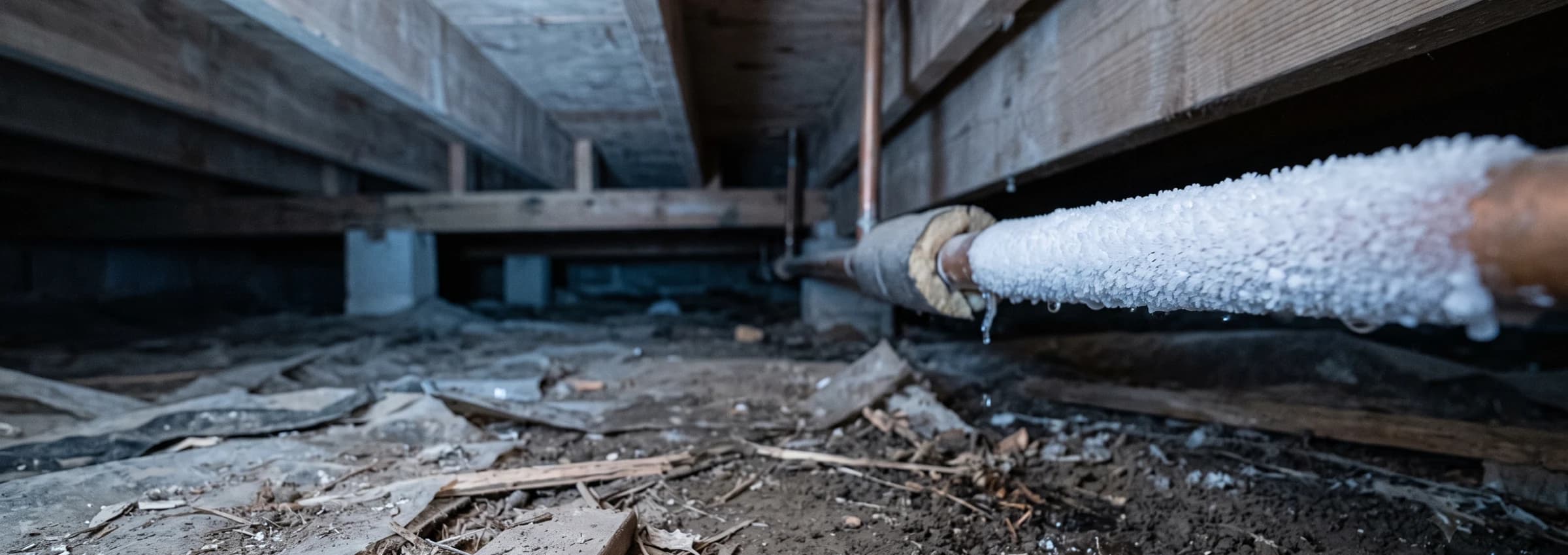

A faucet that's suddenly gone dry in freezing weather, or a ceiling that's already dripping, both have a way of turning a normal morning into an urgent one. Neither means you're too late: a pipe that's still just frozen can usually be caught before it fails, and a pipe that's already burst is a fast-moving problem with a clear fix once the water's stopped. Frozen pipe water damage refers to the cracked pipes, flooding, and structural moisture that follow when ice blocks a water line, a failure the restoration industry classifies and dries out under the same ANSI/IICRC S500 standard that governs any other water loss.
You'll know within a few minutes which situation you're actually in and exactly what to do next, whether that's thawing the pipe yourself or getting a plumber and a water damage restoration crew moving. Acting in the next twenty minutes does more to limit the damage than anything that happens afterward, and mixing up the two responses, thawing a pipe that's already split or shutting off water on one that's merely frozen, wastes the time you don't have.
Key insights
- Pressure builds where the water is trapped, not where the ice is. A frozen pipe usually splits downstream of the ice blockage, at a weak seam or fitting between the ice and a closed faucet, not at the frozen spot itself.
- A hairline crack releases far more water than it looks like it should. IBHS estimates a crack as small as one eighth of an inch can leak up to 250 gallons a day.
- Exposed pipes are at real risk once it's been near 20°F for several hours. A NOAA National Weather Service freeze warning (32°F or below) or hard freeze warning (28°F or below) is a practical cue to check on vulnerable pipes.
- Catching a pipe before it bursts is dramatically cheaper. A plumber's thaw-only visit runs $150–$500. Once a pipe splits, cleanup typically adds $500–$10,000 or more depending on how long it ran before anyone noticed.
- PEX tubing resists freezing better than copper, but it isn't freeze-proof. Its flexibility lets it expand with the ice, though repeated freezing or a rigid fitting can still cause it to fail.
- Insurance usually covers a burst frozen pipe, with one major exception. Standard policies typically deny freeze claims if the home was left unheated or unoccupied without reasonable precautions.
How to tell if a pipe is frozen
A frozen pipe shows up first as no water, or only a weak trickle, from a faucet that worked fine the day before, often paired with frost visible on an exposed section of pipe. These are the signs of a pipe freezing before it actually fails; once water has reached flooring, drywall, or a ceiling, the broader signs of water damage apply instead.
 A weak trickle instead of full flow is often the first sign a supply line has started to freeze, worth checking every faucet in the house rather than just the one you noticed.
Check every faucet in the house after a hard freeze, not just the one you noticed, since more than one line can freeze at once and a fixture you don't use daily might already be affected without your knowing. A supply line to a room that feels warm can still run through an attic, crawl space, or exterior wall before it reaches the fixture, so a warm room is no guarantee the line feeding it stayed above freezing.
No water or a weak trickle
A faucet that ran normally yesterday and now produces nothing, or only a thin stream even at full pressure, is the clearest sign the line feeding it has frozen somewhere between the source and the tap.
Frost on the pipe's surface
Visible frost on an exposed pipe, most common in an unheated basement, garage, or crawl space, marks where the pipe wall has dropped below freezing.
A slight bulge along an otherwise straight run
Ice expanding inside a pipe can push the wall outward just enough to feel or see, particularly on softer materials like PEX.
Gurgling, banging, or a whistling sound
Air and water moving past a partial ice blockage can make noise that wasn't there before, especially when you open the connected faucet.
A toilet that won't refill
If the supply line to a toilet runs through an unheated space, a stalled refill after flushing points to the same blockage as a dry faucet elsewhere.
What to do right now
What you do next depends on whether the pipe is still frozen or has already split, and acting on the wrong one wastes the short window you have to limit the damage. Thawing a pipe that's already split simply pushes more water through the crack, while shutting off the water on one that's merely frozen only delays the thaw you're actually trying to complete.
If the pipe hasn't burst yet
Work through these five steps in order, from relieving pressure to calling in a professional if you can't reach the ice yourself. Skipping ahead to thawing before locating and inspecting the frozen section risks missing a crack that's already there, which changes what the right next step actually is.
 Gentle, moving heat from a pad or hair dryer thaws a straightforward freeze in twenty to thirty minutes; direct flame from a torch or heater can ignite nearby framing or crack the pipe outright.
Open the faucet the pipe feeds
Open it partway. This relieves pressure as the ice continues to expand and gives you an early sign the moment water starts moving again.
Trace the pipe to find the frozen section
Check unheated stretches first, an attic, crawl space, garage, or the run under a sink against an exterior wall. Frost on the outside of the pipe or a slight bulge usually marks the spot.
Inspect before you apply any heat
Feel along the frozen section for a crack or separated fitting. A pipe that has already failed will only leak once it thaws, so finding damage now means shutting off the main water valve instead of warming the pipe.
Warm it gradually from the open end inward
A hair dryer, an electric heating pad, or towels soaked in hot water all work. Move the heat source rather than holding it in one place, and never use a blowtorch or other open flame near a pipe.
Call a plumber if you can't reach it or can't confirm it thawed cleanly
Ice trapped inside a wall, under a slab, or anywhere you can't safely access needs a plumber with proper equipment, and so does a pipe that still won't produce water after a reasonable thawing effort.
If it's already burst
Shut off the main water valve immediately, then cut power to any outlet or fixture the water has reached, since standing water and electricity is a shock hazard the Occupational Safety and Health Administration OSHA warns against entering without confirming the circuit is dead. A breaker panel that's already wet, or one sitting in a flooded room, should be left alone entirely until an electrician or the utility company confirms it's safe to touch.
 Closing the main shutoff, handle turned perpendicular to the pipe, stops water at the source before addressing a frozen or already-burst section anywhere downstream.
Photograph the damage before you move anything, then call a plumber to stop the source and a certified water damage restoration company to start pulling out standing water. Most companies run 24-hour dispatch specifically for events like this, since a burst pipe rarely waits for business hours.
The extraction and drying work that follows runs the same regardless of the room or the season, pulling standing water first and then drying the structure itself. Waiting even a few extra hours lets water travel further into subflooring and wall cavities than a same-day response would allow.
The cause only starts to matter again once the water is stopped and the cleanup scope gets worked out. If the cold snap hasn't broken yet, standing water in an unheated space like a garage, crawl space, or basement can also refreeze before anyone gets to it, which hides how much water is actually present and can stall extraction until the space is warmed up enough to work in.
The ordered water damage restoration checklist is worth working through once these emergency steps are done. Supplies, extraction, drying, and documentation each get their own step in the sequence a homeowner would actually need them over the days that follow.
If the area affected is small and contained, and you've confirmed the water is clean supply-line water rather than anything from a drain, handling the cleanup yourself is realistic, since the extraction and drying steps are the same regardless of what caused the water in the first place. A moisture meter reading under 15 percent on the affected material is a reasonable point to consider it dry; anything still reading higher after a day or two is worth treating as not fully resolved.
That same clean water can also turn into mold within the standard 24 to 48 hour window if drying gets delayed. A room that stayed wet through a multi-day cold snap, particularly one that also refroze, is more likely to need a mold check than one caught and dried within the first day.
Why frozen pipes burst
Water expands by roughly 9 percent in volume as it turns to ice, building more pressure inside the pipe than its wall can hold. That pressure typically cracks the pipe downstream of the ice, at whatever weak point sits between the blockage and a closed faucet, rather than at the frozen spot itself, since the liquid water trapped in that section has nowhere left to go.
 The crack typically forms at a weak seam or fitting downstream of the ice, not at the frozen spot itself, since the trapped water between the blockage and a closed faucet has nowhere else to go.
That pressure buildup explains why a crack can be so small and still release so much water. According to the Insurance Institute for Business & Home Safety, a crack as small as one eighth of an inch can leak up to 250 gallons of water a day once the pipe thaws and pressure normalizes. A weak seam, a threaded fitting, or a section of corroded or older pipe is typically where that failure shows up, not at the coldest point of the run, and those same weak points are exactly where a burst pipe from any other cause tends to fail too, since age and corrosion thin a pipe wall the same way regardless of what finally pushes it past its limit.
Once a pipe fails, the water it releases is almost always Category 1 clean water straight from the supply line, at least at first, which affects how quickly it needs to be addressed and how it should be dried compared to a contaminated source like a sewage backup. That classification can shift to Category 2 if the water sits long enough to pick up contaminants from carpet, drywall, or flooring, which is part of why a fast response matters even for water that started out clean.
Which pipes are most at risk
Pipes running through unheated or poorly insulated spaces face the highest freeze risk, since they're exposed to outdoor-level cold without the residual warmth that heated living space provides. The material a pipe is made of also affects how it responds once ice starts to form inside it.
 Garages are rarely heated and often hold the coldest air in the house, so an exposed run feeding a washing machine like this one is worth insulating even when the rest of the home's plumbing is protected.
A few less obvious risk points get missed even by homeowners who've already insulated the usual spots. The supply line feeding a refrigerator ice maker, a sprinkler backflow preventer, and any pipe running through a bonus room or converted garage without its own heating vent all sit in the same category as an attic or crawl space run: cold, easy to overlook, and rarely checked until the ice maker stops working or a faucet in that room goes dry.
| Location | Why it's vulnerable | What to check |
|---|---|---|
| Attic | Little or no heating, and often poorly insulated from the roof deck above | Any supply line running near an eave or exterior wall |
| Crawl space | Vented to outside air, ground-level cold, minimal insulation on most runs | Pipes closest to foundation vents |
| Garage | Rarely heated, and often holds the coldest air in the house | Washing machine supply lines and any exposed run along the ceiling |
| Exterior walls and cabinets | Thin wall cavities offer little buffer between the pipe and outdoor cold | Kitchen and bathroom sinks on an outside wall |
| Unheated basement | Below-grade cold combined with drafts from foundation gaps | Water heater connections and the main supply line entry point |
Pipe material matters too, though less than exposure and insulation do. Rigid copper has almost no give, so ice pressure has nowhere to relieve itself and the pipe tends to crack. PEX tubing can expand along with the ice and often survives a freeze event that would split copper, but its fittings and connectors are usually rigid metal or plastic and can still fail even when the tubing itself holds. PVC and CPVC sit in between: some give, but brittle enough at low temperatures to crack under sustained pressure. None of these materials is freeze-proof, and a long enough cold snap can defeat any of them if the pipe isn't insulated or the space isn't heated.
Mild-winter climates aren't exempt
A home in a region where hard freezes are rare is often at higher relative risk than a home built for routine winters, not lower. Builders in the South and other mild-winter regions have less incentive to run pipes through interior chases or insulate them heavily, since a hard freeze might only arrive once every few years, and a single-wall exterior run or an uninsulated attic pipe that would be standard practice to protect in Minnesota often goes unprotected in Texas or Georgia. State Farm's own claims data reflects this: of the states with the highest total frozen-pipe claim costs in the 2024 through 2026 period, Texas and Tennessee ranked alongside colder states like Illinois and Washington, and the average paid claim exceeded $30,000. A homeowner in a climate where freezing is the exception rather than the rule shouldn't treat that as a reason to skip insulation and heat-tape protection; if anything, it's the reason to prioritize it.
How to thaw a frozen pipe safely
Thawing a frozen pipe safely means applying gentle, even heat starting from the open faucet end and working toward the ice blockage, never from the middle of a frozen section outward. Working the wrong direction traps the meltwater and pressure between two blockages instead of giving it somewhere to go.
 A hair dryer or heating pad works on any exposed, accessible pipe, but stop the moment you smell burning or see the pipe or nearby wood scorch, since the goal is thawing the ice, not heating the pipe itself.
Start by opening the faucet the pipe feeds, just partway, so water can escape as it starts moving again and so you'll know immediately once the blockage clears. A hair dryer or heating pad usually clears a straightforward freeze within twenty to thirty minutes of steady heat; a section that's been frozen for a full day or longer, or one buried deeper in a wall cavity, can take considerably longer and is more likely to have already cracked. Towels soaked in hot water work too, but need re-soaking every few minutes as they cool, which makes a hair dryer or heating pad the more practical choice for anything beyond a quick, shallow freeze.
Never use a blowtorch, a propane or kerosene heater, a charcoal grill, or any other open flame anywhere near a pipe. The heat is uneven and difficult to control, it can ignite nearby insulation or wood framing, and it can also crack the pipe outright rather than simply thawing the ice inside it. If the frozen section is inside a wall, under a slab, or otherwise inaccessible, or if water flow hasn't returned after a reasonable effort, that's the point to call a licensed plumber rather than continuing to apply heat on your own. A technician with proper thawing equipment can also confirm the pipe hasn't already cracked in a spot you can't see, something worth checking before you choose a water damage restoration company if the thaw reveals damage that's gone beyond a plumber's scope.
A pipe that thaws cleanly, with steady pressure and no visible leak, still isn't automatically in the clear. Ice expansion can leave a hairline stress fracture that doesn't show up until the pipe is under normal pressure for a while, so it's worth running that faucet longer than usual and checking the area again over the next day or two before assuming it's fully resolved. A pipe that's frozen once, even without visibly failing, is also more likely to freeze again at the same spot in a future cold snap, which makes it a good candidate for insulation and heat tape rather than something to leave as is.
What frozen pipe damage costs
What a frozen pipe costs depends almost entirely on whether it's caught before it bursts: a plumber's thaw-only visit runs $150 to $500, while a pipe that's already split adds water damage cleanup on top of the repair. That combination can range from a few hundred dollars for a small, quickly caught leak to tens of thousands for water that ran unnoticed for days.
 A moisture reading and a measured square footage are what a per-square-foot rate actually gets checked against, a tighter number than a flat scenario estimate for a loss spread across more than one room.
Plumbing repair and water damage cleanup are billed separately even though the same event caused both, and insurance treats them differently too. The pipe repair itself is typically an out-of-pocket cost, since a routine plumbing failure isn't a covered peril on its own, while the water damage cleanup that follows is usually what actually gets submitted as a claim.
| Scenario | Typical cost | Why |
|---|---|---|
| Caught before bursting | $150–$500 | Plumber's thaw visit only, no water damage to clean up |
| Burst pipe, caught within hours | $500–$3,500 | Small area affected, extraction and drying limited to one room |
| Burst pipe, undetected overnight | $3,000–$15,000 | Water has spread to flooring, drywall, and possibly a room below |
| Burst pipe in a vacant or unheated home | $15,000–$30,000+ | Water often runs for days before discovery, with multiple rooms and materials affected |
These figures include the plumbing repair and the water damage restoration cost itself. They also assume the water stayed Category 1 clean water throughout, since contamination from a slow leak adds its own cost premium on top of these ranges.
Water damage restoration cost per square foot breaks the extraction-and-drying portion down further by category and material, useful for verifying a contractor's quote against your specific loss. That level of detail matters most for a loss spread across more than one room, where a flat scenario estimate stops being precise enough to check a quote against.
Neither figure includes separate mold remediation, which gets billed on its own if the drying isn't completed within the standard 24 to 48 hour window the EPA cites for mold risk after a water event. Mold remediation for a single affected room typically runs another $1,500 to $6,000 on top of the water damage cleanup itself, a cost worth budgeting for separately rather than assuming it's already covered.
Does insurance cover frozen pipe damage
Standard homeowners insurance typically covers a burst frozen pipe as sudden and accidental water damage, the same category that covers most other pipe failures. The exception that trips up more homeowners with a frozen pipe than with almost any other cause of water damage is the reasonable-care requirement: most policies condition freeze coverage on the homeowner having maintained adequate heat in the home, or having shut off and drained the water supply if the property was left unoccupied during cold weather.
An adjuster investigating a frozen pipe claim will typically ask what the thermostat was set to, whether anyone checked on the property during the cold snap, and whether the home has a documented history of heating problems. A claim from an occupied home with the heat running as normal is usually straightforward. A claim from a vacation home or a rental left unheated over a holiday is where insurers most often push back or deny coverage entirely, since the policy treats an unheated, unoccupied home during freezing weather as a foreseeable risk the owner failed to prevent. The full mechanics of the sudden-and-accidental standard, along with how homeowners insurance covers water damage more broadly, apply here the same way they do to any other cause.
A frozen pipe in a condo or apartment building often involves more than one policy, since water from a unit that froze while its owner was away commonly travels down into the unit below. Responsibility typically splits along the lines set by the building's governing documents: an owner's own HO-6 policy usually covers interior finishes and belongings within their unit, while the building's master policy through the HOA or condo association typically covers shared structural elements and common areas. An owner whose vacant or under-heated unit damages a neighboring unit can also face a liability claim from that neighbor's insurer, separate from their own property claim, which is one more reason a vacant unit needs the same heat and drainage precautions as a single-family home.
When you can't get to it right away
A frozen pipe is most likely to turn into a burst pipe when no one's available to catch it early, whether because the power's out and the heat's gone with it, or because no one's home to notice a faucet that's stopped running. Both situations remove the two things that normally limit the damage: working heat and a person checking on it.
 Carbon monoxide from a generator can build to lethal levels in an enclosed space in minutes, which is why it needs to run outdoors and well away from windows and doors, never in a garage or attached space.
If the power goes out
A furnace with no electricity stops protecting the pipes just as fast as one that's simply turned off, so an outage during a freeze needs its own response. A short outage during a hard freeze carries far more risk than the same gap on an ordinary day, since pipes start losing protection the moment the heat stops regardless of why it stopped.
Prioritize heat over convenience
A generator sized to run at least a portion of the furnace, or a properly vented wood stove or fireplace, matters more during an extended outage than keeping lights or appliances on. Even holding the coldest rooms in the house a few degrees above freezing buys time until power returns.
Never run a generator or a fuel-burning heater indoors or in a garage
Carbon monoxide from a generator or a fuel heater can build to lethal levels in an enclosed space in minutes. Run a generator outdoors, well away from windows and doors, a precaution the CPSC treats as a top winter storm hazard alongside the freeze risk itself.
Drip the pipes most at risk first if power is limited
If a generator can only run intermittently, prioritize dripping faucets on exterior walls, in an attic, or in a garage over interior fixtures that are better protected by the home's structure alone.
Shut off and drain if the outage looks extended
Once it's clear the outage will run more than a few hours during a hard freeze with no backup heat available, shutting off the main water valve and draining the system removes the freeze risk entirely rather than hoping the power returns in time.
If you're away from home
A few precautions before an extended absence close most of the gap between when a pipe fails and when anyone would notice. The real risk during an absence isn't the cold itself, it's the combination of no one checking the thermostat and no one around to catch a problem before it becomes a flood.
Keep the heat on, even if no one's home
Set the thermostat no lower than 55°F rather than turning it off entirely. The cost of a few extra days of heating is small next to the cost of a burst pipe.
Shut off and drain the system for a longer absence
For a trip of more than a few days during winter, shutting off the main water valve and draining the plumbing removes the freeze risk entirely, since there's no standing water left in the pipes to expand.
Ask someone to check the house
A neighbor, family member, or property manager checking every few days can catch a frozen pipe or a heating failure before it becomes a burst one, and can act on your behalf if it already has.
Consider a smart water sensor or automatic shutoff
A sensor that alerts your phone the moment water appears on the floor, or a valve that shuts off automatically when it detects a leak, closes the gap between when a pipe fails and when anyone finds out, which matters most exactly when no one is there to notice.
If a pipe does fail while you're away or during an outage, the how long water damage restoration takes timeline runs longer than usual, since the water has had unmonitored time to spread before extraction even starts. Insurers are also aware of this pattern, which is part of why the reasonable-care standard gets applied more strictly to vacant and seasonal properties than to a home someone lives in full time.
How to prevent pipes from freezing
Preventing frozen pipes means keeping every exposed run above freezing and giving trapped water somewhere to go if a section does start to ice over. A handful of habits, kept up consistently through the coldest months, address nearly every freeze risk a typical home faces, and they sit alongside the rest of a full water damage prevention system rather than replacing it.
 Foam sleeves slow heat loss from an exposed pipe to surrounding cold air, one of the few prevention steps that only needs doing once each fall rather than maintained through the whole winter.
Heat tape deserves a closer look than the rest of this list, since it's the one active, powered protection rather than a passive habit. Self-regulating heat cable wraps directly around a pipe and draws more current as the pipe gets colder, and it depends on a working outlet and an intact thermostat sensor to function, both worth testing before the first hard freeze rather than assuming a cable installed last winter survived the summer undamaged.
| Action | Frequency | Why it works |
|---|---|---|
| Insulate exposed pipes with foam sleeves or heat tape | Once, before winter | Slows heat loss from the pipe to surrounding cold air |
| Keep the thermostat at 55°F or higher, day and night | Continuously through winter | Maintains enough ambient heat that interior pipes stay above freezing |
| Disconnect and drain garden hoses, shut off exterior spigots | Before the first freeze | A frozen hose can transmit pressure back into the interior line it connects to |
| Let vulnerable faucets drip during a hard freeze | During freeze warnings | Moving water resists freezing better than standing water, and relieves pressure if ice starts forming |
| Open cabinet doors under sinks on exterior walls | During freeze warnings | Lets warm room air reach pipes that would otherwise sit in a sealed, colder space |
| Seal drafts around pipe entry points, dryer vents, and foundation gaps | Once, before winter | Stops cold outside air from reaching pipes directly |
A NOAA National Weather Service freeze warning, issued when temperatures are expected to hit 32°F or below, is a practical trigger for the day-of steps: dripping vulnerable faucets and opening cabinet doors. A hard freeze warning, issued at 28°F or below, is worth treating as a signal to also double-check that every exposed pipe you insulated in the fall is still covered, since foam sleeves shift or fall off over a season.
Frequently asked questions
Will pipes freeze at exactly 32°F?
No, not usually. Water inside a pipe needs sustained cold, not just a single moment at freezing, to turn solid enough to block flow. Interior pipes running through heated space rarely freeze even during a hard freeze outside, while an exposed pipe in an attic or crawl space can freeze after several hours near 20°F. The 32°F mark matters more as a trigger to start paying attention than as the point where a pipe actually seizes up.
How long does it take a pipe to freeze solid?
Around 4 to 6 hours for an uninsulated, exposed pipe sitting near 20°F, and considerably longer for an insulated pipe or one with any residual heat nearby. Wind chill speeds this up significantly for pipes running along an exterior wall or through a vented crawl space, since moving cold air pulls heat away faster than still air at the same temperature.
Can I run water to keep pipes from freezing?
Yes. Letting a faucet drip a thin, steady stream, not a full stream, relieves the pressure that builds between an ice blockage and a closed tap, and moving water is harder to freeze than standing water. Open the faucet served by the pipe you're most worried about, usually the one farthest from the main shutoff or the one on an exterior wall, rather than every faucet in the house.
Is a hair dryer safe to thaw a frozen pipe?
Yes, but only when used correctly. Keep it several inches from the pipe rather than pressed against it, and stop immediately if you smell anything burning or see the pipe or nearby wood scorch. A hair dryer only works on exposed, accessible pipe; it can't reach ice trapped inside a wall or under a slab.
Can a pipe burst without any warning that it's frozen?
Yes. If the frozen section sits between two closed fixtures with no faucet open anywhere along that run, there's no drop in water pressure to notice until the pipe has already split and water starts appearing, sometimes in a wall or ceiling you can't see.
Is my landlord required to keep the heat on in winter?
In most states, yes. Habitability laws generally require a landlord to maintain heat and functioning plumbing during cold months, and a frozen or burst pipe caused by a landlord failing to heat the unit typically shifts responsibility for the repair and any resulting damage to the landlord rather than the tenant. Rules vary by state and lease terms, so a tenant dealing with this should check local landlord-tenant law or contact their housing authority.
Should I shut off my main water valve during every freeze warning?
Not necessarily. For an occupied home with normal heating, keeping the thermostat up and letting vulnerable faucets drip is usually enough. Shutting off the main and draining the system makes sense specifically when the home will be unoccupied, when a section of pipe has frozen before, or once a pipe has actually failed and needs to stop flowing immediately.
Does PEX pipe still need to be protected from freezing?
Yes. PEX tubing can expand along with the ice inside it and often survives a freeze event that would split rigid copper, but it isn't freeze-proof. Repeated freezing, extreme cold, or a poorly seated fitting can still cause a split, and the metal or plastic fittings connecting PEX runs don't share the tubing's flexibility. Exposed PEX in an unheated space still needs insulation.
Will homeowners insurance cover damage from a frozen pipe if my heat was off?
Often not, unless you can show reasonable care was taken. If the heat was actually running but simply couldn't keep up with an extreme cold snap, a smart thermostat's temperature log or a utility bill showing continuous heating use can help support the claim. Without that kind of evidence, an insurer investigating a frozen pipe loss has little to go on besides the homeowner's word that the heat was on.
Does a frozen pipe that bursts always lead to mold?
No. Materials dried within the standard 24 to 48 hour window usually avoid it, the same as with any other clean-water loss. The risk goes up specifically when a cold snap delays drying, or when standing water refreezes in an unheated space and hides how wet the area actually is, since both push the timeline past that window before anyone notices, which is when mold from a burst pipe typically takes hold.
Can I clean up a small frozen pipe leak myself?
Yes, if the area is small and contained and the water is clean supply-line water rather than anything from a drain. The extraction and drying steps are the same regardless of what caused the leak, which is why DIY water damage cleanup applies here the same way it does to any other clean-water source.
How do I check whether a contractor's quote for frozen pipe damage is reasonable?
Compare it against a per-square-foot rate rather than a flat scenario estimate, especially for a loss that spread across more than one room. The water damage restoration cost per square foot breaks the extraction-and-drying portion down by category and material, which gives a tighter number to check a specific quote against.
Sam Hickerson is the founder of RestoreAdvisor and writes consumer guides on mold remediation, water damage restoration, inspection, testing, and home recovery. His work focuses on helping homeowners understand costs, risks, and when to call a professional. He draws on guidance from the EPA, CDC, IICRC, and other authoritative sources to make complex home issues easier to navigate.