
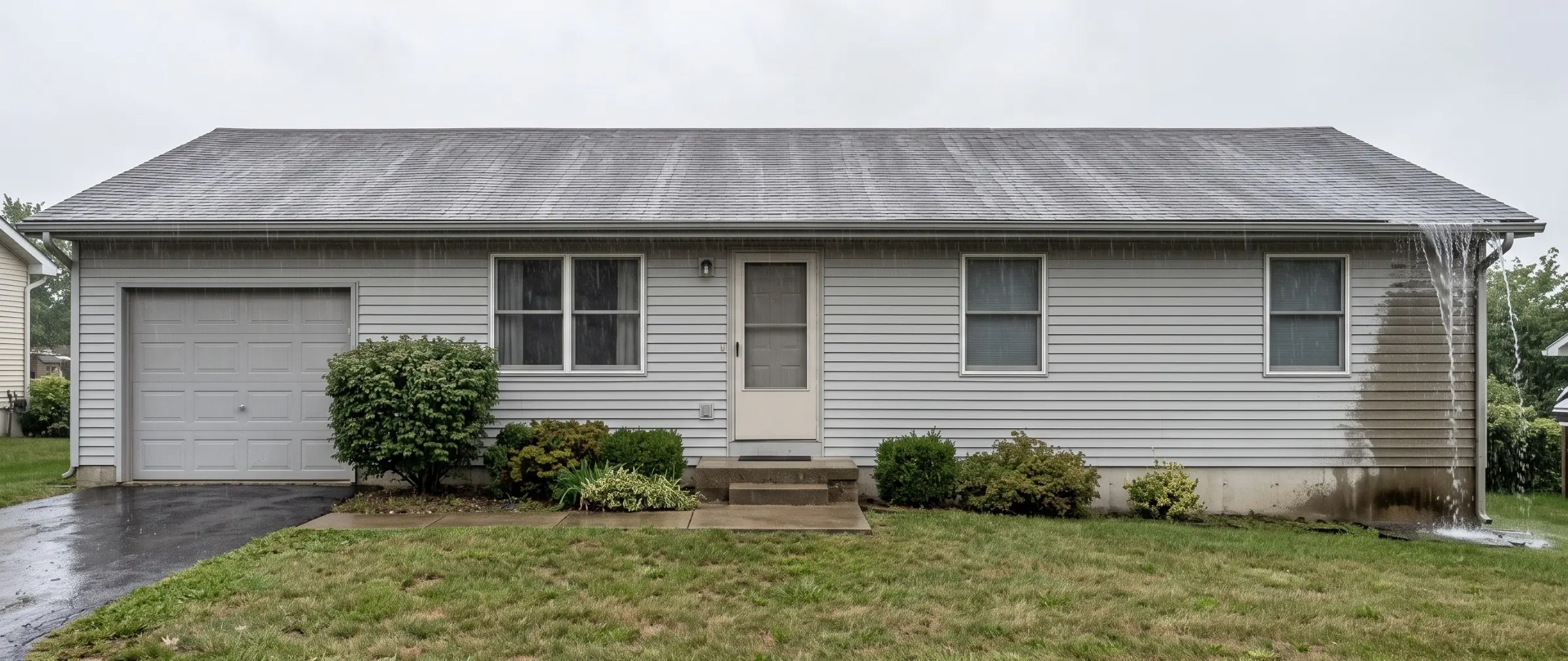

A damp basement wall that only shows up after it rains, or a foundation crack that seems to widen a little more every year, often traces back to something as ordinary as an overflowing gutter or a downspout dumping water in the wrong spot. It's one of the most common causes of foundation and basement water damage, and confirming it usually comes down to checking a handful of specific signs, then fixing it with something as simple as a downspout extension or a few feet of regrading, not a foundation replacement.
Water that enters a home this way starts out as Category 1, clean water under ANSI/IICRC S500, the governing standard for water damage restoration, which is exactly why it's easy to dismiss until the damage is already done. The International Residential Code addresses it directly: Section R801.3 requires roof drainage to be collected and discharged at least 5 feet from foundation walls in areas with expansive or collapsible soils, a rule most contractors apply as a general minimum everywhere because a downspout that dumps water right next to the house is one of the most common, and most fixable, causes of foundation and basement water intrusion in the country.
Key insights
- 5 feet is the code minimum. The International Residential Code's Section R801.3 requires downspouts to discharge at least 5 feet from the foundation in areas with expansive soil, and most contractors treat that as the baseline distance everywhere.
- Grading matters as much as the gutter. Section R401.3 requires the ground to fall at least 6 inches within the first 10 feet away from the house, so a downspout can be perfectly extended and still feed water back toward the foundation if the yard slopes the wrong way.
- Water starts as clean, Category 1 water. Roof runoff is typically the cleanest category under IICRC S500, but it can pick up contamination and reclassify if it sits against a foundation wall or mixes with soil and organic debris for an extended period.
- Mold risk sets in within 24 to 48 hours. The EPA's timeline for mold growth after water intrusion applies just as much to a basement wall soaked by gutter overflow as it does to a burst pipe.
- Insurance usually treats this as a maintenance issue. Because gutter and downspout overflow develops gradually rather than suddenly, most homeowners policies exclude the resulting foundation or basement damage.
- The fix is often inexpensive. A downspout extension or a cleaned-out gutter costs a fraction of the foundation repair or basement waterproofing job it can prevent.
- Foundation and basement damage are usually the most expensive outcomes. The same overflow also stains siding, rots fascia, and erodes landscaping well before it works its way into the foundation and basement.
What to do if water is getting in
If overflow is actively sending water into a wall or a basement during a storm, the priority is stopping the concentrated flow at the source and protecting anything the water could reach before it's fully addressed. Acting quickly limits how much water gets in and what it damages, even though a full inspection still has to happen once the storm passes.
 Even a temporary extension works if it's angled away from the wall, a level or straight run just moves the puddle a few feet without draining it.
Get water away from the wall right now
If it's safe to be outside, redirect the downspout with a temporary extension, a length of scrap gutter, or even a tarp sloped away from the house so water stops concentrating at one spot on the foundation.
Move anything at risk in the basement
Get boxes, electronics, and stored items up off the floor and away from the affected wall before standing water or a damp floor reaches them.
Photograph the water and the source
Photograph both the overflowing gutter or downspout outlet outside and the water entry point inside, since this documents the actual cause if a contractor estimate or an insurance conversation follows.
Start airflow and call for an assessment
Run a fan or dehumidifier on the affected area and call a restoration company or a foundation and drainage specialist to confirm how much water got in and how far it traveled. If the water is extensive enough that it looks like an emergency water damage situation rather than a contained damp spot, treat it that way and get a same-day response rather than waiting for the storm to pass.
How gutter overflow damages foundations
Gutter and downspout overflow causes foundation damage by repeatedly saturating the soil right next to the footing, which increases the hydrostatic pressure pushing against the foundation wall and, over time, can erode or undermine the soil that supports it. A foundation isn't damaged by a single storm's worth of overflow. It's damaged by the same failure point sending water to the same few square feet of soil, storm after storm, for years.
 Section R801.3 requires that discharge point to sit at least 5 feet from the wall, close enough here to feed the saturated soil widening this crack.
Two separate things go wrong at once. First, saturated soil against a foundation wall behaves differently than dry soil. In expansive clay, it swells when wet and shrinks when it dries out again, and that repeated movement stresses the wall and can open or widen cracks. In sandier or looser soil, the same repeated soaking can wash fine particles away from around the footing, a slow erosion process that leaves the foundation less supported than it was when the house was built. Neither process announces itself right away, which is part of why a downspout can sit in the wrong spot for years before anyone connects it to a wall crack or a sinking corner of the porch. In colder climates, a third mechanism adds to both of these: water that's worked its way into an existing hairline crack can freeze during a cold snap, and ice expands with enough force to widen that crack further each winter, so a small crack fed by an overflowing downspout tends to get measurably worse from one year to the next rather than staying the same size.
Second, that same water finds the path of least resistance, and in most homes that path leads straight through a crack, a cold joint, or a porous section of the foundation wall into the basement or crawl space below. If the overflow has already gone on long enough to affect the structure itself, rather than just producing a wet wall, that shifts the conversation from a drainage fix to structural water damage and the kind of evaluation a structural engineer, not just a gutter contractor, needs to weigh in on.
How gutter overflow damages basements
Gutter and downspout overflow causes basement water damage by adding a volume of surface water the foundation and drainage system weren't built to absorb at one concentrated point, which pushes water through cracks, cold joints, or window wells faster than it can drain away. This is the most common route a basement takes on water that has nothing to do with a burst pipe or a sewer backup.
A basement wall that's dry in normal conditions can still leak once a downspout starts feeding it directly. Hydrostatic pressure builds against the outside of the wall during and immediately after a storm, and any weak point, a hairline crack, a poorly sealed window well, the joint where the wall meets the slab, becomes an entry point under that added pressure even if it never leaked before the gutter problem started. Homes with a sump pump often don't notice the connection right away, since the pump is doing its job and keeping the floor dry, but a downspout dumping next to the foundation adds a sudden, concentrated load the pump wasn't sized for, which is a common reason a sump pump failure or a pump that runs constantly during storms traces back to something happening at the roofline rather than the pump itself.
Signs gutters are causing water damage
The clearest sign is timing: water or dampness that shows up during or immediately after rain, and that improves once the weather clears, points to a surface water source like gutters, downspouts, or grading rather than groundwater or a plumbing leak. Pay attention to what's happening outside at the same time water appears inside, since the two are usually connected.
 A stain that dampens after every storm and dries out between them points to surface water from a gutter or downspout, not groundwater or a plumbing leak.
A handful of other signs confirm it before the damage gets worse. Staining or a wet streak directly below a section of gutter, mulch or soil washed away right where a downspout discharges, and a basement or crawl space wall that dampens on the same side as a nearby downspout outlet are all consistent patterns, not coincidences.
| Sign | Where to look | What it usually means |
|---|---|---|
| Water sheeting over the gutter edge during rain | The gutter itself, mid-storm | A clog or an undersized gutter that can't keep up with the roof's runoff |
| Staining or moss below the gutter line | Siding directly under a gutter section | A leak in the gutter seam or a sag that's letting water spill over one low point |
| Eroded soil or mulch washout | The ground right at a downspout outlet | Water discharging too close to the house with no splash block or extension |
| New or widening foundation cracks | Exterior foundation wall near a downspout | Repeated soil saturation and pressure at that specific point |
| A basement wall that dampens after storms but dries between them | The interior wall closest to the problem downspout | Surface water intrusion tied to rainfall, not a constant groundwater issue |
| A sump pump that runs nonstop during heavy rain | The sump pit and discharge line | Added surface water volume overloading a pump that otherwise keeps up fine |
If any of these line up with a wall that's been consistently damp or musty, it's worth confirming with a broader look at the signs of water damage elsewhere in the home, since gutter overflow rarely stays contained to one spot once it's had time to travel. The exterior signs, like eroded soil at a downspout outlet, are usually the easier ones to catch, since they tend to show up well before a wall on the other side of that spot starts to dampen.
What causes gutters to overflow
Gutters and downspouts overflow when something blocks or restricts the path water is supposed to take off the roof, whether that's debris inside the gutter itself, a downspout that's too small or too far from any outlet, or a discharge point that dumps water somewhere it can't actually drain away. Most overflow problems trace back to one of a small number of repeat causes.
 Debris is the most common cause of overflow, but a gutter can also spill over from being undersized, pitched wrong, or fed by a damaged downspout even when it's completely clean.
Debris is the most common by far, but it isn't the only failure point. A gutter can be perfectly clean and still overflow if it's undersized for the roof area it serves, pitched incorrectly so water pools instead of flowing to the downspout, or fed by a downspout that's been dented, disconnected, or clogged further down the line. Heavy, fast-moving storms make every one of these problems worse at once, which is why storm and hurricane water damage claims often trace back to a drainage system that was already marginal before the storm arrived.
| Cause | Why it leads to overflow | Typical fix |
|---|---|---|
| Leaves and debris clogging the gutter or downspout | Water can't reach the downspout outlet and spills over the gutter's edge | Clean gutters, add a debris guard |
| Undersized gutters or downspouts for the roof area | The system reaches capacity before the storm is over | Upsize to a larger gutter or downspout profile |
| Incorrect pitch or a sagging section | Water pools in the low spot instead of flowing downhill to the outlet | Reset hangers and re-pitch the run |
| A damaged, disconnected, or crushed downspout | Water exits partway down instead of reaching the ground outlet | Repair or replace the damaged section |
| Downspout discharge too close to the foundation | Water pools against the wall instead of draining away from it | Add an extension, splash block, or buried line |
| Ice buildup blocking the gutter in winter | Meltwater has nowhere to go and backs up under the roof edge | Manage the ice dam directly, not just the gutter |
In winter, an ice dam blocking the gutter behaves the same way as a debris clog: meltwater has nowhere to go and backs up under the roof edge until the dam itself is addressed, not just the gutter underneath it. Clearing the gutter alone won't fix that kind of backup, since the actual blockage sits higher up on the roof where snowpack is refreezing.
Downspout distance and grading code
The International Residential Code sets two separate requirements that work together to keep roof runoff away from a foundation: Section R801.3 requires downspouts to discharge roof water at least 5 feet from the foundation wall in areas with expansive or collapsible soils, and Section R401.3 requires the ground itself to fall at least 6 inches within the first 10 feet away from the house. Meeting only one of the two rarely solves the problem completely.
 This is what Section R801.3 and Section R401.3 look like met together: discharge at least 5 feet out, onto ground that already falls away from the wall.
A downspout can technically discharge 5 feet from the wall and still send water right back toward the house if the yard is flat or, worse, sloped toward the foundation instead of away from it. That's why a drainage fix usually needs to check both distance and slope, not just add an extension and call it done. On a lot where 6 inches of fall in the first 10 feet isn't achievable because of a property line, a retaining wall, or an existing slope, the code allows drains or swales to carry the water away instead, which is the same underlying solution, a French drain or a graded swale, that a foundation or drainage contractor typically recommends once a simple extension isn't enough.
The expansive and collapsible soils this code section calls out aren't evenly distributed. Clay-heavy soil that swells and shrinks with moisture is common across much of Texas, Oklahoma, and the Southeast, along with parts of the Mountain West and California, which is why downspout distance and grading tend to get far more scrutiny from inspectors and foundation contractors in those regions than in areas with sandier or more stable soil.
When to call a professional
A homeowner can usually handle cleaning, extensions, splash blocks, and a small regrading job without help. A few situations call for a professional instead. Steep or multi-story roofs where gutter cleaning means real fall risk are worth handing to a gutter contractor rather than a ladder and a garden hose. A yard where grading can't be fixed with a shovel, because of a property line, a retaining wall, or a slope that runs the wrong way across most of the lot, usually needs a French drain or a graded swale designed by a landscaping or drainage contractor. And any foundation crack, bowing wall, or basement leak that's already appeared, not just the overflow that's causing it, needs a foundation specialist or a water damage restoration company evaluation before it's sealed or patched, since fixing the crack without fixing the water source it's sitting under just buys time before it reopens.
Vetting a foundation or drainage contractor follows the same basic logic as choosing a water damage restoration company: ask for a written scope that identifies the specific cause, not just a generic waterproofing package, and confirm the fix actually addresses the discharge point or grading problem the inspection found rather than only treating the symptom inside the basement.
Cost to fix gutter overflow
Most fixes for gutter and downspout overflow cost far less than the foundation or basement repair they prevent, and the price scales with how far the problem has progressed before it's addressed. A downspout extension or a thorough gutter cleaning is the cheapest possible fix, while a full drainage system is the most expensive and is usually only necessary once grading alone can't solve the problem.
 Where a homeowner lands in that range usually comes down to how far the problem got before anyone called someone, a downspout extension versus a full French drain.
Most homeowners land somewhere in the middle of that range rather than at either end. A single problem downspout usually means an extension, a splash block, and maybe a small regrading job, all done in an afternoon for a few hundred dollars, while a French drain or waterproofing job only becomes necessary once the water has had years to find its way past the grading and extensions on its own.
| Fix | Typical cost | When it's needed |
|---|---|---|
| Gutter cleaning | $75-$300 | Routine maintenance, twice a year |
| Downspout extension or splash block | $10-$250 | Discharge point sits too close to the foundation |
| Gutter guards, whole house | $1,000-$3,000 | Reducing clogging on a home with heavy tree cover |
| Regrading around the foundation | $1,000-$5,000 | The yard slopes toward the house instead of away from it |
| French drain installation | $1,000-$10,000+ | Grading and extensions alone can't move the volume of water involved |
| Foundation crack repair or basement waterproofing | $500-$18,000+ | The overflow has already caused a crack, leak, or interior damage |
If the overflow has already led to a wet basement or damaged materials, the cost to fix the water damage itself sits on top of whatever it costs to fix the gutters or drainage that caused it, which is the strongest financial argument for catching this early rather than after a flood.
Does insurance cover this damage
Homeowners insurance usually does not cover foundation or basement damage caused by gutter and downspout overflow, because most policies pay for sudden, accidental water damage rather than damage that developed gradually from a maintenance issue. An adjuster who traces a wet basement back to a downspout that's been discharging next to the foundation for several seasons will typically classify that as a maintenance failure, not a covered loss, even if the flooding itself happened during a single storm.
That said, coverage decisions come down to the specific policy and the specific evidence, so it's worth reviewing what homeowners insurance covers for water damage generally before assuming a claim is a lost cause. A sudden failure, like a downspout torn loose in a storm that then floods a basement within hours, sits closer to the sudden-and-accidental side of that line than years of slow overflow do, and documenting the cause with photos and a contractor's assessment matters either way.
DIY fixes and long-term prevention
Most gutter and downspout overflow problems can be fixed by a homeowner without hiring anyone, and the fixes are inexpensive compared to what a season or two of repeat overflow can cost in foundation or basement repair. Every fix works toward the same outcome: getting water off the roof, through the downspout, and onto ground that slopes away from the house.
 Guards cut down on how often debris builds up, but they still need an occasional check, since fine grit and shingle debris can settle on top of the mesh over time.
Clean gutters at least twice a year
Clear leaves, seeds, and granule buildup in late spring and again in late fall, or more often on a lot with heavy tree cover, so the gutter can actually carry the volume it's rated for.
Add downspout extensions or splash blocks
Extend every downspout to discharge at least 5 feet from the foundation, matching the International Residential Code's roof drainage minimum, and set the outlet on a splash block or a short buried line rather than letting it discharge onto bare, flat soil.
Regrade the soil at each downspout outlet
Check that the ground slopes away from the house at each discharge point. A shovel and a few wheelbarrows of soil are often enough to fix a spot that's settled flat or sloped the wrong way over the years.
Install gutter guards to cut down on clogging
A mesh or screen guard reduces how often gutters need cleaning and lowers the odds of a mid-storm clog, though guards still need an occasional check, since fine debris and shingle grit can build up on top of them.
Check for sagging sections and loose brackets after storms
A gutter section that's pulled away from the fascia or sagged toward one low point will keep overflowing at that spot no matter how often it's cleaned, so a quick visual check after a major storm catches this before the next one.
A 5 foot minimum discharge distance is also the baseline IBHS recommends for water management around the home, and pairing that distance with routine cleaning and a periodic grading check covers most of what causes overflow in the first place. For the rest of the home's water damage prevention routine beyond the gutters themselves, roofing, plumbing, and appliance checks round out an annual maintenance schedule.
Frequently asked questions
Can clogged gutters actually cause foundation damage?
Yes. Once a gutter clogs and overflows, water drops straight down along the foundation wall instead of moving away from the house, and the soil next to the footing absorbs far more water than it was graded to handle. Repeated soaking over a season or two is enough to soften that soil, and in expansive clay it can push and pull on the foundation wall as it swells and shrinks.
How far from the foundation should a downspout discharge?
At least 5 feet, per the International Residential Code's Section R801.3 roof drainage requirement for expansive or collapsible soils. Most contractors use that same 5 foot minimum everywhere, since a shorter discharge is a common cause of repeat foundation and basement water damage even outside a technically expansive-soil zone.
How do I know if my basement water is coming from the gutters and not something else?
Check the timing first. Water that shows up during or right after rain, and dries out within a day or two once the rain stops, points to surface water from gutters, downspouts, or grading. A basement that stays damp between rain events, or floods with no storm at all, is more likely a groundwater, sump pump, or plumbing source, worth ruling out with a foundation or basement inspection.
How often should gutters be cleaned to prevent this kind of damage?
Twice a year for most homes, once in late spring after seed and pollen drop and again in late fall after leaves come down. Homes surrounded by mature trees, or in regions with a long pollen or leaf season, often need a third cleaning mid-season to avoid a mid-summer overflow.
Does homeowners insurance cover foundation or basement damage caused by gutter overflow?
Usually not. Most policies pay for sudden, accidental water damage, not damage that built up gradually from a maintenance issue like a clogged gutter or a downspout that's been discharging too close to the house for years. An adjuster who traces the cause back to neglected gutters will typically deny that portion of the claim even if the resulting basement flood itself looks sudden.
Can overflowing gutters cause mold in the basement?
Yes, and faster than most homeowners expect. Once water gets past the foundation wall, mold-favorable conditions can develop within 24 to 48 hours in the affected material, so a damp basement corner that keeps recurring after every heavy rain is worth drying out completely and tracking down at the source, not just wiping clean after each event. The CDC's basic facts about mold note that people with asthma, allergies, or a weakened immune system face a higher health risk from that kind of recurring dampness, which is one more reason to fix the source rather than just cleaning up after each storm.
What's the difference between a downspout extension and a French drain?
A downspout extension is a length of pipe or a flexible sleeve that simply carries water further from the house before releasing it onto the surface. A French drain is a buried, gravel-filled trench with a perforated pipe that collects water along its length and channels it underground to a lower point, which handles a larger volume and works on tighter lots where surface extensions aren't practical.
How much does it cost to fix a downspout that's causing foundation damage?
As little as $10 to $40 for a DIY extension or splash block, or $75 to $250 per downspout for a professional to add a buried extension line. If the fix needs to go further, a full French drain along that side of the house typically runs $1,000 to $6,500, and interior basement waterproofing with a drain system runs several thousand more.
Can I install gutter guards myself to stop the overflow?
Yes, for most standard gutter runs on a single-story or easily accessible roof. Mesh and screen guards are widely sold for DIY installation, though a whole-house job on a steep or multi-story roof is often safer and faster to leave to a gutter contractor, especially if scaffolding or a lift is involved.
How do I tell if bad yard grading, not the gutters, is the real problem?
Watch where standing water collects after a storm. If it pools in a low spot several feet from the house that has nothing to do with a downspout outlet, the grading itself is likely sloped toward the house rather than away from it, a separate problem from an overflowing gutter even though the two often get fixed together.
Can gutters overflow enough to overwhelm a sump pump?
Yes. A sump pump is sized for the groundwater and seepage a basement normally handles, and a downspout dumping directly next to the foundation adds a sudden, concentrated volume the pump wasn't designed for. That extra load is a common reason a sump pump failure shows up during storms even though the pump itself is working correctly.
Is it too late to fix foundation cracks caused by years of gutter overflow?
No, but the gutter and downspout problem has to be fixed first or any crack repair will fail again. A foundation specialist can seal or inject a crack and, if needed, install exterior drainage once the water source feeding that section of wall has actually been redirected away from the house.
Sam Hickerson is the founder of RestoreAdvisor and writes consumer guides on mold remediation, water damage restoration, inspection, testing, and home recovery. His work focuses on helping homeowners understand costs, risks, and when to call a professional. He draws on guidance from the EPA, CDC, IICRC, and other authoritative sources to make complex home issues easier to navigate.