
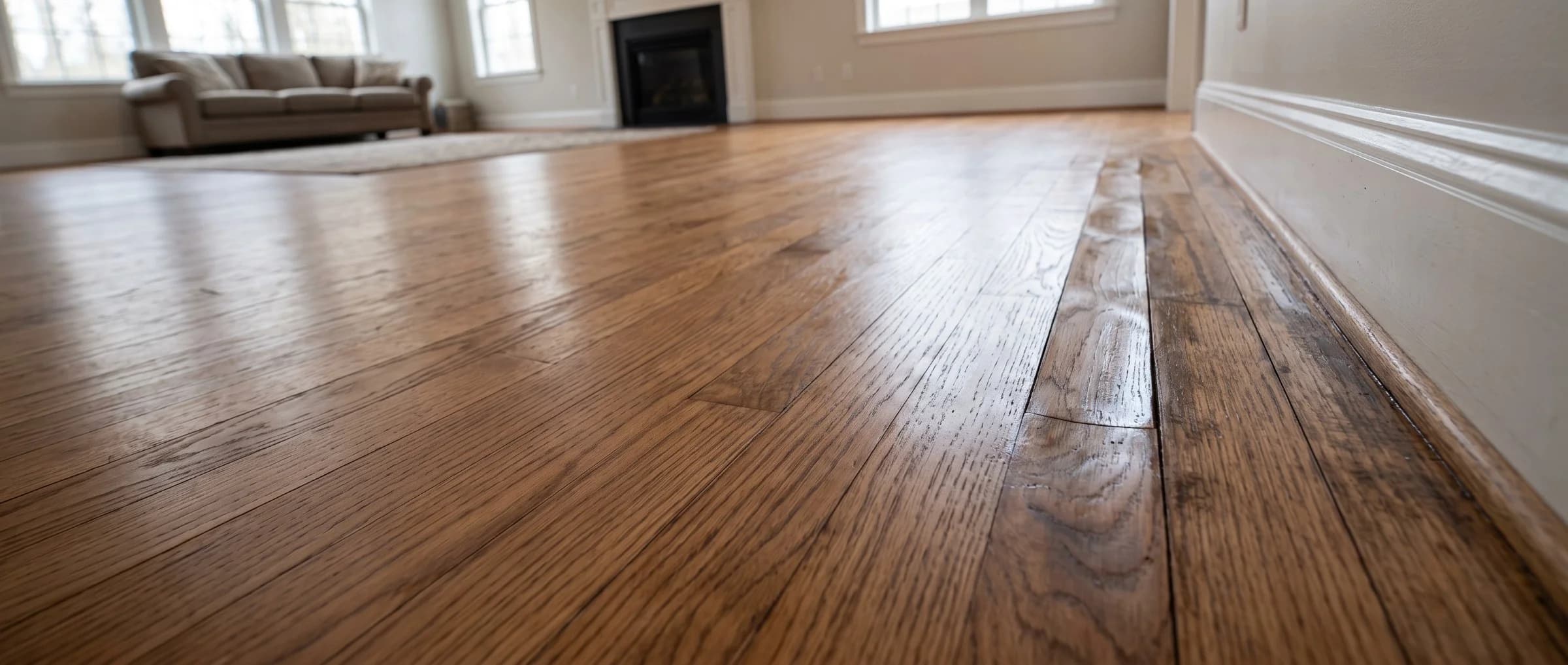

A hardwood floor that's cupping, staining, or sitting under standing water can often be saved, but what happens in the first day or two decides whether the fix is a light refinish or a full tear-out. Sand a cupped floor too early or dry it too fast with a space heater, and a repairable problem turns into a replacement.
Water damaged hardwood floors are flooring that has absorbed enough moisture to swell, discolor, or separate from the subfloor beneath it, a condition assessed under the same IICRC S500 water damage classification system used industry-wide and measured against the National Wood Flooring Association's target moisture content of 6% to 9% for installed hardwood. Getting the drying method right in the first day matters more than which company eventually does the repair, since a floor dried correctly can often be saved even after standing water, while one dried too fast with a space heater or sanded too soon rarely recovers on its own.
Key insights
- The first 24 to 48 hours matter most. Cupping and staining caught and dried within that window usually flatten out and sand away; water left longer often causes permanent warping or subfloor separation.
- Rapid drying causes more damage than slow drying. A space heater or heat gun pulls moisture from the surface faster than the wood's core can release it, which splits and cracks the boards.
- Sanding a still-cupped floor makes it worse. Flattening raised edges before the wood has finished drying and shrinking typically reverses into crowning once the boards settle.
- Solid and engineered hardwood don't respond the same way. Solid wood can usually be sanded and refinished several times; engineered wood's thin veneer wear layer often allows only one light sanding, if any.
- Moisture content, not appearance, determines when refinishing is safe. The National Wood Flooring Association's target is 6% to 9%; a professional-grade moisture meter reading above that range means the floor isn't ready, even if it looks dry.
- Cost swings widely with how long the water sat. A quickly dried spot may only need refinishing for a few hundred dollars, while a floor and subfloor soaked for days can run into five figures.
Signs of hardwood water damage
Water damage on hardwood shows up as changes in the shape, surface, or smell of the boards, not just visible staining. Some signs appear within hours, while others, particularly a musty odor with no staining on top, can mean moisture is trapped between the boards and the subfloor where it isn't visible at all.
 Cupping like this typically resolves once the board and subfloor return to the NWFA's 6% to 9% moisture target; sanding before then usually reverses it into crowning.
Most of these signs start at the seams between boards rather than in the middle of a plank, since that's where water finds the easiest path down to the subfloor. Checking along baseboards, under appliances, and near any fixture with a water line is usually more productive than scanning the open floor first.
| Sign | What it looks like | What it usually means |
|---|---|---|
| Cupping | Board edges higher than the center, a shallow trough down the middle | The underside absorbed more moisture than the top, usually from below |
| Crowning | Center higher than the edges, the reverse of cupping | Often caused by sanding a floor before it finished drying |
| Buckling or lifting | Boards separating from the subfloor, sometimes visibly rising | Prolonged saturation; the adhesive or fasteners have failed |
| Staining or discoloration | Dark patches, often near seams or along a baseboard | Water sitting on or under the finish long enough to penetrate the wood |
| Gaps widening or closing | Seams between boards changing width from normal | Wood swelling (gaps close) or shrinking after drying too fast (gaps widen) |
| Finish clouding or whitening | A hazy, milky patch under the protective coat | Moisture trapped between the finish and the wood surface |
| Musty odor with no visible staining | A smell with nothing obviously wrong on top | Moisture and possible mold developing under the boards, not on them |
A quick way to narrow down which of these you're seeing: press firmly on the affected boards. A floor that flexes or feels spongy underfoot has moisture reaching the subfloor, not just the surface, and that changes the drying approach and the odds of a full recovery. Cupping is by far the most common early sign, and it's also the one most likely to resolve completely if the floor is dried correctly rather than sanded on sight. Musty odors and staining aren't unique to hardwood; the same signs of water damage show up as buckling in carpet or bubbling paint on drywall, just with a different material absorbing the moisture.
What to do right now
Stop the water source first, then focus on removing standing water and starting gradual airflow, not aggressive heat, across the affected boards. The sequence matters: drying too fast is nearly as damaging as not drying at all, since it pulls moisture out of the wood unevenly and splits the boards.
 Fans and a dehumidifier pull moisture out gradually; a space heater or heat gun aimed at the same spot pulls it out too fast and splits the boards instead.
1. Stop the water source
Shut off the supply valve, appliance, or fixture responsible before doing anything to the floor itself. Continued water entry undoes any drying progress and adds to the square footage affected.
2. Remove standing water and wet items immediately
Blot or wet-vacuum any standing water off the surface right away, and move rugs, furniture, and other items off the wet area. A wet rug left in place traps moisture against the boards underneath it.
3. Start gradual air movement, not direct heat
Set up fans and a dehumidifier to circulate air across the floor. Skip space heaters or a heat gun aimed at the wood, since rapid drying pulls moisture out of the surface faster than the core can release it and splits the boards.
4. Photograph the damage before you clean
Capture the standing water, the affected boards, and the source of the leak before moving anything further. This documentation matters for an insurance claim regardless of whether the floor ends up repaired or replaced.
5. Call a restoration company and a flooring professional the same day
A restoration company can extract water and begin structural drying immediately, while a flooring professional can confirm with a moisture meter when the boards are dry enough to sand, refinish, or leave alone. For anything beyond a quickly wiped-up spill, same-day emergency water damage restoration response keeps a manageable problem from spreading to more boards overnight.
What not to do
The fastest way to turn a repairable hardwood floor into a replacement is rushing the drying process, not the water itself. Sanding before the wood has fully dried and applying direct heat both cause more lasting damage than most water events do on their own.
 Sanding a floor before a moisture meter confirms it's dry flattens the raised edges while the core is still swollen, and the board typically crowns once it finishes drying.
Don't sand or refinish the floor before it's confirmed dry
A moisture meter reading, not how the floor looks, determines when sanding is safe. Sanding a cupped floor while the core is still swollen almost always reverses into crowning once the wood finishes drying.
Don't use space heaters or a heat gun to speed up drying
Rapid, uneven drying pulls surface moisture out faster than the wood's interior can release it, which cracks and splits the boards. Fans and a dehumidifier working over several days do less damage than a heater working over a few hours.
Don't wait more than a day or two to call a professional
Moisture reaching the subfloor is associated by the EPA with mold growth within roughly 24 to 48 hours, and every additional day the wood stays wet increases the odds that cupping becomes permanent.
Don't assume a dry-looking surface means the subfloor is dry
Wood dries from the top down, so a floor that feels dry to the touch can still be releasing moisture into the subfloor below it for days or weeks afterward.
Who to call
A water damaged hardwood floor usually needs two different professionals, not one: a water damage restoration company handles extraction and structural drying, while a flooring specialist handles the sanding, board replacement, and refinishing once the floor is confirmed dry. For anything beyond a quickly wiped-up spill, calling both the same day is faster than waiting to see which one turns out to be necessary.
The restoration company's job ends once a moisture meter confirms the floor and subfloor are back in a normal range; verifying that a technician or company holds IICRC Certified Firm status and a WRT (Water Restoration Technician) credential is a reasonable screen at this stage. The flooring specialist's job starts from there, and it's worth asking specifically whether they've handled water damage repairs before, not just routine refinishing, since matching stain and sheen on a partial repair is a different skill than refinishing an undamaged floor. Some companies offer both services under one roof; when they don't, coordinating a start date for the flooring work as soon as the drying company confirms a safe moisture reading avoids the floor sitting exposed and re-absorbing ambient humidity between the two jobs.
Common causes of hardwood water damage
Hardwood floors take on water from two kinds of events: a sudden failure that dumps a large volume in a short time, and a slow leak that goes unnoticed for weeks or months before staining or cupping shows up. The cause matters for more than diagnosis, since it also determines the water's contamination category and, in turn, whether insurance is likely to treat the loss as sudden and accidental.
 A slow supply line leak like this can spread laterally under several boards before it's ever visible on top, which is why cupping often shows up wider than the leak itself.
Dishwasher or refrigerator leak
A cracked supply line, a failed door gasket, or a clogged refrigerator defrost drain can leak slowly for months before cupping or a musty smell appears along the cabinet toe kick. A refrigerator leak is a particularly slow-building one, since the motor's heat can dry the surface between drips even as the underside of the boards keeps absorbing moisture, which is part of why warping under a refrigerator often looks worse than the visible puddle would suggest. A dishwasher leak is one of the more common sources of hardwood damage in a kitchen specifically because it's rarely checked between uses.
Washing machine overflow or supply line failure
A burst hose or an overflowing tub releases far more water in a shorter window than most appliance leaks, which is why laundry rooms and adjoining rooms with hardwood are especially vulnerable to this cause. A washing machine on an upper floor can send that volume straight through the subfloor to a ceiling and hardwood floor below before anyone at the source ever notices.
Water heater failure
A tank rupture or a failed fitting can turn a water heater leak into a fast-moving flood on a nearby hardwood floor, releasing dozens of gallons before anyone notices, particularly in a finished basement or a utility closet off a main living area.
Roof leak dripping onto a floor below
Water traveling down through a ceiling cavity often reaches a hardwood floor on the level below well after the leak itself started, so staining can appear with no obvious source directly overhead.
Failed exterior door threshold or entryway seal
Rain driven against an exterior door can work its way under nearby hardwood through an aging or improperly sealed threshold, not necessarily a gap around the door itself. This one is easy to misdiagnose, since staining near an entryway usually gets blamed on a tracked-in spill rather than an ongoing intrusion at the seal.
Burst or slowly leaking pipe
A supply line failure under or near a hardwood floor is one of the most common causes of cupping specifically, since water spreads laterally under the boards before it's ever visible on top. A burst pipe that goes undetected overnight can affect a much wider area of flooring than the visible wet spot suggests.
Flooding or storm water intrusion
Floodwater is classified as Category 3 water regardless of how brief the exposure, which changes both the cleanup requirements and the odds that the affected boards can be saved rather than replaced.
Sewage backup reaching a hardwood room
Like flooding, a sewage backup is automatically Category 3 contamination. Hardwood exposed to sewage is rarely refinished; the porous wood typically has to come out and be replaced rather than cleaned.
Everyday spills, pet accidents, and wet mopping
A large spill left standing, a pet accident that soaks into a seam, or repeated wet mopping with too much water can each cause the same cupping and staining as a plumbing failure, just on a smaller scale and usually confined to one or two boards.
Solid vs. engineered hardwood
Solid hardwood and engineered hardwood absorb and release water differently, and that difference decides whether a damaged floor gets refinished or replaced. Solid wood is a single piece of timber through its full thickness, while engineered wood is a thin wear layer of real hardwood bonded over a plywood or high-density fiberboard core.
 Engineered hardwood's wear layer runs about 1/16 inch to 3/16 inch thick, thin enough that it often survives only one light sanding before the plywood core beneath it becomes the real risk.
Solid hardwood can typically be sanded and refinished several times over its life, since the board's thickness allows multiple passes before the tongue-and-groove joint is exposed. A solid floor that cups from water exposure often has enough material to sand flat again once it's fully dry, which is one reason solid hardwood has a better track record of surviving a water event than engineered flooring does.
Engineered hardwood's wear layer ranges from roughly 1/16 inch to 3/16 inch, thin enough that it may only tolerate one light sanding, if any, before the veneer is gone. The bigger risk with engineered flooring isn't the surface layer, though; it's the plywood or fiberboard core underneath. Once that core swells or the layers begin to delaminate from prolonged moisture exposure, sanding won't fix it, and the affected boards need to be replaced rather than refinished.
Laminate and luxury vinyl plank aren't real wood. Neither can be sanded or refinished, and swollen or delaminated sections of either are always replaced rather than repaired. Many hardwood-look floors sold today are actually LVP, so it's worth confirming which material is actually installed before assuming a repair-versus-replace decision even applies.
Nail-down, glue-down, or floating hardwood
Most homes have one of three installation types, nail-down over wood, glue-down over concrete, or floating over an underlayment, and each one calls for a different drying approach when it gets wet. How a hardwood floor is installed determines how far water spreads underneath it and which drying method actually works, which is why the same amount of standing water can mean the difference between a two-day dry-out and a floor that has to come out entirely, depending on the home.
 Floating installations are the one case where individual boards can come up for drying or replacement without demolishing the surrounding floor.
Nail-down hardwood over a wood subfloor, typically with a crawl space or basement below, gives water somewhere to travel. Restoration companies can often access the underside from below to speed drying, and the crawl space or basement itself needs to be checked for moisture even if the visible damage is confined to the room above.
Glue-down hardwood over a concrete slab is the harder case. There's no cavity underneath for water to escape into or for a technician to access from below, so moisture gets trapped between the boards and the slab and has to be drawn out through the top, typically with drilled injection ports and negative-pressure drying mats. This method takes longer, and prolonged moisture against the adhesive layer raises the risk of the boards delaminating from the slab entirely, which pushes a marginal case toward replacement rather than repair.
Floating hardwood, most often engineered flooring installed over an underlayment with a click-lock system rather than nails or glue, is a different case still. Water spreads under a floating floor easily since nothing anchors the boards to the subfloor, but that same lack of attachment means individual boards can sometimes be lifted for drying or replacement without demolishing the surrounding floor, an option nail-down and glue-down installations don't offer.
Can the floor be saved?
Whether a water damaged hardwood floor can be saved comes down to how long the water sat and whether the subfloor absorbed moisture along with the boards. A floor dried within the first 24 to 48 hours, with no boards separating from the subfloor, is usually a refinishing job; one soaked for several days or with visible lifting usually isn't.
 A board that flexes or feels spongy underfoot has moisture reaching the subfloor, not just the surface, which tips the decision toward replacement rather than refinishing.
The decision isn't always obvious from a visual check alone, since a floor can look intact while the subfloor underneath is still holding moisture that will cause problems weeks later. That's why a moisture meter reading, taken at multiple points rather than just the worst-looking spot, carries more weight than appearance when the call is close.
| Condition | Salvageable? | Typical fix |
|---|---|---|
| Light cupping, dried within 48 hours | Yes | Dry fully, confirm moisture content, then sand and refinish |
| Surface staining, no cupping | Yes | Clean, dry, and spot-refinish once moisture content is normal |
| Moderate cupping, dried within a week | Often | Extended drying, then refinish; a few boards may need replacing |
| Buckling or boards lifting from the subfloor | Rarely | Remove and replace the affected boards and inspect the subfloor |
| Category 3 water (sewage or floodwater) | Rarely | Remove and replace affected boards regardless of drying success |
| Standing water for several days, source unknown | Case by case | Professional moisture mapping determines the extent before any decision |
The single most common mistake in this decision is sanding too soon. A cupped board that's sanded flat while its underside is still swollen will finish drying after the sanding is done, shrink back down, and crown, the reverse problem, since the center is now higher than the sanded-flat edges. Waiting for a moisture meter to confirm the floor and subfloor have returned to a normal range costs time, but it's the difference between one sanding pass and two. For damage confined to a small area that dried quickly, some homeowners handle the cleanup themselves rather than calling in a full restoration crew.
Repair and replacement cost converge faster than most homeowners expect. A rough rule of thumb from the flooring industry: once the cost of board replacement and refinishing approaches roughly 30% of what a full replacement would cost, replacement usually wins on value even when repair is technically still possible, since a patched floor rarely matches the rest as well as an entirely new one.
How professionals dry and assess floors
Professional drying relies on a moisture meter reading, not visual inspection, to determine when a hardwood floor is safe to sand or leave alone. The National Wood Flooring Association's target for installed hardwood is 6% to 9% moisture content, with readings above roughly 12% treated as unacceptable for refinishing, and boards are tested at multiple points rather than just once, since one high reading in an otherwise dry room usually signals a problem worth investigating further.
 Thermal imaging spots moisture that hasn't reached the surface yet, catching a slow leak before cupping ever becomes visible.
Subfloor moisture matters as much as the flooring itself. NWFA guidance calls for no more than a 4% moisture content difference between the hardwood and the subfloor for strip flooring under 3 inches wide, and no more than 2% for wide-plank flooring, since a mismatch that large is what drives the ongoing expansion and contraction that leads to cupping and gaps even after a floor looks dry on the surface. A hardwood floor with elevated subfloor readings is often classified differently under that same assembly-wide assessment than one where only the surface got wet.
For water that reached beneath the boards rather than just sitting on top, restoration companies use specialty equipment built specifically for hardwood: injection drying systems that force air under the boards through small ports, and drying mats or tents that create negative pressure to pull moisture up and out. Thermal imaging cameras help locate moisture that hasn't reached the surface yet, which is particularly useful for catching a slow leak before cupping becomes visible. Drying a floor this way, rather than with surface fans alone, is often what separates a floor that's fully salvageable from one that looks dry after a few days but keeps moving for weeks afterward.
How long hardwood floors take to dry
Drying time depends almost entirely on how long the water was in contact with the boards and whether it reached the subfloor, not on the square footage affected. A quickly wiped-up spill may not need structural drying at all, while water that sat under the boards for days can take weeks to fully release.
Light exposure that's cleaned up within an hour or two typically needs 3 to 5 days of fan and dehumidifier drying before a moisture meter clears the area for refinishing. Standing water left for several hours extends that to 1 to 3 weeks, since moisture has had time to travel laterally under adjoining boards beyond the visibly wet spot. Water that sat for multiple days, or where the duration is unknown, commonly takes 3 to 6 weeks to dry fully, and that timeline assumes drying starts promptly rather than after the leak has already been discovered late. Carpet, drywall, and insulation each dry on their own schedule, not hardwood's, which is part of why how long water damage restoration takes depends more on what's affected than on the size of the room. Refinishing or repair work itself is usually fast by comparison, typically 1 to 3 days once the floor is confirmed dry, since sanding, staining, and applying a protective finish don't take nearly as long as the drying process that has to happen first.
What to expect during repairs
Sanding and refinishing a hardwood floor is disruptive to live around, even with modern dust-containment equipment, and the room won't be usable for normal foot traffic until the finish has cured. Knowing that ahead of time means you can clear a path to another room or plan to be out of the house that day, instead of finding out once the sander's already running.
 Dust from sanding settles well beyond the immediate work area even with containment equipment, which is why closing doors and covering vents in nearby rooms is worth doing before the job starts.
Sanding generates fine dust that settles well beyond the immediate work area regardless of the containment system used, so nearby rooms benefit from closed doors and covered vents during that phase. The finish coat that follows has its own timeline: most floors can handle light sock-footed traffic within 24 hours, but rugs, furniture, and anything with rubber feet typically need to stay off for a week or more while the finish fully cures, longer for oil-based finishes than water-based ones. Pets and small children should stay out of the work area entirely while sanding and finishing are underway, both for dust exposure and because a partially cured finish marks easily. The disruption doesn't start with the flooring work either; what to expect during water damage restoration typically means fans and dehumidifiers running well before a sander ever gets set up, since the drying phase almost always comes first.
Cost to repair or replace hardwood floors
Cost for a water damaged hardwood floor ranges from a few hundred dollars for a quickly dried spot to well over $15,000 for a floor and subfloor that need full replacement, and the driving factor is almost always how long the water sat rather than the room's total square footage. A single cupped board near a doorway costs nothing like a full room that has to come up and get replaced.
 Matching an existing floor's color and sheen adds cost on top of the repair itself, since a small patch rarely blends in without refinishing a wider area around it.
Matching an existing floor's color and sheen adds cost on top of the repair itself, since stain and finish darken with age and a small patch rarely blends in without refinishing a wider area around it. That extra cost sits on top of the baseline water damage restoration cost for extraction and drying, which is typically billed as a separate line item from the flooring repair itself.
| Scenario | Typical cost | What's included |
|---|---|---|
| Small spill, no cupping, spot refinish | $300–$1,200 | Cleaning, drying confirmation, and light refinishing of the affected area |
| Moderate cupping, dried within a week | $1,500–$4,000 | Extended structural drying, moisture testing, sand and refinish |
| Standing water 24+ hours, several boards replaced | $3,000–$8,000 | Board replacement, blending, and full-room refinish to match |
| Subfloor also damaged | $6,000–$15,000 | Floor removal, subfloor repair or replacement, new flooring installed |
| Whole-room or whole-house replacement after major flooding | $15,000–$30,000+ | Full tear-out and replacement, typically after Category 3 water exposure |
Refinishing alone, once a floor is confirmed dry, generally runs $3 to $8 per square foot depending on wood species and finish. Full replacement runs considerably higher once material and installation labor are added, which is why professionals typically try to salvage as much of the original floor as possible before recommending a full tear-out. Hardwood isn't the only material with its own per-square-foot range, and comparing water damage restoration cost per square foot across categories and materials is often the fastest way to catch a contractor's quote that's out of line.
Does insurance cover hardwood floors?
Whether homeowners insurance covers a water damaged hardwood floor depends on the cause, under the same sudden-and-accidental standard applied to any other water damage claim. A floor damaged by a burst pipe or a sudden appliance failure is typically covered; one damaged by a slow leak that went unaddressed for months, or by flooding without separate flood coverage, usually isn't.
Per NAIC consumer guidance on homeowners policies, coverage turns on that same distinction between a sudden failure and a gradual one regardless of which part of the home is damaged. A dispute specific to hardwood claims comes up more often than on other flooring types: scope of repair. An adjuster may authorize sanding and refinishing only the boards with visible damage, while the homeowner wants the entire room refinished so the repaired section matches the rest of the floor in color and sheen, since wood finish ages and darkens unevenly over time. Some policies include a matching provision that addresses this; many don't, and it's worth confirming before repairs begin rather than after.
Preventing water damage to hardwood floors
Most water damage to hardwood floors traces back to a handful of preventable habits and maintenance gaps rather than a one-time accident. Appliance connections, humidity control, and everyday cleaning practices account for the majority of causes before a plumbing failure ever enters the picture.
 A barely damp microfiber mop cleans just as effectively as a heavily wetted one, without leaving more water on the surface than hardwood finish is designed to handle repeatedly.
Use area rugs with a breathable, non-rubber backing
A rubber-backed rug or mat traps moisture against the finish and can cause discoloration even without an active leak. Look for a breathable felt or woven backing instead, especially near sinks, entryways, and pet water bowls.
Clean up spills immediately, not eventually
Standing water left on a finished hardwood surface for even a few hours can penetrate seams and begin swelling the boards underneath. A towel or dry mop within minutes prevents nearly all surface-level water damage.
Keep indoor humidity between 35% and 55%
Hardwood expands and contracts with humidity swings well outside that range, according to National Wood Flooring Association guidance, which is part of why cupping and gapping show up seasonally in homes without consistent climate control, not just after a leak.
Check appliance supply lines and connections annually
Dishwasher, washing machine, refrigerator, and water heater connections are the most common slow-leak sources reaching hardwood floors. A quick annual check of hoses and fittings catches most of these before they cause visible damage.
Avoid wet mopping; use a damp mop instead
A string mop or a heavily wetted flat mop leaves more water on the surface than hardwood finish is designed to handle repeatedly. A barely damp microfiber mop cleans just as effectively without the cumulative moisture exposure.
Flooring is just one piece of a larger system, and plumbing, appliances, and seasonal maintenance are where most of the same failures start. Staying ahead of water damage prevention across the rest of the house catches most of them before they ever reach a floor at all.
Frequently asked questions
Can water damaged hardwood floors be saved?
Yes, more often than not. Two factors decide it: how long the water sat, and whether the boards have separated from the subfloor. If both are in your favor, plan on a straightforward sand and refinish; if either isn't, get a moisture reading before assuming anything, since a floor that looks fine on top can still fail that test underneath.
How long does it take for hardwood floors to dry after water damage?
Most floors take anywhere from 3 days to 6 weeks, and the deciding factor isn't the room's size, it's whether the water reached the subfloor. A surface spill dries in days; water that sat long enough to soak through the seams can keep releasing moisture for over a month even after the top feels dry to the touch.
What is cupping, and does it go away on its own?
Cupping is when a board's edges sit higher than its center, caused by the underside absorbing more moisture than the top. It often flattens back out on its own once the wood and subfloor return to a normal moisture content, which is why sanding a cupped floor before it's fully dry is the most common mistake in a hardwood water damage repair.
Should I sand my hardwood floors while they're still cupped?
No, not until a moisture meter confirms the boards and subfloor are both back in a normal range. There's no reliable visual test for this: a floor that looks and feels dry to the touch can still read high on a meter for days afterward, which is why professionals test rather than judge by hand.
Is it safe to walk on water damaged hardwood floors?
Usually yes, unless the boards feel spongy, are visibly separating from the subfloor, or the water came from a Category 3 source like sewage backup or floodwater. A soft or bouncy spot underfoot signals subfloor damage that needs a professional inspection before the area sees regular foot traffic again.
Can a refrigerator leak damage hardwood floors under the unit?
Yes, and a refrigerator leak is one of the harder ones to catch early, since nothing about a running unit looks wrong from the outside. Pulling the unit out every year or two to check the water line fitting and the drain pan catches most of these before they reach the floor.
Can a washing machine leak damage hardwood floors underneath it?
Yes, and a washing machine leak usually starts with a failed supply hose rather than the machine itself. Braided stainless steel replacement hoses cost very little compared to the damage a burst rubber hose can cause, and swapping them in is worth doing on a schedule rather than waiting for a failure.
Does homeowners insurance cover water damaged hardwood floors?
It depends on the cause: sudden failures like a burst pipe are typically covered, slow leaks and flooding usually aren't, the same distinction that governs homeowners insurance coverage for water damage generally. If you're filing a claim, photograph the wood species and finish along with the damage itself, since that's what determines whether a replacement board can actually be matched, and adjusters don't always think to ask for it.
Can engineered hardwood be refinished after water damage the same way solid hardwood can?
Not always, and a quick way to check before assuming either way is to look at a transition strip or vent cutout where the edge of a board is exposed. If the color layer is thinner than about 1/8 inch, it likely can't take more than one light sanding, and a flooring professional can confirm before you commit to a refinish plan.
Can mold grow under hardwood floors?
Yes. Trapped moisture reaches the conditions the EPA associates with mold growth within roughly 24 to 48 hours, and a hardwood floor traps that moisture longer than an exposed surface because airflow underneath is limited. A musty smell with no obvious wet spot, an indicator the CDC also flags as a common sign, is usually the giveaway since the surface can look completely normal while the problem sits below it.
Sam Hickerson is the founder of RestoreAdvisor and writes consumer guides on mold remediation, water damage restoration, inspection, testing, and home recovery. His work focuses on helping homeowners understand costs, risks, and when to call a professional. He draws on guidance from the EPA, CDC, IICRC, and other authoritative sources to make complex home issues easier to navigate.