

A burst pipe or an overflowing washing machine can turn into thousands of dollars in repairs before you've had your morning coffee, and the first question most homeowners ask is whether insurance will cover any of it. Homeowners insurance is a package policy that pays for sudden, accidental water damage to a home and its contents under the peril-based structure used in most standard HO-3 policies, while flood damage falls outside that coverage entirely and is handled separately through the National Flood Insurance Program administered by FEMA. The distinction almost always comes down to one question: did the water arrive suddenly, or did it build up over time nobody noticed.
Key insights
- Sudden and accidental wins. A standard homeowners policy pays for water damage that happens suddenly, like a burst pipe or a washing machine hose failure, but not for damage that built up slowly from a leak nobody fixed.
- Flooding needs its own policy. Groundwater, storm surge, and rising rivers are excluded from every standard homeowners policy and require a separate flood policy through the NFIP or a private insurer.
- Backup coverage is usually an add-on. Sewer and drain backups, along with sump pump overflow, are typically excluded by default and require a water backup endorsement, which commonly runs $50 to $250 a year for $5,000 to $50,000 in added coverage.
- Mold has its own sublimit. Even when the water event itself is covered, insurers commonly cap mold remediation coverage at $5,000 to $10,000 regardless of the total claim size.
- Documentation decides disputed claims. Photos, moisture readings, and a clear timeline from the moment you discovered the water matter more to an adjuster than how bad the damage looks.
- A denial isn't final. Most policies include an appraisal clause for valuation disputes, and every state insurance department accepts complaints against carriers that mishandle a claim.
What counts as covered water damage
Homeowners insurance covers water damage when it happens suddenly and accidentally from a source inside the home, such as a burst pipe, a failed appliance hose, or an overflowing bathtub. Insurers look at the same core question across nearly every claim: did the water arrive fast enough that a homeowner had no reasonable chance to catch it first.
 Insurers treat this kind of abrupt supply line failure as sudden and accidental discharge, the standard a policy must meet before a water damage claim is approved.
Coverage extends to the full scope of damage that follows a qualifying event, not just the initial spill. A burst pipe that runs for twenty minutes before anyone notices can still soak flooring, drywall, and insulation across several rooms, and all of that resulting damage stays covered as long as the triggering event itself was sudden.
| Cause | Typically covered | Why |
|---|---|---|
| Burst or frozen pipe | Yes | Sudden pipe failure counts as accidental discharge |
| Washing machine or dishwasher hose failure | Yes | Sudden appliance malfunction |
| Water heater rupture | Yes | Sudden equipment failure |
| Roof leak from storm damage | Yes | Wind or hail creates a covered opening |
| Ice dam backup | Yes | Weight of ice and snow is a named peril |
| One-time toilet overflow | Yes | Sudden discharge from a fixture |
| Fire suppression water damage | Yes | Resulting damage from a covered fire peril |
| Overflow from a tub left running | Usually | Sudden discharge, subject to policy wording |
Every cause on this list shares the same trait: the water arrived within minutes or hours, not weeks. That timing distinction carries through the rest of a policy, including which category and class a technician assigns once the damage is inspected.
What water damage insurance does not cover
Homeowners insurance excludes water damage from flooding, groundwater seepage, sewer or drain backups without an endorsement, and any damage that built up gradually from neglect or normal wear and tear. These exclusions apply regardless of whether the homeowner was aware of the risk, which is why a policy can deny a claim even when the damage came as a genuine surprise.
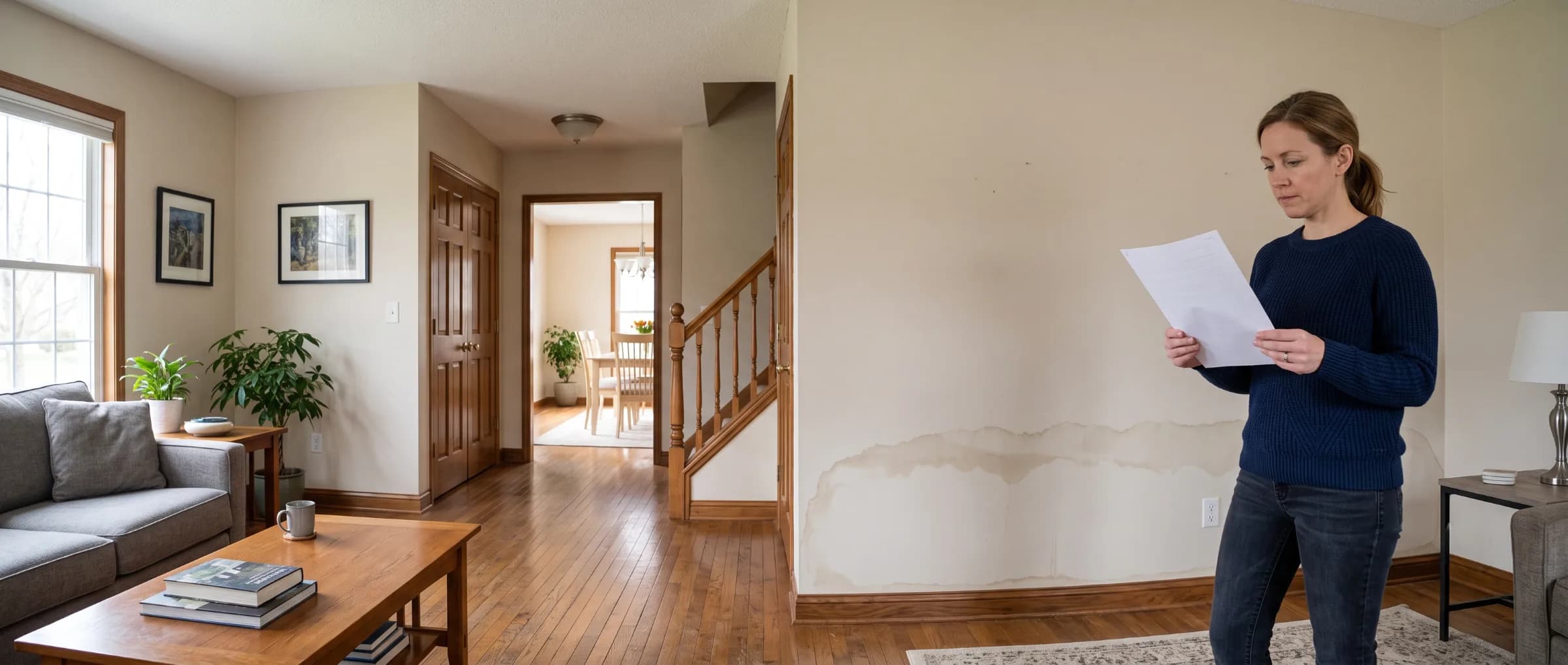
 Gradual damage like this is the leading reason water damage claims get denied, since insurers look for a defined, sudden event rather than staining that built up over weeks or months.
These exclusions typically live under a single water damage clause in the policy rather than being scattered across several sections, so it's worth reading that one clause closely instead of assuming a peril is covered just because it isn't named elsewhere as excluded. Reading that clause before a loss happens, rather than during a claim dispute, is the only reliable way to know which of these exclusions apply to your specific policy and state.
| Excluded cause | Why it's excluded | How to get coverage |
|---|---|---|
| Flooding, storm surge, rising water | Treated as a separate national risk category | Separate NFIP or private flood policy |
| Groundwater seepage through a foundation | Considered a maintenance issue | Foundation and drainage repair, not insurable |
| Sewer or drain backup | Excluded by default | Water backup endorsement |
| Sump pump failure or overflow | Excluded by default | Water backup endorsement |
| Gradual leak or long-term seepage | Considered preventable through upkeep | None; repair promptly and document |
| Wear and tear on pipes or appliances | Considered a maintenance responsibility | None |
| Mold beyond the policy sublimit | Capped regardless of the underlying cause | Separate mold endorsement, where available |
Gradual damage is the single biggest reason a claim gets denied, and it isn't always obvious in the moment. Catching signs of water damage early, before a slow drip turns into months of hidden moisture behind a wall, is often what keeps a loss on the covered side of that line.
Sudden and accidental: the standard insurers use
Sudden and accidental means the water damage happened over a short, defined window, typically minutes to a day or two, rather than building up gradually over weeks or months. Insurers weigh three things when they make that call: how the water entered, how long it likely ran undetected, and whether routine maintenance would have caught it.
A pipe that bursts overnight during a hard freeze is sudden. A supply line that's been weeping behind a cabinet for six months, staining the wood before anyone noticed, is gradual, even though the homeowner genuinely didn't know. Water sitting for more than 24 to 48 hours creates the conditions for mold growth, according to the EPA, which is one reason adjusters scrutinize how long water was present before it was addressed rather than judging strictly by cause. A burst pipe discovered and stopped within hours reads very differently to an insurer than the same burst pipe left running over a long weekend.
Coverage differences for renters and condo owners
Renters and condo owners carry different policies than homeowners, HO-4 for renters and HO-6 for condo owners, and each covers a narrower slice of water damage than a standard homeowners policy. A renters policy covers personal belongings only; the building structure itself is the landlord's responsibility under their own policy. A condo policy typically covers interior finishes, fixtures, and belongings, while the condo association's master policy covers the building shell, roof, and common areas.
Water backup coverage works the same way in both cases and is still worth adding if the unit connects to a shared sewer line. Coordinating repairs between a tenant's insurer, a landlord's policy, and a restoration crew often stretches the timeline well past what a single-owner home sees for how long does water damage restoration take, so confirming who's responsible for which piece before a claim is filed saves time later.
Home warranty vs. homeowners insurance
A home warranty pays to repair or replace a mechanically failed appliance or system, like a worn-out water heater or a washing machine valve, while homeowners insurance pays for the water damage that failure causes to your home and belongings. The two products respond to the same incident in different ways, and confusing them is one of the most common reasons a homeowner files a claim with the wrong company first.
 The tank failing from age falls under a home warranty; the water it releases onto the floor is what a homeowners insurance policy responds to instead.
Skipping a home warranty doesn't leave a homeowner exposed on the water damage side, since a standard insurance policy responds the same way whether or not a warranty exists. What a home warranty actually buys is faster, often no-cost repair or replacement of the failed unit itself, the part insurance was never going to touch in the first place.
| Question | Home warranty | Homeowners insurance |
|---|---|---|
| What it covers | Repairing or replacing the failed appliance or system | Damage to flooring, walls, and belongings the failure caused |
| Example | A water heater rupturing from age | The flooring and drywall the rupture soaked |
| Typical cost | $300 to $600 a year, plus a per-visit service fee | Bundled into your existing homeowners premium |
| What it won't touch | The resulting water damage itself | Normal wear and tear on the appliance or system |
This often means opening two claims for one incident: a service request with the warranty company for the failed unit, and a separate claim with your insurer for the water it released. Keep documentation from both, since a warranty company's repair invoice is often useful evidence for the insurance side of the claim too.
Flood damage and the NFIP
Flood damage is never covered by a standard homeowners policy, regardless of the cause, and requires a separate flood insurance policy through the National Flood Insurance Program or a private flood insurer. FEMA defines a flood as water affecting two or more acres or two or more properties, which is why a single home's basement seepage from heavy rain sometimes gets classified as flooding even when no river or coastline is nearby.
Flood policies through the NFIP carry a standard 30-day waiting period before coverage takes effect, and they cap dwelling coverage at $250,000 with contents coverage capped at $100,000, figures that haven't kept pace with rebuild costs in many markets. Buying a policy the same week a storm is forecast won't help, since the waiting period applies regardless of how imminent the risk looks.
Once a flood claim is approved, the water damage restoration work itself, extraction, drying, and rebuilding, follows the same process as any other loss, even though the insurance policy paying for it is entirely separate. The distinction mainly matters for who you're coordinating with, since the NFIP handles the payout while a restoration company still handles the physical work.
Water backup and sump pump overflow coverage
Water backup coverage is an optional endorsement that pays for damage from sewer and drain backups or a failed sump pump, both of which are excluded from a standard policy by default. It's typically inexpensive relative to the exposure it covers, often $50 to $250 a year for $5,000 to $50,000 in added protection, and it shows up as a separate line item on your declarations page rather than being bundled automatically.
 A sump pump failure like this is excluded from a standard policy by default and only pays out if a water backup endorsement was added beforehand.
Homes with finished basements carry the most exposure here, since a sewer backup or sump failure hits flooring, drywall, and framing all at once. A $2,500 to $18,650 range for water damage restoration cost by room gives a rough sense of how quickly a finished basement loss can exceed a low backup limit, which is worth checking against your policy before you need it rather than after.
How water damage category affects your claim
The water category assigned during inspection, clean, gray, or black water under IICRC S500, affects your claim by determining what materials must be removed and how contamination-related line items get documented, not whether the loss itself is covered. A technician assigns the category during the inspection; your policy's exclusions, not the category itself, decide whether the underlying cause is insured.
Technicians assign a water damage categories rating on the first visit, and insurers frequently ask for that rating in writing, since a Category 3 loss, sewage or contaminated groundwater, often ties directly back to an excluded cause like a sewer backup and triggers stricter documentation requirements before a claim is approved. Getting that rating in writing at the first visit, rather than requesting it later, avoids a documentation gap an adjuster might otherwise flag.
Deductibles and how much you'll actually collect
Your payout equals the covered loss amount minus your deductible, and if you carry actual cash value contents coverage instead of replacement cost, older belongings get paid out at depreciated value rather than what a new replacement would cost today. Standard homeowners deductibles typically run $500 to $2,500, though some states allow a separate percentage-based deductible for named storms that can run higher than a flat dollar amount.
Most replacement cost policies still pay in two installments rather than the full amount up front. The first check reflects actual cash value, the depreciated amount, and the remaining recoverable depreciation is released only after repairs are complete and you've submitted invoices proving the work was done. A smaller-than-expected first payment usually isn't a lowball; it's the first of two payments built into how replacement cost coverage works.
Water backup coverage usually carries its own sublimit and sometimes its own deductible, separate from your main dwelling deductible, so a sewage backup claim can involve two different numbers depending on which coverage responds. Reviewing both figures on your declarations page before a loss happens tells you exactly which deductible applies before you're mid-claim.
A $9,000 sewage backup loss with a $1,000 dwelling deductible and a $5,000 water backup limit shows how these pieces interact: the insurer pays the lesser of the loss after your deductible or the backup sublimit, which caps this claim at $5,000 even though the total damage came to $9,000, leaving the remaining $4,000 as the homeowner's responsibility unless a higher backup limit had been purchased. Raising that limit ahead of time, rather than discovering the gap mid-claim, is usually the cheaper fix in the long run.
Additional living expenses and protective measures coverage
Homeowners insurance typically reimburses additional living expenses, hotel stays, restaurant meals above your normal cost, and pet boarding, up to a limit commonly capped at 12 to 24 months or a percentage of dwelling coverage, when a covered water event makes your home temporarily unlivable. It separately covers the reasonable cost of protective measures taken to keep the damage from getting worse, such as renting fans or tarping a roof.
This coverage is often labeled ALE or loss-of-use on a policy, and protective-measures reimbursement is sometimes called sue and labor coverage, terminology worth recognizing since it doesn't always appear under a plain-English heading. Insurers expect these protective steps taken immediately rather than delayed for approval, so keep receipts for fan rentals, a wet-dry vacuum, or emergency extraction alongside your other claim documentation. Whether to stay in your home or relocate during the job comes down to triggers like lost utilities or a contaminated water category, the same triggers that shape what to expect during water damage restoration once the crew is on site.
How to file a water damage insurance claim
Filing a water damage insurance claim starts with stopping the source and documenting the damage before cleanup begins, then notifying your insurer within the timeframe your policy requires, usually 24 to 72 hours after discovery. Skipping or rushing any step in that sequence is one of the most common reasons a straightforward claim ends up delayed or underpaid.
 Photos taken before any water is removed or materials discarded give an adjuster the clearest picture of the loss and are the single most common gap in denied claims.
The full sequence, from the first call to your insurer through reviewing the settlement, plus what a proof of loss requires and how to handle a denied or disputed payout, is covered in how to file a water damage insurance claim. Start there once you've confirmed the cause is likely covered, since the filing sequence itself is where most delays and denials actually originate.
Documentation your insurer will expect
Insurers expect time-stamped photos and video of the damage before cleanup, a written inventory of affected belongings, moisture readings from the restoration company, and copies of every repair estimate and receipt tied to the loss. Missing any one of these doesn't necessarily sink a claim, but it slows down the adjuster's review and gives them more room to dispute the amount.
 A moisture meter reading paired with dated photos gives an adjuster a defensible record of both the damage and the exact day it was discovered.
What to do if your claim is denied
A denied water damage claim is not final, and most policies include an appraisal clause you can invoke when the dispute is about the dollar amount rather than whether the loss is covered at all. Knowing which kind of dispute you're actually dealing with, coverage versus valuation, determines which option applies first.
 Requesting the specific policy language behind a denial in writing is what separates a real appeal from a follow-up call that goes nowhere.
Disputes over the water damage classes assigned during the estimate, since class drives equipment and labor line items, are common valuation disagreements that go to appraisal rather than a coverage fight. An adjuster who under-classifies the drying difficulty, for example calling a Class 3 loss a Class 2, ends up approving less equipment and fewer monitoring days than the job actually needs.
Whether a dispute like this resolves quickly through appraisal or drags on often comes down to how well the original estimate documented that category and class in writing. Getting it recorded at the first visit, rather than reconstructed later from memory, is what keeps the dispute about the number rather than the paperwork.
Your state's department of insurance, whose consumer guidance NAIC also publishes, accepts complaints against a carrier that mishandled a claim, separate from an ordinary valuation dispute, and filing one costs nothing. It won't force a specific payout, but it creates a formal record of how the insurer handled the claim.
Frequently asked questions
Does homeowners insurance cover water damage from a burst pipe?
Yes, in most cases. A burst or frozen pipe is treated as sudden and accidental water discharge, which is exactly the standard a typical HO-3 policy covers. Coverage can still be denied if the pipe froze because a home was left unheated and unattended without the water shut off.
Is flood damage covered by homeowners insurance?
No, flood damage is not covered by any standard homeowners policy. Rising water, storm surge, and water that affects a broader area beyond your property require a separate policy through the NFIP or a private flood insurer, regardless of how the water entered your home.
Does homeowners insurance cover mold caused by water damage?
Sometimes, but usually with a low dollar cap. If mold grows from a covered water event, most policies still pay for remediation up to a sublimit, commonly $5,000 to $10,000, even when the rest of the claim is paid in full. Mold from an excluded cause, like a slow, undetected leak, typically is not covered at all.
Will filing a water damage claim raise my insurance rates?
Often, yes. A single water damage claim can raise your premium at renewal, and insurers in many states can decline to renew a policy after two or more water-related claims within a few years, which is one reason a small loss under the deductible is sometimes better paid out of pocket.
Does homeowners insurance cover the cost of finding a hidden leak?
Yes, many policies include limited coverage for tear-out, the cost of accessing a hidden leak behind a wall or under a floor, even though they exclude the plumbing repair itself. Check your declarations page for a hidden water damage or access endorsement, since coverage limits vary widely between insurers.
Does homeowners insurance cover water damage to my personal belongings, not just the house?
Yes, personal property coverage pays for damaged belongings, furniture, electronics, and clothing, separately from the dwelling coverage that pays for structural repairs. Whether you're reimbursed at replacement cost or actual cash value depends on which type of personal property coverage you carry.
Do I need water backup coverage if I don't have a sump pump?
Yes, if your home connects to a municipal sewer or septic system. Water backup coverage protects against sewer and drain backups as well as sump pump failure, and a home without a sump pump can still experience a sewer backup during heavy rain or a municipal line blockage.
What happens if I let my homeowners insurance lapse?
Your mortgage lender can buy a replacement policy for you and bill you for it, a practice the CFPB calls force-placed insurance. Force-placed coverage typically costs more than a policy you'd buy yourself, and it often protects only the lender's financial interest in the home rather than your belongings or additional living expenses.
Sam Hickerson is the founder of RestoreAdvisor and writes consumer guides on mold remediation, water damage restoration, inspection, testing, and home recovery. His work focuses on helping homeowners understand costs, risks, and when to call a professional. He draws on guidance from the EPA, CDC, IICRC, and other authoritative sources to make complex home issues easier to navigate.