
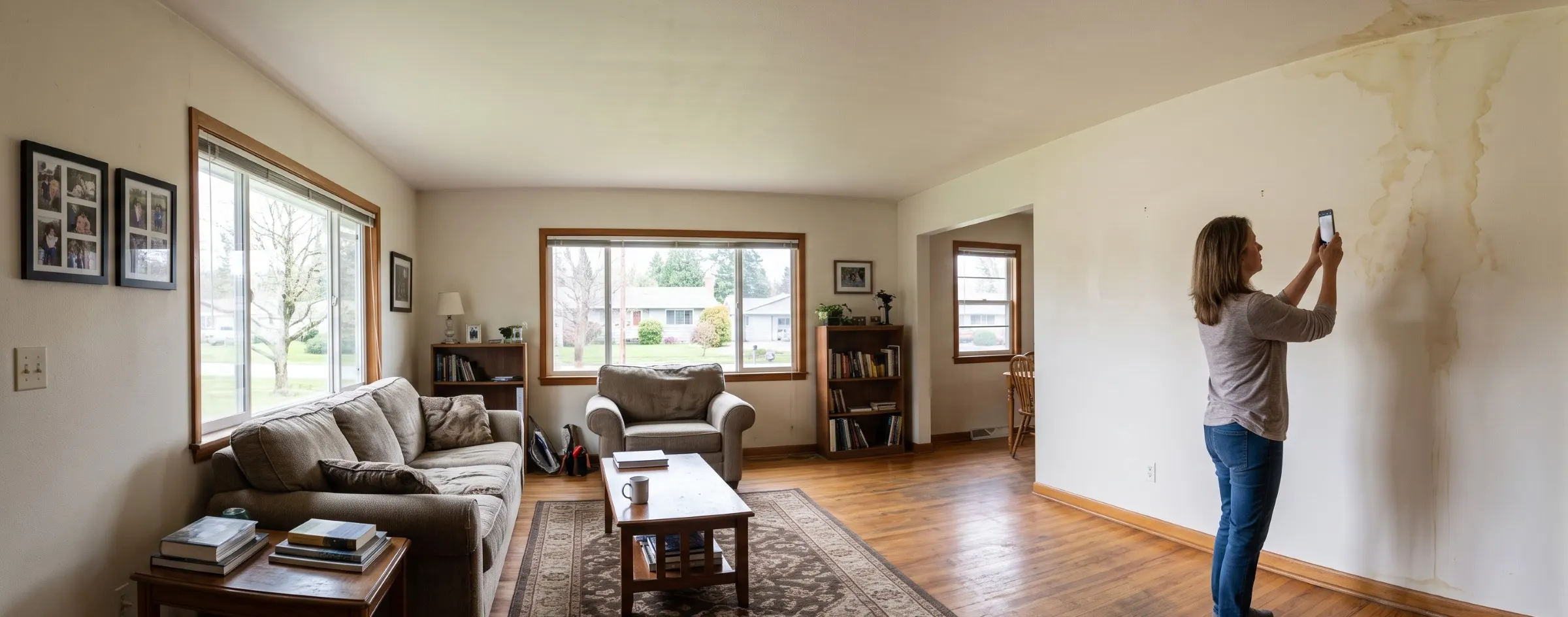

Finding water damage in your home is stressful enough without wondering whether you're capturing what your insurer actually needs to pay the claim in full. Documentation for a water damage claim means working through a checklist of photos, moisture readings, itemized losses, and written records that prove both the cause and the extent of the damage under your policy's terms, and IICRC S500, the industry standard for water damage restoration, treats that written record as part of the job itself rather than an afterthought. Insurers weren't in the room when the pipe let go, so a thin or vague record is one of the most common reasons a legitimate claim gets paid late or paid short.
Key insights
- Photograph the source first. A shot of the corroded fitting or overflowing appliance matters more to an adjuster than a shot of the puddle it created.
- Moisture readings outweigh a description. A logged percentage carries more weight than a note that a wall "felt damp."
- Never discard a damaged item before it's recorded. A photo and a written note come before the trash can, not after.
- Written estimates beat a verbal quote. A phone number scribbled on a napkin won't survive a dispute; an itemized scope of work will.
- A logged call outweighs a remembered one. Write down the date, time, representative's name, and reference number every time you speak with your insurer.
- NFIP flood claims run on a 60-day clock. A sworn proof of loss is due within 60 days of the loss under a standard flood policy.
Why documentation decides your claim
Documentation decides a water damage claim because an adjuster wasn't present when the loss happened and has to reconstruct what occurred from what you hand them. The strength of that record determines three separate things: whether your policy treats the cause as covered at all, how large the loss is calculated to be, and how quickly the payout arrives.
 The printed photo record in front of an adjuster carries more weight than a spoken description of what happened, since a dated image cannot be misremembered later.
An adjuster comparing two identical losses, one with dated photos, a moisture log, and an itemized list, the other with a verbal description and a stack of unsorted receipts, will typically process the first one faster and settle it closer to full value. A sudden-and-accidental standard is what determines whether homeowners insurance covers water damage in the first place, and documentation is simply the evidence that lets an adjuster confirm your loss meets that standard without a lengthy back-and-forth.
Photograph and video correctly
Photographing water damage correctly means capturing the source, the full scope, and a verifiable timestamp before any cleanup begins, since the sequence you follow determines whether an adjuster can reconstruct the loss from your images alone. Skipping straight to close-ups of stained flooring, without the source or a wide shot for context, leaves gaps an adjuster has to fill in with assumptions.
 A photo of the fitting itself, not just the puddle it created, is what tells an adjuster where the water actually originated and which category it falls under.
1. Shoot wide, then close, before you touch anything
Photograph the full room from two or three angles before moving a single item, then move in for close-ups of the specific damage: staining, warping, bubbling paint, or standing water. The wide shots establish context; the close-ups establish detail.
2. Photograph the source, not just the puddle
Get a clear photo of the fitting, appliance, or entry point where the water actually came from. A corroded supply line under a sink, a burst pipe fitting, or a roof penetration tells an adjuster more about cause than any amount of downstream staining does.
3. Put a fixed reference point in the frame
Include a tape measure, a coin, or a doorframe in at least one shot of standing water or a stain, so its size is verifiable later rather than just described in your own words. This single habit resolves more disputes than any other step here.
4. Record one narrated video per affected room
Walk each room slowly with your phone's camera on, saying the room name and what you're seeing out loud as you move. A narrated walkthrough captures spatial relationships, like how far a stain has traveled from its source, that a series of still photos can miss.
5. Photograph again after every stage of cleanup
Take a new set of photos after extraction, after any tear-out, and once drying equipment goes in, so the loss is documented in stages rather than only at the very start. This second and third round of photos is what supports a claim for the mitigation work itself, not just the original damage.
Document the cause, not just the damage
Documenting the cause means capturing evidence of how the water started, not only what it damaged, because coverage almost always turns on cause rather than on the extent of the loss. A sudden supply-line failure and a slow, unnoticed leak can leave nearly identical staining by the time anyone photographs it, and cause is what separates a covered loss from a denied one.
If the source involves a genuine safety hazard, an active spray, exposed wiring, or contaminated water, follow the safety steps on emergency water damage restoration before you get close enough to photograph anything. Once it's safe, document the source itself: the corroded fitting, the failed seal, the point where storm water entered. For a contaminated loss, also note in writing that personal protective equipment was used and by whom, since that detail supports both the category assigned to the water and any related health-and-safety costs on the claim.
Keep a moisture and drying log
A moisture log is a dated record of readings taken at the same points in a structure over the course of drying, and it's the single piece of evidence insurers weigh most heavily when approving equipment days and confirming a job is actually finished. If a restoration company is handling extraction and drying, ask for a copy of their daily log rather than assuming it will be included automatically with the final invoice.
 A single reading only confirms the moment it was taken; three dated entries showing whether the trend is dropping toward dry or still climbing tell an adjuster whether the equipment is working or the source was never actually stopped.
The log matters because water damage categories and the damage class assigned to a loss both come from readings, not appearance. Two rooms that look equally wet on day one can dry at different rates depending on the material involved, and a log that shows readings dropping from 32% to 14% over five days does far more to justify five days of equipment rental than a homeowner's own recollection that "it took about a week."
| Date | Location | Moisture reading | Equipment running |
|---|---|---|---|
| Day 1 | Baseboard, hallway | 34% | Air movers placed, dehumidifier started |
| Day 2 | Baseboard, hallway | 26% | Air movers, dehumidifier |
| Day 4 | Baseboard, hallway | 17% | Dehumidifier only |
| Day 6 | Baseboard, hallway | 12% (dry) | Equipment removed |
A log formatted this way, with a specific location, a numeric reading, and the equipment status on each visit, is what a company following water damage classes conventions should already be producing as part of the job. If you're drying a small area yourself with a rented meter, keep the same format: date, location, reading, and what's running.
Verify your restoration company's file
A complete restoration company file includes a written scope of work, the water category and damage class backed by moisture readings, dated before-and-after photos taken by the crew, and the technician's name and certification. Confirming all four are in your hands before the job closes out is what prevents a gap in your evidence that you'd otherwise have to backfill yourself later. Homeowners hand a lot of the technical side over to whoever is doing the drying and cleanup, but that paperwork doesn't automatically become part of your own claim file unless you ask for a copy.
 A scope of work, category and class assignment, and technician certification should all be in this folder before the job is marked complete, not requested weeks later once the crew has moved on.
A verbal assurance that "everything's documented" from a crew on their way out the door isn't the same as having the file in hand. Request the scope of work, the category and class assignment, the crew's own photos, and the technician's certification before the job is marked complete, not weeks later once the crew has moved on to the next call.
| Document | What it should include | Why it matters |
|---|---|---|
| Written scope of work | Rooms, materials, and tasks itemized line by line | Matches the invoice to what was actually done |
| Category and class assignment | The water category and damage class, with the readings behind each | Supports both coverage and equipment billing |
| Timestamped photos | Before, during, and after shots taken by the crew, not just your own | Corroborates your own photos with an independent record |
| Technician name and certification | Certification type and the company's license number | Confirms the work meets the standard your policy expects |
Asking about this file upfront, before you sign anything, saves you from chasing it down after the fact. Confirming a company routinely provides this kind of documentation is far easier before you hire than after; raising it among the questions to ask a water damage restoration company means one used to insurance work will already have it ready to hand over without being asked twice.
Build an itemized inventory
An itemized inventory is a list of every damaged item with its room, age, estimated value, and supporting proof, and it's what an insurer uses to calculate a contents payout separately from the structural repair estimate. A general statement that "the basement contents were a total loss" invites an adjuster to apply a low, generic estimate; a room-by-room list with values attached does not.
Work through the space methodically rather than trying to remember everything at once. For each item, capture what it was, roughly when you bought it or how old it was, what you'd estimate it cost to replace, and whatever proof you have on hand, a receipt, a bank statement, or simply a photo showing the item in the room before the loss.
| Item | Room | Age / purchased | Estimated value | Proof |
|---|---|---|---|---|
| Sectional sofa | Living room | 3 years | $1,800 | Credit card statement |
| Area rug | Living room | 5 years | $400 | Photo, pre-loss |
| Washer and dryer | Laundry | 8 years | $1,200 | Owner's manual, model number |
| Children's books, misc. | Basement | Varies | $150 | Photo, pre-loss |
High-value items, jewelry, electronics, anything worth more than a few hundred dollars, deserve their own line with a serial number or model number attached whenever one exists. A generic entry like "jewelry, various" invites the same low estimate a vague damage description does.
Save receipts and estimates
Every receipt, written estimate, and repair invoice tied to the loss belongs in a single running file, because an insurer settles a claim against documented costs, not against a number you recall after the fact. This applies to emergency expenses, hotel stays, extra meals, temporary supplies, just as much as it applies to the restoration invoice itself.
Get two to three written, itemized estimates rather than relying on a single verbal quote, and confirm that each one spells out the scope, materials, and labor separately. A detailed written estimate, rather than a flat number over the phone, gives you something concrete to compare against your settlement, which is worth confirming upfront when choosing a water damage restoration company.
If a number on any estimate looks far outside what similar jobs typically run in your area, that gap is worth questioning before you sign anything. A wide spread between two estimates for the same scope of work is usually a documentation problem as much as a pricing one, since the lower bid often leaves out a step the higher one accounts for.
Log calls and emails with your insurer
A communication log is a written record of every call, email, and in-person conversation with your insurer, and it's what turns a disputed "they told me" into a documented fact with a date attached. Insurers keep their own detailed records of every interaction; a homeowner who doesn't do the same is at a real disadvantage if a disagreement comes up later.
 A written note taken during the call, with the date, the representative's name, and a reference number, holds up far better in a dispute than a conversation recalled from memory weeks later.
For every call, write down the date, the time, who you spoke with, and the claim or reference number they gave you before hanging up. Do this right away, not hours later, since details fade fast once you move on to the next task. This habit becomes especially important once you're deep into filing a water damage insurance claim, where the sequence of who said what and when often matters as much as the underlying facts of the damage itself.
Organize and back up your documentation
Organizing your documentation means storing every photo, log, and receipt somewhere you can retrieve it quickly and somewhere a single lost phone or damaged laptop can't wipe it out. A folder system that groups everything by date, with a cloud backup running automatically, solves both problems at once.
Set up one folder per claim, named with the date and a short description, and back it up to cloud storage the same day you take the first photo, not after the fact. This matters most when a deadline is tight: an NFIP flood policy requires a sworn proof of loss within 60 days of the loss, and scrambling to reassemble scattered files against that clock is a self-inflicted problem.
Condo owners have a parallel timing issue worth planning for early, since a water damage in a condo loss often means requesting the association's master policy declarations page before you can even confirm which policy is expected to pay first. That single request can take days to come back, so asking for it the same week the loss happens keeps the rest of your file from stalling behind it.
Common documentation mistakes
The recurring documentation mistakes that hurt a water damage claim almost all come down to timing: waiting to photograph, waiting to notify, or waiting to write something down until the details have already blurred. Each mistake is fixable in the moment it happens, but far harder to fix after the fact.
 Once an item like this is thrown out, its condition, age, and value rest on memory alone; a photo and a written note before it's discarded is what protects that part of the claim.
Discarding damaged items before they're photographed or listed
Once an item is in the trash, its condition, age, and value all rest on memory alone. Photograph and list an item before you throw it out, even if it's obviously ruined.
Waiting days to start documenting instead of the same day
The EPA's guidance on flood cleanup notes that mold-conducive conditions can develop within 24 to 48 hours of a water event, and a delayed documentation start can leave you photographing damage that's already changed in appearance or scope by the time you get to it. Photograph what you can the moment you find it, then go back for cleaner shots once the area is safe to move around in.
Photos with no timestamp, date, or fixed reference point
A photo with no date attached, and nothing in the frame to establish scale, is weaker evidence than one that includes both. Turn on your camera's date stamp and get in the habit of including a reference object in at least one shot per area.
No written moisture log from the restoration company
Verbal assurances that a space is "basically dry" don't substitute for a dated record of actual readings. Ask for the log directly if it isn't offered.
Relying on a remembered phone call instead of a written note
A conversation with an adjuster that isn't written down the same day tends to get remembered differently by both sides weeks later. If a claim ends up disputed, a denied water damage insurance claim is far easier to appeal with a documented call history than without one.
Frequently asked questions
What should I photograph first when I find water damage?
Photograph the earliest visible sign of the source you can find, even if the leak's exact origin isn't obvious yet, and note in writing that the source is still being traced. Adjusters weight a source photo heavily when determining cause and category, so a partial lead is worth capturing before you move anything.
Do I need a moisture log for a water damage claim?
Yes, and if a restoration company hasn't handed you one, ask for it before the crew leaves the final visit, since it's much harder to reconstruct once they've moved on to the next job. Without it, you're left relying on your own memory of how wet things felt, which carries far less weight with an adjuster than dated, numeric readings.
Can I throw away water-damaged items before the adjuster sees them?
No, hold onto damaged items until your adjuster tells you it's fine to discard them, or until you've photographed each one individually with a note on its condition. An exception applies to items that pose an active health or safety risk, such as materials from a sewage backup; photograph those before removal and say so in your claim notes.
How long should I keep water damage documentation?
Keep every photo, receipt, and written record until the claim is fully paid, any repairs are complete, and the statute of limitations for a coverage dispute in your state has passed. Many claims get reopened months later when additional damage surfaces, and a supplemental claim under the same claim number depends on the same original documentation.
Can I submit documentation through my insurer's app?
Yes, most major insurers now accept photos, videos, and documents directly through their claims app or online portal, and doing so timestamps the upload automatically. Submitting through the app or portal creates a record you don't have to rely on your own memory to prove exists, so use it whenever it's available rather than relying on email alone.
Does homeowners insurance require a home inventory?
No policy requires a pre-loss home inventory, but having one dramatically speeds up a contents claim after the fact. The NAIC offers a free home inventory app built specifically for this, and even a room-by-room video shot the day of the loss serves the same purpose after damage has already occurred.
What if I don't have receipts for damaged items?
Bank statements, credit card records, online order histories, and old photos showing the item in your home before the loss can all substitute for a missing receipt. List your best estimate of the purchase date and price for each item and note the source you're relying on, since an estimate backed by a bank statement is far stronger than an unsupported number.
Should I document water damage even if I'm not sure it's covered?
Yes, document it the same way regardless of coverage uncertainty, since the documentation itself is often what determines the coverage decision. A sudden supply-line failure and a slow, unreported leak can look identical by the time an adjuster arrives; your dated photos, moisture readings, and notification timeline are what separate the two.
Do renters need to document water damage differently than homeowners?
Renters document the same way for their own belongings, and a water damage in a rental situation still means sending the landlord written notice, since that's what starts their legal repair clock. A renters insurance policy only covers personal property, so the item-by-item inventory matters even more for a renter than for a homeowner.
How do adjusters use category and class documentation?
Adjusters use the water category, clean, gray, or contaminated, and the damage class to decide what coverage exclusions might apply and what a reasonable scope of repair looks like. A restoration company's written report assigning both, backed by moisture readings, is stronger evidence than a homeowner's own description of how the water looked or smelled.
What's the biggest documentation mistake homeowners make?
Discarding a damaged item before it's photographed is the hardest mistake to undo, since once it's gone there's no way to recreate the record. The other timing mistakes, a late photo, a missing timestamp, an unlogged call, can still be partly corrected days or weeks later; a thrown-out item cannot.
Sam Hickerson is the founder of RestoreAdvisor and writes consumer guides on mold remediation, water damage restoration, inspection, testing, and home recovery. His work focuses on helping homeowners understand costs, risks, and when to call a professional. He draws on guidance from the EPA, CDC, IICRC, and other authoritative sources to make complex home issues easier to navigate.