
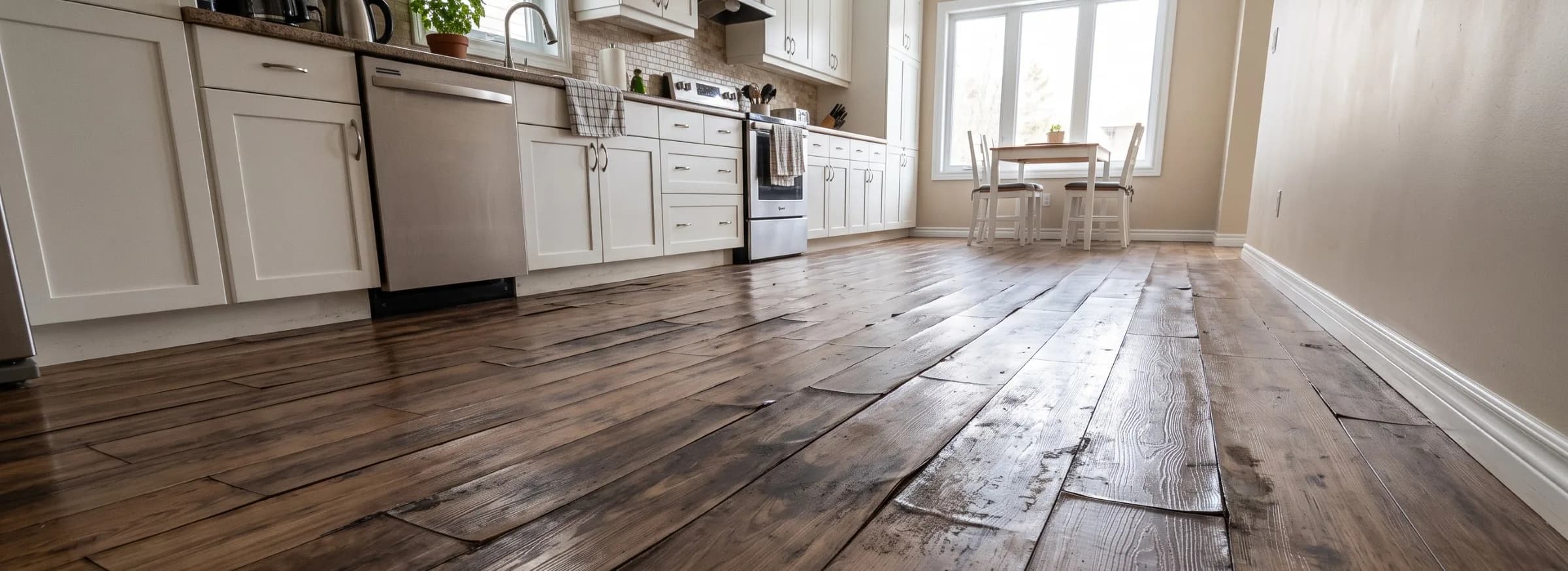

If your laminate floor has started bubbling, lifted at the seams, or gone soft underfoot, how fast you respond determines whether it can be saved or has to be replaced. Laminate flooring is a synthetic floor covering built from a wood-fiber core, typically medium-density or high-density fiberboard, topped with a printed decorative layer and a clear wear layer, and it falls into one of the fastest-failing material categories under the IICRC S500 water damage classification standard because that core absorbs water on contact. A professional water damage restoration company judges whether flooring is worth drying and reinstalling by checking how long the water sat, testing the core for swelling, and confirming the subfloor's moisture level before deciding.
Key insights
- Core damage starts fast. Water can reach the fiberboard core through plank seams in as little as 1 to 2 hours of standing contact.
- Swelling is permanent. Once the core absorbs water and expands, drying the plank does not reverse the damage; it has to be replaced.
- "Water resistant" isn't waterproof. Laminate marketed as water resistant is typically rated for 24 to 48 hours of standing water before the seal fails, not indefinite exposure.
- Small damage stays small. A floating laminate floor can be taken apart from the nearest wall to reach only the damaged boards, without redoing the whole room.
- Subfloor moisture matters more than the surface. New planks installed over a subfloor that's still wet will fail again the same way.
- Repair costs run $150 to $1,500 for a handful of planks; a full-room replacement with subfloor work typically runs $1,500 to $8,000 or more.
Signs of laminate water damage
Water damaged laminate flooring shows up first as bubbling or a raised texture along the seams, followed by lifted or curled edges, discoloration, and a soft or spongy feel underfoot. A musty odor with no visible staining is also common, since water often spreads under the planks before it becomes visible on top.
 A bubbled seam like this means the core has just started absorbing water, and a plank at this stage still has a chance to be saved if it's dried within the first hour or two.
Which sign shows up first depends on where the water entered. A slab leak reaching the subfloor from below, common with basement water damage, tends to announce itself with a musty smell and a soft spot before any visible surface change, while a spill or appliance overflow from above usually shows bubbling at the seams almost right away.
| Sign | What it looks like | What it usually means |
|---|---|---|
| Bubbling or raised texture | A slightly domed or uneven surface along one or more seams | Water has entered the seam and is beginning to swell the core |
| Lifted or curled edges | Plank corners or edges that no longer sit flat | The fiberboard core has absorbed water and expanded unevenly |
| Discoloration or staining | Dark patches, especially near seams or baseboards | Water has been sitting long enough to stain the decorative layer or the core beneath it |
| Soft or spongy feel | The floor gives slightly underfoot in one spot | The core has broken down structurally in that area |
| Musty odor, no visible stain | A damp smell with a dry-looking surface | Water reached the subfloor without visibly affecting the top of the planks |
| Popping or creaking sound | New noise when walking over a previously quiet section | Panels are no longer locked flush, often from swelling at the joint |
A stain that shows up several feet from where a spill actually happened is common with laminate specifically. Water travels sideways along the tongue-and-groove seams faster than it's visible on the surface, so the point where you see damage isn't always the point where the water entered. Checking signs of water damage elsewhere in the home is worth doing if the laminate stain doesn't line up with an obvious spill or leak.
What to do right now
The first hour or two determines whether water damaged laminate flooring can be saved. Stop the water source, cut power to any nearby outlet, remove standing water, check under the nearest edge for subfloor moisture, and start airflow before deciding whether to dry the area in place or start pulling planks.
 Water sitting on a laminate seam for as little as 1 to 2 hours is enough to reach the core, so extraction speed matters more than extraction method.
1. Stop the water source
Shut off the supply valve, appliance, or fixture responsible before doing anything else. Standing water that keeps arriving faster than it can be removed defeats any drying effort.
2. Cut power to nearby outlets if water is standing near them
Water and electricity near a floor-level outlet is a shock hazard, and OSHA's flood response guidance recommends cutting power at the breaker rather than unplugging anything by hand while standing in water.
3. Remove standing water immediately
Use towels, a wet/dry vacuum, or a mop to pull up as much surface water as possible within the first few minutes. The longer water sits on a seam, the more of it works its way into the core.
4. Check under the nearest edge
Lift or gently pry up the baseboard nearest the wet area, or check a nearby plank end if the floor is floating, to see whether water has already reached the subfloor. This tells you whether you're dealing with a surface event or something deeper.
5. Start airflow and document the damage
Set up a fan and, if available, a dehumidifier aimed at the affected area, and photograph the damage before you start moving or removing anything. If the water came from a burst pipe, appliance failure, or another source likely to involve an insurance claim, that documentation matters later.
Skip these steps and you're more likely to end up replacing the floor instead of saving it: running a household vacuum on standing water instead of a wet/dry vacuum, waiting to see if a stain "dries out on its own," or reinstalling the baseboard and calling it done before confirming the subfloor is dry. If the water source was a burst pipe, an active appliance failure, or standing water that keeps spreading, follow the full emergency water damage restoration sequence rather than treating it as a flooring-only problem.
Can laminate flooring be saved?
Water damaged laminate flooring can sometimes be saved if the water is caught within the first hour or two and the core hasn't swollen yet. Once the high-density fiberboard core has visibly bubbled, buckled, or lifted, that damage is permanent and the affected planks need to be replaced rather than dried and reinstalled.
 Once the fiberboard core swells like this, the damage is permanent, and the plank has to be replaced rather than dried and reinstalled.
That wood-fiber core is what makes laminate behave so differently from other flooring after a water event. Unlike solid hardwood, a swollen laminate core can't be sanded down to remove the damage, and unlike vinyl flooring's more water-tolerant polymer core, laminate's core actively absorbs whatever water reaches it. A useful test: press firmly on the affected area with your palm. If it feels solid, the core may still be intact; if it flexes, feels spongy, or you can hear a faint crackling, the core has already broken down and that plank needs to come out.
| Condition | Save or replace |
|---|---|
| Surface wet, no bubbling, dried within 1-2 hours | Often savable with prompt drying |
| Slight edge lift, no soft spots | Monitor closely; may stabilize once dry, but often needs eventual replacement |
| Visible bubbling or buckling | Replace the affected planks |
| Soft, spongy, or cracking underfoot | Replace immediately; core has failed |
| Standing water for 24+ hours | Replace, and check the subfloor underneath |
| Visible mold or persistent musty odor | Replace, and have the subfloor inspected before reinstalling |
Is water resistant laminate waterproof?
No. Even laminate marketed as water resistant or waterproof is rated for limited exposure, not indefinite contact with standing water. Products that pass the NALFA Surface Swell Test, the North American Laminate Flooring Association's ANSI-accredited standard for laminate performance, are typically rated to resist visible swelling for 24 to 48 hours of standing water at the seam before the joint seal is expected to fail.
 The wear layer sheds surface water, but the seam is the weak point where "water resistant" laminate actually fails once the rated exposure window passes.
That rating describes the sealed joint, not the core underneath it. Once water works past the edge treatment, whether because a spill sat longer than the rated window or because the seal was compromised by a scratch or a worn edge, the same wood-fiber core inside a "waterproof" product absorbs water exactly the way standard laminate does. The distinction matters most for buying decisions rather than for damage response: a water-resistant product buys more time to catch and clean up a spill, but it doesn't change how you should respond once water has already been standing for a day or more.
This distinction also affects warranty coverage, which is worth checking before assuming a failed floor is covered. Most laminate manufacturer warranties, including on products marketed as water resistant, explicitly exclude damage caused by standing water, flooding, or an unaddressed leak, since those situations exceed the conditions the product was tested and rated for. A warranty claim is more likely to apply to a manufacturing defect, such as a seam that failed under normal use, than to water damage from a household leak.
Common causes of laminate damage
Laminate flooring is most often damaged by appliance leaks in kitchens and laundry rooms, followed by plumbing failures, roof leaks that travel down through an upper floor, and everyday spills that go unnoticed for too long. Because laminate has almost no tolerance for standing water, even a source that would barely register on tile or vinyl can cause real damage.
 A dishwasher leak often sits against the seams for hours before it's noticed, since the water pools directly at floor level next to the appliance.
Laminate installed directly over a concrete slab without a proper vapor barrier is especially vulnerable to the slower causes on this list, since slab moisture can wick upward into the core independent of any visible leak. A plywood or OSB subfloor over a crawl space is often easier to catch early, since a leak typically stains the crawl space ceiling before it ever reaches the laminate above. That's part of why HVAC condensate overflow and a slow appliance leak are harder to catch early than a burst pipe, which announces itself immediately by comparison.
| Cause | Why it damages laminate | Typical warning |
|---|---|---|
| Dishwasher leak | Water pools directly at floor level next to the appliance, often unnoticed until it reaches the seams | Swelling at planks bordering the kitchen appliance run |
| Washing machine or supply line failure | Larger volume of water than most household leaks, often discovered late | Staining or buckling near the laundry room threshold |
| Refrigerator water line leak | Slow, low-volume leak that can run for weeks before it's noticed | A musty smell near the refrigerator with no obvious stain |
| Burst pipe | Sudden, high-volume water release that can flood an entire room in minutes | Rapid bubbling across a wide area rather than one seam |
| Roof leak | Water travels down through the ceiling and wall cavity before reaching the floor | Staining that appears on the floor near an exterior wall, without an obvious source in the room |
| HVAC condensate overflow | Slow drip near a closet or utility area housing the air handler | Localized swelling confined to one small area over weeks |
| Pet accidents or spills | Small volume, but frequently left unaddressed long enough to reach the seams | Isolated, recurring stain in the same spot |
| Flooding or storm water | Large-volume water intrusion that saturates the entire floor and subfloor | Widespread buckling and lifting across the whole room |
Kitchen sources deserve particular attention since a dishwasher leak can sit against laminate seams for hours before anyone notices standing water on the floor. Appliance leaks in general tend to be the slowest of the group to surface, since the water usually starts hidden underneath or behind the unit rather than spreading across open flooring.
How to repair laminate flooring
Repairing water damaged laminate flooring means removing and replacing the affected planks rather than patching them in place, since a swollen core can't be reversed once it's fully absorbed water. The one exception is a plank caught early, before the core itself has taken on water, where a smaller spot repair can sometimes save it.
 Base molding has to come off first since laminate is a floating floor, giving the planks room to shift as they're worked loose starting from the wall nearest the damage.
Repairing a minor bubble in place
A raised or bubbled edge caught within the first hour or two, before the core has visibly swollen, can sometimes be repaired in place instead of replaced. Inject wood glue or a flooring-grade adhesive underneath the raised section, working it in until it reaches the separating layers, then apply firm, even pressure with a clamp or a heavy weight until the adhesive cures. This only works if the core hasn't already absorbed water and expanded; if the plank still flexes or feels spongy after clamping, or the bubble returns once the weight comes off, the core has already failed and the plank needs to be replaced rather than glued.
Replacing damaged planks
The full replacement process involves confirming the subfloor is dry, disassembling the floating floor back to the damaged section, swapping in matching planks, and reassembling from that point.
1. Confirm the area is fully dry
Use a moisture meter on the exposed subfloor before installing anything new. Most laminate manufacturers expect a wood subfloor reading close to the new planks' acclimated moisture content, while a concrete subfloor should test below roughly 75% to 80% relative humidity, or pass a calcium chloride test, before new flooring goes down. Installing replacement planks over a subfloor that's still holding moisture repeats the same failure within weeks.
2. Remove the base molding
Most laminate is a floating floor, meaning it isn't fastened to the subfloor, so the base molding around the room's perimeter needs to come off first to give the planks room to shift as you work. Older glue-down laminate is less common but does exist; if the planks don't lift freely once the molding is off, the floor is likely glued and will need a different removal approach.
3. Disassemble back to the damaged planks
Most laminate installs left to right using a tongue-and-groove locking system, so lift planks in reverse order, starting from the wall nearest the damage, and label each one with tape so it goes back in the same spot.
4. Cut out an isolated section if needed
If the damaged plank sits in the middle of a large room and pulling up the whole run isn't practical, a circular saw set to the plank's exact thickness can cut and remove just that section, working carefully to avoid scoring the boards on either side.
5. Install matching replacement planks
New planks need to acclimate to the room's humidity and temperature for 48 to 72 hours before installation, the same requirement as the original flooring. Click the replacement into the surrounding boards using the same locking system, tapping gently with a rubber mallet where needed.
6. Reassemble and reinstall the molding
Work back toward the wall in the same order the planks came up, then reinstall the base molding and any transition strips. Check that the new section sits flush with the surrounding floor and that the seams lock tight before calling the repair finished.
If you saved extra planks from the original installation, keep them stored flat in the same room where they'll eventually be used, since laminate finishes can shift slightly with UV exposure over time and a years-old spare may no longer match perfectly. If you don't have spares, contact the original manufacturer or retailer before buying a substitute, since even the same laminate line can vary between production runs.
DIY vs. professional repair
Replacing a small number of laminate planks in an easily accessible area is a reasonable DIY project for someone comfortable with basic tools. Bringing in a flooring specialist or a restoration company makes more sense once the subfloor is involved, the damaged area spans multiple rooms, or the water source was contaminated.
 Professional-grade drying equipment moves far more air across an exposed subfloor than a household fan, which is part of why a restoration company can confirm dryness faster than a DIY setup.
Floor age is also worth weighing before deciding. Laminate installed more than 10 years ago is often a discontinued style, which means sourcing exact-match replacement planks becomes the harder part of the job rather than the physical repair itself, and a flooring specialist with supplier relationships can usually solve that faster than a homeowner searching alone.
| Factor | DIY-appropriate | Call a professional |
|---|---|---|
| Area affected | A few planks in one accessible spot | Multiple rooms, or planks under cabinetry or built-ins |
| Water source | Clean water (Category 1), such as a supply line or appliance | Contaminated water, such as a sewage backup or floodwater |
| Subfloor condition | Dry, confirmed with a moisture meter | Still elevated, or unknown without testing |
| Confirmed dryness | You have a moisture meter and know how to use it | No way to verify moisture content before reinstalling |
| Replacement material | You have matching spare planks | No spares, and matching new stock requires sourcing |
A restoration company brings drying equipment and moisture-verification tools that most homeowners don't have on hand, which matters most when the subfloor itself may have absorbed water. Technicians confirm a subfloor is fully dry as one of the standard steps in what to expect during water damage restoration, a step that's easy to skip when doing the repair yourself. If the water came from a Category 2 or 3 source, gray water from an appliance drain or contaminated water from a sewage backup, professional cleaning and disinfection of the subfloor should happen before any new laminate is installed, regardless of how the repair itself is handled.
Cost to repair or replace laminate
Repairing a small section of water damaged laminate flooring typically costs $150 to $1,500, while a full-room replacement that also involves subfloor drying or repair typically runs $1,500 to $8,000 or more. The biggest cost driver isn't the flooring material itself; it's labor, and whether the subfloor needs attention.
 Premium water-resistant lines run roughly double the per-square-foot cost of standard laminate, a gap that compounds quickly across a full room.
Plank cost itself varies widely by tier, roughly $1 to $5 per square foot for standard laminate versus $3 to $8 for premium water-resistant lines, and that gap compounds quickly across a full room. Disposal of the old flooring and any water-damaged underlayment typically adds a modest flat fee on top of material and labor.
| Scenario | Typical cost | What drives the price |
|---|---|---|
| A few planks, DIY with spare materials | $0-$300 | Materials only, if planks are already on hand |
| A few planks, professional replacement | $150-$1,500 | Labor, sourcing matching planks, disposal |
| Full room, laminate only | $1,000-$4,000 | Square footage, plank cost, labor |
| Full room plus subfloor drying | $2,500-$8,000+ | Extraction and drying equipment, subfloor moisture verification |
| Full room plus subfloor replacement | $4,000-$15,000+ | Damaged plywood or OSB removal and replacement, in addition to new flooring |
Color and pattern matching can also affect the price on a partial repair, since discontinued laminate lines sometimes require refinishing an adjacent section or accepting a visible seam between old and new material. National water damage restoration cost figures break down further by category and class across the whole house.
Material-specific rates in water damage restoration cost per square foot tend to run lower for laminate than for hardwood or tile, since laminate installs faster and needs less specialized labor. That gap is worth checking against any quote that seems unusually high for a laminate-only job.
Does insurance cover laminate damage?
Homeowners insurance typically covers water damaged laminate flooring when the water came from a sudden and accidental event, such as a burst pipe or a failed appliance hose. It typically does not cover damage from a slow leak the homeowner should have caught, normal wear, or flooding, which requires separate flood insurance.
 Photos taken before cleanup begins, along with the date the leak was discovered, are the documentation adjusters weigh most heavily when deciding whether a claim meets the sudden-and-accidental standard.
Insurers evaluate laminate flooring claims the same way they evaluate any other water damage claim, weighing where the water entered, how long it went undetected, and whether reasonable maintenance would have prevented it. A burst pipe or a dishwasher hose that fails without warning generally meets the sudden-and-accidental standard. A slow leak from an aging supply line that's been dripping for months, evidenced by staining that's clearly older than the claim date, is the kind of damage adjusters are more likely to dispute or deny. Documentation matters here: photos taken before cleanup, the date the leak was discovered, and a written repair estimate all support a stronger claim, consistent with NAIC's consumer guidance on homeowners insurance.
Deductibles, documentation requirements, and how actual cash value depreciation applies to older flooring all factor into how homeowners insurance covers water damage, along with the claim-filing process itself. One laminate-specific wrinkle worth knowing: because laminate is relatively inexpensive to replace compared to hardwood, some insurers apply a lower depreciation schedule to it, which can mean a smaller payout on an older floor than you might expect.
Renter or landlord responsibility
In a rental, the landlord is typically responsible for water damaged laminate flooring caused by a plumbing or structural failure, such as a burst pipe or a roof leak, since maintaining those systems falls under the landlord's habitability obligation in most states. A tenant is generally responsible for damage caused by their own negligence, such as an unaddressed spill or a pet accident left standing for days, and for reporting a leak promptly once they notice it.
Reporting timing matters more than most renters expect. A tenant who notices a leak and doesn't tell the landlord right away can end up owing for damage that would have stayed minor if reported immediately, since delayed reporting shifts the reasonable-care burden onto the tenant even when the original cause was the landlord's plumbing. In a condo, a leak that starts in a shared wall or a neighboring unit is usually a master-policy question rather than a personal renters or homeowners policy matter, and the building's HOA or property manager should be looped in alongside any insurance claim.
Preventing laminate water damage
Preventing water damaged laminate flooring means keeping standing liquid off the surface and staying ahead of the appliance and plumbing failures that most commonly cause it. Because laminate has so little tolerance for water once it reaches the seams, prevention matters more here than with almost any other flooring type in the house.
 A 6 mil poly vapor barrier under the underlayment blocks slab moisture from wicking upward into the core, the main reason concrete subfloors need this layer even when there's no visible leak.
Wipe up spills immediately
Any liquid left standing on laminate for more than a few minutes has a chance to work into the seams. This applies to pet accidents and condensation from cold glasses as much as it does to obvious spills.
Check appliance hoses and connections annually
Dishwasher, washing machine, and refrigerator supply lines are the most common sources of laminate water damage in the home. A quick visual check for cracking, bulging, or corrosion at the fittings catches most failures before they happen.
Avoid laminate in consistently wet rooms
Bathrooms, laundry rooms, and below-grade basements put laminate in regular contact with moisture it isn't built to handle. Vinyl flooring tolerates that environment considerably better if you're choosing new flooring for one of these spaces.
Use a moisture barrier underlayment where humidity is a concern
A vapor barrier between the subfloor and the laminate underlayment reduces how much ambient or slab moisture reaches the planks from below, which matters most on concrete subfloors or in humid climates.
Watch for early signs during regular cleaning
Catching a small edge lift or a faint musty smell early, before it spreads to neighboring planks, is what keeps a repair small instead of turning into a full-room replacement.
Whole-house habits matter here too. General water damage prevention steps, like knowing your main shutoff valve location and testing supply lines on a schedule, reduce the odds of the appliance and plumbing failures that account for most laminate flooring claims in the first place.
Frequently asked questions
How long does it take for water to ruin laminate flooring?
As little as 1 to 2 hours of standing contact is enough for water to reach the core through the seams. Visible swelling and edge lifting often show up within 24 hours, and by 48 to 72 hours the damage is usually too advanced to repair. A water heater leak often runs undetected well past these windows, since the leak point isn't always visible right away.
Do I need to replace the whole floor or just a few planks?
Usually just a few planks, since a floating laminate floor can be disassembled from the nearest wall to reach damaged boards without redoing the entire room. A whole-room event like flooding is the exception, since the water typically saturates every plank and the subfloor beneath them at once.
Which sign of water damage should I check first?
Bubbling along the seams and a soft or spongy feel underfoot are the most reliable signs, since both point directly to a core that's already absorbed water. A musty smell without any visible surface change is worth checking too, since it can mean water reached the subfloor before the top of the planks ever showed it.
Is it dangerous to leave water damaged laminate flooring in place?
Yes, if it sits long enough for mold to establish. The EPA and CDC note mold can begin growing within 24 to 48 hours on damp materials that aren't dried out. Beyond the health risk, leaving a swollen section in place also lets moisture keep spreading to neighboring planks and the subfloor underneath.
Can you put new laminate over the same spot where water damage occurred?
Yes, once the subfloor underneath has been confirmed dry with a moisture meter or calcium chloride test. Once the affected planks are pulled up, drying the exposed subfloor tends to go faster than under carpet or hardwood, since there's no padding or finish layer slowing air movement, a comparison detailed further in how long water damage restoration takes.
Is it worth replacing laminate with waterproof vinyl flooring after a leak?
That depends on the room and how often the space sees moisture. Kitchens, laundry rooms, and basements are common places homeowners swap laminate for water damaged vinyl flooring after a leak, since vinyl's core tolerates standing water far better than laminate's wood-fiber core. The same save-or-replace math applies to hardwood, where the core material, not the surface finish, decides whether drying in place is realistic.
Sam Hickerson is the founder of RestoreAdvisor and writes consumer guides on mold remediation, water damage restoration, inspection, testing, and home recovery. His work focuses on helping homeowners understand costs, risks, and when to call a professional. He draws on guidance from the EPA, CDC, IICRC, and other authoritative sources to make complex home issues easier to navigate.