
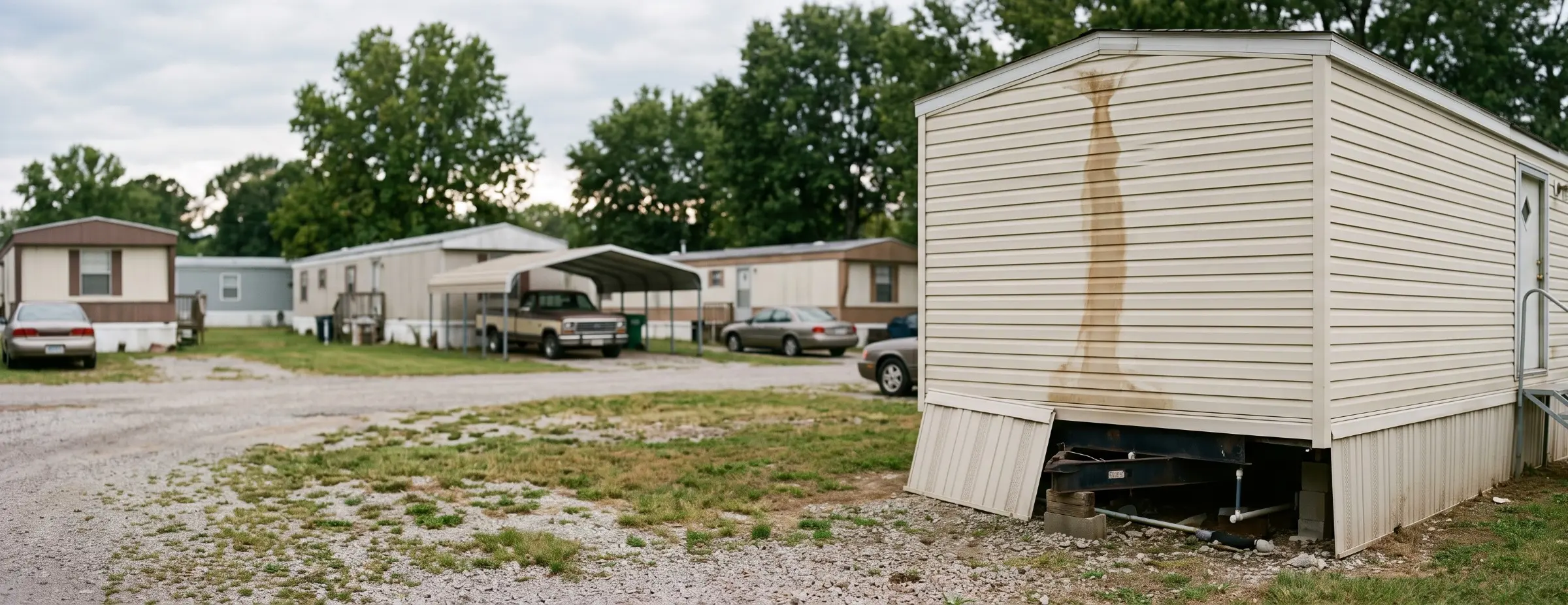

Water pooling under a mobile or manufactured home or seeping along a ceiling seam behaves differently than it does in a site-built house, and the fixes differ too. A leak that would dry out in a day under a conventional floor can instead sit trapped for weeks here.
Water damage in a mobile or manufactured home follows the same IICRC S500 water-category and class system used for any water damage restoration job, but the home itself is built to HUD's federal Manufactured Home Construction and Safety Standards rather than a local building code. Two structural features, the belly board and the marriage line, account for most of what sets a leak here apart from one in a site-built house, and repairs typically run $300 to $15,000 depending on which one is involved.
Key insights
- Two building standards, one date. A home built after June 15, 1976 must meet HUD's federal Manufactured Home Construction and Safety Standards; an older mobile home was built to whatever standard its manufacturer chose.
- The underbelly traps water. A torn belly board seals moisture against the subfloor with no airflow to dry it, unlike an open, vented crawl space under a site-built house.
- Marriage lines are a common hidden source. The seam joining two or more sections in a double-wide or triple-wide home needs a continuous gasket, and a failed one lets water travel along the ceiling and floor at the center of the home.
- Standard homeowners insurance doesn't apply. An HO-3 policy excludes mobile and manufactured homes; coverage comes from a dedicated HO-7 or mobile home policy instead.
- Subfloor material is more vulnerable. Particleboard and OSB, the most common manufactured-home subfloor materials, lose strength faster once wet than the plywood typical in a site-built house.
- Repairs typically run $300 to $15,000. A skirting and belly board fix sits at the low end; a marriage line failure that reaches the subfloor and framing on both sides of the seam pushes it higher.
What makes water damage different
A manufactured home sits on a steel chassis with a sealed, insulated underbelly instead of an open basement or crawl space, so water that gets underneath has far fewer ways to drain or dry out on its own. That single structural difference, more than anything else, is why the same leak plays out differently here than it would in a site-built house.
 HUD's Manufactured Home Construction and Safety Standards require this sealed belly board design, so a leak here has no airflow path to drain or dry the way it would through a foundation wall's vent openings.
The construction date matters for more than terminology. A home built after June 15, 1976 is a manufactured home under HUD's federal Manufactured Home Construction and Safety Standards, a national code covering everything from wall insulation to the plastic belly board wrapping the floor system, regardless of which state the home ships to. A home built before that date is a mobile home in the strict sense, built to whatever standard its manufacturer used at the time, and it typically has thinner insulation and materials that have had decades longer to deteriorate.
Two structural features account for most of that difference: the underbelly, which behaves nothing like an open, vented crawl space, and, in a home built in two or more sections, the marriage line where those sections were joined on site. Each fails in its own way and shows its own set of signs, which is why they're worth treating separately rather than lumping them into one general category of "plumbing issue."
What to do right now
Confirm the water's source before touching anything, since standing water near a breaker panel mounted close to a metal chassis carries a higher shock risk than the same water in a site-built house with more distance between the wiring and the frame. From there, the response follows the same five steps as any active leak, adjusted for a manufactured home's tighter underbelly and skirted perimeter.
 Shut off power from a dry spot rather than reaching across standing water, since a breaker panel mounted close to the home's metal chassis carries a higher shock risk than in a typical house.
1. Cut power at the breaker if it's safe to reach
Many manufactured homes run the main panel close to an exterior wall or inside a utility closet, and a panel sitting near standing water should be shut off from a dry spot rather than approached directly.
2. Stop the water at its source
Shut off the supply valve at the fixture or the main shutoff if the source isn't obvious, and check whether the leak is coming from a supply line, a roof seam, or a window or door seal before assuming it's plumbing.
3. Check the skirting and underbelly
Pull back or open a skirting panel near the leak, since water often pools under the home before it ever shows up as a stain or soft spot inside, and note whether the belly board beneath that spot looks torn or sagging.
4. Photograph the damage, including underneath
Document the interior stain or wet flooring and the underbelly condition separately, since an insurer or adjuster will want to see both.
5. Call for help based on what you find
If water is still actively flooding, or you're not confident it's safe to go under the home yourself, follow the same emergency water damage restoration response used for any active loss and call a restoration company right away rather than waiting to see how bad it gets overnight.
What not to do
Don't assume a dry-feeling floor means the space is fine; a torn belly board can hold standing water against the subfloor for weeks with no visible sign above it. Don't run a household vacuum on standing water, don't repeatedly reset a tripped breaker, and don't seal the skirting back up before the underbelly has had a real chance to dry.
Don't patch a torn belly board with tape before the wet insulation resting on it has actually dried, since sealing damp insulation back in just delays the same problem under a fresh patch. Don't throw out damaged skirting panels or underbelly insulation before photographing them either, since documenting what's underneath is just as useful for an insurance claim as documenting the interior.
Common causes of water damage
Most water damage in a manufactured home traces to one of seven sources, and several of them are specific to how these homes are built rather than to plumbing alone. A site-built house rarely has to account for a roof seam over a structural joint or a belly board tear as a cause at all, since neither exists outside a factory-built home.
 A ridge cap failure over the marriage line is easy to miss from the ground, since the peak sits above eye level and the streak it leaves often gets blamed on the gutter instead.
Marriage line and underbelly failures account for a larger share of that total than they would in a site-built house, since both points are unique to how a factory-built home is assembled and sealed on site rather than ordinary wear on a single fixture. That's why a technician diagnosing a manufactured home checks the seam and the skirting early rather than defaulting straight to the usual suspects of a fixture or appliance.
| Cause | Where it starts | Typical signs |
|---|---|---|
| Marriage line gasket failure | Center seam of a double-wide or triple-wide | Ceiling or floor stain running along the seam |
| Roof seam or ridge cap failure | Roof cap over the marriage line, or a shingle edge | Interior stain that follows the roofline |
| Torn belly board | Underbelly, beneath the floor joists | Musty smell, cold or damp flooring, sagging insulation below the skirting |
| Supply line or fitting failure | Under a sink, behind a washer, or inside the belly | Localized wet cabinet base or a wet spot in the underbelly |
| Window or door seal failure | Window frames and exterior door thresholds | Staining below the sill or along the door frame |
| Water heater failure | Utility closet, often on an exterior wall | Water pooling at the base of the closet |
| Skirting and grading issues | Perimeter of the home at ground level | Water pooling against the skirting after rain |
A water damage from a roof leak at a manufactured home most often starts at the roof cap over the marriage line rather than in the field of the roof itself, since that seam is the joint most exposed to wind-driven rain. Because that seam sits at the peak of the roof rather than on a visible slope, a failed roof cap can go unnoticed from the ground for months.
A water heater leak is more common in a manufactured home than in a comparable site-built house simply because the unit sits in a small, enclosed closet with little room for a drain pan to catch an early failure before it spreads. Window and door seal failure follows a similar pattern of its own, since manufactured-home walls are typically thinner and offer less of a cavity for water to wander through before it stains the interior surface.
The underbelly and belly board
The underbelly is the enclosed space between a manufactured home's floor joists and its steel chassis, sealed on the bottom by a plastic or fiberglass belly board and, in most homes, insulated with fiberglass batts resting directly on that board. Once the belly board tears or a seam pulls loose, water that reaches that cavity has nowhere to drain and no airflow moving through it, so it sits against the subfloor and insulation far longer than the same amount of water would sit in an open, vented crawl space.
 A tear this size lets groundwater and humidity reach the insulation directly, and once it's matted like this, drying alone won't restore it the way it would fluff back out when dry.
According to HUD's own research into moisture problems in manufactured housing, belly board tears were present in every case it documented, tied to the same recurring pattern: a plumbing leak or condensation source feeds water into the belly, the belly board holds it in place instead of letting it drain, and the trapped moisture works its way into the subfloor from below rather than the surface a homeowner would normally check. Manufactured-home subfloor is commonly particleboard or OSB rather than solid plywood, and both materials swell and lose structural strength faster once saturated, which is why a soft or spongy patch of flooring often means the damage has already been sitting for a while.
Leaking supply-air ductwork routed through the belly is a source that's easy to miss, since the moisture never touches a plumbing fixture at all. A duct joint that separates, or a run that sweats heavily in a humid climate, can saturate the surrounding insulation just as thoroughly as a torn belly board letting in groundwater, and it's worth ruling out before assuming a leak has to come from a pipe.
A reading taken from inside the home on top of the flooring rarely tells the whole story, since the surface can register dry while the belly insulation beneath it stays saturated for weeks. The CDC notes that mold colonizes material that stays persistently damp rather than merely wet once, which is exactly the condition a sealed, unventilated underbelly creates. Confirming the underbelly itself is dry, not just the visible floor, is the step a restoration technician should never skip on a manufactured home.
If the subfloor has already softened, that's a water damaged subfloor question of repair versus replacement rather than a simple drying job. A section that gives underfoot rarely recovers just from drying, since the fiber separation behind that softness doesn't reverse once it's set in.
Marriage lines in double-wides
A marriage line is the seam where two or more factory-built sections of a manufactured home are joined on site into one structure, running the full length of the home along the floor, the interior walls, and the roof cap. A double-wide has one marriage line; a triple-wide has two, one between each pair of adjoining sections.
 A stain that runs in a straight line down the seam rather than spreading from one spot usually means the marriage line's roof cap or gasket has failed, not the roof field itself.
The line fails for a handful of predictable reasons: the roof cap covering the seam was installed poorly or has aged past its service life, the home has settled unevenly since it was set, or the gasket sealing the interior seam was never fully compressed when the sections were joined. Because the marriage line runs through the center of the home rather than along an exterior wall, water that gets in there can travel further before it shows up, often appearing first as a ceiling water damage stain that tracks the seam rather than spreading outward from one point, or as buckled flooring running down the center of a room.
A home that has settled out of level is more likely to develop a marriage line problem even if the seam was sealed correctly at installation, since shifting narrows or widens the gap the gasket has to cover. That's a separate repair from patching the seam itself, and it usually calls for a licensed manufactured home installer rather than a general contractor.
Signs of water damage
Several signs point specifically to a manufactured home's own construction rather than to a leak anyone would recognize in any house. A stain that would read as an obvious roof leak in a site-built house can just as easily trace back to a marriage line seam here, so the same visual cue points to a different cause.
 A stain that runs straight down a seam, rather than spreading outward from one spot, is the sign specific to a manufactured home's marriage line rather than a typical roof or plumbing leak.
Most of these signs surface away from the water's actual source, since the underbelly and the marriage line both hide a leak from view until it has already traveled some distance. That lag is why a homeowner often notices a musty smell or a soft spot weeks after the failure actually started, rather than catching it the moment it begins.
| Sign | What it usually means |
|---|---|
| Musty smell with no visible stain | Water trapped in the underbelly against a torn belly board |
| Cold or damp flooring in one area | Wet insulation directly beneath that section of subfloor |
| Ceiling or floor stain running down the center of the home | Marriage line seam failure |
| Sagging or torn insulation visible below the skirting | Belly board tear letting insulation drop |
| Buckled vinyl or linoleum near an exterior wall | Window, door, or wall seal failure |
| Rising water bill with no obvious leak | Supply line leaking inside the belly, out of sight |
A stain or soft spot near an exterior wall or a window is usually easier to diagnose than one running down the center of the home, since the marriage line and underbelly both hide the source from direct view. General signs of water damage that apply to any home, discoloration, a rising water bill, warped flooring, still apply here; the difference is where to check first once you notice one.
DIY versus professional cleanup
A small, contained spill from a supply line or an appliance that you catch and dry within a day is usually within reach for a homeowner comfortable pulling back skirting and running a fan. The comfort level needed is no different than for the same spill in a site-built house; the only real change is that reaching the underside of the floor means working under the home rather than in an open basement.
 Consumer equipment like this can dry a small, contained spill within a day, but it has no way to reach or verify dryness inside a sealed underbelly the way commercial drying equipment does.
Anything involving the marriage line, a torn belly board over more than a small area, or a subfloor that already feels soft is past the point where DIY water damage cleanup techniques for a typical house apply cleanly, since accessing and drying an underbelly correctly takes equipment and know-how most homeowners don't have on hand. Commercial-grade air movers and a moisture meter rated for subfloor readings aren't something most people keep in the garage, and guessing at dryness by touch alone tends to leave a damp pocket behind.
| Factor | DIY-appropriate | Call a professional |
|---|---|---|
| Location | Interior surface, caught within 24 hours | Underbelly, marriage line, or subfloor |
| Water category | Category 1 clean water | Category 2 or 3, or source unknown |
| Area affected | One small, contained spot | Multiple rooms or the full underbelly |
| Structural signs | None | Soft flooring, sagging, or visible framing damage |
Who to call
A manufactured home water event usually needs two different specialists rather than one. A licensed manufactured home installer handles marriage line repair, releveling, and roof cap replacement, work that a general water damage contractor typically isn't trained to do on this specific type of structure, while a restoration company handles extraction, drying, and any contaminated water.
When choosing a water damage restoration company, ask directly whether the technicians have worked on manufactured or mobile homes before, since underbelly access and drying technique differ enough from a site-built crawl space that experience matters. Certification, a written scope, and insurance verification matter here just as they would for any home, with one addition: confirm who is responsible for the underbelly and skirting portion of the job versus the interior.
Cost of cleanup and repair
Cleanup and repair for a mobile or manufactured home typically costs $300 to $15,000, and the total usually depends more on whether the marriage line or underbelly is involved than on the home's overall square footage. Two homes of the same size can land at opposite ends of that range depending on whether the damage stays contained to one room or reaches the seam running through the center of the house.
 Two quotes for the same job can land far apart when one company has priced underbelly and skirting labor before, and the other is estimating it the way it would price an open-room repair.
A single-wide's smaller footprint often keeps costs lower than a comparable site-built house for a similar leak, but specialized underbelly access work can offset that savings. Pulling and replacing skirting panels, working in a confined underbelly, and sourcing belly board material are line items a site-built repair estimate never has to account for at all.
| Scenario | Typical cost | Notes |
|---|---|---|
| Belly board patch and skirting repair | $300–$1,200 | No interior water intrusion |
| Interior extraction and drying, one room | $500–$2,500 | Category 1 water, caught early |
| Marriage line reseal and roof cap | $800–$4,000 | Installer labor plus restoration drying |
| Subfloor replacement, one section | $1,500–$6,000 | Particleboard or OSB removal and replacement |
| Extensive marriage line and structural repair | $6,000–$15,000+ | Framing, subfloor, and both sections affected |
Typical water damage restoration cost figures for a site-built house don't map cleanly onto a manufactured home, since labor for underbelly and marriage line work is priced differently than drywall or carpet replacement in an open room, and not every restoration company quotes it the same way. Getting two quotes from companies that have actually worked underneath a manufactured home before is the more reliable way to sanity-check a number before signing.
Can flooding float a mobile home
Yes, an inadequately anchored manufactured home can float, collapse, or shift laterally during a flooding event, a risk a site-built house on a poured foundation doesn't share. Local flood ordinances typically require a home in a mapped flood zone to be anchored to a permanent foundation system and elevated so its lowest floor sits at or above the base flood elevation.
 A home that shifts off its piers like this is usually treated as a total loss rather than a repair job, since the frame, marriage line, and utility connections rarely survive the movement intact.
Anchoring relies on ground anchors, helical, concrete, or cross-drive types, connected to the home's frame with ties rated for the local wind and flood load requirements, and a design professional typically signs off on the anchor depth and soil conditions before installation. A home that shifts off its anchors during a flood is usually treated as a total loss rather than a repair job, since the frame, marriage line, and utility connections rarely survive the movement intact.
Whether that kind of damage is covered depends on which policy responds. A flood insurance policy for a manufactured home, through the National Flood Insurance Program, can cover structural loss from flooding itself, including a home that floated or shifted off its foundation, while a standard HO-7 mobile home policy typically excludes flood as a cause entirely.
How a mobile home policy differs
Standard homeowners insurance, an HO-3 policy, does not cover a mobile or manufactured home at all. Coverage instead comes from a dedicated HO-7 policy or a separate mobile home form, and both typically settle the dwelling at actual cash value rather than replacement cost unless the policyholder pays for an upgrade, according to the National Association of Insurance Commissioners' consumer guidance on home insurance.
That distinction matters for a water damage claim in two ways. First, how homeowners insurance covers water damage under a sudden-and-accidental standard is similar in principle across HO-3 and HO-7 policies, but the mobile home form often applies stricter age and maintenance conditions before it pays out, and older, pre-1976 homes can be harder to insure or carry fewer carrier options in the first place. Second, whether the home is titled as real property or personal property, chattel, changes which policy applies and sometimes which department handles the claim, so confirming the home's titling status before filing is worth doing early rather than assuming it matches a neighbor's setup.
If you rent the lot your home sits on
Owning a manufactured home while renting the lot it sits on is common in land-lease communities, and that split ownership doesn't change who's responsible for water damage to the home itself. The homeowner still owns, insures, and maintains the structure and its underbelly; the community typically owns the lot, the utility hookups up to the home's connection point, and shared drainage.
A leak traced to a community-owned water or sewer line feeding the home is usually the park's responsibility to fix, though the resulting damage inside the home may still fall to the homeowner's own policy to cover. That's a different situation from someone who rents the home itself rather than owning it and leasing the land, where water damage in a rental tenant-and-landlord rules apply instead.
Risk after moving or buying used
A manufactured home is at its highest risk for belly board and marriage line damage right after it's transported and set up, since the move itself can tear the underbelly and the marriage line hasn't yet proven itself through a full season of settling. That risk carries forward into buying a used home, where damage from a move years earlier can still be sitting unrepaired underneath.
A pre-purchase walkthrough that only covers the interior misses this entirely, since a torn belly board or a poorly sealed marriage line rarely shows up as a stain until well after closing. The same due diligence worth doing when buying any house with a water damage history applies here, with the belly wrap and marriage line added to the list of things to check before signing.
Preventing water damage
Most manufactured-home water damage traces back to a handful of maintenance items that don't get checked as often as they should, largely because they sit out of sight under the skirting or behind a roof cap. None of them require specialized tools, just checking places a typical maintenance routine tends to skip.
 A yearly check like this catches a torn belly board or a pest entry point before either one turns into a hidden water or moisture problem no one notices from inside.
Inspect the belly board and skirting once a year
Pull back a section of skirting and check for tears, sagging insulation, or signs of pest entry, since a small tear left alone eventually lets water and rodents both in.
Check the marriage line seal after any releveling
A home that gets releveled or has settled noticeably should have its marriage line seal and roof cap inspected afterward, since shifting can open a gap that was previously tight.
Keep the roof cap and skylight seals on a maintenance schedule
The seam over the marriage line and any skylight or roof penetration ages faster than the rest of the roof and typically needs resealing well before the roofing material itself.
Confirm skirting vents are clear and grading slopes away from the home
Blocked vents trap moisture in the underbelly, and ground sloping toward the skirting sends rainwater exactly where it shouldn't go.
Add a drain pan under the water heater closet
A small leak inside a tight utility closet has almost nowhere to go but the floor, and a pan with a drain line buys time to catch it before it reaches the subfloor.
General water damage prevention habits, checking supply lines, watching the water bill, keeping gutters clear, still apply to a manufactured home. Skirting, belly board, and marriage line checks are the additional items this kind of structure needs that a site-built house never does.
Frequently asked questions
Is a mobile home the same thing as a manufactured home?
No, though the terms get used interchangeably. A manufactured home is one built after June 15, 1976, to HUD's federal Manufactured Home Construction and Safety Standards. A mobile home, in the strict sense, was built before that date to whatever standard its manufacturer chose at the time.
How do I know if my mobile home's belly board is torn?
Look for insulation hanging below the skirting line, a musty smell rising from the floor vents, or a section of flooring that feels cold and damp compared to the rest of the home. Pulling back the skirting near the suspect area and shining a flashlight at the belly board is the most direct way to confirm a tear.
Can water damage under a mobile home cause the floor to collapse?
Yes, if it goes untreated long enough. Particleboard and OSB subfloor, the materials most common in manufactured homes, lose structural strength as they absorb water, and a soft spot that starts as a slight give underfoot can progress to a hole under sustained weight.
Does homeowners insurance cover a mobile home?
No, a standard HO-3 homeowners policy does not cover a mobile or manufactured home. Coverage instead comes from a dedicated HO-7 policy or a mobile home form, and that policy typically settles the dwelling at actual cash value rather than replacement cost by default.
How much does it cost to fix water damage in a mobile home?
Most jobs run $300 to $15,000. A skirting and belly board repair with no structural involvement sits at the low end, while a marriage line failure that has reached the subfloor and wall framing on both sides of the seam pushes toward the higher end.
Can a torn belly board be repaired without removing the skirting?
No, not properly. The belly board sits above the skirting and below the floor joists, so a technician needs to pull back or remove sections of skirting to reach it, patch or replace the torn material, and confirm the insulation above it is dry before closing the space back up.
How long does mold take to grow after water damage in a mobile home?
Mold can begin colonizing damp material within 24 to 48 hours under the right conditions, the same window the EPA cites for any structure. A sealed underbelly with no airflow often stays wet longer than that, which is why a torn belly board left unrepaired is a common source of a musty smell with no visible stain inside the home.
Is a marriage line leak covered by insurance?
It depends on the cause. A sudden failure, such as a roof cap that tears loose in a storm, is typically treated the same as any other sudden and accidental loss. A marriage line that has been seeping slowly for months due to a gasket that was never properly sealed is more likely to be treated as a maintenance issue and denied.
Who do I call first, a plumber or a restoration company?
Call both around the same time rather than waiting for one to finish before contacting the other. The plumber or manufactured home installer stops the source and repairs the marriage line, roof cap, or supply line, while the restoration company handles extraction and drying, and the two jobs run on different timelines. The same questions to ask a water damage restoration company that apply to any home still apply when you're deciding which one to hire.
Can I stay in my mobile home while it dries out?
Usually, yes, if the damage is confined to one room or the underbelly and the electrical system in the affected area has been checked. A whole-home marriage line failure, a compromised subfloor near a load-bearing wall, or contaminated water from a sewage backup are the situations most likely to require staying elsewhere until the job is farther along, and keeping a written record of the damage and drying progress still applies whether or not you leave.
Does the age of my mobile home affect whether I can get insurance?
Yes. Homes built before the 1976 HUD code are harder to insure and have fewer carrier options, since insurers weigh construction standards, wiring, and plumbing materials that predate any federal requirement. A home's HUD tag, the certification label applied at the factory, is often the first thing an insurer or adjuster asks to see.
What's the difference between a single-wide and double-wide when it comes to water damage risk?
A single-wide has no marriage line, since it ships and sets as one complete section, so its main water damage risks are the roof, windows, plumbing, and underbelly. A double-wide or triple-wide adds the seam between sections as an additional point of failure that a single-wide never has to deal with.
Sam Hickerson is the founder of RestoreAdvisor and writes consumer guides on mold remediation, water damage restoration, inspection, testing, and home recovery. His work focuses on helping homeowners understand costs, risks, and when to call a professional. He draws on guidance from the EPA, CDC, IICRC, and other authoritative sources to make complex home issues easier to navigate.