
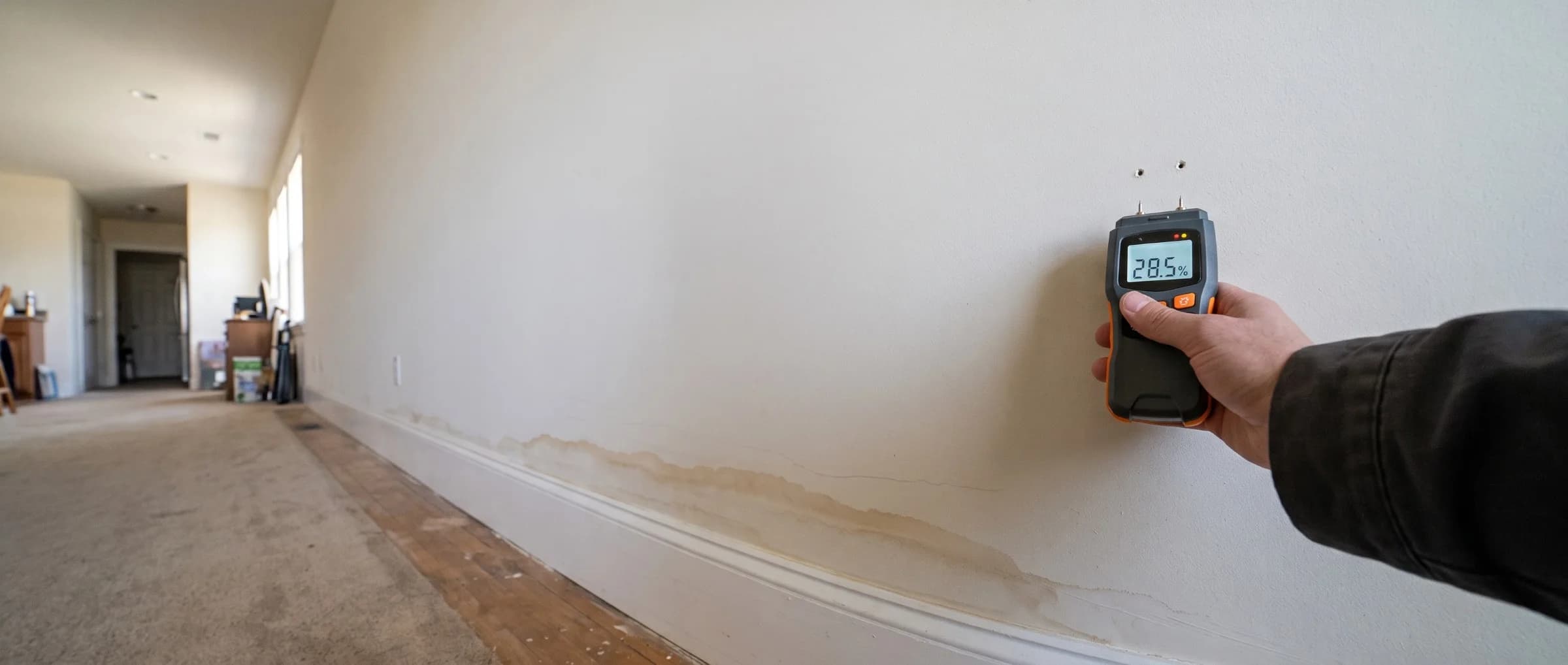

You've got a moisture reading in front of you, maybe from your own meter, maybe from a line on a contractor's estimate, and no way to tell whether it's normal or a real problem. Where that number falls in a water damage restoration job depends on the material, the meter that produced it, and what a dry section of your own home reads right now, and once you know those three things, the number stops being a mystery.
A moisture meter reading is a measurement of how much water a material is holding, expressed as a percentage of the material's dry weight for wood-based products or as a relative scale for materials like drywall and concrete. The IICRC S500 standard governing water damage restoration requires every reading to be judged against an unaffected reference point in the same structure, not against a single fixed number that applies to every home.
Key insights
- Dry is relative, not fixed. IICRC S500 requires comparing a reading against an unaffected reference point in the same material, not a universal cutoff.
- Wood framing. Readings of 7 percent to 12 percent are typical for dry softwood framing; readings above 17 percent to 20 percent signal active moisture and a risk of decay.
- Drywall. Dry gypsum board typically reads under 1 percent moisture content; a reading above that on the same wall as a dry section points to water intrusion.
- Concrete needs a different test. A handheld meter only screens the top few inches of a slab; confirming a slab is dry enough for flooring requires an in-situ relative humidity probe, not a surface reading.
- Pin and pinless serve different jobs. Pinless meters scan large areas quickly without marking the surface; pin meters confirm the exact percentage and depth at a specific spot.
- One reading doesn't confirm a room is dry. Restoration companies take daily readings throughout drying and close out a job only once several consecutive readings match the dry baseline.
What a moisture meter reading measures
A moisture meter reading is an estimate of how much water is present in a material, and it isn't the same number system across every surface in a house. Wood-based products use a moisture content scale that's close to a true percentage, while drywall, plaster, and concrete are read on a relative scale calibrated to that specific meter, which is why a "20" on a wood setting and a "20" on a non-wood setting for the same wall don't represent the same amount of water at all.
 At 18.4 percent, this stud sits well into the elevated range for framing lumber, above the 7 to 12 percent baseline for dry wood.
A 12 percent reading on a wood setting means the wood is holding roughly 12 percent of its own dry weight in water. Readings for drywall, concrete, and other non-wood materials come from a manufacturer's reference scale rather than a literal percentage of water content, which is why the same section of drywall can register "0.4" on one meter and "12" on another and both numbers can be correct on their own scale. The reading only becomes useful once you know which scale produced it and what a dry section of that same material reads on that same meter.
Normal moisture readings by material
Normal moisture readings vary widely by material, and no single percentage applies to a whole house, since a level that's perfectly dry in framing lumber would be alarming in a sheet of drywall. Meter brand and calibration add another layer of variation on top of the material itself, which is one more reason a reading only means something once it's checked against your own home's dry baseline in that same material.
 At 18.5 percent, this floor sits above the 6 to 9 percent range the National Wood Flooring Association sets as the equilibrium target for hardwood.
Carpet and pad behave differently from a rigid material like drywall or wood because water spreads through them by wicking rather than staying where it lands, so a technician checks moisture at several points across a room rather than relying on one spot. A concrete slab carries its own caveat no matter what a handheld meter shows: the reading only reflects the top few inches, so a slab can read dry at the surface while still holding meaningful moisture deeper down.
| Material | Normal / dry | Elevated | Wet / saturated |
|---|---|---|---|
| Softwood framing (studs, joists) | 7%–12% | 15%–17% | 20%+ |
| Drywall (gypsum board) | Under 1% | 1%–4% | 4%+ |
| Carpet and pad | Uniform, low, no pooling | Uneven across the same room | Squishes underfoot, readings climb sharply |
| Plywood or OSB subfloor | 7%–12% | 15%–18% | 20%+ |
| Plaster (older homes) | Under 1% | 1%–3% | 3%+ |
| Concrete slab (surface scan) | Low and even | Uneven, higher near a source | High, visible dampness |
These ranges assume the material is otherwise sound and the meter was set to the correct calibration. A reading that falls outside them is a starting point, not a verdict; it's the signal that tells you where to check next against your home's own dry baseline.
How pros establish a dry baseline
A single moisture reading tells you almost nothing on its own; what it means depends on how it compares to an unaffected section of the same material in the same home. IICRC S500 requires technicians to take a reference reading from a dry area, the same type of wood, the same wall assembly, the same flooring, before judging whether the reading in the damaged area is actually elevated.
This matters because normal moisture content shifts with climate, season, and a home's own construction. A house in a humid coastal region might have a dry baseline of 12 percent on wood framing, while a house in a dry inland climate might run a baseline of 7 percent on the same species and cut of lumber. The same shift also happens across seasons within a single home: framing that reads 7 percent in a dry winter with the heat running can climb to 10 or 11 percent by a humid summer with no leak involved at any point. A number that would be alarming in one home, or one season, is completely ordinary in another, which is why a technician's drying log always lists the reference reading alongside every affected-area reading instead of comparing the affected reading to a chart alone.
Wood moisture readings explained
Wood moisture readings run higher than most other building materials because wood naturally holds more water even when dry, and healthy framing lumber typically settles between 7 percent and 12 percent depending on species and local humidity. Readings climb into the 15 percent to 17 percent range once wood has picked up moisture from a leak or sustained high humidity, and past 20 percent the wood is holding enough water to support decay fungi and, given time, structural softening.
 Cupping like this typically shows up once a board's moisture content climbs several points above the floor's dry baseline, well before a reading would register as fully saturated.
Different wood products behave differently under the same amount of water. Solid hardwood swells and cups at a lower moisture level than framing lumber does, which is why a water damaged hardwood floor can show visible cupping at a reading a stud would tolerate without any visible change. A plywood or OSB subfloor sits in between the two: it tolerates more moisture than finish flooring before it delaminates or swells at the edges, but less than solid framing lumber before it loses stiffness underfoot.
Solid hardwood flooring has its own recognized target: the National Wood Flooring Association publishes an equilibrium moisture content range of 6 percent to 9 percent for most U.S. climates, tighter than the 7 percent to 12 percent range used for framing lumber. A hardwood floor holding moisture outside that narrower range is prone to gapping in dry seasons or cupping in wet ones, even before any water event occurs.
Drywall moisture readings explained
Drywall moisture readings stay much lower than wood readings because gypsum board's paper-and-gypsum core doesn't hold water the way wood fibers do, and dry drywall typically reads under 1 percent on a non-wood setting. A reading above that on the same wall as a section that reads under 1 percent points to active or recent water intrusion rather than normal background humidity.
Drywall also responds to water faster than framing lumber, absorbing moisture through its paper face within minutes of contact and losing structural integrity well before a comparable piece of wood would show any change. That's part of why a water damaged drywall section that stays elevated for more than a day or two, even without visible staining, is usually treated as a sign the cavity behind it needs to be opened up rather than something to wait out.
Concrete and slab moisture readings
A handheld moisture meter can screen a concrete slab's surface, but it can't confirm whether the slab is actually dry enough for new flooring, and that distinction matters most in a below-grade room. Surface meters only read the top few inches of concrete, so a slab that reads dry at the surface can still be holding significant moisture several inches down, particularly in a basement slab poured directly over soil.
 An 88 percent RH reading sits above the roughly 75 to 80 percent threshold most flooring manufacturers require, a depth check a handheld surface meter alone cannot confirm.
Confirming a slab is dry enough for a moisture-sensitive flooring installation requires an in-situ relative humidity probe drilled into the slab, a method covered under ASTM F2170 rather than a surface scan. A restoration crew will still use a handheld meter to screen a slab for obvious moisture and decide whether drying equipment needs to keep running, but a flooring installer relying only on a surface reading before gluing down new flooring is skipping a step the concrete-drying standard calls for.
Category and class impact
A moisture reading feeds directly into two systems that determine how a loss gets handled: how contaminated the water is, and how much material absorbed it. The first is water damage categories, a classification set by the water's source rather than anything a meter measures.
The second is water damage class, and this is where the reading actually does the work: class is defined by the percentage of the affected area's floor, wall, and ceiling materials that tested wet. Neither system is set by the moisture reading alone, but a technician uses the reading as the evidence for assigning water damage classes once the numbers are in.
A room where only a small section of one wall reads elevated is a lighter class than a room where framing, subfloor, and multiple wall cavities all read elevated across a wide area, even if both started from the same size leak. This is also why two rooms damaged by the same burst pipe can end up on different drying timelines: the moisture readings, not the visible damage, determine how much material has to come out and how long the equipment needs to run.
Moisture content vs. relative humidity
Moisture content and relative humidity measure two different things, and mixing them up is one of the most common points of confusion in a water damage conversation. Moisture content, the number a moisture meter reports, is how much water sits inside a specific material. Relative humidity is a separate measurement entirely: how much water vapor is in the surrounding air, read with a hygrometer rather than a moisture meter.
The two are related but not interchangeable. A room can have air quality within the range the CDC associates with limiting mold growth, generally under 50 percent relative humidity, while a specific wall or floor in that same room still tests wet on a moisture meter, because the water is trapped inside the material rather than evaporating into the air. A hygrometer tells you whether the room's air itself is a mold risk; whether a specific wall or floor still needs to dry is a different question, and only the moisture meter answers it.
Pin vs. pinless moisture meters
Pin meters and pinless meters measure moisture differently, and a restoration crew typically carries both because each answers a different question. A pin meter pushes two small electrodes into the material and reads the electrical resistance between them, giving a precise number at an exact depth and spot. A pinless meter holds a flat sensor pad against the surface and reads electromagnetic signals to scan a wider area without breaking the surface, which makes it faster for finding the edge of a wet area but less precise about the exact percentage at any single point.
 A pin meter confirms an exact percentage and depth; a pinless meter scans a wider area but can't confirm how deep the moisture actually sits.
The two also differ in how deep they read. A pin meter's electrodes only reach as deep as they're pushed, typically a quarter inch to three quarters of an inch depending on the model, while a pinless meter reads an averaged value across its scan depth, commonly three quarters of an inch to one and a half inches beneath the surface. That gap is why a technician checking a wall cavity behind drywall often takes both readings at the same spot rather than trusting either meter on its own.
| Meter type | Best for | Trade-off |
|---|---|---|
| Pin | Confirming an exact percentage and depth; documented readings for a drying file | Leaves small marks; slower over large areas |
| Pinless | Screening large walls or floors quickly to find where the water traveled | Less precise at a single point; can't confirm depth |
Most water extraction and drying jobs start with a pinless scan to map how far the water spread, then switch to a pin meter to confirm the depth and severity at the worst spots and to log the exact numbers that go into a drying file. If you're checking your own home with a basic consumer meter, a pinless model is usually the easier starting point since it doesn't leave holes in finished surfaces, though it still needs to be set to the right material to give you a useful number.
Moisture meter vs. thermal camera
A thermal imaging camera and a moisture meter answer different questions, and neither one replaces the other. A thermal camera shows temperature differences across a surface, which can reveal a pattern consistent with trapped moisture, while a moisture meter is the tool that actually measures whether water is present and how much.
 A cooler patch like this only shows evaporative cooling is happening; confirming it's actually water, not a missing patch of insulation, still requires a moisture meter reading at the same spot.
A wet section of drywall often reads cooler on a thermal camera because evaporation pulls heat from the surface, so a technician scans a wall with the camera to find that pattern quickly, then confirms the finding with a moisture meter at the exact spot. The camera can also be fooled by a missing patch of insulation, an air draft, or a difference in paint color, none of which involve water, which is why a cool spot on a thermal image is a lead worth checking, not confirmation that water is actually there.
What throws off a moisture reading
Several common conditions can produce a reading that looks elevated even when the material isn't actually wet, and ruling these out before assuming a leak is active saves an unnecessary tear-out. Each one tends to spike a reading in one exact spot rather than across a wider pattern, which is usually the quickest way to tell a false positive from a leak that's genuinely spreading.
 Metal in the material, not water, is what drives a reading like this; moving the meter a few inches over and rechecking is the fastest way to confirm it.
Metal in the material
Screws, nails, foil-backed insulation, and metal corner bead all conduct electricity and can spike a reading to the top of the scale the moment the meter contacts them, even in bone-dry material. Moving the meter a few inches over and rechecking usually settles it: if the number drops back into a normal range, the first reading was metal, not water.
Salt deposits and efflorescence
Efflorescence, the white mineral deposit that forms on concrete and masonry, is a common sight on a home's foundation walls and increases a material's electrical conductivity, which can make a pin meter register more moisture than is actually present. A pinless reading at the same spot, which relies on electromagnetic signals rather than electrical resistance, is less affected by salt and gives a useful second opinion.
Radiant floor heating and embedded wiring
Heating cables and wiring embedded in a floor or wall can register as a moisture spike on a pinless scan, since the meter is picking up the electromagnetic field around the wire rather than water. Checking a floor plan or having an electrician mark cable runs before scanning avoids mistaking a heated zone for a wet one.
Recent paint, caulk, or sealant
Some silicone-based sealants and fresh paint can produce a false reading on the surface for a short period after application. Letting the material fully cure before testing again, usually a day or two, resolves it.
How to take your own moisture reading
Checking your own moisture reading starts with a consumer-grade pin or pinless meter and a dry reference spot in the same room, not just the section you're worried about. Set the meter to the correct material, take a reading in an area you know is unaffected, then take several readings in the area you're checking and compare the two numbers rather than judging the affected reading against a chart alone.
Some basic consumer meters skip a numeric readout altogether and use a color scale instead, typically green for normal, yellow for elevated, and red for wet. The same reference-point method still applies: check a known-dry spot first and note its color before treating a color reading from the suspect area as conclusive.
For a quick check after a small, contained spill, this comparison method usually tells you whether a wall or floor needs more time to dry or professional attention. It's a different situation once the water source was contaminated, the affected area is large, or you're not confident reading the meter correctly. Once a reading won't budge after a day or two, that's the point to stop drying it yourself and start choosing a water damage restoration company that will document the readings the rest of the way.
How often to take readings while drying
Moisture readings during an active drying job are typically taken once every 24 hours until the affected material matches the dry reference reading on at least two consecutive checks. Drying faster than that risks equipment being pulled before the material is actually dry all the way through, since materials can look and feel dry at the surface while still holding elevated moisture underneath.
This daily pattern is also what separates a properly documented restoration job from a rushed one. A water damage restoration checklist that includes dated moisture logs gives you, and your insurer if you're filing a claim, a record that drying reached the target rather than stopped early. The total number of days a job runs is largely set by how quickly those readings come down rather than by a fixed schedule set in advance.
When you need a professional
A moisture reading calls for a professional once it stays elevated for more than a day or two with no clear improvement, once it shows up in structural framing rather than just a surface material, or once the water source itself was contaminated. At that point, a surface-level fix like running a fan for a few hours isn't going to reach the moisture a meter is finding several inches into the material.
 At 29.6 percent, this stud is well past the point a fan alone can dry; commercial dehumidification is sized to the class of loss, not guessed at.
A restoration company brings equipment a consumer meter and a box fan can't replicate, including structural drying equipment sized to the actual class of loss. If you're comparing companies before hiring one, ask whether they'll show you the daily readings as the job progresses.
A dated moisture log that becomes part of your file if you end up documenting water damage for insurance is also part of what a properly run job leaves behind. A company that produces that log without hesitation is following the same standard a technician uses to decide a room is actually dry.
Frequently asked questions
What is a dry moisture reading?
A dry moisture reading matches the reference reading taken from an unaffected section of the same material in the same home, rather than a single fixed number. For wood framing, that typically falls between 7 percent and 12 percent; for drywall, it's usually under 1 percent.
What is considered a high moisture reading?
A high moisture reading generally sits well above a home's own dry baseline, roughly 17 percent or higher in wood framing, or above 1 percent to 2 percent in drywall on a non-wood setting. The exact cutoff depends on the material and the meter's calibration.
Can a moisture meter be wrong?
Yes, a moisture meter can register a false reading when it contacts metal, embedded wiring, salt deposits, or certain sealants, all of which can spike a reading with no actual water present. Comparing the suspect reading against a known-dry reference spot in the same material usually reveals whether the number is real.
How deep does a moisture meter read?
A pin meter reads only as deep as its electrodes penetrate, while a pinless meter averages a value across its scan depth rather than reporting a single point. Neither reliably reaches several inches into a thick material, which is why a reading that looks normal at the surface doesn't rule out moisture trapped deeper in a wall cavity or a slab; a technician who suspects that opens the material or drills an in-situ probe rather than trusting one surface scan.
Is 20 percent moisture in wood bad?
Yes, but the risk depends on how long the wood stays at that level rather than the number alone. Decay fungi need sustained moisture to establish, so wood that spikes to 20 percent and dries out within a day or two rarely suffers the same damage as wood that sits at that level for weeks, which is why technicians track the trend across several readings instead of reacting to a single elevated number.
Can drywall be dried without removing it?
Yes, drywall can often be dried in place if the elevated reading is limited to the surface and the water was clean, using air movement and dehumidification rather than tear-out. Drywall that stayed wet for an extended period, was exposed to contaminated water, or shows a reading that isn't dropping after a day or two usually needs to be cut out instead.
Why does my moisture meter show different numbers on the same spot?
Small differences between repeat readings of the same spot usually come from pin placement, pressure, or the meter switching between material settings, and a little variation is normal. A large swing between readings, or a number that keeps climbing rather than settling, points to a real change in the material instead of meter inconsistency.
What moisture reading is safe for new flooring?
A reading within a few percentage points of the subfloor's own moisture level is generally considered safe, more so than any single fixed number. Installers typically let new flooring acclimate in the room for several days before installation and compare its reading to the subfloor's; flooring installed before the two are close is the most common cause of cupping or gapping within the first year.
Does a low moisture reading mean there's no mold risk?
Not necessarily. Mold can begin developing within the timeframe the EPA cites for flood cleanup, roughly 24 to 48 hours after a material gets wet, so a reading taken well after that window can come back low even in an area that supported mold growth before it dried out.
Sam Hickerson is the founder of RestoreAdvisor and writes consumer guides on mold remediation, water damage restoration, inspection, testing, and home recovery. His work focuses on helping homeowners understand costs, risks, and when to call a professional. He draws on guidance from the EPA, CDC, IICRC, and other authoritative sources to make complex home issues easier to navigate.