
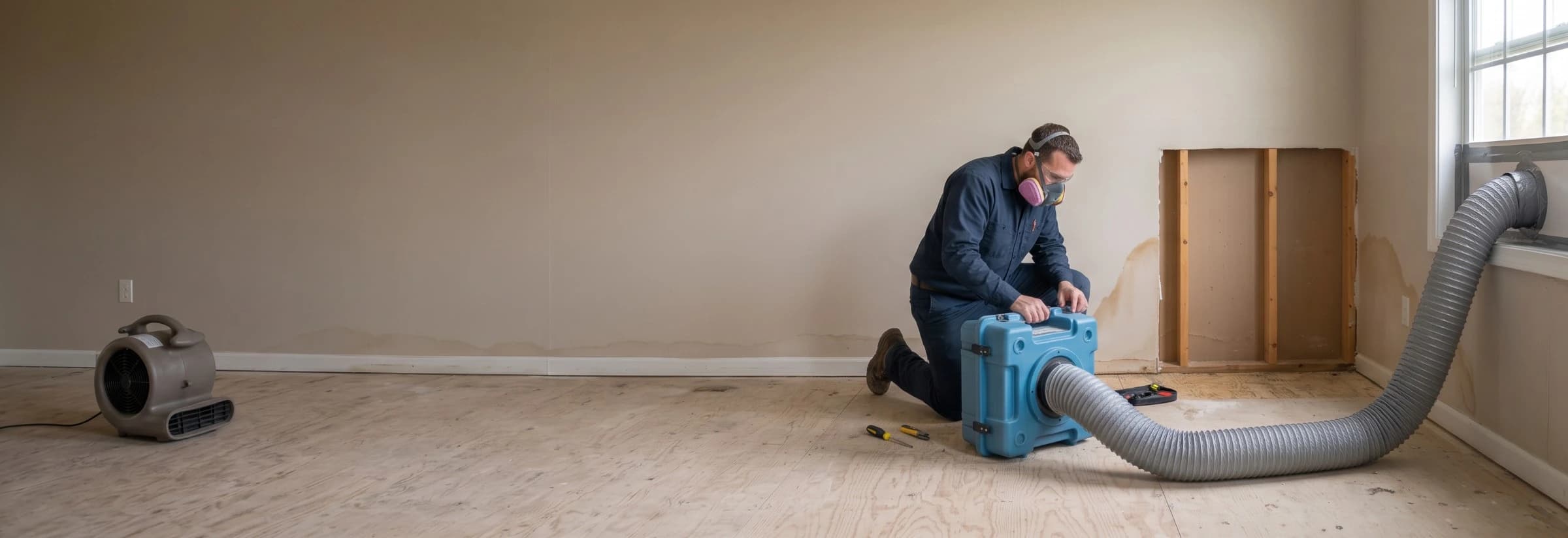

A damp, sour, or sewage smell that lingers after the water is gone usually means something wet is still hidden in the structure. Air fresheners and open windows only cover it for a few hours, because the odor is coming from materials and moisture the room still holds.
Water damage odor is the musty, sour, or sewage smell released when wet building materials support bacteria and mold growth. Restoration professionals working to the IICRC S500 water damage standard and S520 mold remediation standard treat it as a symptom of a moisture source or contaminated material that has to be found and fixed.
Each smell points to a likely source, removal runs in a fixed order from wet materials to a final check, and professional treatment typically costs $200–$3,000. Hidden moisture and misused ozone are two common reasons smells return. Odor removal is the last stage of water damage restoration, and it only works once the water and the wet materials behind the smell have been dealt with.
Key insights
- The smell points to the source. Musty suggests mold or mildew, sour suggests bacteria in wet fabric or padding, and rotten egg or sewage suggests contaminated water or a dry drain trap.
- Odor lives in porous materials. Drywall, carpet pad, and insulation absorb odor compounds and keep releasing them, so deodorizing the air while they stay in place only delays the smell.
- Remove, dry, clean, then deodorize. Treatments applied before the source is gone and the structure is dry are the most common reason a smell returns.
- Ozone comes last. The EPA cautions that ozone is a lung irritant and does not effectively remove mold at levels safe for people.
- Typical professional cost is $200–$3,000. Costs climb when odor soaked carpet, drywall, or subfloor has to be removed as part of the job.
- A smell that lasts past 48 hours means moisture is still present. Materials left wet longer than 24–48 hours are where mold and bacteria establish.
Why water damage smells linger
Water damage smells linger because wet materials feed bacteria and mold, and those organisms release gases as they grow. Porous materials such as drywall, carpet pad, insulation, and wood framing also absorb odor compounds, so the smell keeps coming out of the structure long after the visible water is removed.
 The EPA says that if wet materials are dried within 24–48 hours, mold will not grow in most cases, but insulation left wet past that window keeps releasing odor and is typically cut out and replaced.
Time and water quality set how deep the odor goes. The EPA says that if wet materials are dried within 24–48 hours of a leak or spill, mold will not grow in most cases, so materials that stay wet past that window start to support microbial growth, and contaminated water adds bacteria and organic waste. The EPA flood cleanup recommendations treat prompt drying and removal of wet porous materials as the core of controlling indoor air problems after flood water damage.
Humidity keeps the cycle going. A basement, crawl space, or wall cavity that stays above 60% relative humidity can rewet materials that felt dry to the touch, which is why a smell often seems to fade in winter and return in summer.
What each water damage smell means
Musty smells usually mean mold, sour smells mean bacteria in wet fabric, and rotten egg or sewage smells mean drain gas or contaminated water. Each smell points to a likely source, which tells you how fast to act and whether the job is a cleaning task or a professional one.
 Amber smells leave roughly 48 hours to find and dry the source, while red smells signal sewer gas, contaminated water, or an electrical hazard that needs action right away. Sewage odor points to Category 3 water under IICRC S500.
Urgency runs from days to immediate. A musty smell gives you a short window to find and dry the source, while sewage, rotten egg, or burning smells call for action right away. Odor alone cannot confirm a cause, so confirm any smell with a moisture reading or a visual check of the suspected area.
| Smell | Likely source | Urgency | What to do |
|---|---|---|---|
| Musty or earthy | Mold or mildew growing in damp drywall, wood, or insulation | Within 48 hours | Find the wet area, dry it, and check moisture readings |
| Sour or like sweaty socks | Bacteria in wet carpet, padding, or an HVAC drip pan | Same day | Remove wet padding, clean the source, and dry the area |
| Rotten egg | Sewer gas or hydrogen sulfide from a dry drain trap or backup | Immediate | Ventilate, stop using the fixture, and call a plumber |
| Sewage or fecal | Contaminated water (Category 3) in flooring, walls, or a crawl space | Immediate | Keep people out and call a professional |
| Rotting or decaying | Wet organic material, or dead pests in a damp wall cavity | Within days | Locate and remove the source, then clean and dry |
| Burning or electrical | Wet or shorted wiring, outlets, or appliances | Immediate | Shut off power at the breaker and call an electrician |
A rotten egg smell can also be natural gas, which has an added odorant that smells the same way. If the smell is strong, leave the home, avoid switches and flames, and call the gas utility from outside. Sewage falls into Category 3 of the water damage categories, the highest contamination level, which carries the strictest removal requirements.
A burning or electrical smell after water exposure is a fire and shock risk that needs an electrician before anything else. Cut power to the affected circuit at the breaker only if you can reach the panel without standing in water, and have an electrician inspect the wiring before anyone restores power.
Where hidden odor sources hide
Hidden odor sources sit inside wall cavities, under flooring, in carpet padding, above ceilings, in HVAC components, and in crawl spaces. These areas stay wet longest because air does not move through them, and they are the usual reason a room smells even though every visible surface looks clean and dry.
 Water that soaks through carpet collects in the padding and subfloor, where it keeps releasing odor after the surface feels dry. Padding that stayed wet past 24–48 hours is typically removed and replaced.
Odor that gets stronger along a baseboard, near a vent, or in one corner of the room points to moisture in the structure behind that spot. For crawl spaces, standing water and damp soil often produce an earthy smell that rises into the living space above, which is why crawl space water damage usually calls for pumping out standing water and drying the soil and insulation before any deodorizing.
| Location | Why odor persists | Signs to check |
|---|---|---|
| Wall cavities and insulation | Wet insulation holds moisture against drywall and framing for weeks | Musty smell along baseboards, stained or soft drywall |
| Under flooring and subfloor | Water pools between layers where air cannot reach | Cupped boards, soft spots, smell that rises from floor seams |
| Carpet padding | Padding absorbs water and organic residue and dries slowly | Sour smell that grows when you walk on the carpet |
| Ceiling voids | Leaks collect in insulation and joist bays above finished ceilings | Stains, sagging drywall, smell that worsens after rain |
| HVAC ducts and drip pans | Standing condensate and damp duct lining spread odor through vents | Smell strongest when the system runs |
| Crawl spaces | Damp soil, wet insulation, and poor airflow keep humidity high | Earthy smell that rises through floors |
| Behind baseboards and cabinets | Wet backing panels and framing stay damp behind finished surfaces | Localized smell, peeling paint, warped trim |
How to find the source of the smell
The fastest way to find the source of a water damage smell is to follow the odor to its strongest point, then confirm with a moisture meter and a thermal camera before opening anything. Smell narrows the search to a wall, floor, or vent, and instruments show whether that spot is wet.
 Wet materials read cooler on a thermal camera because evaporation pulls heat from the surface, but the image only shows where to measure. A moisture meter reading confirms whether the area is actually wet.
A structured search saves demolition. Cutting into drywall at random spreads dust and spores, while a mapped search shows where moisture is and where it is not. Work in order and stop once you find wet material, since that is the material to dry or remove.
1. Follow the smell
Walk the room with the windows closed and the HVAC off, noting where the odor is strongest. Check along baseboards, in corners, at floor seams, and near vents, then repeat with the system running to see whether the air handler is spreading it.
2. Take moisture readings
Run a pin or pinless moisture meter along the suspect wall and floor at several heights, and compare the results with a wall you know is dry. Readings clearly above that baseline mark the wet zone.
3. Scan with a thermal camera
A thermal camera shows cool, damp areas behind finished surfaces. It flags where to measure but not how wet a material is, so confirm anything it shows with the meter.
4. Inspect the HVAC system
Check the condensate drain pan, drain line, and accessible duct sections for standing water, slime, or wet insulation. Odor that is strongest at the vents and worse when the system runs points to this source.
5. Open a small inspection hole
If the readings and the smell agree but nothing is visible, cut a small hole in the drywall or pull a section of baseboard to look at the insulation and framing. Wet, dark, or slimy material is the source.
How to remove water damage odor
Water damage odor removal follows seven steps in order: stop the water, remove what cannot be saved, dry, clean, filter the air, deodorize, and verify. Skipping to deodorizing is the most common mistake, because treatments only work once the source is gone and the structure is dry.
 Restorers cut a few inches past the visible stain line, because drywall wicks moisture above the stain and any wet material left behind keeps producing odor.
Homeowners can handle small clean water incidents with fans, a dehumidifier, and cleaning. Contaminated water, large areas, or smells that persist call for a restoration company with drying and air filtration equipment.
1. Stop the water and identify the source
Shut off the water supply or stop the leak, then note whether the water was clean, gray, or contaminated. The emergency response steps in the first hours decide how much material can be saved and how far the odor spreads.
2. Remove unsalvageable materials
Pull out carpet pad, wet insulation, saturated drywall, and any porous material that stayed wet past the drying window. These materials hold odor compounds and microbial growth that cleaning cannot fully reach, and leaving them in place is the most common reason a smell comes back.
3. Dry the structure completely
Run air movers and dehumidifiers until framing, subfloor, and remaining materials reach dry standards on a meter, well beyond a dry feel. Documented structural drying with moisture readings at the start and end prevents trapped moisture from restarting the odor weeks later.
4. Clean hard surfaces
Scrub framing, concrete, tile, and sealed surfaces with detergent and water, then apply an antimicrobial where the water was contaminated or the area stayed wet. Cleaning removes the residue that odors cling to, which a spray or fog cannot do on its own.
5. Filter the air
Run a HEPA and activated carbon air scrubber during cleaning and drying. HEPA captures particles and spores, and carbon adsorbs the gases that create the smell, so the two work together as odor control while the source is being removed.
6. Deodorize
Apply a deodorizing method such as hydroxyl treatment, thermal fogging, or supervised ozone once the source is removed and the surfaces are clean and dry. Treatment at this stage neutralizes leftover odor molecules instead of masking an active source.
7. Verify the smell is gone
Confirm dry moisture readings, air the space for a day or two, and check again when humidity rises or the HVAC runs. A smell that returns under those conditions means moisture or absorbed odor is still in the structure and the source search should resume.
Which materials can be deodorized?
Hard, nonporous, and sealed materials can be cleaned and deodorized after water damage, while porous materials that stayed wet for more than 24–48 hours usually have to be removed. Porous materials absorb water and odor deep inside their structure, and surface treatments cannot reach the bacteria and residue inside them.
 Under IICRC S500, porous materials that absorbed sewage or floodwater are treated as contaminated and removed, while nonporous surfaces can be cleaned and disinfected in place.
Contamination level changes the rule. Materials exposed to clean water and dried quickly often survive, while anything that absorbed sewage or floodwater is generally discarded no matter how it looks. Deciding by material type and exposure avoids leaving a hidden source behind, even when the material no longer smells. The IICRC S520 mold remediation standard takes the same approach, calling for contaminated materials to be removed and cleaned instead of masked with deodorizers.
Hard surfaces
Tile, sealed concrete, glass, metal, and sealed wood can be washed with detergent and treated with an antimicrobial, and they rarely need replacement unless the water was contaminated and left standing for days.
Solid wood framing
Studs and joists can usually be cleaned, dried, and treated in place, since dense wood does not hold odor as deeply as drywall or padding. Moisture readings confirm framing is dry before anything is closed back up.
Carpet and pad
Carpet pad almost always has to go after a soaking, and carpet over it is worth saving only when the water was clean and drying began quickly. Carpet that absorbed sewage or sat soaked for days should go regardless of how it looks once it dries.
Drywall and insulation
Drywall that stayed wet, and any insulation that absorbed water, are typically cut out and replaced. Both hold moisture against framing and continue producing odor if left in place.
Upholstery, mattresses, and porous items
Upholstered furniture, mattresses, and pillows that soaked through rarely recover, and sewage exposure makes them a disposal decision. Solid wood pieces that dried quickly are the main exception and can often be cleaned and refinished.
Sewage and black water odors
Sewage and black water odors mean the water carried bacteria and organic waste, which changes both the health risk and the cleanup method. The space needs professional disinfection instead of household deodorizing.
 Sewage backups are Category 3 water under IICRC S500, so porous materials that absorbed it are removed and hard surfaces are cleaned and disinfected in place before any deodorizing.
Cleanup after a sewage backup follows a fixed order, and odor control follows the same rule: remove porous contaminated materials first, then clean, disinfect, and dry. A sewage smell that continues after cleanup usually means saturated subfloor, insulation, or drywall was left in place.
A rotten egg smell with no water event often comes from a dry drain trap. Floor drains, guest bathroom sinks, and unused tubs lose the water seal in their P traps, which lets sewer gas rise into the room. Refilling the trap with water, or adding a trap primer to a floor drain, restores the seal, and a smell that persists after that points to a venting or sewer line problem that needs a plumber.
Hydrogen sulfide is the gas behind the rotten egg smell of sewage. According to ATSDR, it can deaden the sense of smell at high concentrations, so in an enclosed space such as a sewage filled basement or crawl space the odor may seem to disappear while exposure continues. Leave the area if the smell is strong or you feel dizzy, and do not rely on smell alone to judge whether the air is safe.
Do vinegar and baking soda work?
Vinegar, baking soda, and charcoal only help with mild, surface level smells. They absorb or neutralize some odor compounds in the air, but they cannot dry a wall cavity, reach bacteria inside carpet pad, or remove odor coming from wet materials or hidden moisture.
 Vinegar and baking soda only treat odor on the surface, so they cannot reach smell trapped inside wet drywall, carpet pad, or subfloor that has not been dried or removed.
DIY methods help after the source is removed and the structure is dry, and they suit small clean water incidents on hard surfaces. Used earlier, they can make a homeowner believe the problem is solved while moisture builds unseen.
| Method | What it does | Limits |
|---|---|---|
| Baking soda | Absorbs some odor from carpet, upholstery, and enclosed air | Only works on surface odor and saturates quickly |
| White vinegar | Neutralizes some odor on hard surfaces and in laundry | Does not kill all mold and leaves its own smell until it airs out |
| Activated charcoal | Adsorbs odor gases from the air in small spaces | Limited capacity and does not remove the source |
| Open windows and fans | Move humid, smelly air out of the space | Adds humidity when outdoor air is damp and does not dry structure |
| Dehumidifier | Lowers humidity so bacteria and mold slow down | Does not remove odor already absorbed into materials |
| Commercial odor sprays | Mask or neutralize odor in the air for a short time | Do not address the source and often return within days |
| Bleach | Disinfects hard nonporous surfaces | Does not penetrate porous materials and should never be mixed with ammonia |
Air circulation and humidity control do the most work of these options, because they address the conditions that produce odor. A dehumidifier that keeps a room steadily dry slows microbial growth, while sprays and gels only change what the room smells like.
When to call a professional
Call a professional when the water was contaminated, the smell has lasted more than 48 hours, the affected area is larger than about 10 square feet, or anyone in the home has asthma or a weakened immune system. Those conditions involve hidden moisture, health risk, or materials that household cleaning cannot fix.
The 10 square foot threshold comes from the EPA mold cleanup recommendations, which say larger areas of mold generally call for professional help. Odor that keeps returning after drying and cleaning usually means mold or moisture inside the structure.
Credentials tell you whether a contractor can handle odor properly. Look for IICRC certified technicians, such as those holding the Water Damage Restoration Technician (WRT) or Applied Microbial Remediation Technician (AMRT) certifications, and ask what equipment and standards they will use. A contractor who plans only to fog or spray, with no removal, drying, or moisture verification, is treating the symptom.
Separating a water damage job from a mold job matters for cost and process, because mold that has grown into materials adds containment and removal work. A good contractor will tell you whether your home needs water damage restoration or mold remediation before quoting either.
Which professional treatments work?
Professionals use five odor treatments: HEPA and carbon air scrubbing, hydroxyl generators, ozone, thermal fogging, and sealing. Each targets a different part of the problem, and none replaces removing the source and drying the structure, so restoration companies combine them after removal.
 Thermal fogging and ozone come after removal and cleaning, and the space stays unoccupied until the fog or gas has cleared.
Choosing between them depends on what is producing the smell, whether people or pets can leave the space, and how deep the odor has penetrated. Hydroxyl works slowly over days, while ozone and fogging act faster but need the space empty. Ask any contractor which method they plan to use and why, because choosing a water damage restoration company that combines removal, drying, and treatment matters more than which product it sprays.
| Method | How it works | Best for | Occupancy |
|---|---|---|---|
| HEPA and carbon air scrubbing | Filters particles with HEPA and adsorbs odor gases with carbon | Ongoing odor control during drying and cleaning | Safe with people present |
| Hydroxyl generators | Produce hydroxyl radicals that break down odor molecules over time | Light to moderate odor in spaces that can run for days | Generally safe with supervision |
| Ozone generators | Produce ozone that oxidizes odor molecules | Heavy odor in sealed spaces after source removal | Unoccupied only |
| Thermal fogging | Heated deodorizer fog penetrates cracks and porous surfaces | Smoke, sewage, and deep porous odor after cleaning | Unoccupied during treatment |
| Sealing and encapsulation | Odor blocking primer or sealer on cleaned, dry framing | Residual odor in framing and subfloor after removal | Follow product ventilation directions |
Sealing and encapsulation only hold on clean, dry framing, since a sealer over damp or dirty wood traps the odor underneath. Fogging and ozone follow the same logic and belong after cleaning.
Is ozone safe for water damage odor?
Ozone is not safe in an occupied space, but professionals use it safely in a sealed, unoccupied structure after the source is removed. It oxidizes odor molecules, yet it is a lung irritant, so people, pets, and plants have to stay out during treatment and the space has to be aired out before anyone returns.
 Professionals run ozone only in a sealed, posted room with everyone out, then ventilate it before anyone returns, because the ozone levels needed to remove odor exceed what is safe to breathe.
The EPA ozone generator recommendations state that ozone can damage the lungs, worsen asthma, and that at levels safe for people it does not effectively remove indoor pollutants or mold. Workplace and product limits reflect the same concern: OSHA sets a workplace limit of 0.1 ppm over an 8 hour day, the FDA limits ozone from medical devices to 0.05 ppm, and California requires indoor air cleaners to emit no more than 0.050 ppm.
Ozone should never be the only response to sewage contamination or mold growth, because it does not remove contaminated material. Heavy treatment can also degrade rubber, some plastics, and other materials.
Consumer ozone machines are the biggest risk. They are sold as air cleaners, yet the CARB air cleaner rules exist because these devices can raise indoor ozone above safe levels. A room that smells sharp or makes you cough after an ozone machine has run needs to be ventilated and vacated.
How long to stay out after treatment?
After odor treatment, stay out for as long as the contractor's written instructions and the product label require, since reentry time depends on the method. HEPA and carbon scrubbers generally run with people present, while ozone and thermal fogging require everyone to leave during treatment and until the space has been aired out.
 Reentry depends on the treatment method and the contractor's written instructions, so keep the window open and the fan exhausting outdoors until the room is cleared, not until the smell seems gone.
Ask for the reentry time before work starts, and do not go back sooner because the smell seems gone. A sharp, clean, or electrical smell after ozone means the gas is still present, and people with asthma or lung conditions are the most affected by leftover ozone.
People and pets
Keep children, older adults, and anyone with asthma or lung disease out until the contractor clears the space. Move pets, including fish and birds, to another location for the full treatment and airing period.
Plants and food
Remove houseplants and cover or remove open food before treatment. Ozone can damage plants, and fog can settle on open surfaces. Wash dishes, counters, and food prep areas that were exposed before using them again.
Ventilation
Open windows and run exhaust fans before staying in the space, so treated air leaves the home instead of circulating through it. Keep the fans running for the airing period the contractor specifies, and leave interior doors open so air moves through every room.
Signs the space is not ready
A sharp smell, coughing, or throat or eye irritation means the space needs more airing time. Leave and ventilate again before returning. If irritation continues after a full day of airing, contact the contractor before staying in the space.
How long does water damage odor last?
Water damage odor lasts from a few days to several months depending on how quickly the source was removed and dried. A smell from a clean water leak dried within 48 hours can clear in days, while odor from wet padding, drywall, or mold left in place can persist until that material is removed.
 Odor fades as materials reach dry standards, so moisture readings on the framing show whether the source has dried better than the calendar does. If a smell has not improved after a week of drying and cleaning, ask for new readings.
The timeline depends on what remains in the structure. Deodorizers can shorten the last stage, but they cannot shorten the time a wet material keeps producing odor. If a smell has not improved after a week of drying and cleaning, treat that as a sign that a source is still hidden.
| Situation | Typical timeline | What controls it |
|---|---|---|
| Clean water dried within 48 hours | Hours to a few days | How fast the area reaches dry standards |
| Wet drywall or insulation removed | Days after removal | Whether all wet material is out and framing is dry |
| Carpet pad left in place | Weeks to months | The pad keeps releasing odor until it is removed |
| Sewage or Category 3 water | Days after removal and disinfection | Complete removal of porous materials and cleaning of framing |
| Mold growing inside walls | Until the growth is removed | Finding and removing the affected material |
| Masking sprays or fresheners only | Returns within days | The source is untouched |
Timelines shift with the humidity level of the home. A drier house clears odor faster than one that runs damp, and a smell that returns in humid weather is a sign that moisture is still available to the source.
How much does odor removal cost?
Professional water damage odor removal typically costs $200–$3,000, with most of the spread coming from whether odor soaked materials have to be removed. Deodorizing an area that has already been dried and cleaned sits at the low end, while removing carpet, pad, drywall, or subfloor moves the job to the high end.
 Wet carpet pad keeps releasing odor until it is removed, which is why removing and replacing it is one of the larger costs in an odor job.
Cost figures are estimates based on restoration industry pricing, and quotes vary by region, room size, and the severity of contamination. Odor treatment is usually a small part of the total, since water damage restoration cost is driven mostly by extraction, drying, and rebuilding.
| Service | Typical cost | What drives the price |
|---|---|---|
| Surface cleaning and antimicrobial | $200–$800 | Area size, contamination level, and surface type |
| HEPA and carbon air scrubber | $70–$150 per day | Number of units and days of operation |
| Hydroxyl generator | $75–$200 per day | Room size and treatment length |
| Ozone treatment | $200–$600 per treatment | Space size, sealing work, and airing time |
| Thermal fogging | $250–$700 per treatment | Area size and surface complexity |
| Sealing and encapsulation | $200–$800 | Area size and product used |
| Carpet and pad removal and replacement | $500–$2,000 | Square footage and carpet grade |
| Removing odor soaked drywall or subfloor | $500–$3,000 | Amount of material and access to the area |
Getting several written quotes shows which contractors include removal, drying, and verification. Putting the same questions to ask a water damage restoration company to each one, such as which equipment, standards, and guarantees they use, makes quotes comparable on scope instead of price alone.
Does insurance cover odor removal?
Homeowners insurance usually covers odor removal when the odor comes from a covered water loss, such as a sudden pipe burst, but it typically does not cover odor from gradual leaks, poor maintenance, or flooding without a separate flood policy. Odor treatment is normally handled as part of the repair of the covered damage instead of as a separate claim.
Coverage depends on the cause of the water, so the policy language matters more than the smell. Many policies exclude long term seepage and mold that follows neglected repairs, and mold coverage is often capped or limited. Reading the cause of loss wording in the policy and reporting the loss promptly protects the claim, especially for sudden events such as a burst pipe, which are the water damage losses insurance typically covers.
Timing affects how an odor claim is handled. Reporting the loss promptly, photographing damaged materials before they are removed, and keeping receipts for cleaning and equipment show that the odor came from the covered event and that reasonable steps were taken to limit it.
Documentation carries the rest of the claim. Moisture readings and contractor notes on materials removed tie the smell to the loss, and adjusters typically expect this kind of insurance documentation alongside photos and receipts.
What if the smell comes back?
If the smell comes back after treatment, moisture or an absorbed source is still in the structure, and the fix is to find it instead of treating again. Repeating the same deodorizing rarely works because the cause was never removed.
 A smell that returns only when the system runs often traces to a clogged condensate line or standing water in the drain pan, so inspect both before treating the room again.
The timing of a returning smell narrows the cause. A smell that returns in humid weather points to moisture, one that returns at a single spot points to a missed material, and one that returns only when the system runs points to the HVAC.
1. Recheck moisture readings
Measure framing, subfloor, and the lower wall against a known dry baseline. Readings that have crept back up mean water is still entering or was never fully dried.
2. Look for missed materials
Check for padding under thresholds, insulation in wall bays, drywall behind cabinets, and the backing behind baseboards. Small pieces of porous material left in place can keep a whole room smelling.
3. Test on a humid day
Note when the smell strengthens and read a hygrometer at the same time. A smell that tracks humidity confirms moisture is the trigger. Readings above 60% relative humidity while the smell peaks point to more dehumidification or a hidden wet area.
4. Inspect the HVAC system
Check the drain pan, drain line, and ducts again, since a smell that appears only when the system runs is usually a sign of HVAC condensation that was never traced or corrected. Standing water in the pan or slime on the duct lining confirms it.
5. Bring the contractor back
Ask for a written record of what was removed, dried, and treated, and have them recheck readings and expose the suspect area. A callback should start from the original drying records.
How to keep the smell from coming back
Keeping the smell from coming back depends on keeping materials dry: hold indoor humidity below 60%, ideally between 30%–50%, and fix leaks quickly. A hygrometer, which costs little, shows humidity trends before a musty smell appears.
 Holding humidity between 30% and 50% keeps materials dry, and a hygrometer on the wall shows the trend before a musty smell returns. Draining the dehumidifier by hose keeps it running when the tank would otherwise fill.
Check under sinks and around appliances a few times a year. Catching a slow drip early costs far less than replacing wet drywall later.
Control humidity
Run a dehumidifier in basements and other damp areas to keep humidity down. Empty the tank often or connect the unit to a drain, since a full tank stops working.
Fix moisture entry points
Repair leaking roofs, plumbing, and window seals, and correct grading or drainage that sends water toward the foundation. A basement that keeps taking on water usually has a failed sump pump or a drainage problem, since repeated cleanup will not stop it.
Ventilate wet rooms
Run bathroom and kitchen fans during and after showers and cooking, and vent dryers outdoors. Moist air that has nowhere to go settles into walls, ceilings, and carpet.
Confirm dryness before rebuilding
Check that framing and subfloor are dry before insulation, drywall, or flooring go back. Learning how to read moisture meter readings helps you tell dry from damp and avoid sealing moisture inside a wall.
Replace, do not mask
Replace materials that stayed wet instead of sealing or painting over them. Fresh materials over a dry, clean structure end the smell, while masking a wet one only delays it.
Frequently asked questions
Is a musty smell after water damage always mold?
Not always, but often. Damp cardboard, wet fabric, and bacteria in standing water all produce a musty odor without visible mold, yet a musty smell that lasts more than 24–48 hours after water exposure usually points to microbial growth somewhere out of sight. Finding and drying the hidden moisture is the fastest way to tell the difference.
Will a dehumidifier get rid of water damage smell?
Only partly. A dehumidifier lowers humidity so the source stops feeding bacteria and mold, but it does not remove odor compounds already in the air or absorbed into materials. It works best alongside cleaning, removal of unsalvageable materials, and carbon air filtration.
Do air purifiers with carbon filters help with water damage odor?
Yes, when the unit is sized for the room. Carbon adsorbs the gases that cause odor while a HEPA filter captures particles, and the AHAM CADR rating shows whether a unit can clean the air in a room of your size. Small units with a thin carbon layer saturate quickly and stop working on odor.
Why does the smell come back on humid days?
Moisture is still present somewhere. Materials that stayed damp or absorbed odor residue release it again when indoor humidity rises, which points to a hidden wet area, an unremoved porous material, or a humidity problem that was never corrected.
Can you smell water damage before you see it?
Yes, often. Water sitting in wall cavities, under flooring, or above ceilings produces odor well before stains, warping, or visible mold appear. A smell that gets stronger near a wall, floor, or vent usually points to where the moisture is.
Does ozone kill mold or just the smell?
Neither reliably. Ozone can break down some odor molecules, but the EPA states that ozone at levels safe for people does not effectively remove mold, and mold growing inside materials has to be removed and dried.
Is water damage odor harmful to breathe?
Sometimes, yes. The smell is mainly a warning sign, but hydrogen sulfide, sewage contamination, and mold growth can irritate the airways, and infants, older adults, and people with asthma or weakened immune systems are more at risk, as the CDC mold health information describes.
Can you paint over a water damage smell?
No, not effectively. Paint and odor sealing primer can mute a faint smell, but they trap moisture and leave the source behind. Sealing only makes sense after the source is removed and the surface has been dried and verified.
Will clothes and bedding lose the water damage smell?
Usually, with the right wash. Launder at the hottest temperature the care label allows using detergent plus oxygen bleach, or run a separate cycle with 1 cup of white vinegar. Items soaked in sewage water should be discarded.
- IICRC: S500 Standard for Professional Water Damage Restoration
- IICRC: S520 Standard for Professional Mold Remediation
- EPA: Flood Cleanup and Indoor Air Quality
- EPA: Mold Cleanup in Your Home
- EPA: Ozone Generators That Are Sold as Air Cleaners
- OSHA: Ozone Permissible Exposure Limit
- FDA: Maximum Acceptable Level of Ozone (21 CFR 801.415)
- CDC: Basic Facts About Mold
- CARB: Air Cleaning Devices for the Home
- ATSDR: Hydrogen Sulfide Public Health Statement
Sam Hickerson is the founder of RestoreAdvisor and writes consumer guides on mold remediation, water damage restoration, inspection, testing, and home recovery. His work focuses on helping homeowners understand costs, risks, and when to call a professional. He draws on guidance from the EPA, CDC, IICRC, and other authoritative sources to make complex home issues easier to navigate.