
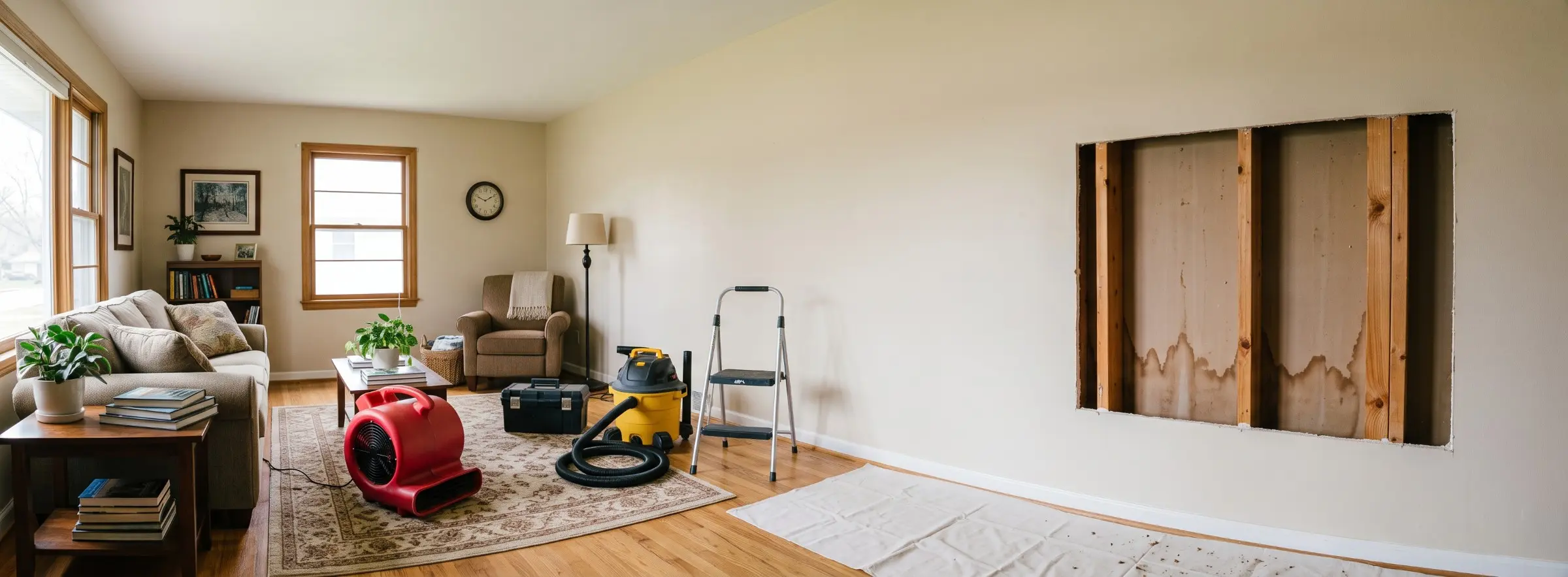

Water damage repairs range from a five-minute drywall patch to a full electrical rewire, and only some of that work needs a permit. A repair permit is a local building department's written approval to do work regulated under the International Residential Code, and it exists to confirm that the finished repair meets the same safety standard as new construction, not to slow down a homeowner drying out a wet closet.
Under IRC Section R105.2, most jurisdictions exempt ordinary, cosmetic repairs from a permit, while work that touches structural framing, electrical wiring, plumbing, or a mechanical system almost always requires one. The distinction has nothing to do with how the water got there. The extraction and drying side of water damage restoration follows the ANSI/IICRC S500 standard, and that mitigation work is a separate question from whether the repair that follows needs a permit.
Key insights
- Cosmetic repairs are usually exempt. Drywall patches, flooring, painting, and cabinet swaps typically fall under the ordinary repair exemption in IRC Section R105.2.
- System and structural work almost always needs one. Electrical, plumbing, gas, HVAC, and framing repairs are regulated construction, even when water caused the damage.
- Extraction and drying are never permitted work. Pulling water out and running equipment is mitigation under the ANSI/IICRC S500 standard, not construction, and stands entirely outside the permit process.
- Flood zones carry an extra rule. Repair costs near or above half the home's market value can trigger FEMA's substantial damage rule, forcing the whole structure up to current flood codes.
- Skipping a required permit has consequences years later. It can leave an insurance claim underpaid now and complicate a home sale down the road.
- Two lesser-known rules can work in your favor. Genuinely urgent work can start before the permit is approved, and some homeowners policies reimburse the permit fee itself through ordinance or law coverage.
Is a permit required?
Most water damage repairs do not need a permit, and the ones that do almost always involve structural, electrical, plumbing, or mechanical work rather than cosmetic finishes. Patching drywall, replacing flooring, or repainting after a wall has dried out typically falls under the ordinary repair exemption, while cutting into framing, rewiring an outlet, or replacing a water heater usually does not.
 Exposed wiring like this falls outside the ordinary repair exemption in IRC Section R105.2, unlike a simple drywall patch nearby.
Where that line sits depends on the city or county issuing the permit. The national baseline comes from IRC Section R105.2, which spells out what counts as an exempt ordinary repair, though a local building department can narrow that baseline further, so the same job can be a phone call in one town and a filed application in the next.
What decides whether you need one
A repair permit usually comes down to whether the work is cosmetic or structural, not whether water caused the damage. Building departments generally exempt ordinary repairs, meaning like-for-like replacement of a finish material, but they require a permit once the work touches a load-bearing wall, a required exit path, or a building system such as electrical, plumbing, or HVAC.
A flood cut on a contaminated wall, for example, only needs a permit if the crew removes framing the wall depends on for support; cutting out and discarding wet drywall alone typically does not. When water has soaked into framing long enough to raise a real question about the wood's strength, that has moved into structural water damage, and the repair almost always needs a permit and a structural inspection before anyone closes the wall back up.
Repairs that usually don't need one
Cosmetic and like-for-like repairs make up most of the work homeowners do after a leak, and most of it falls outside permit requirements. Replacing drywall, flooring, cabinets, trim, or paint with the same type of material, in the same location, without touching wiring or plumbing behind it, is the kind of ordinary repair that stays exempt in most jurisdictions.
 A like-for-like patch such as this stays inside the ordinary repair exemption in IRC Section R105.2 as long as nothing behind the wall changes.
This exemption applies whether the material was destroyed by the water itself or removed afterward as part of the drying process, since a building department cares about what goes back into the wall, not why the old material came out. The same logic covers smaller touch-ups, such as re-caulking a tub surround or refinishing a hardwood floor that only needed sanding rather than full replacement.
| Repair | Permit needed | Why |
|---|---|---|
| Drywall patch or full-wall replacement, like-for-like | Usually no | Cosmetic finish, no structural or system change |
| Carpet, hardwood, tile, or vinyl flooring replacement | Usually no | Finish material only |
| Cabinet or vanity replacement | Usually no | Finish material only |
| Painting and trim | Usually no | Cosmetic only |
| Insulation replacement in an open wall or attic | Usually no | Material swap, not a structural or system change |
Replacing water damaged drywall like-for-like almost always stays in this exempt category, since the panel itself carries no structural or safety function once it's back in place. The one exception is a fire-rated wall, such as a shared wall between a house and an attached garage, where the drywall's thickness and layers are part of the fire rating and any change to them can require a permit.
A water damaged subfloor sits closer to the line. Swapping a small, non-structural section of plywood is often still exempt in the same way flooring is, but replacing subfloor across a large area or over floor joists that also need repair usually crosses into the structural work covered next.
Repairs that usually do need one
Permit-triggering repairs are the ones that touch a building system or the structure itself rather than just a finish. Electrical work, plumbing beyond clearing a stoppage, gas line repair, HVAC or water heater replacement, and structural framing repair all typically require a permit and an inspection before the wall closes back up.
 Panel and circuit work like this is regulated construction under most residential codes, which is why it requires both a permit and an inspection even for a small repair.
These repairs share one trait: they involve a licensed trade and an inspection step that confirms the finished work meets current code, not just that it matches how the system looked before the water damage happened. A building department can require that inspection even when the replacement part is functionally identical to the original, since code requirements sometimes change in the years between when a system was installed and when it fails.
| Repair | Permit needed | Why |
|---|---|---|
| Electrical repair or rewiring (an outlet, a circuit, a panel) | Yes | Life-safety system regulated by code |
| Water heater replacement | Yes | Combustion, venting, or electrical connections change |
| Plumbing repipe or relocated fixture | Yes | Affects the potable water and drain system |
| HVAC or ductwork replacement | Yes | Mechanical system regulated by code |
| Structural framing repair, such as studs or floor joists | Yes | Affects the building's structural capacity |
| Reroofing or roof deck replacement | Yes | Structural and weatherproofing system |
Rewiring an outlet after water damage or replacing a damaged circuit is electrical work in the plainest sense, and it needs both a permit and an inspection in nearly every jurisdiction, regardless of how small the affected area looks. The same logic covers combustion equipment. A furnace or boiler that vents combustion gases has to be reinstalled to its manufacturer's clearances and venting requirements, which a mechanical inspector confirms at the permit stage rather than after the fact.
That's why a water heater leak that ends in full tank replacement almost always needs a permit. The new unit's combustion venting or electrical connections, and its temperature-and-pressure relief valve, all fall under code review that a homeowner or handyman can't sign off on alone.
Extraction and drying need no permit
The water removal phase of a restoration job is mitigation, not construction, and it stands entirely outside the permit system. A technician following the ANSI/IICRC S500 standard to pull standing water, run air movers, and take moisture readings is preventing further damage, not altering the structure, so none of it triggers a building department's involvement.
The permit question only shows up once the drying is finished and someone starts putting the room back together. After a burst pipe, for instance, a crew can spend days extracting water and running dehumidifiers without a single permit involved, then still need one for the drywall, insulation, or electrical work that follows if that work reaches a building system or structural framing.
The 50 percent rule
A separate rule applies specifically to homes in a mapped flood zone. Under FEMA's substantial damage standard, if the cost to repair a flood-damaged structure to its pre-loss condition equals or exceeds 50 percent of the building's market value, most participating communities require the entire structure to be brought up to current flood-resistant construction standards, not just the damaged portion, before any permit is issued.
 A repair cost near or above half the home's value can trigger the substantial damage rule regardless of how contained the visible stain line looks from outside.
The dollar comparison runs against the home's market value, not a fixed number, so the same repair bill can trigger the rule in a lower-value home while barely registering against a larger one. Local officials, not the insurance company, make the substantial damage determination, usually as part of reviewing the permit application itself.
That threshold gets checked against the whole repair scope, not room by room, so a home that took on water from flooding can hit the 50 percent mark even when the damage looks contained to one floor. Reaching it can mean elevating utilities, raising the lowest floor, or other work well beyond what caused the original claim.
Utility elevation and lowest-floor changes triggered this way are treated as flood mitigation, not storm repair. That distinction matters for coverage, since this kind of upgrade typically isn't paid for by a standard water damage claim even when the same event is what forced the assessment in the first place.
The same math applies after a major storm, since wind and water damage from one event are added together when a building department calculates the repair cost against the home's value. A homeowner working through storm and hurricane water damage should ask the local building department for a substantial damage determination before committing to a repair scope, since that number, not the insurance settlement, decides whether the flood rule applies.
Who pulls the permit
The property owner is ultimately responsible for a permitted repair, even when a contractor physically files the paperwork. Most licensed contractors pull permits under their own license as a routine part of the job, and a homeowner doing the work themselves can generally pull an owner-builder permit instead, though some jurisdictions limit that option for electrical or plumbing work.
This is worth confirming before signing a contract rather than after. Part of choosing a water damage restoration company is asking directly which parts of the job the company will permit itself and which parts get handed to a licensed electrician, plumber, or general contractor for that piece of the scope.
That question matters even on a straightforward job. A company that skips a required permit to save a few days is cutting a corner that becomes the homeowner's problem later, not the contractor's, once the wall is closed and the crew has moved on.
Multi-trade jobs are where this gets confusing, since one event can require more than one permit from more than one party. A homeowner dealing with a roof leak that also damaged the ceiling below might see the roofing contractor pull a roofing permit for the deck and shingles while the restoration company or a separate contractor pulls a building permit for the drywall and any electrical work in the ceiling.
How emergency permits work
Most codes let genuinely urgent work start immediately and treat the permit application as paperwork that follows within a day or two, not a gate a homeowner has to clear first. Under IRC Section R105.2.1, a contractor can perform true emergency repairs and file for the permit the next business day, as long as the building department is notified and the work itself would have needed a permit anyway.
 Cutting power to a hazard like this qualifies as emergency work under most codes, with the permit paperwork filed after the fact rather than before.
What counts as an emergency is narrow and safety-driven, not a matter of convenience. Cutting power to a flooded panel, temporarily shoring up a sagging ceiling, or the kind of urgent, safety-first response that defines emergency water damage restoration typically qualifies, while routine finish work like drywall or flooring replacement does not, since none of that has to happen before the building department opens the next morning.
The exact filing window and the definition of an emergency both vary by city, running anywhere from within 24 hours in some places to a few business days in others. The safest move is to have the contractor call the building department the same day emergency work starts, rather than assume a single standard applies everywhere.
Combustion equipment is a common example of a genuine emergency. A boiler or radiator leak that can't be safely isolated carries its own shutoff and carbon monoxide risk on top of the water itself, and shutting it down safely counts as emergency work even though the wall repair that follows does not.
If you skip a required permit
An unpermitted repair that should have been permitted doesn't disappear once the drywall is painted. If a building department discovers it, whether through a complaint, a resale inspection, or an unrelated permit application, it can require the wall or ceiling to be opened back up for inspection and assess a fine on top of the cost of redoing work that already looked finished.
The more common way this surfaces is at resale. An unpermitted repair to foundation water damage, for example, can go unnoticed for years until a buyer's inspector spots patched concrete with no permit on file, at which point it becomes a negotiation problem rather than a quiet fix.
The building department's paperwork and the real estate transaction rarely connect at the time the work is done, which is exactly why unpermitted work is so easy to get away with in the short term. It only becomes visible again once someone with a reason to check, an inspector, an appraiser, or a title company, goes looking.
That visibility is also a disclosure question for whoever eventually sells the home. Most state forms ask directly whether repair work was permitted, and it's the kind of history you're expected to cover when you disclose water damage when selling a property, even years after the work looks finished.
Does insurance cover the permit?
Some homeowners insurance policies pay for the permit fee itself and any code-upgrade cost it triggers, through a feature called ordinance or law coverage. Keeping that paperwork with the rest of what you're using for documenting water damage for insurance makes it far easier to show an adjuster which cost came from a code requirement rather than the original damage.
 Ordinance or law coverage is a named endorsement, not a standard feature, so it is worth confirming on the policy itself rather than assuming it applies.
Without that endorsement, a standard policy typically pays only to restore what was damaged, not to bring an older, undamaged part of the same system up to a new code requirement the permit process now demands. This shows up most often on older homes, where a permitted repair to one part of an electrical panel or plumbing system can trigger a review of the whole system rather than just the damaged section.
Effect on your insurance claim
Skipping a required permit can cost you twice, once at the time of the repair and again if you ever file a related claim later. According to NAIC, insurers routinely evaluate whether prior repairs were done to code when they assess a new loss, and work with no permit on file is harder for a homeowner to prove was done correctly.
That evaluation isn't limited to the exact component that failed originally, either. An adjuster reviewing a new claim can look at any earlier repair in the same area of the home, not just the one tied to the current loss.
The clearest version of this problem shows up on systems that fail again later. If homeowners insurance covers water damage from a new event on the same wall or system, an adjuster who finds an earlier, unpermitted repair in that spot can reduce or deny the payout on the theory that the prior work, not the new event, caused the failure.
Renters, landlords, and condo owners
Pulling a permit is the property owner's job, not the tenant's, since a permit is tied to the building rather than to whoever happens to be living in it. A renter who reports a leak promptly and documents the damage has done their part; arranging and paying for any permitted repair work falls to the landlord.
 Whoever owns the structure is responsible for pulling the permit, whether that is a landlord, a unit owner, or the building's association.
That responsibility doesn't change the underlying rules, only who has to act on them. Anyone dealing with water damage in a rental can expect the same repair, whether it needs a permit or not, that a homeowner would need for the identical damage in an owned home.
Condo ownership adds a coordination step on top of the usual permit rules. Structural and building-system repairs after water damage in a condo often involve both the unit owner's contractor and the homeowners association or building management, since work inside shared walls, risers, or the building envelope may need the association's approval before a permit application can even be filed.
How to check if you need one
Confirming whether a specific repair needs a permit usually takes one phone call, not research. Working through the same handful of questions each time that call happens keeps it short and gets a clear answer before any work starts.
1. Call the local building department
A five-minute phone call to the city or county building department, describing the exact repair, is usually faster and more reliable than searching online, since permit rules vary block by block in some areas.
2. Ask specifically about the trigger, not just the trade
Instead of asking "does drywall need a permit," describe what's behind the wall: whether wiring, plumbing, or structural framing will be touched, since that detail is what actually decides the answer.
3. Check whether the property sits in a mapped flood zone
If the home is in a flood zone, ask the building department directly whether the repair cost is being evaluated against the substantial damage threshold before any work begins.
4. Get it in writing when a job spans more than one trade
For a repair that touches roofing, electrical, and drywall in the same event, confirm with each contractor which permit covers which part of the scope so nothing gets skipped between them.
5. Fold the answer into how you vet a contractor
Add the permit question to the list of things you confirm before signing, alongside licensing and insurance, so it's settled before work starts rather than discovered afterward.
Permit cost and how long it takes
A repair permit for a single trade, such as an electrical or plumbing fix, typically runs $50–$500 depending on the city and the scope of work, with larger structural or whole-system permits landing at the higher end of that range or beyond it. Timing varies just as widely: a straightforward trade permit can be issued the same day over the counter in some cities, while a structural repair that needs plan review can take a few weeks before work is cleared to start.
 A written estimate should break out the permit fee as its own line item, separate from labor and materials, so it is easy to compare against the local fee schedule.
Some cities charge a flat fee per trade, while others calculate the fee as a percentage of the project's declared value, often one to three percent, which can push a permit for a large structural rebuild well past $500. A failed first inspection adds cost and time too, since most building departments charge a separate re-inspection fee and schedule it as a new appointment rather than a same-day recheck.
Frequently asked questions
Does water damage restoration require a permit?
Usually not for the restoration itself. Extraction, drying, and cleaning are mitigation work, not construction, so they never need a permit. The repair that follows only needs one if it touches structural framing, electrical wiring, plumbing, or a mechanical system.
Do I need a permit to replace drywall damaged by water?
No, in most jurisdictions, as long as the replacement panel matches the original and nothing behind the wall changes. Drywall replacement crosses into permit territory only if it exposes wiring or plumbing that also needs work, or if it's part of a fire-rated wall assembly.
Do I need a permit to replace a subfloor damaged by water?
It depends on the scope. Swapping a small, non-structural section of plywood is often exempt, but replacing subfloor across a large area, over damaged floor joists, or as part of a larger structural repair usually requires a permit.
Does replacing a water heater after a leak require a permit?
Yes, almost always. A new water heater changes electrical or gas connections, venting, and the temperature-and-pressure relief valve, all of which a plumbing or mechanical inspector has to confirm.
Do I need a permit to fix an outlet or circuit damaged by water?
Yes. Any repair to house wiring, including replacing a corroded outlet or a circuit that failed after flooding, is electrical work regulated by code and typically needs both a permit and an inspection.
Will my restoration company pull the permit for me?
Sometimes, but not automatically. A restoration company usually handles the water removal and drying without a permit, then either pulls the permit itself for any reconstruction it performs or hands that scope to a licensed electrician, plumber, or general contractor who pulls it instead.
Can emergency water damage repairs start before the permit is approved?
Yes, for the kind of genuinely urgent, safety-driven response that defines emergency water damage restoration. Most codes let a contractor perform true emergency repairs, such as cutting power to a flooded panel, and file the permit application the next business day or within a similar short window set by the local building department.
What happens if I skip a permit that was required?
The building department can require you to open the wall back up for inspection, and you may face a fine on top of the cost of doing the work twice. Unpermitted work also tends to surface later, during a home sale or an unrelated insurance claim.
Can an unpermitted repair affect my homeowners insurance claim?
Yes, in two ways. An insurer can decline to pay for repair work that wasn't done to code, and a future claim on the same wall or system can be denied or reduced if the adjuster finds prior work with no permit on file.
Does homeowners insurance cover the cost of a permit?
Sometimes, through a feature called ordinance or law coverage. Without that endorsement, a standard policy typically pays to restore what was damaged, not to cover a permit fee or a code upgrade the permit process requires on an undamaged part of the same system.
Does a permit affect how I disclose the repair when I sell my house?
Yes. Most state disclosure forms ask directly whether repair work was permitted, and an unpermitted repair to a major system is the kind of fact a seller is expected to disclose even after the work looks finished.
Do storm or flood repairs need a different kind of permit?
Sometimes, yes. If the repair cost approaches or exceeds half the home's market value, most communities in a mapped flood zone apply FEMA's substantial damage rule, which requires the whole structure to be brought up to current flood-resistant construction standards before repairs proceed.
How much does a permit for water damage repairs cost, and how long does it take?
Most repair permits run somewhere between $50 and $500 depending on the scope and the city, with larger structural or full-system permits costing more. Approval typically takes anywhere from same-day for a simple trade permit to a few weeks for one that requires plan review.
Do renters need to worry about permits for water damage repairs?
No. Pulling a permit is the property owner's responsibility, not the tenant's, since the permit is tied to the building itself. A renter's job is to report the damage promptly, not to arrange or pay for any permitted repair work.
Sam Hickerson is the founder of RestoreAdvisor and writes consumer guides on mold remediation, water damage restoration, inspection, testing, and home recovery. His work focuses on helping homeowners understand costs, risks, and when to call a professional. He draws on guidance from the EPA, CDC, IICRC, and other authoritative sources to make complex home issues easier to navigate.