
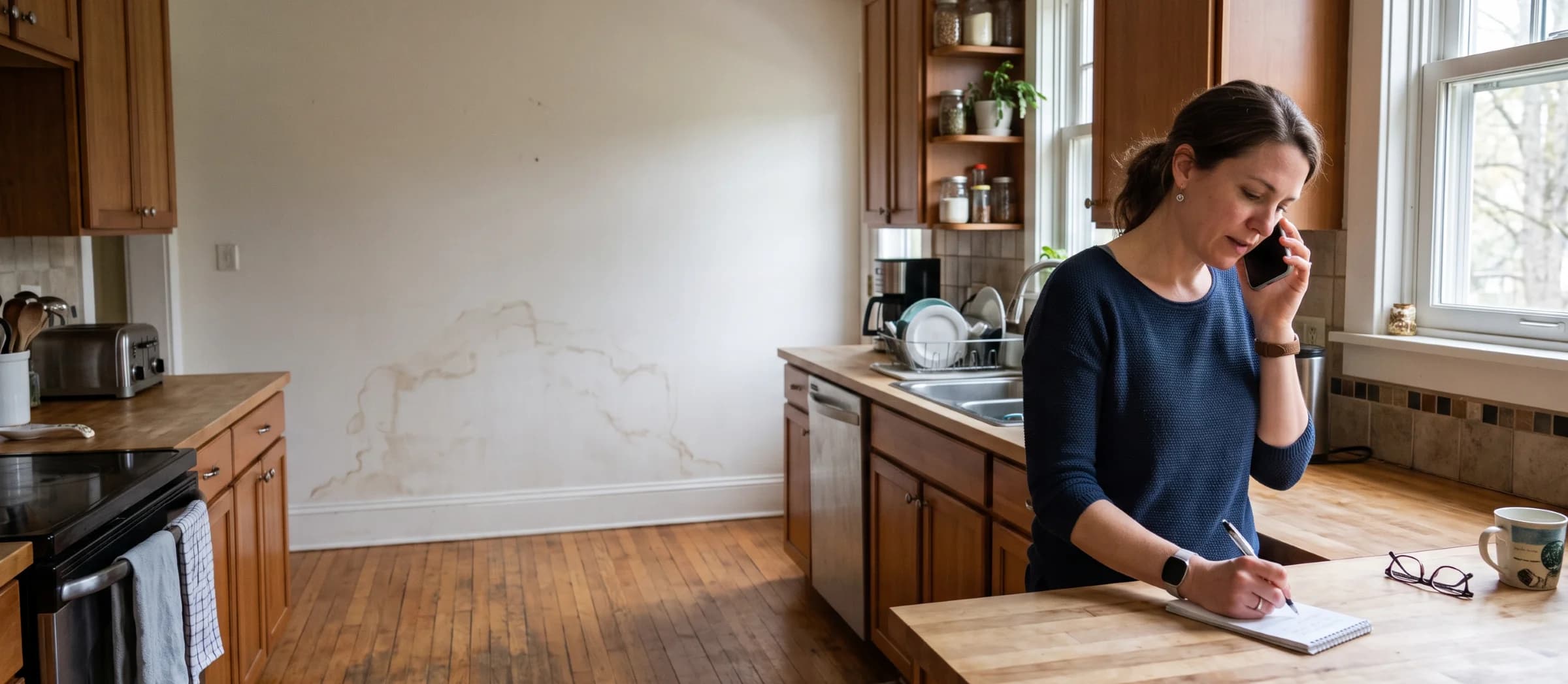

Water is still drying out of your carpet, and you have three companies to call with nothing to tell them apart but a phone number and a star rating. Price alone will not show you which crew documents everything your insurer needs or which one disappears halfway through the job. Ask the right questions at each stage, on the first call, when checking references, during the in-home estimate, on insurance and billing, and right before you sign, and you will hear the difference between a solid answer and one that should send you to the next name on your list.
Every legitimate water damage restoration company works from the same baseline standard, the IICRC S500, the Institute of Inspection, Cleaning and Restoration Certification's Standard for Professional Water Damage Restoration, which governs how technicians categorize water, verify drying, and document a job for your insurer. A company that knows the standard answers these questions with specifics. One that does not tends to answer in generalities.
If you're dealing with emergency water damage and haven't documented it yet, take photos and shut off the water source before making your first call.
Key insights
- Free inspections are common, free written estimates are not. Most companies inspect your property at no cost, but confirm on the first call whether the written estimate itself carries a fee.
- Certification belongs to the technician, not the company. Ask for the individual technician's IICRC credential and number, not just a general claim that the company is "certified."
- A legitimate estimate is itemized by category and class. A flat lump-sum number with no breakdown is harder to dispute if your insurer's adjuster comes back with a lower figure.
- Direct billing does not remove your responsibility to check coverage. A company can bill your insurer directly and your policy can still exclude the specific cause of loss.
- Category 3 water triggers OSHA's bloodborne pathogens standard, 29 CFR 1910.1030. Ask what personal protective equipment the crew uses on contaminated water, since this signals whether they follow safety protocol or cut corners.
- A valid state license number is never a hard question. A company with nothing to hide provides it immediately, unprompted, on the first call.
Why the questions you ask determine the outcome
The questions you ask determine whether you hire a company that follows IICRC S500 procedures and documents everything your insurer needs, or one that runs a few fans, hands you a lump-sum invoice, and leaves the drying unverified. Insurers routinely dispute invoices from companies that skip moisture-meter documentation, which can turn an already-approved claim into a homeowner's out-of-pocket dispute months later.
A water damage restoration job moves through extraction, drying, and repair in a matter of days, which leaves little room to switch companies once work is underway. Asking the right questions before a crew steps inside your home is the only real leverage you have, since once equipment is running and materials are removed, you are largely committed to that company for the rest of the job.
Questions to ask during your first phone call
The first call should confirm a company's licensing, IICRC certification, insurance, bonding, and availability before you invest time in a full in-home estimate. These questions take under five minutes and rule out unqualified companies immediately.
 Checking a company's state contractor license number and IICRC certification record before the first call takes a few minutes and can rule out unlicensed operators before they ever enter the home.
1. "Are you licensed to do restoration work in this state?"
Most states require some form of contractor registration for restoration work, and a legitimate company gives you a license number without hesitation. A vague answer, or a claim that licensing "doesn't apply" to restoration, is a reason to keep calling around.
2. "Are your technicians IICRC certified, and in which specific credentials?"
The baseline credential is IICRC's Water Restoration Technician, or WRT. A technician who cannot name their water damage restoration certifications on the spot likely does not hold one, and certification belongs to the individual, not just the company's marketing claims.
3. "Are you insured for general liability and workers' compensation?"
General liability protects your property if something is damaged during the job. Workers' compensation protects you from personal liability if a technician is injured while working in your home. Ask for both, not just one.
4. "Are you bonded?"
A surety bond is separate from insurance and gives you a way to recover money if a company fails to complete the job or does substandard work. Not every state requires it, but a company that carries one has an added layer of financial accountability behind its promises.
5. "How quickly can a technician arrive today?"
Structural materials that stay wet for more than 24 to 48 hours risk mold growth, according to the EPA, so response time is not just a convenience question, it directly affects your final cost and drying timeline. A specific arrival window is a good answer. "We'll get someone out as soon as we can" is not.
6. "Do you handle both mitigation and repair, or only water extraction?"
Some companies stop at extraction and drying, leaving you to find a separate contractor for drywall, flooring, and repairs. Ask how that handoff would affect how long water damage restoration takes to fully complete if the same company cannot carry the job through to completion.
7. "Is the initial inspection free, and is there a cost if I decide not to hire you?"
Most companies inspect for free, but not all. Confirm this before scheduling, since a first inspection should be free at a legitimate company, and any fee should be disclosed up front rather than added to an invoice later.
8. "Can you send proof of your license and insurance before you arrive?"
A company that can text or email a license number and a certificate of insurance within a few minutes is operating like a real business. One that stalls or changes the subject is worth a second look before you let anyone into your home.
Questions to ask for references
Reference questions confirm a company's track record once you have narrowed your first-call list to one or two finalists, checking recent, comparable jobs and any complaints on file with the state licensing board before you schedule an in-home estimate with either one.
 Photos from a company's actual past jobs are harder to fabricate than online reviews, and asking to see a set from a project similar in scope to yours is a faster credibility check than a star rating alone.
9. "Can you give me references from jobs like mine in the past year?"
Recent references matched to your type and size of damage tell you more than a list of names from several years ago. Ask specifically for contacts with a similar category and class of water damage.
10. "Do you have before-and-after photos from recent projects?"
Photo documentation from past jobs is a quick way to gauge the quality and thoroughness of a company's work before they start on yours.
11. "Has your company had any complaints filed with the state licensing board?"
Most state contractor licensing boards maintain a public complaint record. Asking the company directly, then verifying independently, tells you whether their answer matches the public record.
Questions to ask during the in-home estimate
The in-home estimate should confirm the water damage's category and class, the drying plan and equipment, materials requiring removal, crew and containment details, and how the company handles contents and vulnerable occupants. These questions confirm the technician is diagnosing the job correctly rather than guessing.
 A technician who names the water's IICRC S500 category and class during the walkthrough, rather than just pointing at visible staining, is basing the estimate on an actual assessment instead of a guess.
12. "What category and class is my water damage?"
Category refers to contamination level, from clean water to sewage as defined by the water damage categories, and class refers to how much moisture the affected materials absorbed. A technician who cannot name both after inspecting your property has not actually assessed the job, they are estimating from a glance.
13. "What is your plan for drying, and how long will it take?"
A specific plan names the number of air movers and dehumidifiers, the rooms they will cover, and a target number of days within the overall water damage restoration process. "A few days" with no supporting detail usually means the company has not measured moisture levels yet.
14. "How will you confirm the space is fully dry before you call the job complete?"
A legitimate company takes a final moisture-meter reading against a dry, unaffected reference point in your home rather than relying on a visual check. Ask for that reading in writing, since a callback for hidden moisture weeks later is one of the more common complaints against restoration companies.
15. "What equipment will you use, and how much of it will be running here?"
Under-equipping a job to save on rental costs is a common shortcut that extends drying time and increases the risk of secondary damage. Ask the technician to walk through exactly what will be placed in each affected room.
16. "Will you need to remove drywall, flooring, or other materials?"
Materials that absorbed water below the surface, like wet carpet padding or drywall behind a baseboard, often cannot be dried in place. Ask which materials are salvageable and which will need to be cut out and replaced.
17. "Do you handle my personal belongings, or is that a separate company?"
Some companies clean and store contents on-site, others pack out furniture and valuables to an offsite facility, and some do not touch contents at all. Ask which applies before assuming your belongings are covered by the same visit.
18. "How many technicians will be on site, and will the same crew return each day?"
A rotating crew with no continuity between visits often means inconsistent monitoring and gaps in documentation. Ask whether one technician will own your job from start to finish.
19. "Do you subcontract any part of this job?"
Subcontracted repair work is common and not automatically a problem, but you should know who is actually inside your home and whether that subcontractor carries their own insurance.
20. "How will you protect the parts of my home that were not damaged?"
Containment barriers, floor protection, and negative air pressure during demolition keep dust and contaminants from spreading to unaffected rooms. A technician with a clear containment plan has done this before.
21. "What precautions do you take if young children, older adults, or anyone with a health condition lives here during the work?"
Air scrubbers, negative air containment, and stricter dust control matter more when a vulnerable household member is present during demolition or drying. A company that has handled this before gives a specific answer, not a generic one.
22. "What is your plan if you find mold once work begins?"
Mold discovered mid-job means mold after water damage has already started, and it should trigger a documented change in scope, not an unplanned upcharge with no explanation. Ask how the company handles this before it happens, not after.
23. "How many projects this size have you completed in the past year?"
A company that mostly handles small leaks may not be the right fit for flood water damage across multiple rooms, and the reverse is also true. Match the company's typical job size to your actual damage.
Questions to ask about insurance and billing
The insurance and billing questions confirm whether the company bills your insurer directly, uses estimating software like Xactimate that adjusters recognize, and how it handles a gap between its quote and the adjuster's approved amount. Confirm these details before any invoice arrives so you know exactly what you owe out of pocket.
 A written estimate broken out by category and class, not a single lump sum figure, is what lets you check a company's math against what your insurer ultimately approves.
24. "Will you bill my insurance company directly?"
Direct billing means you are not covering the full cost out of pocket while a claim is processed, though you are still responsible for your deductible. Ask whether direct billing is standard practice or handled case by case.
25. "What documentation will you provide for my claim?"
Photos, moisture readings, and a written scope of work are standard documentation an adjuster expects to see. A company that cannot describe what it documents likely is not documenting consistently.
26. "Do you use Xactimate or similar software my insurer recognizes?"
Estimating software that insurers use internally tends to produce numbers adjusters accept with less back-and-forth. A company using its own unstructured pricing format may face more disputes over the final invoice.
27. "What happens if the adjuster's estimate is lower than your quote?"
Ask this before work begins, not after you receive a bill. A reputable company explains how it handles the gap, whether that means negotiating with the adjuster directly or discussing the difference with you first.
28. "Am I responsible for my deductible up front?"
Some companies collect the deductible at the start of the job, others invoice it later. Either is normal, but you should know which applies before work begins.
29. "Does my policy cover this specific cause of loss?"
Coverage depends heavily on the cause. Flood damage from rising exterior water is generally excluded from a standard homeowners policy and covered only through the National Flood Insurance Program.
A burst pipe is typically covered instead. Ask the company what they have seen insurers approve or deny for causes similar to yours, then confirm the specifics with your own adjuster.
Questions to ask about the estimate and contract
The estimate and contract should confirm itemized pricing by category and class, the payment schedule, warranty terms, and how the company handles a change order if additional damage turns up once work begins. Get all of it in writing while the terms are still negotiable, before you sign anything.
 Verbal promises about scope or price are not enforceable, so confirming the payment schedule, warranty term, and change order process are all written into this document is what actually protects you.
30. "Is the estimate written and itemized by category and class?"
An itemized estimate breaks the water damage restoration cost down by task and material rather than presenting one lump number. This is what protects you if a dispute comes up later with your insurer or the company itself.
31. "What is the payment schedule?"
Ask whether payment is due at specific milestones, such as after mitigation and again after repairs, or entirely upon completion. Get the schedule in writing before work starts.
32. "Do you offer a payment plan or financing if my insurance doesn't cover the full cost?"
Not every company offers this, but for large reconstruction jobs it is worth asking before you are stuck choosing between an out-of-pocket lump sum and delaying repairs. A same-day, straightforward answer, even if the answer is no, tells you the company has dealt with this situation before.
33. "Do you charge separately for mitigation and reconstruction?"
Mitigation, the extraction and drying phase, and reconstruction, the rebuild phase, are often priced and invoiced separately, sometimes by different crews within the same company. Confirm this up front so the total cost is not a surprise.
34. "What happens if you find additional damage once work begins?"
Hidden damage behind a wall or under flooring is a normal part of what to expect during water damage restoration, so ask how the company handles a change in scope, and insist that any change order be provided in writing before additional work or cost is added.
35. "Do you offer a warranty on the work, and for how long?"
A specific time period, commonly one to two years for workmanship, is a good answer. No warranty at all, or a vague "we stand behind our work" with no term attached, is not.
36. "What is the estimated completion date, and what happens if you miss it?"
Ask for a target date and what accountability exists if the timeline slips significantly beyond weather delays or supply issues outside the company's control.
37. "Can I get everything we've discussed in writing before you start?"
Verbal promises about scope, timeline, or pricing are not enforceable. A written estimate and signed contract are what protect you if something goes wrong.
Quick reference checklist
A quick reference checklist groups every question by stage, first call, references, in-home estimate, insurance and billing, and contract, so you can jot notes and compare answers now, and revisit the broader water damage restoration checklist once the work itself begins.
First call
Licensing, IICRC certification, insurance, bonding, response time, service scope, free inspection, and proof of credentials.
References
Recent, comparable references, before-and-after photos, and any complaints on file with the state licensing board.
In-home estimate
Category and class, drying plan, dry-confirmation method, equipment count, materials requiring removal, contents and pack-out handling, crew consistency, subcontracting, containment plan, precautions for vulnerable household members, mold contingency, and comparable job experience.
Insurance and billing
Direct billing, documentation provided, estimating software used, adjuster-gap handling, deductible timing, and coverage for your specific cause of loss.
Estimate and contract
Itemized pricing, payment schedule, financing options, mitigation-versus-reconstruction billing, change order process, warranty terms, completion date, and everything in writing.
Frequently asked questions
How many restoration companies should I get quotes from?
One quote is usually enough for a true emergency, since speed matters more than comparison shopping while water is actively spreading. For non-urgent repair work once mitigation is done, getting two or three quotes lets you compare scope and line items rather than just a bottom-line number.
Is it normal for a restoration company to ask for payment before starting work?
No, most legitimate companies do not require full payment up front. A deposit for materials on a large reconstruction job is sometimes reasonable, but a company demanding full payment in cash before any work begins is a red flag worth walking away from.
Can I negotiate the price with a water damage restoration company?
Rarely on insurance-covered mitigation work, since pricing typically follows standardized estimating software like Xactimate that adjusters expect. You generally have more room to negotiate on out-of-pocket repair and reconstruction costs, especially on scope rather than the per-unit price.
What if a restoration company refuses to give references?
That is a reason to call a different company. Established, licensed water damage restoration companies routinely provide references from recent jobs, and hesitation or outright refusal usually signals a lack of a real track record.
Can I choose my own restoration company, or does my insurer decide?
You can choose your own company. Insurers can recommend a preferred vendor list, but they cannot require you to use a specific company, and choosing your own does not affect your claim as long as the work is documented properly.
What should I do if a restoration company pressures me to sign immediately?
Slow down and get a second opinion before signing anything, especially if you have not yet run through the credential and contract checks in how to choose the best water damage restoration company. Legitimate mitigation work can typically start the same day without requiring an on-the-spot signature, and pressure to sign before you have read the estimate is a common tactic among storm-chasing crews.
How do I verify a technician's IICRC certification is real?
Search the technician's name directly in the IICRC's certification records rather than relying on a truck logo, a website badge, or a verbal claim. A legitimate technician can provide their certification number without hesitation.
What happens if I am not satisfied with the completed work?
Most legitimate companies will return to address documented issues at no additional charge, within the warranty period stated in your signed contract. Confirm those warranty terms before signing so you know exactly what recourse you have if a problem shows up after the crew leaves.
Sam Hickerson is the founder of RestoreAdvisor and writes consumer guides on mold remediation, water damage restoration, inspection, testing, and home recovery. His work focuses on helping homeowners understand costs, risks, and when to call a professional. He draws on guidance from the EPA, CDC, IICRC, and other authoritative sources to make complex home issues easier to navigate.