
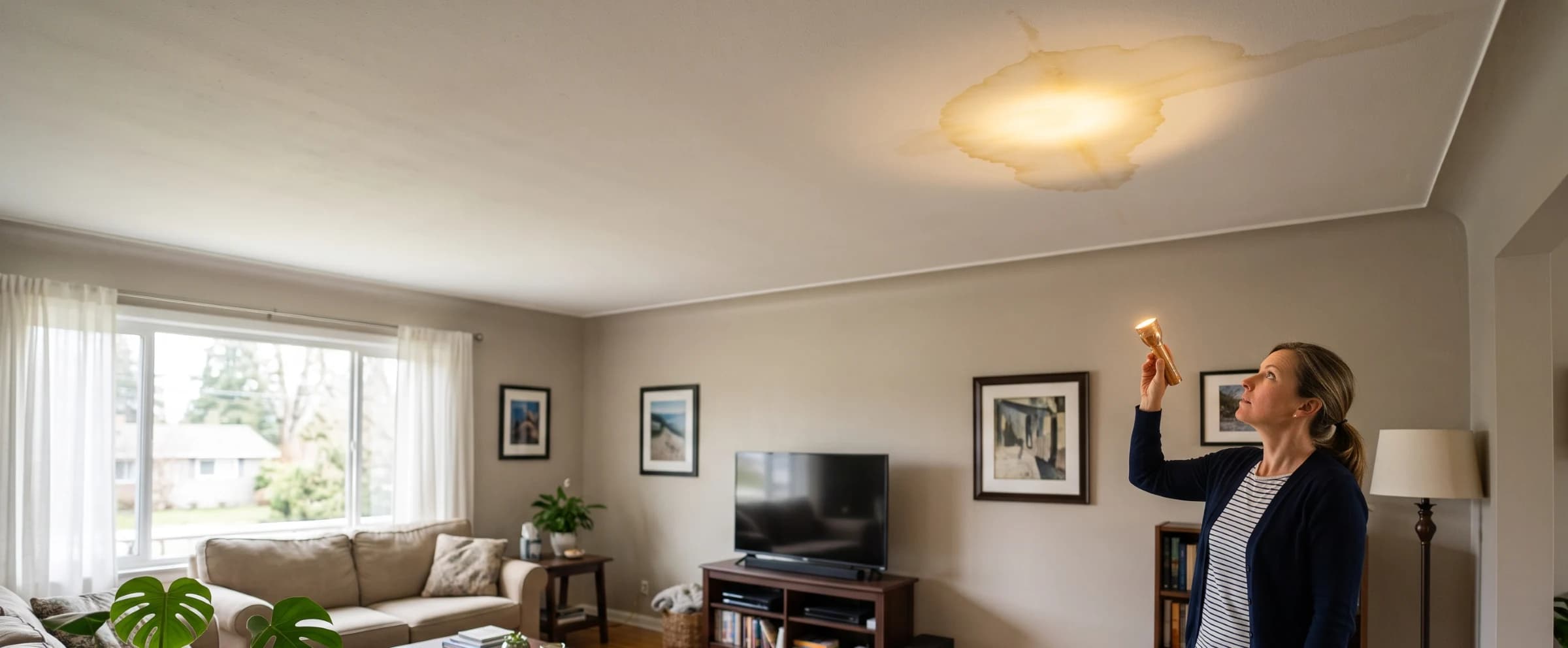

A water stain that showed up overnight, a musty smell that will not go away, or a spot on the floor that feels soft underfoot rarely comes with an explanation attached. Water damage tends to announce itself through small, easy to dismiss details rather than an obvious flood, which is exactly why the first sign is worth taking seriously instead of waiting to see if it happens again.
Water damage signs are the visible, audible, and measurable indicators that water has intruded into a home beyond what its materials are built to tolerate, a category of evidence the IICRC S500 standard treats as the starting point for any professional inspection. They show up by sense, by location, and by urgency, so matching what you are looking at to what it actually means starts with knowing where to look. Some signs are an early warning worth watching, and some mean water is actively spreading right now, so knowing which one you are looking at changes what you do next.
Key insights
- Mold risk starts fast. Materials that stay wet for more than 24 to 48 hours typically begin developing mold, per EPA guidance on indoor moisture.
- Your water bill can catch what your eyes miss. A bill that rises 20 percent or more without a change in household use often points to a hidden leak rather than seasonal variation.
- Moisture meters have a clear cutoff. Readings above roughly 17 percent in wood or drywall indicate active water intrusion, while dry material typically reads between 5 percent and 12 percent.
- Ceiling stains rarely mark the source. Water travels along the path of least resistance before it surfaces, so a stain often sits several feet from the actual leak.
- A smell can outrun the mold itself. A musty odor without any visible growth still signals trapped moisture and is worth investigating on its own.
- Texture changes mean time has passed. Sagging ceilings, bulging walls, and spongy flooring all indicate water has been present long enough to compromise the material, not a surface level issue.
What are the earliest signs of water damage in a house?
The earliest signs of water damage aren't always something you can see. A water bill that climbs without explanation, paint that bubbles or peels, a door or window that suddenly sticks, and a ceiling that starts to sag all show up before a leak becomes large enough to see running water, which is why it helps to keep a simple water damage restoration checklist of what to watch for, so catching one early keeps the eventual repair smaller.
 Paint typically bubbles once trapped moisture has broken its bond with the wall, a stronger indicator of an active leak than a stain alone.
A sudden change in your water bill
A bill that climbs without any added water use in the household often means a leak is running somewhere out of sight, sometimes before any visible sign appears at all.
Peeling or bubbling paint
Moisture trapped behind paint breaks its bond with the surface underneath, causing bubbles, flaking, or a texture that looks blistered.
A door or window that sticks or won't close properly
Wood door and window frames swell as they absorb moisture, so a door that suddenly drags on the floor or a window that won't latch the way it used to is often an early structural sign rather than normal settling.
Sagging or drooping ceiling
Drywall loses rigidity as it absorbs water, so a ceiling that dips in the middle usually means water is actively pooling above it.
A musty smell that will not go away
Standing moisture produces an earthy odor within a day or two, often before any visible staining appears.
Cracks in walls or a shifting foundation
Water that pools against a foundation for an extended period can cause the surrounding soil to expand and contract, which shows up as new cracking in walls, floors, or the foundation itself.
Signs you can see: stains, discoloration, and surface damage
Visible signs of water damage differ depending on how long the water has been present. A single day of exposure typically produces surface staining, while several weeks of exposure adds texture changes such as cracking, chalking, or crumbling material on top of the discoloration, often the point where a simple cleanup turns into full water damage restoration.
 Wood flooring cups when the underside absorbs moisture faster than the top, a sign the water has already reached the subfloor rather than sitting on the surface.
Not every stain is water damage still in progress. A stain with a hard, defined edge that stops spreading after a week or two is more likely old and already resolved, while one with a soft, feathered edge that grows noticeably after rain points to an active leak. Checking a suspect stain again after the next rainy day is one of the simplest ways to tell an old mark from a current one without cutting into the wall.
| Sign | Where it typically appears | What it usually means |
|---|---|---|
| Yellow or brown ring stains | Ceilings, upper walls | Slow leak from above, often a roof or plumbing line |
| Dark streaking below a stain | Corners where walls meet ceilings | Ongoing moisture wicking downward over time |
| White chalky residue | Basement or masonry walls | Water evaporating through concrete or brick |
| Green or black speckled patches | Corners, behind furniture, under sinks | Mold growth, indicating moisture present 24 hours or more |
| Cupped or crowned wood flooring | Near exterior doors, kitchens, bathrooms | Water absorbed into the subfloor from below |
| Rust colored spots on carpet | Edges of carpeted rooms | Water wicking up from a slab or subfloor |
| Rust or corrosion on metal fixtures | Pipe fittings, door hinges, HVAC vents, appliance connections | Sustained moisture exposure, often present for weeks |
Signs you can smell and hear
A musty, earthy smell is one of the most reliable early signs of water damage, since it develops from bacteria and mold spores multiplying in damp material within 24 to 48 hours, a window the EPA cites as the point where a moisture problem becomes a mold problem. Running, dripping, or hissing sounds coming from inside a wall or ceiling with no obvious source point to an active leak rather than a past one.
A smell that persists after normal cleaning, and especially one that intensifies in humid weather, is worth investigating even if nothing is visible yet. Mold can begin growing on a damp surface within this same window according to CDC: Basic Facts About Mold, which is why an odor alone is reason enough to check further rather than wait for a visible patch to appear.
Sounds are less common but more urgent. A hissing noise behind a wall usually means a pressurized supply line is actively leaking, while a dripping sound points to a slower drain or fixture leak. Either one is a reason to shut off the water at that fixture, or at the home's main valve, until the source is located.
Signs you can feel: soft spots, warping, and bulging surfaces
Water that has soaked into a material for days or weeks changes its texture before it changes its appearance, often once moisture content passes the same 17 percent threshold used to confirm active water intrusion elsewhere in a home, which is why touch catches damage before a visual scan does. Flooring that feels spongy, drywall that gives under light pressure, and walls that bulge outward all indicate saturation behind the surface.
 Drywall that dents or cracks under light pressure has already broken down its gypsum core, a stage past what a moisture meter reading alone would suggest.
Spongy or soft flooring
Carpet padding, subflooring, and laminate underlayment absorb water like a sponge, so a soft or squishy feeling underfoot usually means saturation well below what you can see.
Drywall that flexes or crumbles under light pressure
Dry drywall is rigid. Drywall that dents easily, feels damp, or crumbles at the edges has absorbed enough water to break down its paper and gypsum core.
Bulging or bowing walls
A wall that curves outward instead of sitting flat usually means water pressure or saturated insulation is pushing against the interior surface from behind.
Loose or lifting tile
Grout and adhesive lose their bond when the subfloor beneath them stays wet, so tiles that shift, crack, or sound hollow when tapped often sit above a hidden leak.
Room-by-room signs of water damage
Where a sign shows up narrows down its likely cause well before a professional inspection confirms it, since bathrooms, kitchens, basements, and attics each fail in different, predictable ways based on what runs through or near them. The room where a leak originates also often shapes its water damage categories under IICRC S500, since a supply line leak in a kitchen starts out as clean water while a slow leak near a toilet or sewer line typically does not.
 A worn wax ring or failed seal at the toilet base lets water seep beneath the flooring with each flush, damage that spreads under the tile long before grout discoloration reaches the surface.
A sign that shows up in more than one room at the same time is worth noting on its own. A ceiling stain in a hallway paired with warped flooring in the adjacent bathroom, for example, usually points to a single shared source, most often a leak at a floor joint or wall cavity the two rooms have in common, rather than two unrelated problems.
| Room or area | Common sign | Likely cause |
|---|---|---|
| Bathroom | Soft flooring near the toilet base or tub, peeling caulk | Worn wax ring, tub or shower pan seal failure |
| Kitchen | Warped cabinet flooring, bubbling in the toe kick | Sink supply or drain leak, dishwasher or ice maker line |
| Basement | Musty smell, chalky residue at the floor-wall joint | Groundwater seepage, foundation cracks, sump pump failure |
| Attic | Dark staining on the roof deck, wet insulation | Roof leak, ice dam, failed vent flashing |
| Ceiling below a bathroom | Yellow-brown ring stains, sagging drywall | Plumbing leak in the floor above |
| Laundry room | Pooling near the washing machine, warped flooring | Supply hose failure or drain line backup |
| Exterior walls | Bubbling paint, efflorescence, cracked siding | Poor grading, gutter overflow, flashing failure |
Exterior signs of water damage around your home
Exterior signs of water damage usually appear before interior signs do, since roofing, gutters, and grading are a home's first line of defense against water intrusion. Missing or curling shingles, gutters that overflow during rain, and soil that slopes toward the foundation instead of away from it all create conditions for water to reach the structure, often long before any repair is needed indoors at all.
 Debris blocking the gutter corner is forcing water over the side instead of down the downspout, sending it straight against the siding and foundation below.
Damaged or missing roof shingles
Curling, cracked, or missing shingles expose the roof deck underneath, and a single compromised section is often enough to let water into the attic during heavy rain, a common path to water damage from a roof leak.
Overflowing or clogged gutters
Gutters that spill over the side instead of channeling water to the downspout send water directly against the siding and foundation instead of away from it.
Negative grading near the foundation
Soil that slopes toward the house rather than away from it directs rainwater against the foundation wall, where it can seep through cracks or the joint where the wall meets the slab, a common contributor to foundation water damage.
Cracked or gapped siding and window flashing
Gaps around windows, doors, or siding seams let wind driven rain behind the exterior finish, where it can travel downward for a considerable distance before showing up as an interior stain.
Hidden water damage signs behind walls and under floors
Hidden water damage produces no visible sign on the finished surface itself, which is why a moisture meter or infrared reading is the only reliable way to confirm it. The most common hiding spots are behind tile, under flooring, and inside exterior wall cavities, where insulation holds moisture against the back of the drywall.
 A reading this far above the 17 percent threshold confirms active water intrusion even when the wall surface shows no staining, discoloration, or other visible sign.
A moisture reading above roughly 17 percent in wood or drywall means the material is still actively wet, while a healthy baseline typically falls between 5 percent and 12 percent depending on the material. How difficult that moisture is to remove, and how much equipment the job takes, is what the water damage classes system measures once a professional confirms the reading.
Moisture meter reading
A pin or pinless moisture meter, available for under $50 at most hardware stores, gives a numeric reading that removes the guesswork from a surface that only feels slightly damp.
Infrared thermal imaging
A thermal camera does not detect water directly, but it flags temperature differences in a wall or ceiling that often correspond to a wet area behind the surface, worth confirming with a moisture meter or professional inspection.
The tap test
Tapping along a wall or ceiling and listening for a dull or hollow sound compared to the surrounding surface can indicate softened material underneath, though it is far less precise than a moisture reading.
Some hidden water damage shows up in the people living with it before it shows up on a wall. Allergy symptoms or respiratory irritation that get worse indoors, particularly for household members with asthma, can appear before any visible sign as trapped moisture raises humidity in an enclosed space. A pattern where those symptoms ease away from home and return once someone is back inside is worth treating as a reason to check for a leak, not dismissing as a seasonal allergy.
Water bill and water pressure changes that signal a leak
A water bill that rises 20 percent or more without a corresponding increase in household use is one of the more reliable non-visual signs of a hidden leak, since it reflects water loss even when nothing looks wrong. A sudden, unexplained drop in pressure at a faucet or shower is the other common sign, caused by water escaping through a break in the line before it reaches the fixture, the same kind of failure behind most burst pipe water damage.
Both signs point toward the plumbing system rather than roof or exterior intrusion, and both are worth checking against a simple meter test: turn off every fixture and appliance in the home, note the water meter reading, wait 30 minutes without using any water, then check the reading again. Any movement on the meter during that window means water is escaping somewhere in the system, even if nothing is visible yet.
Signs that mean you have an emergency, not a slow leak
Active water that is currently spreading, standing water, a visibly dripping ceiling, or a supply line spraying into a room, is a sign of emergency water damage, and it calls for shutting off the water source immediately rather than waiting to schedule an inspection. A slow leak, by contrast, produces staining, odor, or soft spots that develop gradually and allow more time to plan a response.
 Water actively reaching a light fixture is an electrical hazard, not just a leak, and the power to that circuit should be shut off at the breaker before anyone touches the area.
If you see standing water, active dripping from a ceiling or light fixture, or a wall that is visibly wet to the touch, shut off the water at the fixture or the home's main valve, move anything valuable out of the affected area, and call a restoration company rather than waiting until morning. Every hour water sits on flooring or inside a wall adds to the water damage restoration process a professional needs to complete, since materials that could have been dried within the first 24 to 48 hours often need to be removed and replaced once saturation goes on longer than that.
Electrical hazards are the other reason speed matters in an active leak. Water anywhere near an outlet, light fixture, or electrical panel means the power to that area should be shut off at the breaker, not just the switch, before anyone attempts to clean up or even walk through standing water, a precaution OSHA's flood response guidance treats as a priority step rather than an afterthought.
Waiting on an active leak also affects the eventual bill. A leak caught and dried within the first day or two typically stays toward the lower end of water damage restoration cost ranges, while a leak left standing for a week or more often adds materials removal, mold remediation, and structural repair on top of the original mitigation.
How to confirm what you're seeing is water damage before you call a professional
A moisture meter reading above the dry baseline for the material in question is the most reliable way to confirm water damage without professional equipment, though a reading alone will not show the full extent of what is happening behind a wall or under a floor. Photographing the area, noting when the sign first appeared, and checking nearby plumbing or roofing for an obvious source all help narrow down whether the issue is isolated or ongoing.
 Dated photos of a stain's size and shape give a technician a baseline to compare against at inspection, which helps confirm whether the leak is still active or already resolved.
If self-testing turns up a reading above roughly 17 percent, or a sign keeps reappearing after you dry and clean the area, the next step is a professional inspection rather than continued DIY monitoring. A technician holding water damage restoration certifications such as IICRC's Water Damage Restoration Technician credential uses moisture mapping and category testing to determine the full extent of a leak, not just the spot where it happens to be visible.
Bring photos, the date the sign first appeared, and any water bill or pressure changes you have noticed to that inspection. This context helps a technician distinguish a new leak from an older, already resolved one, which affects both the diagnosis and whether the damage falls under an active insurance claim.
Not every company that answers the phone after a storm is equipped to do this well, and the fastest available appointment is not always the most qualified one. Verifiable certifications and a documented inspection process matter as much when choosing a water damage restoration company for a confirmed hidden leak as they do for an obvious flood.
Frequently asked questions
Can water damage be present without any visible signs?
Yes, water damage can be present with no visible signs at all, especially within the first 24 to 48 hours or in enclosed spaces like wall cavities, subfloors, and behind tile where a moisture meter is the only reliable way to detect it. A change in smell or in your water bill often shows up before any visual sign does.
How quickly do signs of water damage appear after a leak starts?
Signs typically appear within 24 to 48 hours for surface staining and odor. Hidden signs behind walls or under flooring can take days to weeks to surface visibly, depending on how enclosed the space is and how much water is involved.
Do all water leaks cause a noticeable spike in the water bill?
No, not every leak raises the water bill enough to notice, since a slow drip or a leak tied to an occasionally used fixture may only add a small amount to overall usage. A supply line break or a running toilet flapper typically produces a visible spike within a single billing cycle.
What color are water stains, and does the color matter?
Water stains typically appear yellow, brown, or copper colored, caused by minerals and tannins drying on the surface rather than by the water itself. A darker or larger stain generally points to more water or a longer exposure time, not a different type of leak.
Is a musty smell always a sign of mold, or just moisture?
No, a musty smell on its own means moisture, not necessarily mold, since the odor comes from microbial activity that can begin before mold is visible. The smell alone is reason enough to investigate further rather than wait for a visible patch to confirm it.
Can water damage cause health problems before mold appears?
Yes, elevated indoor humidity from an active leak can aggravate allergies and respiratory symptoms even before mold becomes visible, particularly for household members with asthma or other sensitivities. The EPA recommends addressing moisture within 24 to 48 hours specifically to reduce this risk.
How can I check for water damage behind drywall without cutting into it?
A moisture meter is the most practical way to check without cutting into drywall, since both pin and pinless models read moisture content through the surface. A thermal camera or a professional inspection are the next steps if a reading is inconclusive or the area is large.
Should I trust a DIY moisture meter reading, or do I need a professional?
A DIY moisture meter reading is reliable for a single, accessible spot check, but it will not map the full extent of a leak across a wall or floor the way professional equipment does. If a reading confirms elevated moisture, the questions to ask a water damage restoration company before hiring someone to look further are worth reviewing, since not every inspection is equally thorough.
Sam Hickerson is the founder of RestoreAdvisor and writes consumer guides on mold remediation, water damage restoration, inspection, testing, and home recovery. His work focuses on helping homeowners understand costs, risks, and when to call a professional. He draws on guidance from the EPA, CDC, IICRC, and other authoritative sources to make complex home issues easier to navigate.