
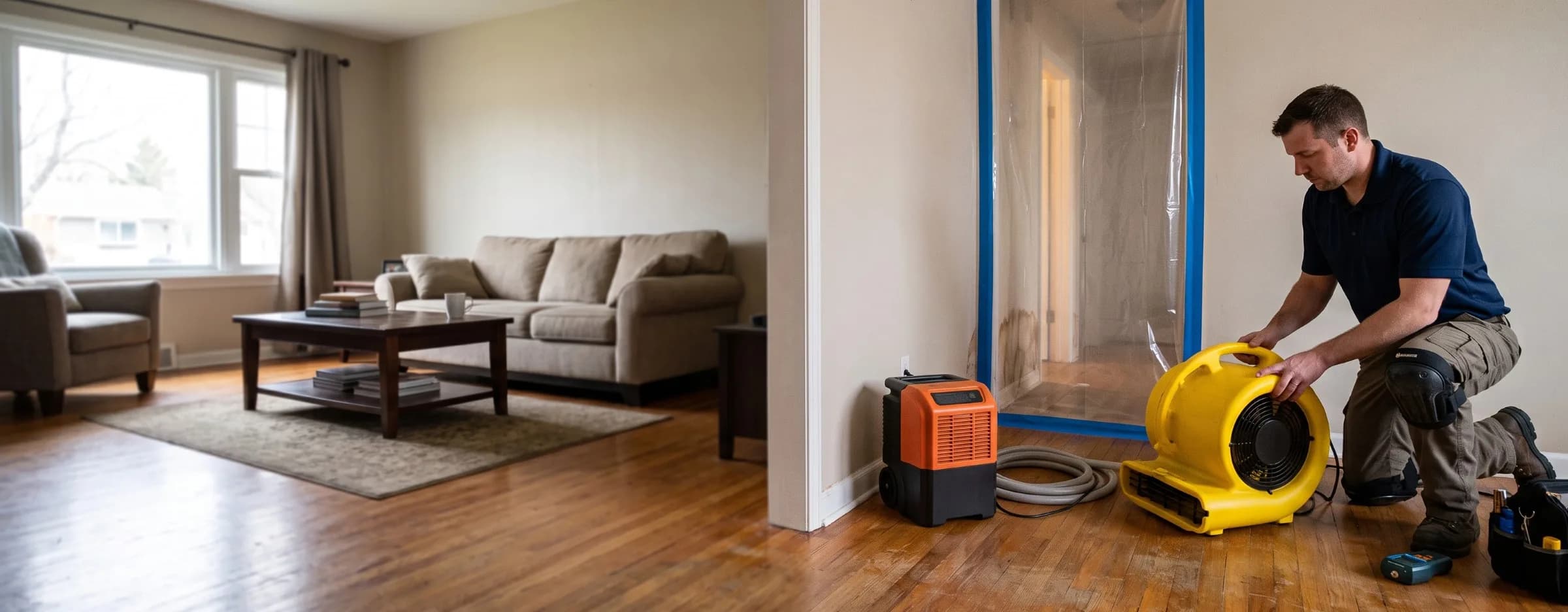

Whether a household can remain in the home during water damage restoration comes down largely to the water's contamination category and how much of the structure the loss affects, not the homeowner's preference. For most single-room, clean-water losses, the household stays home for the entire job.
For contaminated water, multi-room spread, or a compromised structure, relocation becomes necessary regardless of how the family would prefer to handle it. That determination follows the ANSI/IICRC S500 standard, the industry benchmark restoration companies use to classify a loss and decide how a job will run.
Key insights
- Staying home is the default, not the exception. A single-room loss from a clean source rarely requires anyone to leave.
- Category matters more than square footage. A small Category 3 loss can force relocation faster than a larger Category 1 one.
- Electrical and structural hazards override everything else. Standing water near a breaker panel or a sagging ceiling means leaving immediately, no matter the cause.
- Containment usually protects the rest of the home. Plastic sheeting and negative air pressure let a household use unaffected rooms while one area dries.
- Insurance pays for a hotel only when the home is documented as uninhabitable. Leaving by choice, for noise alone, usually isn't reimbursed.
- Mold risk sets the clock. The EPA's 24 to 48 hour window for microbial growth is one reason technicians push to dry a space quickly, whether or not anyone is staying in the home.
Can you stay home during restoration?
Most homeowners can stay in their home during water damage restoration. The exceptions are contaminated water, a structural hazard, or a loss large enough that the equipment and demolition take over rooms the household needs every day.
 Morning routines like this one usually continue uninterrupted since the water's IICRC S500 category, not the size of the sealed area, determines whether a household needs to relocate.
Restoration companies classify every loss two ways before deciding how a job will run: by category, which measures contamination, and by class, which measures how much of the structure absorbed water. A Category 1 leak from a supply line contained to a laundry room rarely changes daily life at all. A Category 3 sewage backup that reaches a finished basement is a different situation entirely, and staying home isn't a reasonable option until the contaminated materials are removed.
When you have to leave immediately
Two situations call for leaving the home right away: standing water near an electrical source and the smell of gas. A third, a sagging or bulging ceiling, means staying out of that specific room rather than evacuating the whole house, since the right response is a controlled release, not waiting it out.
 A bulging ceiling should be relieved with a controlled puncture rather than left to fail on its own, the same collapse mechanics covered under structural water damage.
Water anywhere near an outlet, an appliance cord, or a breaker panel creates a real shock risk, and OSHA's flood response protocol calls for cutting power at the breaker from a dry location rather than wading through standing water to reach a switch. This holds even for a switch or outlet that looks unpowered, since floodwater can carry current from a submerged appliance elsewhere on the same circuit.
A ceiling or floor section that has visibly begun to sag or bulge is carrying trapped water weight, the same mechanics behind structural water damage, and can fail without warning if left alone. Puncturing it in a controlled spot with a screwdriver, over a bucket, releases that weight safely; the room stays off-limits until that's done and a technician has checked the framing. If a gas odor accompanies the water event, evacuate the home and call the gas utility from outside before doing anything else.
A loss severe enough to trigger any of these hazards usually needs a same-day, emergency water damage restoration response rather than a standard scheduled visit. Lost utilities and losing access to the only bathroom are two of the more common reasons a stay-home job turns into a relocation, beyond these acute, immediate hazards.
What makes staying home safe
Four factors decide the stay-or-leave question on almost every job: the water's contamination level, how much of the home is affected, whether any immediate safety hazard exists, and whether the loss takes away access to a kitchen or the only bathroom. None of these factors work in isolation. A large area of Category 1 water is often more livable than a small area of Category 3 water, because contamination carries a health risk that square footage alone doesn't.
 A technician's first-visit reading, not a visual look at the damage, determines the water's category and class, the two factors that decide whether staying home is realistic.
A technician typically makes this call at the first inspection, but it isn't necessarily final. A source that looks clean at first glance can test differently once sampled, since water damage categories can shift from Category 1 toward Category 2 or 3 the longer contaminated water sits, and a job's scope can grow mid-project if a wall cavity turns out wetter than expected.
| Factor | Impact on staying | Who makes the call |
|---|---|---|
| Water category | Clean water usually allows staying; contaminated water usually doesn't | Restoration technician, based on source |
| Extent of the loss | One or two rooms is manageable; multi-room or multi-floor often isn't | Restoration technician, at inspection |
| Safety hazard | Electrical contact, sagging ceilings, or gas odor mean leaving immediately | Anyone in the home, right away |
| Access to essentials | Losing the only kitchen or bathroom usually forces relocation | Homeowner, based on household needs |
How water category affects staying
Category is the single biggest factor in the stay-or-leave decision, because it measures contamination rather than volume. Under IICRC S500, water is assigned to one of three categories, and that assignment changes what's reasonable to ask a household to live around.
 A clean source like a burst supply line keeps water at Category 1 under IICRC S500, the classification least likely to require leaving the home.
Category 1 water comes from a clean source, a supply line, a water heater, or rainwater, and it carries no meaningful health risk on contact. A burst pipe contained to one wall or one room is a textbook example of a job a household can stay home for from start to finish. Category 2 water, sometimes called gray water, carries some contamination, dishwasher discharge or an overflowing washing machine are common sources, and it calls for more caution around the affected area but rarely forces a full relocation on its own.
Category 3 water is grossly contaminated: sewage, floodwater, or water that has sat long enough to grow bacteria. A sewage backup reaching a living space is the clearest case where staying home isn't advisable until the contaminated materials are removed and the area is disinfected, regardless of how small the affected footprint looks. Category isn't always obvious from a visual inspection either, which is why a technician samples and classifies the water before recommending whether the household should relocate.
Water damage class and equipment
Class measures how much water a structure absorbed and how hard it will be to dry, and it determines how much equipment ends up running in the home. A Class 1 loss, water confined to part of one room with little absorption into materials, might need a single air mover and a small dehumidifier. A Class 4 loss, water trapped in materials like plaster, brick, or concrete, can require specialty equipment running continuously for a week or more.
Higher class numbers translate directly into more equipment, more noise, and a larger footprint the household has to work around. A household staying home through a Class 1 or 2 job barely notices the equipment outside the affected room. A Class 3 or 4 job, especially one spanning multiple rooms, is a much bigger daily presence, even when the water itself was clean. A technician determines the class at inspection using absorption and material type, tracked on water damage classes, and it can shift upward mid-job if hidden moisture turns up behind a wall.
Staying in part of your home
A loss confined to one floor or one wing of a home rarely requires leaving the whole property, since technicians can seal off the affected area and keep the rest of the home running on its normal air and utility supply. A finished lower level with basement water damage is the most common version of this: a household stays upstairs while the level below dries out, with a plastic barrier and negative air pressure keeping moisture and odor from spreading past the stairwell.
The same logic works in reverse for a loss confined to an upper floor or a single wing. Whether a partial stay works comes down to whether that section can be fully sealed off from the rooms the household still needs, including shared HVAC returns that could otherwise pull moisture or odor into the rest of the house.
Staying home phase by phase
Staying home looks different at each stage of the job: extraction is the most disruptive phase but the shortest, drying is the longest, and cleaning and repairs are usually the least restrictive. A straightforward single-room job typically moves from first visit to final walkthrough within one to two weeks, with drying accounting for most of that stretch.
 Drying is the longest phase of a job, typically 3 to 5 days for a contained loss, and the room stays off-limits until a moisture reading, not a visual check, confirms it's dry.
Extraction and the first day
The first visit is the most disruptive part of the job, and it's also the shortest. A technician removes standing water with pumps and extraction equipment, which means the affected room is off-limits while hoses and cords are in active use. Most households can use every other room in the home during this phase; the exception is a Category 2 or 3 loss, where containment barriers go up before extraction starts and the crew will direct you away from adjoining spaces until the source water is gone.
Drying, the longest stretch
Once standing water is out, air movers and dehumidifiers take over, and this is the phase that runs the longest, typically 3 to 5 days for a contained loss and considerably more for a higher-class job. Technicians push to keep this phase moving quickly in part because the EPA puts the window for mold growth on wet materials at 24 to 48 hours, whether or not anyone is living in the home during that stretch. The affected room stays closed off, but the equipment noise reaches into nearby rooms, which is usually the main disruption during this stretch rather than any access restriction. A technician takes daily moisture readings and won't clear a room for normal use based on how it looks; a section that reads visually dry can still test above 17 percent on a moisture meter, well above the roughly 15 percent baseline most materials need to hit before drying is considered complete.
Cleaning, repairs, and reconstruction
Once drying is confirmed, the household regains use of the space for cleaning and any repair work, though a room with exposed wall cavities or subfloor still isn't usable until framing and drywall go back in. This phase can stretch from a few days for a straightforward drywall patch to several weeks for a job involving flooring or cabinetry, with each stage broken out in equipment and timing detail on water damage restoration process. Total job length varies just as much by severity and material as each phase does: a single bathroom leak might wrap up in under a week, while a multi-room loss with flooring replacement can run past a month.
Living around the equipment
The drying equipment's noise and heat, more than any safety concern, are the biggest daily disruption of staying home, and both are temporary and manageable with a few adjustments. Air movers and industrial dehumidifiers run continuously and add a low mechanical hum to nearby rooms, and dehumidifiers in particular raise the temperature of the space they're working in by several degrees. Opening a window near the containment barrier to air out a room is one of the most common mistakes households make during this phase, since it introduces new humidity into a space the equipment is actively working to dry and can add days to the timeline. The added electricity draw is usually modest against a household's overall bill, since air movers and dehumidifiers are built for continuous, energy-efficient operation rather than the intermittent draw of typical appliances.
| What changes | Typical effect | What helps |
|---|---|---|
| Noise | Continuous hum from air movers and dehumidifiers | Close interior doors to the affected room; use a white-noise app for sleep |
| Heat | Nearby rooms can run several degrees warmer | Keep unaffected rooms' vents open and thermostat running normally |
| Air movement | Slight increase in dust as materials dry out | Wipe surfaces in adjoining rooms more often during the job |
Equipment left running is doing its job, and unplugging or moving it to quiet a room slows the dry time and can extend the whole job by days. If the noise or heat becomes hard to live with rather than just inconvenient, tell the restoration company; they can sometimes reposition equipment or adjust the containment barrier without compromising the dry time.
Is the air safe to breathe?
Yes, in nearly every case. The air in the rest of the home stays safe to breathe while air movers and dehumidifiers run, even continuously; an industrial smell and some dust from drying materials are the more common complaints, not a genuine air-quality hazard.
The exception is chemical or odor treatment, not the drying equipment itself. Antimicrobial and biocide products used on framing in Category 2 or 3 jobs are EPA-registered and applied directly to the material, not sprayed into the air, so they don't require leaving the home once applied and dried according to label instructions. Ozone generators are a different matter: they're occasionally used for a severe, lingering odor after the structure is dry, and ozone at the concentration these machines produce is not safe to breathe. A restoration company running an ozone treatment will ask everyone, including pets, to leave the treated room and any directly connected space for the treatment window, typically a few hours, and will ventilate the area before anyone returns.
Kids, pets, and vulnerable members
Children and pets should stay out of the affected room until it's confirmed dry, and household members with asthma, allergies, or a weakened immune system need extra distance from a Category 2 or 3 loss even when the rest of the family is staying home without issue. Symptoms in these groups also tend to surface faster than in the rest of the household, since dust and dampness affect sensitive airways first.
 Keeping children and pets out of the affected room, not just the equipment itself, is what the CDC identifies as the main precaution for sensitive household members during a job.
Children
Keep kids out of the affected room entirely, including during the drying phase, since exposed materials, cords, and running equipment all present hazards a young child won't recognize on their own. A closed door and a clear household rule are usually enough for a contained, single-room job.
Pets
Pets should be kept away from any room with active extraction, exposed wall cavities, or contaminated water, and a leash or crate in an unaffected part of the home works well during the noisiest first day. Once a room is contained and drying, most pets can be near it without issue as long as they can't reach the equipment or wet flooring.
Household members at higher risk
The CDC advises extra caution for infants, older adults, pregnant individuals, and anyone with asthma, allergies, or a compromised immune system during water damage cleanup, since prolonged dampness is more likely to trigger symptoms in these groups. If someone in the household falls into one of these categories and the loss is Category 2 or 3, or spans more than one room, it's worth discussing temporary relocation with the restoration company even if the rest of the household could reasonably stay.
Preparing your home to stay
A few adjustments before the crew's first visit make staying home noticeably easier: picking a room away from the equipment as a home base, protecting nearby belongings from dust, and having a backup plan if the affected space is a kitchen or laundry room. None of these take more than a few minutes, and doing them before the first visit means less scrambling once extraction equipment and cords are already in place.
 Covering open shelving near the containment barrier takes a few minutes and prevents fine drying dust from settling on belongings in adjoining rooms.
Choose a home base room
Pick the room farthest from the affected area, ideally on a different floor if the job is on a lower level, and treat it as the quiet zone for sleeping or working while equipment runs elsewhere. A closed door between that room and the containment barrier cuts most of the noise on its own.
Cover what's nearby, not just what's damaged
Drying materials release fine dust as they dry out, and it tends to settle in the rooms closest to the containment barrier rather than the room being dried. Covering open shelving or moving sensitive items out of adjoining rooms for the first few days keeps cleanup afterward to a minimum.
Plan around an affected kitchen or laundry room
A kitchen or laundry room that's part of the loss means adjusting daily routines around it rather than the whole home, a portable burner and a nearby laundromat cover most of the gap until that space is cleared for use again. Ask the technician at the first visit roughly when each fixture in that room will be usable again, since a sink or stove is sometimes cleared before the whole room is.
Keep a charged phone and a flashlight within reach
Equipment placement sometimes requires briefly cutting power to a room or outlet, and a charged phone and a flashlight nearby save a trip through an active work area in the dark. This matters most during the first visit, when extraction equipment and cords are still being set up.
Cost to stay vs. insurance
Staying home during restoration usually costs nothing beyond a modest, temporary bump in the utility bill from the drying equipment, separate from the water damage restoration cost of the repair itself, which runs the same whether or not the household relocates. Leaving costs considerably more, and whether insurance covers that cost depends entirely on whether the home is documented as genuinely uninhabitable, not on personal preference.
 Additional living expenses coverage only reimburses a hotel stay once the home is documented in writing as unsafe to occupy, not for a personal preference to avoid the noise.
This cost is tracked separately from the deductible on the structural repair claim, so staying home doesn't lower that deductible and relocating doesn't raise it. The two run through different parts of a policy, additional living expenses on one side and the dwelling or contents claim on the other, which is one reason an adjuster asks specifically whether a household stayed or relocated when reviewing a file.
| Scenario | Typical added cost | Insurance coverage |
|---|---|---|
| Staying home during a contained job | A modest increase in the electric bill from equipment | Not applicable; no relocation occurred |
| Choosing to leave for comfort, not safety | Full hotel and meal cost out of pocket | Rarely, without a documented habitability finding |
| Relocating because the home is uninhabitable | Hotel, meals above normal cost, sometimes pet boarding | Often, under additional living expenses coverage |
Additional living expenses coverage, sometimes labeled loss of use on a policy, reimburses the difference between normal household costs and the extra cost of living elsewhere while a home is being restored. According to NAIC, this benefit only applies once an adjuster or the restoration company documents that the home doesn't have safe access to essentials like a working kitchen or bathroom; a household that relocates purely to avoid noise typically pays that cost itself.
Policy limits and how insurers calculate the reimbursed amount vary by carrier, a distinction homeowners insurance and water damage walks through in more detail. Most policies cap the benefit at 12 to 24 months or a set percentage of the dwelling coverage limit, whichever comes first.
Keeping a log of which rooms were unusable and for how long strengthens a claim either way, whether the household stayed home or relocated. Photos, a written notice to the insurer, and a dated record are the habits that matter most.
Renters and staying home
A tenant's decision to stay home during restoration works the same way a homeowner's does, based on category, class, and safety, but the financial and legal side runs through the landlord and a renters policy rather than a homeowners policy. The property owner is generally responsible for the structural repair regardless of who caused the leak, while a tenant's own HO-4 policy, if one exists, covers loss of use for the tenant's own living costs, not the building itself.
A tenant who is asked to relocate for safety reasons should get that request in writing from the landlord or the restoration company, since it becomes the documentation that supports any reimbursement claim later. Repair-timeline expectations and who pays for what differ by state, a split laid out in full on water damage in a rental.
Signs to reconsider staying home
A worsening odor, a household member developing symptoms, visible mold, or a drying timeline that keeps slipping past its original estimate are all signs worth revisiting the decision to stay, even if the loss looked minor enough to stay home for at the start. Logging each one against a dated record makes a pattern easier to spot than relying on memory alone.
The odor is getting worse, not better
A musty or industrial smell in the first day or two is normal as materials dry out, but an odor that intensifies after equipment has been running for several days usually means moisture is still trapped somewhere it hasn't been found yet. Flag it to the restoration company rather than waiting for the scheduled recheck.
Someone in the household starts feeling unwell
New or worsening coughing, congestion, headaches, or skin irritation in anyone at home during the job is worth taking seriously, particularly for infants, older adults, or anyone with asthma or allergies, who the CDC identifies as more sensitive to prolonged dampness. Symptoms that start after the equipment goes in, not before, are more likely tied to the job than to something unrelated.
Mold becomes visible anywhere in the home
Any visible mold growth, on a baseboard, behind a piece of furniture, or on a surface the crew hasn't opened up, changes the job's scope and the staying-home calculation along with it. This goes beyond the routine dust and drying smell from the first few days; visible growth means calling the restoration company before the next scheduled visit, not waiting for it.
The drying phase keeps missing its estimated end date
A drying timeline that gets extended once is common and usually just reflects a wetter-than-expected material. A timeline that keeps extending past two or three rechecks without a clear explanation is a sign the scope may be larger than originally assessed, and it's a reasonable point to ask directly whether staying home still makes sense for the rest of the job.
Frequently asked questions
Can you stay in your home during water damage restoration?
Yes, in most cases. If the water is clean, the affected area is limited to one or two rooms, and there's no electrical or structural hazard, staying home is the norm rather than the exception.
How do you know if you have to leave your home during water damage restoration?
You have to leave when the water is contaminated, Category 2 or 3, when standing water has reached an outlet or breaker panel, when a ceiling or floor shows signs of sagging, or when the job removes access to your only kitchen or bathroom, the same triggers that shape the broader stay-or-relocate call in what to expect during water damage restoration. None of these need to wait for a scheduled visit; call the restoration company as soon as any of them shows up.
Will insurance pay for a hotel if I choose to leave during restoration?
Sometimes, through additional living expenses coverage, but only once the restoration company or adjuster puts in writing that the home isn't safe to occupy. Without that documentation, the cost is out of pocket even if the disruption feels significant.
Can I stay in my basement while water damage restoration happens upstairs?
Often yes, and the reverse works too. The one real caveat is egress: if the basement is the only exit from a bedroom or living space on that level, confirm with the crew that access stays clear during active extraction, not just that the levels are sealed off from each other.
Is it safe to sleep in a room next to one being dried out?
Usually yes, once standing water is gone and the room is contained. The bigger issue is noise from air movers and dehumidifiers, not air safety, unless the water source was contaminated.
Do I have to leave if the water damage is only in one bathroom?
No, not typically. A single-bathroom leak from a clean source is one of the most common scenarios where a household stays home for the entire job with no real disruption to daily routines.
How long do you have to stay away from a room being dried?
Usually 3 to 5 days for a contained loss, longer for a higher-class job. A brief, supervised trip in to grab a specific item is often fine, but the room isn't cleared for normal use, sleeping, storage, cooking, until the technician confirms it on a follow-up visit.
Can pets stay home during water damage restoration?
For most clean-water jobs, yes, once extraction is done and the room is contained. A Category 2 or 3 loss is the exception: pets need to stay clear of the treated area for the whole job, not just while extraction is underway, since any antimicrobial treatment stays off-limits until cleanup is finished.
Does staying home during restoration affect my insurance claim?
No, staying home doesn't reduce or complicate a claim on its own. What matters to an adjuster is documentation of the damage and the mitigation steps taken, the same documentation that matters when filing a water damage insurance claim.
Sam Hickerson is the founder of RestoreAdvisor and writes consumer guides on mold remediation, water damage restoration, inspection, testing, and home recovery. His work focuses on helping homeowners understand costs, risks, and when to call a professional. He draws on guidance from the EPA, CDC, IICRC, and other authoritative sources to make complex home issues easier to navigate.