
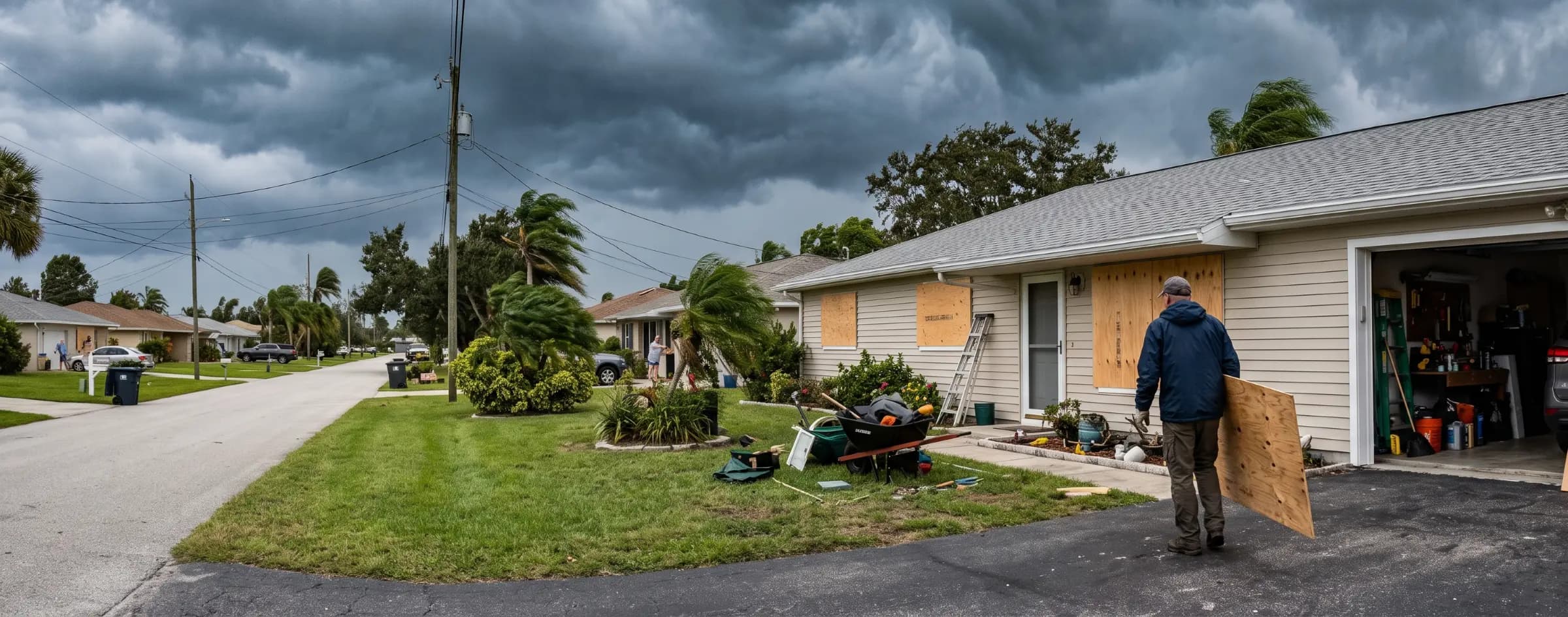

Water is sitting in your home after a storm, and the next few decisions matter more than most people realize, because storm and hurricane water damage rarely comes from a single source. Wind can drive rain through a broken window while, hours later, storm surge rises through the foundation of the same house, and your insurance treats those two events as completely separate claims.
Storm and hurricane water damage is water intrusion caused by a tropical storm or hurricane, arriving either as wind-driven rain through a wind-created opening or as storm surge and rising floodwater from outside the home, and the two are classified and insured differently under ANSI/IICRC S500 and standard homeowners policy language. That distinction, how the water got in, is what determines which policy pays and what restoration costs.
Key insights
- Two different perils, two different policies. Wind-driven rain is typically covered by a standard homeowners policy, while storm surge and rising floodwater require separate flood insurance, and a single hurricane often produces both.
- Named storm deductibles aren't your normal deductible. Once a storm is officially named, a separate deductible of 1% to 10% of your home's dwelling coverage value can apply instead of your standard flat-dollar deductible, per NAIC.
- Storm surge can raise water levels dramatically. Storm tide, the combination of storm surge and normal high tide, can reach up to 20 feet or more in extreme events, according to NOAA's National Hurricane Center.
- Power outages extend the mold-risk window. The usual 24 to 48 hour window before mold risk increases gets worse when a hurricane knocks out power to the air conditioning and dehumidifiers a home needs to dry.
- Combined claims need separate documentation. When wind and water both cause damage, insurers commonly assign different adjusters to each peril, so photos and moisture readings that clearly show which force caused which damage matter more than in a single-cause claim.
- Cost swings widely by peril, not just square footage. Wind-driven rain damage typically runs far less than storm surge flooding, since flood water usually reaches Category 3 contamination and requires far more material removal.
What to do right now
The first few hours after a storm or hurricane determine how much of your home you keep. Follow this sequence in order, since calling your insurer before confirming it's safe to reenter, or removing water before it's documented, can cost you more than it saves.
 Photographing a stain's full spread before cleanup begins gives an adjuster a timestamped baseline, which matters most once a home's wind and flood damage get split into separate claims.
1. Confirm it's safe to go back inside
Check for downed power lines, a gas odor, and standing water near outlets before entering, and wait for an official all-clear if your neighborhood was under evacuation. Many jurisdictions use a color-coded placard system after a major storm, green for safe to enter, yellow for restricted entry, red for unsafe, and a tag posted on your door takes priority over your own judgment. Just six inches of moving water can knock a person down, and a foot of fast-moving water can move a vehicle, so treat any standing water outside as a hazard rather than an inconvenience until you know its depth and current.
2. Cut power at the main breaker
Shut off electricity at the breaker panel if it's dry and reachable without stepping through standing water. Water conducts electricity well enough to cause serious injury even at a distance, which is why OSHA specifically warns against entering a flooded structure with live electrical circuits.
3. Board up or tarp openings if it's safe to do so
Cover broken windows, a missing section of roof, or a damaged door with plywood or a tarp to stop additional wind-driven rain from entering while you arrange a permanent repair. This single step often determines whether your damage stays a water damage restoration job or escalates into a full reconstruction.
4. Document everything before you touch anything
Photograph every affected room from multiple angles, close-ups of the specific damage source, and the exterior of your home showing the storm's condition. This documentation is what separates a wind claim from a flood claim later, and it's far harder to reconstruct after cleanup begins.
5. Call your insurer and a restoration company at the same time
Start your claim and schedule emergency water damage restoration in parallel rather than waiting for an adjuster to arrive first. Most policies expect you to prevent further damage, and drying delays after a storm compound fast when humidity is already elevated regionally.
6. Start removing standing water only if it's shallow and clean
Water under a few inches with no visible contamination can often be managed with a wet vac while you wait for help. Anything deeper, discolored, or carrying a sewage or chemical odor should be left to a professional with the right protective equipment, since Category 3 water calls for safety goggles, heavy-duty gloves, steel-toe boots, and waterproof, chemical-resistant clothing, gear most homeowners don't keep on hand, and the EPA warns that floodwater exposure can affect indoor air quality well after the water itself is gone.
What not to do
A handful of mistakes show up constantly after storms and hurricanes, and each one either raises your restoration bill or complicates your claim. Adjusters specifically look for evidence of these errors when evaluating a payout, so avoiding them protects your claim as much as it protects your home.
 A generator this close to an open garage can let carbon monoxide build up in the enclosed space behind it, one of the most common causes of storm-related CO poisoning.
Don't wade into water you can't see the bottom of
Floodwater hides downed wires, sharp debris, and open utility access points, and depth is deceptive in a dark or flooded room.
Don't wait for an adjuster before mitigating further damage
Most policies require you to take reasonable steps to prevent additional loss once it's safe, and a restoration company's arrival doesn't need to wait for a claim number.
Don't assume your homeowners policy covers all the water in your home
A single storm can generate both a covered wind claim and an excluded flood loss in the same house, sometimes in the same room, and treating the whole event as one claim is a common way homeowners underestimate their out-of-pocket cost.
Don't run a generator inside a garage or near an open window
Carbon monoxide from a generator can build up fast in an enclosed or partially enclosed space, and storm aftermath is one of the highest-risk periods for CO poisoning deaths nationally.
Don't throw away damaged materials before they're photographed and itemized
Adjusters and restoration companies both rely on seeing the damage in place, and discarding materials early is one of the most common reasons a claim gets underpaid.
Wind damage vs. flood damage
Wind-driven rain and storm surge are the two ways storms put water inside a home, and they're covered by two different insurance policies. Wind-driven rain is water pushed through a wind-created opening, like a broken window, a torn-off section of roofing, or a door blown open, and it's generally treated as wind damage under a standard homeowners policy. Storm surge and rising floodwater, by contrast, is a form of flooding that enters from outside the structure at ground level, and FEMA's flood definition excludes it entirely from standard homeowners coverage, requiring separate flood insurance through the NFIP or a private carrier.
 This is a wind-created opening under ANSI/IICRC S500, the detail that puts water like this on a standard homeowners policy instead of a flood policy.
This wind-versus-flood split surprises a lot of homeowners because it's counterintuitive: the same storm, sometimes the same afternoon, can produce water that's covered and water that's not, based entirely on how it entered the house rather than how severe the storm was. A homeowners policy typically covers wind-driven rain that continues for days through a wind-created opening, even though the opening itself only lasted a moment, while storm surge is excluded from the first drop regardless of how long it lingers.
| Peril | Typical source | What covers it | Water category |
|---|---|---|---|
| Wind-driven rain | Broken window, missing shingles, blown-open door | Standard homeowners policy | Usually Category 1 or 2 |
| Storm surge | Ocean or bay water pushed onshore by wind | Flood insurance (NFIP or private) | Category 3 |
| Rainfall flooding | Overwhelmed storm drains, rising rivers | Flood insurance (NFIP or private) | Category 3 |
| Downed tree on roof | Wind uprooting or snapping a tree | Standard homeowners policy (wind peril) | Usually Category 1 or 2 |
The category difference matters as much as the coverage difference. Wind-driven rain is usually clean or lightly contaminated water that falls under water damage categories 1 or 2, while storm surge is automatically Category 3 regardless of how clear it looks, since it's carried in from outside the structure and may pick up sewage, chemicals, or debris along the way. Storm surge is also historically the leading cause of hurricane-related deaths in the United States, according to NOAA's National Hurricane Center, which is part of why Category 3 water requires a professional response rather than DIY cleanup.
Filing a claim when a storm causes both types of damage
Hurricanes routinely cause both wind damage and flood damage in the same event, and insurers handle that combination through separate claims rather than one blended payout. The two claims move on different timelines and can reach different conclusions about the same room, which is why documentation from the first hours after the storm carries more weight here than in a single-cause claim.
 The tarp marks a wind claim, the waterline marks a flood claim, and this same house can carry both at once.
Named storm deductibles
Once a storm is officially named by the National Hurricane Center, a named storm deductible often replaces your standard flat-dollar deductible for that specific loss. Rather than a fixed amount like $1,000, this deductible is calculated as a percentage, typically 1% to 10% of your home's dwelling coverage value, so a $400,000 home with a 3% named storm deductible carries a $12,000 deductible before your insurer contributes anything, according to NAIC. Around 19 states currently allow named storm or hurricane deductibles, concentrated along the Atlantic and Gulf coasts, and the trigger, whether it activates at a hurricane watch, a warning, or landfall, varies by state and by policy.
When wind and water both cause damage
Adjusters determine coverage by tracing the sequence and source of each portion of damage rather than treating the whole loss as one event. If wind broke a window and rain entered through that opening, the resulting damage is typically a wind claim. If water rose from the ground after storm surge or heavy regional flooding, that portion is a flood claim, even if it happened during the same storm and even if it ends up in the same room. Because homeowners and flood insurers often use separate adjusters, disputes over which peril caused which damage are common enough that they've generated their own body of insurance litigation, and detailed timestamped documentation is frequently what settles them in the homeowner's favor.
Where storm and hurricane water comes from
Storms and hurricanes introduce water into a home through several distinct paths: wind-driven rain through a broken window or damaged roof, storm surge pushing seawater inland, downed trees puncturing the structure, and a sump pump failure during an extended power outage. Most major storm events involve more than one path at once, and identifying which one applies to your home changes both the water category assigned and which insurance policy responds.
 Water that enters a home from outside like this is automatically Category 3 under IICRC S500, regardless of how clean it looks once it recedes.
Roof and window failures account for most storm-related water intrusion nationally, since wind speeds well below hurricane strength are enough to lift shingles or shatter glass. Storm surge, by contrast, is geographically limited to coastal and low-lying properties within a mile or two of open water, so not every cause here applies equally to every home.
| Cause | How it happens | Typical peril | Water category |
|---|---|---|---|
| Wind-driven rain | Rain forced through a broken window, damaged roof, or open gap | Wind | 1–2 |
| Storm surge | Ocean or bay water pushed inland by hurricane winds | Flood | 3 |
| Downed tree or debris strike | High winds snap or uproot trees onto a roof or wall | Wind | 1–2 |
| Roof membrane or shingle failure | Sustained wind lifts or tears roofing material | Wind | 1–2 |
| Rainfall flooding | Storm drains and rivers overwhelmed by rainfall totals | Flood | 3 |
| Power outage disabling a sump pump | Extended outage stops the pump while groundwater keeps rising | Neither (mechanical) | 1–2 |
A roof leak is one of the most common single points of failure in a storm, since sustained wind uplift and flying debris both target roofing material before anything else on the structure gives way. Once the roof deck is breached, water travels the same path it would in any roof leak, down through insulation and drywall, but the volume during an active storm is usually much higher than a routine leak, since the opening stays exposed to hours of continuous wind-driven rain rather than a slow drip.
Downed trees and storm debris
A downed tree is one of the most common ways storm water damage starts, and it comes with a sequencing problem that wind-driven rain and storm surge don't have. If a tree lands on your roof or wall, removal usually has to happen before a roofer or restoration crew can safely access the damage, which means debris removal is often the first paid service on a storm claim rather than an afterthought.
 A branch resting on the roof like this has to come off before a restoration crew can safely access the breach underneath it, which is why removal is usually billed as its own line item.
Whose insurance pays for removal is more straightforward than most homeowners expect. Under most standard homeowners policies, your own policy covers removing a tree that damaged your structure, even if the tree grew on a neighbor's property, as long as it caused actual damage to a covered structure. A tree that falls in your yard without touching your house typically isn't covered, regardless of whose yard it came from. Removal cost runs $500 to $5,000 depending on the tree's size and whether it's resting on the structure or already on the ground, and it's normally billed separately from water damage restoration.
Clearing small branches and light yard debris is reasonable to do yourself, but a tree resting on a roof or wall should never be moved by a homeowner, since the structure underneath is often compromised in ways that aren't visible from the ground. That same boundary defines DIY water damage cleanup generally: material you can clear safely versus damage that needs a professional regardless of how minor it looks.
Categories and classes after a storm
Storm and hurricane damage is assessed using the same water damage categories and classes system used for every other cause, but a single storm job frequently spans more than one category and class at once. A bedroom with wind-driven rain coming through a broken window might sit at Category 1, Class 2, while the basement of the same house floods with storm surge and lands at Category 3, Class 4 within the same visit. This is unusual outside of storm events, since most other causes, like a burst pipe or a dishwasher leak, produce a single category and class for the whole affected area.
This dual use of water damage classes is one reason storm and hurricane jobs take longer to scope accurately than a single-source leak. A restoration company needs to classify each affected area separately rather than applying one classification to the whole home, and insurance documentation needs to reflect that split for the claim to process correctly.
Cost of storm and hurricane water damage restoration
Storm and hurricane water damage restoration typically costs $1,500 to $75,000 or more, depending far more heavily on which peril caused the damage than on square footage alone, since wind-driven rain and storm surge require very different scopes of work. A wind-driven rain claim in one bedroom can cost a fraction of what a storm surge claim costs in a same-size room, since the water category determines how much material has to be removed rather than simply dried in place.
 Tarping is billed as its own emergency line item, separate from the water damage restoration cost, since it has to happen before an adjuster even scopes the loss.
Costs also climb when a single job spans both perils, since a restoration company has to treat and dry the wind-driven rain portion and the storm surge portion as separate scopes within the same house. Regional demand during an active hurricane season pushes per-job costs higher too, since a widespread storm draws on the same limited pool of restoration crews and equipment that every other affected home nearby is also competing for. Large or multi-story homes with whole-structure flooding and a full roof replacement can push total cost past $100,000, especially when reconstruction competes for contractors against every other property damaged by the same storm.
| Scenario | Typical cost | What drives it |
|---|---|---|
| Wind-driven rain, single room | $1,500–$5,000 | Drying, minor drywall and flooring repair |
| Wind-driven rain, multiple rooms or attic | $5,000–$15,000 | Roof repair coordination, insulation replacement |
| Storm surge, partial home | $15,000–$40,000 | Category 3 material removal, extended drying |
| Storm surge, whole home | $40,000–$75,000+ | Full demolition, structural drying, reconstruction |
| Emergency board-up or tarp service | $300–$1,500 | Roof size, number of openings, material cost |
Two additional line items show up almost exclusively on storm and hurricane jobs and rarely on other water damage restoration cost estimates. Emergency roof tarping or board-up service is usually billed separately from the restoration work itself, since it happens before an adjuster or even a restoration company can fully scope the loss. Downed tree and debris removal is billed separately too, and it often has to happen before restoration work can even begin. The underlying pricing mechanics stay the same as any other cause once the category and class are determined, so a precise per-square-foot comparison follows the same logic across water categories.
The restoration process
Storm and hurricane restoration usually requires two contractors working in sequence rather than one, since roof or exterior repair and water mitigation are different trades with different timelines. The general restoration process of inspection, extraction, drying, and reconstruction still applies, but a storm job typically adds an emergency stabilization phase at the front, board-up or tarping, and sometimes runs two classification and drying tracks in parallel if both wind-driven rain and storm surge affected the same property.
Verifying credentials matters more on storm jobs than usual, since major hurricanes draw in out-of-town contractors and scam activity increases during regional disaster response. The same vetting checklist for choosing a water damage restoration company applies here, with one addition specific to storms: confirm the contractor is licensed to work in your state rather than one that just followed the storm in.
Avoiding storm chasers and contractor fraud
Unlicensed contractors follow hurricanes from region to region, and the FTC specifically warns that recovery scams reliably follow every major storm. These "storm chasers" often go door-to-door in the days right after a hurricane, before most homeowners have even heard from their insurer, and they rely on urgency to skip the vetting a homeowner would normally do.
A few red flags show up in nearly every version of this scam: demanding full payment upfront or in cash, pressuring you to sign a contract or an assignment of benefits form on the spot, offering to waive your deductible, and having no verifiable local address or license. A legitimate contractor will give you a written contract, proof of license and insurance, and time to review both before you sign anything. If someone refuses any of those three, that's reason enough to choose another company, regardless of how urgent your damage feels.
Preparing your home before hurricane season
The Atlantic hurricane season runs from June through November, and most of the prevention steps that reduce storm water damage need to happen before a storm is named, not after. Working through this list once before June, rather than scrambling once a storm is already in the forecast, is what actually keeps a home dry when the season arrives.
 Overhanging branches like this are one of the most common single points of failure in a storm, and trimming them back before hurricane season starts is far cheaper than debris removal after.
Have your roof inspected annually
A small gap in shingles or flashing is the difference between a dry attic and a Category 1 loss during sustained wind-driven rain, and it's one of the most effective single steps a homeowner can take, per IBHS.
Clear gutters and downspouts before the season starts
Clogged gutters push water toward the roofline and siding instead of away from the house, right when sustained rainfall is most likely to test every weak point.
Confirm your sump pump has a battery backup
A battery backup that can run through an extended power outage is what keeps groundwater from rising into a basement while the rest of the house loses power during the storm itself.
Trim trees with branches overhanging the roofline
Overhanging branches are a direct path for wind to drive debris into a roof section that would otherwise hold up fine on its own.
Review your named storm deductible and flood insurance status
Do this before hurricane season starts, not during an active storm watch, since most flood policies carry a 30 day waiting period before coverage begins.
Homes that lose power for extended periods during a storm face a longer mold-risk window than a typical leak, since air conditioning and dehumidification stop running exactly when humidity is highest. That extended window is what makes mold after water damage a bigger risk following a hurricane than after a routine leak, since the clock starts running before drying even begins. These hurricane-specific steps are a narrower, more urgent version of general water damage prevention, which applies the same underlying principles year-round.
Frequently asked questions
Does homeowners insurance cover hurricane water damage?
It depends on how the water got in. A standard homeowners policy typically covers wind-driven rain that enters through a wind-created opening, like a broken window or missing shingles, but it excludes storm surge and rising floodwater, which require a separate flood insurance policy through the NFIP or a private carrier.
Is storm surge covered by insurance?
No, not under a standard homeowners policy. Storm surge is classified as flood damage regardless of what caused the storm, and it's only covered if you carry separate flood insurance.
What is a named storm deductible?
A named storm deductible is a separate, higher deductible, usually 1% to 10% of your home's dwelling coverage value, that applies once a storm is officially named by the National Hurricane Center. It replaces your standard deductible for that specific loss.
How do I know if my damage was caused by wind or flooding?
Look at the water's path and timing. Water that entered through a roof, window, or wall opening created by wind is typically wind-driven rain, while water that rose up from the ground or a nearby body of water is flood damage. When both happen in the same storm, a restoration company's documentation and moisture readings become the evidence your adjusters use to sort out which peril caused which portion of the damage.
Can I file two insurance claims for the same hurricane?
Yes, and it's common. If your hurricane caused both wind damage and flood damage, you'll typically file one claim with your homeowners or wind insurer and a separate claim with your flood insurer, each evaluated by its own adjuster.
How long does storm and hurricane water damage restoration take?
A single room affected by wind-driven rain typically dries in 3 to 5 days. Whole-home flooding from storm surge can take several weeks once extraction, demolition, drying, and reconstruction are all factored in, and timelines often extend further when a hurricane also caused a regional shortage of restoration crews.
Should I file a claim for minor storm damage?
Not always. If the repair cost is close to or below your named storm deductible, paying out of pocket is often the better financial move, since a claim during an active hurricane season can affect future premiums and claims history even when the payout is small.
How much does storm and hurricane water damage restoration cost?
It typically costs $1,500 to $75,000 or more, depending far more on which peril caused the damage than on square footage. Wind-driven rain runs $1,500 to $15,000 in most cases, while storm surge flooding runs $15,000 to $75,000 or more, and a cost per square foot comparison is the most reliable way to estimate your specific scenario once the water category is known.
What should I photograph before starting cleanup?
Beyond the damage itself, capture anything that helps date and separate the two perils: a timestamp or a dated newspaper in frame, the source of entry (a specific broken window or roof gap) rather than just the standing water, and the exterior conditions at the time, since wind speed and surge height both factor into which policy an adjuster assigns the loss to.
How can I prevent storm and hurricane water damage?
Have your roof inspected annually, clear gutters and downspouts before hurricane season starts, confirm your sump pump has a battery backup, and trim branches overhanging the roofline. Reviewing your named storm deductible and flood insurance status matters just as much as physical prep, since coverage gaps are far harder to fix once a storm is already in the forecast. These hurricane-specific steps are a narrower, more urgent version of general water damage prevention, which applies the same principles year-round.
Sam Hickerson is the founder of RestoreAdvisor and writes consumer guides on mold remediation, water damage restoration, inspection, testing, and home recovery. His work focuses on helping homeowners understand costs, risks, and when to call a professional. He draws on guidance from the EPA, CDC, IICRC, and other authoritative sources to make complex home issues easier to navigate.