
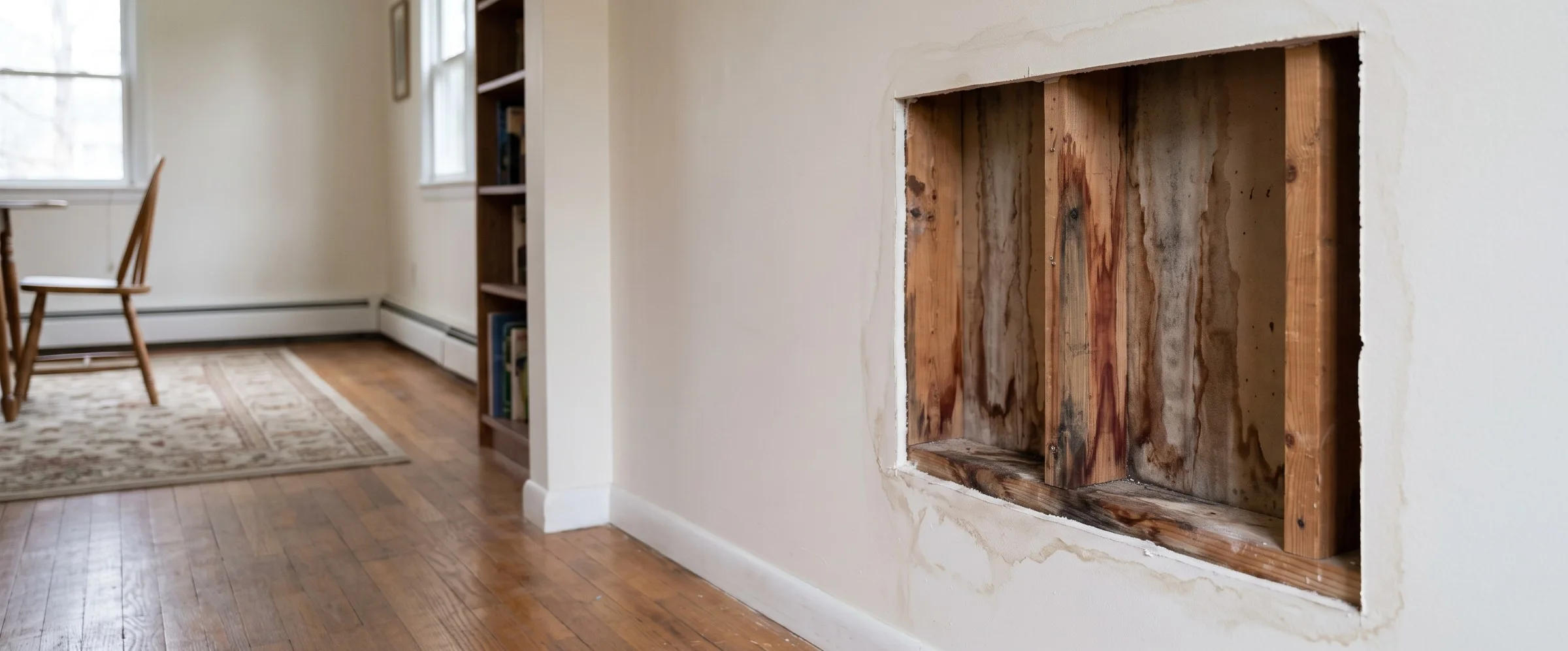

A sagging section of floor, a wall that's begun to lean, or a crack that keeps reopening after a patch job is a different problem than a stain that dries out and disappears. The first sends water into paint and carpet. The second sends it into the parts of the house holding everything up. Knowing which one you're looking at determines whether a drywall contractor can fix it or whether a structural engineer needs to sign off first.
Structural water damage is water intrusion that has reached a home's load-bearing components, framing, floor joists, subflooring, roof trusses, or foundation walls, rather than remaining confined to drywall, paint, flooring, or other finish materials. Under the ANSI/IICRC S500 water damage classification standard published by the IICRC, damage this deep in a structure typically falls into Class 3 or Class 4, the categories reserved for water that has been absorbed by low-permeance materials like framing lumber, concrete, and stone.
Key insights
- Structural vs. cosmetic. Water damage is structural when it reaches framing, joists, subflooring, or the foundation. Damage confined to drywall, paint, or carpet is cosmetic even when it looks severe.
- The quarter-inch threshold. A horizontal or stair-step foundation crack wider than about ¼ inch, or one that keeps growing, is a common trigger for a structural engineer visit rather than a simple patch.
- Permits usually required. Sistering a joist, repairing a foundation wall, or underpinning typically requires a building permit and inspection, and skipping that step can complicate a future home sale or insurance claim.
- Engineers, not contractors, make the call. A restoration company or general contractor can flag a likely structural issue, but only a licensed structural engineer can confirm the cause and specify a safe repair.
- Flooded homes face a compliance threshold. Under FEMA's 50 percent rule, homes in mapped flood zones where repair costs reach half the structure's market value must be rebuilt to current floodplain codes, not just restored.
- Cost spans widely by scope. Structural water damage repair ranges from a few hundred dollars for a single sistered joist to tens of thousands for foundation underpinning or a structural rebuild.
What counts as structural water damage
Structural water damage is any water intrusion that affects a component the house actually depends on to stay standing: floor joists, wall studs, roof trusses, subflooring, structural beams, or the foundation itself. Damage confined to paint, wallpaper, carpet, or a single sheet of drywall is cosmetic, even when it looks alarming, because none of those materials carry any of the building's load.
 Staining alone does not confirm decay; a moisture reading above roughly 20 percent under IICRC S500 is the threshold that actually signals active risk.
The distinction matters because the two problems get fixed differently and cost differently. A cosmetic repair means replacing a finish material once the area is dry. A structural repair means an engineer or a specialty contractor has to confirm the load-bearing member still carries its intended weight, and reinforce, sister, or replace it if it doesn't, before anything gets covered back up. As a category, water damage restoration includes both kinds of repair, but only structural damage requires an engineer's sign-off before the job is actually finished.
Wood framing loses strength as it absorbs moisture, not just once it's visibly rotted. Framing lumber becomes vulnerable to decay fungi once it reaches roughly 20 percent moisture content, the threshold IICRC S500 uses to flag active decay risk, and that breakdown of wood fiber can happen over a matter of weeks, well before any sagging is visible from inside the house. The International Residential Code's decay-protection requirements, under Section R317, exist for this exact reason: framing that stays in contact with damp conditions is expected to be treated or naturally decay-resistant, because sustained moisture is understood to compromise ordinary lumber over time. Steel connectors, joist hangers, and fasteners corrode on a similar timeline once they stay wet, and corroded steel loses grip strength while still looking intact from the outside. Concrete and masonry foundations respond differently: water doesn't rot concrete, but it dissolves and shifts the soil supporting it, which is why most foundation-related structural water damage traces back to what's happening in the soil rather than the concrete itself.
Signs of structural water damage
A handful of signs separate ordinary water damage from damage that has reached the framing or foundation: sagging or bouncy floors, walls or ceilings that visibly lean or bulge, doors and windows that stick or won't latch, and cracks that keep reopening after a patch. Any one of these on its own is worth a closer look, and two or more together is a stronger signal that a structural assessment, not just a drying-and-repainting job, is the right next step.
 The staining tracking below the crack shows water has been entering for a while, not from a single recent event, which is part of why a stair-step pattern like this is worth a professional look rather than a simple patch.
Not every sign carries equal weight. A single hairline crack or one sticking door is common in almost any home and rarely means anything structural on its own, but a cluster of signs appearing in the same room within a few months of each other is a different story. Location matters too: the same crack pattern reads differently on an exterior foundation wall than it does on an interior partition wall, since only one of the two is actually carrying the weight of the structure above it.
| Sign | Where it shows up | Why it matters | What to check |
|---|---|---|---|
| Sagging or springy floor | Living areas, over a crawl space or basement | Usually means a joist or beam has lost load capacity | Press against the joist from below if the underside is accessible |
| Bulging or leaning wall | Basement or foundation walls | Signals soil pressure or sustained water intrusion behind the wall | Hold a level or straightedge against the surface |
| Cracks wider than ¼ inch | Foundation, especially horizontal or stair-step cracks | Horizontal cracks under lateral pressure are far more serious than vertical settling cracks | Measure width with a crack gauge or a coin for reference |
| Doors and windows that stick | Anywhere in the house, worse near the affected area | The frame has likely shifted slightly out of square | Try several doors on the same level; more than one sticking is a pattern |
| Musty smell with no visible source | Near the affected framing cavity | Water and decay are active inside a wall or floor assembly, not just on the surface | A surface moisture reading won't catch this; ask for a probe reading instead |
| Fasteners backing out of drywall | Ceilings and walls near the water source | Framing has moved enough to push nails or screws loose | Look for a slight dimple or protruding head running in a straight line |
These structural indicators sit on top of the more general signs of water damage most homeowners already know to watch for: staining, discoloration, and warped flooring. The difference is what they're pointing to. General signs mean water got in; the signs above mean the water may have already cost the frame some of its strength. A musty smell with no obvious source is worth taking seriously on its own, since the EPA notes that mold growth can begin within 24 to 48 hours once building materials stay wet, which puts a hidden framing cavity on the same clock as any other saturated material.
Structural risk by water damage class
Structural risk rises with the water damage classes defined under IICRC S500, since each class describes how much of a room's material has absorbed water rather than just how much water is visible. Class 1 and Class 2 losses rarely threaten framing, because absorption stays under roughly 40 percent of the affected materials. Class 3 and Class 4 losses are where structural risk actually starts, because water has reached low-permeance materials like framing lumber, plaster, and concrete rather than staying in carpet and drywall.
 A reading of 21.8 percent crosses the roughly 20 percent threshold IICRC S500 treats as the point where decay risk becomes active, not just a stain that dried out.
A class rating isn't fixed at the moment water enters a room. Water that starts as a Class 2 loss can progress to a Class 3 or 4 rating within days if it isn't extracted, since the longer materials stay wet, the deeper the absorption reaches into subflooring, framing, and any concrete in contact with the water.
| Class | Absorption | Typical structural risk |
|---|---|---|
| Class 1 | Under 5 percent | Minimal; cosmetic materials only |
| Class 2 | 5 to 40 percent | Low; worth monitoring framing if water sat more than a day |
| Class 3 | Over 40 percent, often from overhead | Moderate to high; framing, subfloor, and ceiling joists commonly affected |
| Class 4 | Bound in low-permeance materials like concrete, hardwood, or plaster | High; specialty drying and often a structural inspection are needed |
A class rating on its own doesn't confirm structural damage, since it's a measure of how the water was absorbed rather than a verdict on whether framing has been compromised. It's a useful shortcut for deciding how urgently to escalate: a Class 3 or 4 loss in an area with visible framing exposure is reasonable grounds to request a structural opinion alongside the standard drying work.
What causes structural water damage
Most structural water damage traces back to one of a handful of sources: prolonged flooding, foundation water intrusion, a hidden leak that ran undetected, or a roof or drainage failure that reached framing before anyone noticed. Each one damages the structure on a different timeline, which affects how much warning a homeowner typically gets before the damage becomes serious.
 A slow drip like this can run for weeks before it surfaces as a visible stain, which is why a hidden leak often does more framing damage than a single sudden burst.
More than one cause is often present at once, particularly after a major storm, when wind-driven rain, a compromised roof, and overwhelmed drainage can all reach the same structure within the same event. Homes built before the 1990s carry an additional risk factor regardless of cause, since older framing lumber and foundation waterproofing methods generally have less inherent moisture tolerance than current materials and code requirements provide.
| Cause | How it damages the structure | Typical severity |
|---|---|---|
| Foundation water intrusion | Hydrostatic pressure and soil erosion undermine footings and foundation walls | Moderate to severe, usually progressive over months or years |
| Flooding | Prolonged submersion saturates framing, subflooring, and insulation below the waterline | Severe, especially past a few days of standing water |
| A hidden leak that ran for weeks or months | Framing stays at an elevated moisture content long enough for decay fungi to establish | Moderate to severe, worse the longer it went unnoticed |
| Sump pump or drainage failure | Repeated basement flooding saturates framing and undermines a slab from below | Moderate, cumulative across multiple events |
| A roof leak left unrepaired | Water travels into roof trusses, ceiling joists, and top plates before it reaches the visible ceiling | Moderate to severe, with real ceiling collapse risk |
| A burst pipe inside a wall or floor cavity | Water sits against framing inside the cavity for hours before anyone finds it | Low to moderate if caught within a day, higher after that |
| Storm and wind-driven water | Combines water intrusion with wind-load stress on the same framing members at once | Severe, and often layered with wind damage itself |
Two of these causes account for most of the structural claims a restoration company sees, starting with foundation water damage. It's usually a soil and drainage problem before it's a concrete problem, and it tends to progress slowly enough that homeowners have time to catch it before it reaches the framing.
Water from flooding works on a different timeline. A single event can saturate framing throughout an entire lower level within hours, which is why flood-damaged structures get evaluated on a different standard than a slow leak would be.
What happens if left untreated
Structural water damage gets measurably harder and more expensive to fix the longer it goes unaddressed, since both decay and soil movement compound rather than plateau. A crack or a soft spot that would have cost a few hundred dollars to repair in month one can require thousands by month twelve, once the framing has lost real strength or the foundation has shifted further out of position.
 Wood this far into decay no longer holds together under simple probing, a stage that typically takes a year or more of sustained moisture to reach, well past the point where sistering alone would be enough.
The exact timeline varies by cause and climate, but the pattern holds across nearly every case a restoration company sees: a hidden problem that surfaces early and gets addressed within weeks stays a repair, while the same problem left through multiple wet seasons tends to become a replacement. Humid climates and homes with poor drainage compress that timeline further, since the framing never gets a real chance to dry out between water events.
| Timeframe | What's typically happening | Repair scope at this point |
|---|---|---|
| A few weeks | Framing moisture content rises; early decay fungi may establish | Sistering or a spot repair, still relatively low cost |
| A few months | Decay spreads, fasteners loosen, and minor sagging becomes visible | Joist or beam replacement, subfloor sections |
| A year or more | Structural members lose meaningful load capacity; cracks widen; doors and windows shift | Multi-member replacement, possible foundation work |
| Multiple years, untreated | Load-bearing capacity is compromised enough to risk partial collapse | Major reconstruction, engineer-directed rebuild |
This progression is also why water damage restoration timelines vary so much between two homes with what looks like a similar amount of visible damage. One caught early is a drying job. One caught late is a rebuild.
What to do right now
If you suspect structural damage, stay off the affected area and cut power or water to it if either is actively present nearby, then document what you're seeing before calling a professional. A few careful steps in the first hour keep a bad situation from becoming worse while the right person gets scheduled.
 A dated photo like this becomes the reference point a structural engineer, contractor, and insurer will all ask for later, especially if the crack changes width before anyone gets a professional opinion.
1. Stay off and away from the affected area
Avoid walking on a floor that feels soft or bouncy, and keep everyone clear of a wall or ceiling that's visibly bulging or actively cracking further.
2. Cut power to the area if water is present
If water is actively reaching the space, cut power to it at the breaker before doing anything else. Wet framing near live wiring is a shock hazard, and the OSHA guidance on flood response treats this as a first step for good reason.
3. Photograph the damage from multiple angles
Wide shots that show the whole wall or floor, plus close-ups of any crack or gap, create a dated record that a structural engineer, a contractor, and an insurer will all ask to see.
4. Note when the sign first appeared and how it's changed
A crack that's stayed the same width for years reads differently to an engineer than one that's visibly grown over a few weeks. Write the date down now, since it's easy to lose track of once repairs start.
5. Call a structural engineer or a water damage restoration company
Call a restoration company if water is present now, and a structural engineer if the concern is about framing or foundation integrity specifically. Many cases genuinely need both, especially when water is still actively spreading, since that calls for the same emergency water damage restoration response any active leak requires, structural question aside.
Some signs warrant staying out of the area entirely rather than waiting for a scheduled inspection. These are the ones where the movement or intrusion is active rather than old and settled, which is the detail that actually separates an emergency from a routine call.
A floor that visibly sags or bounces underfoot
Treat this as an active load concern, not a cosmetic annoyance, until someone confirms the joists underneath are still sound.
A wall or ceiling that's actively bulging or bowing
Ongoing movement, rather than a static condition, is the detail that separates an urgent call from a routine one.
A cracking or popping sound coming from the framing
Audible movement in wood or framing connectors is a sign something is shifting in real time.
A door or window that has suddenly jammed shut
A frame that's moved enough to jam a door in the last day or two points to active structural movement, not old settling.
Water actively entering through a new or widening crack
Fresh water entering through a crack means the problem is still active, not one that already stabilized.
Who to call for structural damage
The right professional depends on what you're trying to confirm. A restoration company handles water extraction and drying, a general contractor handles repairs once the scope is defined, and a structural engineer determines whether a load-bearing component is actually compromised. Getting the order right matters, since a contractor who patches over a joist that was never evaluated can end up covering a problem instead of fixing it.
 A restoration technician can flag likely structural concerns like this staining pattern, but confirming the framing still meets code typically requires a licensed structural engineer's sealed report.
Many established restoration companies keep a structural engineer on referral for exactly this reason, since the two professions run into the same handoff repeatedly. A homeowner working with a restoration company that already has that relationship in place typically gets an engineer scheduled faster than one starting the search from scratch after the fact.
| Professional | What they actually do | Call them when |
|---|---|---|
| Water damage restoration company | Extracts standing water, dries the structure, and documents moisture readings | Water is present now, or was recently, regardless of whether structural damage is suspected |
| Structural engineer | Inspects load-bearing components, calculates whether they still meet code, and issues a signed report | A sign points to compromised framing, foundation movement, or a beam or wall that no longer reads level |
| General contractor | Carries out the repair once the scope is defined: sistering joists, pouring a footing, reframing a section of wall | The engineer's report specifies what needs to happen, or the damage is clearly cosmetic from the start |
For the restoration side of the job, the same standards apply as choosing a water damage restoration company for any other cause: licensing, insurance, and a written scope of work before anything begins. On the engineering side, look for a state-licensed structural engineer, a PE rather than a general home inspector, with experience in residential water-damaged framing specifically, and ask for a signed, sealed report rather than a verbal opinion. Insurers and any future buyer will both want that document on file.
How professionals assess the damage
Assessing structural water damage starts with a moisture reading, not a guess. Under IICRC S500's drying benchmarks, a pin or pinless meter reading above roughly 17 to 20 percent in framing lumber signals active saturation, while a reading under 15 percent generally means the wood has dried enough that decay risk has passed. A technician or engineer pairs that reading with a visual and physical check: pressing on the suspect area, sighting down a wall or floor for visible deflection, and confirming whether a surface that should read level actually does.
Some of the hardest cases to assess are the ones with no visible source at all. A slab leak can run for months underneath a foundation before a warm spot or a rising water bill gives it away, and by that point an engineer may need a core sample to confirm the slab and any adjacent framing are still sound.
A roof leak causes a similar problem from the opposite direction: water travels along roof sheathing and rafters before it ever shows up as a ceiling stain, so the visible damage is often smaller than what's actually happened above it. In both cases, the engineer's job is to trace the moisture path back to its source rather than treating the visible symptom as the full extent of the problem.
Termite and pest risk
Prolonged structural moisture attracts termites and other wood-destroying insects, in addition to weakening the wood directly. Softened, partially decayed wood is easier for termites to chew through than dry, sound lumber, which means a structural water problem left unaddressed can also become a pest problem.
Subterranean termites in particular need consistent ground moisture to survive, which makes a chronically damp crawl space, basement, or foundation perimeter one of the more common places for an infestation to take hold undetected. A structural inspection triggered by water damage is a reasonable moment to ask for a termite and wood-destroying-insect check at the same time, since the same crawl space or foundation area that's already been opened up for a moisture assessment is the easiest place to look.
Cost to repair structural water damage
Cost to repair structural water damage typically runs $350 to $20,000 or more, and the deciding factor is almost always how much of the structure has to be opened up, not how much water was involved. A single sistered joist and a patched section of subfloor cost far less than a foundation that has to be underpinned.
 Sistering, bolting a new joist alongside the damaged one, keeps the original in place and typically runs a few hundred dollars per joist, far less than a full structural replacement.
Structural repair costs also sit on a separate line from the water extraction and drying phase of the job, even when the same event caused both. A homeowner might see a mitigation invoice of a few thousand dollars for drying equipment and moisture monitoring, followed by a second, unrelated invoice from the contractor or engineer once the structural scope is confirmed.
| Repair scope | Typical cost | What it involves |
|---|---|---|
| Sealing a hairline foundation crack | $150–$400 | Epoxy or polyurethane injection, no structural reinforcement needed |
| Sistering a damaged floor joist | $150–$325 per joist | Bolting a new joist alongside the compromised one instead of replacing it |
| Replacing a floor joist | $350–$1,000 per joist | Full removal and replacement when sistering isn't enough |
| Subfloor replacement | $500–$7,000 | Depends on square footage and whether flooring above needs to come up too |
| Foundation wall crack repair or bracing | $75–$8,400 | Ranges from a simple crack injection to carbon fiber straps or wall anchors |
| Foundation underpinning | $7,000–$30,000+ | Piering or helical piles to stabilize a foundation that has actually settled |
| Full structural rebuild after collapse | $20,000–$75,000+ | Rare, but the outcome when framing or a foundation failed completely before anyone caught it |
A single point of failure is usually the cheapest scenario to fix, since the damage stays contained to one area. A burst pipe caught within a day usually means one or two sistered joists and a subfloor patch, often under $2,000 total.
A structure that's absorbed water from repeated sump pump failure over several events tends to cost more, since the framing and slab have been through more than one saturation cycle by the time anyone calls a professional. Each cycle adds a bit more moisture the wood never fully sheds, which is part of why repeat basement flooding is harder to price accurately than a single, contained event.
Permits and inspections
Most structural repairs require a building permit and a follow-up inspection before the work is considered complete. A contractor's word that the job is done isn't sufficient on its own in most jurisdictions. Sistering or replacing a joist, repairing a foundation wall, and underpinning all typically fall under a jurisdiction's building code rather than being treated as routine maintenance.
Skipping the permit step can create problems well beyond the repair itself. Unpermitted structural work is a common reason a home inspection flags an issue during a future sale, and some insurers can decline a related future claim if the original repair was never inspected and approved. Asking a contractor directly whether permits and inspections are included in their quote is worth doing before signing anything.
Does insurance cover structural damage
Homeowners insurance covers structural water damage the same way it covers any other water damage, through the sudden-and-accidental standard rather than a separate structural clause. A burst pipe that damages framing is typically covered under dwelling coverage the same as a burst pipe that only reaches drywall, while gradual damage from a slow leak the homeowner knew about or should have caught earlier is typically excluded regardless of how far it spread.
 Collapse coverage under a standard policy is narrow, typically limited to causes like hidden decay or the weight of rainwater, which is why documentation matched to a specific cause matters more here than in an ordinary water damage claim.
Actual collapse of a building, or part of one, is usually handled under a separate collapse provision within the policy rather than the general water damage language. Standard policies extend collapse coverage to a narrow list of causes: hidden decay, the weight of rainwater, weight of contents, and defective construction methods among them, according to NAIC's consumer guidance on how these provisions are typically written. Collapse caused by flooding is treated differently. It falls under the same flood exclusion that applies to any other flood-related loss, which is why a home in a mapped flood zone needs a separate flood policy to cover structural failure from rising water.
Flood zones carry one more wrinkle worth knowing before repairs start. Under FEMA's 50 percent rule, a home in a mapped Special Flood Hazard Area where repair costs reach half the structure's pre-damage market value has to be rebuilt to current floodplain codes rather than simply restored, which can mean elevation or other changes well beyond fixing the framing itself. Local building officials trigger this determination, not insurers, which makes it a separate hurdle from the insurance claim itself.
Home value and resale
Structural water damage affects home value primarily through disclosure and buyer perception rather than a fixed percentage discount. A documented, professionally repaired structural issue with permits and an engineer's report on file reads differently to a buyer than an undocumented crack a seller hopes nobody asks about.
Sellers in nearly every state are required to disclose known structural issues, including past water damage that reached the framing or foundation, even after the repair is complete. Whether a repaired structural issue still counts as material, and what happens if a seller skips disclosing it, depends on state-specific rules for how you disclose water damage when selling a home, since the standard isn't the same everywhere.
Preventing structural water damage
Preventing structural water damage comes down to keeping water away from framing and foundations before it has a chance to sit and compound. Grading that slopes away from the foundation, a sump pump that gets tested rather than assumed to work, and prompt attention to any small leak all keep water from ever reaching the load-bearing parts of the house.
 A pump that fails silently during a storm is one of the more common ways repeated basement saturation ends up undermining a slab, which is why testing it before wet season matters more than assuming it works.
The broader system of water damage prevention, gutter maintenance, pipe insulation, appliance hose checks, and shutoff valve awareness, catches most of these problems well before they reach a joist or a foundation wall. A handful of habits matter specifically for structural risk, beyond the general prevention list.
Walk the foundation perimeter once a year
Check for new cracks, efflorescence, or soil pulling away from the foundation, ideally right after the wettest season your area sees.
Test the sump pump before wet season, don't just assume it works
A pump that fails silently during a storm is one of the more common ways repeated basement saturation ends up undermining a slab.
Keep grading and downspouts extended away from the house
Directing water away from the foundation is the single largest lever most homeowners actually control, and it costs nothing beyond a downspout extension.
Address a hidden leak within days, not months
Framing that dries out within a week or two rarely reaches the moisture content where decay becomes a structural concern.
Have a previously repaired area re-inspected if new signs appear nearby
A foundation section or joist that was patched years ago is worth a second look before assuming a new crack or soft spot is unrelated.
Frequently asked questions
Is all water damage structural?
No. Most water damage stays confined to drywall, paint, flooring, or carpet and never reaches a load-bearing component. Structural water damage specifically means the water reached framing, joists, subflooring, or the foundation, which is a smaller subset of water damage overall.
How can I tell if water damage is structural or just cosmetic?
Check whether the affected material is load-bearing. A stained ceiling tile or discolored drywall panel is cosmetic. A floor that feels soft or springy underfoot, a wall that's visibly out of plumb, or a foundation crack wider than about a quarter inch points toward structural involvement and is worth a professional look before any cosmetic repair happens.
Can water damage actually cause a house to collapse?
Yes, though full-building collapse is rare. Partial collapse, a section of ceiling giving way under saturated insulation, a deck or porch floor failing, or a section of foundation wall buckling under soil pressure, is the more common outcome, and it's exactly the scenario collapse coverage in a homeowners policy is written to address.
Does homeowners insurance cover structural damage from water?
Sometimes, depending on the cause. A sudden and accidental source like a burst pipe is typically covered under dwelling coverage even if the damage reached the framing, while gradual damage from a long-term leak is typically excluded. The same homeowners insurance and water damage rules apply regardless of whether the damage reached the framing, and structural damage from flooding falls under flood insurance rather than a standard homeowners policy.
How much does it cost to fix structural water damage?
Typically $350 to $20,000 or more, depending entirely on scope. Sistering a single joist can run a few hundred dollars, while foundation underpinning or a multi-joist subfloor replacement runs into the thousands.
Do I need a structural engineer, or can a contractor handle it?
A structural engineer needs to confirm the diagnosis first if there's any real chance the damage is structural. A contractor can carry out the repair once the engineer's report defines the scope, but a contractor working without that report is making an assumption about load capacity that isn't theirs to make.
How long can wood framing stay wet before it's structurally compromised?
There's no single deadline, but risk builds quickly once framing lumber sits above roughly 20 percent moisture content. Decay fungi can establish within a few weeks under those conditions, and the weight of standing or trapped water adds its own acute stress well before any rot becomes visible.
Can a sagging floor from water damage be fixed without replacing the whole floor?
Often yes. Sistering, bolting a new joist alongside the damaged one, resolves most cases where the joist has lost some strength but hasn't failed outright, and it costs considerably less than a full floor replacement.
What is FEMA's 50 percent rule, and does it apply to my situation?
It applies only to homes in a mapped flood zone. If repair costs reach half the home's pre-damage market value, local building officials require the structure to be rebuilt to current floodplain codes rather than simply restored, which can add scope well beyond whatever your storm and hurricane water damage coverage pays out for the damage itself.
Should I keep living in the house if I suspect structural damage?
It depends on severity, and a structural engineer's assessment is what actually answers that question. Stay out of any specific area that feels unstable or shows active movement while waiting for that assessment, since surface-level caution is reasonable even before a professional confirms how serious the underlying problem is.
Sam Hickerson is the founder of RestoreAdvisor and writes consumer guides on mold remediation, water damage restoration, inspection, testing, and home recovery. His work focuses on helping homeowners understand costs, risks, and when to call a professional. He draws on guidance from the EPA, CDC, IICRC, and other authoritative sources to make complex home issues easier to navigate.